

A piece of equipment fails at the worst possible time. A doctor has a full schedule. The team is already stretched. Cash is available, but not enough to absorb a large purchase without putting pressure on payroll, inventory, or the next slow month.
That's where most veterinary owners make a financing mistake. They focus on approval first and structure second. Fast money can solve today's problem and create a larger one next quarter if the repayment schedule doesn't fit the practice's cash flow.
The better question isn't just, “Can I get this funded?” It's, “Which financing structure protects the practice while still getting the equipment in place quickly?” For owners evaluating financing options equipment loans veterinary practices, that distinction matters more than rate-shopping in isolation. The right loan supports production, preserves liquidity, and leaves room for normal operating surprises. The wrong one adds fixed pressure at exactly the time a clinic needs flexibility most.
The Modern Vet's Guide to Smart Financing
A common scenario looks like this. A clinic needs a new imaging unit, dental system, or lab analyzer because the existing equipment is slowing down care, creating bottlenecks, or becoming unreliable. The owner could pay cash, but that would thin reserves. The owner could take the first available loan, but that might force a short repayment schedule with payments that feel manageable on paper and tight in real life.
Veterinary financing works best when it supports both clinical necessity and financial durability. Equipment can increase efficiency, improve diagnostics, and help a practice stay competitive, but only if the debt structure fits how the practice earns and spends money.
Practical rule: Never evaluate a loan by monthly payment alone. Evaluate it by what the payment does to operating flexibility.
A healthy financing decision accounts for three things at once:
- Urgency of need: If the equipment is essential to care delivery, speed may matter more than securing the absolute lowest long-term cost.
- Cash flow rhythm: Some practices can absorb a fixed payment comfortably. Others need more room because revenue and expense timing don't line up neatly.
- Bigger strategic context: A standalone equipment purchase should be financed differently than equipment tied to an acquisition, renovation, or expansion.
Owners who approach financing this way usually make cleaner decisions. They avoid over-borrowing for the wrong purpose, but they also avoid the opposite problem, which is under-financing and then using operating cash to solve capital problems. In veterinary medicine, that's how equipment decisions start affecting staff stability, inventory management, and owner stress.
Your Veterinary Financing Toolkit Explained
A practice owner might need to replace an ultrasound unit, preserve cash for payroll during a slow collections month, and plan for a future buy-in, all within the same year. Those are three different financing jobs. Using one loan type for all three usually creates unnecessary cost, tighter cash flow, or both.
SBA loans for larger, multi-part needs
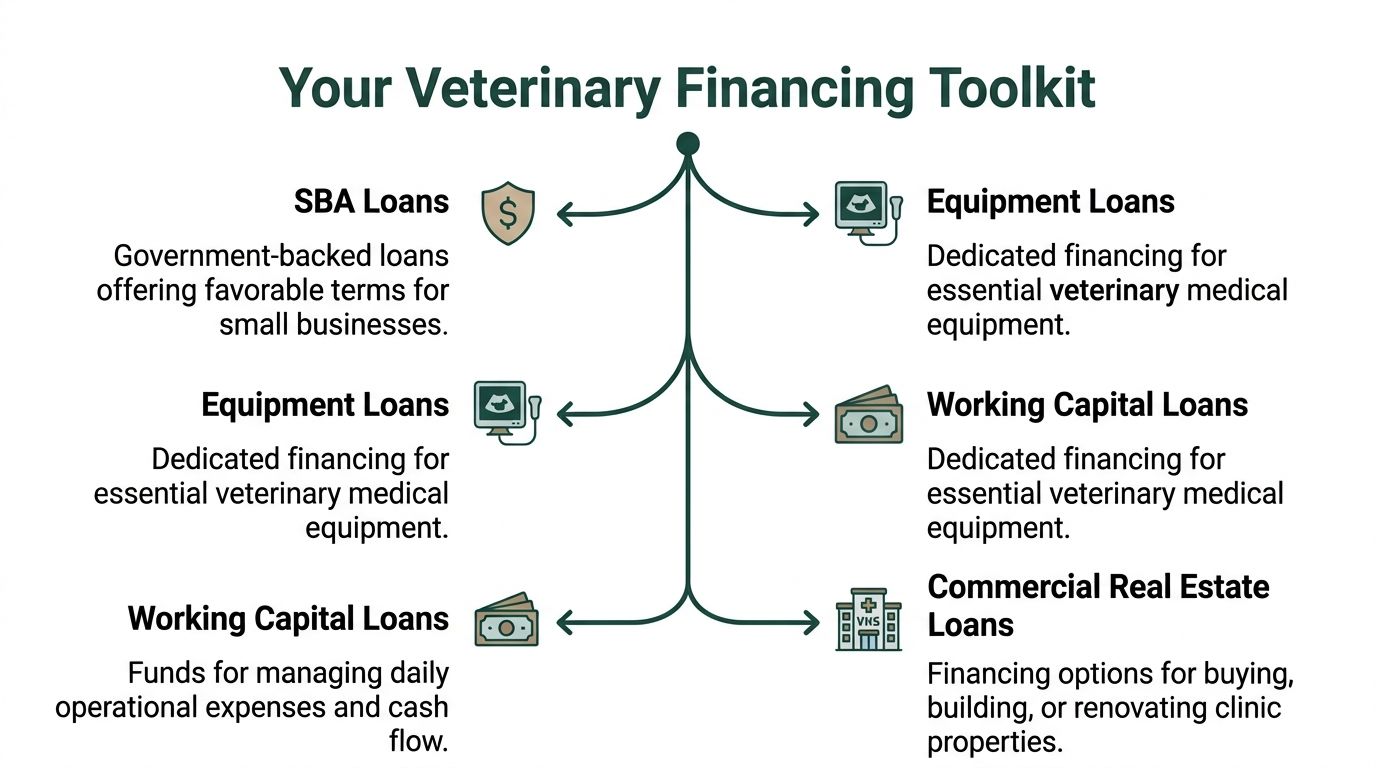
An SBA 7(a) loan is often the best fit when the project includes several moving parts under one plan. That can include equipment, renovations, working capital, partner buy-ins, or an acquisition. The practical advantage is consolidation. One closing, one repayment structure, and more control over how much cash stays in the business after funding.
Many owners focus on rate and miss structure, yet the latter is often more critical. If equipment is part of a larger transition, folding it into one broader loan can reduce payment pressure compared with financing each piece separately. That strategy often improves early cash flow, which is usually more valuable than shaving a small amount off one isolated equipment note.
Equipment loans for targeted technology purchases
Equipment financing works best when the purchase is specific and the asset can stand on its own financially. The equipment usually serves as collateral, which can make approval more direct and documentation lighter than a broader practice loan. For a standalone purchase such as digital radiography, dental imaging, lab analyzers, or surgical equipment, that efficiency has real value.
Owners considering veterinary equipment financing for clinical technology purchases should look past speed alone. A dedicated equipment loan can be clean and appropriate, but it is not always the lowest-cost choice if the same equipment is being purchased alongside an expansion, acquisition, or buildout.
Working capital for operating stability
Working capital financing serves a different purpose. It supports short-term operating needs such as payroll, inventory, marketing, or uneven revenue timing. It should not be used to carry the full cost of long-life equipment unless there is a clear short-term reason and a repayment plan that the practice can absorb comfortably.
I often see profitable practices run into temporary cash pressure because production, collections, and vendor payments rarely line up perfectly. In those cases, working capital can protect operations. It can also become expensive if owners use it as a substitute for proper term financing.
A cash flow problem and a capital investment are not the same problem. They should not be financed the same way.
Acquisition and real estate loans for ownership changes
Some financing needs deserve their own structure from the start. Practice acquisition loans are built for ownership transfers, buy-ins, and full purchases of existing hospitals. Commercial real estate loans are designed for buying, building, or improving a property the practice will occupy.
The main decision is matching the loan to the actual objective:
- Use SBA financing for broader projects with several uses of funds.
- Use equipment financing for a defined asset purchase that stands alone.
- Use working capital financing for short-term operating liquidity.
- Use acquisition or real estate financing when the transaction centers on ownership or property.
Problems usually start when owners finance convenience instead of purpose. The right tool protects liquidity. The better strategy is choosing the structure that supports both the purchase and the practice's next stage of growth.
Matching Equipment Loans to Asset Lifespan
A practice buys a new digital radiography unit, signs a short repayment term to save on interest, and then feels the payment every month before the unit has fully paid back its cost. I see this mistake often. The equipment was a sound purchase. The structure around it was not.
Why asset-secured lending changes the math
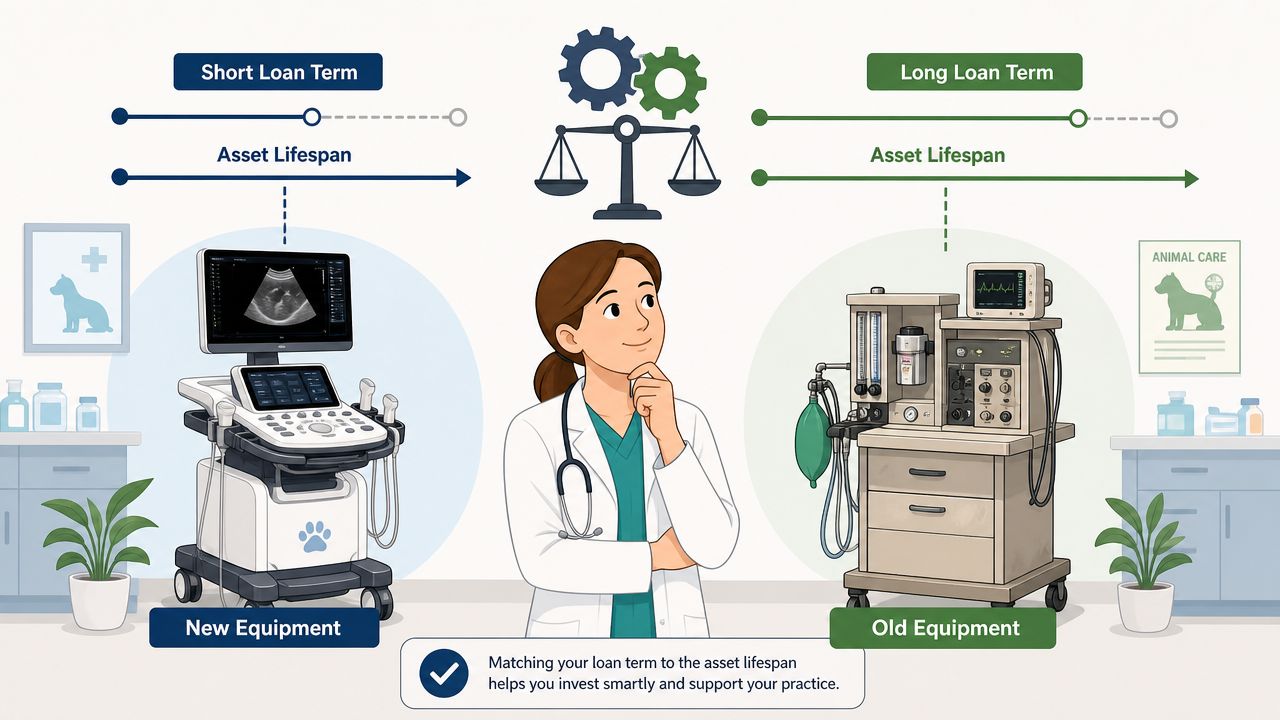
Equipment financing works best when the repayment period lines up with the asset's useful working life. If a piece of equipment will support diagnostics, surgery, dentistry, or lab efficiency for years, the debt should usually be spread over a period that fits that contribution.
Veterinary equipment loans are often secured primarily by the equipment itself. That usually gives owners more flexibility than using a general-purpose loan for the same purchase. The practical benefit is cash preservation. A structure that limits upfront cash strain and keeps payments reasonable leaves more room for payroll, inventory, marketing, and the normal surprises that hit practice cash flow.
Owners reviewing veterinary equipment financing solutions should focus on this before they look at rate alone.
Match the term to the asset, not your impatience
The goal is straightforward. Long-life equipment should not be forced into an unnecessarily aggressive payoff schedule unless the practice has excess cash flow and a clear reason to shorten the term.
That does not mean every owner should stretch repayment as long as possible. Longer terms can reduce monthly pressure, but they can also increase total borrowing cost. Shorter terms can save interest, but they raise the monthly fixed obligation and can squeeze operating cash at the wrong time. The right answer depends on how quickly the equipment will affect revenue, labor efficiency, case acceptance, or referral retention.
A sound equipment financing decision usually includes four things:
- A clear operational purpose: The equipment solves a defined clinical, staffing, or workflow problem.
- A term that fits the asset's useful life: The practice is still getting value from the equipment while it is paying for it.
- Healthy reserve protection: Cash stays in the business for routine volatility and planned growth.
- A payment the clinic can carry in average months: The loan has to work in normal production periods, not just strong ones.
The better question to ask
Owners often ask whether they can afford the equipment. I advise them to ask whether they can afford the payment structure without weakening the practice elsewhere.
That distinction matters. A profitable hospital can still create stress by paying too much upfront or by compressing repayment into a term that crowds out hiring, inventory, or marketing. In many cases, financing produces the best result when it lets the asset contribute to cash flow while the practice keeps its reserves intact.
There is also a larger strategic point that many owners miss. If the equipment purchase is part of an acquisition, expansion, or major renovation, standalone equipment debt is not always the cheapest or cleanest answer. Bundling that equipment into a broader loan can reduce immediate cash pressure, simplify the capital stack, and sometimes improve the overall economics of the project. The strongest structure is the one that supports both the asset and the next stage of the practice.
Comparing Top Financing Options Side-by-Side
A practice owner replacing radiology equipment this quarter can reach three very different financing outcomes from the same purchase. One structure closes quickly but stands alone. Another takes more underwriting but may fit a broader capital plan better. The third works best for a mature hospital with clean financials and a strong banking relationship.
That is why side-by-side comparison matters. The loan with the fastest approval is not always the loan with the lowest total cost. The loan with the lowest posted rate is not always the structure that protects monthly cash flow.
The central trade-off
Veterinary owners usually compare three paths: SBA 7(a) loans, conventional bank loans, and equipment finance agreements.
Each solves a different problem.
SBA 7(a) financing is built for larger projects with multiple uses of proceeds. Conventional bank debt tends to fit established practices that present strong historical performance and organized documentation. Equipment financing is narrower by design. It is built around a specific asset and often moves faster because the equipment itself supports the credit structure.
For owners reviewing current veterinary practice loan rates, this comparison is more useful than focusing on rate alone.
Veterinary loan comparison
| Feature | SBA 7(a) Loan | Conventional Bank Loan | Equipment Finance Agreement |
|---|---|---|---|
| Best use | Acquisition, expansion, renovation, or projects with several capital needs | Established practices with strong banking profile | A defined equipment purchase |
| Funding speed | Usually the slowest of the three because underwriting is more detailed | Moderate, often slower than equipment-only financing | Usually the fastest option |
| Typical pricing | Often competitive over a longer amortization | Often competitive for strong borrowers | Varies widely by asset type, term, and borrower profile |
| Credit profile | Lenders usually expect a solid borrower profile and clean documentation | Best fit for borrowers with strong credit and consistent performance | More flexible when the asset is easy to value and resell |
| Time in business | Often better for practices with operating history or a clear transition plan | Best fit for established practices | Can work for newer buyers in the right deal |
| Loan size | Works well for larger projects | Depends on bank appetite and borrower strength | Tied to the equipment package and vendor invoice |
| Collateral structure | Often includes a broader business collateral package | Often includes broader business support and owner backing | Usually secured primarily by the equipment |
| Primary advantage | Can cover multiple needs in one loan | Can offer attractive terms for strong practices | Speed and simple asset-specific structure |
| Primary drawback | More paperwork and a longer approval cycle | Less flexible for complex or transitional situations | Limited use of proceeds and shorter terms in many cases |
How owners usually choose
A practical pattern looks like this:
- Choose SBA 7(a) when the equipment is part of a larger transaction and the goal is to finance the full project in one structure.
- Choose a conventional bank loan when the practice already has scale, stable margins, and lender-ready financial reporting.
- Choose equipment financing when the purchase is isolated, timing matters, and speed carries real operating value.
The missed point in many comparisons is strategic, not technical. If the equipment is being purchased alongside an acquisition, buildout, or ownership transition, a standalone equipment note can create a heavier near-term payment than necessary. In those cases, the better question is not which loan type wins in isolation. It is which structure leaves the practice with the healthiest cash flow after the project closes.
That is the comparison that protects profitability.
The Untapped Strategy of Bundling Your Loans
A buyer closes on a practice, replaces aging imaging equipment in the first month, and then realizes the new equipment note is due on top of the acquisition payment, payroll, and the usual post-closing cleanup. I see this mistake regularly. The problem is rarely the equipment itself. The problem is splitting one business plan into separate debts with different timelines and less room for error.
Why bundling matters during transitions
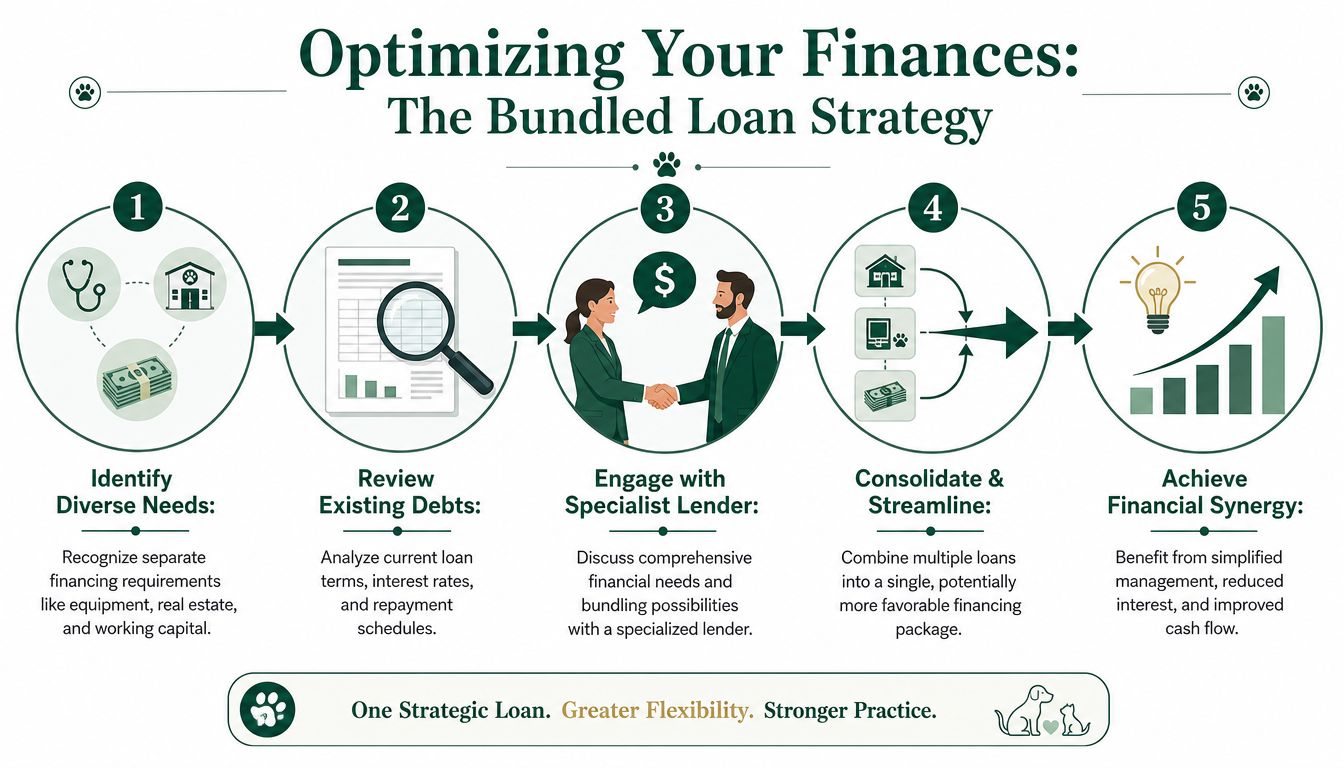
Bundling works best when equipment is tied to a larger event: an acquisition, partner buy-in, relocation, or expansion. In those situations, the primary financing question is not whether the equipment can be financed on its own. It usually can. The better question is whether a separate equipment note puts unnecessary pressure on cash flow during a period when the practice is already absorbing change.
A broader business loan can often cover equipment, transaction costs, and operating cushion in one structure. That matters because equipment financing often amortizes faster than acquisition debt. A faster amortization schedule can produce a payment that looks manageable on paper but feels heavy in the first year of ownership.
This is the strategic advantage many owners miss. Bundling can lower the monthly debt burden early in the project, preserve liquidity, and reduce the odds that a strong transaction feels tight after closing.
Two ways the same purchase affects cash flow
Consider a common example. A doctor buys a clinic and needs a new digital dental unit, updated monitors, and a few treatment room upgrades right away.
If those purchases go on a separate equipment loan, the practice now carries one payment for the acquisition and another for the equipment, often on a shorter schedule. That can tighten working capital just as the owner is dealing with staff turnover, vendor changes, software conversion, and uneven collections.
If the equipment is included in the main financing package, the debt structure usually aligns better with the full project. The practice has fewer moving parts, one underwriting process, and a payment structure that is often easier to support from normal operations.
Owners who may need extra operating room during the transition should also look at how working capital financing for veterinary practices fits alongside a larger loan request.
Bundling works best when the equipment purchase is part of the business plan, not treated as a separate event after the fact.
When bundling deserves serious consideration
Bundling often makes sense when:
- The equipment is needed at closing or immediately after: Delaying the purchase would affect production, workflow, or client experience.
- The owner is already borrowing for a larger project: One coordinated structure is often easier to manage than stacked loans.
- Cash reserves need protection: Lower near-term payment pressure can matter more than getting the fastest standalone approval.
- The transition has execution risk: New ownership periods usually bring surprises, and tight debt service leaves less room to handle them.
Bundling is not always the right answer. A standalone equipment loan can still be the better choice when the purchase is isolated, the timing is urgent, or the practice wants to keep the larger financing request simpler. But when equipment is clearly part of an acquisition or expansion plan, separating it just because it seems administratively easier can raise total strain on the practice.
Good loan structure protects cash flow first. That is what gives the owner room to stabilize operations, keep margins intact, and let the investment pay off.
Navigating the Underwriting and Tax Implications
A practice owner may feel confident about the equipment decision and still lose time, flexibility, or tax value because the financing file was weak. I see this often when a doctor focuses on the rate first and treats underwriting and tax planning as paperwork to clean up later.
Lenders that know veterinary practices underwrite the business, not just the machine. They want to see whether the clinic can carry the payment through ordinary operations while still protecting payroll, inventory, and owner liquidity. That review usually includes revenue consistency, doctor production, EBITDA or operating income trends, existing debt, cash on hand, and the purpose of the new borrowing.
That matters even more when equipment is part of a larger acquisition or expansion plan. A lender will usually view bundled financing more favorably when the equipment clearly supports the post-closing model, such as adding dental capacity, replacing aging imaging, or outfitting added exam rooms. The request becomes easier to defend when the asset ties directly to revenue, efficiency, or service mix.
What lenders want to see
Underwriting gets stronger when the story is specific.
For a standalone equipment request, the lender will focus on the asset, the practice's cash flow, and whether the useful life of the equipment supports the repayment term. For a bundled request, the lender also looks at how the equipment fits into the full project and whether combining the debt improves payment coverage instead of tightening it. That is one of the most overlooked advantages of bundling. It can produce a structure that is easier for the practice to carry month to month than stacking a separate equipment note on top of an acquisition or buildout loan.
Owners improve approval odds when they prepare these items before applying:
- Clear use of proceeds: Show exactly what is being purchased and why it matters operationally.
- Recent financial statements: Profit and loss statements and balance sheets help the lender judge current performance.
- Business and personal tax returns: These help confirm earnings, ownership, and overall repayment strength.
- Equipment quotes or project budgets: Specific numbers reduce underwriting delays and last-minute revisions.
- A practical cash flow explanation: Show how the new payment fits into an ordinary month, not just a best-case month.
A vague request slows everything down. A defined request with a clear operational purpose usually gets better traction.
The tax side changes the real cost
Tax treatment affects the true economics of the decision. Financing terms matter, but so does what happens after closing when the practice's CPA records the asset, depreciation, and interest expense.
For many veterinary practices, Section 179 and bonus depreciation are part of the analysis when qualifying equipment is purchased. The benefit depends on taxable income, entity structure, timing, and whether the practice can use the deduction in the year of purchase. Leasing can produce a different result. Bundling can change timing and allocation issues as well, especially if the larger loan includes multiple asset categories with different tax treatment.
I tell owners to review the financing structure and the tax result together. A lower payment can still be the right choice even if it does not create the largest immediate deduction. In other cases, buying instead of leasing produces better after-tax value over the holding period.
A financing structure that looks good at signing can hurt cash flow later if the owner never reviewed the tax treatment with a CPA.
The practical standard is simple. Submit a clean file, explain how the equipment supports the practice, and review the after-tax outcome before signing. That is how owners avoid approval surprises and choose debt that supports profitability instead of straining it.
Your Financing Decision Checklist
Most equipment financing decisions become easier when the owner stops asking for the “best loan” and starts asking the right sequence of questions. The right structure depends on urgency, scope, liquidity, and how the new debt fits into the next few years of the practice.
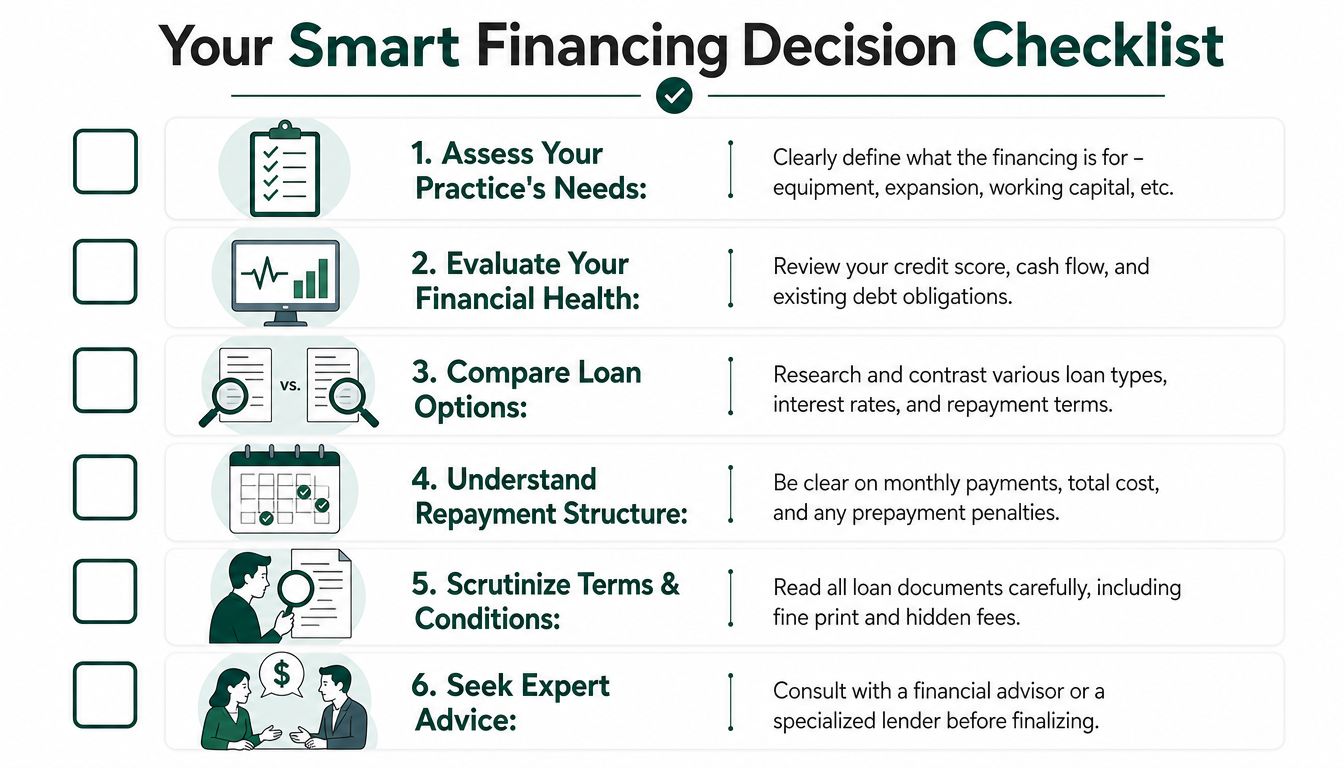
Use this checklist before you request quotes or sign terms:
- How urgent is the equipment need? If the asset is required immediately, speed may justify a narrower financing option.
- Is this purchase part of something bigger? If the answer is yes, bundling may protect cash flow better than separate loans.
- What matters more right now? Decide whether your priority is lower monthly payment, lower total financing cost, or faster access to the equipment.
- How much cash should stay in the business? Strong owners protect operating liquidity instead of using reserves to solve every capital need.
- Can the practice carry this payment in an ordinary month? Underwrite your own payment stress before a lender does.
- Have you reviewed the tax impact with your advisor? The structure should make sense after financing and after taxes, not just at signing.
A good financing decision should help the practice operate better, not just close faster. If you're weighing financing options equipment loans veterinary practices, think beyond approval and focus on fit. That's where long-term value usually shows up.
If you want help evaluating acquisition loans, equipment financing, or working capital structures built specifically for clinics, Veterinary Practice Loans works with veterinary owners across the United States to compare options, clarify trade-offs, and build financing that supports practice growth without putting unnecessary strain on cash flow.
