
You're reviewing your clinic's profit and loss statement before a lender meeting, and the bottom line looks familiar but not especially useful. Interest expense reflects financing decisions, depreciation reflects prior equipment purchases, and personal or unusual expenses may sit beside ordinary clinical costs. The question is simple: what earning power does the practice generate from its operations before the proposed loan is added?
That's where net operating profit after taxes, or NOPAT, becomes valuable. It isolates operating earnings after tax while excluding interest expense and non-operating items. For a veterinary practice owner seeking acquisition funding, equipment financing, working capital, or expansion capital, NOPAT gives the lender a cleaner view of the business being financed.
Why Lenders Care About Net Operating Profit After Taxes
A clinic owner applying for an acquisition loan may show strong revenue and a disappointing bottom line. The difference could come from interest on old equipment financing, refinancing costs, a non-operating gain, or an unusual expense. A lender must separate those financing and accounting effects from the earnings generated by appointments, procedures, pharmacy sales, laboratory work, and day-to-day clinic operations.
NOPAT starts with operating profit, or EBIT, applies the applicable tax rate, and excludes interest expense and non-operating items. It captures after-tax operating earnings with financing effects removed, making results easier to compare across practices with different debt structures. This overview of NOPAT and its use in operating analysis explains the metric's role in operating analysis.
The operating question behind the loan request
Suppose an owner is buying a neighboring veterinary practice. The target has strong revenue, but its existing owner financed expensive equipment several years ago. Interest and related financing charges may suppress reported net income even when the clinical operation produces dependable earnings.
The lender's question is direct: does the practice generate enough after-tax operating profit to support the acquisition plan?
NOPAT addresses that question by focusing on the operation itself. It reflects the earnings produced by veterinarians, technicians, appointments, pharmacy sales, laboratory services, surgery, and the infrastructure required to deliver care. That view helps a lender assess the business before considering the proposed loan's interest rate, repayment schedule, and capital structure.
Net income and existing debt still matter. Underwriting also reviews scheduled payments, liquidity, collateral, tax returns, owner compensation, and the proposed loan structure. NOPAT provides the operating starting point for credit analysis, not the full decision.
Lender perspective: A weak operating model remains weak under a different financing structure. A loan can fund a healthy clinic, yet repayment depends on sustainable operating earnings.
Why owners should calculate it first
Lenders and valuation analysts commonly use NOPAT as the numerator in return on invested capital, or ROIC. The formula is ROIC equals NOPAT divided by invested capital. It shows whether operating profit supports the capital committed to the practice, including working capital, equipment, build-outs, and other operating assets.
Owners should calculate NOPAT before submitting financing materials. A defensible calculation lets the lender verify the logic faster and gives the owner a clear explanation when recurring operating performance differs from the reported bottom line.
The calculation should match the financing purpose. For an acquisition request, separate the target's recurring operations from the buyer's proposed financing. For equipment financing, show whether the existing clinic generates enough operating profit to absorb the asset's expected cost. For expansion capital, distinguish the current location's results from projected performance at the new site. This financial strategy framework for NOPAT and invested capital provides related guidance on the relationship between operating profit and invested capital.
The NOPAT Formula and Step-by-Step Calculation
The basic formula is direct:
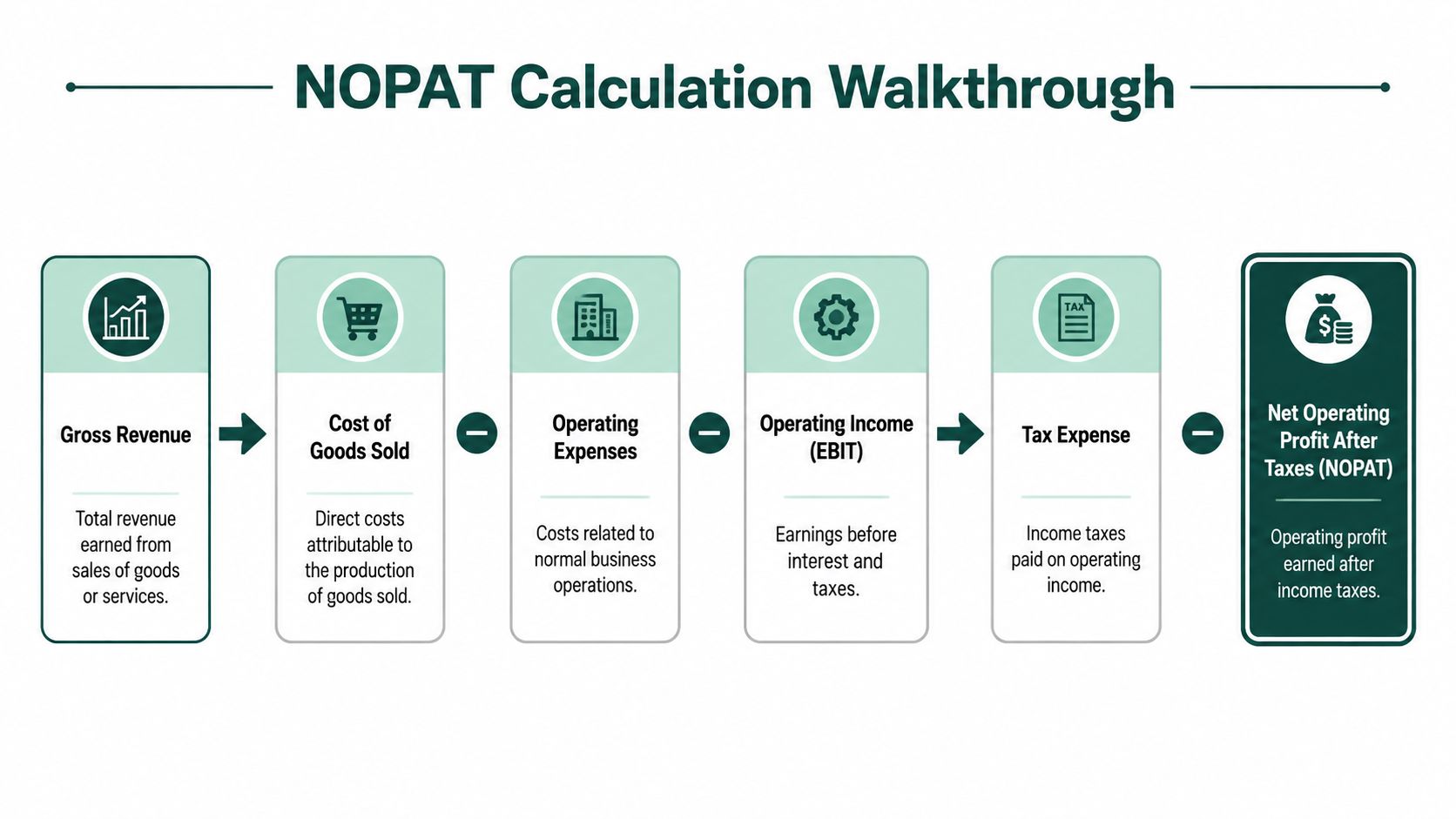
NOPAT = EBIT × (1 − effective tax rate)
EBIT means operating income before interest and taxes. The calculation should begin with revenue and subtract the costs required to run the clinic. It shouldn't include interest expense, gains or losses from selling assets, investment income, or other non-operating items.
Step one, build operating profit
Consider a single-location veterinary practice with $1.8 million in annual revenue. This is an illustrative example, not a benchmark.
| Income statement line | Amount |
|---|---|
| Gross revenue | $1,800,000 |
| Pharmaceuticals and medical supplies | ($360,000) |
| Veterinary and support staff wages | ($720,000) |
| Rent and occupancy | ($108,000) |
| Utilities and facility costs | ($36,000) |
| Marketing and client acquisition | ($54,000) |
| Administrative and operating costs | ($162,000) |
| Operating profit, or EBIT | $360,000 |
The practice's operating profit is $360,000. The calculation includes the direct and overhead costs required to deliver care. Pharmaceuticals and supplies belong in the operating calculation because they're consumed or sold through normal clinical activity. Staff wages, rent, utilities, and marketing also belong above EBIT because they support recurring operations.
Do not subtract interest expense in this step. Interest reflects how the practice is financed, not how efficiently it delivers veterinary services. Don't include income from an investment account or a gain on the sale of old equipment either. Those amounts aren't generated by the clinic's ordinary operating process.
Step two, apply the tax effect
Assume the clinic's normalized effective tax rate for analysis is 25%. The tax adjustment is:
- EBIT: $360,000
- Tax on operating profit: $90,000
- NOPAT: $270,000
The resulting $270,000 NOPAT represents after-tax operating earnings before interest expense.
The tax rate must be defensible. For a taxable corporation, the analysis may begin with the company's effective tax position, then adjust for unusual credits or non-recurring items. For a pass-through practice, the entity may not pay income tax directly, yet the owners still bear tax on income. A lender may apply a normalized tax rate to make the operating result comparable with other businesses.
That's why you shouldn't copy the tax expense line from the P&L without reviewing the ownership structure and tax returns. The tax line may be unusually low, unusually high, or absent at the entity level. NOPAT is an analytical measure, so the tax assumption should reflect the tax burden a lender believes is appropriate for the operating earnings being evaluated.
Step three, document every adjustment
Keep a reconciliation from reported operating income to adjusted EBIT, then from adjusted EBIT to NOPAT. Label each adjustment and attach support, such as invoices, settlement documents, asset-sale records, lease agreements, or tax filings.
A clean calculation has three qualities:
- It starts from a verifiable operating line.
- It excludes financing and non-operating activity.
- It explains the tax rate instead of hiding it.
That presentation gives the lender something useful to test rather than forcing the underwriting team to reconstruct the metric from scattered records.
NOPAT vs Net Income vs EBIT vs EBITDA
A lender reviewing a veterinary practice does not treat every profit figure as interchangeable. The right metric depends on the loan decision, the practice's asset demands, and the underwriting model used for repayment capacity.
Use this brief reference:
| Metric | Best use in a lending review |
|---|---|
| NOPAT | Comparing operating performance with the capital invested in the clinic |
| Net income | Reviewing reported profitability, tax filings, and the effect of the owner's financing structure |
| EBIT | Comparing operating results before the tax position is applied |
| EBITDA | Screening cash generation before depreciation and amortization are considered |
The important difference is how lenders use these figures after they enter the underwriting file. Their spreadsheet or underwriting platform may pull net income from the financial statements, use EBITDA in a debt-service screen, and calculate or review EBIT when comparing operating performance. NOPAT often receives closer attention when the lender is assessing whether the clinic's operating return supports the capital required for an acquisition or expansion.
That distinction changes how you should prepare the request. Do not lead with the metric that looks highest. Lead with the metric that answers the lender's immediate question, then provide the other figures as a reconciliation.
Choose the lead metric by loan type
Acquisition financing: Lead with normalized operating performance, including NOPAT, so the lender can assess the target business separately from the buyer's proposed debt. Provide net income and EBITDA to show how the reported statements connect to the underwriting model.
Equipment financing: Lead with EBITDA or another cash-flow measure when the lender is testing repayment capacity. Pair it with NOPAT or EBIT to show that the clinic's earnings come from ongoing operations, not from an accounting presentation that ignores the asset base.
Expansion financing: Lead with NOPAT and EBIT when the request depends on the clinic's ability to generate returns from additional rooms, staff, or equipment. Then show how the projected debt service affects net income and available cash.
Working-capital financing: Emphasize net income, cash conversion, and liquidity. A strong NOPAT result does not replace evidence that receivables, inventory, payroll, and supplier obligations can be managed through the borrowing period.
Advanced imaging, surgical equipment, and renovated facilities make EBITDA especially easy to misread. Adding back depreciation can clarify operating cash generation, but it does not remove the cost of maintaining or replacing those assets. A lender will test whether the proposed loan leaves room for those demands.
Practical rule: Give the lender one connected package, not four competing answers. Reconcile NOPAT, net income, EBIT, and EBITDA, state which figure leads the request, and explain why that figure fits the loan purpose. This makes the file easier to underwrite and reduces the chance that a high but incomplete metric drives the decision.
Adjusting for One-Time Items and Tax Effects
A reported P&L rarely provides a perfect picture of recurring clinic performance. Veterinary practices relocate, renovate, replace equipment, receive insurance recoveries, settle disputes, and occasionally record grants or other unusual income. NOPAT becomes useful only when the owner separates recurring operations from events that won't repeat.
Identify the items that distort operations
Start by reviewing the operating expense detail, general ledger, and fixed asset register. Flag transactions that are unusual in nature, unlikely to recur, or unrelated to the normal delivery of veterinary care.
Common examples include:
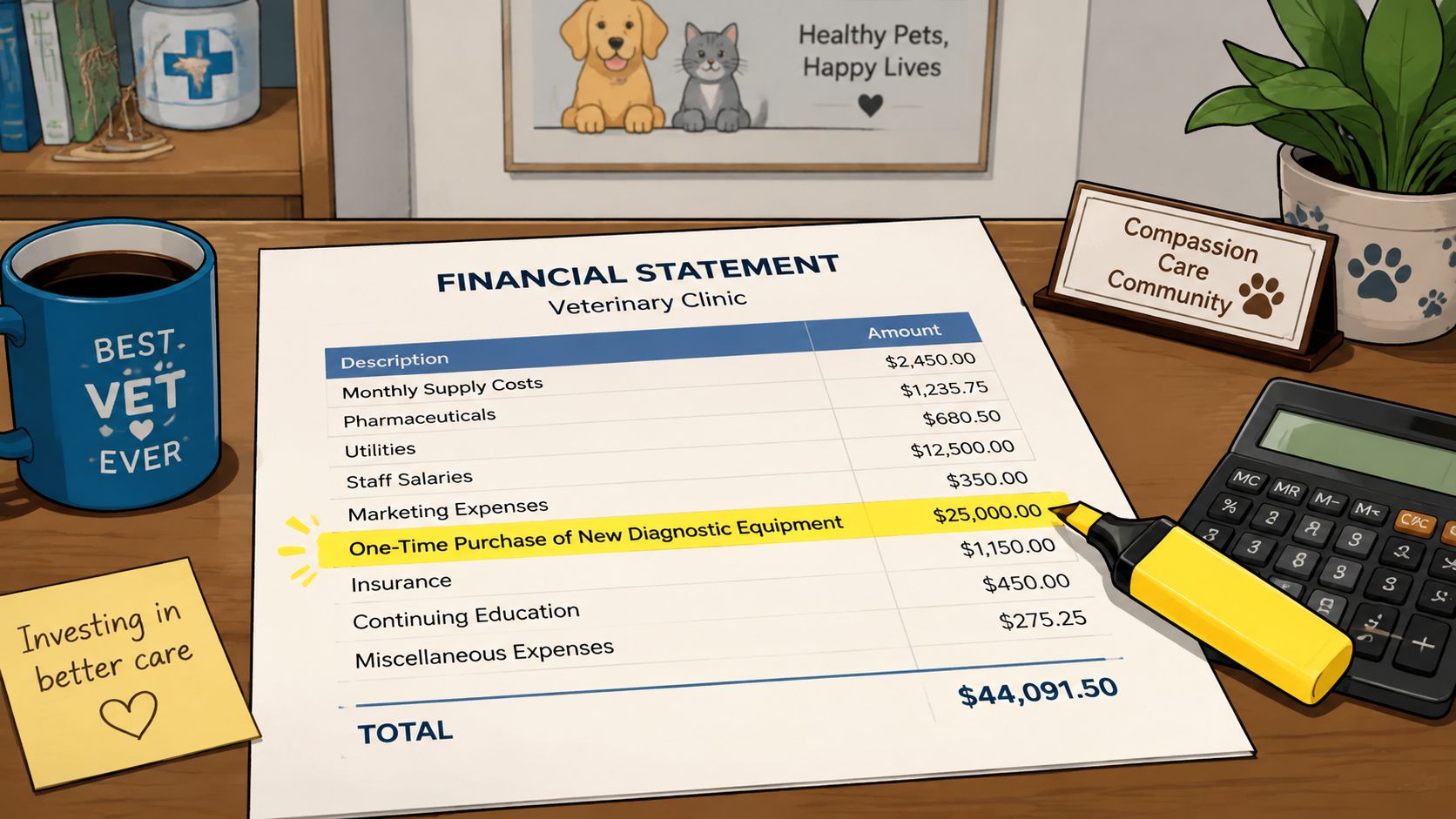
- Equipment sale proceeds: A gain from selling outdated X-ray equipment shouldn't be treated as recurring clinical profit.
- Relocation and renovation costs: A major move or build-out may depress one period without representing the ongoing cost structure.
- Insurance recoveries: An unusual reimbursement may offset a loss but doesn't demonstrate normal operating capacity.
- Legal settlements: A one-time settlement can reduce reported profit without changing the clinic's recurring economics.
- Relief grants: A grant may increase reported income without arising from ordinary patient care.
The adjustment must match the accounting treatment. If an unusual expense was included in operating expenses, add it back only when it's non-recurring and supported by documentation. If a gain was included in operating income, remove it. Don't call a recurring cost “one-time” because it's inconvenient for the loan request.
Normalize the tax effect
Tax normalization creates another judgment point. An S-corporation or LLC may pass taxable income through to its owners rather than showing the full income tax burden on the practice's own income statement. The absence of entity-level income tax expense doesn't mean the operating earnings are tax-free.
A lender may apply a normalized tax rate to adjusted EBIT. That approach makes the clinic easier to compare with a taxable entity and prevents a low reported tax expense from making NOPAT look stronger than the underlying economics support.
Document the reasoning in a short schedule:
| Adjustment area | Treatment |
|---|---|
| Reported operating profit | Starting point |
| Unusual operating expense | Add back only if non-recurring and documented |
| Non-operating gain | Remove from operating profit |
| Recurring owner-related cost | Normalize, don't automatically eliminate |
| Tax rate | Explain the basis and apply consistently |
Owner expenses require care. A personal expense incorrectly charged to the clinic may be removed, but a reasonable replacement cost for the owner's clinical or management role still belongs in the analysis. Lenders underwrite the practice as an operating business, not as a personal spending account.
Using NOPAT in ROIC and Lender Cash-Flow Assessment
A clinic owner requesting an expansion loan should model the proposed project separately from the existing practice. NOPAT helps show whether new operating assets can produce enough after-tax profit to justify the capital committed. Use it to evaluate acquisition, equipment, and facility requests before presenting them to a lender.
Use ROIC for project decisions
ROIC compares a project's expected after-tax operating contribution with the capital required to put it into service. Do not rely only on the practice's current ROIC. A profitable clinic can still weaken its overall capital efficiency by approving an expansion that adds substantial cost but little incremental operating profit.
For example, an existing practice may produce steady NOPAT from its current exam rooms, staff, equipment, and working capital. A proposed expansion adds build-out costs, equipment, inventory, and other operating assets. Model the expansion on its own:
- Existing practice NOPAT: Recurring after-tax operating profit before the project.
- Project capital: Build-out, equipment, inventory, and other operating assets required.
- Incremental EBIT: Additional operating profit expected from the project.
- Project tax effect: Normalized tax applied to that incremental operating profit.
- Project NOPAT: Incremental EBIT after the modeled tax effect.
- Project ROIC: Project NOPAT compared with the new capital committed.
If project ROIC is weaker than the existing practice's return, the owner needs a clear reason to proceed, such as capacity constraints or a credible path to stronger utilization. Revenue growth alone does not support a financing request.
How lenders assess repayment capacity
Lenders do not expect NOPAT to repay debt by itself. They use operating earnings as a starting point, then test the cash demands that NOPAT does not directly capture, including capital expenditures, working capital changes, taxes, and scheduled debt payments.
For an acquisition loan, the lender may review normalized operating earnings, owner compensation, recurring capital requirements, purchase price, and the proposed debt structure. For an equipment package, the question is whether the existing clinic can support the new payment after maintenance costs and expected utilization. For a working capital line, the review centers on payroll, pharmaceutical inventory, receivables, deposits, and repayment behavior.
A strong NOPAT calculation cannot repair a cash-flow gap. It can show whether the weakness comes from the operating model, the project assumptions, or the proposed debt burden. Build repayment timing and borrowing costs into the forecast by reviewing veterinary practice loan terms and repayment options.
Financing insight: Request debt the operating model can carry, not debt the asset purchase price happens to justify.
Practical Tips for Clinic Owners Preparing Financing Requests
Calculate NOPAT before sending financial statements to a lender. That gives you time to correct classifications, explain adjustments, and address weak periods with evidence instead of excuses.
Prepare the file a lender can verify
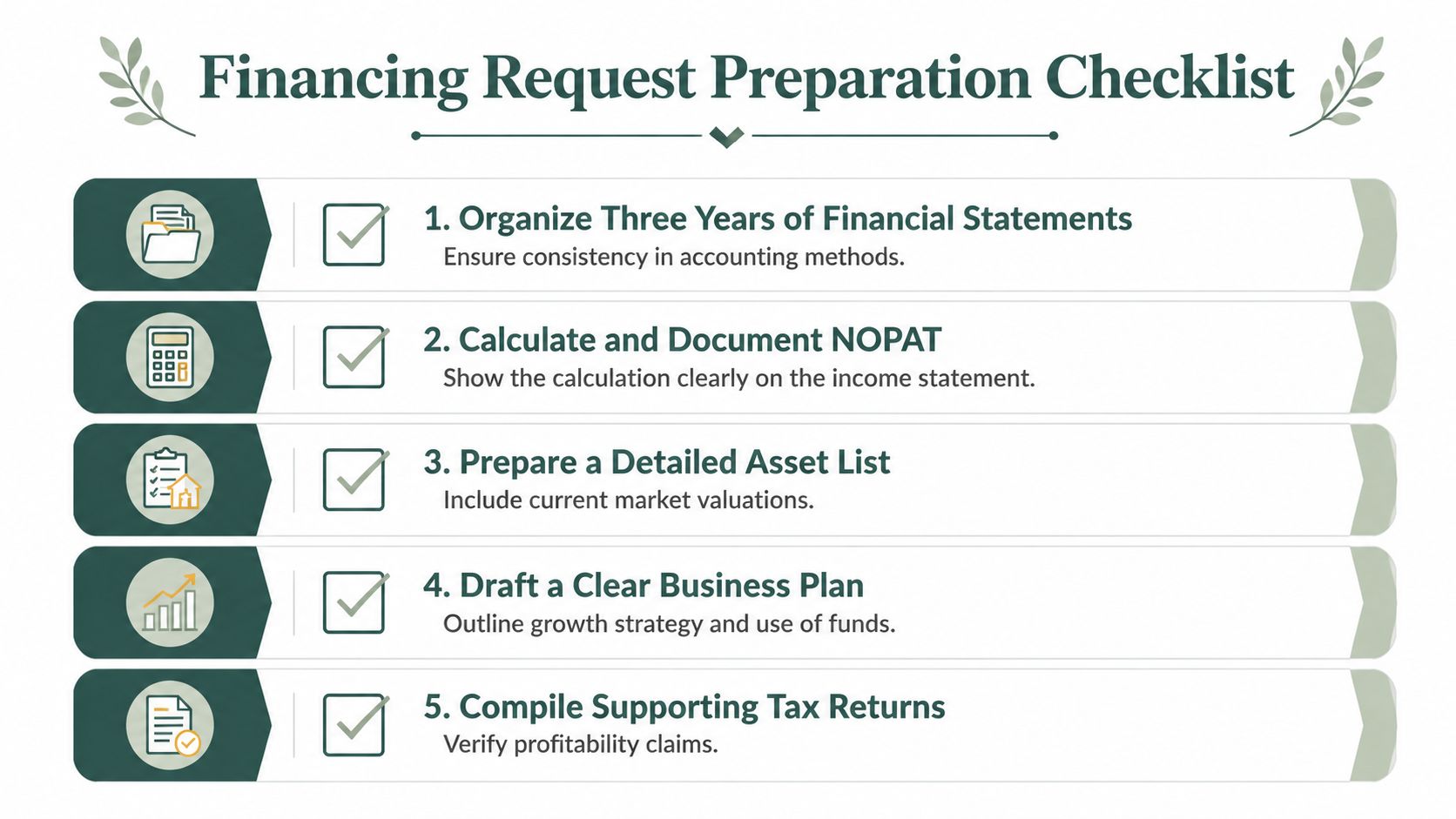
Use a consistent package:
- Separate personal and practice spending. Remove personal expenses from the operating schedule, then add back a defensible replacement cost when the expense relates to the owner's work.
- Reconcile fixed assets. Match the depreciation schedule to the fixed asset register and identify equipment that was sold, retired, or replaced.
- Document unusual transactions. Keep invoices, settlement records, insurance correspondence, grant records, and asset-sale documents with the normalization schedule.
- Create a normalized P&L. Show reported EBIT, each adjustment, adjusted EBIT, the tax assumption, and NOPAT.
- Explain ownership and taxes. Tell the lender whether the practice operates through a corporation, S-corporation, LLC, partnership, or another structure.
For a financing request, consistency matters more than presentation polish. If revenue is recorded one way in the tax return and another way in management reports, resolve the difference before underwriting begins.
Choose the right reporting period
Use trailing-twelve-month information when the clinic has experienced a recent change in volume, staffing, pricing, ownership, or location. Use year-end statements when they provide the cleanest complete accounting record. In either case, reconcile the selected period to the tax returns and explain material differences.
Multi-location groups should calculate NOPAT by location before presenting consolidated results. A profitable hospital may conceal a weaker satellite clinic, while a newer location may be investing heavily before reaching its planned operating level. Lenders need both the group picture and the contribution of each site.
Before discussing rates, assemble the information needed to evaluate structure, repayment burden, collateral, and risk. A clear NOPAT schedule will make conversations about veterinary practice loan rates more productive because the lender can connect pricing to a documented operating profile.
Limitations of NOPAT and What Lenders Look at Next
NOPAT is powerful, but it isn't cash in the bank. It doesn't show when receivables convert to cash, how much inventory absorbs liquidity, or how much capital the clinic must spend to maintain equipment and facilities.
Lenders therefore review NOPAT alongside free cash flow, debt service coverage ratio, current ratio, accounts receivable aging, deposits, tax returns, and existing obligations. A practice can report attractive operating earnings while struggling to collect receivables or fund payroll during a heavy inventory cycle.
NOPAT can also mislead when wellness-plan revenue is collected or recognized differently from the timing of care, or when a recent build-out creates a temporary mismatch between capital spending, depreciation, and operating results. The lender will test those timing issues rather than accepting the headline metric.
Collateral matters too. Owners preparing an application should understand what assets are required for a veterinary practice loan and how those assets relate to the requested financing.
Use NOPAT to establish the clinic's operating earnings. Then support it with a complete cash-flow and credit package. That combination gives lenders a credible basis for deciding how much debt the practice can carry and how the financing should be structured.
Veterinary Practice Loans helps veterinarians and clinic owners finance acquisitions, equipment purchases, working capital, startups, build-outs, and expansion projects. Visit Veterinary Practice Loans to discuss your NOPAT calculation, organize the financing request, and identify a loan structure that fits the practice's operating cash flow.
