

You're reviewing a practice purchase agreement while also pricing imaging equipment, planning payroll, and wondering how much cash must remain in the bank after closing. That's the point where many veterinarians make an expensive mistake: they choose the loan with the lowest quoted payment instead of matching the financing structure to the practice's stage, asset life, and cash-flow risk.
U.S. Bank veterinary practice loans can support several ownership situations, including startups, acquisitions, renovations, equipment purchases, operating expenses, expansion, debt consolidation, marketing, and staffing. The important question isn't whether one product can fund the project. It's whether the term, collateral, payment schedule, and flexibility fit what you're buying. This guide takes a practical view of that decision.
Where U.S. Bank Veterinary Practice Loans Fit in Your Ownership Plan
Veterinary financing changes meaningfully depending on where you are in the ownership cycle. A new clinic has no operating history, an acquisition has historical revenue to analyze, and an established location may need capital without disrupting existing cash flow. Treating those situations as interchangeable leads to poorly sized debt.
Start with the ownership event
For a de novo clinic, the financing must cover build-out, equipment, initial inventory, staffing, marketing, and the period before revenue stabilizes. A longer practice loan can help absorb high upfront costs, but the payment must still be tested against a conservative ramp-up forecast. Interest-only payments may preserve cash early, but they create a larger payment obligation once principal amortization begins.
A partner buyout is different. The location may already produce revenue, but the lender still needs to understand whether the departing owner's compensation, debt, and distributions will change after the transaction. The buyer should model the new payment against the remaining doctors, staffing plan, and expected production rather than relying only on the seller's historical numbers.
An acquisition of an established practice usually offers the strongest operating evidence because the buyer can review revenue, expenses, deposits, and production by doctor. That evidence doesn't eliminate risk. A change in owner behavior, compensation, hours, referral patterns, or lease terms can weaken cash flow after closing.
For a renovation, expansion, or equipment refresh, the central issue is useful life. A long loan may reduce the monthly payment, but it can leave you paying for an asset after it becomes outdated or needs replacement.
Practical rule: Finance long-lived real estate with a structure suited to real estate. Finance equipment according to how long it should remain productive, not simply according to the lowest monthly payment.
U.S. Bank states that its veterinary practice financing can provide up to 100% financing for clinic and hospital startups, acquisitions, and expansions, with up to six months of interest-only payments, practice loan terms of up to 15 years, and commercial real estate terms that can extend to 25 years. Review the best banks for veterinary practice loans when you're comparing that structure with other lending categories.
Match the loan to your holding horizon
If you expect to own the practice for a long time, a broader practice loan may make sense for acquisition goodwill, build-out, and working capital. If you're buying technology that may need replacement sooner, a shorter equipment structure can limit the chance that the debt outlasts the asset.
My recommendation is straightforward. Separate the uses before you apply, then ask the lender to price each use under the structure it deserves. Don't bury short-lived equipment inside a long acquisition loan just because the blended payment looks easier.
The Loan Products U.S. Bank Offers Veterinary Practices
A first-time buyer funding an acquisition has different needs from an established owner replacing an imaging system. U.S. Bank's veterinary financing works as a set of structures, so match the product to the ownership stage, the use of proceeds, and the asset's useful life. The lender's practice-financing page lists startups, acquisitions, renovations, equipment, operating expenses, expansion, debt consolidation, marketing, and staffing as potential uses. It also describes customized terms with fixed rates and prepayment options. Review the U.S. Bank veterinary practice financing details for the stated structure.
Use a practice loan for the practice itself
An acquisition or startup loan fits a transaction involving more than one physical asset. Proceeds may cover goodwill, build-out, operating needs, and the broader cost of establishing or transferring ownership. Depending on the transaction, the collateral package may include the practice, business assets, personal guarantees, equipment, and real estate.
This structure usually fits:
- Acquisitions, where the buyer needs funding for the operating business and transaction costs.
- Partner buy-ins or buyouts, where ownership changes while the clinic remains open.
- Startups, where construction, staffing, inventory, and early operating capital arrive before revenue.
- Expansion, where added space or a second location depends on projected demand.
Practice terms can run up to 15 years, while commercial real estate terms can extend to 25 years, according to U.S. Bank's veterinary loan information. Those limits do not determine the right structure. Cash flow, collateral, credit, and the specific use of proceeds should set the term.
A high-rate environment makes that choice more important. A longer term reduces the required monthly payment and can protect cash flow during a startup or acquisition ramp. It also keeps debt outstanding longer and may leave you paying for equipment after technology has become obsolete. Finance equipment according to how long it should remain productive, not just by the lowest monthly payment.
Use equipment financing for identifiable assets
Equipment financing fits a request centered on imaging, surgical, laboratory, or information technology equipment. U.S. Bank says veterinary equipment can be financed with no down payment, terms from 24 to 60 months, and funding in as little as 48 hours in most cases for existing customers. The stated program allows financing amounts up to $250,000. Review the U.S. Bank equipment financing program for current product conditions.
A term loan gives you ownership and a defined repayment schedule. Leasing can create a different payment and end-of-term structure, so examine purchase options, residual obligations, maintenance responsibilities, and total cost. When comparing a lease to a loan, the critical question is whether the structure ends before the equipment's productive value deteriorates.
Consider operating liquidity separately
A working capital line or term loan can support payroll, supplies, inventory, marketing, and uneven collections. It can work alongside an acquisition loan because closing should not consume every dollar of operating liquidity. A line generally suits fluctuating needs, while a term loan creates a fixed payment for a defined project.
Marketing spend and temporary staffing gaps are usually handled as working-capital needs within the broader practice-financing structure, rather than treated like long-lived equipment. Size that borrowing around the period before the spending produces revenue, then avoid carrying those short-lived costs across an unnecessarily long term.
Commercial real estate financing belongs in its own analysis when you are buying the building. Separating real estate from practice acquisition debt can clarify the collateral and repayment horizon, though it may create multiple payments and closing requirements.
| Product | Typical Use | Collateral | Term Range | Best Fit |
|---|---|---|---|---|
| Practice financing | Startup, acquisition, expansion, renovation, operating needs | Practice and business assets, with other support as required | Up to 15 years for practice loans | Owners financing a broad ownership event |
| Equipment financing | Imaging, surgical, laboratory, and IT equipment | Financed equipment and related guarantees | 24 to 60 months | Clinics buying identifiable equipment |
| Working capital line or term loan | Payroll, supplies, inventory, and operating reserves | Business assets and owner support as required | Depends on approval and structure | Practices managing variable cash flow |
| Commercial real estate financing | Clinic building purchase or real estate investment | Commercial property | Up to 25 years for commercial real estate terms | Owners purchasing the building |
| SBA-backed structure | Eligible acquisition, startup, equipment, or real estate uses | Business, personal, and program-required collateral | Depends on the SBA program and lender approval | Borrowers needing a government-backed structure |
My recommendation is direct. Separate the uses before applying, then ask the lender to price each use under the structure it deserves. Do not bury short-lived equipment or temporary operating needs inside a long acquisition loan merely because the blended payment looks easier.
How U.S. Bank Underwrites a Veterinary Clinic Application
Underwriting starts with repayment capacity, not the equipment list. A lender wants to know whether the clinic can produce enough dependable cash flow to service debt after paying doctors, staff, rent, supplies, taxes, and owner compensation.
The five signals that shape the file
Credit and personal obligations matter because a startup has no production history to support the request. The lender will examine your credit profile, existing debt, liquidity, and ability to contribute resources without draining personal reserves.
Historical cash flow carries more weight in an acquisition or expansion. The lender will review tax returns, profit-and-loss statements, revenue trends, doctor production, and normalized expenses. A practice that looks profitable only because the seller underpaid themselves may not support the proposed debt once the buyer hires appropriately.
Deposits confirm the revenue story. Bank activity can show whether reported collections arrive consistently, whether revenue is concentrated in a small number of accounts, and whether deposits align with the financial statements. Mismatches don't automatically end a deal, but they require an explanation.
Collateral supports the structure. Equipment, real estate, business assets, and practice value may all enter the analysis. Goodwill can be important in a veterinary acquisition, but it's not the same as liquid collateral. Don't assume a strong practice valuation will substitute for weak cash flow.
The transaction documents reveal execution risk. Purchase agreements, leases, licensing, ownership documents, equipment quotes, and transition arrangements tell the lender whether the deal is defined well enough to close.
What changes by request type
A startup application depends heavily on the owner's experience, credit, liquidity, feasibility work, and projected cash flow. An acquisition file benefits from actual production history, but the buyer still needs to explain the transition plan and demonstrate that the post-closing business can carry the new debt.
An equipment-only request is narrower. The lender focuses on the owner or operating business, the equipment, the quote, and the expected ability to repay. Before submitting, use this veterinary practice loan asset checklist to identify gaps in the collateral package.
Underwriting advice: Don't present a forecast as a promise. Present it as a set of assumptions that you can defend, stress, and update.
Documentation, Application Process, and Funding Timelines
A clean financing file answers the lender's questions before the first request for clarification. Assemble the documents in one organized package, label the periods clearly, and reconcile differences between tax returns, internal reports, deposits, and the purchase agreement.
Build the financial package first
For an established practice or acquisition, expect to prepare:
- Practice tax returns: Gather historical returns covering the periods requested by the lender.
- Year-to-date financials: Include current profit-and-loss statements and balance-sheet information where available.
- Production reports: Break revenue down by doctor and, where useful, by service category.
- Business bank statements: Provide recent statements that support the reported deposit pattern.
- Personal records: Include personal tax returns, an updated personal financial statement, and authorization for a current credit review.
- Transaction documents: Add the purchase agreement, equipment quote, lease, real estate closing information, and ownership documents.
- Operational records: Provide licenses, organizational documents, and any transition or management agreements relevant to the deal.
A startup replaces historical production with a feasibility study, detailed assumptions, projected cash flow, build-out costs, staffing plans, and evidence of the owner's clinical and management readiness. A vague projection won't compensate for missing operating logic.
Understand the timeline without relying on the marketing version
Some equipment requests can move quickly. U.S. Bank states that eligible existing customers may receive equipment funding in as little as 48 hours in most cases, subject to the program and approval. A full practice acquisition or startup requires more work because the lender may need deeper financial analysis, appraisal, collateral review, lease approval, and final legal documentation.
The process typically moves through these stages:
- Initial review and prequalification, where the lender screens the use, borrower profile, and preliminary financial information.
- Full application, supported by the complete financial and transaction package.
- Underwriting, including cash-flow analysis, collateral review, and follow-up questions.
- Verification, which may include appraisal, equipment verification, landlord approval, licensing confirmation, or other third-party requirements.
- Closing and funding, after conditions are satisfied and documents are executed.
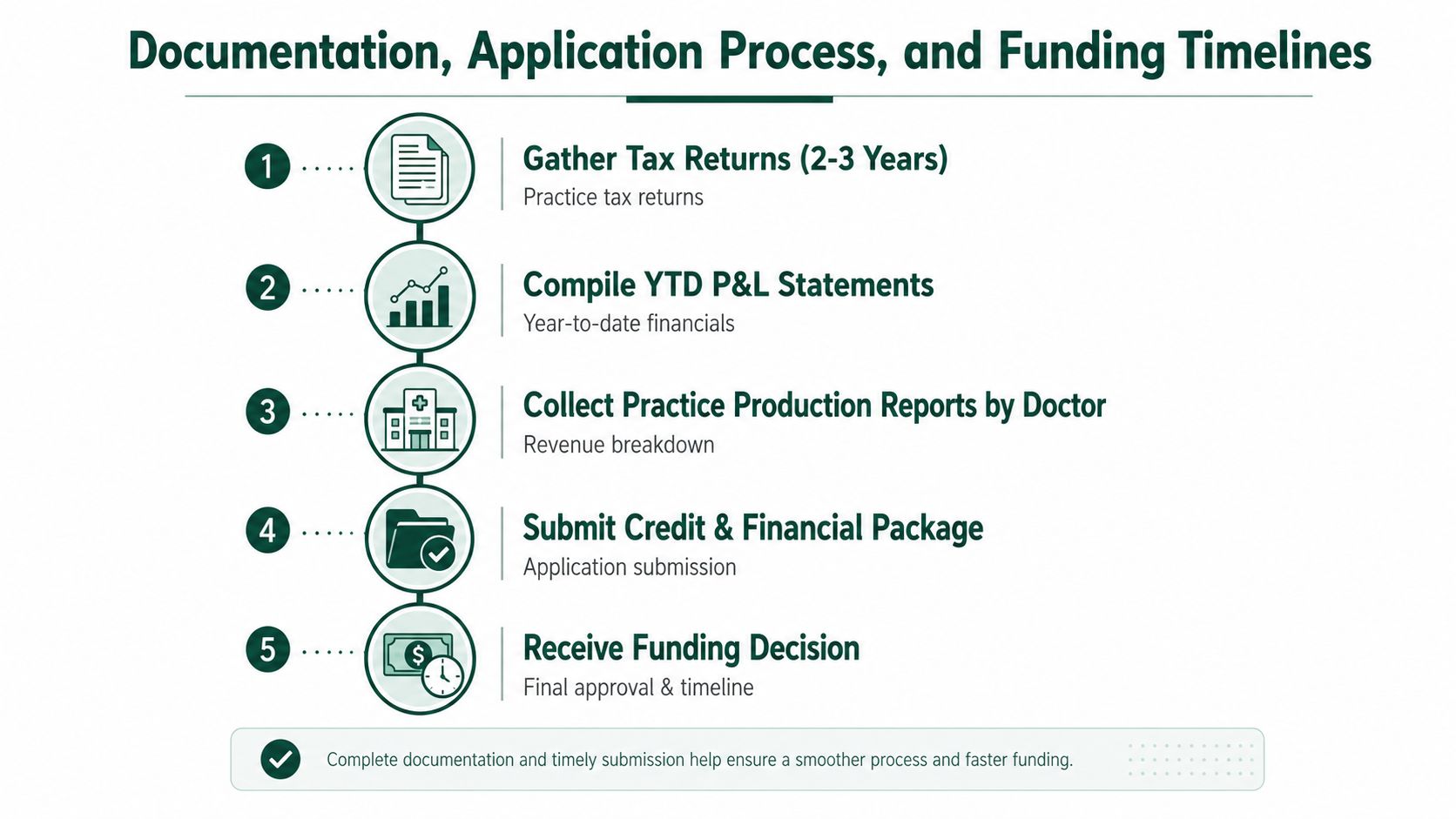
Ownership transitions, holdbacks, landlord consent, franchise approvals, appraisal timing, and incomplete records can stretch the schedule. If a seller is waiting for a closing date, submit the full package before negotiating a date you can't support.
A short educational overview can help you orient new partners before the lender call:
Comparing U.S. Bank Loans to SBA and Conventional Options
A startup, acquisition, and equipment refresh create different repayment risks. Match the loan to the asset's useful life and the practice's cash-flow stage, especially while rates remain high. A longer term can protect monthly liquidity, but it may leave you paying for equipment after its value and clinical usefulness have declined.
U.S. Bank conventional practice financing may fit borrowers seeking a direct bank relationship and broad use of proceeds. It can support equipment, acquisitions, expansion, and selected startup transactions. An SBA structure may fit a borrower whose conventional request creates too much equity or collateral pressure. Review our guide to SBA loans for veterinary practices to understand how those programs differ.
U.S. Bank announced a new startup loan product for dental and veterinary practices on May 11, 2026. The announcement describes conventional lending opportunities for startups that meet industry experience, production capability, and credit parameters. It presents the product as part of the bank's healthcare business banking expansion, not as an automatic approval path. Read the U.S. Bank startup loan announcement while testing whether the offering matches your startup profile.
| Feature | U.S. Bank Conventional | SBA 7(a) | SBA 504 |
|---|---|---|---|
| Primary fit | Broad practice financing, equipment, startups, acquisitions, and expansion | Acquisitions, partner transactions, working capital, and eligible business uses | Long-lived commercial real estate and qualifying large equipment |
| Rate exposure | Negotiated structure, potentially fixed depending on approval | Program and lender dependent | Designed for qualifying fixed-asset financing with a blended structure |
| Equity requirement | Depends on the borrower and transaction | Depends on lender and program requirements | Requires project-specific borrower contribution |
| Amortization | Practice loans up to 15 years, real estate terms up to 25 years | Program and use dependent | Long-term fixed-asset structure |
| Prepayment | Product-specific; review the loan documents | Program and lender dependent | Program-specific and may involve restrictions |
| Main advantage | Direct structure and potentially simpler execution | Government-backed support for eligible borrowers | Strong fit for long-lived fixed assets |
| Main caution | Bank credit and collateral standards can be demanding | More program rules and documentation | Poor fit for short-lived working capital or rapidly aging equipment |
Choose by ownership stage and asset. Use conventional financing when the file is strong and flexibility matters. Consider SBA 7(a) when an acquisition or working-capital need exceeds what conventional financing can comfortably support. Use SBA 504 for a qualifying building or substantial fixed-asset project, not routine operating liquidity.
Compare total fees, required equity, guarantees, prepayment terms, closing requirements, and documentation burden. A lower rate can still produce the weaker deal if a long term delays principal reduction, creates a payment cliff, limits an exit, or leaves you refinancing equipment that has already lost value. Ask for the payment under a slower revenue ramp before selecting the term.
Repayment Scenarios for Startups, Acquisitions, and Equipment Refreshes
A payment illustration is useful only when the assumptions are visible. The requested scenarios include loan amounts and terms, but the verified information doesn't provide interest rates, fees, amortization formulas, or production assumptions. That means no responsible calculation can produce a payment, total interest figure, or break-even production level without inventing data.
The right way to use these examples is to examine the structure and risk direction, then obtain lender-specific numbers for the actual quote.
Startup structure
Consider a startup requiring $650,000 in financing, with a five-year interest-only working-capital line that converts to a ten-year term loan. During the interest-only period, the owner pays financing cost without reducing principal. Once conversion occurs, the clinic must support principal repayment as well as interest.
That structure may protect liquidity during a ramp, but the future payment should be modeled before closing. Ask the lender to show the payment at conversion, the balance at conversion, and the cash-flow coverage under a slower ramp. If the clinic can't support the converted payment under conservative assumptions, the interest-only period is postponing the problem.
Acquisition structure
A $1.4 million acquisition with 10% buyer equity creates a clear ownership contribution, but the payment still depends on the actual rate, fees, amortization, and whether the financing includes real estate, goodwill, working capital, or equipment. A ten-year SBA 504 package and a seven-year conventional structure can produce very different monthly obligations and interest totals, but those figures cannot be calculated accurately from the available facts alone.
The shorter conventional structure may reduce the repayment horizon while increasing the monthly burden. The longer fixed-asset structure may lower the monthly requirement while extending the period during which debt remains outstanding. Compare both against normalized owner compensation and expected post-closing cash flow.
Equipment refresh
A $250,000 equipment refresh on a five-year lease-equivalent term illustrates the central trade-off. Shorter repayment can reduce the chance that the loan survives past the equipment's productive life, but it raises the monthly cash requirement. U.S. Bank's equipment program states that financing can reach $250,000, with terms from 24 to 60 months and no down payment required under the stated program conditions. Those facts describe availability, not the final cost of a particular quote.
| Scenario | Loan Amount | Term and Structure | Approx. Monthly Payment | Total Interest Paid |
|---|---|---|---|---|
| Startup | $650,000 | Five-year interest-only line converting to a ten-year term | Requires lender rate and conversion balance | Requires lender rate, fees, and payment schedule |
| Acquisition | $1.4 million transaction with 10% buyer equity | Ten-year SBA 504 comparison against seven-year conventional financing | Requires approved rate, financed amount, and amortization | Requires approved rate, fees, and amortization |
| Equipment refresh | $250,000 | Five-year lease-equivalent term | Requires equipment rate and repayment structure | Requires equipment rate, fees, and end-of-term terms |
For each quote, request three outputs: the payment during every phase, the total amount repaid, and the remaining principal at the point you might sell, refinance, or replace the asset. Then calculate the minimum production required to cover debt after operating expenses. Don't use gross revenue as the break-even measure. Use cash available after doctor compensation, staffing, supplies, rent, taxes, and normal maintenance.
Cost, Prepayment, and Refinancing Decisions That Change the Math
The quoted rate is only one part of the cost. Owners should read the prepayment section, identify when interest-only payments end, and understand whether a line can be repaid and redrawn or whether it converts into a fixed obligation.
Prepayment changes your exit options
A term loan may carry conditions on early repayment, while an open line may allow more flexible paydown. Ask whether extra principal payments reduce future interest, whether a fee applies, and whether the lender recalculates the payment or shortens the schedule.
The answer matters if you expect to sell, admit a partner, buy another location, or refinance. A loan that looks inexpensive at closing can become restrictive if the practice's ownership plan changes.
Interest-only periods need a hard landing plan
U.S. Bank's veterinary practice financing describes up to six months of interest-only payments. That period can help a startup preserve working capital, but it doesn't reduce the underlying balance. Before accepting it, put the post-interest-only payment into the monthly forecast and test the practice against weaker collections, higher staffing costs, and delayed production.
Refinancing should solve a defined problem
Refinancing can make sense when the current payment no longer matches the practice's cash flow, when a rate improvement produces meaningful savings after fees, or when short-lived assets have been incorrectly bundled into long-term debt. It may not make sense if the new loan only extends the same balance without addressing weak operating performance.
| Situation | Refinance Trigger | Watch Out For |
|---|---|---|
| Payment rises after an interest-only period | Post-conversion coverage is weaker than forecast | Refinancing may extend the problem instead of fixing it |
| Equipment is aging before the loan is paid | Remaining balance exceeds practical asset value | You may need cash to cover the gap |
| Ownership change is approaching | New structure better fits the buy-in or sale | Prepayment fees and lender consent |
| Rates or terms improve materially | Savings exceed closing and documentation costs | A longer term can increase total interest |
| Cash flow has stabilized | Stronger performance supports a better structure | New underwriting may uncover unrelated issues |
Prepare refreshed financial statements, debt schedules, deposit records, and asset information before requesting a refinance. You'll move faster when the lender can see exactly what changed and why the new structure is safer.
Your Next Steps and Decision Checklist
Start by naming the use of funds in one sentence: startup, acquisition, partner transaction, equipment, real estate, working capital, or expansion. Mixed-purpose requests are common, but the lender still needs a clear allocation so each debt component can receive an appropriate term.
Prepare before the first lender call
- Define the ownership event: Explain what you're buying, building, replacing, or refinancing.
- Collect the financial history: Assemble the requested practice financials, tax returns, bank statements, production reports, and personal records.
- Document the transaction: Keep the purchase agreement, equipment quote, lease, real estate documents, licenses, and organizational records together.
- Review your credit profile: Resolve unexplained issues and avoid taking on new obligations while the application is under review.
- Build a downside forecast: Show what happens if the ramp is slower, expenses rise, or the seller's production doesn't transfer fully.
- Request comparable proposals: Ask U.S. Bank, an SBA lender, and a conventional bank to quote the same uses and assumptions.
Ask the U.S. Bank practice lender:
- Which proceeds belong in practice financing, equipment financing, real estate financing, or working capital?
- What payment begins after any interest-only period?
- What are the prepayment conditions?
- Which collateral and guarantees are required?
- What could delay closing or funding?
- What balance will remain if you sell or refinance later?
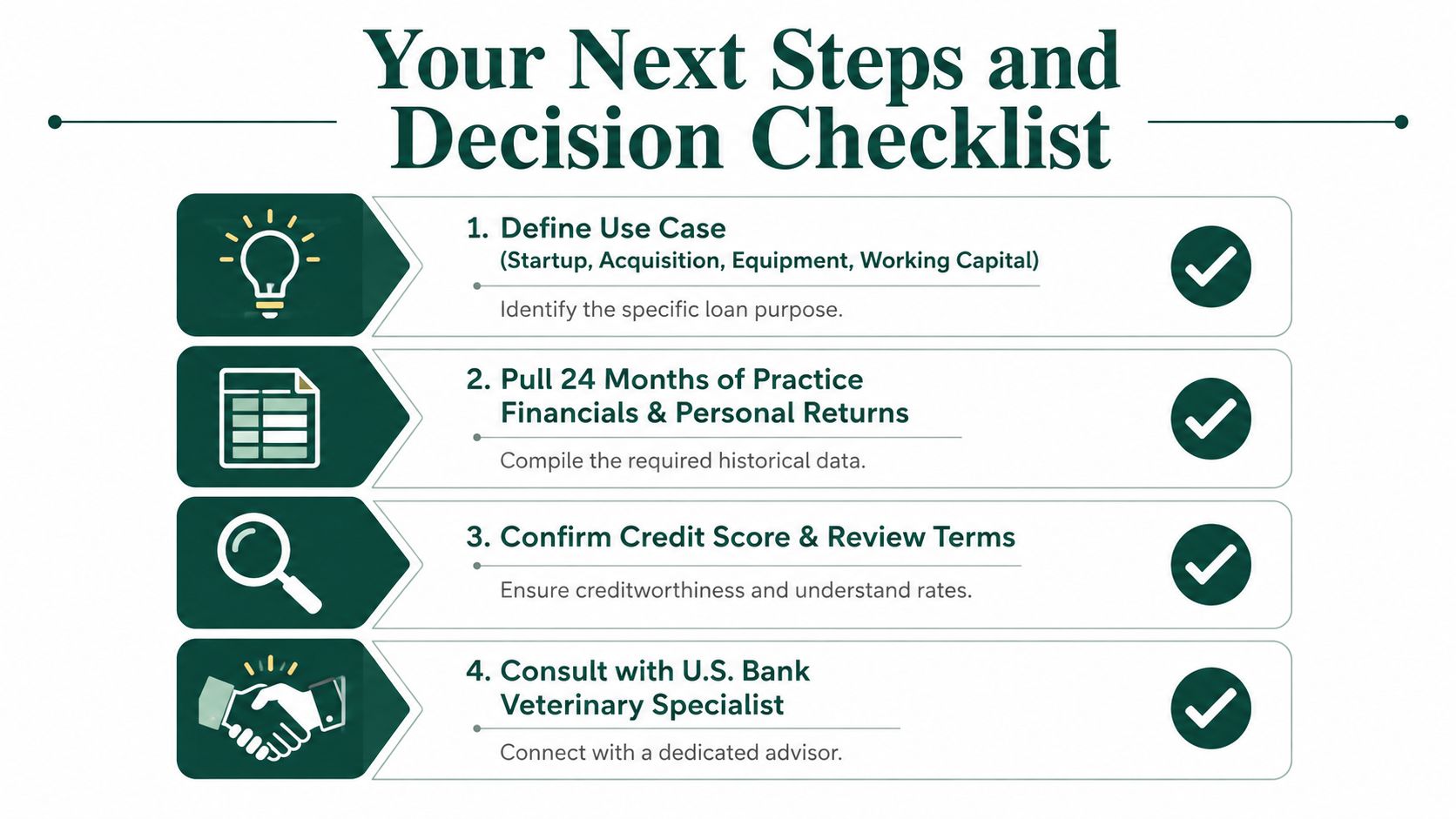
Choose the offer that balances term length, payment stability, prepayment flexibility, collateral requirements, and total cost. The lowest rate isn't automatically the safest financing, and the lowest payment may create the greatest long-term risk.
Veterinary Practice Loans helps veterinary owners evaluate financing for acquisitions, startups, equipment, working capital, and expansion while comparing structure, amortization, and total cost. Visit Veterinary Practice Loans before your lender call to organize the financing questions and deal terms you need to compare.
