
What Assets Are Required for a Veterinary Practice Loan
 Reviewed by Marie Lokmanyan, Senior Loan Consultant · Updated
Note: Rates, fees, down payments, valuation multiples and lender details below are general market information gathered from public sources, not a quote or offer. Your actual terms depend on the lender, your credit, the practice's financials and market conditions. Confirm current terms with the lender before you rely on them.
You walk into a lender meeting expecting to discuss your credit history, revenue, and expansion plan. Instead, the questions turn to equipment ownership, real estate, accounts receivable, inventory, debt schedules, and what happens if the practice can't repay the loan. That shift surprises many veterinarians because a practice loan isn't just a larger version of a personal signature loan.
The better question isn't only what assets are required for a veterinary practice loan. It's which assets drive approval for the product you want, which assets support repayment, and which items merely complete the lender's file. A clinic acquisition, equipment purchase, working capital facility, startup, and real-estate-backed expansion each use a different collateral logic.
"The Moment a Practice Loan Suddenly Feels Real"
A veterinarian sits across from the lender with a productive clinic, a clear use for the funds, and years of operating history. The practice may own diagnostic equipment, surgical assets, pharmacy inventory, receivables, or a building. The owner expects the discussion to center on credit and revenue. Those factors matter, but the underwriter is also asking a harder question: if repayment fails, what assets exist, who owns them, how quickly can they be valued, and how much of the debt can they support?
That is when the loan becomes a real business transaction. The lender is reviewing a collateral package, cash flow, and transition risk together.
Deal-table reality: Strong credit helps, but it does not replace clean ownership records, credible valuations, and proof that the pledged assets belong to the practice.
The standard package may include real estate, vehicles, machinery and equipment, inventory, accounts receivable, and other liquid business assets, as described in this veterinary collateral primer. The exact mix depends on the loan product. An equipment request may rely heavily on the equipment being purchased. A practice acquisition may involve business assets, real estate, and personal support. Working capital financing may give greater attention to receivables and overall operating performance.
Some SBA-style practice loans also require a lien on all business assets and a personal guarantee. That structure gives the lender rights across the operating company instead of limiting recovery to one machine or account.
The approval question is therefore more specific than what assets are required for a veterinary practice loan. Ask which assets drive the decision and which merely complete the file. Lenders commonly review:
- Collateral: The hard and financial assets available to support repayment.
- Loan-product fit: The way acquisition, equipment, working capital, startup, and expansion financing change the asset mix.
- Proof: Records that establish ownership, condition, value, and collectability.
- Preparation: Cleanup work that strengthens the package before underwriting.
A credit-score mindset alone misses the point. The right assets, properly documented, make the proposed loan easier to evaluate and the practice easier to finance.
See what your practice could qualify for
Tell us what you are funding and we’ll connect you with a financing partner who works with veterinary practices. Free, and checking options won’t affect your credit. Compare options in our guide to veterinary practice loans.
"What Lenders Actually Mean by Collateral"
A home mortgage usually points to one dominant asset, the property. Veterinary lending is different. A clinic loan often uses a layered collateral stack, with several business assets supporting the obligation and expected cash flow carrying the repayment burden.
The lender's logic is straightforward. The practice must generate enough cash to service the debt, while pledged assets provide a recovery path if the business underperforms or defaults. Underwriters therefore examine both the operating business and the assets behind it. A clinic with valuable equipment but weak collections has a different risk profile from a clinic with modest hard assets and strong, well-documented receivables.
The recovery ladder
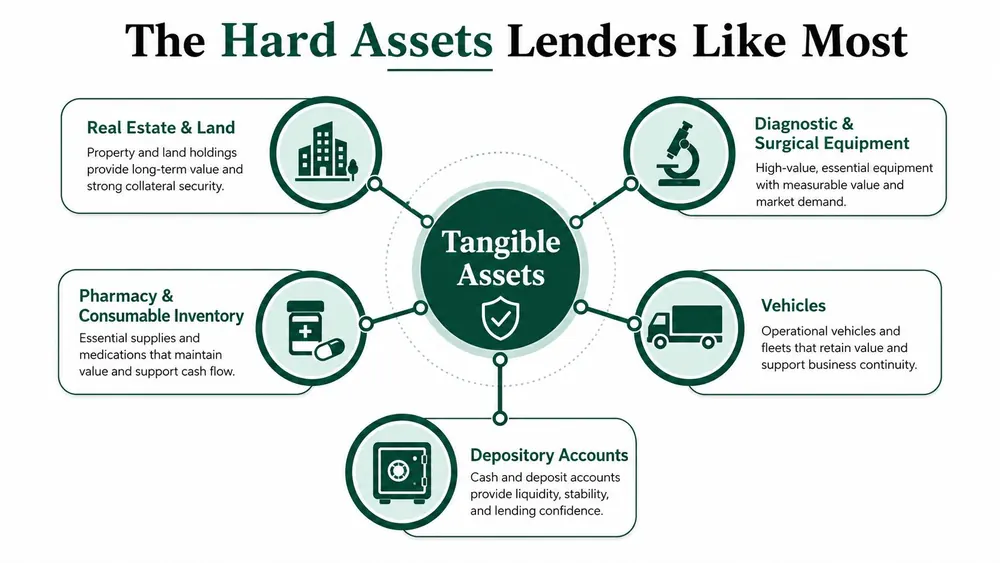
Lenders commonly review the following categories:
- Real estate and land: A practice building and the land beneath it can provide substantial collateral support when the borrower owns the property.
- Machinery and equipment: Diagnostic systems, surgical equipment, laboratory machines, treatment fixtures, and related clinical assets can be pledged.
- Vehicles: Practice-owned vehicles may form part of the business collateral package.
- Inventory: Pharmacy stock, medical supplies, and consumables have value, although their condition, turnover, and shelf life matter.
- Accounts receivable: Receivables can support borrowing, but their quality depends on aging, collectability, and proper records.
- Liquid business assets: Depository accounts and other liquid assets can strengthen the lender's recovery position.
The lender may also require a personal guarantee, particularly in an SBA-style structure or where the business collateral doesn't fully support the requested amount. A guarantee isn't the same as pledging a specific personal asset, but it gives the lender a claim against the guarantor if the business can't meet its obligations.
Why the package matters
The collateral list is not a box-checking exercise. Ownership records, asset condition, liens, valuations, and cash-flow evidence determine how much practical support each item provides. Equipment can be useful collateral without being worth its original purchase price. Receivables can look large on a balance sheet while proving weak if they are old or difficult to collect.
The lender is effectively asking, what can repay the loan through operations, and what can support recovery outside operations? Your application should answer both questions.
A short video can help owners visualize how lenders think about business assets and secured borrowing.
"The Hard Assets Lenders Like Most"
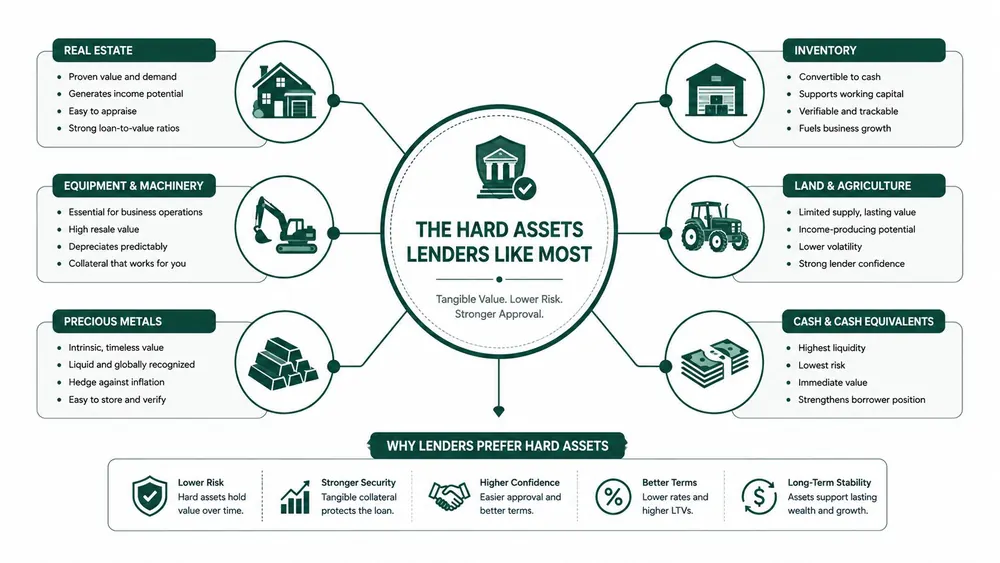
The most persuasive collateral is usually easy to identify, document, and value. That doesn't mean every hard asset contributes equally. A building may provide durable support, while inventory requires closer scrutiny because its value can change with use, expiration, and turnover.
Real estate and land
Practice-owned real estate is often the strongest category in the package. The lender wants evidence of ownership, existing liens, legal description, and current value. A property appraisal establishes the lender's view of market value, while title work identifies ownership issues and prior claims.
Real estate won't automatically carry an approval. The property still needs to fit the transaction, and the practice's cash flow must support repayment. But a clinic owner who owns the building generally presents a stronger collateral story than an owner operating from a lease with no business property.
Diagnostic and surgical equipment
Equipment includes imaging systems, laboratory analyzers, surgical tools, treatment tables, dental equipment, and practice technology. Underwriters look for purchase invoices, serial numbers, ownership status, existing financing, maintenance condition, and useful life.
Equipment financing is often secured by the equipment itself. That structure can align repayment with the asset's useful life and reduce the need to pledge unrelated collateral, as explained in this veterinary equipment financing resource. The lender still needs to know whether the asset is transferable and whether a secondary market exists.
Pharmacy and consumable inventory
Inventory includes medications, supplies, implants, food, and other consumable stock. Lenders may include it in the broader collateral package, but inventory doesn't receive the same treatment as a building. Its value depends on condition, turnover, expiration, and whether records reconcile with the balance sheet.
An owner should maintain a current inventory report and identify obsolete or slow-moving items before applying. Inflated inventory values weaken credibility because the lender knows the balance sheet may not reflect liquidation value.
Vehicles
Practice-owned vans and other business vehicles can be pledged as assets. The lender will typically want ownership records, existing lien information, and a reasonable indication of current value. Vehicles can support the package, but they rarely substitute for a sound operating plan or sufficient repayment capacity.
Depository accounts and receivables
Cash held by the business and collectible receivables can improve the overall picture. The key distinction is liquidity and reliability. A clean deposit history and reconciled receivables ledger give the lender more confidence than an unsupported balance-sheet figure.
"How the Asset Mix Changes by Loan Product"
There isn't one universal answer to what assets a veterinary practice loan requires. The product determines the lender's preferred collateral, the role of personal support, and the paperwork needed to validate the transaction.
| Loan Product | Primary Collateral | Personal Guarantee | Special Documentation |
|---|---|---|---|
| Acquisition loan | Practice assets, goodwill, receivables, and sometimes real estate | Often part of the structure | Valuation, purchase agreement, financial statements, debt schedule, and receivables aging |
| Equipment financing | The financed equipment itself | Depends on structure and borrower strength | Equipment quote, ownership details, serial information, and useful-life analysis |
| Working capital line | May be unsecured or broadly lien-backed | Varies by lender and risk | Cash-flow records, deposits, borrowing-base information, and operating statements |
| Startup financing | Limited existing business assets, owner support, and projected cash flow | Commonly important | Business plan, projections, personal financial information, and build-out budget |
| Real-estate-backed expansion | Building and land, with operating assets supporting the wider deal | May be required | Appraisal, title work, and environmental review |
Acquisition loans
An acquisition loan usually combines several needs. The buyer may be financing goodwill, hard assets, transition costs, and working capital in one transaction. The practice's existing revenue, financial statements, valuation, and receivables quality can carry more weight than the buyer's personal asset list.
SBA-style practice structures may place a lien on all business assets and require a personal guarantee. The asset package therefore extends beyond the equipment room and into the operating company.
Equipment financing
This is the cleanest collateral relationship. The equipment being purchased secures the financing, and the repayment period should make sense relative to the asset's useful life. Owners should avoid using a broad, expensive structure for a single identifiable purchase unless the broader flexibility is worth the additional exposure.
Working capital
Working capital facilities are designed around liquidity, not a single durable asset. They may be unsecured or backed by a broad business lien. The lender focuses on collections, deposits, payroll needs, inventory purchases, and the practice's ability to normalize cash flow.
Startup and expansion
A startup has no established operating asset base, so the lender weighs owner credit, available equity, projections, and the viability of the plan. An expansion loan may add build-out costs, new equipment, and real estate. For SBA-related structures and veterinary practice transactions, this SBA lending overview provides useful context for how broader business collateral can enter the structure.
The conclusion is simple. Match the collateral conversation to the product, not to a generic checklist.
"Goodwill Receivables and Other Intangibles"
Goodwill is where many owners receive conflicting answers. One lender may describe goodwill as part of the acquisition value, while another may insist that tangible assets and cash flow provide the practical protection. Both positions can be reasonable because goodwill behaves differently from equipment or real estate.
In an acquisition, goodwill represents the value of the established client base, reputation, operating history, team, location, and expected future earnings. A clinic with limited fixtures can still be financeable if its revenue, recent financial statements, collections, and valuation support the purchase price. Some veterinary lending guidance says lenders may lend against goodwill or future collections in the right acquisition structure, while other guidance emphasizes a lien on tangible business assets.
The distinction is critical: goodwill may drive approval without functioning like liquidation collateral. If the practice fails, goodwill can disappear quickly. Lenders therefore rely on the ongoing business, transition plan, and repayment capacity rather than treating goodwill like cash in a bank account.
Receivables are useful only when they are collectible
Accounts receivable can strengthen an acquisition or working capital request, but age and quality matter. A current, reconciled receivables ledger tells the lender that billed services are converting into cash. An aging report full of stale balances tells a different story, even if the total receivables number looks attractive.
Future collections can also support a transaction when the acquired practice has a stable operating history. That support is much weaker for a de novo startup because projected collections haven't been demonstrated through an existing business.
For owners buying an established clinic, an acquisition structure that recognizes goodwill and future collections may be appropriate. For a startup, tangible build-out assets, owner support, and credible projections become more important.
The question to ask: Which assets make the lender comfortable approving this product, and which assets merely appear in the lien documents?
Owners exploring a purchase should understand how valuation and transition risk interact with collateral. A focused veterinary practice acquisition loan resource can help frame that conversation before the application is submitted.
"The Documentation That Proves Your Assets Exist"
A lender approves the file they can verify, not the clinic the owner describes. The review tests ownership, value, condition, existing debt, and whether the assets support the proposed repayment plan. Some documents drive approval, while others allow underwriting to complete its checklist.
For an acquisition, the package can include three years of personal tax returns from guarantors owning 20% or more equity, three years of business tax returns from the target practice, year-to-date financial statements, a debt schedule, aged accounts receivable, an independent practice valuation, and a signed purchase agreement. Use this veterinary practice financing documentation guide to organize the lender-preparation file.
Build the file around lender questions
- Personal tax returns: Verify the financial position and income history of significant guarantors.
- Business tax returns: Establish the target practice's historical operating record.
- Year-to-date financials: Show whether current performance matches prior results.
- Debt schedule: Identify obligations, liens, balances, and payment demands against business assets.
- Aged receivables: Separate collectible revenue from balances unlikely to become cash.
- Independent valuation: Support the value assigned to goodwill, equipment, and the practice overall.
- Signed purchase agreement: Define exactly what the buyer will acquire and finance.
- Appraisal, title, and environmental work: Validate real estate value, ownership, and property risks.
Real-estate-backed deals may require a lender-ordered appraisal costing approximately $3,000 to $7,000, plus Phase I environmental and title work. Treat these as transaction requirements, not optional administration. They may not improve the asset's value, but missing them can delay or stop the closing.
Working capital needs a separate line in the plan. New owners may need to budget $100,000 to $200,000 for drug and supply inventory and payroll during the first 60 to 90 days, before collections normalize. That liquidity is not collateral, but it can determine whether the practice reaches stable repayment. Document the use of funds clearly, because a well-supported liquidity plan strengthens the case even when those dollars do not secure the loan.
"How to Position Your Assets Before You Apply"
Asset preparation isn't busywork. It changes how quickly a lender can understand the deal and whether the collateral package appears controlled.
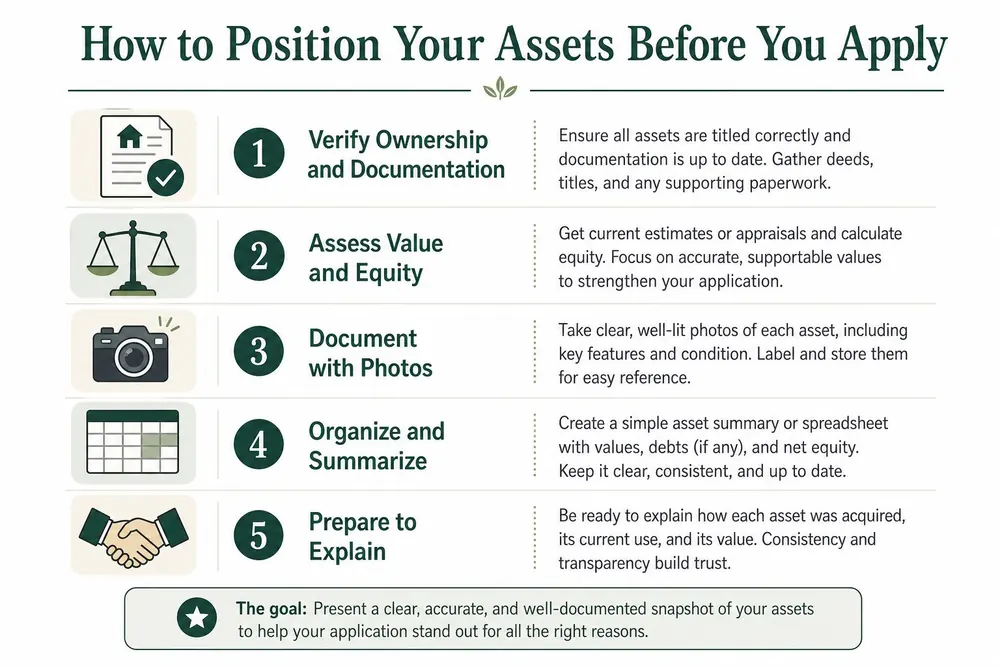
Start with ownership. Confirm that the entity applying for the loan owns the equipment, vehicles, inventory, and accounts receiving the practice's revenue. Resolve old liens, missing titles, and assets still registered to a former entity. If a seller owns the building separately, document the lease or the property transaction clearly.
Then reconcile the numbers. Your equipment list should agree with the fixed-asset schedule. Inventory reports should reconcile with accounting records. Receivables should tie to the general ledger and show which balances are current, disputed, or unlikely to be collected.
A practical preparation checklist
- Clean up titles: Gather deeds, vehicle titles, equipment ownership records, and existing lien information.
- Reconcile receivables: Produce an aging report that matches the books and explain unusual balances.
- Document equipment: Record model details, serial numbers, purchase dates, financing status, and condition.
- Separate business and personal assets: Keep practice assets titled to the business and maintain clean financial statements.
- Decide your guarantee position: Know which personal assets you might pledge and which protections you need before signing.
Avoid acquiring unnecessary assets just to inflate the balance sheet. A lender values useful, identifiable, properly owned assets more than cluttered schedules filled with items that have little recovery value.
Structure the debt around the asset: Durable equipment can justify a term structure aligned with its useful life. Short-term operating needs shouldn't be financed as if they were long-lived property.
Owners with thin hard assets still have options. Strengthen the cash-flow story, clean up receivables, support goodwill with an independent valuation, and present a realistic transition or startup budget. The right lender may care more about the quality of the business than the volume of equipment in the building.
"Stop Asking What Assets and Start Asking Which Ones"
The answer to what assets are required for a veterinary practice loan depends on the transaction. A practice acquisition may combine goodwill, receivables, equipment, inventory, real estate, and working capital. An equipment loan may rely mainly on the machine being purchased. A working capital facility may emphasize liquidity and cash flow rather than a specific hard asset.
The asset categories are familiar, but their importance isn't equal:
- Approval drivers: Strong cash flow, credible receivables, an independent valuation, useful equipment, and real estate can materially shape the lender's decision.
- Collateral support: Inventory, vehicles, and other business assets can broaden the recovery package.
- Paperwork requirements: Ownership records, debt schedules, titles, appraisals, and lien information prove that the stated collateral is real and available.
- Personal exposure: A personal guarantee can remain a meaningful part of the structure, especially where business collateral is limited or the product uses a broad lien.
Lead with the strongest asset category for the product you want. Prepare the documentation before approaching lenders. Treat the personal guarantee as a real variable to understand and negotiate, not as a formality buried in the closing documents.
Veterinary Practice Loans helps veterinarians and practice owners evaluate acquisition, equipment, working capital, startup, and expansion financing around the assets and cash flow that support the deal. Visit Veterinary Practice Loans with your asset list, financial records, and financing objective ready, and start a focused conversation about the right loan structure.