
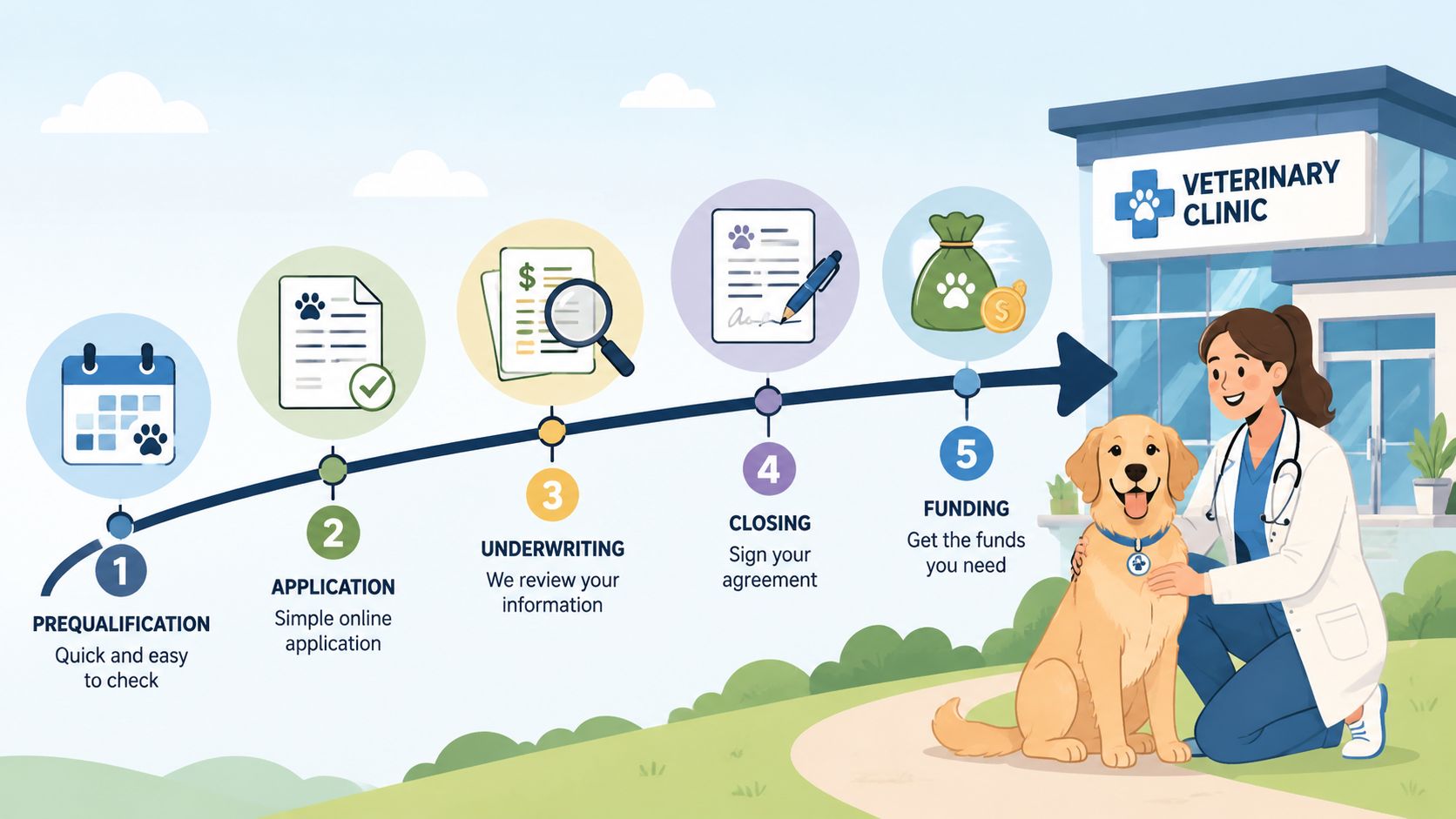
Expect roughly 1 to 12 weeks, depending on the loan type. SBA-style and practice acquisition deals commonly take 60 to 90 days, while equipment financing may close within days to a few weeks.
That range is more useful than a single answer, but it still doesn't tell you where the time goes. A veterinary clinic loan can move quickly through credit review and then stall because a seller hasn't supplied tax returns, a landlord hasn't approved a lease assignment, or an appraiser hasn't completed a property report. The fastest way to predict your funding date is to separate the loan into its stages, identify who controls each stage, and prepare the documents before the lender asks for them.
What a Realistic Veterinary Loan Timeline Looks Like
A veterinary loan can take about one to twelve weeks from application to funding, but the product and deal structure determine where the days go. Equipment financing usually moves faster than a practice acquisition. SBA-style financing and real-estate-backed transactions involve more review, documentation, and closing conditions. SBA guidance commonly places funding within 30 to 90 days from application, with simpler cases moving faster and complex transactions taking longer, as described in this SBA loan timing overview.
A $40,000 ultrasound purchase and a $1.2 million acquisition may both be called “business loans,” but they follow different paths. An equipment lender may need a dealer invoice, basic financial information, and confirmation of the asset. An acquisition lender must assess the buyer, seller, practice cash flow, valuation, purchase agreement, lease, collateral, guarantors, and closing conditions.
The product determines the clock
Start with the loan purpose when estimating the timeline:
- Equipment financing usually has a short path because the asset and its price are easy to identify.
- Working capital financing requires review of deposits, cash flow, existing obligations, and repayment capacity.
- Acquisition financing adds valuation, transaction documents, seller cooperation, lease review, and ownership-transfer requirements.
- Real estate or build-out financing may require appraisal, title work, environmental review, zoning confirmation, and contractor documentation.
- SBA-style financing adds lender underwriting and SBA-related review before the closing package is complete.
The borrower controls some gates, shares control of others, and cannot control the lender's queue or a third-party appraisal. You can control the items that commonly stall clinic deals: submit complete tax returns, respond to conditions the same day, and keep the seller, accountant, landlord, and equipment dealer engaged.
Practical rule: Don't ask only, “How long does the loan process take?” Ask, “Which stage is most likely to hold my clinic loan, and what can I deliver before it starts?”
Mortgage lending offers a useful comparison because its process is more standardized. Home purchases commonly take several weeks to close, with appraisal, title, underwriting, and document review extending the timeline. This mortgage closing timeline explanation supports the practical lesson: collateral and documentation create delays even when the lending process follows a familiar structure.
For veterinary practice owners, the biggest time savings usually come before underwriting begins. Organize the financial file, confirm the transaction terms, and identify third-party approvals early. That preparation will not eliminate lender or appraisal delays, but it prevents avoidable pauses that the borrower controls.
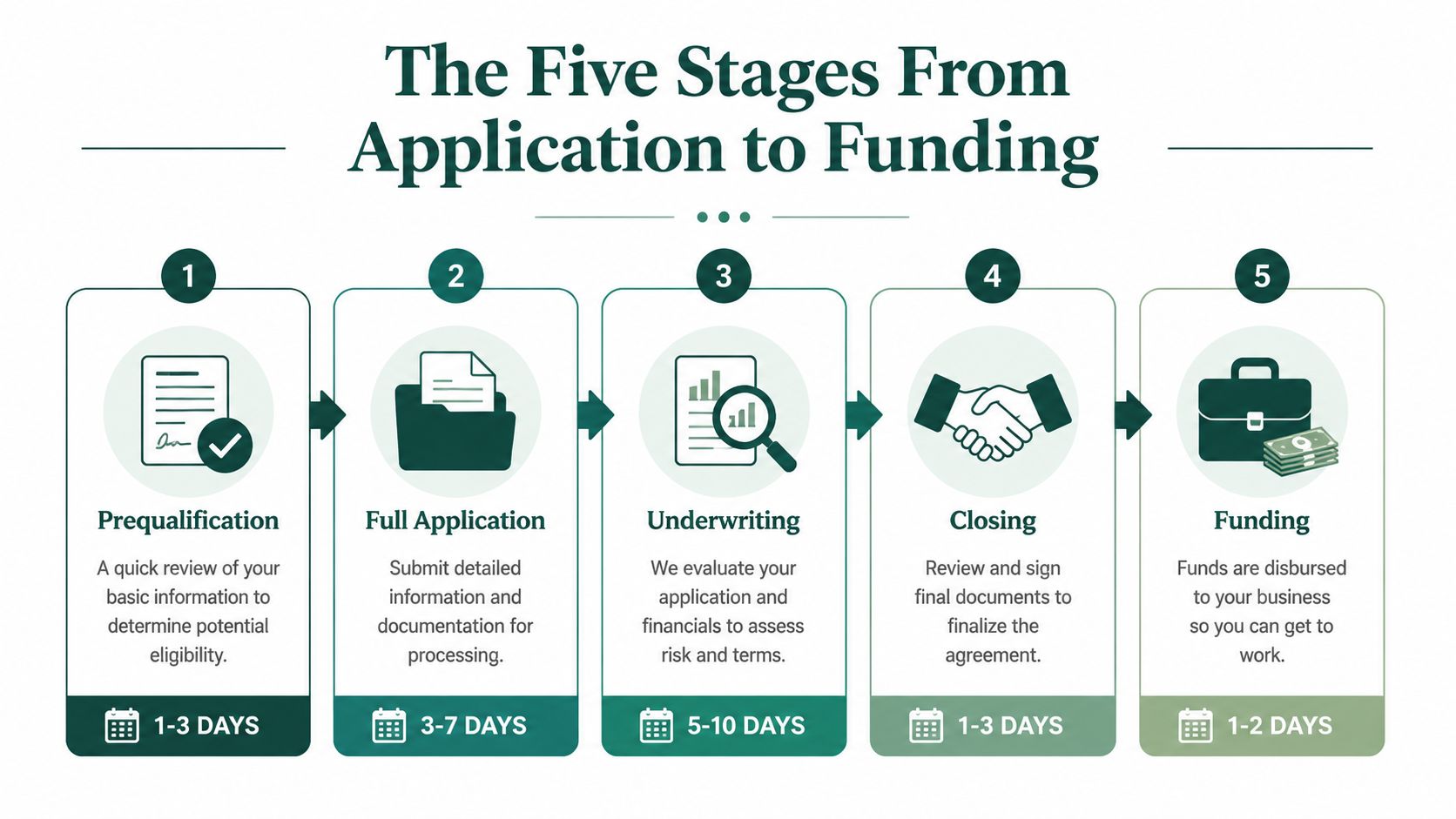
The Five Stages From Application to Funding
A veterinary loan passes through five stages, and the slowest point depends on the loan type, the transaction, and the documents the clinic can produce. Practice owners control more of the timeline than they often realize, especially before lender review begins.
1. Prequalification
For SBA-style lending, prequalification often takes one to seven days, according to this SBA process breakdown. The lender reviews the estimated loan amount, practice revenue, ownership experience, personal credit profile, existing debt, and intended use of funds.
Some lenders can assess preliminary information with a soft credit inquiry. This is an initial fit check, not final approval. It shows whether the request appears workable and identifies the documents or loan structure requiring closer review.
Clinic owners slow this stage by presenting an incomplete revenue picture, omitting existing debt, or changing the use of funds after review has started. Set the request clearly at the outset.
2. Full application
The full application is usually the first stage where the borrower directly determines the pace. Prepare personal and business tax returns, a current profit-and-loss statement, balance sheet, debt schedule, entity documents, bank statements, licenses, purchase documents, and equipment quotes when applicable.
For SBA financing, document collection commonly takes one to two weeks, while the initial application and prequalification period may take one to seven days. An organized package lets the lender begin analysis immediately. Sending one statement or tax return at a time creates avoidable pauses.
Missing tax returns create an obvious delay. Undisclosed guarantor debt creates a larger problem because the lender must reassess repayment capacity after the file seemed complete.
3. Underwriting
Underwriting and lender review commonly take one to three weeks for SBA-style financing. Clinic acquisitions and unusual collateral can take longer. The lender examines historical cash flow, debt obligations, personal financial strength, ownership structure, and the proposed repayment plan.
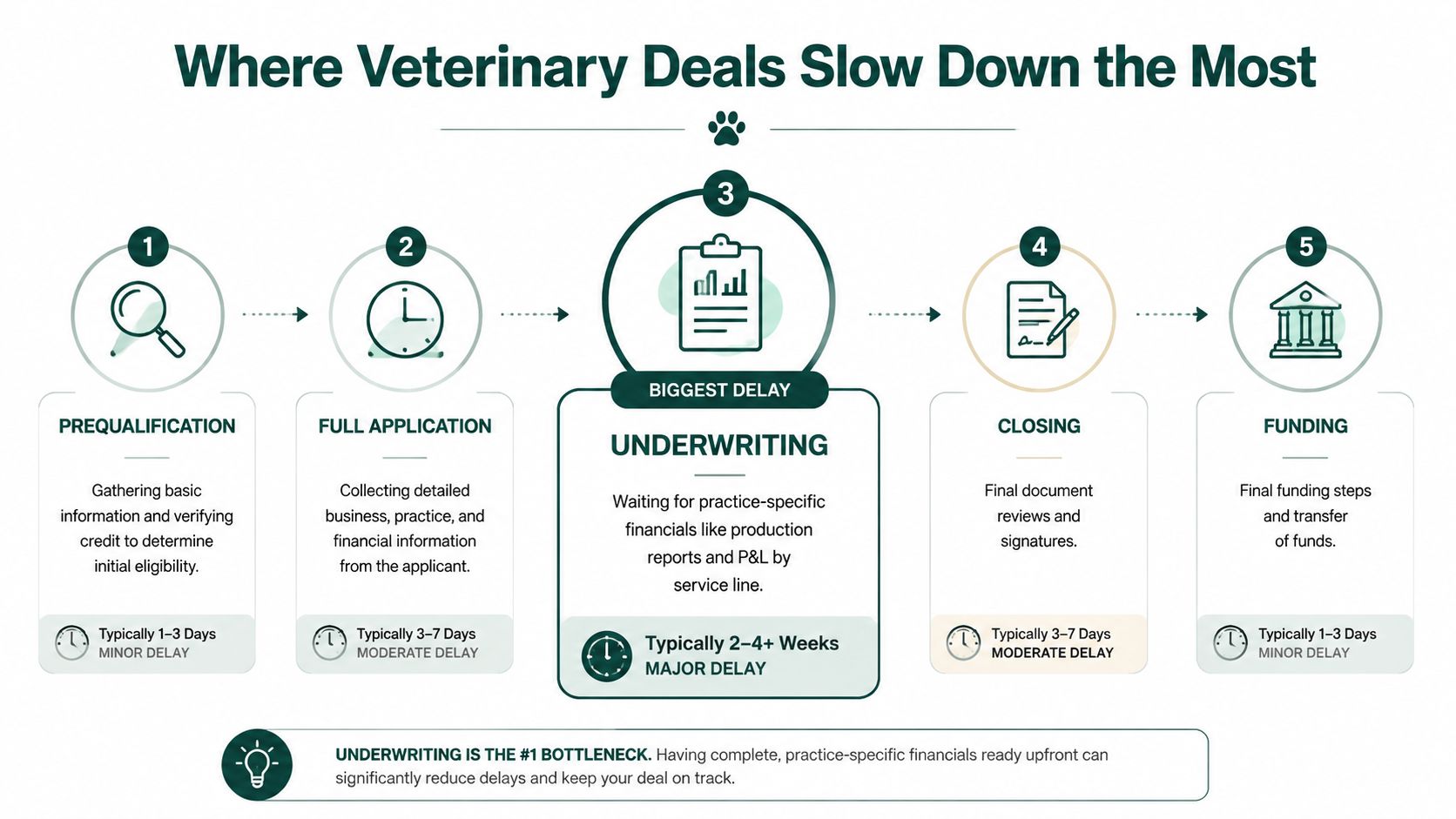
Veterinary deals require practice-specific analysis. The lender may need to reconcile revenue by service line, doctor production, pharmacy and laboratory income, payroll structure, recurring and unusual expenses, and the effect of a departing owner.
The file stalls when the profit-and-loss statement does not match deposits, production reports are unavailable, or a major year-over-year change lacks an explanation. Respond the same day when possible, but send accurate answers rather than rushed guesses.
4. Closing
Closing commonly takes one to two weeks in SBA timelines, although simpler products may close faster. The lender completes final document review, confirms entity authorization, checks title or lease matters where relevant, and prepares the loan documents.
Commercial lease issues frequently appear at this point. The clinic may need landlord consent, a lease assignment, an updated certificate of insurance, or proof that the borrowing entity has authority to operate at the premises. Involve the landlord early instead of waiting for closing conditions.
5. Funding
Funding follows signed documents and satisfaction of final conditions. Proceeds may go to the designated operating account, seller, equipment dealer, contractor, or another approved recipient.
Approval does not make funding automatic. A missing signature, incorrect wire instruction, unresolved insurance requirement, or dealer invoice discrepancy can still delay release. Keep every transaction party engaged until the funds have arrived. The borrower controls preparation and response time, while the lender's queue and third-party reviews remain outside the clinic's control.
Comparing Timelines by Loan Type
The loan type sets the timeline before the application begins. Replacing a failed imaging unit follows a different path from buying a full-service hospital, so practice owners should match the financing structure to the deadline.
| Loan Type | Typical Timeline | Main Driver of Speed |
|---|---|---|
| Equipment financing | Days to a few weeks | Clear asset, dealer invoice, and verified collateral |
| Working capital line or term loan | About 7 to 21 days | Cash-flow review and complete financial records |
| Conventional practice acquisition | About 45 to 75 days | Valuation, purchase agreement, lease, and underwriting |
| SBA 7(a) acquisition financing | About 60 to 90 days | SBA review, lender underwriting, closing preparation, and collateral diligence |
| Veterinary real estate financing | About 45 to 90 days | Appraisal, title, environmental review, and property requirements |
| Alternative or revenue-based financing | About 5 to 14 days | Automated or simplified review, with higher borrowing cost |
SBA acquisition financing generally takes longer because underwriting, SBA review, closing preparation, and collateral diligence each create a separate queue. Plan around the 60 to 90 day range shown in the table, not the fastest possible outcome. The SBA loan options for veterinary practices can help you assess whether that structure fits the purchase and its closing deadline.
Equipment financing is usually the fastest practical choice for a defined purchase. A specific invoice and responsive dealer give the lender a focused collateral review instead of requiring analysis of an entire operating practice. Custom, imported, or installation-heavy equipment can still add time when delivery or installation confirmation is required.
Working capital financing falls between those timelines. The lender must review deposits, expenses, existing debt, and payment capacity, but the file typically avoids a seller valuation and property appraisal. Complete financial records are the main factor the clinic controls.
Real-estate financing takes longer when appraisal, title, environmental review, or other property requirements remain open. Choose the loan structure early, then ask the lender for its document checklist and internal deadline. The fastest approval is useless if the product cannot fund before the seller, equipment dealer, or landlord expects completion.
Where Veterinary Deals Slow Down the Most
Underwriting usually takes the largest share of time in a veterinary deal. Lenders must turn clinic operations into a reliable repayment picture, yet many small-business files show only total revenue and expenses. They do not explain production by doctor, service-line mix, pharmacy activity, or owner compensation. Those missing details create questions, conditions, and review cycles.
Acquisition files create multiple queues
A practice acquisition can stall even when the buyer has strong credit. The lender may still need a valuation, the buy-sell agreement, seller financing terms, lease review, and landlord consent.
Each party controls part of the schedule. The seller provides historical records. The buyer's accountant explains adjustments. The landlord handles assignment or lease changes. The lender assembles the closing package. One delayed response can hold the entire transaction, so acquisition timelines depend on coordination as much as borrower qualifications.
Property and build-out add outside dependencies
Real-estate-backed loans and construction funding introduce work outside the clinic and lender. Appraisal, title review, environmental diligence, zoning, permits, contractor bids, and draw procedures can each affect the closing date.
Converted retail or mixed-use locations require closer review. The lender must confirm that the clinic can legally operate there and that the property supports the proposed financing structure. Permit or zoning questions often surface late, after other underwriting work is complete.
SBA review is only one SBA delay
SBA-style packages can lose time during guaranty review, re-disclosure, and final eligibility checks. SBA process documentation identifies separate review, closing, and funding milestones, which means approval does not always equal immediate access to funds.
Equipment loans usually avoid these queues, but custom units can add shipping, delivery, and installation verification. The pattern is consistent: specialized collateral and less predictable cash flow require more validation.
Before submission, use this veterinary practice loan asset checklist to identify missing support. Fixing gaps before underwriting is faster than answering conditions after an analyst begins review.
Practical Ways to Speed Up Approval
Approval moves faster when the lender receives a complete, consistent file on the first pass. You cannot control every queue, but you can eliminate the pauses your practice creates.
Build the file before applying
Create one organized folder containing:
- Practice financials: Provide 24 months of business financial statements, tax returns, and a current year-to-date P&L.
- Debt information: List every business and personal obligation, including balances, payment amounts, and guarantor responsibilities.
- Revenue detail: Ask your accountant for production or revenue splits by doctor and service line.
- Entity records: Include formation documents, ownership information, licenses, and authorization records.
- Collateral support: Add an equipment quote, dealer invoice, vendor contract, or asset list that matches the requested use of funds.
The lender should not have to reconstruct your practice from scattered attachments. Combine deposit history into one PDF, label files clearly, and check that dates and entity names match throughout the package. Inconsistent records create questions, and unanswered questions create conditions.
Remove seller and vendor delays
For an acquisition, ask the seller to prepare the due-diligence package before underwriting begins. Include financial statements, tax returns, purchase terms, lease information, equipment details, and other records needed to verify the practice.
For equipment financing, secure the final quote and dealer contact information early. A vendor that responds slowly can delay funding even when the borrower has no credit issue. Review veterinary practice equipment loans while collecting the quote, so the requested structure matches the asset and use of funds.
Borrower-controlled time is the cheapest time to eliminate.
Treat conditions as deadlines
Answer underwriting questions within 24 hours whenever possible. If the lender requests related documents, send the full response together. Ask your accountant for any required revenue explanation immediately, then submit the explanation and supporting records in one package.
Sign disclosure and closing documents the day they arrive. Before signing, verify names, entity information, loan proceeds, payment instructions, and collateral descriptions. A small correction can otherwise trigger another document cycle.
Speed comes from preparation, not repeated follow-up. Put one person in charge of the file, track every open request, and confirm when each item is complete. That discipline keeps a clean application from becoming the bottleneck.
Common Trade-Offs Between Speed and Terms
Fast funding can solve a deadline, but it often costs more. Online and alternative lenders may fund within 48 to 72 hours, yet the offer may carry higher costs, shorter repayment periods, or payment structures that strain clinic cash flow. Some use factor rates in the 1.15 to 1.30 range. Bank and credit-union products generally require more documentation and patience.
| Lender Type | Typical Time to Fund | Relative Cost | Best Fit Scenario |
|---|---|---|---|
| Bank or credit union | Several weeks | Lower relative cost | Stable clinic with strong records and flexible timing |
| SBA-style lender | About 60 to 90 days | Moderate relative cost | Acquisition, expansion, or build-out requiring longer repayment |
| Equipment lender | Days to a few weeks | Varies by asset and profile | Identifiable equipment with a clear invoice |
| Alternative or revenue-based lender | About 5 to 14 days, with some offers funding in 48 to 72 hours | Higher relative cost | Time-sensitive need where cash flow can absorb the payment |
Compare the financing cost with the consequence of waiting. A partner buyout, lease deadline, equipment replacement, or acquisition window may justify a faster structure. Approve it only after testing the payment against payroll, inventory, and emergency reserves. A loan that closes quickly but weakens operating cash is not a successful timeline.
For a clinic acquisition or major build-out, SBA-style financing usually offers a more workable repayment structure than short-term alternatives, while taking longer because the review is deeper. If the practice can wait, that additional runway may protect cash flow and reduce the pressure created by aggressive payments.
Speed should solve a specific business problem. Use it for a deadline the clinic cannot miss, not as the default measure of a good loan. When timing is flexible, prioritize terms your practice can sustain after funding closes.
Matching the Right Loan to Your Practice Timeline
A deadline determines the right loan structure. Start with the date funds must be available, then match the product to the use, amount, and repayment capacity. Do not choose a loan solely because it closes fastest.
Use this order:
- Urgency: Set the firm date for equipment delivery, a lease obligation, an acquisition, or a working-capital need.
- Loan purpose and size: Choose financing designed for that transaction and amount. Equipment purchases, operating needs, and acquisitions require different reviews.
- Practice fit: Check repayment length, collateral, cash flow, ownership structure, and documentation against the clinic's actual position.
- Preparation: Assemble financial statements, tax records, seller information, invoices, and ownership documents before submission.
The phase you control most is preparation. Missing records and slow answers can add days or weeks, especially in an acquisition where the lender must review both the practice and the transaction. A solo owner buying a clinic without an established lender relationship should allow more time. An established practice with organized records can reduce avoidable delays when refinancing or adding a partner.
Match speed to the business consequence of waiting. If the deadline is flexible, choose terms the clinic can carry after closing. If timing is fixed, accept a faster structure only after testing payments against payroll, inventory, and emergency reserves.
Veterinary Practice Loans provides financing for acquisitions, equipment, working capital, startups, and expansion. Bring your funding purpose, target amount, and required date, and request a timeline built around the transaction.
