

You've finished your clinical training, found a promising location, and started discussing financing. Then the lender asks for your veterinary practice business plan. You submit a polished document filled with your credentials, service ideas, and optimistic revenue projections, only to discover that the underwriting team cares less about your enthusiasm than about whether the practice can preserve cash and repay debt during a slow opening period.
A fundable plan answers a harder question than “Can this veterinarian provide excellent care?” It answers, “Can this business generate enough cash, on schedule, under pressure, to cover payroll, inventory, operating costs, and debt service?” The model must reflect the realities of startup ramp-up, acquisition diligence, staffing, ownership changes, and veterinary market competition.
Why Most Veterinary Business Plans Fail at the Lender Meeting
A veterinarian arrives at the lender meeting with a thick plan. The executive summary describes a compassionate care model, the operations section lists modern equipment, and the marketing section promises strong community engagement. The revenue forecast rises sharply almost immediately, but the plan doesn't show how many appointments produce that revenue, when clients pay, how payroll is funded during the ramp, or what happens if the opening takes longer than expected.
The lender doesn't reject the plan because the doctor lacks clinical credibility. The rejection comes because the document doesn't prove cash-flow control. Annual totals conceal timing gaps. A revenue line without service volumes and pricing cannot be tested. A projected profit without a monthly cash balance doesn't show whether the practice can make payroll before collections stabilize.
Lender-facing rule: Clinical expertise establishes credibility. Monthly cash flow establishes repayment capacity.
The market context matters too. The U.S. veterinary sector is established and large, with the Census Bureau estimating about 34,000 veterinary establishments in 2022, compared with 28,691 in 2009, an 18.5% increase over 13 years. AVMA reported 127,131 veterinarians actively engaged in U.S. practice at the end of 2023 and 130,415 total U.S. veterinarians as of December 31, 2024. Those figures support expansion, acquisition, and new-clinic strategies, but they also confirm that a lender expects precise location, staffing, and patient-volume assumptions. See the AVMA veterinary profession market data for the underlying figures.
The gaps that trigger concern
Most rejected plans have one or more of these weaknesses:
- Unverified revenue growth: The forecast assumes rapid patient adoption without connecting visits, average transaction value, provider capacity, and marketing activity.
- Annual-only projections: The plan shows yearly profit but not opening cash, monthly receipts, operating outgoings, financing outgoings, or closing cash.
- Thin market analysis: The owner identifies nearby clinics but doesn't explain how the practice will win clients or respond to corporate consolidation.
- Incomplete documentation: Personal debts, leases, equipment obligations, tax returns, and sources of funds don't reconcile.
- No downside case: The owner presents one optimistic forecast instead of showing how the practice survives slower receipts or higher expenses.
Before submission, review the lender's expectations around assets required for a veterinary practice loan. A strong plan makes the lender's verification work easier. A weak plan makes the lender discover risk one missing document at a time.
Core Components of a Lender-Ready Veterinary Practice Business Plan
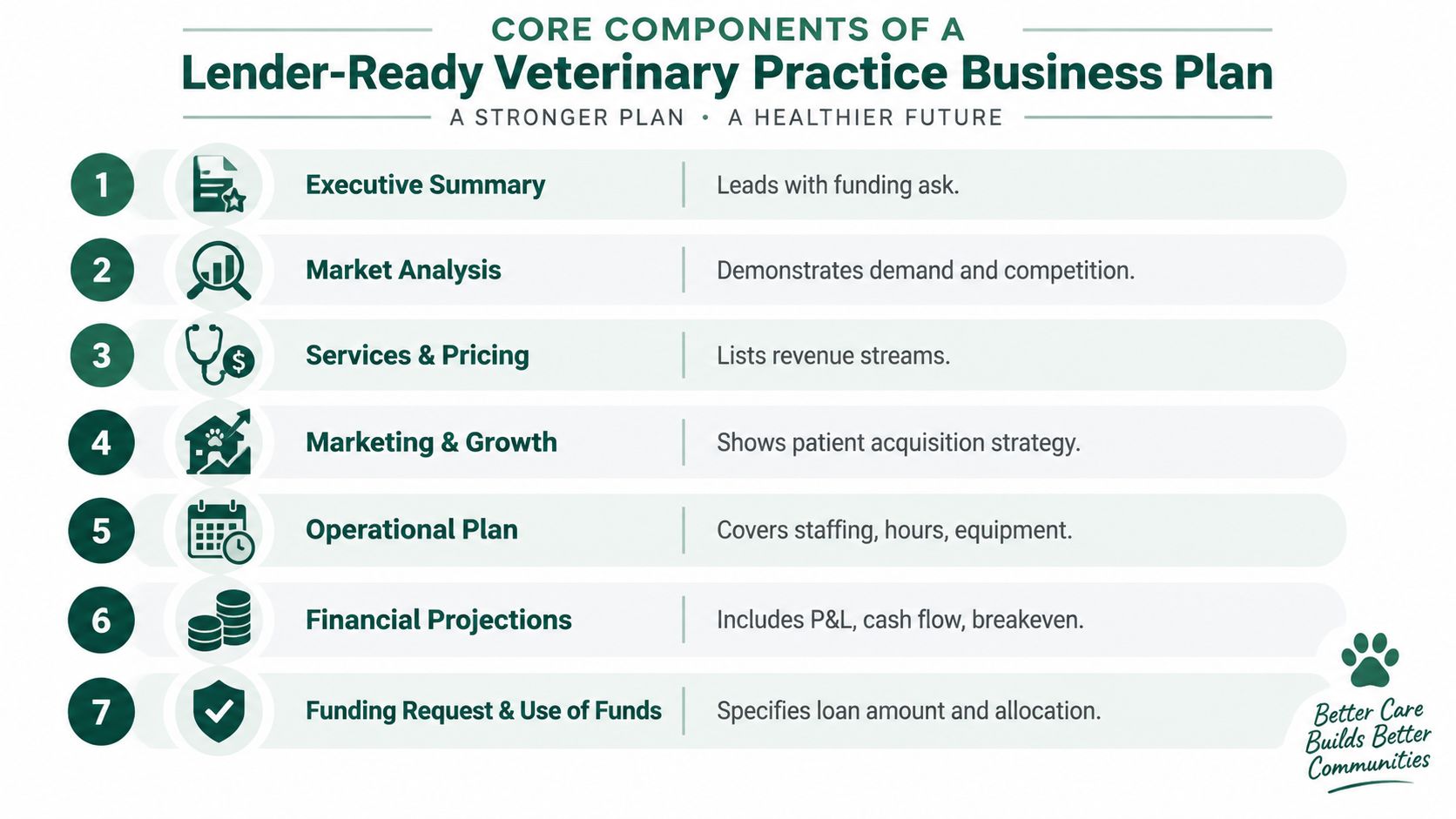
A lender-ready plan answers seven underwriting questions. Treat it as an evidence package, not a personal narrative. Every section must support the financial model, clarify repayment capacity, or reduce a specific lending risk.
Lead with the funding case
Executive summary: State the practice model, funding request, use of funds, ownership, and repayment logic immediately. For an acquisition, summarize the purchase price, historical earnings, proposed financing, and valuation method. Keep your professional biography brief and place the funding case first.
Market analysis: Define the service area, client profile, competitor set, referral relationships, pricing position, and local demand indicators. Explain why the location can support the proposed provider capacity. For a new clinic, show how it will attract initial clients. For an acquisition, identify retention opportunities and geographic or service gaps.
Services and pricing: List wellness care, surgery, dentistry, diagnostics, pharmacy, preventive programs, and planned specialty services. Connect each category to equipment, staffing, pricing, expected volume, collection timing, and margin assumptions. A lender should be able to trace every major revenue line to a service the practice can deliver.
Marketing and growth: Identify referral sources, digital discovery, community outreach, client-retention systems, and launch activities. Separate awareness work from appointment-generation activity. Include the cost and timing of each activity in the financial model, then connect projected appointments to provider capacity.
Operational plan: Describe the facility, hours, appointment capacity, equipment, inventory controls, staffing schedule, software systems, compliance procedures, and owner responsibilities. Assign responsibility for medicine, client service, inventory, payroll, and financial review when the owner is treating patients. Staffing assumptions must match the services and appointment volume in the forecast.
Financial projections: Build monthly income statements, balance sheets, and cash-flow statements for the first year, followed by annual projections for the remaining forecast period. Reconcile the statements and show the path from appointments to receipts, gross margin, operating profit, cash balance, and debt service. Include base and downside assumptions so the lender can assess repayment under pressure.
Funding request and use of funds: Specify the amount requested, owner contribution, equipment and build-out allocation, startup inventory, professional fees, working capital, collateral, and financing structure. Every use belongs in the sources-and-uses schedule and must appear at the correct point in projected cash flow.
Keep the narrative and model synchronized
If the operations plan says the clinic opens with one veterinarian, the forecast cannot assume production from several providers. If marketing begins before opening, pre-opening expenses must appear before receipts. If the practice offers surgery, equipment, staffing, inventory, pricing, and capacity must connect across the plan.
The lender will test debt service coverage using a defined calculation. State the numerator and denominator, apply the lender's required method, and show how coverage changes during the ramp. An unexplained favorable ratio weakens credibility. Transparent assumptions, reconciled statements, and stress-tested repayment capacity carry more weight than decorative precision.
Building a 12-Month Cash Flow Model That Survives Underwriting
Lenders fund repayment capacity, not an annual sales story. Your veterinary practice business plan should begin with a monthly 12-month cash-flow model containing explicit rows for opening balance, receipts, operational outgoings, investment and financing outgoings, net cash flow, and closing balance. The methodology should reconcile monthly totals to annual totals and test the cash equation in every month.
This structure matters because a new veterinary business can take up to about three years to reach profitability. An annual model may show an acceptable long-term result while hiding a cash crisis during the opening period. Payroll, inventory, rent, insurance, loan payments, and build-out costs don't wait for the practice to become mature. The veterinary practice operating profit resource can help frame the distinction between accounting performance and cash available to the business.
Build receipts from operational assumptions
Start with service categories, not a single revenue line. For each category, document expected appointments or procedures, fee assumptions, provider capacity, collection timing, refunds, and any third-party payment delays. Wellness, surgery, dentistry, diagnostics, pharmacy, and emergency services should appear separately when they have different margins or cash patterns.
Then create a ramp that reflects hiring, opening date, appointment availability, referral development, and client acquisition. Don't use a smooth curve merely because spreadsheets prefer smooth curves. A credible forecast may show uneven monthly receipts, marketing-driven changes, seasonal softness, or a delayed provider start.
Separate cash expenses from accounting expenses
Operating outgoings should include payroll, payroll taxes, benefits, rent, utilities, supplies, pharmaceuticals, laboratory fees, insurance, marketing, software, maintenance, professional fees, and taxes as applicable. Investment outgoings should capture equipment, construction, deposits, and other pre-opening expenditures. Financing outgoings should show principal, interest, fees, and equity funding according to their actual timing.
Use a cash reserve measured in months of operating expenses, not as an arbitrary static balance. The model should also identify the point at which cash falls to its minimum and show the specific funding source that protects the practice at that point.
| Category | Month 1 | Month 6 | Month 12 | % of Revenue |
|---|---|---|---|---|
| Opening cash balance | Enter actual opening balance | Link to prior closing balance | Link to prior closing balance | Not applicable |
| Patient and service receipts | Volume and collection assumptions | Updated run rate | Mature-year assumption | Calculate from model |
| Operational outgoings | Pre-opening and launch costs | Staffing and operating run rate | Expected steady-state costs | Calculate from model |
| Investment and financing outgoings | Equipment, build-out, fees, debt service | Scheduled payments | Scheduled payments | Calculate from model |
| Net cash flow | Receipts less total outgoings | Receipts less total outgoings | Receipts less total outgoings | Calculate from model |
| Closing cash balance | Opening balance plus net cash flow | Opening balance plus net cash flow | Opening balance plus net cash flow | Not applicable |
Stress-test before showing the lender
Run at least three cases: base, downside, and severe downside. Reduce receipts, delay the ramp, raise staffing costs, extend equipment delivery, and test slower collections. The objective isn't to make the downside case look comfortable. It's to prove that you know the minimum cash balance, the trigger for corrective action, and the available liquidity.
Compare the first six months primarily against the practice's own prior months. External benchmarks are directional and vary by region and practice model. Monitor payroll as a share of revenue, inventory and cost of goods sold, accounts receivable, monthly net cash flow, and cash runway. One cited industry benchmark places healthy payroll at roughly 40% to 47% of revenue and inventory or COGS at about 20%, as detailed in veterinary practice growth KPI guidance.
Choosing the Right Funding Path for Your Practice Stage
Funding needs change sharply depending on whether you're opening, buying, or expanding. A lender underwrites a startup from evidence of owner capability, market demand, capital adequacy, and forecast discipline. An acquisition has operating history to examine. An expansion should demonstrate that the existing practice can support the added debt and that the new investment has a measurable business purpose.
Startup funding
A startup has no established patient base or historical cash flow. The plan must therefore carry more persuasive evidence around location, service scope, launch timing, staffing, equipment, marketing, and working capital. Lenders will focus on the owner's liquidity, credit profile, management readiness, and the downside model.
Don't present startup financing as a single equipment purchase if the business also needs payroll, inventory, rent, professional fees, deposits, and opening-period liquidity. The sources-and-uses schedule must show the entire capital requirement and the owner's contribution.
Acquisition financing
An acquisition benefits from historical operations, but only if the buyer verifies them. AVMA reported that 42% of veterinarians who identified as owners or associates were owners in 2018, down from 47% in 2008, while 21.3% of all veterinarians identified themselves as practice owners in 2018. A separate AVMA-linked summary reported that corporate consolidators owned 25% of U.S. veterinary practices in 2020, up from 6% in 2016, while 65% remained privately owned. These ownership shifts affect purchase competition, succession planning, talent retention, and exit options. The AVMA findings on practice ownership provide the source context.
Valuation must match quality and risk. Market benchmarks cited for transactions place single-doctor practices around 5x to 8x SDE, platform-grade multi-doctor AAHA-accredited practices with disciplined ProSal economics at 11x to 15x EBITDA, and specialty referral or 24/7 emergency centers at 14x to 22x EBITDA. Treat these as transaction benchmarks, not promises. Purchase price, debt service, retention risk, normalized owner compensation, and capital expenditure needs still require independent diligence.
Expansion financing
Expansion funding is strongest when the existing practice has reliable reporting and a clearly defined use of funds. Show the current location's cash generation, the proposed service line or site, incremental staffing, equipment utilization, marketing requirements, and the point at which new receipts cover added costs.
| Funding Path | Typical Loan Range | Down Payment | Key Lender Requirement | Common Loan Type |
|---|---|---|---|---|
| Startup | Derived from complete sources-and-uses schedule | Based on lender and borrower structure | Market evidence, owner strength, detailed monthly cash flow, adequate liquidity | SBA-style or conventional term financing |
| Acquisition | Based on verified purchase price and repayment capacity | Based on lender and transaction structure | Historical financial diligence, valuation support, transition plan, debt-service analysis | Acquisition term loan |
| Expansion | Based on project scope and incremental cash flow | Based on asset and lender structure | Existing-practice performance, ROI logic, equipment or build-out detail | Equipment financing, term loan, or working-capital facility |
The specific loan structure should fit the asset and risk. Review loan types for veterinary practices before choosing between acquisition, equipment, working-capital, and expansion financing. Don't force a startup-style forecast onto an acquisition, or treat an expansion like an untested de novo clinic.
Assembling Documentation and Preparing for Lender Questions
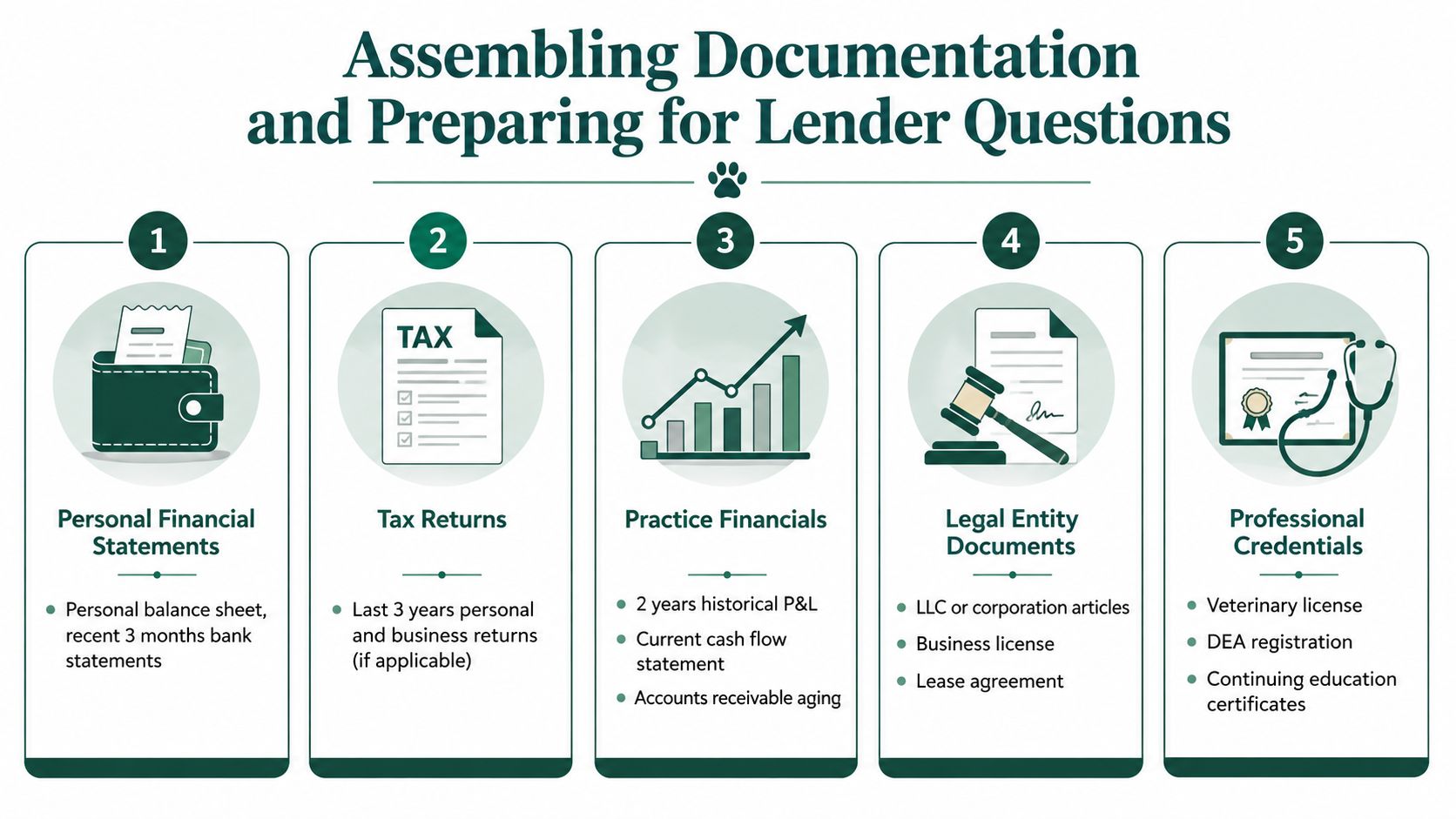
A lender meeting goes better when the documentation answers questions before they're asked. Organize the package into clearly labeled folders, use consistent dates and entity names, and reconcile every figure across the business plan, tax returns, financial statements, and sources-and-uses schedule.
Assemble the core file
- Personal financial statements: Include personal assets, liabilities, liquidity, contingent obligations, and a personal debt schedule.
- Tax returns: Provide requested personal and business returns, with explanations for unusual income, losses, or changes in ownership.
- Practice financials: For an acquisition, prepare at least three years of audited financial statements, tax returns, profit-and-loss reports, and cash-flow analyses, as recommended in the veterinary transaction diligence guidance from the veterinary practice acquisition market resource.
- Legal documents: Include entity formation records, leases, purchase agreements, licenses, insurance, employment agreements, and any real-estate documents.
- Professional credentials: Provide veterinary licenses, controlled-substance and DEA records where applicable, resumes, ownership history, and evidence of management training.
Add doctor production schedules, compensation reconciliation, pharmacy and inventory audits, staff-retention mapping, patient and client file review, and a CPOM-state legal review for acquisitions. The lender needs to know what earnings are transferable and which relationships depend entirely on the seller.
Answer the questions behind the questions
How will you acquire clients? Tie channels to launch dates, budgets, referral relationships, appointment capacity, and conversion assumptions. Avoid saying “strong demand” without showing how demand becomes booked visits.
Why will revenue grow? Break growth into provider capacity, operating hours, service mix, pricing, retention, and new-client acquisition. If one assumption drives most of the increase, identify it and stress-test it.
What happens if an associate leaves? Show coverage options, recruitment timing, compensation structure, appointment capacity, and the cash effect of replacing that provider.
Why is this purchase price reasonable? Reconcile normalized earnings, owner compensation, capital expenditures, client retention, staffing, and the relevant valuation benchmark.
What protects repayment? Walk through the monthly cash model, minimum closing balance, reserve, collateral, owner equity, and corrective actions. Bring your accountant or practice advisor when the questions involve normalization, tax treatment, or valuation.
Lead the meeting with the funding request and repayment case. Use the narrative to explain the assumptions, then let the schedules prove that the assumptions reconcile.
Common Financial Mistakes That Sink Veterinary Practice Plans
A lender sees the weakness in a forecast when the first slow month turns profitable only on paper. Build the model around staffing, appointment capacity, payment timing, and corrective actions. A credible plan shows how the practice protects cash when results miss the base case.
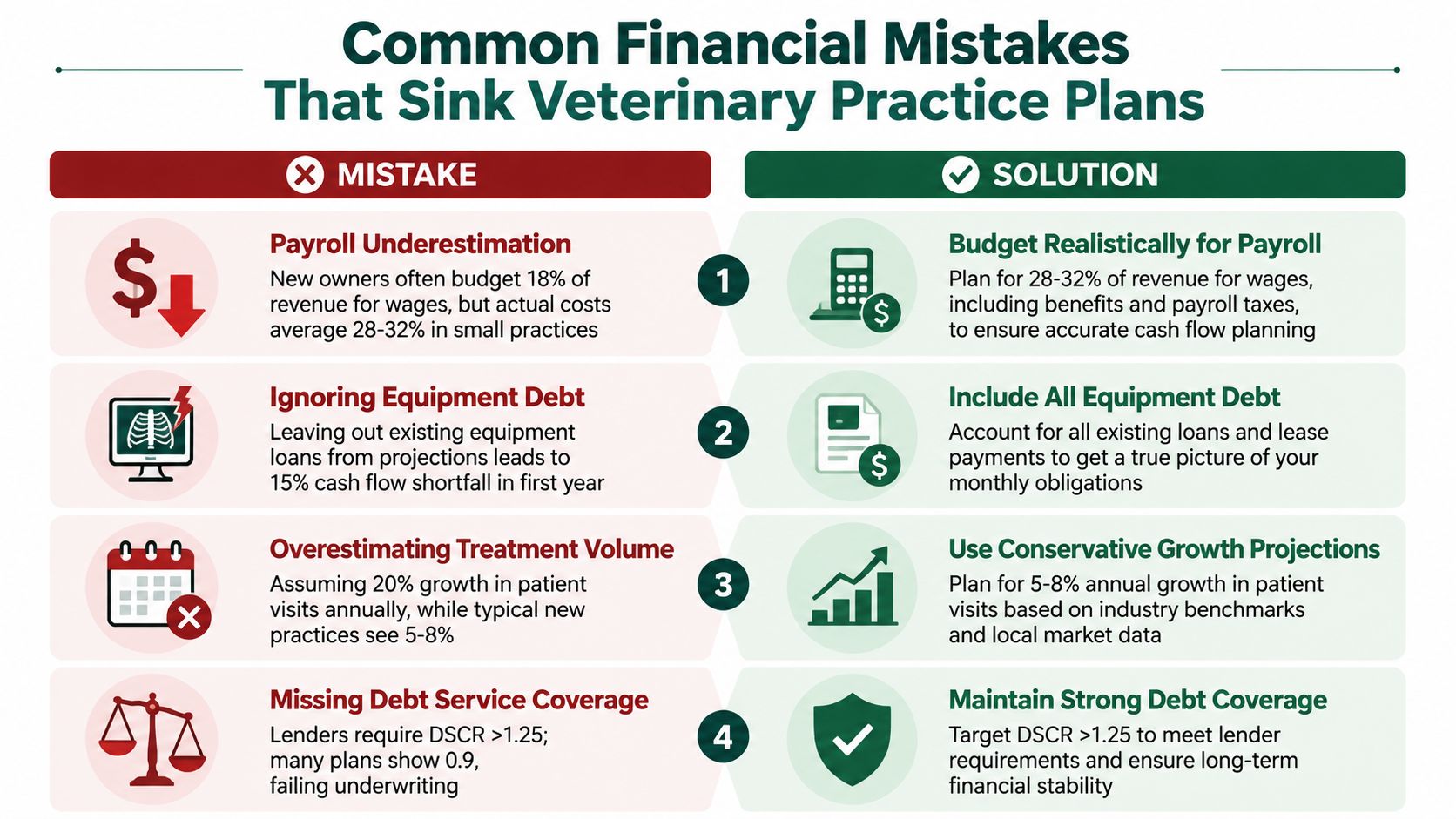
Four corrections that improve credibility
- Underestimating payroll: Set the staffing schedule before projecting profit. Include veterinarian compensation, technician coverage, client service, benefits, payroll taxes, recruiting, and planned vacancies. Payroll commonly falls around 40% to 47% of revenue in a healthy practice. If your assumption differs materially, explain the staffing model, service mix, or operating hours that support it. See this veterinary practice KPI guidance.
- Ignoring ownership competition: A clinic cannot claim an uncontested market while corporate ownership expands. Map local competitors, ownership, services, recruiting conditions, and pricing signals. Then state the specific reason clients and employees will choose your practice. General market information can frame the question, but local evidence must support the forecast.
- Drawing a hockey-stick revenue curve: A sudden increase unsupported by appointments, providers, hours, pricing, and marketing spending will weaken underwriting confidence. Tie monthly receipts to those operating drivers, then add a delayed-ramp case that shows the effect on cash and debt service.
- Leaving cash timing out of the plan: Profit does not pay bills before receipts arrive. Show monthly opening and closing balances, inventory purchases, payroll dates, debt payments, deposits, equipment timing, and a reserve measured in months of operating expenses.
The same standard applies to acquisitions. Seller earnings do not transfer automatically. Verify production, compensation, inventory, controlled substances, records, leases, staff stability, and client retention before setting debt size. Stress-test the model for slower retention, provider turnover, and delayed collections, then document the cash actions management will take.
Your Action Plan From Draft to Funded Practice
Treat the funding process as a sequence of gates, not a single writing assignment.
- Weeks 1 to 3, research: Define the practice scope, map competitors and demand, confirm the location, and collect personal and practice records.
- Weeks 4 to 8, modeling: Build the monthly cash flow, three-year financial statements, sources-and-uses schedule, debt assumptions, and downside cases. Don't contact lenders until the model reconciles.
- Weeks 9 to 12, submission: Review the package with an accountant or advisor, resolve inconsistencies, prepare concise answers, submit to appropriate lenders, and respond quickly to follow-up questions.
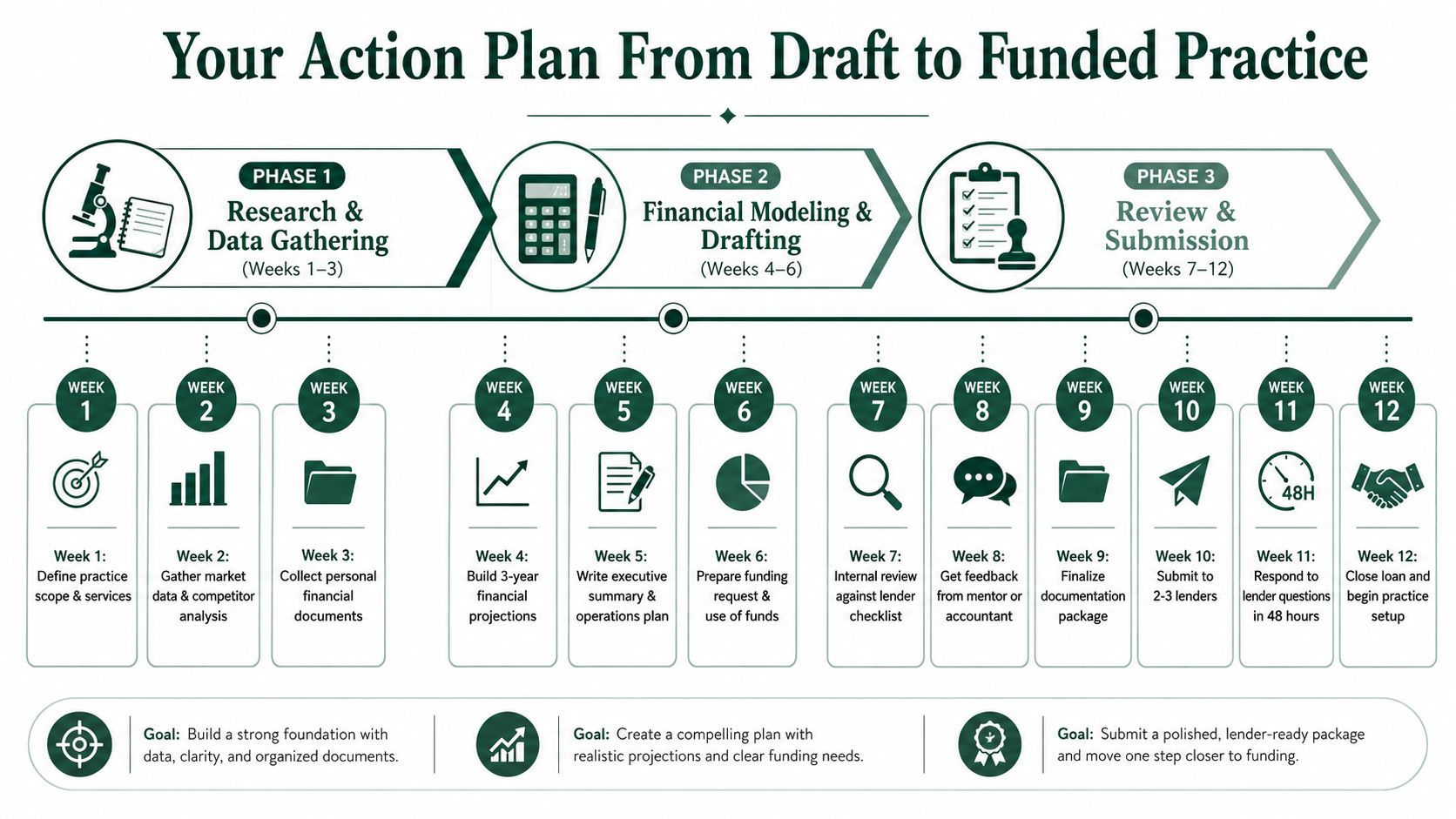
Use a go or no-go test before submission: every funding use is documented, every projection ties to an operating assumption, the minimum cash balance remains explainable, debt service is tested under downside conditions, and the narrative matches the numbers. Startups need proof of demand and liquidity. Acquisitions need verified earnings and transition planning. Expansions need incremental ROI and existing-practice support.
Veterinary Practice Loans helps veterinarians evaluate financing for acquisitions, startups, equipment, working capital, and expansion projects. Visit Veterinary Practice Loans with your draft cash-flow model and funding schedule to discuss a structure aligned with your practice stage and underwriting needs.
