

A referral comes in for advanced imaging. The surgical team needs a more capable monitoring system. The laboratory analyzer is slowing down appointments, and the practice's cash reserve is already committed to payroll, medications, inventory, and routine repairs. Paying cash may keep the clinic debt-free, but it can also leave the owner with too little room to handle an ordinary difficult month.
That's why the better question usually isn't whether to finance equipment. It's how to finance equipment without making the practice fragile. The right structure connects repayment to the asset's useful life, clinical utilization, resale value, and replacement cycle. A low monthly payment can still be a poor decision if the clinic is paying for obsolete technology after it needs to be replaced.
Introduction to Financing Veterinary Equipment Without Draining Cash
A veterinary practice depends on productive assets. Imaging systems, surgical tables, anesthesia equipment, dental units, laboratory analyzers, computers, and practice-management infrastructure all support patient care and revenue generation. Yet many of these purchases require a substantial upfront commitment, particularly when several departments need upgrades at the same time.
Financing lets the clinic preserve working capital while putting the equipment into service. The broader equipment finance market reached an estimated $1.34 trillion in 2023, with 7.1% nominal growth compared with 2022, according to equipment finance market data. That estimate was based on approximately $2.3 trillion in total equipment and software investment, of which roughly 57.7% was financed, or 64.2% in the private sector. The same source reports that 82% of end-users used some form of financing to acquire equipment and software.
For a clinic owner, the practical lesson is simple. Financing isn't an unusual workaround reserved for practices that can't afford equipment. It's a standard capital-allocation tool that helps businesses keep cash available for the work the equipment is supposed to support.
Practical rule: Borrow for an asset that improves capacity, quality, efficiency, or revenue. Don't borrow merely because the monthly payment looks comfortable.
A historical U.S. benchmark shows how financing has become embedded in equipment purchases. A 2015 equipment finance market study estimated that 68% of equipment and software investment was acquired through financing, compared with 55% in an earlier 2011 estimate. The same study put total equipment and software investment at $1.5 trillion and estimated the financed portion at about $1.02 trillion.
The veterinary application is more important than the market headline. A clinic should match repayment with the period during which the equipment can reasonably produce value. A long-life surgical asset may support a conventional loan. Rapidly changing imaging or information technology may call for a lease, rental, or shorter repayment period with a clear upgrade or return option.
This guide focuses on that decision. You'll see how to assess the need, compare structures, calculate total cost, prepare an application, and avoid the mistake of choosing a loan solely because it has the smallest monthly obligation.
Evaluating What Your Practice Actually Needs Before You Borrow
Before speaking with a lender, define the business case for the equipment. The lender will evaluate credit, cash flow, and collateral, but the owner has to answer a more basic question: what problem will this purchase solve, and how often will the practice use it?
Start with the clinical demand. Review appointment patterns, referral activity, procedure volume, and the delays caused by current equipment. Ask the veterinarians which cases are being referred elsewhere or postponed. Ask technicians where manual work, repeated setup, or unreliable equipment consumes time. Ask the practice manager whether the proposed purchase will reduce outsourcing, increase appointment capacity, or shorten turnaround time.
Separate essential capacity from attractive technology
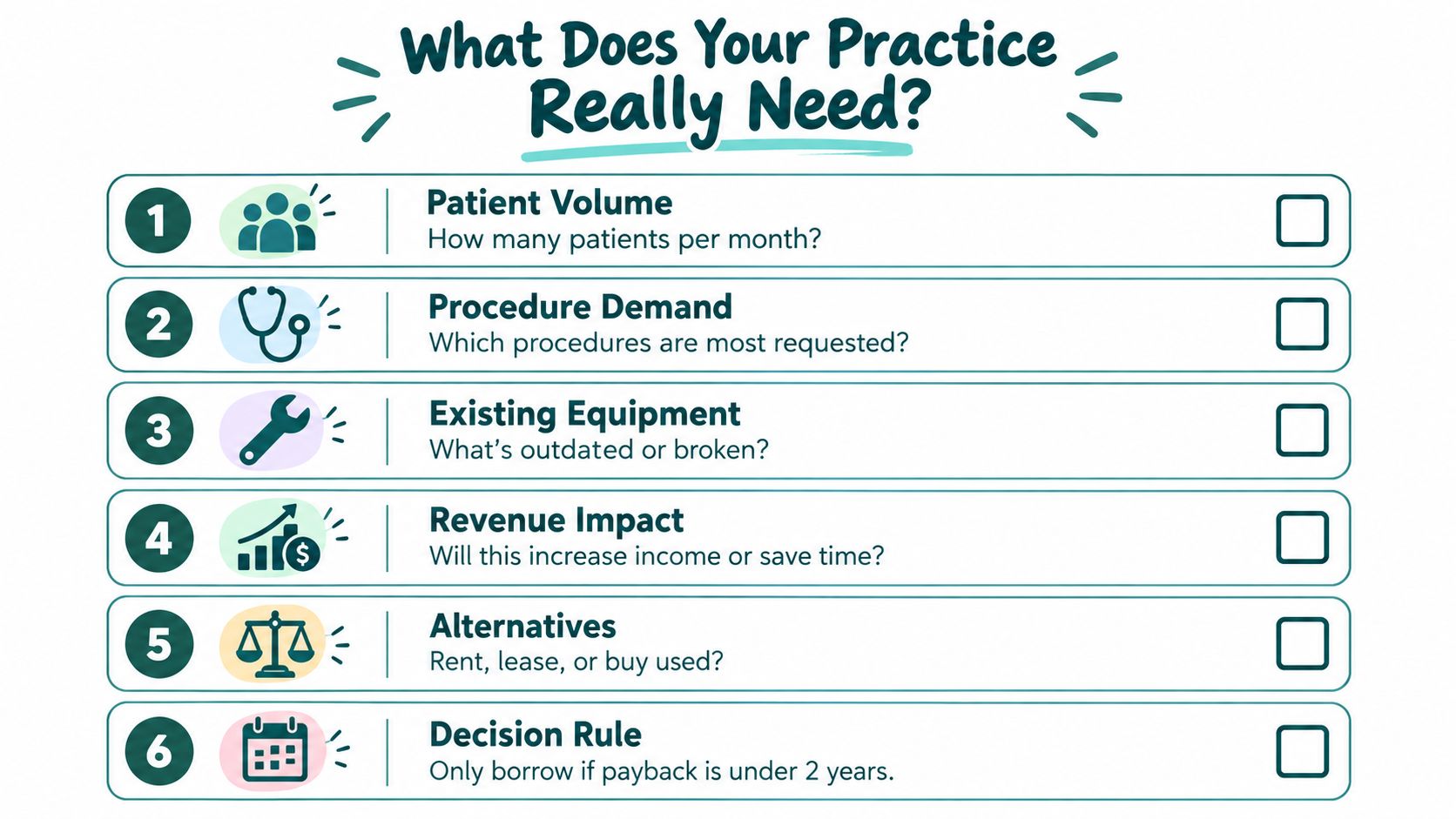
A useful assessment considers six areas:
Patient volume: Estimate how many patients could use the equipment during a normal operating period. A high-capability system may be difficult to justify if utilization will remain occasional.
Procedure demand: Identify the procedures that generate consistent demand, not just the cases the team hopes to add. A piece of equipment should have a credible place in the appointment book.
Existing equipment: Document what's outdated, unreliable, slow, or no longer supported. Replacement need can justify financing more strongly than a general desire to modernize.
Revenue and efficiency impact: Consider whether the asset adds billable services, keeps cases in-house, reduces outsourcing, saves staff time, or improves scheduling. Use conservative assumptions rather than the vendor's most optimistic forecast.
Alternatives: Compare buying new with buying used, renting, leasing, sharing access, or waiting. An alternative may preserve flexibility when technology changes quickly.
Decision rule: Require a clear reason to proceed. For example, the practice might approve borrowing only when expected cash contribution and operational value support a sensible repayment plan.
Estimate useful life and obsolescence risk
Useful life isn't the same as the period before a machine breaks. It's the period during which the equipment remains clinically appropriate, supported, interoperable, and economically useful. A surgical table may remain productive for many years, while a technology-heavy system may lose practical value sooner because software, connectivity, or diagnostic capabilities change.
Ask the vendor about upgrade paths, service availability, consumables, warranties, trade-in policies, and end-of-term choices. Ask the lender what happens if the equipment is replaced before the balance is paid. If the answer involves a large payoff, an unplanned refinance, or an uncertain resale process, that risk belongs in the decision.
Build the cash-flow case before the loan application
Create a simple forecast that includes expected additional revenue, avoided outside costs, staff time, maintenance, supplies, training, insurance, and downtime. Don't count the same benefit twice. If faster diagnostics create more appointments, separate that effect from the savings created by keeping cases in-house.
A lender quote should come after this work, not before it. Financing can make a necessary purchase manageable, but it can't turn low utilization into a sound investment.
Comparing Equipment Financing Options for Veterinary Clinics
Veterinary owners usually choose among four broad structures: an equipment loan, a lease or rental, vendor financing, and an SBA-style loan. Each can work. The right choice depends on ownership goals, technology risk, cash-flow timing, collateral, and the likely exit from the agreement.
| Financing Option | Best For | Ownership and End of Term | Key Trade Off |
|---|---|---|---|
| Equipment loan | Long-life assets with predictable use and resale value | The practice generally owns the equipment after repayment | Ownership and equity come with fixed obligations and replacement risk |
| Lease or rental | Technology that may need frequent replacement or flexible access | The lender or lessor may retain ownership, with return, renewal, or purchase choices depending on the contract | Flexibility can cost more over time, and end-of-term language matters |
| Vendor financing | A clearly specified purchase where convenience and bundled terms matter | Ownership depends on whether the arrangement is a loan, installment sale, or lease | Easy coordination may limit comparison with other financing offers |
| SBA-style loan | Larger projects where equipment is part of a broader startup, acquisition, or expansion plan | The practice may own the equipment, subject to the loan structure and collateral requirements | Longer repayment can improve cash flow while increasing total financing cost |
Equipment loans
A traditional equipment loan is often the cleanest fit for durable assets with a stable clinical role. The equipment commonly serves as collateral, and the practice builds ownership as it repays the balance. This structure can suit surgical infrastructure, dental equipment, or other assets expected to remain useful through the repayment period.
The danger is extending the term beyond the equipment's economic life. A lower payment won't help if the practice must replace the asset while still making payments on the old one.
Leases and rentals
Leasing and rental models become more attractive when obsolescence is difficult to predict. They can make it easier to upgrade, return, or replace equipment, depending on the contract. That flexibility is valuable for rapidly evolving imaging, software-dependent systems, and equipment where resale value is uncertain.
Read the end-of-term provisions carefully. Confirm who owns the asset, whether there's a purchase option, how early termination works, and what condition requirements apply at return.
Vendor financing and SBA-style structures
Vendor financing can simplify the transaction because the equipment quote and financing process may be coordinated. Convenience shouldn't replace comparison. Review the cash price, financed price, fees, service obligations, warranties, and prepayment terms separately.
An SBA-style structure may make sense when equipment is part of a larger financing need, such as a startup, acquisition, build-out, or expansion. It may provide broader borrowing capacity, but the owner should compare total cost and collateral requirements rather than focusing only on the payment.
For a broader explanation of structures used by veterinary practices, review this guide to equipment financing and leasing for veterinary clinics.
Calculating Affordability and Total Cost the Smart Way
A new dental unit can generate revenue quickly, yet its payment may collide with payroll, inventory, taxes, repairs, or a slow month. Set affordability from the clinic's normal cash generation, then test the same payment against a weaker operating period. Lender approval is a financing decision, not proof that the purchase fits your cash flow.
Use four checks before signing:
- Operating cash flow: Calculate cash remaining after ordinary expenses, owner compensation, taxes, and required working capital.
- New debt service: Add the proposed principal and interest payment to existing obligations drawing from the same cash.
- Ownership costs: Budget for maintenance, service contracts, consumables, training, insurance, software, installation, and downtime.
- Replacement exposure: Estimate whether the technology could require an upgrade before the loan balance is cleared.
Equipment financing may support up to 100% of equipment cost, with the equipment serving as collateral. The same equipment financing benchmarks place overall approval rates in early 2026 around 76.8%, with small-ticket approval rates around 80.9%. Those figures describe underwriting outcomes. They do not show whether your clinic can absorb the payment during a difficult quarter.
Compare the full cost, not only the payment
Calculate the complete obligation:
Total financing cost = down payment + scheduled payments + origination fees + documentation fees + required services + expected end-of-term costs
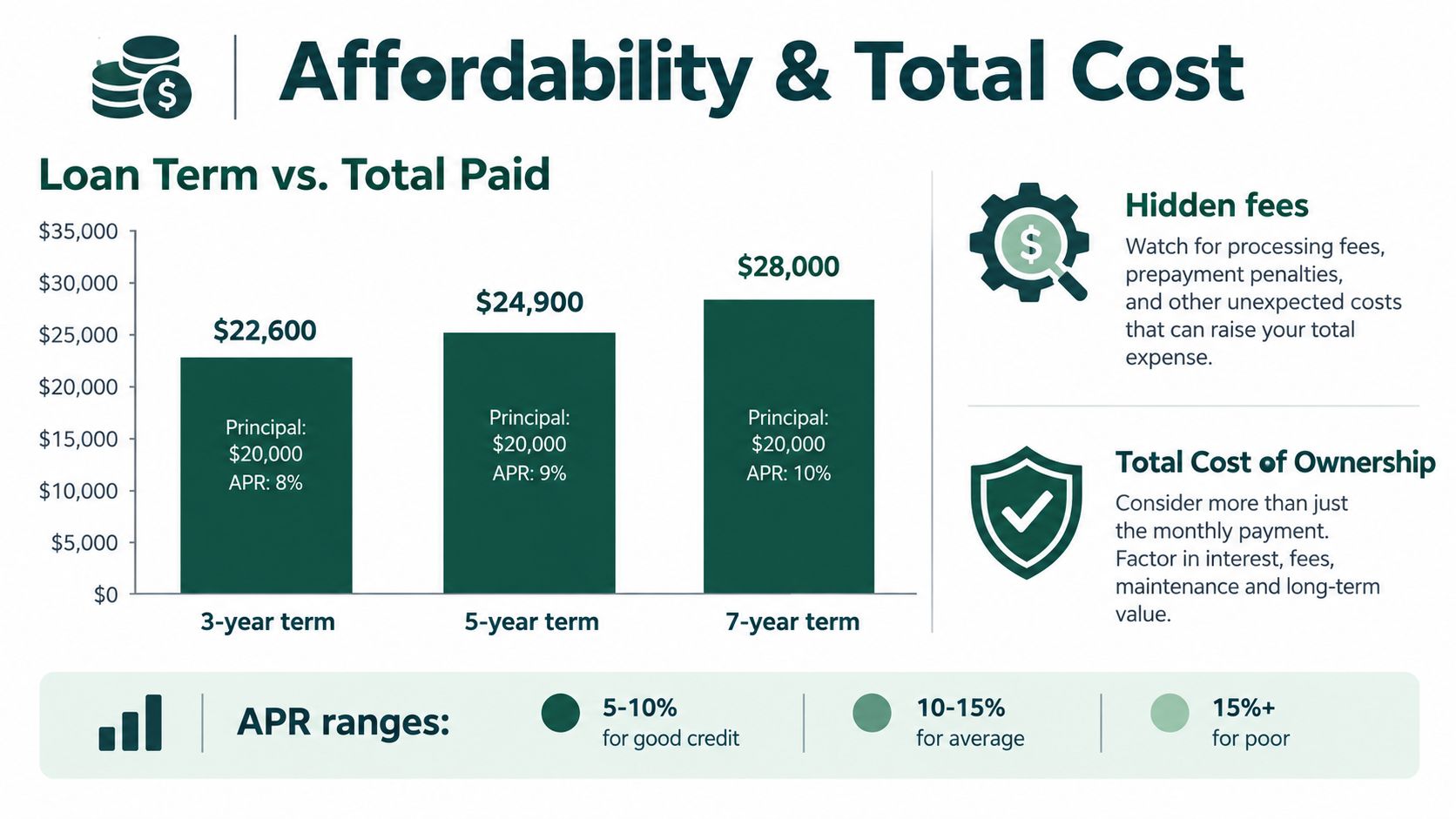
Compare that result with the cash price and other available structures. A longer term can reduce the monthly payment while increasing interest and leaving the practice responsible for an aging asset after its strongest production years.
The supplied visual shows this trade-off for a $20,000 principal example. Total paid cost reaches $22,600 on a three-year term at 8% APR, $24,900 on a five-year term at 9% APR, and $28,000 on a seven-year term at 10% APR. These figures illustrate the structure only. They are not a quote for a veterinary transaction.
Match the term to the asset
Start with useful life, expected utilization, resale value, and the likely upgrade cycle. A high-use imaging system may support a faster payoff, while software-dependent technology with uncertain resale value may require a different structure. The repayment schedule should reflect the period in which the equipment is likely to produce dependable cash.
Before comparing APRs, review current equipment financing rates so the term and structure discussion starts from realistic pricing. Lenders generally review borrower credit, debt service against business cash flow, and recovery value. Collateral can limit the lender's loss, but it does not protect the clinic from an obsolete asset.
Strong-credit borrowers may see bank equipment loan pricing around 6.5% to 9.5% APR in 2026. SBA-style equipment financing commonly prices higher and may offer longer terms. Specialized or used equipment, weaker credit, and thin resale markets can push APRs into the 11.5% to 16% range or higher, based on business loan default and equipment finance data.
A workable payment still needs room for maintenance, downtime, hiring, and the next capital requirement. If utilization must stay perfect for the loan to work, the structure is too tight.
Preparing Documents and Applying With Confidence
A well-organized application helps the lender understand the practice without repeated follow-up. Prepare the financial story before submitting anything. The goal isn't to bury the lender in files. It's to connect the clinic's revenue, deposits, operating obligations, and equipment purpose in a clear sequence.
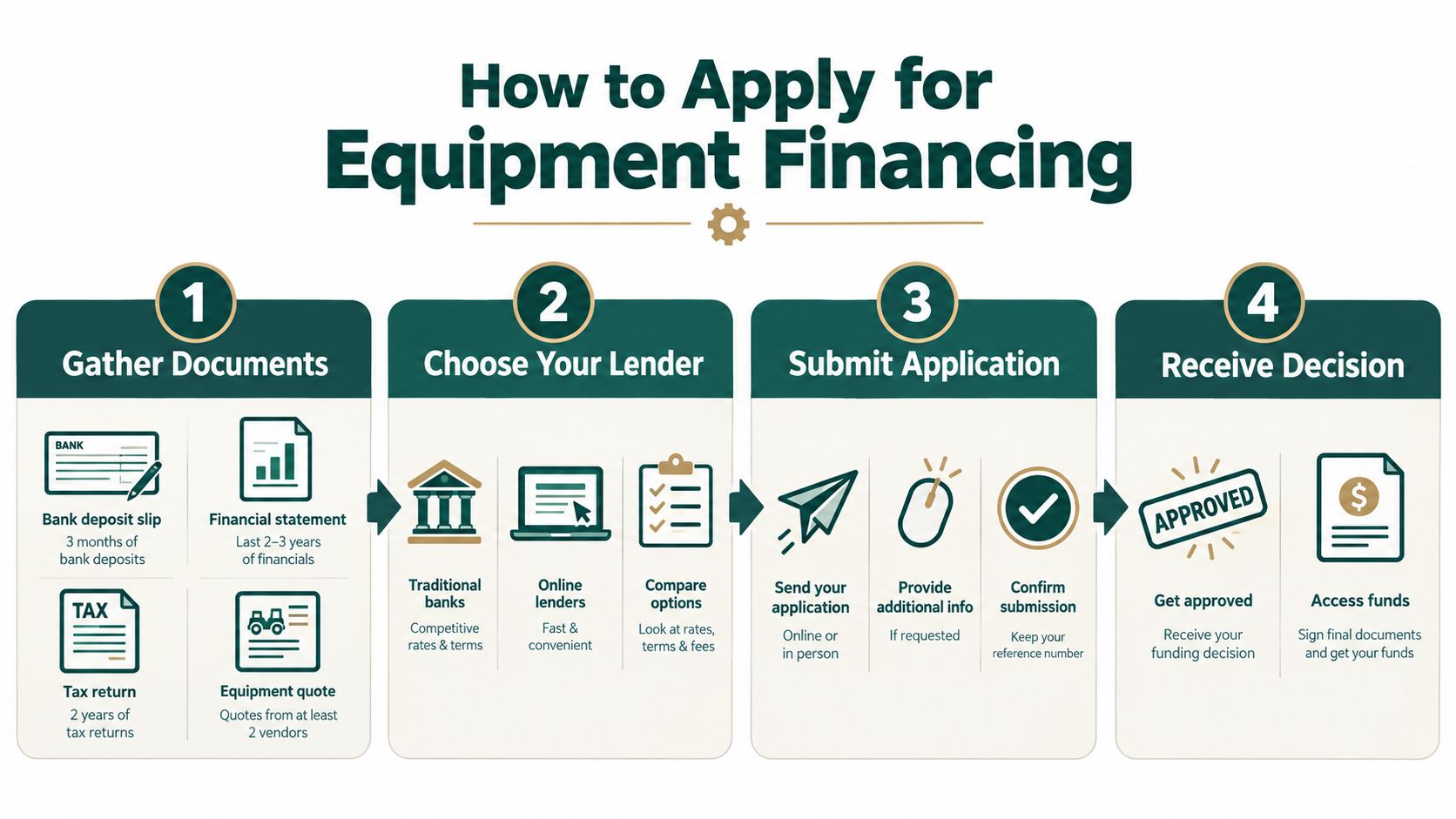
Gather the core file
Most equipment applications will ask for some combination of:
- Business financial statements: Provide current income statements, balance sheets, and a cash-flow view that reflects the clinic's actual operations.
- Tax returns: Have the requested business and personal returns available, especially when the owner's personal guarantee or credit history forms part of the review.
- Bank activity: Organize recent business bank statements or deposit records so the lender can see actual cash movement, not only reported revenue.
- Equipment documentation: Obtain a detailed quote or invoice identifying the equipment, configuration, installation, training, warranty, and any related services.
- Business projections: Explain expected utilization, new procedures, staffing needs, pricing assumptions, and how the purchase fits the practice plan.
- Ownership and credit information: Keep identification, entity documents, ownership details, and explanations for unusual credit or cash-flow items ready.
Choose the lender channel deliberately
The lender most familiar with your checking account isn't automatically the best fit for a specialized veterinary asset. Banks may offer competitive pricing for strong borrowers and conventional equipment, while specialty and non-bank lenders may be more flexible with used equipment, unusual collateral, newer practices, or industry-specific cash-flow patterns.
Recent market data show U.S. equipment finance new business volume reached a record $11.6 billion in January 2026, while approval rates fell to 76.8% and bank volume dropped 11.7% month over month, according to January 2026 equipment finance activity. The practical takeaway is to compare lender channels based on asset type, practice profile, documentation standards, and total cost, rather than assuming one category will approve every application.
A veterinary-focused financing provider may evaluate clinic revenue, deposits, and cash flow alongside credit history. Veterinary Practice Loans offers equipment financing for imaging, surgical, laboratory, and information technology equipment, along with other practice financing options. That can be relevant when the purchase is part of a larger ownership or expansion plan rather than an isolated invoice.
Compare offers line by line
Request written terms and place them in a side-by-side worksheet. Include interest rate or APR, term, payment frequency, down payment, origination charges, prepayment conditions, collateral, personal guarantees, insurance requirements, and end-of-term obligations.
Use the veterinary equipment financing requirements as a preparation reference, then ask each lender what remains outstanding. When criteria are met and documentation is complete, decisions may be available as fast as within 24 hours, but speed shouldn't replace diligence. A quick approval for an unsuitable structure is still an expensive mistake.
Making the Right Choice and Avoiding Costly Mistakes
The strongest equipment financing decision follows the asset, not the advertised payment. Start by identifying the clinical problem, confirming realistic utilization, and estimating the period during which the equipment will remain productive. Then choose a structure that gives the practice an appropriate ownership position and a manageable exit if technology changes.
Replacement risk deserves special attention. Current industry commentary describes a shift toward shorter-term leases, rentals, and value-added services, with replacement demand becoming the main driver of equipment investment in 2026, according to equipment finance trends for 2026. For veterinary owners, that means a technology purchase needs an upgrade plan before the first payment is due.
Use this decision filter
- Buy with a loan when the equipment has durable clinical value, predictable utilization, and reasonable resale support.
- Lease or rent when rapid obsolescence, upgrade frequency, or uncertain utilization creates meaningful ownership risk.
- Use vendor financing only after comparing the financed price and contract terms with independent offers.
- Consider an SBA-style structure when equipment is part of a broader startup, acquisition, build-out, or expansion project.
- Reject the purchase when the business case depends on perfect scheduling, optimistic pricing, or a payment that leaves no operating cushion.
Avoid financing terms that continue well beyond the asset's useful economic life. Don't overlook service contracts, software, consumables, installation, training, or downtime. Don't assume a used asset is cheaper in practice until you've checked support, parts availability, calibration, and resale demand.
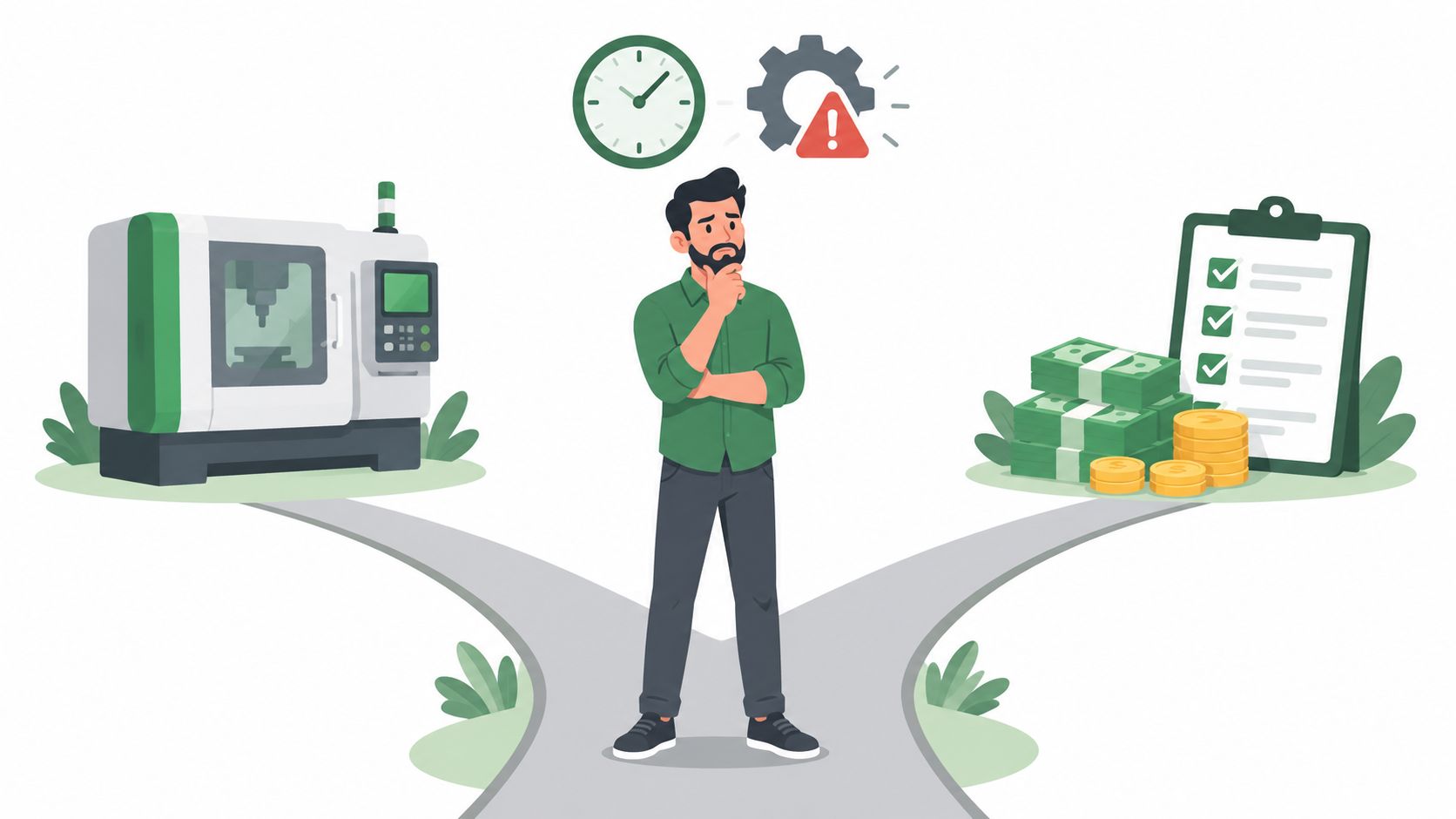
The final test is resilience. After the payment, can the practice still fund payroll, inventory, repairs, taxes, and ordinary surprises? If the answer is uncertain, redesign the purchase or the financing structure before committing. A sound agreement should help the clinic use productive equipment without forcing the owner to sacrifice the liquidity that keeps the practice stable.
Veterinary Practice Loans can help you evaluate equipment financing alongside working capital, acquisition, startup, or expansion needs, with terms discussed in plain English and aligned to clinic cash flow. Visit Veterinary Practice Loans to start a conversation about the equipment, repayment structure, and documentation your practice needs.
