
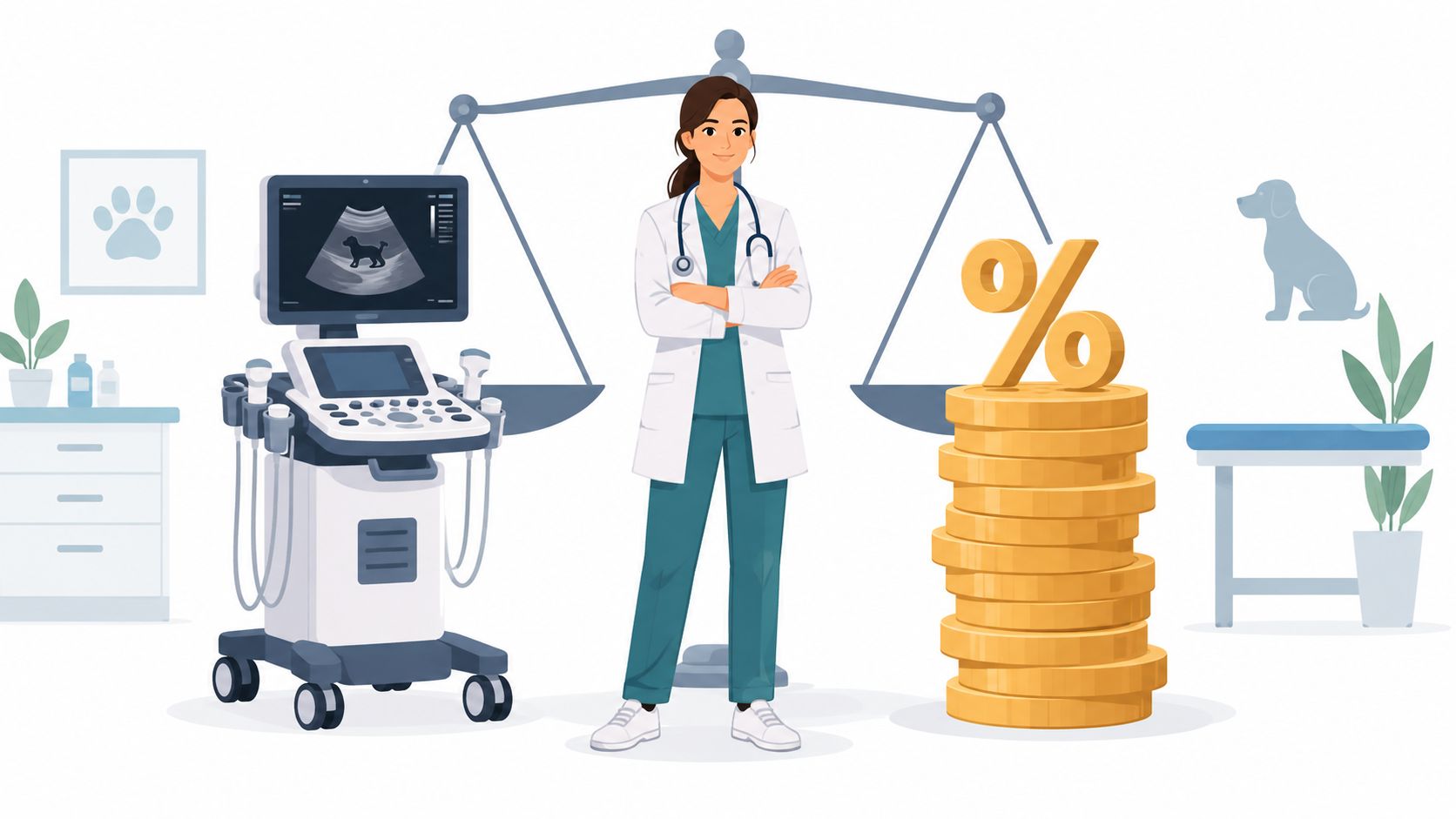
Strong-credit borrowers using banks or credit unions are commonly seeing about 6% to 12% APR in 2026, SBA-backed equipment financing is often around 9% to 12% APR, and online or alternative lenders can run roughly 12% to 30%+ APR. That spread is the whole story. Equipment financing rates aren't one market number. They change sharply based on lender type, credit quality, and whether you use a loan, lease, SBA structure, or captive financing.
You're probably in the middle of a familiar decision. A vendor just quoted digital X-ray, ultrasound, lab analyzers, or surgical equipment. The equipment makes sense clinically, but the financing proposal looks murky. The monthly payment seems manageable, the rate looks “competitive,” and the paperwork skips past the details that drive total cost.
That's where practice owners get trapped.
A veterinary clinic doesn't buy equipment in a vacuum. You're balancing payroll, drug inventory, build-out costs, and uneven monthly collections. If you choose the wrong structure, you can overpay for a perfectly good machine, or lock yourself into a payment schedule that strains the practice for no operational benefit.
Introduction to Equipment Financing Rates for Veterinary Practices
A solo owner replacing an aging digital radiography unit faces a different financing decision than a multi-doctor hospital adding a second in-house lab line. Both are buying equipment. Neither should accept the first quoted rate at face value.
Published 2026 market guides place qualified borrowers near 7% to 15% APR on average, with some sources putting the center of gravity around 8% to 12% APR for established businesses with mid-to-strong credit, according to 2026 equipment financing rate guides. That sounds tidy. It isn't. The same practice can receive meaningfully different offers depending on the lender channel and the structure chosen.
Here's the first decision filter I use with veterinary owners:
| Situation | Usually the smarter first look |
|---|---|
| Buying long-life imaging or fixed clinical equipment | Bank or credit union loan |
| Need long amortization and lower monthly debt service | SBA-backed financing |
| Need speed and can tolerate higher cost | Online or alternative lender |
| Equipment may become outdated before it wears out | Lease |
| Manufacturer is offering subsidized pricing | Captive promotion |
Headline APR matters, but total cost of capital matters more. A lease with a lower payment can still cost more than a loan if the residual or end-of-term buyout is unfavorable. A higher-rate structure can still be the right call if it protects working capital during a renovation or growth push.
What practice owners should focus on first
Before you talk to any lender, answer these questions:
- How long will you realistically keep the equipment? A radiography suite and a surgical table don't age the same way.
- How easy is it for a lender to resell it? Specialized veterinary devices often price differently than more liquid general-purpose assets.
- Do you want ownership at the end? If yes, some leases become more expensive than they first appear.
- Is your priority lowest total cost, lowest monthly payment, or fastest funding? You only get to optimize one of those cleanly.
The most expensive financing mistake in veterinary equipment isn't always taking a high APR. It's choosing the wrong structure for the asset's useful life.
How Equipment Financing Rates Work and What They Include
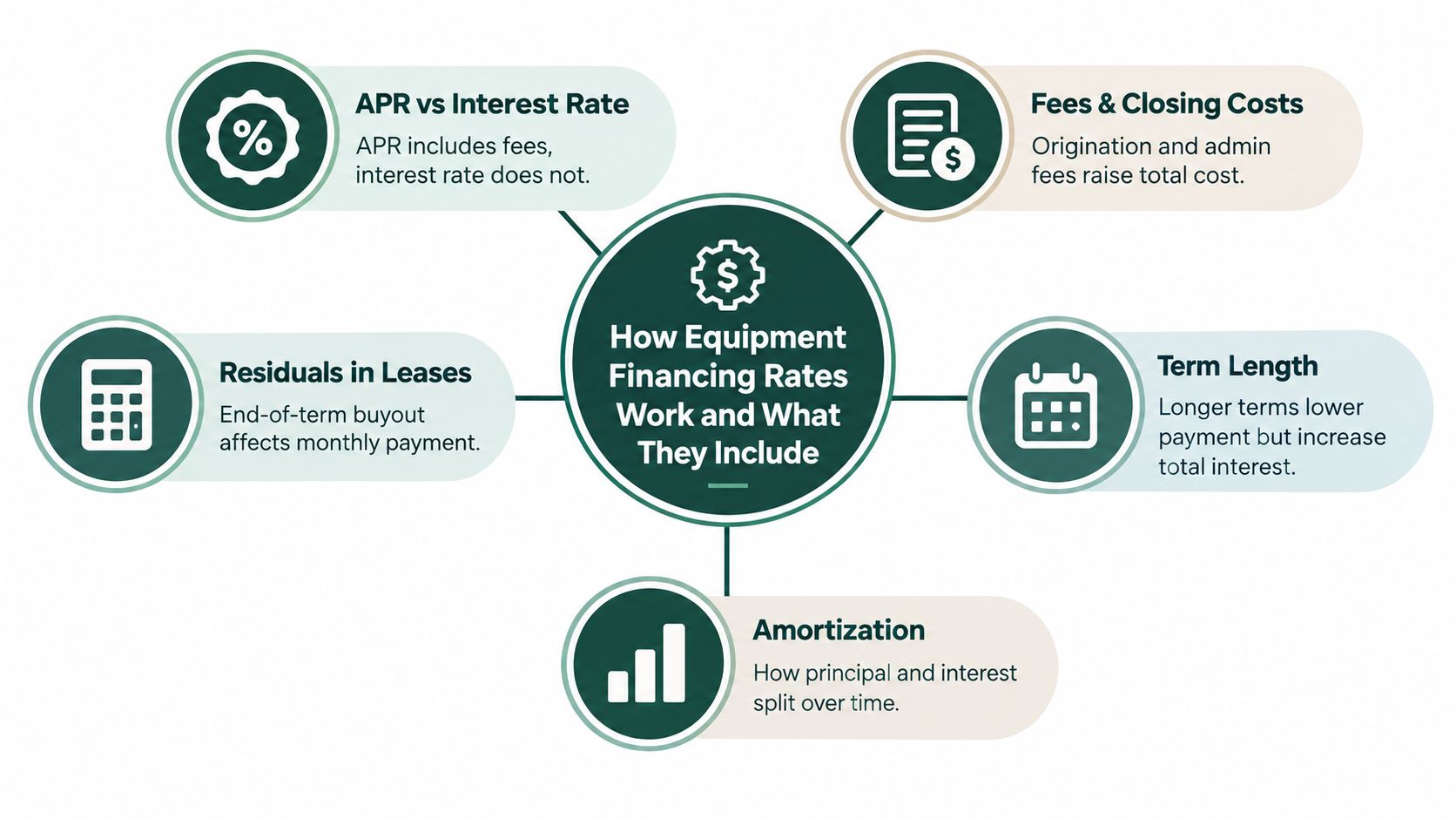
APR is only part of the cost. Practice owners who compare offers by monthly payment alone usually miss the economics.
APR isn't the same as the note rate
The interest rate tells you what's charged on the principal. APR is broader. It folds in certain fees and gives a better read on borrowing cost over a year. If a lender quotes a low note rate but layers in origination or documentation charges, the offer may be less attractive than it first appears.
That matters in veterinary equipment because many purchases happen under time pressure. A practice replacing failed anesthesia monitors or a lab analyzer often focuses on speed and payment size. Lenders know that. Some quotes are designed to look cheap monthly while burying cost elsewhere.
Leases change the math
A loan is straightforward. You borrow, you amortize, you own the equipment when the obligation ends.
A lease adds more moving parts:
- Residual value: A lower monthly payment often means a larger end-of-term buyout or less favorable ownership economics.
- Usage horizon: If you expect to replace the asset before the end of its full useful life, leasing can make sense.
- Ownership outcome: Some leases are good fit structures for technology turnover. Others are expensive paths to ownership.
For a veterinary clinic, that distinction matters most with equipment that can become outdated before it physically wears out, such as imaging systems or certain diagnostic platforms.
Term length changes affordability and total cost
Longer amortization reduces the monthly payment. It also usually increases total interest paid over time. Shorter amortization can reduce total financing cost, but only if the payment doesn't squeeze operations.
Use this rule:
- Match the term to the equipment's practical use inside your clinic.
- Don't finance obsolete-prone technology on an overly long schedule just to chase a lower payment.
- Don't force a very short term on foundational equipment if it weakens cash reserves you need elsewhere.
Practical rule: If the machine will produce value for years and hold resale value, financing it longer can be sensible. If it may need replacement sooner, stretching repayment too far usually backfires.
Lenders underwrite you and the asset
Veterinary owners sometimes assume their personal or business credit is the only thing that matters. It doesn't.
Lenders also assess:
- Asset type
- Asset age
- Expected useful life
- Secondary market resale value
- How specialized the equipment is
That's why two clinics with similar credit can get different offers on different machines. A lender is pricing both repayment risk and liquidation risk.
What Determines Your Rate From Credit to Asset Life
A two-doctor animal hospital can buy an ultrasound and a surgical laser in the same quarter, with similar revenue and similar credit, and still get two very different offers. The reason is simple. Lenders price the borrower, the equipment, and the exit path if something goes wrong.
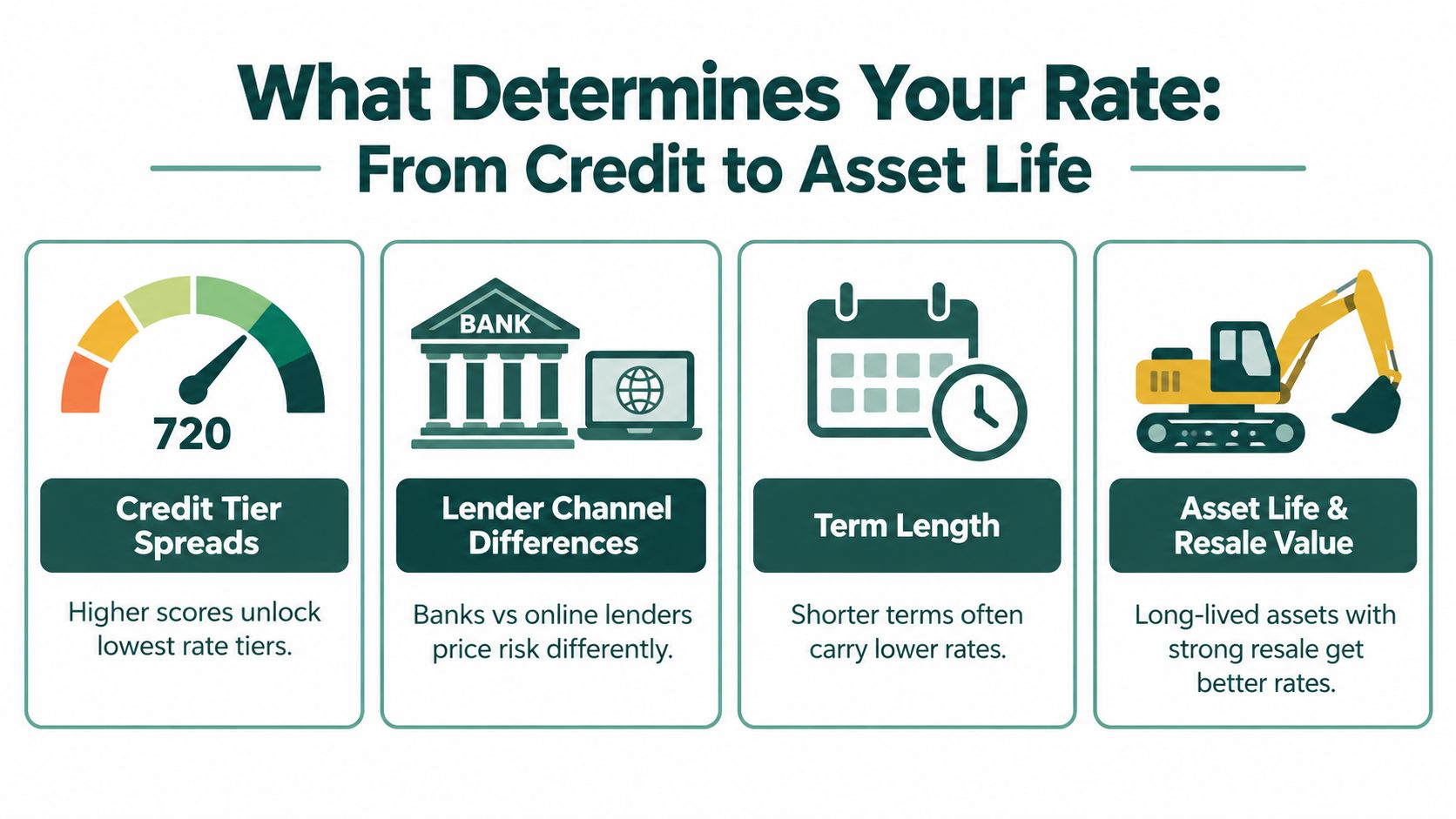
Credit quality sets the floor
Credit still drives pricing fast. Strong borrowers usually get access to the lowest-cost structures, lower down payment requirements, and cleaner terms. Weaker files get priced for more risk, and the extra cost rarely shows up in rate alone. It often appears in fees, shorter terms, larger upfront cash requirements, or personal guarantee strength.
For practice owners, the practical question is not whether good credit helps. It does. The question is whether your credit profile is strong enough to make financing cheaper than using cash once you factor in taxes, liquidity, and what that cash could do elsewhere in the practice.
Lender type changes the deal, not just the quote
Bank, credit union, online lender, SBA structure, and manufacturer or captive financing do not price risk the same way. They also do not care about the same things.
Banks usually want cleaner credit, stronger debt service coverage, and equipment with a useful life that supports the term. SBA structures can tolerate more complexity and stretch amortization, but the longer repayment period can raise total borrowing cost even if the payment feels easier. Captive programs can look attractive on a specific machine, especially if a manufacturer is supporting the rate, but you still need to compare the full contract against ownership value and end-of-term options.
If you want a practical breakdown of equipment financing and leasing for veterinary clinics, start there before you compare offers.
Asset quality drives rate because lenders care about resale
This is the rate driver many veterinary owners underestimate.
A lender is not only asking whether your clinic can pay. The lender is also asking what the equipment is worth in year three if it has to be sold. That matters a lot with veterinary equipment because secondary market strength varies widely.
Digital radiography, standard ultrasound systems, and other broad-use assets usually underwrite better because more buyers exist if the lender needs to remarket the unit. A highly specialized device built for a narrow clinical use can price worse even in a healthy practice because liquidation risk is higher. Used equipment can also price differently from new equipment for the same reason. Remaining useful life and resale confidence are thinner.
This is why headline APR can mislead you. A slightly higher rate on an asset that holds value and leaves you with meaningful resale proceeds can beat a lower rate on a structure that gives you no equity at the end.
Term length should follow useful life, not monthly payment alone
Match the term to the equipment's real working life inside your hospital. Not the brochure life. Not the tax life. The practical life.
For example, durable core equipment that should stay productive for years can support a longer amortization if that preserves cash for staffing, buildout work, or inventory. Technology that may age out faster should not be financed on an overly long schedule just to force the payment down. That is how owners end up making payments on equipment they already need to replace.
Use a simple filter:
- Finance longer when the asset should hold value and stay useful well beyond the early years
- Keep terms tighter when the technology may become outdated before the note is paid off
- Reject any structure that creates a low payment by pushing too much cost to the back end
Your structure changes total cost of capital
This is the decision point that matters most. Compare the rate, but decide based on total cost.
A loan usually makes more sense when the equipment is likely to keep value and you want ownership upside. A lease can make sense for faster-turn technology or when you want lower upfront cash and clearer upgrade flexibility. An SBA structure can help when cash flow is tight and term length matters more than rate alone. Captive financing can be useful when a manufacturer is supporting a promo, but only if the rest of the contract is competitive.
For a veterinary practice, that means you should judge every offer against two questions. How much will this capital cost over the full term? What will I own, or be able to sell, at the end? Those two answers matter more than the quoted APR.
Comparing Equipment Financing Structures and Lender Options
A practice owner financing a new digital X-ray unit, ultrasound, and anesthesia monitors can get four very different offers that all look reasonable at first glance. The quoted rate will not tell you which one is cheapest. The structure will.
Equipment Financing Rates by Lender and Structure
| Lender or Structure | Typical APR Range | Typical Term | Best Fit in a Veterinary Practice |
|---|---|---|---|
| Bank equipment loan | 6.5% to 9.5% APR | Often several years, commonly aligned to asset life | Durable equipment with solid resale value, such as radiology, dental, or surgical equipment you expect to keep |
| Credit union equipment financing | 6% to 12% APR | Commonly several years | Strong-credit borrowers who want conventional ownership with competitive pricing |
| SBA 7(a) equipment financing | 9.0% to 9.75% APR | Longer terms than many conventional structures | Large purchases where payment relief matters more than the lowest possible rate |
| SBA-backed equipment financing | 9% to 12% APR | Often long amortization | Expansion-stage practices trying to protect cash flow |
| Equipment lease | 6.99% to 13.99% APR | Varies by lease design | Technology-sensitive equipment or planned upgrade cycles |
| Sale-leaseback | 8.5% to 12.5% APR | Varies | Practices pulling cash back out of equipment already owned |
| Captive-finance promotion | 0% to 8.99% | Often promotional and asset-specific | Manufacturer-supported purchases where the full contract terms stay competitive |
| Online or alternative lender | 12% to 30%+ APR | Usually shorter | Time-sensitive replacements when speed matters more than cost |
APR ranges above are drawn from previously cited market summaries and lender-category snapshots noted earlier in the article, including the sources already referenced for conventional, SBA, lease, and alternative equipment financing ranges.
Bank and credit union loans
Start with a conventional loan when the equipment should still be useful and saleable years from now.
That usually fits digital radiography, dental suites, anesthesia machines, exam tables, and other core assets that do not need a frequent refresh cycle. If you finance those assets with a plain loan, you preserve the resale upside. That matters. If the unit still has value in five or seven years, ownership offsets part of your real cost of capital in a way a lease often does not.
The trade-off is simple. Underwriting is tighter, documentation is heavier, and approval may take longer.
SBA-backed financing
SBA money earns its place when monthly payment pressure is the problem.
A long amortization can make an expensive purchase workable during an expansion, relocation, or buildout phase. That is often the right answer for a growing hospital adding multiple treatment-room systems or a larger imaging package while also carrying other project costs. You may pay more over time than you would with a shorter conventional loan, but lower debt service can protect hiring plans, inventory levels, and operating cash.
That is a real benefit, not a technicality.
Leases and captive offers
Leases make the most sense on equipment that may lose practical value before it wears out. Ultrasound can fall into that category in some practices. So can software-tied diagnostic platforms, lab systems, or other equipment where upgrade timing matters almost as much as useful life.
Do not judge a lease by payment alone. Check four points:
- End-of-term purchase option
- Residual value assumptions
- Usage or upgrade restrictions
- Total dollars paid before you own anything, if ownership is even included
Captive financing deserves the same treatment. A 0% promotion can be attractive, but only when the equipment price, term, fees, and end-of-term rights also make sense. If the vendor inflates the equipment cost, limits early payoff, or pushes you into a weak residual structure, the promo rate is not saving you money.
Sale-leasebacks and fast online financing
Sale-leaseback is a cash management tool, not a bargain structure. It can help if your practice owns equipment free and clear and needs liquidity for another priority, but you are monetizing an asset you already paid for. Use it deliberately.
Online and alternative lenders serve one purpose well. Speed. If a sterilizer, imaging system, or other revenue-critical machine fails and you need a replacement approved fast, paying more for faster execution can be justified. It should still feel expensive, because it is.
If you want a practical starting point for comparing lender categories used by clinics, review these equipment financing lenders for veterinary practices.
The right structure depends on two numbers. What will the financing cost over the full term, and what will the equipment be worth to you at the end through ownership, trade-in, or resale. That is how you choose between a loan, lease, SBA option, or captive offer without getting distracted by headline APR.
Veterinary Equipment Use Cases and Rate Implications
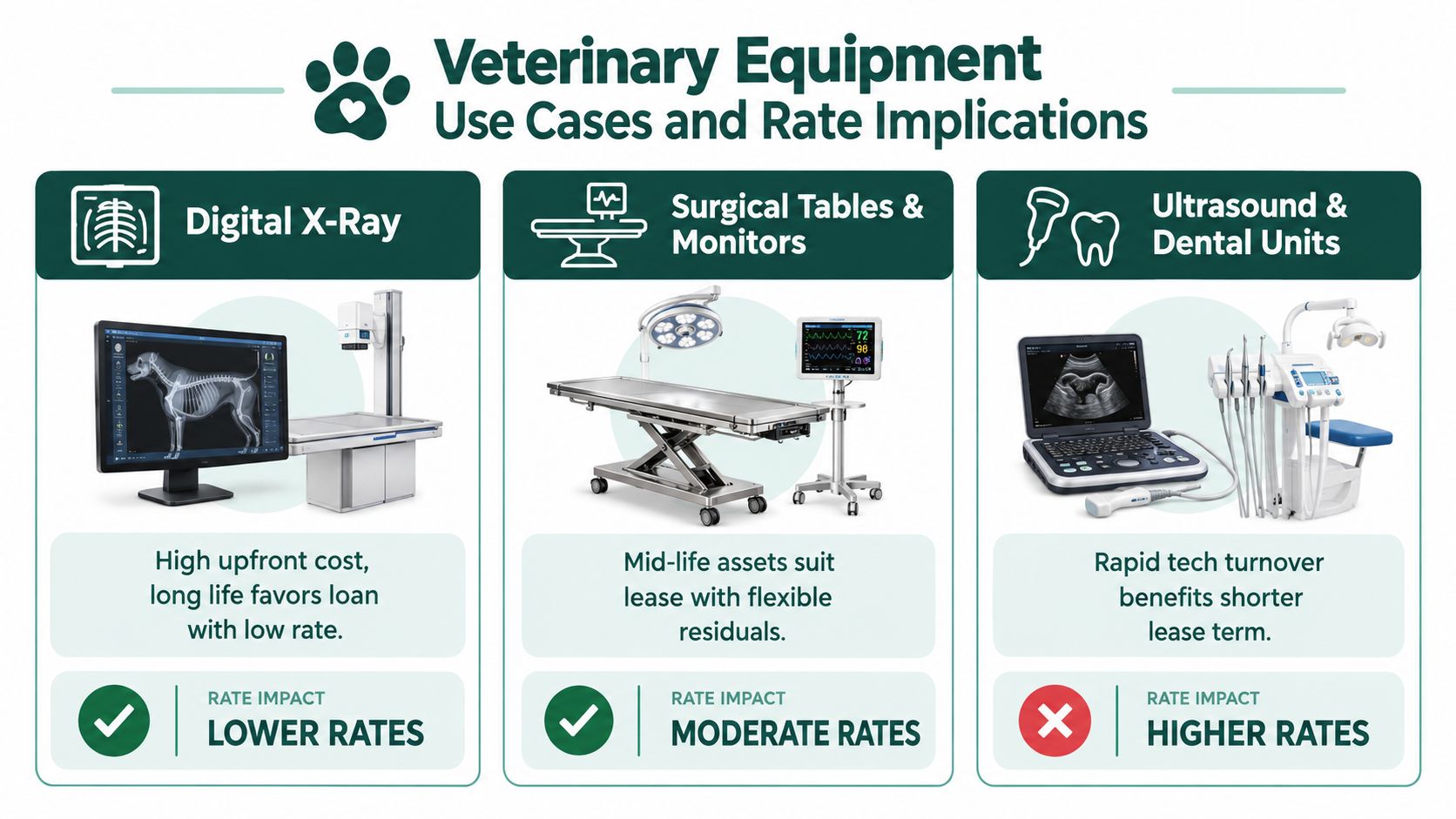
Veterinary equipment doesn't finance uniformly. A lender sees different risk in digital X-ray, a used ultrasound, a surgical suite, and practice IT.
Imaging equipment
Digital X-ray and ultrasound often justify careful structure selection because they combine clinical importance with meaningful capital cost. If the equipment is new and holds resale value reasonably well, loan financing is often more attractive than a lease because you're paying for a durable revenue-producing asset.
If the technology refresh cycle is likely to be shorter, a lease can make more sense. That's especially true when the clinic expects to replace or upgrade before the full physical life is exhausted.
If ultrasound is part of your purchase evaluation, review veterinary ultrasound equipment financing considerations.
Surgical and anesthesia equipment
Surgical tables, lights, monitors, and anesthesia systems often sit in the middle ground. They're necessary, they tend to have practical staying power, and they don't always warrant the complexity of a lease unless cash preservation is a top objective.
For these assets, I usually favor simple ownership structures unless the practice is in a larger expansion cycle and needs to preserve liquidity. The cleaner the asset and the more stable its long-term use, the stronger the case for conventional financing.
In-house lab analyzers
Lab equipment creates a different issue. It can be clinically central and financially productive, but some analyzers are specialized enough that resale and replacement dynamics complicate pricing.
That can push owners toward shorter commitments or lease structures if they expect technology change or service-plan dependency to influence future replacement decisions. If the analyzer is niche and the lender discounts its resale value, the financing offer may not be as favorable as the practice's credit alone would suggest.
IT and practice systems
Computers, servers, phones, and software-adjacent hardware often don't deserve the same financing treatment as core clinical equipment. When an asset has lower liquidation value or a faster obsolescence curve, long-term financing becomes less attractive.
Use a blunt rule here:
- Finance high-resale, long-life equipment
- Lease or self-fund faster-aging technology
- Be cautious with used specialized assets if the quote isn't compensating you for the added risk
Used equipment and soft or specialized assets often price wider than standard equipment, with recent 2026 snapshots citing newer titled assets at 6% to 14%, used equipment at 8% to 18%, and soft or specialized assets at 12% to 22% in 2026 structure and asset-type pricing guidance.
How to Secure Lower Equipment Financing Rates
You can influence your quote. Not completely, but enough to matter.
Start with the levers that move pricing most
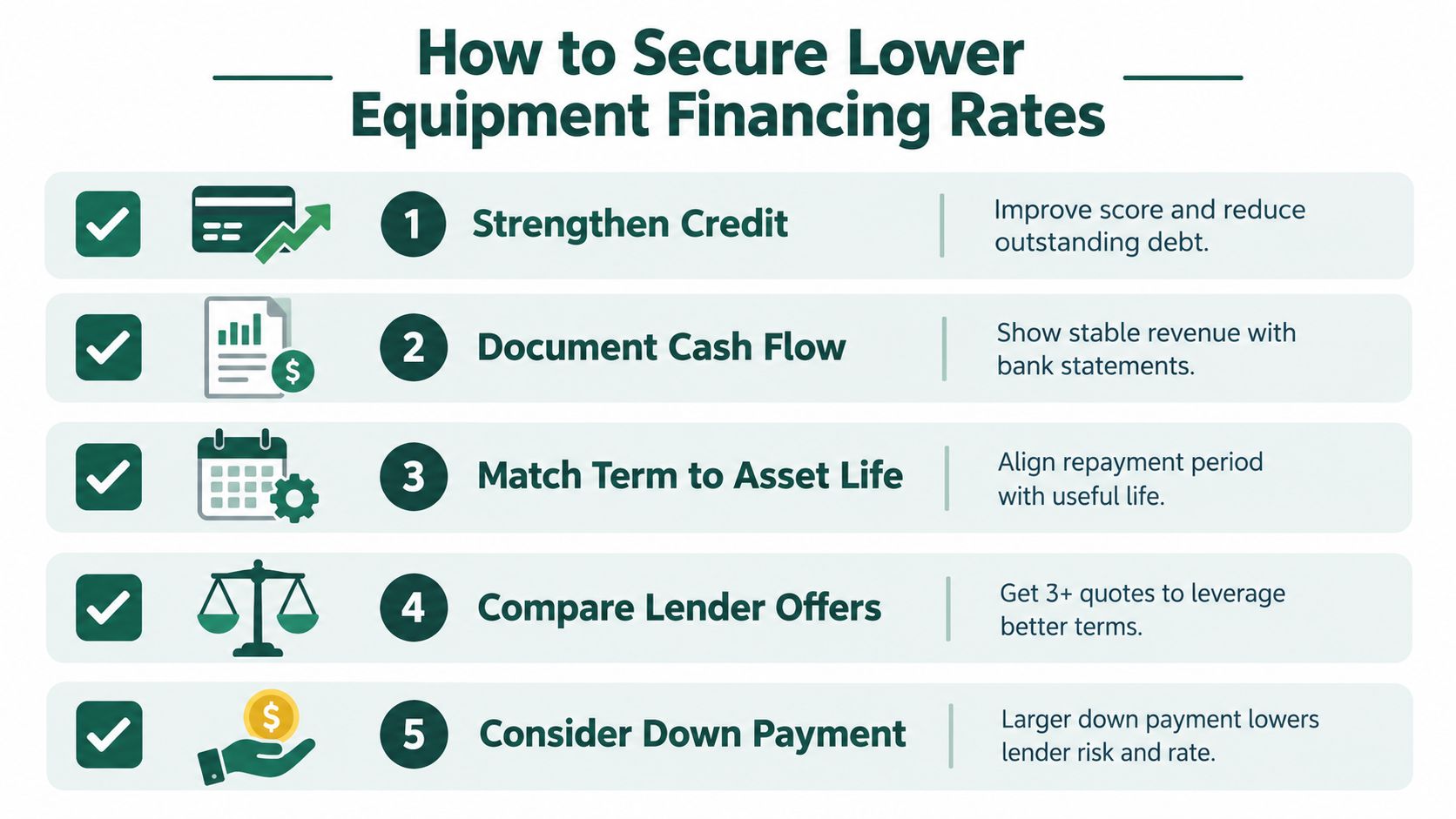
Use this checklist before you sign anything:
- Strengthen your file: Clean up personal and business credit issues, reduce avoidable debt, and organize current financial statements before applying.
- Show clean cash flow: Lenders price confidence. If your deposits, revenue pattern, and debt service capacity are easy to understand, underwriting usually goes better.
- Match term to equipment life: Don't ask for a structure that makes no sense for the asset. It weakens the file and can worsen pricing.
- Compare lender categories, not just offers: Get quotes from more than one type of financing channel so you can compare speed, term, and ownership outcome, not just APR.
- Negotiate the non-rate items: Fees, residuals, end-of-term buyout language, and prepayment flexibility can change total cost materially.
The highest-impact move for most veterinary owners is simple: apply before the equipment becomes urgent. Urgency weakens your leverage.
Don't chase the lowest payment blindly
A lower monthly number can hide a bad structure. Ask every lender these questions in plain English:
- What do I own at the end?
- What fees are included outside the stated rate?
- If this is a lease, what is the buyout?
- Can I prepay without a painful penalty?
- Why is this term length appropriate for this asset?
If the lender can't answer directly, move on.
Use asset quality to your advantage
When the equipment is new, standard, and easier to resell, say that clearly in the application process. Don't assume the lender understands the difference between a broadly marketable imaging unit and a narrower specialty device.
If the equipment is more specialized, consider whether a larger down payment, a different structure, or a shorter commitment improves the risk picture. That won't always produce a lower nominal rate, but it can produce a better overall deal.
Shop with a financing framework
I'd line up options in this order:
- Conventional bank or credit union first for strong borrowers buying durable equipment
- SBA-backed financing next when payment relief matters
- Lease review when refresh cycles or flexibility matter more than immediate ownership
- Captive offer review if promotional pricing is on the table
- Faster alternative financing only when timing forces it
One option some veterinary owners evaluate is Veterinary Practice Loans, which focuses on financing structures for veterinary acquisitions, equipment, working capital, and clinic growth.
Choosing the Right Financing Path for Your Practice
A startup owner buying a first imaging suite shouldn't optimize for the absolute lowest rate if doing so starves the clinic of operating cash. In that situation, preserving liquidity and keeping monthly debt service manageable usually matters more than winning the headline APR contest.
An established clinic upgrading core lab or surgical capacity should usually push harder for lowest total cost. If the equipment will stay in service for years and support stable production, straightforward ownership financing often beats more complex structures.
A multi-location group has a different problem. It may care less about the single lowest equipment rate and more about consistency, speed across sites, and not tying up too much cash during broader expansion. In that case, standardized structure and execution discipline can matter as much as pricing.
Use a simple decision rule:
Pick the goal before you pick the lender
- Choose lowest total cost when the equipment is durable, revenue-producing, and likely to stay in service.
- Choose lowest monthly payment when growth, renovation, or working capital pressure makes cash preservation critical.
- Choose fastest funding only when the operational need is immediate and the clinic can justify the added financing cost.
If you don't decide what matters most before collecting quotes, lenders will decide for you by steering the conversation toward payment instead of total cost.
The right financing path for a veterinary practice isn't the one with the prettiest advertised rate. It's the one that matches the asset's life, the clinic's cash flow, and your actual ownership plan.
If you're weighing equipment quotes and want help comparing loan, lease, SBA, or cash-flow-driven options, Veterinary Practice Loans works specifically with veterinary owners on equipment purchases, acquisitions, working capital, and clinic expansion. Visit Veterinary Practice Loans to review financing options built around how veterinary practices operate, not generic small-business assumptions.
