

A clinic owner sits across from a six-figure equipment quote, calculator open, cash reserves visible on the balance sheet, and a schedule already crowded with payroll, inventory, and facility expenses. The question isn't whether the clinic can afford the machine. It's whether paying cash, taking an equipment loan, or leasing it will protect the practice while the asset earns its keep.
Veterinary equipment financing and leasing work best when you match the structure to the asset. A digital X-ray system, ultrasound unit, dental station, laboratory analyzer, and practice-management server don't depreciate, age, or become obsolete in the same way. Treating them as one category is how owners end up financing yesterday's technology for tomorrow's payments.
The broader market shows why this decision deserves careful attention. The equipment finance industry reached an estimated $1.34 trillion in 2023, and 82% of businesses acquiring equipment or software used at least one financing method, according to the Equipment Leasing & Finance Foundation market summary. Leasing was the most common payment method in that data, used by 26% of businesses, compared with secured loans at 16%, lines of credit at 14%, and unsecured loans at 8%.
I've sat with clinic owners weighing these exact quotes. My recommendation is direct: start with the equipment's useful life, obsolescence risk, expected utilization, and effect on monthly cash flow. Then compare the financing structures, tax treatment, accounting impact, and exit terms. The sections below walk through those decisions and show when ownership, flexibility, or a hybrid approach makes the most sense.
The Equipment Decision Every Clinic Owner Faces
The first step is to stop asking, “Should I finance or lease equipment?” Ask a more useful question: What should happen to this specific asset after the agreement ends?
If the answer is “I want to keep it and use it for years,” equipment financing usually deserves priority. If the answer is “I expect to replace it before it is fully worn out,” leasing may better protect the clinic from outdated technology. That distinction matters more than the label on the quote.
Start with the asset, not the payment
A digital X-ray system may remain clinically useful long after its loan is paid off. A surgical table or built-in cabinetry can serve the practice for a long operating horizon with limited technology risk. An ultrasound system, laboratory analyzer, or server may still function properly while newer software, probes, processors, or integrations make the older system less attractive.
Each category creates a different economic problem:
- Imaging equipment: Consider serviceability, software support, image quality, workflow integration, and resale value.
- Surgical and dental equipment: Focus on physical durability, utilization, repair costs, and whether the equipment is tied permanently to the facility.
- Laboratory systems: Evaluate reagent commitments, maintenance coverage, throughput, and the risk of changing testing requirements.
- IT hardware and software-embedded systems: Give greater weight to refresh timing, compatibility, cybersecurity support, and upgrade flexibility.
Published guidance shows why useful life can't be treated as a universal number. Machinery and equipment are often assigned useful lives of 7 to 10 years, IT hardware commonly falls within 3 to 5 years, and heavy plant can extend to 10 to 20 years, according to industry benchmark guidance on equipment useful lives. Those ranges aren't a veterinary practice forecast, but they reinforce the central point: the structure should follow the asset's economic life.
Practical rule: Finance what you expect to own after the payments end. Lease what you expect to replace before then.
Protect the operating business
A clinic can make a technically sensible equipment purchase and still create a poor financing decision if the payment leaves too little room for payroll, inventory, repairs, or a slower month. Cash is not idle when it protects the practice from operational surprises.
The decision should therefore include more than the equipment quote. Compare the full payment schedule, down payment, fees, maintenance responsibilities, insurance requirements, end-of-term options, and the consequences of early payoff or early termination.
The industry remains structurally important because businesses use financing to match payments with the useful life of productive assets. ELFA reported that new business volume in the $1.3 trillion industry grew 3.1% in 2024, after 1.1% growth in 2023, as documented in the 2024 Horizon Report fact sheet. For a clinic owner, the practical lesson is simple: financing isn't an unusual workaround. It's a normal way to deploy capital without paying the entire equipment cost from operating cash.
How Equipment Financing and Leasing Actually Work
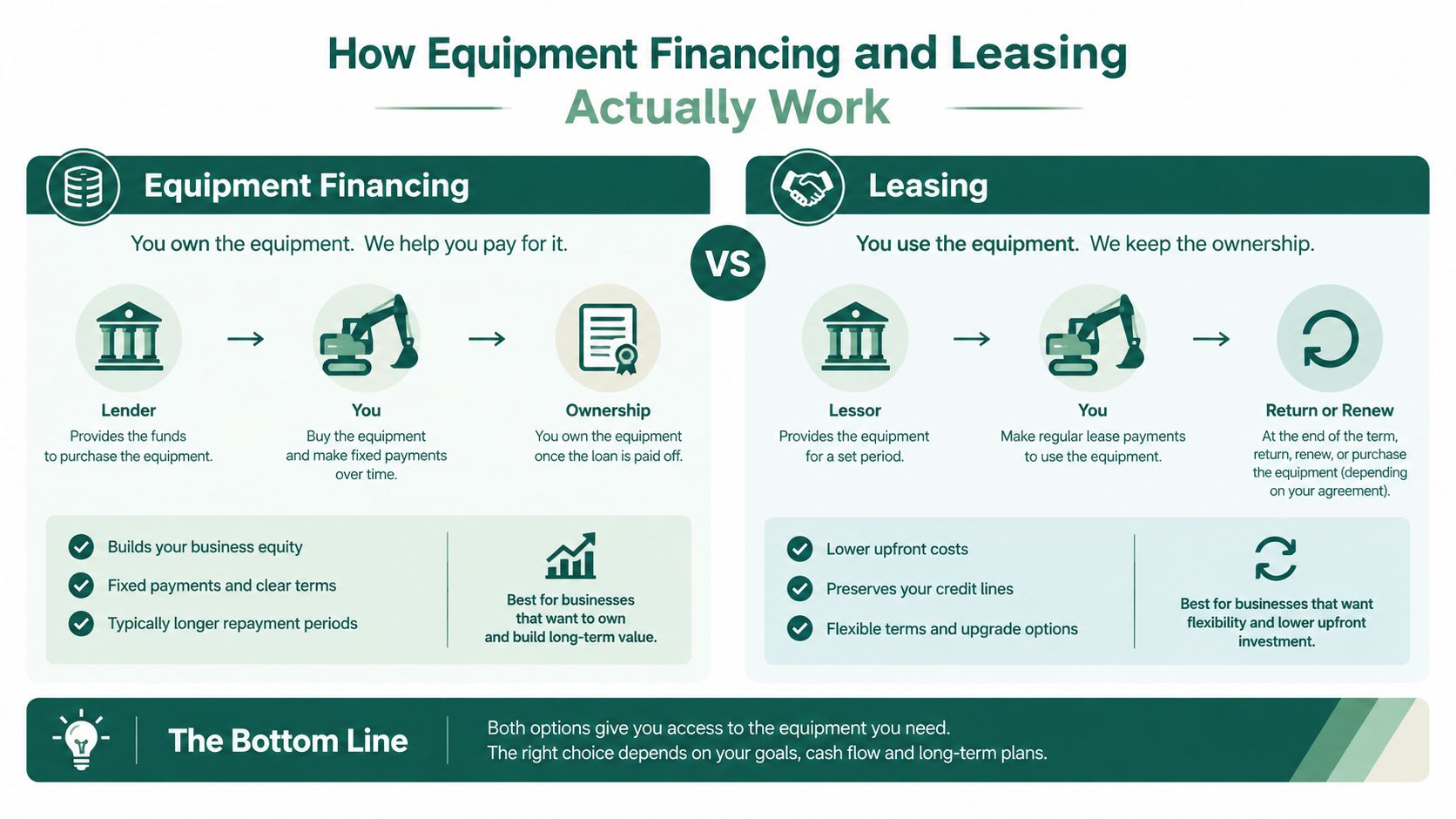
Equipment financing is usually a loan or installment sale secured by the equipment. The clinic takes ownership, or beneficial ownership, from the beginning, makes scheduled principal-and-interest payments, and gives the lender a security interest until the balance is paid.
Leasing is a rental contract for the right to use the asset. The lessor retains ownership, the clinic makes periodic lease payments, and the agreement specifies what happens at the end. Depending on the structure, the clinic may return the equipment, renew the lease, purchase it for a preset amount, or buy it at fair market value.
The financing path
With an equipment loan, the lender advances funds for the purchase. The clinic typically pays a fixed amount according to an agreed schedule, although the exact payment can vary with rate type, fees, down payment, and term.
Common quoted terms include 36, 48, 60, and sometimes 84 months. Those terms aren't automatically appropriate. A longer term may reduce the monthly payment while increasing total financing cost and creating a mismatch if the equipment becomes obsolete sooner.
At payoff, the clinic owns the equipment outright, subject to the lender releasing its security interest. If the practice sells or replaces the asset before payoff, it must address the remaining loan balance, resale proceeds, and any prepayment conditions.
Lease structures that change the outcome
A capital lease, often called a finance lease, is built around eventual ownership. A common dollar-buyout structure transfers ownership for a nominal amount at the end, while a finance lease may use another preset purchase option. The clinic generally carries the economics of ownership even if the agreement uses the word lease.
An operating lease, often structured with a fair market value purchase option, is built around flexibility. At the end, the clinic may return the equipment, renew the arrangement, or purchase the asset at its then-current fair market value. The lessor relies partly on the asset's residual value rather than recovering the entire cost through the clinic's payments.
The residual can materially change the payment. Industry analysis notes that lease terms of 15 to 25 years may represent only 50% to 70% of an asset's useful life, leaving residual values commonly around 30% to 60% of original equipment cost, sometimes higher, according to residual value analysis from the Equipment Leasing & Finance Foundation. Veterinary terms will vary, but the principle applies: a durable asset with predictable resale value can support a lease payment that doesn't amortize the entire purchase price.
Read the end-of-term language carefully. A low monthly payment isn't a bargain if the clinic faces an expensive purchase option, restrictive return conditions, automatic renewal, or a costly early termination requirement.
Cost, Tax, and Cash Flow Compared
The monthly payment is only one line in the decision. A clinic owner should compare the full economic cost, the timing of deductions, the effect on reported liabilities, and the amount of flexibility left at the end.
| Criterion | Equipment Financing | Leasing |
|---|---|---|
| Total cost | Often favorable for durable assets kept after payoff, but includes interest, fees, maintenance, and ownership costs | May cost more over repeated replacement cycles, but residual value can reduce periodic payments |
| Payment design | Principal and interest are paid over the agreed term | Payments cover the right to use the asset, with the structure reflecting residual value and end-of-term options |
| Tax treatment | The clinic may claim allowable depreciation, including Section 179 or bonus depreciation when eligible | Payments may generally be treated as operating expenses in a true lease, subject to classification and tax rules |
| Monthly cash flow | Can require a larger payment because the clinic is paying toward full ownership | Can preserve cash when the lessor retains residual value, but the clinic may not build equity |
| Balance sheet | Equipment and related debt are generally recorded | Treatment depends on accounting classification and applicable reporting rules |
| End of term | Clinic owns the asset after payoff | Clinic may return, renew, or purchase, depending on the agreement |
| Upgrade path | Replacement may require selling the asset and settling remaining debt | A well-structured lease can make planned technology refreshes easier |
For long-life imaging equipment, financing often wins on lifetime economics because the clinic can keep using the asset after the loan ends. The clinic pays interest, but it also builds ownership and retains future use or resale value.
For fast-changing ultrasound and IT categories, leasing can preserve working capital and reduce residual risk. Independent industry coverage identifies lease use at 62% of transactions for IT hardware, networking gear, and software-embedded systems, while equipment leases across all types represent 38% of equipment finance transactions, as reported in equipment financing and lease statistics. Those figures support an asset-specific approach, not a blanket preference for leasing.
The right comparison is a total-cost model. Include the purchase price, financing charges or rent, fees, maintenance, insurance, installation, software support, buyout amount, return costs, and the value of keeping the equipment after the agreement. For a broader framework, review this guide to total cost of capital.
Tax deductions can change the ranking. The next issue is how each structure affects the clinic's tax return, financial statements, and future borrowing capacity.
Tax Treatment and Balance Sheet Impact
Tax treatment and accounting treatment answer different questions. A lender may call an agreement a lease, while the clinic's accountant classifies it differently for tax reporting or financial statements. Asset type matters here. Imaging and surgical equipment often support ownership and depreciation over a longer useful life, while fast-changing lab or IT equipment may require closer review of tax timing, replacement plans, and lease classification.
With equipment financing, the clinic generally records the equipment as an asset and the financing as debt. Each payment includes principal and interest. Principal reduces the liability, while interest may be deductible under applicable rules.
Financing and ownership deductions
If the clinic owns the equipment for tax purposes, it may qualify for depreciation deductions. Section 179 and bonus depreciation may apply to qualifying equipment, but eligibility, annual limits, taxable income, placed-in-service rules, and current law all matter.
The timing can help a clinic with taxable income that wants a larger deduction in the acquisition year. It may provide less value when the practice cannot use the deduction efficiently or already claims substantial depreciation from other purchases. Your accountant should evaluate the clinic's full tax position rather than treating the deduction as an automatic benefit.
A financed purchase also changes the balance sheet. The clinic reports both the asset and the debt. That can increase reported debt levels even when the equipment supports the liability through patient-care revenue. The presentation may affect a bank's review of future borrowing, debt covenants, or partner buy-in terms.
Leasing and classification
A true operating lease may allow the clinic to treat scheduled payments as operating expenses for tax purposes, subject to the agreement and applicable rules. The lessor generally retains tax ownership, so the clinic does not automatically claim the equipment's depreciation.
A capital or finance lease may be recorded more like a purchase. The clinic may recognize an asset and liability, then claim depreciation and interest according to the applicable treatment.
Current accounting rules can require right-of-use accounting for an operating lease. “Operating” does not mean the arrangement disappears from every financial statement. The accountant must review the agreement and the clinic's reporting framework before the owner signs.
| Issue | Equipment Financing | Equipment Leasing |
|---|---|---|
| Tax ownership | Clinic generally owns the asset for tax purposes | Lessor may retain tax ownership in a true lease |
| Depreciation | Allowable depreciation may be available | Clinic generally does not claim depreciation in a true lease |
| Section 179 | May apply if the equipment and clinic qualify | Generally unavailable when the lessor owns the asset for tax purposes |
| Bonus depreciation | May apply when eligibility requirements are met | Generally unavailable to the clinic in a true lease |
| Payment deduction | Interest may be deductible, while principal reduces debt | Lease payments may be deductible according to the lease classification |
| Financial statements | Asset and debt are generally recorded | Right-of-use asset and liability treatment depends on applicable accounting rules |
| Reported debt load | Debt can increase reported debt levels | Lease obligations may still affect reported liabilities and lender analysis |
Do not sign based on a tax summary from the financing source. Send the complete agreement to the clinic's accountant before execution, including purchase options, residual language, maintenance obligations, and renewal terms. For long-life imaging or surgical assets, confirm the ownership and depreciation treatment. For lab and IT equipment with faster replacement cycles, review whether the tax benefit justifies carrying an asset or liability beyond its useful life.
Real Scenarios From a Working Veterinary Practice
The same financing rule shouldn't govern every piece of equipment. A clinic that applies one structure across imaging, ultrasound, and IT can miss the cost and operational differences between those assets.
Replacing a digital X-ray system
A general practice needs to replace an aging digital X-ray system. The equipment will be used throughout the week, integrated into routine appointments, and supported by a service plan that the owner expects to maintain for years.
Financing is the stronger starting point. The clinic is buying a durable revenue-producing asset, expects to retain it after the payment term, and can spread the cost across the period in which the system supports patient care. Ownership also gives the practice an asset it can continue using after payoff or sell when a later replacement becomes necessary.
The owner should still compare the loan term with the system's expected economic life. A long term can create a payment mismatch if software support ends or image compatibility changes before the debt does.
Upgrading ultrasound
A specialty clinic wants newer ultrasound capability, but it also needs cash for staffing, facility work, and another technology purchase. The clinic expects the equipment to remain clinically useful, yet it doesn't want to commit all available liquidity to one upgrade.
Leasing may fit better here. A lease can make payments predictable and preserve cash for expenses that directly affect capacity. The owner must review the purchase option and renewal terms, especially if the practice might want to keep the system after the lease ends.
For a clinic evaluating this category, review the practical considerations in veterinary ultrasound equipment financing, then request both a purchase-financing quote and a lease quote for the same configuration.
Replacing equipment at lease end
A multi-doctor clinic reaches the end of an operating lease on a laboratory analyzer. The analyzer still works, but service availability has become less predictable and the manufacturer has introduced a newer system with better workflow integration.
The clinic shouldn't automatically renew. It should compare three choices: return the analyzer, purchase it at the stated fair market value, or replace it under a new agreement. The decision depends on current service support, expected remaining useful life, compatibility with the clinic's lab process, and the cost of downtime.
Leasing can deliver its main strategic value here. The clinic preserves the ability to make a decision with current information instead of being locked into ownership of an asset that no longer fits its workflow. That flexibility has value, but only if the agreement clearly defines return conditions, notice requirements, and end-of-term charges.
Choosing the Right Path for Your Clinic
Use a written decision process before requesting proposals. Don't let a lender's preferred structure become the clinic's default because the quote arrived first.
Six questions to answer
1. How long will the clinic use the asset?
Finance equipment that the practice expects to keep well beyond payoff. Consider leasing when technological obsolescence or changing software support will probably make replacement attractive before ownership becomes valuable.
2. What is the complete cost?
Compare the down payment, interest or lease charges, origination fees, maintenance, insurance, installation, software support, end-of-term purchase price, and residual risk. A low monthly payment can conceal a substantial purchase obligation or a longer repayment period.
3. Can the practice handle the payment in a slower month?
Test the payment after payroll, rent, inventory, existing debt service, taxes, and planned improvements. If one weak month would force the clinic to use a credit line for ordinary operations, the structure is too aggressive.
4. What will appear on the financial statements?
Ask how the transaction affects assets, liabilities, depreciation, and lender covenants. A clinic with expansion plans should understand whether the new obligation could limit future borrowing.
5. What is the upgrade and service plan?
For imaging and laboratory systems, ask who handles repairs, how software updates work, what happens during downtime, and whether replacement components remain available. For IT, assess compatibility and refresh timing before deciding how long the agreement should run.
6. How can the clinic exit?
Review prepayment penalties, early termination costs, purchase options, renewal language, notice deadlines, return conditions, and responsibility for shipping or restoration. The end of the agreement is part of the price, not an administrative detail.

Make the proposals comparable
Request like-for-like quotes using the same equipment configuration, funded amount, term, down payment, maintenance assumptions, and end-of-term outcome. Separate the equipment economics from the financing structure so a discounted machine price doesn't hide an expensive lease.
Get the lender and accountant to explain the same scenario in plain language. The lender should explain payment mechanics, security interests, buyouts, and exit provisions. The accountant should explain tax ownership, depreciation, deductions, and financial statement treatment.
A veterinary-focused lender may also help compare equipment structures within the broader practice plan. Veterinary Practice Loans' equipment financing lenders page is one place clinic owners can review financing support related to equipment purchases.
Which Option Wins and When
There isn't one universal winner. Financing wins when ownership, long useful life, and lifetime cost matter most. Leasing wins when technology changes faster than the clinic wants to own it.
For durable, clinic-specific assets, I generally favor financing. Surgical tables, cabinetry, sterilization equipment, and certain facility improvements are difficult to replace because they become part of the clinic's operating environment. If the practice expects a long ownership horizon, building equity and retaining use after payoff usually outweigh the flexibility of returning the asset.
For fast-evolving technology, leasing deserves serious consideration. Ultrasound systems, laboratory analyzers, networking equipment, and software-dependent IT hardware can lose practical value before they physically fail. A lease can shift more residual and obsolescence risk to the lessor while giving the clinic a clearer refresh path.
Digital X-ray sits between those categories. A heavily used system with stable support and a long expected service life may justify financing. A system tied to frequent software changes, proprietary integrations, or an aggressive upgrade plan may fit a lease better.
| Equipment Category | Recommended Structure | Why It Fits |
|---|---|---|
| Surgical tables and cabinetry | Equipment financing | Durable, clinic-specific assets can remain useful after payoff |
| Sterilization equipment | Usually equipment financing | Physical utility may outlast the financing term |
| Digital X-ray | Financing or lease, based on support and upgrade plans | The practice must weigh durable use against software and compatibility risk |
| Ultrasound | Often leasing for active refresh plans | Technology and clinical capabilities can change faster than ownership economics |
| Laboratory analyzers | Lease when service and replacement timing are uncertain | The clinic retains more flexibility as workflow and support needs change |
| IT hardware and networking | Leasing when refresh timing is short | Fast obsolescence makes residual risk and upgrade access important |
| Facility improvements | Equipment financing or term funding | Improvements are tied to the premises and usually support a longer practice horizon |
Use the tax analysis as a decision input, not as the starting point. A Section 179 or bonus depreciation opportunity may favor ownership for a qualifying clinic, but the accountant must confirm eligibility and practical value. A lease deduction spread over the term may better fit another clinic's taxable income and cash needs.
The best structure often is hybrid: own the room, lease the technology. Finance the durable infrastructure and clinic-specific equipment. Lease the assets most likely to be replaced, upgraded, or affected by changing support standards. Before signing, model both paths using total cost, monthly cash flow, tax treatment, balance sheet impact, service requirements, and the exact end-of-term outcome.
Veterinary Practice Loans helps clinic owners compare financing for equipment purchases, working capital, build-outs, acquisitions, and expansion plans. Bring your equipment quote and cash-flow priorities to the conversation, then visit Veterinary Practice Loans to review financing options built around veterinary practice economics.
