
A clinic can be profitable on paper and still feel short on cash on Friday afternoon. Payroll is due, a distributor invoice is waiting, and several client balances won't arrive until later. The financing decision then becomes urgent, but urgency can make an attractive-looking rate more dangerous than it appears.
A working capital loan interest rate is only one part of the cost. The base rate, lender spread, fees, repayment frequency, amortization, and timing of your clinic's revenue all affect how much the borrowing will take from operating cash. Two practices requesting the same amount can receive very different offers because their credit history, cash flow, collateral, and loan structures differ.
This guide translates those mechanics into practical terms for veterinary owners and managers. You'll learn how rates are built, what drives a quote, how SBA-style, bank, and online products differ, and when a faster, higher-rate facility can cost less in practice because it fits the cash-flow gap better.
Introduction Why Working Capital Rates Matter for Clinics
Consider a small animal practice preparing for a busy period. The clinic needs to replenish pharmaceuticals and surgical supplies, cover payroll, and keep routine operations moving. Client payments may arrive unevenly, while employees and suppliers expect payment on schedule. A working capital facility can bridge that timing problem, but its repayment can also become another fixed obligation competing with payroll and inventory.
That's why the rate matters before the loan is signed, not only when the monthly payment appears. A quoted rate may be fixed or variable, stated as an APR or presented through another pricing method. Fees and payment cadence can change the effective cost even when two offers appear similar at first glance.
The useful question isn't “Which offer has the lowest rate?” It's “Which offer covers the gap without creating a larger cash-flow problem?”
For a clinic, the answer depends on the purpose of the funds. A defined inventory purchase may suit a term loan with a predictable payment. Recurring payroll gaps may call for revolving access, where the practice draws only what it needs. A short-lived receivables mismatch may justify a faster facility with a higher nominal cost, provided the repayment ends before it begins to squeeze normal operations.
A lender also looks beyond the requested amount. Credit history, deposits, cash-flow consistency, time in business, collateral, guarantees, loan size, and term all influence pricing. A multi-location group with stable deposits may receive a different offer from a newer clinic with seasonal revenue, even if both request the same working capital amount.
The goal is not to chase the lowest advertised number. It's to understand the relationship between borrowing cost and operating liquidity, then choose a structure your clinic can repay comfortably.
How Working Capital Loan Interest Rates Actually Work
A clinic may need cash before client payments arrive, while payroll, medications, and supplier invoices remain due. The quoted interest rate affects the cost of filling that gap, but the rate alone does not show how the financing will behave inside the practice's cash flow.
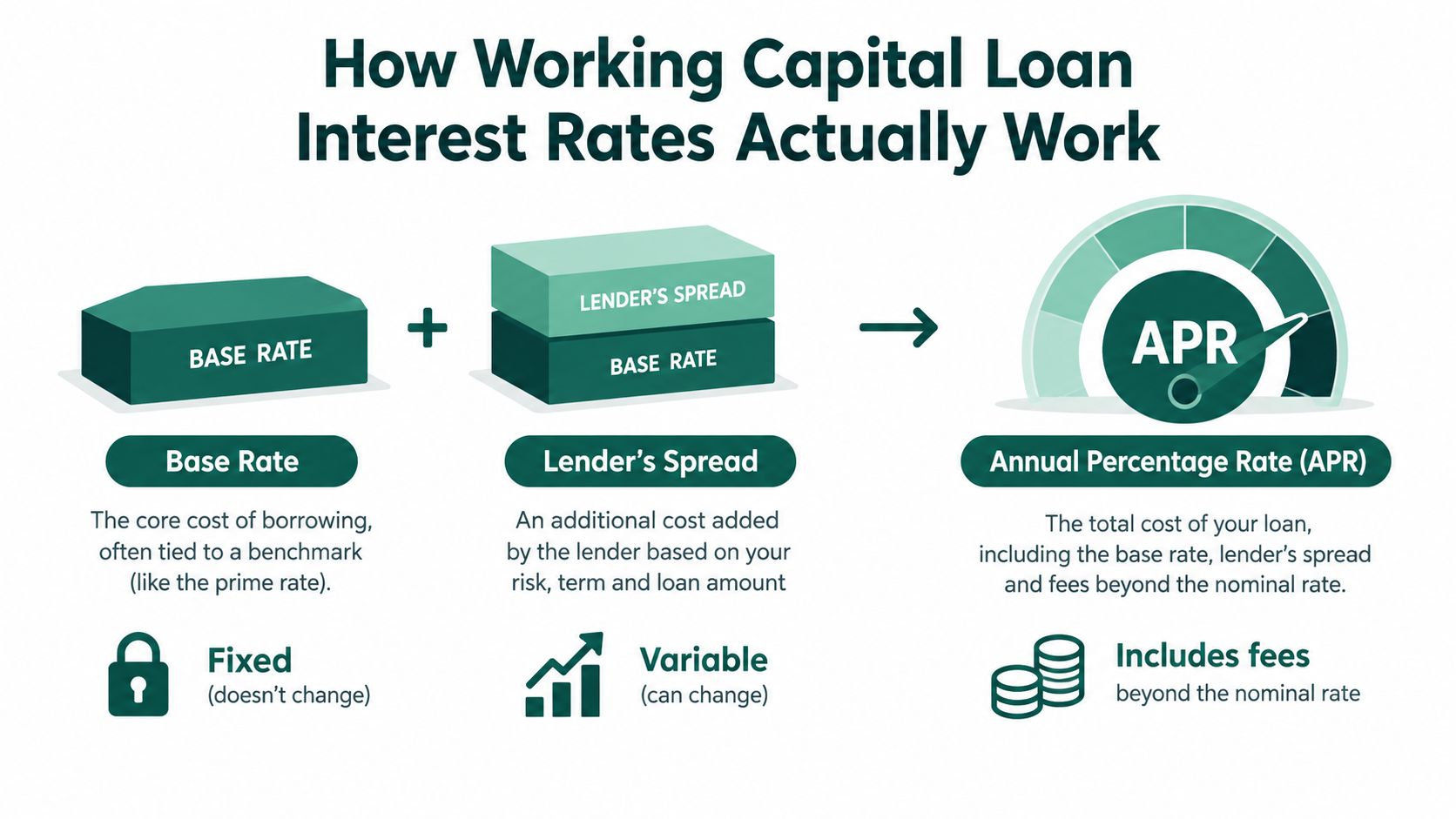
The basic pricing model is base rate plus lender spread. The base rate reflects the wider borrowing environment. The lender spread is the added margin for credit risk, operating costs, loan structure, and expected return.
The base rate works like the rent for a treatment room. The lender spread covers the added costs of keeping that room usable and adapting it to a clinic's needs. Comparing only the base rate is like judging a facility by rent while ignoring utilities and maintenance.
Fixed and variable pricing
A fixed rate remains unchanged under the loan agreement. Scheduled payments are easier to forecast, which can help a practice plan for veterinarians, technicians, rent, and supply orders.
A variable rate can change when its underlying base rate changes. That creates a different budgeting question: can the clinic still handle the payment if the rate rises during a period of slower collections? The answer depends on the agreement, the adjustment rules, and how quickly the balance will be repaid.
Why APR and payment cadence matter
The nominal interest rate is only one part of the cost. APR is intended to include interest and certain financing fees, giving borrowers a broader comparison point. Review the agreement as well, because fees, payment timing, prepayment terms, and product-specific pricing determine how much cash leaves the practice.
Payment cadence can matter as much as the quoted rate. A facility with frequent payments may cost less overall but place greater pressure on daily deposits. A higher-rate option with payments aligned to the clinic's collection cycle can be cheaper in practice if it prevents unnecessary borrowing or lets the balance disappear sooner.
Amortization affects the same trade-off. A longer schedule lowers each payment but keeps the balance open for longer. A shorter schedule may reduce total time in debt, while concentrated payments can strain operations during a slow receivables period.
For a plain-English explanation of repayment structure, review these working capital loan terms.
Practical rule: Compare APR, total repayment, payment frequency, and expected payoff date together. The lowest headline rate is not always the lowest operating cost.
Before comparing offers, record the amount deposited, every fee deducted or added, the payment amount, payment frequency, first payment date, and expected payoff date. That worksheet turns a rate quote into a cash-flow decision.
What Determines Your Rate as a Veterinary Clinic
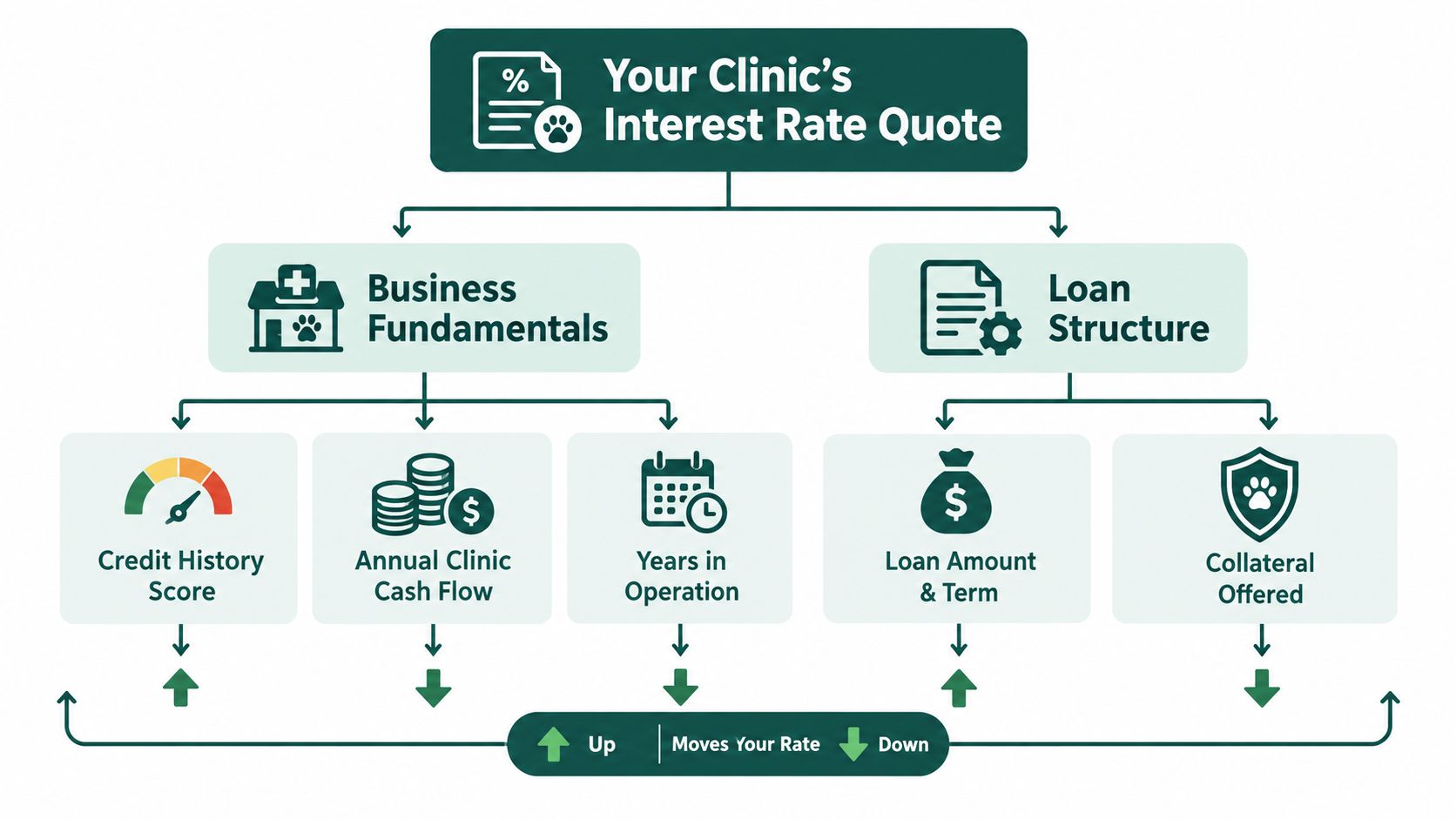
A clinic preparing for payroll, inventory, or a receivables gap may receive different rate quotes from lenders. The reason is that pricing reflects several signals together. Those signals can look different for a single-location general practice, an emergency hospital, or a multi-location group.
Business fundamentals
Credit history shows how the owners and clinic have handled past obligations. On-time payments can support lender confidence, while recent delinquencies, repeated inquiries, or unresolved debt may produce more cautious pricing. Confirm whether the review includes business credit, personal credit, or both.
Cash flow and deposits help a lender judge whether ordinary operations can support repayment. Regular deposits and reconciled accounts usually provide a clearer picture than strong revenue paired with irregular cash movement. Separate recurring clinical receipts from one-time events, owner transfers, and unusual deposits so the lender can evaluate the practice's normal cash cycle.
A clinic's collection pattern matters here. A practice that receives payments steadily may support a different repayment plan from one that waits longer for insurance or account receivables, even when both report similar revenue.
Time in business and revenue stability distinguish an established operating pattern from a recently opened clinic still building its client base. Seasonal demand is not automatically a problem. The clinic should explain the pattern and show how it handles payroll, inventory, and receivables during slower periods.
Multi-location groups should document intercompany transfers and location-level performance. Without that context, consolidated deposits or uneven results between locations can make the business appear harder to assess.
Loan structure
Loan size and term affect both pricing and repayment pressure. Under SBA 7(a) rules, larger facilities can carry a lower permitted spread over the base rate, as documented in SBA lender guidance. Borrowing more is not automatically cheaper overall. The requested amount can, however, affect the margin applied to the facility.
Collateral and guarantees change the lender's exposure. Eligible collateral or a guarantee may improve access or pricing, while increasing the owner's or clinic's risk if repayment fails. Ask what secures the obligation and whether a guarantee applies before comparing rates.
The lender evaluates these factors as a group. Strong deposits may help offset a shorter operating history, while useful collateral may not solve a payment schedule that conflicts with the clinic's collection cycle. A slightly higher rate can therefore produce a lower practical cost if its structure matches incoming cash and reduces the need to borrow again.
A pre-application check
Before applying, review:
- Credit records: Check for errors, late payments, and existing obligations.
- Bank activity: Reconcile deposits and identify overdrafts or unusual transfers.
- Revenue pattern: Note seasonal demand, recurring services, and large fluctuations.
- Debt capacity: Compare current payments with ordinary operating cash flow.
- Funding purpose: Match the requested amount to a defined payroll, inventory, or receivables need.
Clear records give the lender less uncertainty to price. They also help you compare offers by total cash leaving the clinic, not only by the quoted rate.
How Rates Differ by Loan Product and Structure
A clinic may receive a lower stated rate yet face a heavier repayment burden. The practical cost depends on how the balance is calculated and how often cash leaves the practice. Monthly amortization, weekly or daily withdrawals, interest on the amount drawn, and factor-style pricing can produce very different results.
Comparing the main structures
| Product Type | Typical APR Range | Repayment Structure | Best Fit for Clinics |
|---|---|---|---|
| SBA-style term loan or line | Approximately 6%–13% APR | Stated APR, typically structured repayment or revolving availability | Planned working capital, payroll support, inventory, or recurring liquidity needs for qualified borrowers |
| Conventional bank facility | Approximately 6%–13% APR | Interest and principal under agreed bank terms, with payment timing set in the facility | Established clinics with documented cash flow and a preference for conventional underwriting |
| Online working capital product | Approximately 12%–35% APR or higher | May use weekly, daily, or other frequent payments, with fees varying by provider | Time-sensitive gaps where speed or flexible qualification matters |
| Short-term factor-rate product | Roughly 40%–110% APR-equivalent, depending on term length | Fixed total repayment or frequent remittances rather than conventional amortization | Very brief gaps only when the clinic can repay without disrupting core operations |
These ranges are comparison bands from working capital loan market snapshots, not a promise for any particular clinic. The same quoted rate can have a different cash-flow effect depending on payment timing.
A term loan provides a defined amount with a scheduled repayment plan. It can suit a known inventory order or planned payroll bridge. A line of credit provides access up to an approved limit, allowing the practice to draw only what it needs. That can reduce interest on unused availability, although the agreement may include fees or variable pricing.
A short-term online product may fit a brief timing gap. For example, a clinic might need supplies immediately to keep scheduled procedures on track while receivables are expected soon. A higher rate can cost less in practice if the product is repaid quickly and its payment cadence follows those incoming receipts.
The risk changes when short-term financing covers a long-term deficit. Frequent fixed withdrawals can strain a clinic that already lacks enough operating cash each cycle. Before signing, compare total repayment, every fee, payment frequency, first payment date, and the projected cash balance after each withdrawal.
Clinics waiting on unpaid invoices can also examine accounts receivable financing for veterinary practices. Converting eligible receivables into working cash may fit a collection-timing problem better than taking a product with frequent repayments. The right comparison is the cash cost of the full structure, not the headline rate alone.
Typical Working Capital Loan Interest Rate Ranges Today
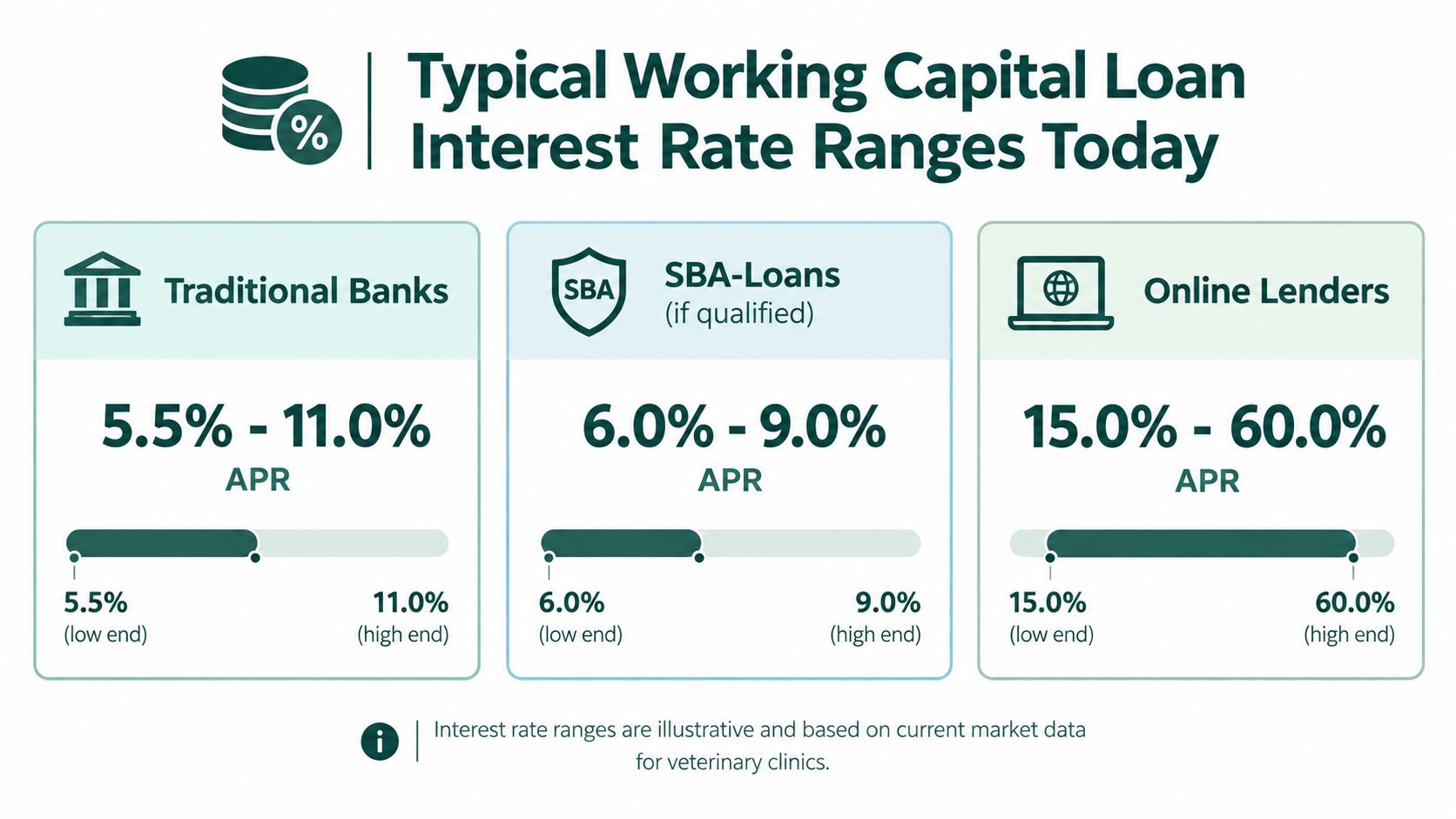
A clinic may see a quoted rate that looks attractive until repayment timing exposes the actual cost. Current market summaries place roughly 8%–13% APR within reach for SBA or bank-qualified borrowers, while shorter-term online financing can exceed 60% effective APR when the provider uses a factor rate instead of conventional interest. The 2026 working capital loan rate overview provides a broad reference point, not a universal clinic rate card.
A practice with stable deposits, complete records, and an appropriately sized request may receive pricing near the lower end. A newer clinic, uneven cash flow, or a need for rapid funding can produce a higher quote. Those ranges also describe different repayment structures, so comparing percentages alone can mislead. A higher rate may cost less in practice when a short facility clears a brief timing gap, while a lower rate can strain cash flow if repayments arrive before insurance or client receipts.
The prime-rate effect
Variable working capital financing follows the broader rate cycle. From December 2008 through December 2015, the prime rate stayed at 3.25%, while larger SBA 7(a) variable loans with maturities of seven years or longer were approximately 6.0%. By early 2026, the comparable large-loan SBA variable benchmark had reached about 9.75% to 11.25%, depending on loan size and structure. Smaller tiers could reach 12.25% to 13.25%, as described in this historical SBA loan rate analysis.
An older quote may therefore be a poor comparison. The change from the 3.25% prime era to a 6.75% prime environment roughly doubled all-in pricing for many borrowers, according to the same analysis.
Reading your quote
Ask the lender to identify the base rate, spread, reset frequency, and conditions that allow the rate to change. SBA ceilings are tied to the base rate rather than a fixed nominal APR, so a variable facility can move with market conditions. Loan size also affects permitted pricing. Under the SBA's 7(a) rules, maximum spreads range from base plus 6.5% in the smallest tier to base plus 3.0% above $350,000.
Compare the payment schedule with the clinic's collection rhythm. A quote near 9% and one near 13% may both be reasonable after considering size, risk, term, structure, and the cash cost of each repayment.
Practical Ways to Lower Your Cost of Capital
Lowering the working capital loan interest rate is only one possible improvement. You can also reduce the total cost by choosing a better-sized facility, avoiding unused borrowing, and preventing payment timing from damaging daily liquidity.
Start with a cleaner repayment story
Give the lender organized bank statements, current financial statements, debt schedules, and a short explanation of seasonal patterns. Reconciled deposits help distinguish recurring clinic revenue from owner contributions or one-off transfers. A clear use-of-funds plan can also prevent the lender from pricing an open-ended request as if the purpose were uncertain.
Improve credit before applying when the timeline allows. Review outstanding obligations, correct reporting errors, and avoid taking on unnecessary new debt immediately before the application. These steps won't guarantee a lower quote, but they can make the clinic easier to underwrite.
Borrow for the actual gap
Oversizing a facility can increase total interest and tempt the practice to use funds for expenses that don't generate a clear cash-flow return. Undersizing can force a second application or leave payroll exposed. Build the request around the timing of supplier bills, payroll, and expected collections rather than choosing an amount based only on the maximum available.
For SBA-style borrowing, larger loan tiers may carry lower permitted spreads, as established in the SBA pricing rules. That benefit must be weighed against the cost of borrowing money the clinic doesn't need.
Match payment timing to receipts
Monthly payments may fit a clinic whose collections arrive in predictable cycles. Weekly or daily withdrawals can create pressure when insurance, referral, or client receivables arrive later. A line of credit may be more efficient for a recurring gap because the practice draws and pays interest on the amount used, but availability fees and variable pricing still require review.
A shorter term may reduce the period of outstanding debt, while a longer term may preserve liquidity through lower scheduled payments. Neither is automatically cheaper for every clinic.
Compare the complete offer
Use a written comparison that includes:
- Net proceeds: How much reaches the clinic after fees?
- Total repayment: What will the practice pay from start to finish?
- Payment cadence: Are withdrawals daily, weekly, or monthly?
- Rate behavior: Is pricing fixed, variable, or based on another method?
- Early payoff terms: Does repayment reduce the cost, or is the charge fixed?
- Collateral exposure: What business or personal assets secure the facility?
For a broader framework on evaluating financing expense, review this guide to the total cost of capital.
Before your lender call: Bring a cash-flow forecast, current debt schedule, documented use of funds, and a comparison sheet that shows both rate and repayment timing.
Choosing the Right Working Capital Rate for Long Term Stability
The right working capital loan interest rate is the one that supports the clinic after funding, not merely the one that wins a spreadsheet comparison. A practice needs enough liquidity to pay staff, maintain inventory, handle repairs, and absorb normal collection variation after the new payment begins.
Use a simple two-offer test. First, calculate the total dollars repaid and the net funds received. Second, place every payment on the clinic's expected cash-flow calendar. Third, test a slower collection period and ask whether the practice can still meet payroll and essential supplier obligations. Finally, identify whether the facility ends after a defined term or encourages repeated borrowing.
A lower APR with a longer amortization may protect liquidity when the clinic's revenue is uneven. A higher-rate facility may be cheaper in practice when the gap is brief, the repayment is aligned with incoming receipts, and the product avoids carrying a larger balance for longer than necessary. The decision depends on duration, cadence, fees, and operational fit, not the headline rate alone.
Ask the lender to explain the base rate, spread, fees, payment calculation, reset terms, collateral, guarantees, and early repayment treatment in plain language. If the answer doesn't make sense alongside your cash-flow forecast, the offer isn't ready for approval.
Veterinary Practice Loans provides financing options for clinic working capital, equipment, acquisitions, startups, and expansion, with guidance focused on comparing terms, amortization, and total cost. Visit Veterinary Practice Loans to discuss a working capital structure that fits your clinic's payroll, inventory, and receivables cycle.
