

You're reviewing a veterinary practice that looks attractive on paper. Revenue appears steady, the seller describes a loyal client base, and the equipment seems ready for another owner. Then the underlying records arrive. Bank deposits don't reconcile to reported cash revenue, a lead veterinarian may not stay, the lease has little remaining certainty, and several major assets are approaching replacement. Each issue can change the price, the financing structure, or whether the acquisition makes sense at all.
A due diligence checklist when buying a business should follow an ordered workflow, not a document dump. Establish financial capacity first, uncover debt and liabilities, validate revenue quality and customer relationships, test staffing and compliance, then assess the facility, equipment, and post-close capital needs. That sequence helps you separate purchase-price risks from problems that may not reduce the seller's price but will weaken cash flow after closing.
The process also answers the lender's practical questions. Can the practice repay acquisition debt from verified cash flow? Will the lease support the loan term? Will veterinarians, technicians, and clients remain after ownership changes? Are controlled-substance records, permits, contracts, and equipment liens in order? A completed checklist gives your attorney, accountant, and lender the evidence needed to evaluate ownership transition, collateral, working capital, and closing certainty.
1. Financial Statements and Revenue Verification
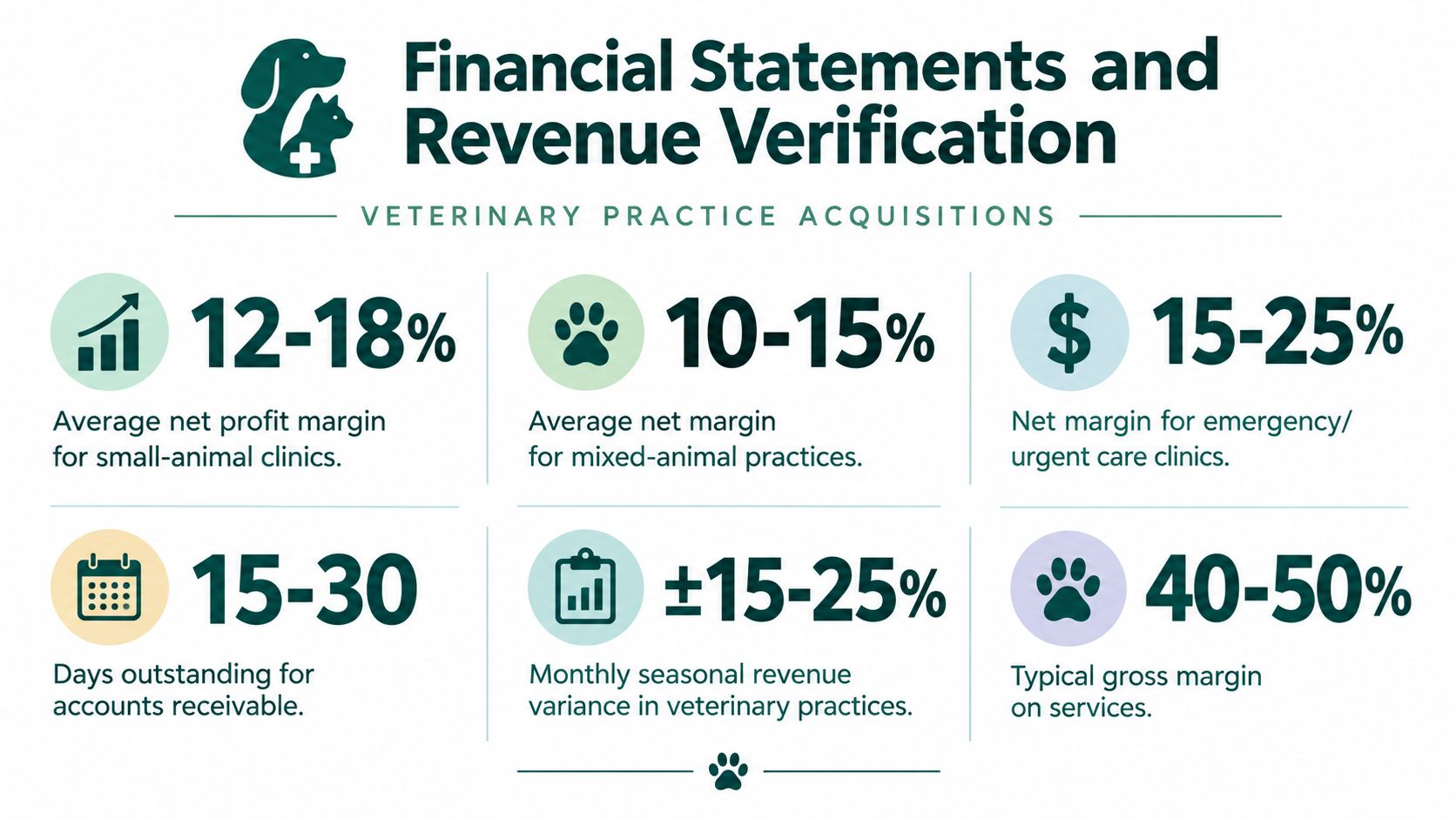
A veterinary practice's profit and loss statement is a starting point, not proof of sustainable earnings. Request income statements, balance sheets, cash flow statements, federal tax returns, general ledgers, and business bank statements for the available historical period. Lender diligence guidance also calls for reconciling bank deposits to reported cash revenue and testing whether inventory and assets could be converted to cash.
For a veterinary practice, review revenue by service line instead of relying on one annual total. Separate preventive care, surgery, dentistry, emergency work, boarding, retail, pharmacy, and other services. Reconcile each category to production reports, appointment volumes, procedure records, patient counts, and deposits. Strong reported revenue may depend on one clinician, an unusual billing period, or income that will not transfer reliably to a new owner.
Test earnings quality before discussing debt financing
Ask the seller and CPA to identify owner-specific expenses, one-time repairs, related-party payments, unusual payroll, and revenue that will not recur. Each add-back needs supporting documentation and a clear explanation of its post-close treatment. A lender will usually focus more on verified cash flow than on an attractive adjusted EBITDA figure.
Build the review file around evidence:
- Historical statements: Obtain income statements, balance sheets, cash flow statements, tax returns, and bank statements, then reconcile material differences.
- Revenue detail: Divide revenue into clinical and nonclinical service lines, then identify changes in mix, pricing, and volume.
- Deposit testing: Have your CPA compare reported cash revenue with bank deposits and investigate unexplained gaps.
- Working-capital evidence: Review inventory, accounts receivable, accounts payable, and recurring cash requirements. Reported profit is not the same as cash available after closing.
- Location detail: For multiple sites, request both consolidated and location-level results. A strong location can conceal a weak one.
Verify the cash conversion before setting a purchase price or sizing acquisition debt. The same evidence also shows whether the buyer will need working capital after closing for payroll, inventory, repairs, or other operating demands.
Deal timing affects what the review can uncover. Historical M&A analysis covering more than 40,000 transactions over roughly 40 years places the rate of deals failing to create expected value between 70% and 90%, depending on methodology, with one summary identifying 70% to 75% as the best-supported estimate. That analysis also says quality diligence typically requires 60 to 90 days. A rushed review can leave EBITDA errors, customer issues, or cash-flow weaknesses undiscovered.
Use the veterinary practice net operating profit after taxes guidance when translating operating results into an acquisition model. The final underwriting case should still rest on source records, reconciled deposits, documented adjustments, and cash-flow assumptions that the buyer, accountant, attorney, and lender can review.
2. Debt and Liability Assessment
A veterinary practice can show healthy earnings while existing obligations consume the cash a new owner needs for payroll, inventory, repairs, and debt service. Build the liability file from documents, not memory. Request the latest balance sheet, loan statements, vendor aging, payroll and tax records, lease agreements, employment commitments, insurance claims, litigation disclosures, warranties, and correspondence about disputed amounts. Match every listed obligation to a contract, statement, filing, or other supporting record.
Start with financed assets. For each loan or line of credit, obtain the original agreement, current payoff statement, collateral description, interest rate, maturity date, payment schedule, and prepayment terms. Imaging systems, anesthesia equipment, laboratory analyzers, surgical assets, and information technology can carry liens that affect an asset purchase. Confirm whether each debt will be paid at closing, assumed by the buyer, or refinanced within the acquisition structure.
Define what transfers at closing
The purchase agreement should identify transferred and excluded liabilities with precision. Review pharmaceutical supplier balances and payment arrangements closely. Ownership changes can lead suppliers to impose different terms or require faster payment, creating a working-capital need even when the outstanding balance appears manageable.
Lease obligations require a separate decision because assignment and landlord consent may determine whether the practice can continue operating from its current location. Check renewal rights, rent escalation provisions, maintenance duties, personal guarantees, default provisions, and change-of-control language. Obtain written confirmation of any required consent before treating the lease as transferable.
Use the liability file to answer the lender's main questions:
- Debt service: Compare projected payments with verified operating cash flow. Model the effect of weaker collections, staffing changes, and post-close repairs rather than relying on an unsupported coverage target.
- Collateral: List the assets securing existing loans and identify releases required before the buyer can pledge them.
- Guarantees: Determine whether the seller has personal guarantees and whether the current lender will release or replace them after transfer.
- Unreported claims: Reconcile the schedule with credit reports, tax records, UCC filings, vendor statements, and legal disclosures.
The Fundenza commentary on diligence-stage transactions reports that 38% of transactions entering due diligence don't close, while 62% of completed deals still experience a price adjustment during or after diligence. It attributes roughly half of failed diligence-stage deals to unacceptable findings and the other half to price gaps created by the process. These figures support a practical point for veterinary buyers: liability review protects value and financing capacity, not just closing paperwork.
Resolve documented obligations through a seller payoff at closing, escrow, purchase-price reduction, lender-approved assumption, or specific indemnity. If the seller cannot document an obligation or identify who will satisfy it, treat the uncertainty as a closing condition and a potential post-close cash-flow risk.
3. Customer Base and Revenue Stability
A veterinary practice can report strong revenue while depending on relationships that belong to a specific veterinarian, location, or referral arrangement. Validate the customer base before treating historical sales as financeable earnings. Request an anonymized database export showing account identifiers, pet type, last visit date, lifetime revenue, appointment history, service categories, and outstanding balances.
Have the practice-management-system administrator or vendor explain how the export was produced. Reconcile active records with appointment logs, invoices, wellness plans, email permissions, and deposit activity. Look for duplicate households, inactive accounts, missing contact details, and pets not seen for an extended period. Poor data quality can inflate retention and cross-sell assumptions.
Test concentration and owner dependence
Rank revenue by client and account, then identify the source of each relationship. Separate individual pet owners from breeders, boarding relationships, farms, shelters, corporate accounts, and referral arrangements. For material accounts, request contracts and correspondence, check for change-of-control provisions, and determine whether the relationship depends on the seller personally.
M&A guidance on customer data quality notes that B2B data can decay by 25% to 30% annually. Apply the same verification discipline to veterinary records. Test freshness, consent, duplicates, missing contacts, and discrepancies between systems before using the database to support valuation or lender projections.
Review the evidence that connects the client file to future cash flow:
- Retention behavior: Calculate repeat visits from the practice's appointment and invoice history, using one consistent measurement period. Investigate whether returning clients use routine care, diagnostics, surgery, pharmacy, or other services.
- Revenue concentration: Rank clients and accounts by revenue and model the cash-flow effect if a major relationship does not transfer.
- Scheduling quality: Examine cancellations, no-shows, appointment lead times, reminder workflows, and unused capacity. These records can reveal whether reported demand converts into completed visits.
- Relationship ownership: Where legally and ethically appropriate, assess whether clients identify with the clinic, its location, or a particular veterinarian.
- Communication assets: Verify ownership and access to email lists, phone numbers, social profiles, loyalty programs, and wellness-plan records. Confirm that consent and transfer practices support post-close communication.

The financeable finding is a repeatable pattern of visits, collected revenue, documented consent, diversified service use, and a credible transition plan. Declining activity, owner-specific loyalty, or unverified accounts should affect the valuation, seller transition obligations, and working-capital reserve. They may also require lender-approved adjustments to projected post-close cash flow.
4. Staff Credentials, Retention, and Employment Agreements
A clinic can show strong historical earnings and still become difficult to finance if the lead veterinarian leaves after closing. Patients may follow a trusted clinician, while technicians retain operational knowledge and support staff keep scheduling, pharmacy, inventory, and client communication working. Treat staffing as evidence of future cash flow, not only as an expense line.
Request an employee census listing each person's role, start date, compensation, production incentives, benefits, scheduled hours, leave obligations, and employment status. Obtain signed agreements for veterinarians, managers, technicians, and other key employees. Review termination rights, malpractice coverage, confidentiality, ownership of records, restrictive covenants, bonuses, and promises that do not appear in payroll records.
Verify licenses and transition capacity
Confirm every veterinarian's license through the applicable state veterinary board. Check controlled-substance responsibilities and registrations where relevant. A veterinary-focused attorney should review licensing status, professional discipline, complaints, malpractice history, and continuing-education records rather than relying on a résumé.
Test the operating model if the lead veterinarian is unavailable. Document backup coverage, cross-trained technicians, clinical protocols, delegated authority, and the manager's ability to run daily operations. Confidential interviews with key employees can reveal retention risks, undocumented duties, and concerns about the ownership change. Use a process that protects confidentiality and avoids disrupting the seller's business.
The question is whether the practice has enough documented capability to operate when one person is absent.
Build the financing model from actual retention requirements. Include possible transition bonuses, recruiting costs, wage adjustments, benefit changes, training, temporary coverage, and production guarantees. Use payroll records, signed agreements, accountant guidance specific to the market, and written offers that key employees are prepared to accept. These costs affect post-close cash flow and working-capital needs, even when they do not justify a lower purchase price.
Review turnover by role and ask why employees left. A stable doctor group with repeated support-staff departures may indicate management, scheduling, workload, or culture problems. Those risks can reduce appointment capacity, increase payroll costs, and delay debt repayment after closing.
Restrictive covenants may protect client relationships in some transactions, but enforceability varies by state and situation. Counsel should review them before assigning value to that protection. Closing documents should cover records access, transition introductions, staff notices, and the seller's availability for training. Obtain written evidence of expected retention and coverage, then give the lender and accountant a clear distinction between purchase-price risk and the cash required to operate after closing.
5. Regulatory Compliance and Licensing
Before valuing a veterinary practice, confirm that it can legally provide care after the ownership change. Review veterinary board requirements, controlled-substance rules, pharmacy permissions, OSHA obligations, zoning, facility permits, medical-waste handling, animal-welfare duties, and any boarding or overnight services. An expired permit or unresolved complaint may be easy to correct, or it may limit the practice's operating model and financing options.
Build the file from documents, not verbal assurances. Request inspection reports, complaint records, notices, corrective-action plans, permits, registrations, and regulator correspondence. Ask the seller to disclose pending investigations, audits, citations, and informal warnings, including matters that have not produced a formal penalty. Counsel should determine whether each license transfers, requires a new application, or depends on the buyer's professional ownership structure.
Test controlled-substance records against actual operations
Controlled substances require evidence-level review. Examine inventory procedures, dispensing logs, storage controls, reconciliation records, disposal records, and reports filed after loss or theft. Compare written policies with staff workflows and transaction records. A policy manual shows what should happen, not what has happened.
Confirm zoning and facility permissions with the relevant local authority. A clinic may have operated for years under an unapproved use, while a renovation may have changed permit requirements. Check building, environmental, fire, signage, waste, and occupancy documentation that applies to the property.
Track each issue in a remediation register:
- Finding: State the violation or uncertainty precisely.
- Evidence: Attach the inspection report, permit, complaint, or regulator correspondence.
- Owner: Assign responsibility to the seller, buyer, landlord, or outside contractor.
- Resolution: Set a cure date, closing condition, escrow amount, or post-close work plan.
Medical waste, sharps, pathological materials, pharmaceuticals, and biohazards need documented disposal procedures and pickup records. Inspect storage areas and identify who receives manifests. For boarding or overnight care, verify the separate animal-care and facility requirements rather than assuming the medical-practice license covers those services.
The financing model should show whether compliance work is a purchase-price issue or a post-close cash requirement. Regulatory findings can affect price, closing timing, insurance, lender confidence, and working capital. A minor issue with a documented cure may be manageable. Missing records, undisclosed complaints, or unclear ownership authority warrant legal review and may require seller remediation before closing.
6. Equipment Inventory, Condition, and Financing
A clinic can appear fully equipped while carrying immediate repair costs, outdated systems, or debt that follows the assets. Walk through every treatment room, surgery area, laboratory, pharmacy, reception space, and back office with the inventory in hand. Record the manufacturer, model, serial number, purchase date, condition, maintenance status, calibration history, ownership, and financing status for each material asset. “Included” in the seller's list does not prove clear ownership, working condition, useful life, or transferability.
Classify equipment by clinical importance and replacement exposure. Imaging, anesthesia, sterilization, laboratory, dental, refrigeration, communication, network, and practice-management systems create different risks. A machine that works during the inspection may still require a service contract, software license, replacement part, or integration expense shortly after closing.
Price replacement capital separately from purchase value
Request maintenance, repair, calibration, and service records. Have a qualified veterinary equipment specialist inspect major assets, confirm serial numbers, and identify parts or support that may no longer be available. Frequent repairs, missing calibration records, poor image quality, outdated software, or unavailable parts weaken the value assigned to the equipment. Check for liens, leases, security interests, and payoff amounts, then reconcile those obligations with the purchase agreement and closing statement.
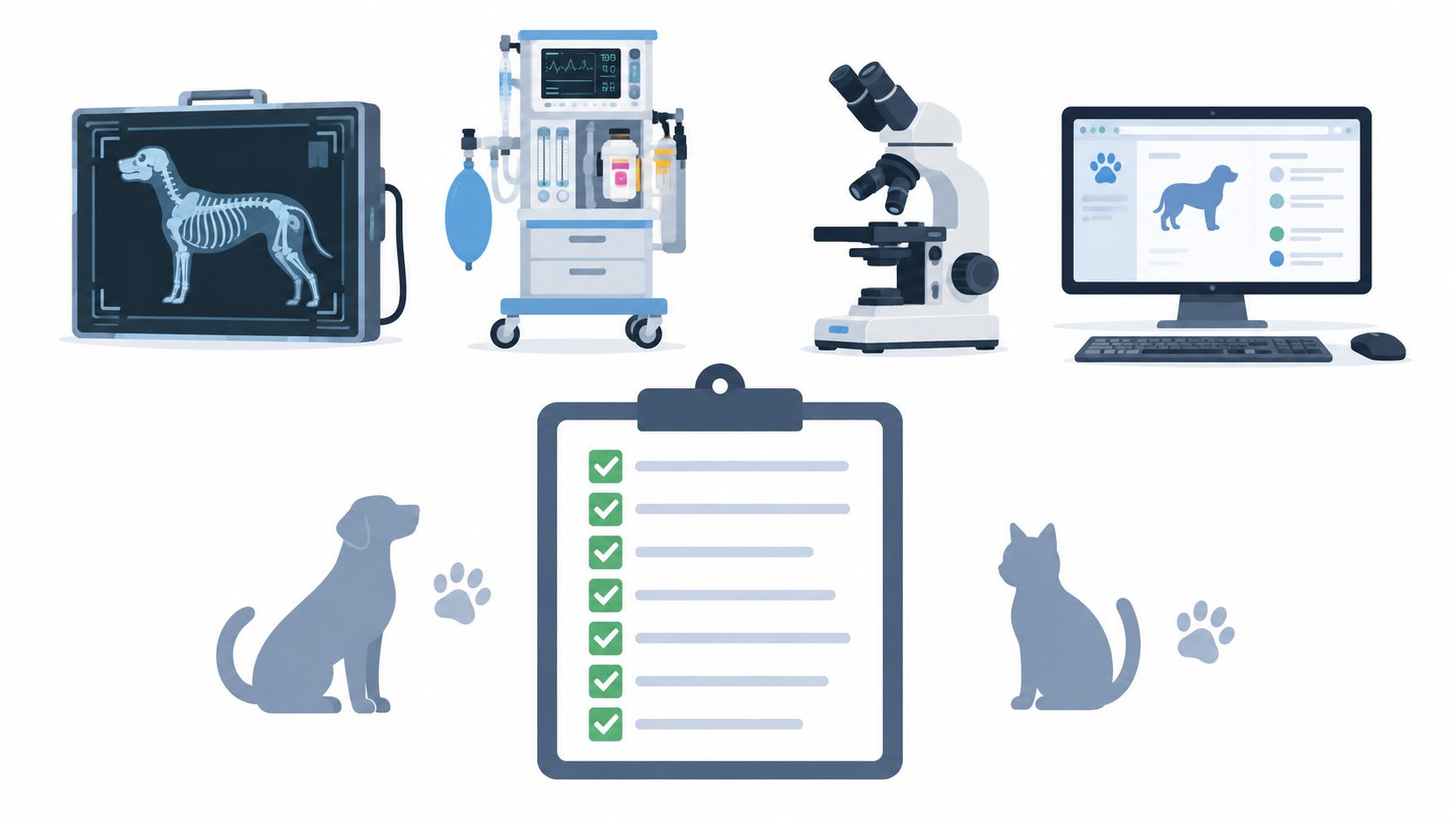
Review the practice-management system, EMR access, backups, cybersecurity controls, network design, user permissions, service contracts, and data-export capability. Confirm that diagnostic equipment communicates with the existing systems and that access and data can transfer at closing. Replacing one component may also require migration, retraining, subscriptions, or integration work.
Separate two decisions: Set the equipment value used in the purchase price, then calculate the replacement capital the clinic needs after closing.
Build a replacement schedule based on condition and clinical necessity. Include immediate repairs, service contracts, planned replacement, installation, staff training, downtime, and financing payments. For equipment financing and leasing structures, review Veterinary Practice Loans equipment financing and leasing as one reference, then compare the proposed repayment terms with expected equipment use and post-close cash flow.

Use the video below as a practical prompt for inspecting equipment categories. Qualified professionals should validate condition, compliance, ownership, and financing assumptions before those findings affect price or lender approval.
7. Real Estate and Lease Analysis
A practice can show strong earnings and still become difficult to finance if its premises are uncertain. Request the complete lease, amendments, side letters, notices, renewal exercises, rent statements, and landlord correspondence. Review these documents with the attorney, because a seller's summary may omit assignment restrictions, maintenance disputes, personal guarantees, restoration duties, or a renewal deadline that arrives shortly after closing.
Calculate the full occupancy burden. Include base rent, common-area charges, taxes, insurance, utilities, repairs, waste services, parking, signage, and required capital work. Compare that total with verified cash flow and projected debt payments. A facility that works operationally may still leave too little cash for debt service, staffing changes, equipment replacement, or other post-close needs.
Landlord consent belongs in the transaction plan. Examine assignment and change-of-control provisions, including situations where the selling entity remains in place. Obtain the landlord's position on payment history, maintenance responsibilities, unresolved disputes, planned property work, and approval of the buyer before the deal becomes difficult to unwind.
Use the site visit to test whether the premises support the clinical plan:
- Building condition: Inspect HVAC, plumbing, electrical capacity, roofing, flooring, lighting, accessibility, and parking.
- Clinical layout: Check exam-room flow, surgery separation, isolation capacity, pharmacy security, storage, and client circulation.
- Expansion potential: Identify unused space, shared-tenant restrictions, structural limits, and landlord approval requirements.
- Renewal certainty: Confirm option dates, notice procedures, escalation formulas, and the economic terms that would apply.
- Ownership documents: If the property is included, review title, liens, environmental concerns, easements, and building records.
The lease term should support both the operating plan and the proposed financing term. A lender may question long-term acquisition debt when the buyer's right to occupy the premises could end before the projected debt repayment period. Confirm the timeline early, not during final underwriting.
If renewal is near, seek an extension or replacement lease before closing, subject to legal review. If the landlord will not provide reasonable certainty, reflect that risk in the price, structure, or closing conditions. A lower purchase price does not resolve the practice's inability to operate from its current location.
For an owned property, separate real-estate value from practice value. Obtain the appropriate appraisal, title review, environmental assessment, and allocation of consideration. These findings can change available collateral, taxes, insurance, and the loan structure.
8. Accounts Receivable and Collection Practices
Revenue becomes usable cash only after collection. Request an accounts-receivable aging report dated near the analysis date, then reconcile it with the general ledger and bank activity. Separate balances by payer type, including pet owners, insurers, corporate accounts, payment-plan providers, and other arrangements used by the clinic.
The balance alone does not establish value. For each material category, identify who owes the money, when the balance arose, whether the underlying service is documented, and whether the buyer will receive the collection benefit after closing. The purchase agreement should state whether pre-close receivables remain with the seller, transfer to the buyer, or require a defined allocation of collections and costs.
Test collectibility before treating receivables as an asset
Review bad-debt write-offs, refunds, credit memos, disputed invoices, payment-plan defaults, insurance denials, and collection-agency activity. Match aged balances to receipts posted after the reporting date. Long-outstanding balances may be overstated, especially when prior write-offs or denials are inconsistent.
Observe the collection process rather than relying only on written procedures. Ask who collects at checkout, who approves payment plans, how declined cards are handled, and when staff send reminders, place accounts on hold, or refer balances externally. Historical behavior and results should support the stated policy.
Prioritize these tests:
- Aging integrity: Reconcile the aging report to the ledger and investigate manual adjustments, unusual credits, and recently reclassified accounts.
- Insurance timing: Sample claims from submission through payment, recording denial, resubmission, and delay patterns.
- Payment plans: Review approval criteria, terms, defaults, security, and responsibility after closing.
- Cash conversion: Compare invoiced services with deposits and assess liquidity for payroll, inventory, and debt service.
- Closing allocation: State who owns pre-close receivables, who collects them, and who pays related collection costs.
Have the CPA reconcile the last 12 months of bank deposits to reported cash revenue and test whether inventory on hand is salable. This source-document review gives the lender a better basis for evaluating repayment capacity than summary reports alone.
If receivables may support borrowing, review accounts receivable financing for veterinary practices. Eligibility depends on collection quality, documentation, transfer rights, and lender criteria. Financing should support verified receivables, not conceal weak collection performance. Confirm that balances are real, collectible, and transferable before assigning them value in the purchase or post-close cash-flow plan.
8-Point Due Diligence Comparison for Buying a Business
| Item | Implementation complexity | Resource requirements | Expected outcomes | Ideal use cases | Key advantages |
|---|---|---|---|---|---|
| Financial Statements and Revenue Verification | Medium–High, requires accounting analysis and trend reconciliation | 3–5 years financials, tax returns, bank statements, analyst time | Verified revenue trends, margins, seasonality, accurate loan sizing | Acquisition valuation, financing, performance benchmarking | Establishes baseline profitability and cash‑flow patterns; uncovers one‑time items |
| Debt and Liability Assessment | High, legal and contract review plus lien searches | Debt schedule, loan docs, UCC filings, legal counsel | Complete liability picture, debt service metrics, transfer obligations | Purchase negotiations, refinancing, structuring assumed debt | Prevents inheriting hidden obligations and enables debt assumption/refinance decisions |
| Customer (Pet Owner) Base and Revenue Stability | Medium, CRM/production analysis and sample stakeholder checks | Client database export, appointment history, marketing metrics | Client retention rates, revenue concentration, predictability | Assessing post‑close revenue risk, retention strategy, growth planning | Identifies concentration risk and retention gaps; informs client retention plans |
| Staff Credentials, Retention, and Employment Agreements | Medium–High, credential verification and contract review | Employment agreements, license checks, HR interviews, background checks | Key‑person risk assessment, retention needs, compliance status | Transition planning, budgeting retention incentives, regulatory compliance | Ensures licensed workforce, reveals key‑person dependencies, supports retention planning |
| Regulatory Compliance and Licensing | High, specialized veterinary regulatory/legal review | Inspection reports, permits, DEA/state board records, veterinary legal counsel | Compliance status, remediation plan, licensing transferability | Pre‑acquisition legal risk assessment, multi‑state operations | Prevents fines/license suspensions and ensures legal operation post‑acquisition |
| Equipment Inventory, Condition, and Financing | Medium, technical condition assessments and financing review | Equipment list, maintenance records, vendor contracts, equipment specialist | Condition report, remaining useful life, replacement and capex plan | Capital planning, equipment financing/refinance, operational continuity | Reveals deferred maintenance, budgets capex, identifies refinancing opportunities |
| Real Estate and Lease Analysis | Medium–High, lease legal review and facility inspection | Lease and amendment docs, landlord contact, facility walk‑through, title/ESA if owned | Occupancy cost, renewal/assignment risk, expansion potential | Location valuation, refinancing, expansion or relocation decisions | Identifies lease risks, clarifies landlord obligations, highlights below‑market rates |
| Accounts Receivable and Collection Practices | Low–Medium, AR aging and policy audit | AR aging schedule, GL reconciliation, collection policies, insurer data | DSO, bad‑debt exposure, cash‑flow timing and collection efficiency | Working capital planning, post‑close cash management, AR financing | Improves cash flow forecasting, quantifies collectability and AR risk |
Turn Findings Into a Financeable Acquisition Plan
Due diligence ends with decisions, not a larger folder. Put every finding into one of four outcomes: proceed, renegotiate price or terms, require a seller cure before closing, or walk away. This classification prevents a buyer from treating every problem as either harmless or fatal.
Proceed when the evidence supports the seller's earnings, the client and staff transition is credible, the facility is secure, and known capital needs fit the operating model. Renegotiate when the practice is viable but the price assumes stronger revenue quality, lower concentration, cleaner receivables, or better equipment than the records support. Require a seller cure when the issue can be resolved before closing, such as a lien release, missing permit, lease consent, payoff letter, or corrective compliance action. Walk away when the seller won't provide evidence, material risks remain unquantifiable, or verified cash flow can't support the proposed obligations.
Rebuild the purchase-price model
Recalculate the final price using verified earnings rather than the initial marketing package. Adjust for owner replacement costs, recurring payroll, normalized supplies, collections, taxes, debt payoff, working capital, and revenue that may not transfer. A seller's add-backs should improve the model only when the related expense disappears after closing.
Then separate purchase consideration from post-close cash needs. Include:
- Transition costs: Retention arrangements, recruiting, temporary coverage, training, and seller support.
- Compliance work: Permits, waste handling, controlled-substance controls, facility repairs, and legal remediation.
- Equipment reserves: Immediate repairs, service contracts, replacement assets, installation, software, and downtime.
- Working capital: Payroll, pharmaceutical inventory, supplies, receivables timing, and seasonal or irregular cash flow.
- Facility commitments: Rent changes, required improvements, deposits, insurance, and lease-related costs.
Diligence has become longer and more data-heavy. One independent study reports an average diligence phase of 203 days for deals completed from 2013 through 2022, compared with 124 days from 2008 through 2012. It also reports that older deals averaged 124 days of pre-announcement diligence, involved about 152 virtual data-room users, and included more than 34,000 pages of disclosures. Those figures support a staged process: review trailing financials, KPI trends, deposits, and customer concentration before exclusivity, then deepen legal, tax, cyber, operational, lease, and equipment review once access is justified. See the SS&C Intralinks due diligence report for that research.
Give the lender a decision-ready file
Assemble the completed document set with a veterinary-focused attorney, accountant, and lender. The file should include tax returns, financial statements, bank statements, revenue and production reports, customer concentration analysis, accounts-receivable aging, debt schedule, equipment inventory, lease and amendments, licenses, compliance records, purchase agreement, transition plan, operating projections, and the risk-remediation budget.
Your lender will want the model to connect evidence to repayment. Show how verified cash flow supports debt service, how the lease supports the loan term, how staffing changes affect payroll, how equipment reserves protect operations, and how working capital covers the gap between billing and collection. If the practice has variable or owner-dependent cash flow, explain the assumptions rather than burying them in an optimistic forecast.
Veterinary Practice Loans offers acquisition loans, working capital financing, equipment financing, startup funding, and expansion loans for qualifying veterinary operations. Terms and eligibility depend on the documentation, proposed structure, credit profile, cash flow, collateral, and applicable lender criteria. Prepare the prioritized lender package before requesting a final structure, so the financing conversation reflects the practice you're buying.
Start with a risk register that ranks each issue by dollar effect, closing urgency, operational impact, and owner responsibility. Then attach the evidence, proposed remedy, negotiation position, and lender treatment. That discipline turns a due diligence checklist when buying a business into an acquisition plan built for clinical continuity and financeable cash flow.
Veterinary Practice Loans offers acquisition loans, working capital financing, equipment financing, startup funding, and expansion loans for veterinary clinics. Visit Veterinary Practice Loans to discuss the documentation and financing structure that fit your proposed practice purchase.
