
You're looking at a clinic purchase, a build-out, or a partner buyout, and the financing question isn't academic anymore. The seller wants certainty, the bank wants clean numbers, and you need a structure that won't choke cash flow after closing. That's exactly where a veterinary practice SBA loan earns its place, if you use the right program for the right deal.
I'll be blunt. Most owners waste time asking, “Can I get SBA financing?” when the key question is, “Which SBA structure fits this transaction, and when is SBA a bad idea?” If you're buying goodwill, equipment, and maybe the building, the answer usually starts with SBA. If you only need fast working capital or a small equipment refresh, it often doesn't.
What a Veterinary Practice SBA Loan Actually Does
A veterinarian looking at a two-doctor clinic has two very different thoughts at the same time. One is excitement about ownership. The other is that the deal needs capital for the purchase, the transition, and probably some repairs or equipment right after closing. A veterinary practice SBA loan exists for exactly that kind of problem.
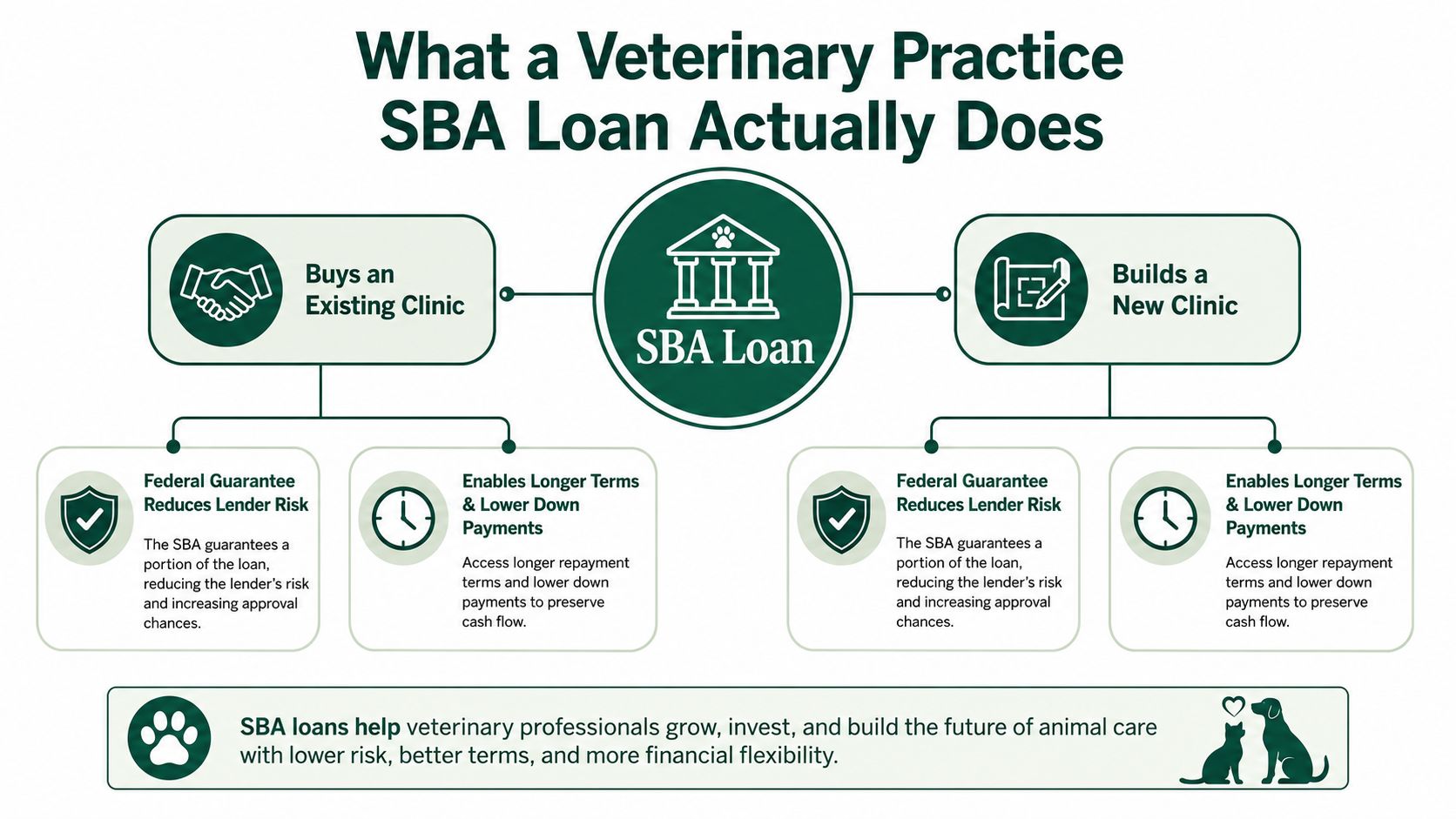
The Small Business Administration doesn't lend money directly. It backs a portion of a bank loan, which lowers lender risk and makes it easier for the bank to approve deals it might otherwise decline or structure too tightly. In veterinary practice financing, that matters because these transactions often need lower cash injection, longer amortization, and enough flexibility to cover both hard assets and the operating ramp after closing.
The real role SBA plays in practice ownership
For most owners, SBA is not the loan. It's the framework that makes the loan possible. That framework matters because veterinary clinics rarely need just one thing. They need acquisition financing, equipment money, and sometimes real estate money, all tied to the same ownership change.
The main programs are SBA 7(a) and SBA 504. Consider the 7(a) as the flexible structure for buying a practice, funding working capital, and combining several uses into one term loan. Consider the 504 as the tool for real estate and fixed assets, one that fits owner-occupied property or long-lived assets better than a general business acquisition.
Practical rule: if the deal includes goodwill and operating assets, start with 7(a). If the deal is mostly a property play, 504 deserves a hard look.
That's the simplest way to filter the decision. If you're still deciding whether to buy an existing clinic or start from scratch, SBA is relevant in both cases, but it plays a different role. For a purchase, it can help you buy a going concern. For a new build, it can help you finance the clinic shell, the fit-out, and the opening run-up without forcing you into a pile of separate notes.
The right lens is not “Is SBA available?” The right lens is “Does SBA match the asset life and the ownership structure?” If the answer is yes, it's worth the time. If not, you should move on quickly.
SBA 7(a) Versus SBA 504 for Veterinary Clinics
Here's the clean answer. SBA 7(a) is the workhorse for most veterinary deals because it can bundle acquisition, equipment, build-out, and working capital into one amortizing facility up to $5 million and finance up to 90% of a project. It can amortize over 10 years for a business purchase or up to 25 years when real estate is included, and the SBA guarantees up to 85% of qualifying 7(a) loans.
SBA 504 is narrower. It is built for owner-occupied real estate and other long-lived fixed assets. In mixed real estate deals, that difference drives the structure. SBA 504 can finance up to 90% of covered expansion costs and carries occupancy rules such as 75% for new construction and 51% for existing buildings (dvm360 on long-term financing and tax cuts).

The decision rule is simple. If the deal is mainly about the practice itself, meaning goodwill, equipment, or a partner buyout, 7(a) wins. If the transaction is dominated by the building or a major fixed-asset expansion, 504 usually wins because it is designed for that purpose and keeps the fixed-asset debt in its own lane.
Split structures often make the most sense in mixed deals. A buyer may use 7(a) for the acquisition side and 504 for the real estate side, but only when the transaction, occupancy, and lender appetite line up. Do not force a 504 structure onto a deal that is really about goodwill. Do not force 7(a) to behave like a real estate-only loan when the property piece is the true long-term asset.
For a deeper view of the acquisition side, review the internal guide on veterinary practice acquisition financing.
The lender conversation should start with use of proceeds, not just rate. That is the part too many owners miss.
Eligibility and Documentation Veterinary Owners Need
SBA eligibility looks simple on paper and gets strict fast in underwriting. The borrower needs to be a for-profit U.S. business, the owners have to be active in the operation, the deal has to fit SBA size standards, and the borrower must show reasonable invested equity plus a believable path to repayment. If one of those pieces is thin, the file slows down or falls apart.
A veterinary buyer should clear the basics before the lender sees the file.
What I'd check before I'd submit a file
- Entity and ownership: confirm the clinic is set up as a qualifying business and the buyer will operate it.
- Equity: make sure the buyer has real cash at risk or seller financing that the lender will treat as equity.
- Repayment story: tie the loan request to clear cash flow, not optimism.
- Deal purpose: match the request to eligible SBA uses, especially if the transaction includes property.
- Business history: show stable operations, not just a sudden jump in revenue with no explanation.
That list is basic for a reason. Plenty of veterinary deals get sloppy right there. A lender does not care that the practice is busy if the file cannot show staying power after the handoff. It wants evidence that the business can carry debt once the ownership change is complete.
The document stack usually starts with business tax returns, personal tax returns, a personal financial statement, year-to-date profit and loss, a current balance sheet, a debt schedule, practice production reports, and a written business plan that explains the loan purpose and expected performance. Underwriting gets stricter, not looser, when the deal involves a clinic with uneven collections or a highly compensated owner who needs normalizing adjustments.
Missing production reports are a delay magnet. So are unexplained add-backs, irregular deposits, and a balance sheet that has not been reconciled.
SBA 504 has its own real-estate logic, including occupancy rules such as 75% for new construction and 51% for existing buildings (U.S. Small Business Administration). That matters if the clinic owns, or plans to own, the property.
The best preparation is boring. Clean tax returns, clean production reports, and a clean narrative beat a polished pitch deck every time. If the file has holes, fix them before you talk about terms.
How the SBA Application and Underwriting Timeline Actually Runs
A clean SBA file doesn't move in one shot. It moves in phases, and each phase has a different failure point. The borrower who understands that usually closes faster because they stop treating the process like a single application and start treating it like a managed project.

Where the file actually moves
- Initial lender screening. The lender checks whether the deal fits SBA rules and whether the clinic's story makes sense.
- Document collection. You assemble returns, financials, production data, and the transaction narrative.
- SBA portal submission and review. The loan is packaged and submitted for review.
- Underwriting. The bank analyzes the business and the principals, then clears conditions.
- Closing and funding. Final docs are signed and money moves.
A clean veterinary file can still get stuck. The slowest points are usually practice-management software exports, appraisal timing for the clinic or property, and environmental review on owner-occupied real estate. Those aren't glamorous problems, but they're the ones that burn weeks.
The smartest move is to work in parallel. Lock your rate conversation early, line up the equity, and build the transition plan while documents are still moving. If the seller is staying on for a handoff, get that schedule and role definition organized before underwriting starts asking questions.
The relevant thing to remember is this. SBA 7(a) can bundle acquisition, equipment, build-out, and working capital into one amortizing facility up to $5 million, while SBA 504 is better reserved for owner-occupied real estate or other long-lived fixed assets. That decision affects timeline because a mixed-use deal needs more coordination than a simple equipment note.
If your lender acts surprised by the file halfway through, you picked the wrong lender. A vet-focused file should be familiar territory, not a science experiment.
SBA Versus Conventional Financing Under Today's Rates
The current question isn't whether SBA loans exist. It's whether they still make sense when rates are higher and cash flow is tighter. Recent lender guidance places 2026 SBA 7(a) pricing in the roughly 10.25% to 11% range for larger loans, which makes amortization structure and any interest-only period highly material to monthly debt service (Today's Veterinary Practice on lending and capital funding).
Here's the way I'd frame it. SBA is not automatically cheaper. It can be smarter because it stretches the term, absorbs goodwill, and protects cash flow better on mixed-use and acquisition-heavy deals. But on a smaller transaction, the guarantee fee and longer packaging time can erase the advantage.
SBA 7(a) Versus Conventional Veterinary Practice Loan
| Factor | SBA 7(a) | Conventional Practice Loan |
|---|---|---|
| Typical fit | Acquisition, working capital, equipment, mixed-use deals | Clean, simpler borrowing needs |
| Term structure | Longer amortization, including real estate terms up to 25 years | Often shorter, more rigid |
| Down payment | Often lower because of SBA structure | Usually higher cash injection |
| Goodwill financing | Yes, that's a core strength | Usually limited or unavailable |
| Speed | Slower | Faster when the file is simple |
| Best use | Practice purchase, partner buyout, build-out | Shorter-term, simpler credit needs |
If you want the rate conversation in plain English, use SBA when the debt needs to behave like long-term ownership capital. Use conventional financing when you care more about speed and simplicity than structure. A smaller working capital need or a fast equipment refresh can be better handled outside SBA.
The monthly payment gap matters more than people admit. A lower rate on a short amortization can still produce a worse monthly burden than a slightly higher SBA rate over a longer term. That's why the payment structure matters as much as the headline pricing.
For owners comparing rate sheets in detail, the internal rate guide on veterinary practice loan rates belongs in the diligence stack.
The hard truth is this. If the deal is goodwill-heavy, SBA usually wins. If the deal is small, clean, and time-sensitive, conventional debt often wins. Judge the structure by the monthly payment and the use of proceeds, not by brand loyalty to one loan type.
Three Realistic Veterinary SBA Use Cases
The solo doctor with a promising offer on a two-doctor clinic usually has the same problem. The practice has value beyond the equipment on the floor, and the buyer doesn't want to tie up all their liquidity just to close. In those cases, the common structure is around 10% buyer equity with an SBA-backed senior term loan, and sometimes a subordinated seller note, because goodwill often represents roughly 60% to 80% of the purchase price in veterinary acquisitions.

Three deals I'd expect to see
- Acquisition: A solo doctor buys a $1.4 million two-doctor clinic with $140,000 of equity through SBA 7(a).
- Expansion: A growing practice uses a blended structure for a new site, with the acquisition side and build-out side handled separately when that makes underwriting cleaner. A detailed expansion guide can help shape that request, including the internal resource on veterinary practice expansion financing.
- Equipment upgrade: A clinic with real operating volume finances imaging or surgical equipment with a structure matched to the asset life, sometimes better handled through 504 when the transaction also includes property.
The acquisition story is the clearest. The buyer isn't just purchasing tables and monitors. They're buying the client schedule, the staff continuity, and the transition path. That's why SBA 7(a) matters, because it can finance the goodwill portion that conventional lenders usually won't touch.
The second story is the one many owners get wrong. If the project includes a build-out, the loan shouldn't be shaped only around the equipment invoice. The space itself, the occupancy, and the ramp period matter just as much as the machines. A good lender should ask how the location will be used, not just how much the scanner costs.
The third story is about discipline. Not every hardware purchase needs a large mixed-purpose loan. If the equipment is the main issue, keep the debt narrow. If the property is part of the expansion, then the structure should reflect that reality.
Good SBA structures don't feel clever. They feel matched to the asset you're actually buying.
When SBA Is the Wrong Choice for a Veterinary Practice
SBA is not the right answer for every clinic, and pretending otherwise is lazy advice. If you only need a modest working capital cushion, a veterinary line of credit under $200,000 is usually the cleaner tool because it's built for short-term liquidity, not long-horizon growth. If you're replacing a piece of equipment with a clear useful life, a dedicated equipment note can be cheaper and faster.
The same logic applies to urgency. If the seller wants a quick close and the transaction is otherwise simple, a conventional structure may beat SBA on speed. Packaging time matters, and so do guarantee-related fees, especially when the loan size is small relative to the effort involved.
There are also borrower-fit problems that don't get enough airtime. A clinic owner with weak covenants, recent credit events, or non-resident alien status may not qualify cleanly and may need a different capital path. In those situations, chasing SBA for weeks is just expensive denial avoidance.
The other bad fit is a deal with messy use-of-proceeds. SBA rules are useful, but they're not forgiving if the borrower keeps changing the story midway through. If the owner says it's an acquisition, then a renovation, then a refinance, the file starts to look undisciplined.
My rule: if the debt need is short, small, and simple, don't force SBA into it.
That doesn't make SBA weak. It makes it specific. Use it when the deal is big enough, mixed enough, or goodwill-heavy enough to justify the structure. Walk away from it when the money need is narrow and the clock is tight.
Practical Steps to Strengthen Your SBA Application
Start with the numbers you already control. Reconcile personal and business credit, pull two to three years of clean tax returns and production reports, and normalize owner compensation before a lender has to ask for it. If the file is messy on paper, the lender will assume the operations are messy too.
Line up your 10% equity early, either in cash or through seller financing that the lender will count properly. Then write a one-page narrative that connects the loan proceeds to a specific business outcome, like a practice purchase, a build-out, or a transition period that needs working capital. Don't make the lender guess.
Choose a lender that underwrites veterinary practices regularly. If you want a specialty option that focuses on clinic financing, Veterinary Practice Loans is one place owners look, but the bigger point is to pick a lender that understands how veterinary revenue, staffing, and transition risk work.
The decision framework is simple. 7(a) wins for acquisitions, goodwill, and mixed-use deals. 504 wins when the real estate or fixed-asset piece dominates. Walk away from SBA when the need is small, fast, or too messy to justify the process.
If you're weighing a clinic purchase, a build-out, or a partner buyout right now, send your deal summary, tax returns, and use-of-proceeds outline to Veterinary Practice Loans. A clear review from a lender that understands veterinary practice SBA loan structures can save you weeks of chasing the wrong financing path.
