

A clinic's digital radiography system has become unreliable, the surgical table is due for replacement, or a new imaging platform could expand diagnostic capacity. The equipment is valuable, the vendor wants a prompt decision, and paying cash would reduce the reserve needed for payroll, inventory, and unexpected clinical expenses. At that moment, the monthly payment can look like the main issue. It isn't. The legal structure behind that payment determines who owns the asset, who controls it, what happens if the clinic upgrades early, and how the obligation appears in the financial statements.
An equipment financing agreement can be especially confusing because it may resemble a loan economically while using different legal and pricing language. A veterinary owner might receive title immediately, see no stated interest rate, and still grant the lender a security interest that affects a later sale, refinance, relocation, or trade-in.
The modern market shows why this subject deserves careful attention. The Equipment Leasing & Finance Foundation estimated the U.S. equipment finance industry at $1.34 trillion in 2023, while 82% of end-users used some form of financing for equipment and software acquisitions, according to this overview of equipment finance benefits. Financing is therefore a normal capital-planning method for productive assets, not merely a fallback for owners who can't pay cash.
This guide is written for solo veterinarians, established practice owners, managers, and multi-location groups. Use it as a lookup reference. Start with the structure if you're comparing a loan and an EFA, review the clauses before signing, then use the term, covenant, negotiation, and document sections when a specific proposal is in front of you.
Introduction to Equipment Financing Agreements for Veterinary Practices
A small animal practice is preparing to install an advanced imaging system before its busiest diagnostic period. The equipment could improve clinical capacity, but the practice still needs cash for staffing, pharmaceuticals, repairs, and routine operating costs. A manageable payment may look attractive until the owner asks the questions that shape future control: Does the clinic own the system immediately? Can it sell, trade, or replace it before the final payment? Does the lender's lien reach other practice assets? What happens if the equipment loses resale value faster than the remaining obligation declines?
An equipment financing agreement should therefore be read as more than a payment schedule. Its ownership terms, security-interest language, default remedies, insurance requirements, and prepayment provisions work together. They determine whether the practice can upgrade imaging equipment early, sell a surgical system, relocate the clinic, or refinance without an unexpected payoff or lender approval.
The broader equipment finance market shows that financing is a regular part of business investment planning, as noted in the earlier U.S. equipment finance market discussion. That approach can fit veterinary operations because imaging, surgical, laboratory, and information technology equipment may support revenue over several years. Matching repayment with the period in which the asset helps the practice can preserve cash for patient care and daily operations. The trade-off is that ownership may come with a lien and less flexibility until the obligation is satisfied.
Who should use this guide
A first-time owner can use the definitions to understand what a lender is offering and which rights remain with the clinic. An established practice can examine clauses and covenants for restrictions on upgrades, relocation, insurance, or asset sales. A multi-location group should pay close attention to lien scope, assignment rights, and whether one purchase creates obligations for related entities.
The equipment examples matter because each asset carries a different business risk. A diagnostic imaging system may lose value when newer technology reaches the market. A surgical table may involve different service needs and resale considerations. Laboratory equipment may depend on utilization, maintenance records, and compatibility with the clinic's workflow.
What to clarify before comparing offers
Request more than the periodic payment. Ask for the total amount payable, every fee, the exact collateral description, insurance and maintenance obligations, the early-payoff procedure, and the lender's rights if the clinic sells or replaces the equipment. A lower monthly payment can still restrict a commercially sensible upgrade or sale.
Practical rule: Treat the EFA as a control document, not just a payment document.
What an Equipment Financing Agreement Is and How It Differs From Loans and Leases
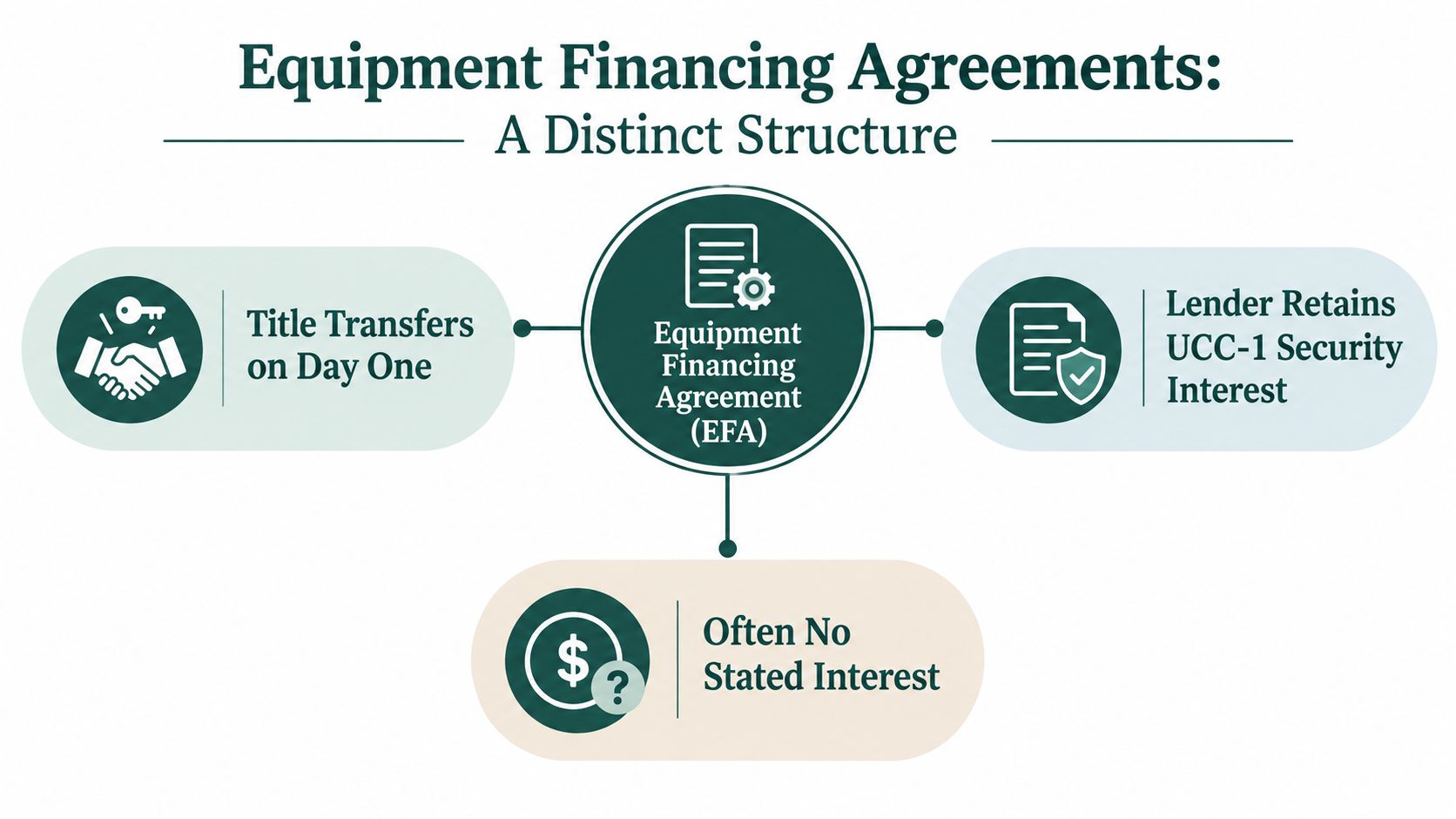
An equipment financing agreement, or EFA, is commonly structured so the borrower receives title to the equipment on day one while the lender retains a UCC-1 security interest. The security interest gives the lender rights in the collateral if the borrower defaults, even though the clinic is the owner under the agreement. The contract may also omit a stated interest rate and a conventional principal-interest breakdown, which can make the economics harder to interpret.
That structure differs from a traditional equipment loan in presentation, but the practical comparison should begin with ownership and remedies rather than labels. Under a conventional loan, the borrower generally owns the equipment and grants collateral rights to the lender. An EFA may reach a similar economic result while using a payment formula that doesn't display interest in the same familiar way.
A true lease requires a different question. The clinic may receive possession and use of the equipment while the lessor retains ownership, subject to the contract's end-of-term options. The clinic's rights to buy, return, renew, or substitute the asset depend on the lease language, not on the fact that the practice has used the equipment throughout the term.
Compare the legal logic
| Structure | Who holds title | Lender or lessor protection | End-of-term control |
|---|---|---|---|
| Equipment loan | Usually the clinic | Security interest in the equipment | Clinic generally retains the asset after repayment |
| EFA | Borrower receives title at the outset | UCC-1 security interest and contractual remedies | Clinic owns the asset, but liens and payoff terms matter |
| True lease | Lessor retains title | Ownership rights and lease remedies | Depends on return, renewal, or purchase provisions |
Suppose a clinic acquires digital radiography under an EFA. The practice may own the system immediately, but it can't assume ownership means unrestricted disposal. A lien may need to be released before a buyer receives clear title, and the agreement may prohibit a sale, relocation, or substitution without the lender's consent.
A surgical table illustrates a second distinction. If the table is financed under a conventional loan, the owner may understand the outstanding balance through an amortization schedule. If it is financed under an EFA with no stated rate, the practice still needs an equivalent economic disclosure so it can compare total repayment, payoff value, and the cost of replacing the asset.
For a broader discussion of the differences among structures, review this equipment financing and leasing resource. The central lesson is simple: loan versus lease is only the starting point. The more useful analysis asks who owns the equipment, what collateral the lender controls, how the obligation is reported, and how easily the clinic can change course.
Key Clauses Every Veterinary Owner Should Review
An EFA should be read as a collection of operating rules. Each clause affects what the practice must do while the equipment is in service and what the lender can do if the clinic misses an obligation. The wording often appears technical, but the underlying questions are concrete.

Grant of security interest
This clause identifies the lender's collateral rights. Language may state that the borrower grants a security interest in the equipment, related replacements, proceeds, records, or other described property.
For a clinic, accuracy matters. The agreement should identify the imaging unit, laboratory analyzer, surgical equipment, or IT asset clearly enough to distinguish it from other practice property. If the description is broad, ask whether the lender is taking only the financed equipment or a wider category of assets.
A UCC filing can affect later financing. A lender may also request a broader lien package, so the owner should understand whether the agreement covers one asset or reaches other practice property.
Payment obligations
The payment clause should state the amount, due dates, payment method, late charges, taxes, and any adjustment mechanism. Don't rely on a vendor quote or summary page if the signed agreement contains different terms.
Ask for a complete payment schedule. If the EFA doesn't state an interest rate or separate principal from interest, request a plain-English explanation of the total repayment and the amount required to satisfy the obligation on selected future dates.
Representations and warranties
These provisions contain statements the borrower is making about authority, ownership, financial information, legal status, and the equipment transaction. A clinic may represent that it has authority to sign, that information supplied to the lender is accurate, and that the equipment isn't subject to another lien.
The practice should confirm that the signing entity matches the entity purchasing and operating the equipment. A mismatch among the owner, professional entity, management company, and guarantor can create avoidable documentation problems.
Default and remedies
Default language defines what happens after missed payments, false statements, insolvency events, unauthorized transfers, insurance lapses, or covenant violations. Remedies may include acceleration of the balance, repossession, sale of collateral, and recovery of enforcement costs.
A missed payment is only one possible trigger. An owner should identify notice requirements, cure periods, and whether a nonpayment breach can become immediately enforceable or instead allows time to correct the problem.
Insurance and maintenance
The agreement may require property insurance, liability coverage, lender loss-payee status, routine maintenance, approved service work, and protection against damage or loss. These terms should match how the clinic operates.
For an imaging system, ask who must maintain service records and what happens if a covered loss occurs. For laboratory equipment, clarify whether consumables, calibration, and service contracts are part of the clinic's responsibility or the financed transaction.
Assignment and transfer
Assignment clauses control whether the lender can transfer its rights and whether the clinic can assign, sell, relocate, or transfer the equipment. A growing practice should review these provisions before opening another location or reorganizing its operating entities.
Read every clause that uses “consent,” “approval,” or “sole discretion.” Those words often control whether an ordinary business decision requires lender involvement.
Essential Definitions and Accounting Treatment Under ASC 842
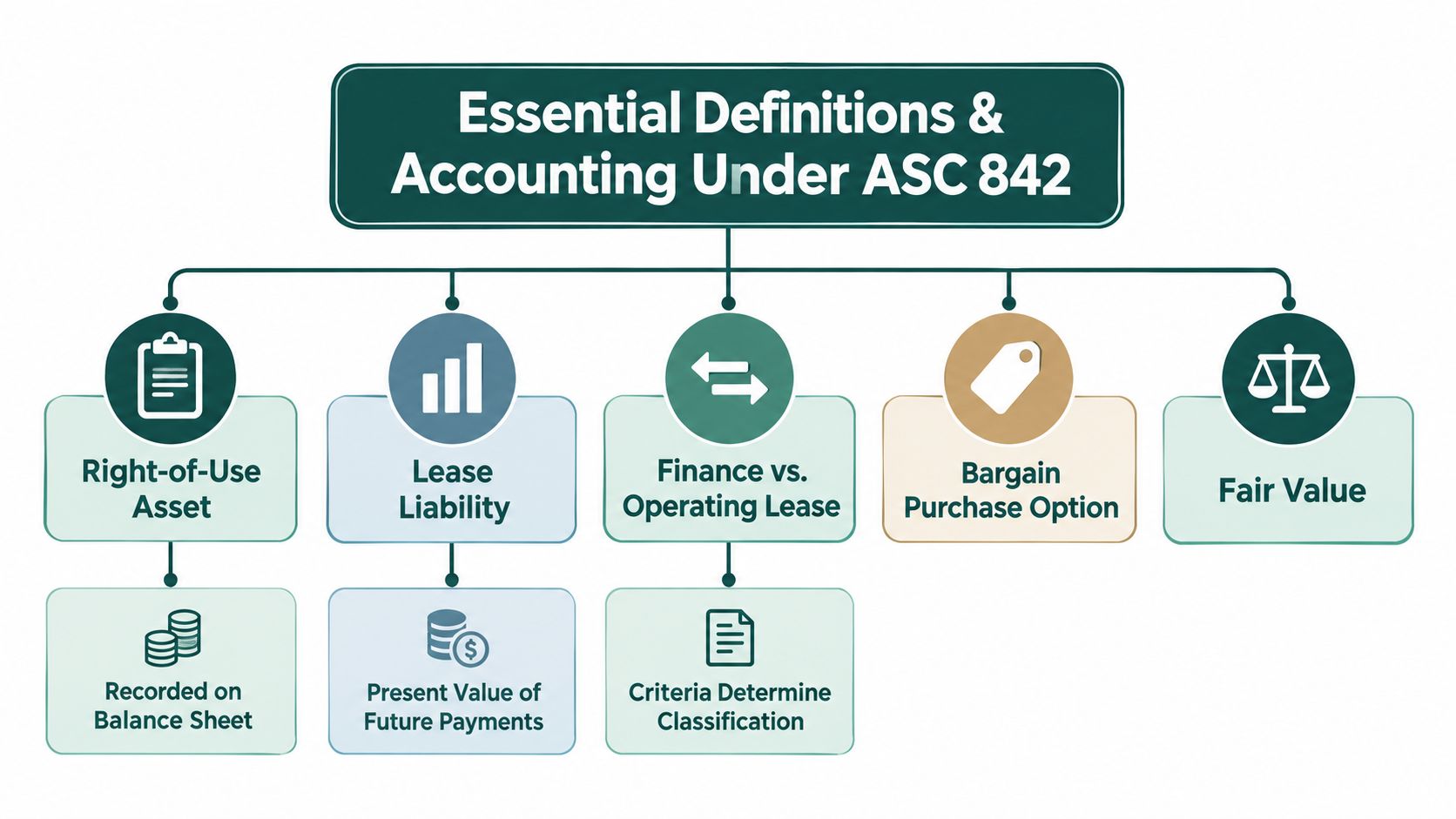
A clinic may finance an imaging platform through an agreement that calls the asset equipment, collateral, or leased property. The financial statements may record a right-of-use asset and lease liability at the same time. These labels describe different parts of the same arrangement, so owners should ask their accountant to review the complete contract before signing.
Under U.S. GAAP ASC 842, most lease arrangements longer than 12 months are recognized on the balance sheet through a right-of-use asset and a corresponding lease liability measured from the present value of future lease payments. The accounting treatment and common classification thresholds are summarized in this explanation of equipment lease accounting under ASC 842. The rule affects how the obligation appears in the financial statements. It does not determine whether the agreement gives the clinic the right ownership economics, a manageable payment burden, or enough flexibility to upgrade or sell the equipment early.
Definitions that drive the result
- Right-of-use asset: The recorded right to use leased equipment during the contract period. In a veterinary practice, this could be an imaging platform, surgical system, or laboratory analyzer.
- Lease liability: The present value of the future payments the practice must make under the lease.
- Finance lease: A lease treated as transferring substantially the ownership economics to the lessee. Expense generally follows an interest-plus-amortization pattern.
- Operating lease: A lease classification that generally produces a different expense presentation, often through a straight-line lease-cost pattern.
- Bargain purchase option: A purchase option priced low enough that exercising it is economically compelling under the applicable analysis.
- Fair value: The value used in classification and measurement comparisons. The stated payment amount alone does not establish fair value.
Why classification matters
Finance-lease classification generally reflects a substantial transfer of ownership economics when the arrangement includes transfer of title, a bargain purchase option, a lease term of 75% or more of estimated economic life, or present value of minimum lease payments at or above 90% of fair value. These thresholds can make the arrangement appear more like debt than rent in the clinic's financial statements.
That presentation matters if the practice later seeks funding for a second location, renovation, or replacement equipment. A recognized liability can affect how lenders assess the clinic's total fixed payment burden, even when the equipment supports revenue. It also helps explain why an early upgrade or sale requires more than checking the resale value. The owner must understand the remaining liability, purchase rights, and release conditions.
Give the accountant the final agreement, payment schedule, purchase options, guarantees, and side arrangements. Ask for a written explanation of the expected balance-sheet treatment before committing the clinic.
Typical Term Structures and Repayment Alignment for Clinical Equipment
Term selection should follow the equipment's productive life, expected utilization, and likely replacement cycle. Institutions commonly define capital equipment as nonexpendable tangible personal property with a useful life greater than one year, while IRS and MACRS recovery periods for many business equipment classes are commonly five or seven years, according to this equipment financing resource. Those horizons often provide useful anchors, but they aren't automatic answers for every veterinary asset.
A long term can reduce the periodic burden while increasing the time the clinic remains obligated. A shorter term may retire the balance sooner but place greater pressure on operating cash flow. The right choice depends on whether the asset will remain productive throughout the repayment period and whether the practice expects technology changes to create an early replacement need.
Compare the term choices
A fixed-term EFA offers predictable payments and a defined payoff date. A deferred start can help when installation occurs before the equipment begins generating revenue, but the owner should confirm whether interest or other charges accrue during the deferral. Seasonal adjustments may fit practices with uneven collections, provided the total repayment and timing remain clear.
An early buyout option can preserve flexibility, but its value depends on the actual payoff formula. A clause that permits early satisfaction without explaining the amount may not provide a usable exit strategy.
| Equipment Category | Typical Useful Life Anchor | Common EFA Tenor | Collateral and Pricing Note |
|---|---|---|---|
| Imaging equipment | Asset-specific useful life and replacement cycle | Often aligned with the expected productive period | Serial-number detail, service history, technology obsolescence, and residual value affect lender risk |
| Surgical equipment | Expected clinical durability and utilization | Commonly matched to the period of regular use | Condition, maintenance, and resale demand influence collateral value |
| Laboratory equipment | Useful life, utilization intensity, and compatibility | Should reflect expected replacement timing | Calibration, service records, and specialized resale markets matter |
| IT and practice technology | Shorter technology cycle than durable furnishings | Avoid extending repayment beyond practical usefulness | Rapid obsolescence can weaken resale value and refinancing leverage |
Describe the collateral precisely
The agreement should identify manufacturer, model, serial number, accessories, and location when appropriate. Clear traceability supports insurance claims, inventory control, and a later release of the lender's lien.
Specialized clinical assets can depreciate in market value faster than the balance declines. Independent collateral-management coverage notes that technology-intensive equipment can move from about 80 cents on the dollar at origination to around 40 cents two years later, as discussed in this collateral value analysis. That example isn't a forecast for every veterinary asset, but it highlights the risk of choosing a term solely by payment size.
For equipment-specific financing considerations, review the financing options for veterinary practice equipment. Compare the expected payoff balance with the likely trade-in or resale value before signing.
Covenants Restrictions and Cross References That Affect Flexibility
The most restrictive part of an EFA may not be the payment clause. Ongoing covenants can determine whether a clinic may relocate equipment, sell an older unit, refinance the obligation, or add a new location without lender approval.
A financial reporting covenant might require regular statements, tax returns, or notice of material changes. A blanket lien provision may reach assets beyond the equipment named in the purchase order. A transfer restriction may prevent the practice from moving an ultrasound from one location to another without consent.
Follow the cross-references
Definitions often control the scope of later obligations. “Collateral” may include replacements, accessions, proceeds, or records. “Event of default” may incorporate a breach from another agreement. “Permitted transfer” may define when a sale or relocation is allowed.
Read the agreement as a connected system:
- Locate the defined terms. Identify words such as collateral, default, affiliate, permitted lien, and material adverse change.
- Trace every reference. Follow sections that say “as defined,” “subject to,” or “notwithstanding.”
- Test a real clinic decision. Apply the language to a planned sale, upgrade, relocation, or entity restructuring.
- Record the required consent. Note who must approve the action, what documents are required, and whether approval can be withheld.
Apply the clauses to common scenarios
Suppose a clinic wants to sell an ultrasound before the EFA ends. The owner needs to know whether sale is prohibited, permitted after payoff, or allowed with the lender's written consent and a required payment from sale proceeds. If the equipment has lost value faster than the outstanding balance, the clinic may need additional cash to release the lien.
A CT upgrade creates a similar problem. The lender may require the original equipment to remain insured and maintained until payoff, while the practice wants to trade it in. The replacement may also become collateral, and the old lien may need a formal release.
Blanket liens deserve separate attention because they can affect future borrowing. A new lender may need a subordination agreement or payoff arrangement before financing another asset.
A low periodic payment can be expensive in flexibility if the agreement makes ordinary replacement decisions subject to approval.
Before signing, ask whether the EFA permits collateral substitution, early trade-in, relocation among related clinic entities, and refinancing. Put negotiated permissions in the agreement or an attached amendment, not in an informal conversation.
Negotiation Tips to Protect Cash Flow and Future Options
Negotiate the complete obligation, not just the payment shown in the proposal. A clinic can tolerate a periodic amount but still face a difficult outcome if the total payoff, fees, lien scope, or replacement rules are unclear.
Request the economic picture
Ask for a payment schedule that shows every required payment, fee, tax, insurance charge, and payoff amount. If the EFA has no stated interest rate, request an equivalent explanation of the implied economics so you can compare it with other structures.
The useful questions are direct:
- Total repayment: What will the clinic pay from funding through final satisfaction?
- Early payoff: How is the payoff calculated on a selected future date?
- Prepayment cost: Is there a penalty, minimum interest charge, or administrative fee?
- Late payment: When does a late charge apply, and when does nonpayment become a default?
- Collateral release: What document confirms that the lien has been released?
A headline payment can conceal the cost of a long obligation. A lower amount may result from a longer term, a final balloon, deferred payments, or fees added elsewhere in the documents.
Preserve replacement rights
Ask for a written process for selling, trading, or substituting equipment. The clause should explain how the lender applies sale proceeds, how much must be paid to release the lien, and whether replacement equipment can become substitute collateral.
This matters for imaging and laboratory assets where technology can change before the financing ends. A practice shouldn't discover at trade-in that it must fund a gap between the equipment's resale value and the payoff balance.
Match obligations to clinic operations
Insurance and maintenance requirements should reflect the practice's actual procedures. Clarify who selects the insurer, how claims are handled, what service records must be retained, and whether a temporary equipment failure creates a reporting obligation.
Request cure periods for administrative breaches and reporting delays. A clinic may fix a missed certificate or provide a late financial report without intending to abandon the financing, but the contract should state whether that opportunity exists.
For additional context on selecting a lender and evaluating financing terms, review the equipment financing lenders resource. Document every negotiated change in the final agreement, schedule, rider, or written consent.
Quick Reference Checklist of Required Documents and Final Review Steps
Prepare the document package before submitting an application. Organized records help the lender understand the practice, the equipment, and the proposed repayment source. They also give the owner a chance to find inconsistencies before signing.
Gather the application materials
- Practice financials: Assemble recent financial statements, tax information, revenue records, and debt obligations requested for underwriting.
- Equipment quote: Provide the vendor quote, exact equipment description, accessories, installation costs, and serial numbers when available.
- Insurance evidence: Confirm the required coverage and identify how the lender must be listed.
- Entity documents: Include formation records, ownership information, signing authority, and any guarantor documents.
- Collateral records: Collect purchase invoices, existing lien information, titles where applicable, and UCC search authorizations.
- Operating context: Prepare a concise explanation of how the equipment will be used, which services it supports, and how repayment fits clinic cash flow.
Review the final agreement
Read the signed version, not only the proposal or approval summary. Check each item below:
- Confirm the borrower, guarantor, vendor, and equipment owner are identified correctly.
- Match the model, serial number, accessories, location, and purchase price to the actual order.
- Reconcile the payment schedule with the disclosed total repayment and all fees.
- Identify the exact prepayment, early buyout, and payoff procedures.
- Locate the security-interest grant and determine whether it covers only the equipment or additional assets.
- Review insurance, maintenance, inspection, reporting, and recordkeeping requirements.
- Mark every event of default, notice period, and cure period.
- Confirm whether sale, relocation, substitution, refinancing, or affiliate transfer requires consent.
- Ask the accountant to confirm expected ASC 842 treatment when the arrangement is a lease.
- Save the final agreement, amendments, payment schedule, insurance certificate, and lien-release records together.
The final question is practical: If the clinic needs to upgrade, refinance, relocate, or sell the asset before the term ends, can the owner describe the process and the likely cash requirement? If the answer is unclear, pause before signing and request a written explanation.
Veterinary Practice Loans helps veterinary owners evaluate equipment financing alongside the clinic's broader cash-flow and growth needs, with guidance on structure, total cost, and repayment alignment. Visit Veterinary Practice Loans to discuss financing for imaging, surgical, laboratory, or technology equipment before you commit to an agreement.
