

Your lobby is full. Your doctors are running on time only because the team is sprinting. Techs are doubling back between cramped treatment areas. Clients are asking for appointments you can't fit in. You know demand is there, but the building, equipment, or staffing model isn't keeping up.
That's where most owners make the wrong move. They treat all growth the same and ask for “an expansion loan” before they've decided what kind of expansion they're financing.
That's a mistake because veterinary practice expansion financing isn't one product. It's a strategy. Adding exam rooms, buying imaging equipment, acquiring another clinic, and opening a satellite location should not be financed the same way. The wrong structure can slow your timeline, strain cash flow, and saddle the practice with debt that doesn't match the asset you're buying.
I've seen owners overcomplicate small projects and underprepare for big ones. The fix is simple. Match the financing to the expansion type, the urgency, and the cash flow profile. When you do that, funding becomes a growth tool instead of a burden.
From Crowded Waiting Room to Growth Blueprint
A packed clinic is a good problem. It's still a problem.
When your waiting room stays full and your schedule is booked out, the pressure shows up everywhere. Doctors lose efficiency. Support staff get frustrated. Clients wait longer. You start turning away demand you worked hard to earn. At that point, “we need more space” usually means one of three things: renovate the current clinic, add equipment that increases throughput, or expand into another location.

Growth pressure needs a financing plan
A lot of owners try to solve an operational bottleneck with a vague budget and a rushed loan application. Lenders can spot that immediately. Worse still, your own numbers will punish you for it later.
A sound financing plan starts by asking a blunt question: What exactly are you buying, and when does it start producing cash flow? A treatment area remodel behaves differently than a clinic acquisition. New dental equipment has a different payoff pattern than a de novo build. The debt structure should reflect that reality.
Practical rule: Finance short-life needs with shorter, faster capital. Use longer-term financing for assets and projects that take longer to stabilize.
The real goal isn't borrowing money
The goal is to convert demand into durable revenue without breaking the practice in the process.
That means you need a blueprint that covers scope, timing, staffing, ramp-up, and working capital. If your project is small and urgent, speed may matter more than the lowest possible rate. If your project is large and transformational, lower-cost long-term financing usually matters more than speed.
Owners who understand that distinction make better decisions. They expand with less stress, cleaner underwriting, and far fewer surprises after funding closes.
Mapping Your Growth Defining Your Financing Needs
A packed schedule does not tell you how much to borrow. It tells you where the strain is showing. Your job is to translate that strain into a specific project, a realistic budget, and a debt request that matches how fast the investment will pay you back.
Start by naming the expansion correctly. Owners get into trouble when they treat every growth project like generic "practice expansion." It is not. A two-operatory remodel, a CT purchase, a satellite clinic, and an acquisition should not be financed the same way because the cash flow timing is completely different.
Match the budget to the type of growth
Use four categories:
- Internal renovation or build-out: More exam rooms, better treatment flow, surgery upgrades, or front-desk changes that raise throughput in the current location.
- Equipment-led expansion: Imaging, dental, lab, surgical, or software and IT purchases that add capacity or new services.
- Satellite clinic or de novo site: A second location, a startup site, or a leased space that needs build-out plus operating runway.
- Acquisition: Buying an existing hospital, a partner's ownership stake, or a nearby clinic.
That distinction matters because speed and cost do not carry equal weight in every case. Renovations and equipment upgrades often justify faster, higher-cost capital if the project is modest and the return starts quickly. Acquisitions and de novo builds usually call for lower-cost, longer-term financing because the dollar amount is larger and the stabilization period is longer.
Build the budget line by line, not from a headline number
For a renovation, your budget should include more than the contractor quote:
- Construction and tenant improvements: Demolition, walls, plumbing, electrical, flooring, cabinetry, and finish work
- Clinical reconfiguration costs: Exam room fixtures, treatment updates, and workflow changes that affect daily production
- Permits and professional fees: Architectural, engineering, legal, and municipal costs
- Downtime and disruption: Reduced appointment volume, temporary schedule compression, and extra labor pressure during the project
For equipment-driven expansion, list the full cost of getting the asset productive:
- Equipment price
- Shipping, installation, and calibration
- Room preparation or electrical upgrades
- Training
- The early utilization gap before the team is using the equipment at a profitable level
If equipment is the core use of funds, use a structure designed for the asset rather than forcing it into a broad expansion loan. Review equipment loans for veterinary practices to compare terms against the equipment's useful life and expected revenue contribution.
New sites and acquisitions need a different budget logic
A second location or de novo build fails financially for one reason more than any other. The owner budgets the physical project and underfunds the ramp.
Your checklist should include:
- Leasehold build-out
- Initial equipment package
- Opening inventory
- Pre-opening and early-stage payroll
- Marketing and launch spending
- Working capital to cover slower collections and uneven case volume
Acquisitions are different. You are buying an operating cash flow stream, a client base, a team, and the risk that the handoff does not go exactly as planned. Industry data from the American Veterinary Medical Association's veterinary practice ownership resources can help frame ownership and transaction planning, but the practical financing question is simpler: how much of the purchase price is supported by normalized earnings after doctor compensation, debt service, and retention risk? That is the number lenders care about, and you should care about it first.
One bad assumption here can distort the entire loan request.
Add working capital deliberately
Owners regularly understate this line item because it feels less tangible than equipment or construction. That is a mistake.
Expansion creates a lag between spending and collections. You hire before the schedule is full. You stock inventory before usage stabilizes. A second site may need months before recurring demand looks reliable. If you skip working capital, the original practice ends up carrying the new project, and that pressure shows up fast in cash flow.
A strong financing request answers three questions without hand-waving:
- What exactly are you funding?
- How much is project cost versus operating runway?
- When should the expansion begin covering its own debt payments?
If you cannot answer those clearly, you are not ready to apply.
Choosing Your Funding Path From SBA to Specialized Loans
Most owners start with one question: “What loan can I get?”
The better question is: What funding structure fits this project best? That's how you avoid using a slow, document-heavy loan for a straightforward renovation, or using short-term capital for a major acquisition that needs breathing room.
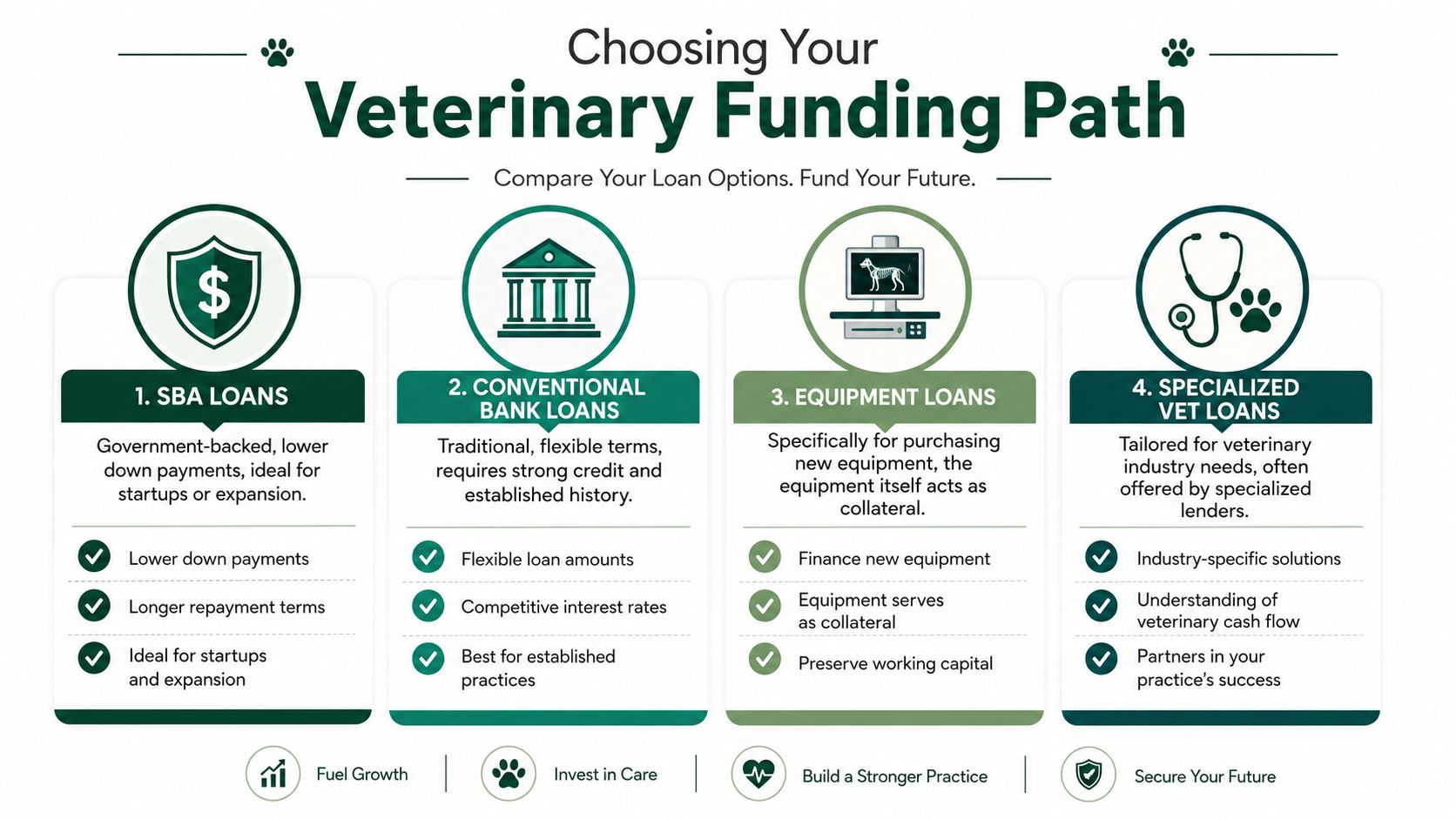
The core decision is speed versus long-term cost
For major expansions, SBA financing is often the right tool. For smaller, time-sensitive projects, it often isn't.
According to veterinary funding options for vet clinics, SBA 7(a) loans can fund up to $5 million, with repayment terms up to 10 years for working capital and business acquisitions and up to 25 years for commercial real estate. That same source notes processing times of 30 to 90 days for SBA 7(a) loans, compared with 24 hours to 3 days for short-term working capital loans. It also notes that working capital loans typically scale to 50 to 100% of a practice's average monthly revenue.
That's not a minor difference. It's a strategic fork in the road.
Side-by-side comparison
| Funding path | Best fit | Timing profile | Typical structure |
|---|---|---|---|
| SBA 7(a) | Acquisition, real estate, major build-out, larger expansion | Slower approval and closing | Longer repayment horizon, useful for larger projects |
| Conventional term loan | Established practice expansion with strong financials | Moderate | Structured repayment over a set term |
| Equipment financing | Imaging, lab, surgical, dental, and technology purchases | Often faster than SBA | Tied closely to the asset being purchased |
| Working capital loan | Payroll, inventory, launch cushion, short-term operational pressure | Fastest | Flexible use, shorter horizon |
| Revenue-based term loan | Smaller renovations or equipment-led upgrades where speed matters | Faster than SBA for the right project | Repayment aligned more closely with business cash flow |
When SBA is the right answer
Use SBA financing when the project is large, long-lived, and worth the paperwork.
That usually means an acquisition, a major de novo site, a large facility expansion, or a real estate component. For those cases, longer repayment terms can make the monthly obligation more manageable while the project matures. If you're exploring that route, review SBA loans for veterinary practice financing.
SBA also tends to make more sense when your priority is total financing efficiency over time, not immediate speed. If closing in a few days doesn't change the outcome, lower-cost long-term capital can be the smarter choice.
When non-SBA options are the better move
If you're adding two exam rooms, replacing key equipment, upgrading treatment flow, or handling a project that doesn't justify a drawn-out process, don't default to SBA just because it sounds official.
Smaller expansions often need speed and simpler execution. Waiting on a long approval cycle for a modest project can cost more in lost production than you save in rate. Fast capital isn't automatically expensive capital. It's just priced for a different use case.
If the expansion is modest and urgent, the winning loan is often the one that gets the project operating sooner, not the one with the most attractive headline term.
Specialized veterinary financing matters
Veterinary practices aren't generic small businesses. Your revenue mix, staffing model, equipment use, and case flow aren't the same as a restaurant or retail store. Owners do better when the financing structure reflects clinical operations, seasonal cash needs, and how quickly the new capacity will be used.
That's why I push owners to decide in this order:
- Define the project
- Map when cash goes out
- Map when revenue comes in
- Choose the loan that matches the gap
Do that, and the funding path usually becomes obvious.
Preparing Your Case The Lender's Underwriting Checklist
A lender approves a story backed by documents. If your package is weak, scattered, or inconsistent, underwriting slows down and trust drops immediately.
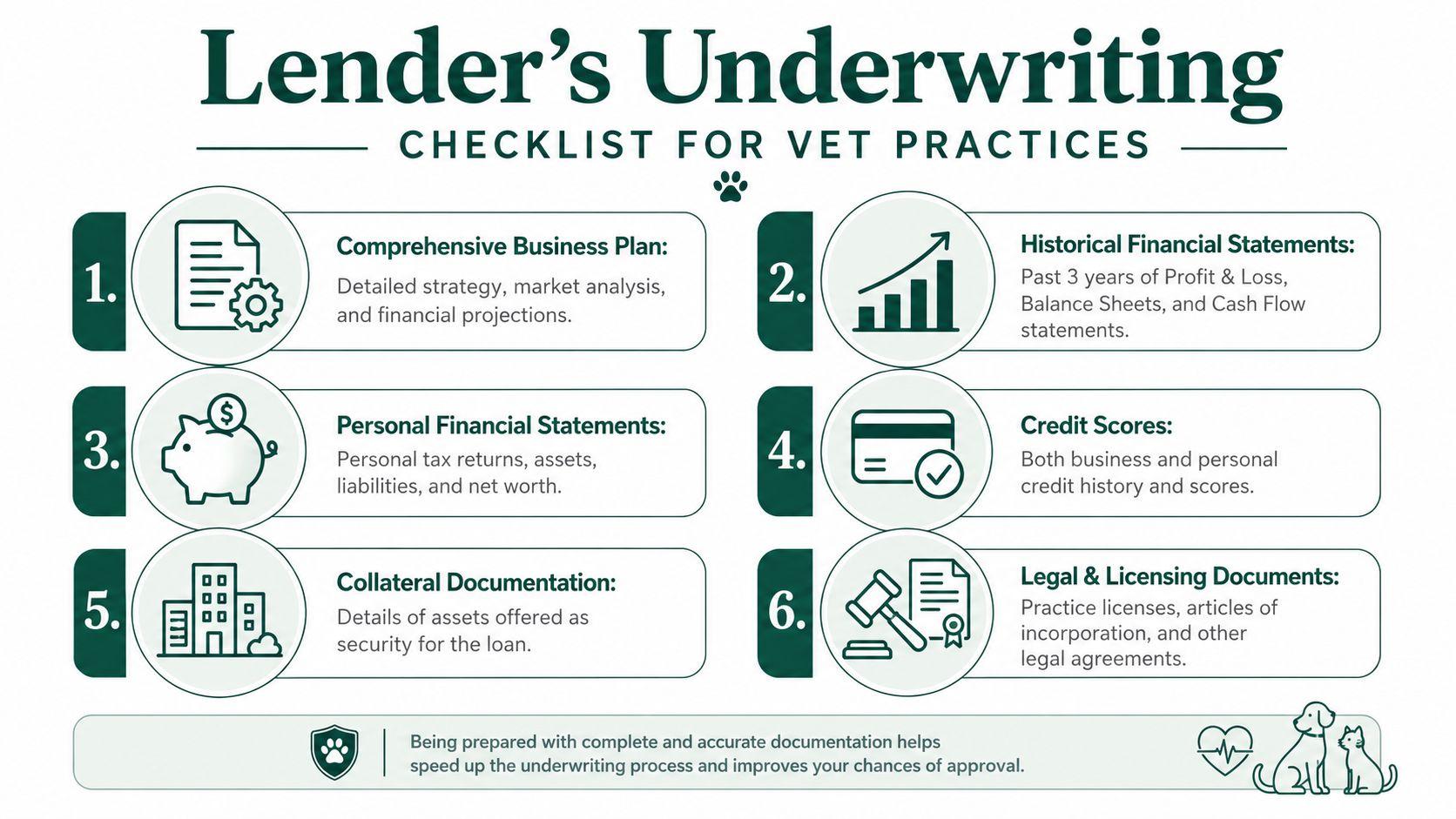
Show the lender how the practice works
Your application should prove that the clinic is financially disciplined today and that the expansion has a rational payoff tomorrow.
Start with the core financial package:
- Profit and loss statements: These show operating performance and trends.
- Balance sheets: These show liquidity, debt load, and overall financial position.
- Cash flow information: This helps the lender see whether the practice can absorb another payment.
- Tax returns: These validate the operating picture.
- Business bank statements: These help confirm deposit activity and cash movement.
For acquisitions or larger projects, lenders also scrutinize how much debt the practice can carry relative to cash flow. That's why clean reporting matters. If your books are sloppy, fix them before you apply.
Write a business plan that underwriters respect
Most business plans are too long and too vague. Lenders don't need a motivational essay. They need a practical operating case.
Include:
- Project description: What you're doing and why now.
- Use of funds: A clear breakdown, not a round number.
- Operational impact: Added capacity, added service capability, or added geography.
- Staffing plan: Who will work the expansion and when they'll be hired.
- Ramp assumptions: How the project moves from launch to stable operation.
- Repayment logic: Why the debt fits the practice's financial profile.
Underwriter mindset: “Can this owner explain the project in plain English, and do the numbers support the explanation?”
Personal documents still matter
Even when the practice is strong, lenders usually want to understand the owner behind it.
Prepare these early:
- Personal financial statement
- Personal tax returns
- Ownership details and legal formation documents
- Licensing and organizational records
- Any purchase agreements, leases, or equipment quotes tied to the project
These items don't just check a box. They help the lender assess reliability, financial stability, and execution risk.
Anticipate the weak points before underwriting finds them
If collections dipped recently, explain why. If you had unusual expenses, document them. If the practice had turnover, show how operations stabilized. If the expansion depends on a new doctor, explain recruitment and timing.
Strong applications don't pretend risks don't exist. They frame the risks and show control.
That's the difference between a file that stalls and a file that moves.
Decoding the Fine Print Comparing Loan Offers and True Costs
The cheapest loan on paper can be the most expensive loan in practice.
That happens when owners focus on one headline number and ignore timing, fees, repayment pressure, prepayment terms, and the operational cost of waiting. A loan offer is a business instrument, not a trophy for getting the lowest quoted rate.

What to compare beyond the rate
When two offers hit your desk, review them in this order:
- Use restrictions: Can you apply the funds to the full project, or only part of it?
- Funding timeline: Will the money arrive when you need it?
- Repayment structure: Does the payment fit the cash flow pattern of the expansion?
- Fees and total borrowing cost: A lower rate can still produce a worse overall deal if fees are heavier.
- Prepayment terms: Flexibility matters if the project performs well and you want to refinance or pay down early.
- Covenants and conditions: Some terms can limit future decisions or create reporting burdens you didn't expect.
For a current market reference point, veterinary practice loan rates can help you frame what you're seeing in offers.
Speed has economic value
Owners often get tripped up. They compare rate to rate when they should be comparing business outcome to business outcome.
According to financing timelines for veterinary practice growth, smaller renovations or equipment purchases under $500K can often be funded in 21 to 30 days through revenue-based term loans, while SBA loans for acquisitions can take 45 to 90 days to close.
That difference matters if your project is simple and revenue-generating.
Here's the practical version:
| Scenario | Better fit | Why |
|---|---|---|
| Small renovation blocking patient flow | Faster non-SBA loan | Speed may unlock capacity sooner |
| Equipment purchase tied to immediate service demand | Equipment or revenue-based structure | The asset can begin contributing quickly |
| Large acquisition with goodwill and transition complexity | SBA or longer-term acquisition financing | Longer structure fits a larger strategic purchase |
| New build with real estate or heavy upfront cost | SBA-oriented structure | Longer terms can reduce strain during ramp |
Don't ask which loan is cheapest. Ask which loan leaves the practice stronger twelve months after funding.
The wrong comparison leads to bad choices
A slower loan with a lower cost of capital may be the right move for an acquisition because acquisitions need time, diligence, and a long runway. The same logic can be terrible for a modest renovation that's delaying appointments every week.
Likewise, fast money isn't automatically smart. If you use a short-horizon structure for a project that takes too long to stabilize, you create repayment pressure before the expansion is ready.
The correct analysis is simple:
- How fast do you need the funds?
- How fast does the project produce cash flow?
- How long should the debt live relative to the project benefit?
If your answer to those three questions is clear, the fine print gets much easier to judge.
Beyond Funding Managing Your Finances for Sustainable Growth
Three months after closing is where expansion projects either start paying off or start draining the practice. The loan is funded, the contractor has been paid, the equipment is installed, or the new location is open. Now the question is simple. Is the expansion producing cash fast enough to justify the debt you chose?
That question matters even more because different expansion types create different repayment pressure. A fast non-SBA loan for a renovation or equipment upgrade can make perfect sense if the added capacity turns into appointments and revenue quickly. A longer SBA structure usually fits an acquisition or de novo build better because those projects take longer to stabilize. If you ignore that timing after closing, you can post growth on paper and still strain cash every month.
Build a post-funding scorecard
Run the expansion as its own financial line of business for at least the first year. Do not lump it into general practice performance and assume you will spot problems early. You will not.
Track a short list of metrics every month:
- Debt payment by loan so the obligation stays visible
- Revenue tied to the expansion such as added procedures, additional appointments, or production from a new doctor
- Labor tied to the expansion including hires that were made ahead of demand
- Project-specific overhead such as rent, utilities, software, service contracts, and inventory for the new capacity
- Cash reserves so you know whether growth is helping liquidity or consuming it
If you added exam rooms, measure appointment utilization and doctor throughput. If you financed imaging, dental, or surgical equipment, measure usage, case acceptance, and scheduling lift. If you bought another practice or opened a new site, separate one-time startup or transition costs from steady operating expenses. That is how you identify the actual trend.
Guard cash while the expansion matures
Debt problems rarely start with the interest rate. They start with sloppy cash management after funding.
Use these rules:
- Keep reserves untouched unless the plan calls for them. Expansion always costs more and takes longer than the optimistic version.
- Hire in stages when possible. Payroll usually arrives before full production.
- Control inventory tightly. Growth often triggers overbuying, especially after adding new services.
- Review pricing and scheduling quickly. If demand is there but margins are thin, fix the operational issue instead of blaming the loan.
- Set a decision deadline. If the project is missing targets after a defined period, change staffing, hours, marketing, or service mix immediately.
Short-term financing leaves less room for delay. That is the trade-off. You get speed on the front end, but you need faster operational results on the back end. Longer-term SBA-style debt gives acquisitions and de novo builds more breathing room, but that breathing room is not permission to drift.
Treat lender communication as part of risk management
Good borrowers talk to lenders before a problem becomes a covenant issue or a missed payment. If collections tighten, hiring runs ahead of plan, or the build-out timeline slips, communicate early. Clear reporting protects credibility and gives you more options if you need an adjustment later.
Owners who handle post-closing reporting well usually get better access to future capital. That matters when the next step is another equipment purchase, a refinance, or a second location.
Expansion succeeds when the debt term matches the project timeline and the owner tracks results with discipline after funding.
If you're evaluating veterinary practice expansion financing and want guidance that matches the project to the right loan structure, Veterinary Practice Loans helps practice owners compare acquisition financing, equipment loans, working capital, startup funding, and expansion options built for veterinary clinics.
