

You're probably looking at one of two situations right now. A practice owner is ready to retire, and the numbers look promising. Or you've found a clinic that seems ideal operationally, but the financing options are pulling you in different directions.
That's the moment where many good buyers get stuck. Not because they can't run a hospital, but because loan structure changes the economics of ownership in ways that aren't obvious at first glance. The wrong structure can turn a healthy clinic into a monthly cash squeeze. The right one can leave room for payroll, inventory, hiring, and the normal surprises that come with clinical ownership.
A veterinary practice acquisition loan isn't just a way to fund a purchase. It's the framework that determines how much pressure the practice will feel after closing. If you're moving from associate to owner, evaluating partnership buyout terms, or trying to buy a clinic with real estate attached, the financing decision matters almost as much as the practice you choose.
From Associate DVM to Practice Owner
Most veterinarians don't struggle with the clinical side of ownership. They struggle with the leap.
As an associate, you already know how a hospital runs. You know what a booked schedule looks like, what happens when staffing gets tight, and how quickly a good front desk team can change client retention. Ownership adds a different layer. You stop thinking only about medicine and start thinking about debt service, lease terms, payroll timing, inventory turns, and whether the purchase price leaves enough breathing room after closing.
That's why the financing conversation needs to start early. The loan isn't the last step after you find a practice. It shapes what kind of practice you can safely buy in the first place.
What changes when you become the buyer
The biggest shift is responsibility for the payment. As an associate, high goodwill, an older building, or uneven collections may look manageable if the clinic is busy. As the buyer, you have to ask a harder question. Will this clinic still feel healthy after the loan payment hits every month?
That's where many first-time buyers benefit from practical ownership-focused guidance, especially when they're sorting through structures like Petfolk veterinary practice ownership loans. The goal isn't to borrow the maximum. The goal is to buy in a way that protects the practice after you take over.
Practical rule: If the payment only works on a spreadsheet and not in an operating clinic, it's the wrong deal or the wrong structure.
What a smart buyer decides first
Before you compare lenders, decide these points:
- What are you really buying. A solo clinic, a partner buyout, a satellite location, or a hospital with owned real estate each calls for a different financing approach.
- How much transition cushion you need. Most buyers focus on the purchase price and underestimate the importance of liquidity after closing.
- What matters more, speed or payment flexibility. In a competitive transaction, fast execution matters. In long-term ownership, monthly affordability usually matters more.
A lot of guides stop at “here are your options.” That's not enough. The useful question is which option fits the clinic, the valuation mix, and your tolerance for post-close pressure.
What Is a Veterinary Practice Acquisition Loan
You agree on a purchase price for a clinic, then the lender's questions start. How much of that price is equipment. How much is goodwill. Are you buying the building too. Those answers shape the loan more than many first-time buyers expect, because they directly affect term length, down payment pressure, and the monthly payment the practice has to carry.
A veterinary practice acquisition loan is the financing used to buy an existing clinic as an operating business. It usually covers more than the sale price on the listing sheet. In many veterinary deals, the loan structure has to account for goodwill, medical equipment, leasehold improvements, limited working capital, and sometimes the property.
What the loan is really financing
From the lender's point of view, this is not just an asset purchase. It is a cash flow purchase.
That distinction matters in veterinary medicine because many acquisitions are driven heavily by goodwill. The value often sits in the client base, doctor production, referral patterns, reputation, and the clinic's ability to keep generating earnings after the owner changes. If the deal also includes the building, the structure changes again. Real estate can often be financed on a longer repayment schedule than goodwill or equipment, which can lower the monthly payment even if the total borrowing amount is higher.
Buyers looking at SBA loans for veterinary practice acquisitions usually start there for one practical reason. The structure is often flexible enough to combine several parts of the transaction into one loan.
A veterinary practice acquisition loan may cover:
- The practice purchase price. This includes the business entity or assets being acquired, along with client relationships and goodwill.
- Equipment included in the sale. X-ray, dental, lab, surgical, and other clinical assets are often part of the financing package.
- Commercial real estate. Buying the building with the hospital can improve control over occupancy costs, but it also changes the size and structure of the deal.
- Working capital at closing. Some buyers need a cash cushion for payroll, inventory, marketing, or slower collections during the transition.
Why acquisition financing is different from other borrowing
Veterinarians sometimes lump all business loans together. That leads to bad comparisons.
An acquisition loan is built around ownership transfer and practice cash flow. Equipment loans are tied to specific hard assets. Lines of credit are meant for short-term operating swings. A general term loan may help in some situations, but it often does not fit a deal where most of the value is intangible and the repayment period needs to reflect that.
| Loan type | Best use | Limitation for an acquisition |
|---|---|---|
| Equipment financing | Buying a specific clinical asset | Usually limited to hard collateral, not goodwill or full ownership transfer |
| Working capital line | Covering short-term cash needs | Helps operations, but does not typically fund the full purchase |
| General term loan | Broad business borrowing | May offer less flexibility when the deal includes large goodwill value or real estate |
The trade-off that matters most to buyers
The practical decision is usually not whether financing exists. It is whether the structure fits the clinic you are buying.
A practice with strong cash flow but little real estate may rely heavily on goodwill financing. That can work well, but the payment has to leave room for staffing, inventory, equipment replacement, and your own compensation. A deal that includes real estate may increase the total purchase price, yet still produce a more manageable monthly obligation if part of the debt is spread over a longer term. That is one reason two clinics with the same headline price can feel very different after closing.
I tell buyers to stop looking only at rate and start looking at payment durability. If the loan works only when the seller's numbers hold perfectly and every doctor stays productive from day one, the structure is too tight.
Common acquisition situations
One buyer is purchasing a solo practice from a retiring owner and taking over mostly goodwill and equipment.
Another is buying a partner's share, where valuation, compensation cleanup, and lender comfort with the remaining ownership team matter as much as the price.
A third is acquiring a clinic plus the building. That buyer takes on a larger total obligation, but may gain better payment structure, long-term control of occupancy costs, and an appreciating asset outside the operating business.
The loan is only a tool. The primary question is whether the clinic can support it and still stay healthy.
Comparing Loan Types SBA Conventional and Alternative
You find a clinic that looks right on paper. Collections are steady. The staff is stable. The seller also owns the building. Then the loan proposals arrive, and the critical decision begins. One option gives you a lower payment but takes longer to close. Another closes faster but puts more pressure on cash flow from month one.
That is the choice in this section.
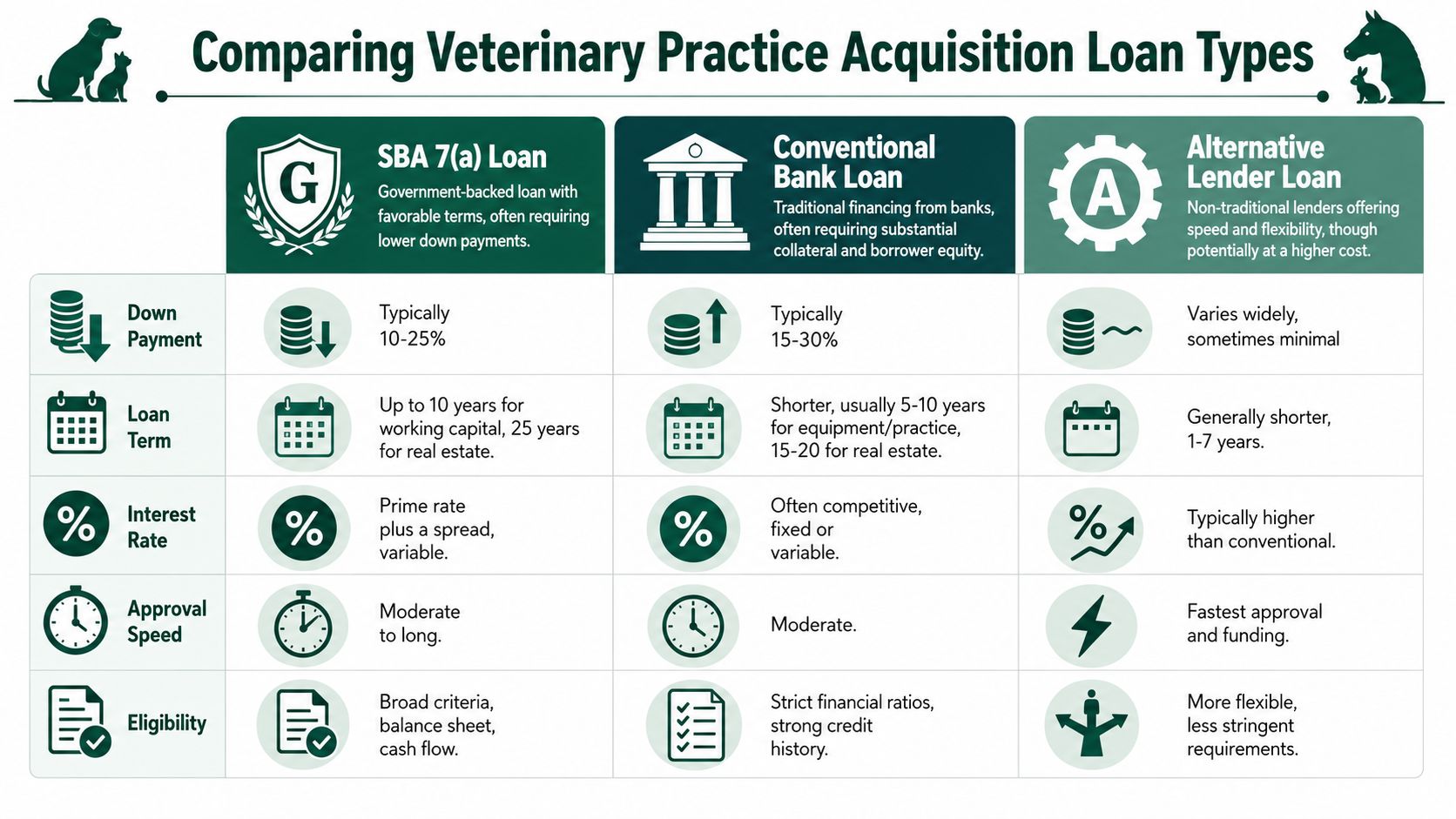
The three main paths are SBA-backed financing, conventional bank financing, and alternative or hybrid capital. Each can work. The right fit depends less on the headline rate and more on how the structure handles goodwill, real estate, and your first 12 to 24 months of ownership.
A visual comparison helps before we get into the trade-offs.
SBA usually fits goodwill-heavy acquisitions better
For many owner-operator purchases, SBA is the first structure worth testing. The reason is simple. Veterinary deals often include a large goodwill component, and SBA lenders are generally more comfortable financing that than many conventional banks are. If you want a grounding in how these loans are commonly structured, this guide to SBA loans for veterinary practice acquisitions lays out the standard framework.
From a buyer's perspective, the biggest advantage is payment relief. Longer repayment terms usually produce a lower monthly obligation than a shorter conventional note on the same purchase price. That matters when the value of the deal sits mostly in goodwill rather than hard collateral.
SBA also becomes more attractive when real estate is part of the transaction. Folding the building into the financing can increase the total dollars borrowed, but the longer repayment period on the property portion often improves monthly affordability. I have seen two buyers pay similar total prices for two different clinics, yet the one who included real estate in the right structure had more breathing room each month.
The trade-offs are real.
- Documentation is heavier
- Approval can take longer
- Many loans carry variable rates, so payments can rise if rates move up
Those drawbacks matter most when the seller wants a quick close or when the deal is already running on a tight transition schedule.
Here's the video version of the comparison if you want the framework in a different format.
Conventional loans reward stronger files and cleaner deals
Conventional financing can be a very good option, but it usually asks more from the deal. Banks tend to like acquisitions with strong historical cash flow, a reasonable purchase multiple, and less reliance on goodwill. They also tend to prefer borrowers who present a cleaner, lower-risk file.
The practical appeal is speed and simplicity. Conventional lenders may move faster than SBA lenders, especially when the bank already knows the borrower or the practice profile fits well inside its credit box. That can help in a competitive purchase process.
The main risk is payment compression. Shorter amortization often means a higher monthly payment, even if the rate looks attractive at first glance. For a veterinarian buying a clinic with thin staffing coverage, deferred equipment upgrades, or a noticeable amount of seller add-backs that may not survive after closing, that higher payment can strain the practice quickly.
Conventional debt usually works best when:
- Cash flow remains strong after owner compensation is normalized
- The lender is comfortable with the goodwill portion
- You want fewer program rules than an SBA structure may require
It works less well when the deal only pencils out because the term needs to be stretched.
Alternative and hybrid structures solve specific problems
Alternative capital is rarely the cheapest money in the room. It is often the money that makes a hard deal possible.
That may include seller financing, a short-term working capital facility, or a hybrid structure that combines senior bank debt with another piece behind it. In veterinary acquisitions, seller notes are often useful because they reduce the cash the buyer needs to bring in and keep the seller tied to a successful handoff for a period after closing.
Used carefully, a hybrid structure can solve a valuation gap. It can also give a buyer enough liquidity to handle opening inventory, payroll timing, software conversion, or equipment replacements without draining reserves on day one.
Used poorly, it creates a stack of payments that looks manageable in a spreadsheet and feels very different in the second slow month after closing.
I tell buyers to be careful here. If the acquisition already needs a seller note, a line of credit, and an aggressive projection to work, the issue may not be financing creativity. The issue may be that the clinic is overpriced or under-earning.
A practical way to choose
Use this filter instead of asking which loan type is best in the abstract.
| If the deal looks like this | Usually start here | Main caution |
|---|---|---|
| High goodwill, limited hard collateral, need lower monthly payments | SBA | Longer process and more paperwork |
| Strong cash flow, cleaner collateral story, seller wants speed | Conventional | Higher monthly debt service if term is shorter |
| Gap between what the bank will fund and what the seller wants | Hybrid with seller participation | More complexity and less margin for error |
| Practice plus real estate | SBA or a split structure with property financing | Larger total debt, more diligence, more moving parts |
The deciding question is straightforward. After paying the loan, can the clinic still support doctor pay, team retention, normal equipment replacement, and a reasonable buffer for bad months?
If the answer is only yes under a perfect forecast, keep working on the structure or the price.
Are You Eligible Underwriting Criteria Explained
A buyer can have strong production, clean personal finances, and a solid reputation in the local veterinary community and still run into underwriting trouble. I see it happen when the purchase price is heavy on goodwill, the clinic needs working capital right away, or the loan structure leaves too little room after debt service.
Underwriting is the lender's process for deciding whether this specific deal works. The lender is not only judging you as a borrower. They are judging whether the clinic, the valuation, and the proposed loan terms can hold up after closing.
How lenders read your file
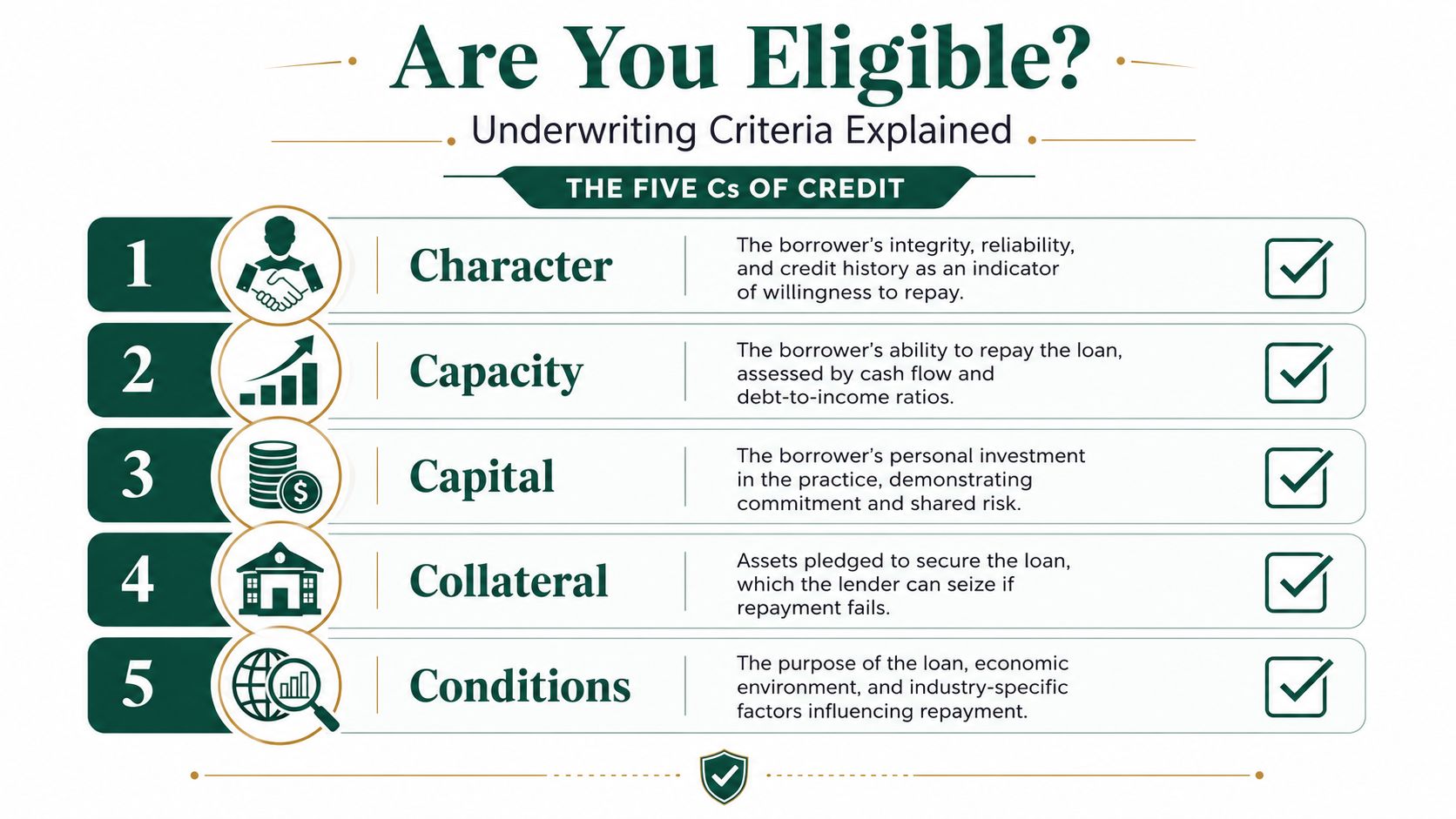
Lenders usually frame the review through the Five Cs of Credit. In veterinary acquisitions, those categories are practical.
Character covers personal credit, payment history, tax compliance, and how you handle the process. A late surprise on student loans, unpaid taxes, or inconsistent disclosures can slow or kill an otherwise good file. Strong credit helps, but clean documentation matters just as much.
Capacity gets the most attention for a reason. The lender wants to see that the practice can make the loan payment, pay the owner fairly, keep staff, and absorb normal bumps in payroll, inventory, and equipment expense. If the deal only works when every projection breaks your way, underwriting gets tight fast.
Capital means liquidity and reserves. Some buyers assume zero down means zero cash needed. That is not how I advise clients to think about it. Even if the structure allows a very high advance rate, buyers still need post-close breathing room for deposits, payroll timing, repairs, and slower collections during transition.
Collateral matters, but veterinary acquisitions often involve a lot of goodwill. That is one reason SBA financing fits many practice purchases better than conventional debt. Conventional lenders usually get more comfortable when there is stronger hard collateral or real estate in the deal. If the price is mostly intangible value, underwriting can become more conservative or require a different structure.
Conditions covers the story of the transaction. Why is the seller exiting? How long will they stay? Is there client concentration, associate dependence, deferred equipment spending, or a lease problem? A lender wants a believable transition plan, not just a promising spreadsheet.
What eligibility looks like in a real veterinary deal
A lender is usually testing four practical questions.
Can this buyer run the clinic credibly?
Ownership experience is helpful, but it is not required. Lenders look for clinical production history, leadership ability, and a realistic plan for handling medicine, team management, and the business side after closing.Can the practice support the debt without starving operations?
This is where loan structure matters. A longer SBA amortization can lower the monthly payment and protect practice cash flow, especially in deals with heavy goodwill. A shorter conventional term may save interest over time, but it can put more pressure on the clinic every month.Is there enough cash outside the deal?
Buyers need reserves. I get concerned when a doctor uses every available dollar to close and has nothing left for the first staffing issue, equipment failure, or dip in production.Does the valuation match the risk?
A lender will look harder at a high multiple, weak margins, or earnings that depend too heavily on the selling doctor. Goodwill is financeable in many veterinary deals, but it still has to be supported by durable earnings.
Where buyers get tripped up
The weak point is often not personal eligibility. It is the fit between the practice and the loan.
For example, a hospital purchase with real estate can look safer on paper because there is more collateral. It can also create a much larger total debt load. If the property is included, the buyer has to support both the operating business and the building payment. Monthly obligations may still work if the term is long enough and the clinic margins are healthy, but the added debt changes the margin for error.
The opposite problem shows up in goodwill-heavy deals. A buyer may prefer conventional financing because the process can be faster, but a shorter repayment period can raise monthly payments enough to strain the practice in year one. SBA financing often gives that same clinic more room to operate, hire, and replace equipment, even if the paperwork is heavier and the closing takes longer.
That is the core underwriting question. Not whether the buyer is qualified in the abstract, but whether this clinic can stay healthy under this debt structure.
A practical view of the underwriting stages
Underwriting usually unfolds in four steps.
Initial review
The lender looks at your background, personal financial statement, tax returns, and the broad terms of the purchase.Business cash flow analysis
The underwriter examines tax returns, profit and loss statements, production trends, doctor mix, and add-backs. They want to know what the clinic earns, not what everyone hopes it will earn after closing.Structure testing
The lender checks whether the deal still works if revenue softens, payroll rises, or the seller transition is less smooth than planned. This is often where high-goodwill pricing or aggressive repayment terms start to show stress.Conditional approval
If the file holds up, the lender issues a list of conditions tied to valuation support, legal documents, insurance, entity formation, lease terms, and closing items.
A strong buyer can still get declined if the payment is too high for the clinic's cash flow. A less experienced buyer can still get approved if the practice is priced well, the earnings are stable, and the structure leaves room for the business to breathe.
That is how to think about eligibility. It is a credit decision, but it is also a practice-health decision.
The Application to Closing Timeline
A buyer signs a letter of intent in January and hopes to take over by early spring. Then the seller's numbers come in half-finished, the lease needs review, and the lender has questions about how much of the price is equipment, how much is goodwill, and whether the building is part of the deal. That is how a reasonable timeline turns into a long one.
The process feels less stressful when you know what happens between application and funding, and where loan structure changes the pace. In practice, SBA deals usually involve more documentation and more back-and-forth. Conventional loans can move faster, but speed only helps if the payment still leaves the clinic healthy after closing.

Stage one through three
The first stage is initial inquiry and pre-qualification. The lender reviews your background, the rough purchase price, whether real estate is included, and the broad cash flow profile of the clinic. A practice purchase that is mostly goodwill usually gets a different conversation than one with a meaningful real estate component, because the repayment structure may need to do more work to keep the monthly payment manageable.
The second stage is application submission. During this stage, the file either stays clean or starts to drift. Personal financial statements, tax returns, practice financials, draft legal documents, and lease or property information all need to match. If the seller is including the building, expect another layer of review because the lender has to separate the operating business from the property side of the transaction.
The third stage is underwriting and due diligence. This is often the longest phase. The lender tests whether the practice can carry the debt under the proposed terms, not just whether the buyer looks qualified on paper. If goodwill makes up a large share of the price, underwriting tends to spend more time on earnings quality, client retention, provider mix, and whether the payment still works under realistic operating conditions. Buyers comparing structures should review current veterinary practice loan rates and repayment options with the term length in mind, because a faster conventional closing is not always the better outcome if it creates a tighter monthly obligation.
A seller who wants a quick close may prefer conventional financing. A buyer taking on a high-goodwill deal often benefits from the longer amortization and lower payment pressure that SBA financing can offer. That is the trade-off.
Stage four through six
Once underwriting clears, you move to loan approval and commitment. The lender issues conditions that must be satisfied before funding. Those conditions often cover insurance, entity documents, final purchase terms, lease assignments, valuation support, and proof that any required cash injection is available.
Next is legal documentation and review. This stage looks administrative, but it has real consequences. If the purchase agreement says one thing, the loan approval says another, and the closing attorney has a third version, funding can stall quickly.
The final stage is closing and funding. Money is disbursed, ownership transfers, and the buyer becomes the operator. From a practical standpoint, this is also when the debt structure stops being theoretical. The payment becomes part of payroll planning, inventory decisions, equipment timing, and your margin for a slow month.
Where delays usually happen
The same problem areas show up again and again:
Incomplete seller financials
Missing year-end statements, unclear add-backs, or poor bookkeeping slow underwriting immediately.Unclear purchase agreement terms
Goodwill, equipment, real estate, and working capital should be defined precisely.Real estate complications
If the clinic property is part of the transaction, title work, appraisals, environmental review, and lease structure can add time.Late buyer responses
A lender request that sits for several days can push back the entire file.Valuation pressure
If the price is aggressive relative to earnings, the lender may ask for more equity, a structure change, or a revised purchase price.
Buyers close faster when they treat financing like clinic operations. Keep documents organized, answer questions quickly, and assign responsibility for each moving part.
A clean closing timeline usually starts before the application. It starts with a well-structured deal, complete financials, and a loan choice that fits both the purchase price and the day-to-day reality of running the hospital.
The True Cost of Your Loan A Worked Example
A buyer agrees to pay a fair price for a solid small-animal hospital, gets a decent rate, and still feels squeezed six months after closing. I have seen that happen more than once. The problem usually is not the practice. It is the loan structure.
A veterinary practice acquisition loan has to fit the economics of a working hospital. Monthly debt service affects hiring, medical inventory, equipment replacement, owner pay, and how much stress a slow quarter creates. Rate matters, but structure decides how heavy the loan feels in real life.

Start with the payment, not the headline rate
I tell buyers to test four things before they get attached to any term sheet:
- What is the monthly payment
- How much cash stays in the business after closing
- How exposed is the payment to future rate movement
- Will the clinic still feel operationally healthy after debt service
That fourth question is the one many buyers skip. A loan can look reasonable in a spreadsheet and still create constant pressure inside the practice. If every technician hire, inventory order, or doctor schedule change has to be filtered through the loan payment, the structure is too tight.
That is why buyers should review current veterinary practice loan rates and structure options together, not treat rate as the whole decision.
A practical example
Take a buyer acquiring a hospital where a large part of the purchase price is goodwill rather than equipment. That is normal in veterinary transactions. It also means the lender is financing earning power, client loyalty, and transferability, not just hard assets.
Now compare two common paths:
| Structure choice | Practical effect inside the practice |
|---|---|
| SBA loan with a longer repayment structure | Lower monthly payment, more breathing room for payroll and working capital, more total interest over time |
| Conventional loan with a shorter amortization | Higher monthly payment, faster principal reduction, less room if collections dip or staffing costs rise |
| Business purchase only | Debt is concentrated in the practice cash flow, which can raise monthly pressure |
| Business plus real estate | Payment may be spread across a longer real estate term, which can ease monthly strain but increases deal complexity and total capital committed |
This is the essential trade-off between SBA and conventional financing for many veterinarians. SBA often gives the buyer more flexibility when goodwill is a big part of the price or when preserving cash matters. Conventional financing can work very well for a buyer with strong liquidity, a cleaner asset mix, and enough free cash flow to handle a firmer payment.
Neither option is automatically better.
The right answer depends on what the hospital can support after payroll, rent or real estate costs, lab bills, inventory, software, and owner compensation.
Why real estate can change the decision
If the building is included, the economics often shift. Part of the total debt may be placed on a longer real estate schedule, which can reduce monthly pressure compared with financing the practice alone on a shorter business-only structure.
That does not make real estate an automatic yes.
Buying the property ties up more capital, adds another layer of underwriting, and changes your exit options later. But in the right clinic, especially one with stable location value and long-term plans to stay put, real estate can improve day-to-day affordability even if the total transaction is larger.
Goodwill is where buyers need to be honest
Goodwill-heavy deals deserve extra scrutiny because the payment has to be carried by future performance. If collections soften after the seller leaves, or if one associate resigns during the first year, a short amortization can become painful fast.
I usually want buyers to pressure-test the deal under a less flattering version of year one:
- one doctor produces less for a few months
- payroll runs higher than expected
- some clients do not transition smoothly
- inventory and repairs cost more right after closing
If the loan still works under those conditions, the structure is probably sound. If the payment only works when everything goes right, the loan is too aggressive.
What usually holds up best
The strongest acquisition structures tend to share a few traits:
- The payment leaves room for normal operating surprises
- The buyer keeps a real cash cushion after closing
- The term matches the asset mix and the clinic's cash flow
- The goodwill valuation is supported by earnings, not optimism alone
What gets buyers into trouble is just as consistent:
- using every available dollar for the down payment
- choosing the shortest term only because it looks disciplined
- assuming the seller's final year will repeat without disruption
- taking a goodwill-heavy deal and layering on a payment with no margin for error
A good acquisition loan does more than close the transaction. It lets the hospital function well while ownership changes hands. That is the standard that matters.
Key Risks and How to Mitigate Them
A buyer can get through underwriting, sign closing documents, and still end up with a strained clinic six months later. The usual cause is not one dramatic mistake. It is a loan structure that looked acceptable on paper but gave the hospital too little room once real ownership started.
The biggest risk is paying for earnings that do not hold after the transition. In veterinary acquisitions, that often shows up in goodwill. If too much of the price rests on the seller's reputation, referral habits, or personal client relationships, the monthly payment can stay high even while production dips. That problem usually hits harder with a shorter conventional structure than with a longer SBA term. The conventional loan may cost less over time, but the higher monthly payment leaves less room for a slow doctor ramp, staff turnover, or softer-than-expected collections.
A related risk is combining practice goodwill and real estate without thinking through the payment effect. Owning the building can be a strong long-term move. It also adds fixed cost on day one. If property is rolled into the same transaction, the deal needs to support both the practice note and the property obligation while still leaving enough cash for payroll, inventory, repairs, and owner distributions that are sustainable.
Four problems show up again and again:
Goodwill priced above what the clinic can support
Review valuation logic, not just the top-line price. Ask how much revenue depends on the selling doctor, a few large clients, or unusual recent growth. If earnings are narrow or transition risk is high, a lower price, seller note, or longer amortization may be safer than forcing a tight conventional payment.The wrong loan type for the clinic's cash flow
SBA financing often gives a buyer more breathing room each month. Conventional financing can work well for stronger deals, especially when the practice has stable earnings and less transition risk. The trade-off is simple. Lower total borrowing cost often comes with less monthly flexibility. Choose the structure that protects year-one operations, not the one that only looks disciplined in theory.Staff or doctor disruption after closing
A hospital can survive an old x-ray unit longer than it can survive losing the head technician or an associate who carries a meaningful share of appointments. Identify key employees early, understand compensation pressure, and budget for retention before closing.Too little operating cash after the deal funds
Buyers get into trouble when every available dollar goes toward closing. Keep cash reserved for normal surprises, including inventory resets, equipment service, payroll timing, and slower collections during the handoff.
One test helps cut through a lot of optimism. Build the post-close budget using lower production, slightly higher payroll, and a few months of friction in client retention. Then compare how that budget performs under an SBA payment versus a conventional one. If only one structure leaves the clinic healthy, that is usually the answer.
I also want buyers to separate two questions that often get blended together. Can the bank approve the deal? Can the hospital carry the debt without starving the business? Those are not the same question.
The safer loan is the one that leaves the clinic able to absorb normal operating problems and still function well.
The best mitigation plan is rarely complicated. Buy at a price supported by earnings. Match the loan term to the clinic's real cash flow. Be cautious about loading in real estate if it pushes the monthly obligation too high too early. Keep cash in the business after closing. That is how you protect both the acquisition and the practice you just worked so hard to buy.
FAQs About Veterinary Practice Loans
Can I qualify if I still have student loan debt
Yes, potentially. Student debt doesn't automatically disqualify you. The key issue is whether the full picture still supports repayment. Lenders look at your personal obligations and the practice's ability to carry the acquisition structure together.
Do I need prior ownership experience
No. Lack of ownership experience by itself usually isn't the deciding factor. Lenders care more about whether you understand the clinic, have relevant clinical experience, and are buying a practice whose operations you can realistically manage.
Should I agree to a seller note
Often, yes, if the structure is sensible and clearly documented. A seller note can help align incentives during the transition and may strengthen the overall financing package. It shouldn't be treated as free money, though. It changes the capital stack and needs to fit the clinic's post-close cash flow.
How soon after DVM graduation can I apply
There isn't one universal timeline. What matters is whether you've built enough clinical credibility, personal financial stability, and operational understanding to make the lender comfortable. Some buyers move quickly. Others benefit from more time as an associate before stepping into ownership.
Is a fast loan always better in an acquisition
Not usually. Fast matters when the seller's timeline is tight, but speed alone doesn't make a deal healthy. If the faster structure creates too much monthly pressure, you may win the practice and still inherit a problem.
What should I review before signing the commitment
Focus on repayment term, rate structure, required equity, guarantees, collateral, and any conditions tied to closing. Then ask the most important question of all: does this loan leave the clinic enough room to operate well after I take over?
Veterinary buyers don't need generic small-business advice. They need financing guidance that reflects how clinics operate, how acquisitions are structured, and how debt affects day-to-day ownership. If you're evaluating an acquisition, refinancing an ownership transition, or comparing structures for a clinic purchase, Veterinary Practice Loans offers veterinary-focused financing options built around acquisitions, equipment, working capital, startups, and expansion.
