
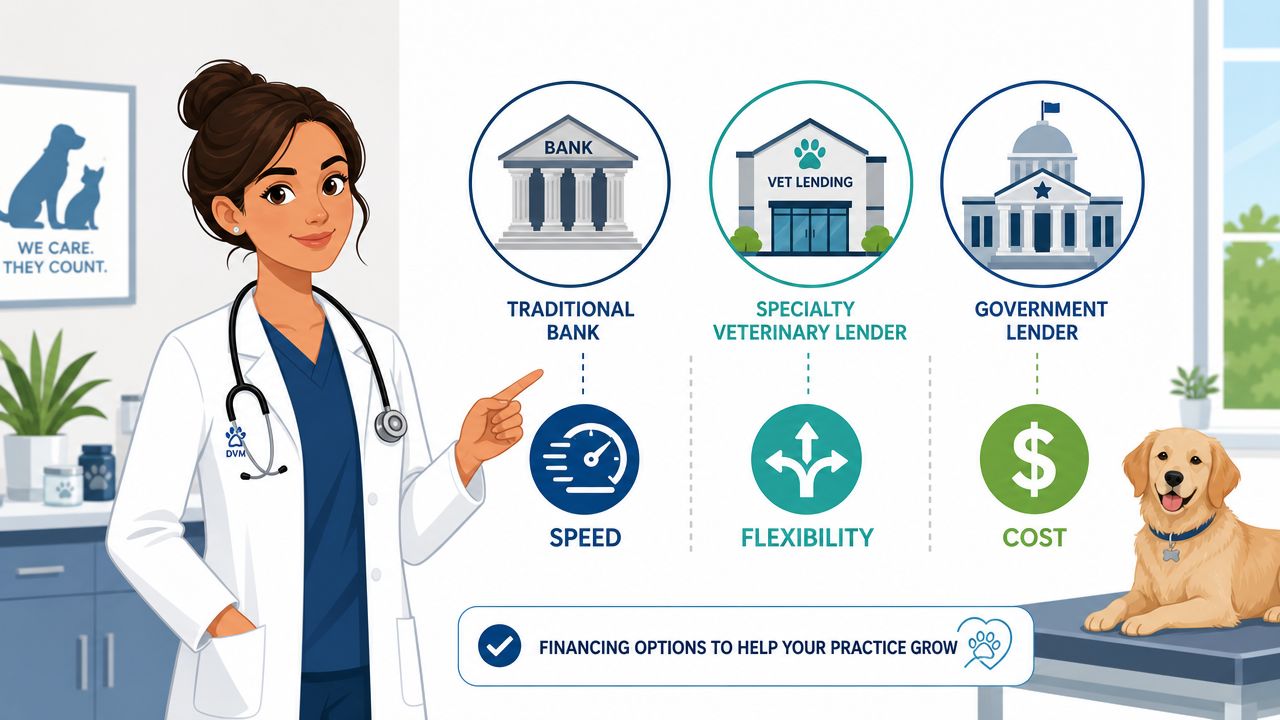
You're staring at a real decision, not a theoretical one. The seller wants to move, your associate wants to buy in, the architect keeps asking for deposit checks, or the ultrasound unit has already crossed from “aging” into “unsafe to ignore.” In veterinary deals, the wrong lender choice doesn't just cost you a little on rate, it can slow the transaction, distort the structure, and force you to patch together capital at the last minute.
The best lenders for veterinary practice loans are the ones that match the deal you have, not the headline product name in a brochure. A buy-in needs different underwriting than a de novo clinic. A seller-financed transition needs a different capital mix than an equipment refresh. If you treat every request like a generic small-business loan, you usually get generic terms, slower answers, and more cleanup later.
| Criterion | SBA-Preferred Lenders | Bank Practice-Solution Teams | Specialty Veterinary Lenders |
|---|---|---|---|
| Deal fit | Strong for acquisitions, real estate, and larger practice purchases | Strong for established practices and straightforward commercial borrowing | Strong for clinic-specific cash flow needs, transitions, and mixed uses |
| Underwriting focus | Practice cash flow, documents, and program rules | Borrower strength plus practice performance | Clinic revenue, deposits, collateral, and transaction structure |
| Speed | Slower because of program steps | Usually faster than SBA | Often the quickest for well-documented deals |
| Transition support | Good when the transaction is clean and well documented | Good for standard ownership changes | Useful when the deal has buy-in, seller note, or bridge components |
| Best use case | Bigger acquisitions and real estate-heavy deals | Established owners who can document strength clearly | Owners who need flexibility, speed, or a more tailored structure |
Where Most Veterinary Owners Start the Wrong Search
A lot of owners begin with the wrong question. They type “small business loan” into a search bar, get a pile of generic options, and then spend days trying to make a practice transaction fit a product built for retail, construction, or software. That is how a clinic owner ends up comparing monthly payments before anyone has even agreed on how the purchase, transition, or build-out is going to work.
Start with the deal structure. An associate buying in, a founder opening a de novo clinic, a group expanding to a second location, and an owner replacing aging equipment are not asking for the same capital. The lender that likes equipment collateral may not be the right fit for goodwill-heavy acquisitions, and the lender that moves quickly on working capital may not want to handle a partner transition cleanly.
That is why the phrase best lender is misleading if you say it without the transaction attached. The right question is, “Who will finance this kind of veterinary deal with the least friction and the fewest surprises?” That answer changes depending on whether you need purchase money, build-out funds, transition capital, or a bridge for the seller note.
Practical rule: if the lender does not ask about practice cash flow, transaction structure, or the exit plan, you are probably talking to the wrong desk.
Veterinary buyers are often told to prepare 2 to 3 years of tax returns, production reports for acquisitions, and 24-month cash-flow projections for de novo clinics, which shows how specialized underwriting has become in real practice finance Launch Advisor guidance on veterinary SBA loan cash flow modeling. That is not a consumer loan process. It is a deal process, and it should be handled like one. If you need a place to start on that side of the file, review Veterinary Practice Loans' guide to SBA loans for veterinary practice.
How Veterinary Practice Lenders Differ
The three lender categories matter because each one prices risk differently. SBA-preferred lenders work within a federal guarantee structure, conventional bank practice-finance teams rely on established credit and clean underwriting, and specialty veterinary lenders focus on clinic-specific revenue, deposits, collateral, and transaction complexity.
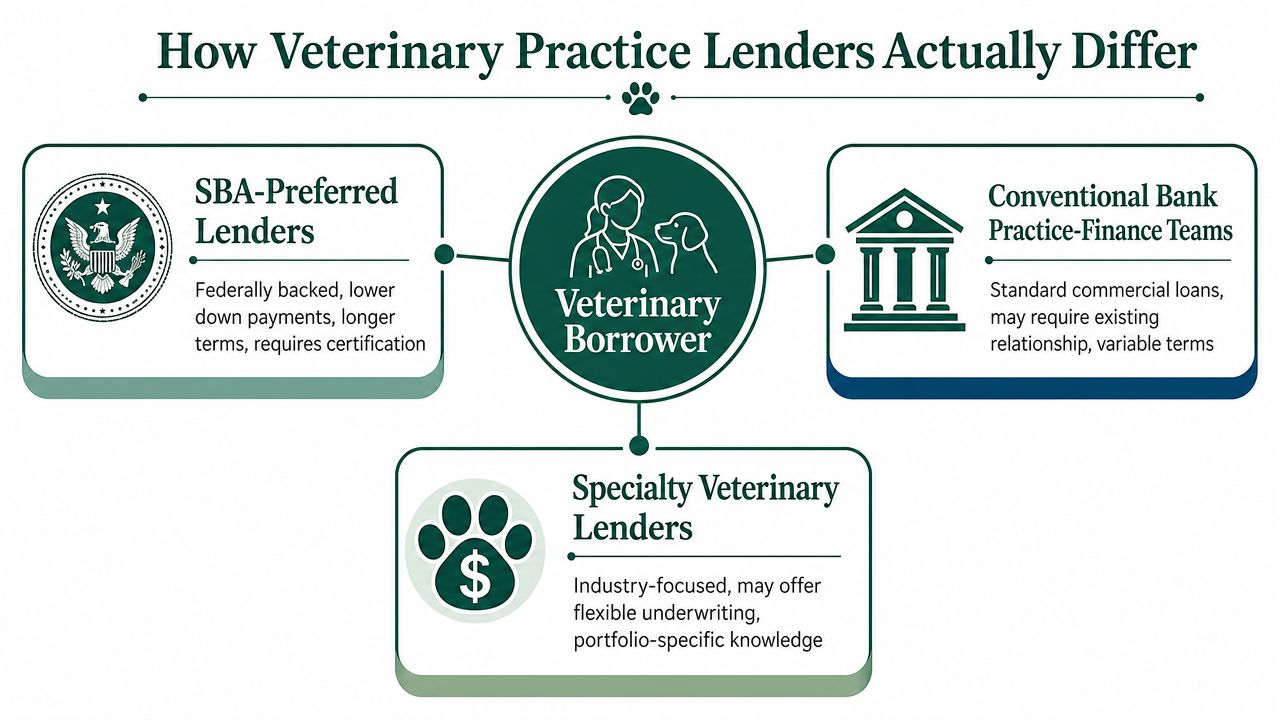
SBA lending still drives a large share of acquisitions because the structure gives buyers room to make the numbers work. It can guarantee up to 85% of a loan, allow borrowing up to $5 million, and stretch repayment to 25 years for real estate or 10 years for working capital and equipment. That matters in veterinary finance because acquisitions, build-outs, and equipment bundles eat cash fast, and longer amortization keeps the monthly payment from crushing the file. If you are screening an acquisition and want to see how that financing path gets structured, start with a veterinary practice acquisition loan.
Conventional practice-finance teams work differently. They move faster and ask fewer questions than SBA desks, but they want a stronger borrower profile and a cleaner story. If your practice is established, your numbers are stable, and the transaction is straightforward, this category can get the job done without much friction.
Specialty veterinary lenders sit in the middle on flexibility and usually win when the deal does not fit a standard box. They are the group most willing to underwrite around clinic performance instead of relying only on personal credit, which helps when the practice is healthy but the ownership path is messy.
The trade-off is simple. SBA gives you structure and long tenor. Conventional lending gives you speed and familiarity. Specialty lending gives you flexibility.
A practical benchmark from bank practice-solution guidance is that lenders often expect a DVM license, personal credit around 680+, financial statements, and debt schedules, while digital workflows can return decisions in about a week. If a lender cannot tell you what they need or how they underwrite, they are not ready for a serious practice deal.
Comparing the Major Lender Categories Side by Side
Owners usually stop guessing and start making real decisions here. The question is not which lender sounds nicest. It is which lender can close the transaction in front of you.
A lender that works for a standard clinic purchase can fail on a partner buy-in. A file that fits a clean bank loan can fall apart once seller notes, transition timing, or partial ownership transfer enter the mix. That is why lender choice should track the deal structure, not just the label on the term sheet.
| Criterion | SBA-Preferred Lenders | Bank Practice-Solution Teams | Specialty Veterinary Lenders |
|---|---|---|---|
| Underwriting basis | Practice cash flow, structure, and program rules | Borrower strength plus practice performance | Clinic performance, deposits, collateral, and deal structure |
| Common uses | Acquisitions, real estate, larger build-outs | Established practice borrowing, cleaner transactions | Acquisitions, equipment, working capital, and transitions |
| Borrower profile | Often needs strong documentation and patience | Often expects solid credit and stable operations | Often more open to nonstandard transaction shapes |
| Timeline posture | Slower, but often worth it for larger deals | Faster when the file is clean | Fastest when docs are organized and the fit is clear |
| Ownership transitions | Works well when the transfer is well documented | Can work for standard buy-ins | Often better when the transition has seller notes or layered funding |
| Smaller liquidity needs | Usually not the first choice | Sometimes available as separate credit | Can be useful, but smaller revolving needs are often handled separately |
The deal-size issue matters too. Lines of credit are typically below USD 200,000 in many practice-finance setups, so do not try to force a revolving need into the same conversation as a practice acquisition U.S. Bank veterinary loans page. That figure should change how you package the request. If you need acquisition money and near-term operating cushion, ask for both pieces as separate parts of the financing plan.
Lenders also care about what sits behind the borrower. The strongest offers usually come from lenders that can evaluate both practice cash flow and asset-specific collateral instead of leaning only on personal credit. Two lenders can sound similar at the proposal stage and still produce very different underwriting results once the file is reviewed.
The structure language deserves attention. Some lenders are comfortable with a clean purchase and little else. Others handle expansion capital, transition costs, and a temporary working-capital need without forcing the file into an artificial box. If a lender keeps saying yes only after stripping out half the deal, that is a mismatch, not a creative solution.
For deals that are really SBA-shaped, the financing usually fits better when the lender understands both the program rules and the practice transition. If you want a closer look at how that works, read the SBA loans for veterinary practice overview. For a deeper breakdown of acquisition-specific lending, see the practical overview on veterinary practice acquisition loan structures.
Matching Lender Type to the Deal You Actually Have
The fastest way to waste time is to apply the same lender logic to every veterinary transaction. A practice acquisition, partner buy-in, equipment refresh, working-capital line, and de novo build-out each reward a different financing posture.
A clean acquisition usually belongs in the SBA lane or with a lender that can underwrite the clinic, not just the buyer. A partner buy-in is trickier because the business is already operating, but ownership is changing hands in pieces, so the deal often needs a lender that understands partial transfers and transition timing. Equipment refreshes are simpler. If the purchase is tied to a specific asset and the practice can support the payment, that's a cleaner financing story.
Working capital is its own category. If the issue is payroll, inventory, or a short-term cash squeeze, the right lender is usually the one that can move quickly and avoid forcing long-term debt onto a short-term problem. De novo build-outs are different again, because the lender has to trust your projections before the doors are even open.
Candid advice: don't try to finance every dollar of a transition the same way. Seller notes, bank debt, and operating capital often need to be split across different sources.
Conventional loans are often used for acquisitions and buy-ins, and owner financing is still used to make deals happen when external capital is limited; ownership-transition structures can be more complex than standard practice loans Today's Veterinary Practice on lending and capital funding. That matters because the best structure is often a combination, not a single loan product.
When I look at a file, I usually think in this order. First, what part of the deal is permanent. Second, what part needs speed. Third, what part can be handled by the seller. That sequence usually gives owners a more realistic path to closing than shopping for one magical lender to do everything.
What Lenders Expect Before They Approve Anything
A lender is not trying to be poetic about your practice. It wants to know whether the debt gets paid and whether the transaction holds together under scrutiny.
Most files start with the same core documents, but underwriting is where deals separate. A DVM license, solid personal credit, financial statements, and debt schedules belong in the first package, because a clean submission gives the underwriter something to approve instead of something to chase. If the paperwork is incomplete, the file stalls. If the transition story is vague, it stalls later.
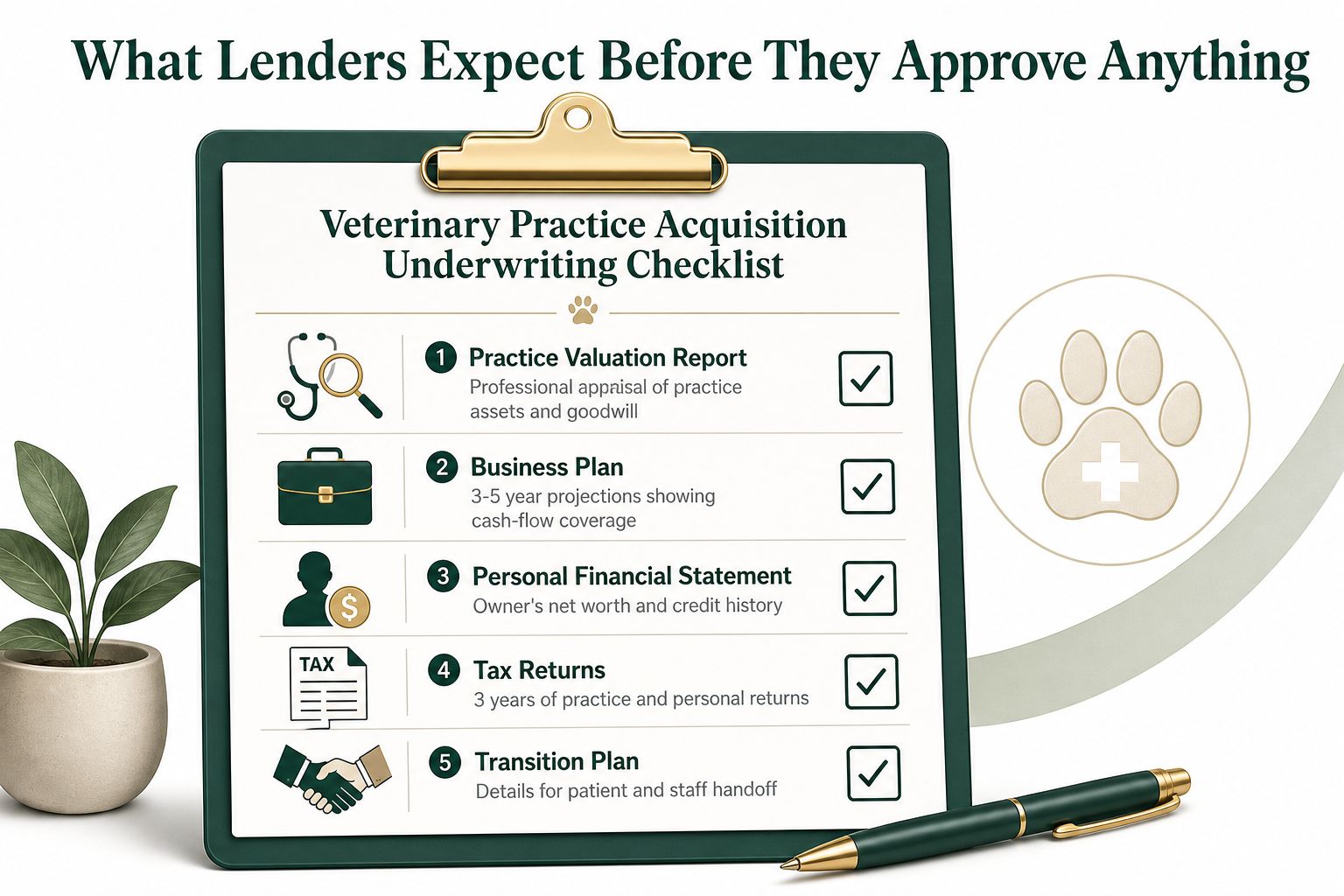
I want a borrower to bring me the file in this order, because this is what moves a decision.
- Practice valuation report. The lender needs a defensible price, especially when goodwill is part of the transaction.
- Business plan or projections. A startup, expansion, or partner buy-in has to show how cash flow supports the debt.
- Personal financial statement. The owner's outside assets, liabilities, and liquidity matter.
- Tax returns. Veterinary borrowers are commonly asked for 2 to 3 years of returns, depending on the deal type Launch Advisor guidance on veterinary SBA loan cash flow modeling.
- Transition plan. If staff, clients, or a seller note are part of the structure, the lender wants to see who is staying, who is leaving, and how the handoff works.
For acquisitions, production reports matter because they show how the clinic earns. For a startup or de novo, the lender will focus hard on the assumptions behind the cash-flow model. A thin package does not get rescued by optimism.
The ownership change matters just as much as the numbers. A partner buy-in, succession shift, or seller-financed deal needs a lender that can understand where the debt sits in the overall structure and what happens if one piece fails. If you want a closer look at how lenders talk about terms, see veterinary practice loan rates.
The fastest way to move a file forward is to answer two questions clearly. Can the practice produce enough cash to support the debt, and does this change in ownership make sense. If both answers are obvious, the conversation changes quickly.
Funding Speed and Timeline Realities for Veterinary Deals
A seller wants a closing date. The landlord wants signed documents. The equipment vendor wants a deposit. That is the pressure around veterinary financing, and it is where lender types separate fast.
Digital application workflows can return decisions in about a week, and practice-focused teams often reach out within 2 business days or faster once the file is clean and complete. Specialty lenders in the veterinary space are usually set up for quick review, and simple transactions with tight paperwork can move without much drag.
SBA deals usually take longer because the program adds steps. That is the tradeoff for getting the longer tenor and structure that can make an acquisition or build-out workable. If the deal can wait and the payment structure matters, the extra time can be worth it. If the seller is forcing a fast close, the timeline itself may tell you to choose a different lender type.
Speed still gets overrated. A quick no is still a no, and a fast term sheet that collapses under covenant pressure, collateral requirements, or transition friction helps no one.
If the lender cannot explain the file path in plain English, they probably are not ready to close on your schedule.
The practical move is to ask three direct questions before you commit. How fast can you issue a decision, what documents stop the clock, and what conditions can change the final structure? Those answers matter more than a loose promise about fast funding.
Choosing and Negotiating Beyond the Headline Rate
Owners love to shop rate, because rate is visible. The problem is that the cheapest looking deal can become the most annoying one once you add prepayment limits, covenant pressure, and transition restrictions.
You should compare amortization, prepayment flexibility, covenant structure, and transition support before you compare monthly payment alone. If you're likely to sell, buy in a partner, or refinance within a few years, those details can matter more than a small difference in the quoted rate. A lender that penalizes flexibility can cost you more than a lender that charges a cleaner price.
The negotiation also changes by transaction stage. A first-time buyer might care most about approval certainty and manageable payments. An established owner expanding into another location may care more about covenant simplicity and draw flexibility. A succession case often lives or dies on how the lender handles the seller note, the timing of ownership transfer, and any personal guarantee.
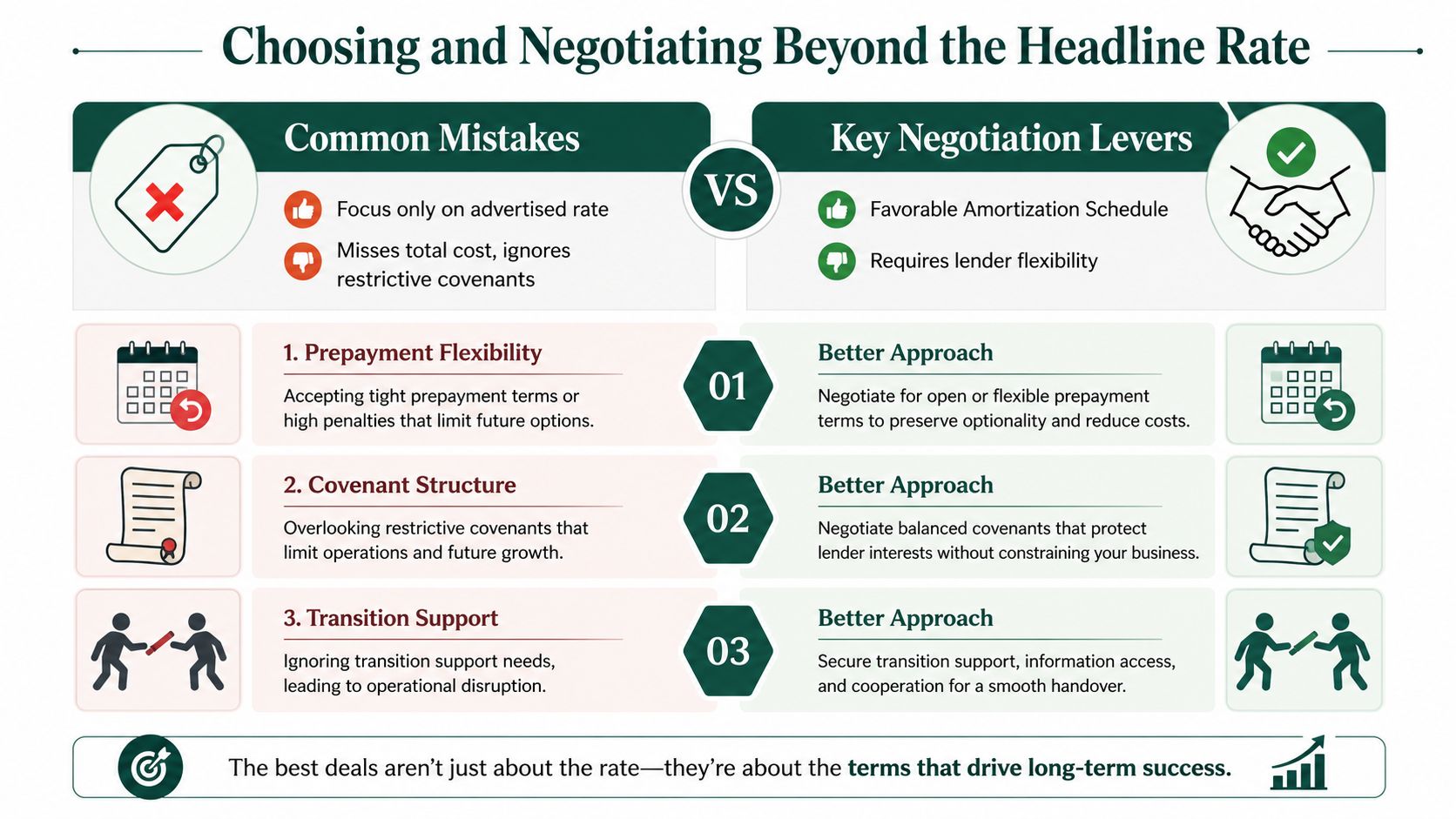
That's why lender selection should track your exit plan. If you think the business will change hands again, the loan has to leave room for that reality. If you're building the clinic for the long haul, you can afford to value stability over optionality. Neither is right in the abstract. One is right for your timeline.
For rate context only, use the loan terms page at veterinary practice loan rates, then compare any offer against the actual obligations attached to it. If the lender won't explain the full cost of the structure, you don't have enough information to sign.
Your Decision Framework and Next Steps With a Lender
Start with the owner stage, not the product label. A first-time buyer should focus on a lender that understands practice acquisition underwriting and transition risk. An established owner expanding should look for a lender that can handle larger facility, equipment, or multi-site needs without choking the file in committee. A succession case should prioritize a lender comfortable with seller-financed pieces and ownership transfer mechanics.
Veterinary-focused underwriting can help when a general small-business lender would look only at personal credit. In practice, clinic revenue, deposits, and cash flow can broaden eligibility and make the file more understandable to the decision-maker. That matters for owners who run strong operations but don't look perfect on a generic business application.
The market itself is getting larger, not smaller. The global veterinary practice finance market was estimated at USD 4.8 billion in 2024 and is projected to reach about USD 8.9 billion by 2033 at a 7.1% CAGR, which points to a growing lender set for acquisitions, equipment, and working-capital products in veterinary care Dataintelo veterinary practice finance market report. More lender attention usually means more product choice, but it also means more noise. That's exactly why structure matters.
A clean next move looks like this.
- Assemble the file first. Get the tax returns, financial statements, debt schedules, and transition documents together before you call.
- Request parallel term sheets. Compare at least two lender categories, not just two quotes from the same bucket.
- Judge the full structure. Look at amortization, prepayment language, guarantees, and whether the lender understands the deal shape.
- Use the lender that fits the transaction. If the file is messy, favor flexibility. If the deal is clean and time-sensitive, favor speed. If the purchase is large and the payment needs to stay manageable, favor structure.
Veterinary Practice Loans offers financing options for acquisitions, equipment, working capital, startup funding, and expansion, all built around clinic transactions rather than generic small-business borrowing. If you're sorting out a buy-in, a practice purchase, or a build-out and want a financing conversation tied to the deal structure, visit Veterinary Practice Loans and start with the transaction you have.
