

You're five minutes into a conversation with a banker, and the question lands faster than you expected, how much of this practice's cash flow can support a purchase? If you're looking at a Thrive Pet Healthcare-adjacent deal, or buying into a market where Thrive's footprint affects competitive dynamics, that question gets sharper. Lenders don't just underwrite the clinic in front of them, they also read the surrounding market, the consolidation story, and the credit behavior of the large groups setting the tone.
That's why Thrive Pet Healthcare veterinary practice ownership loans aren't a generic lending topic. Thrive sits inside a consolidation wave that has moved corporate-backed ownership to roughly 22% of U.S. veterinary businesses, up from about 16% three years earlier, while corporate groups are estimated to control 75% to 80% of specialty and emergency hospitals. Those numbers matter because they shape how lenders think about acquisition risk, liquidity, and whether a nearby independent practice can still grow on stable terms. DealSeam's veterinary PE rollup tracker
Understanding the Veterinary Practice Ownership Landscape
A veterinarian can do everything right clinically and still hit a financing wall. That usually happens when the buyer assumes a practice loan is just a larger version of a normal small-business loan. It isn't. Ownership lending in veterinary medicine sits at the intersection of clinical production, client payment behavior, equipment intensity, and the long tail of transition risk.
Thrive's position in the market makes that reality easier to see. The company, previously known as Pathway Vet Alliance, completed a major distressed debt exchange in March 2025 that extended all maturities to June 2028 and added incremental liquidity through a new superpriority revolver plus first-lien and second-lien layers. Octus notes the transaction happened after Thrive was already under increasing pressure in private-credit markets.
What buyers feel on the ground
That kind of capital structure doesn't stay locked inside boardrooms. It affects how local lenders think about the markets where large consolidators operate, especially when a buyer's target practice is tied to referral patterns, staff competition, or pricing pressure from a chain with deep reach. A banker looking at a nearby independent hospital may ask whether the practice's revenue is resilient enough to withstand a more aggressive corporate competitor.
Practical rule: if the market is crowded with capital-backed groups, lenders often become more conservative, not less. They want a clearer story about patient retention, doctor retention, and post-close liquidity.
For the buyer, that means the financing conversation starts earlier than the letter of intent. It starts when you decide whether you're buying a true operating business with a stable patient base, or buying into a market that may require a stronger balance sheet to stay competitive.
The best borrowers don't just ask, “Can I get approved?” They ask, “What assumptions will the lender make because Thrive and other consolidators have changed the market around me?” That's the right question, because the answer shapes your valuation, your down payment posture, and how much room you have left for staffing, upgrades, and transition fixes after closing.
What Veterinary Practice Ownership Loans Actually Are
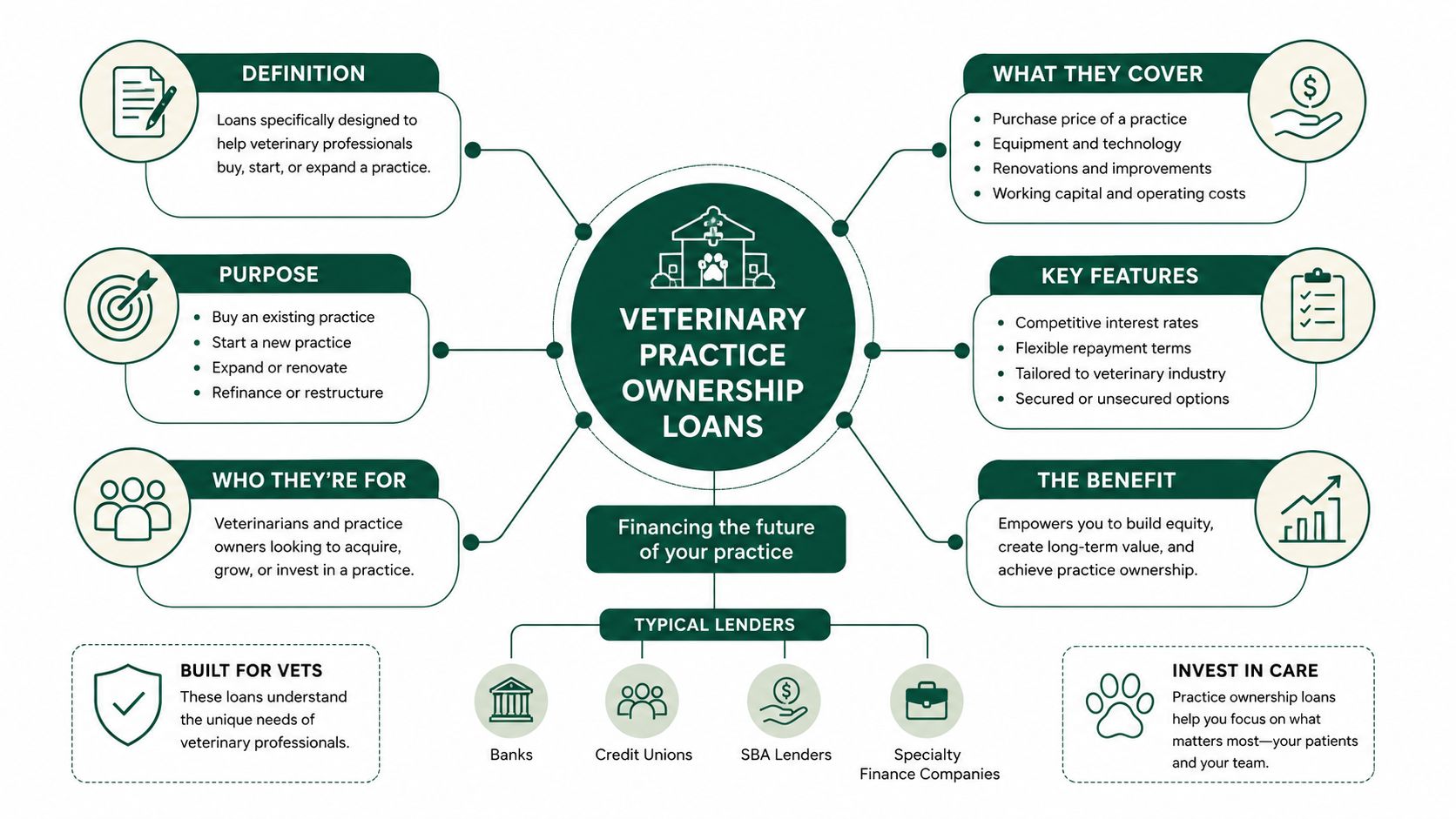
Veterinary practice ownership loans are purpose-built financing tools for buying, building, expanding, or stabilizing a clinic. The structure matters because veterinary businesses don't behave like ordinary retail or service companies. Revenue can be lumpy, equipment costs are front-loaded, and payroll doesn't wait for a slow month to improve.
A good ownership loan matches that reality. It gives you capital for the transaction or project, then repays over a schedule that reflects the practice's operating rhythm. That's why lenders look closely at clinic deposits, recurring client flow, equipment needs, and the durability of the revenue model. They're not only asking whether the practice is profitable. They're asking whether the business can keep producing enough cash to carry the debt without starving operations.
Why this category is different
A general-purpose business loan can ignore the way a clinic's revenue gets earned. Veterinary ownership financing can't. A practice may look strong on paper but still need a repayment structure that accounts for staffing ramp, inventory purchases, and the lag between a clinical improvement plan and the cash it generates.
That's also why ownership loans and working capital conversations tend to overlap. You may be financing the acquisition itself, but the key question is whether you'll have enough liquidity after closing to absorb a staffing miss, a doctor departure, or an equipment repair that wasn't in the seller's clean-up list.
If a lender seems focused only on the purchase price and ignores post-close operating stress, the structure may be too tight for a real veterinary transition.
Veterinary Practice Loans positions this type of financing around clinical operations, which is the right framing for a buyer. The loan should fit the practice, not the other way around. If the repayment schedule, documentation burden, and covenant package don't reflect how veterinary cash flow works, the “approval” can become a burden the day you sign.
Loan Types for Every Stage of Practice Growth
Not every owner is solving the same problem. A first-time buyer, a partner buying out a retiring associate, and a multi-site group opening another location all need different capital structures. Treating those situations as interchangeable is how borrowers end up overpaying for flexibility they don't use, or worse, underfunding the exact thing they needed most.
Here's the basic map.
| Loan Type | Best For | Typical Use Case |
|---|---|---|
| Acquisition loan | Buying a practice or equity stake | Partner buy-in, full practice purchase, additional location |
| Working capital line | Smoothing operating cash flow | Payroll, supplies, inventory, short-term liquidity gaps |
| Equipment financing | Buying clinical or IT assets | Imaging, surgical gear, lab systems, practice software |
| Startup funding | First-time ownership | Build-out, staffing, initial inventory, early ramp |
| Expansion loan | Growth inside an existing footprint | Renovation, relocation, exam room additions, satellite sites |
The most common mistake is asking a transaction loan to do a working capital job. That usually creates pressure in the first 6 to 12 months, when a new owner is still learning the staffing mix, client cadence, and ordering patterns of the clinic. The opposite mistake is funding too much liquidity for a narrow equipment purchase, which can leave you carrying debt longer than the asset justifies.
Matching the loan to the growth stage
An acquisition loan makes sense when control changes hands. A working capital line makes sense when the business is healthy but timing is messy. Equipment financing fits when the asset has a clear useful life and the payment schedule should track its contribution to revenue. Startup money matters when the practice has no historical operating base to lean on, because the early months are usually about ramp, not immediate maturity.
Expansion debt is different again. Renovation and relocation can lift throughput, but they also disrupt the schedule while construction, permitting, and staffing changes play out. That's why a lender's patience matters almost as much as the rate.
For a practical overview of structuring ownership debt, the framework in this veterinary SBA loan guide is useful because it clarifies how ownership, expansion, and transition financing can be matched to different clinic goals. The key is to choose the product that fits the actual operating event, not the one that merely sounds easiest to close.
How Thrive Pet Healthcare Influences Lending Assumptions
A buyer looking at a Thrive-affiliated clinic is not just underwriting a practice. They are also reading the market signal that comes from a large, heavily financed operator whose debt structure has already required adjustment. In March 2025, Thrive completed a distressed debt exchange that pushed maturities out to June 2028 and added incremental liquidity through a new superpriority revolver plus first-lien and second-lien layers. That matters because lenders tend to treat a consolidator's financing strain as a clue about how cautious they should be with veterinary credit more broadly.
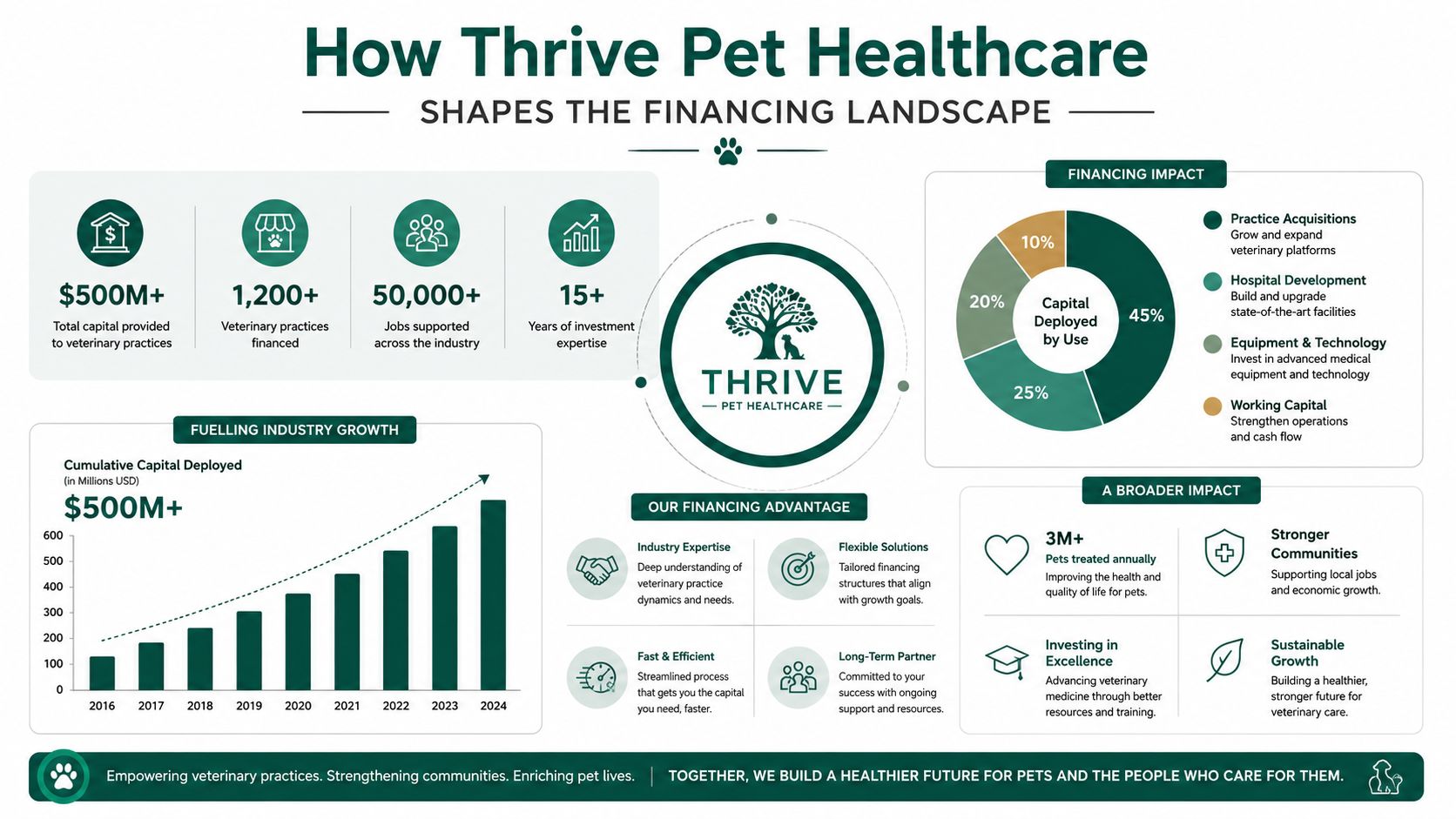
The practical effect is simple. When a large consolidator needs fresh liquidity and a more layered debt stack, lenders usually become more conservative about capital structure, collateral, and cash flow durability. That caution can spill into nearby practice financing, especially for a buyer who is acquiring from, competing with, or operating near a group under pressure. A 2025 report said Thrive's $1.55 billion term loan maturing in March 2027 was quoted around 78.375/79.75, and its revolver around 74.288/75.663, while another 2025 analysis said the first-lien term loan had moved from all-cash pay to partial PIK and was marked at 95.7% of par. Ion Analytics
What that means for buyers
A lender seeing those signals may press harder on EBITDA quality, post-close liquidity, and whether projected cash flow deserves a haircut. That does not kill the deal. It tightens the assumptions. The bank may want stronger reserves, a more conservative valuation, or a clearer path to payment stability if the practice's referral base, staffing pool, or local market is tied to Thrive's footprint.
That scrutiny matters because consolidation still shapes ownership decisions in major U.S. veterinary markets. Larger groups can support acquisition financing through recurring cash flow and roll-up economics, but they also make an independent buyer prove the clinic can stand on its own.
For practices in competitive regions, the local question is often whether the clinic can keep doctors and clients if a large chain changes pricing, hours, or staffing nearby. Buyers in those areas often benefit from reviewing location-specific ownership financing considerations before they finalize deal structure.
Underwriting Criteria and Documentation Essentials
Lenders look at veterinary practice ownership differently than they look at a generic small business. Credit still matters, but clinic-level cash flow matters more. So does the stability of deposits, the pattern of revenue, and the borrower's ability to support debt service without draining working capital right after closing.
The newer layer is revenue durability. Practices that lean heavily on cash-pay, membership, or wellness-plan models get read differently than practices that rely on classic fee-for-service collections. If the revenue mix is changing, lenders want to know whether the new mix is dependable or just temporarily boosted by marketing, pricing, or a temporary surge in demand.
The documents that do the heavy lifting
Most buyers need three years of financials, a valuation, and a clear repayment story built from actual operating cash flow. That's the baseline. Then lenders dig into whether the practice has enough margin to absorb schedule volatility, staffing pressure, and rising client sensitivity without missing debt service.
A strong package usually shows three things clearly:
- Historical consistency, not just a good recent month.
- Revenue quality, meaning the lender can see what part of the income stream is recurring or durable.
- Post-close breathing room, so the clinic isn't operating on fumes after the seller walks away.
Useful test: if you had to explain the practice's ability to service debt using only collected cash, not optimistic production, would the story still hold?
That test matters because veterinary practices can look busy while still feeling financially tight. The earlier market discussion about Thrive and broader consolidation makes lenders extra alert to anything that could weaken repayment. If the surrounding market is stressed, underwriting usually gets stricter, not looser.
The buyer's job is to remove ambiguity before it becomes a lender objection. Clean financials, a realistic transition plan, and a documented source of repayment make a much stronger case than projected optimism. If the practice depends on revenue that could soften under price pressure, the borrower should be ready to explain how the clinic will protect collections, retain clients, and manage mix shifts after closing.
Decision Factors That Make or Break Your Financing Choice
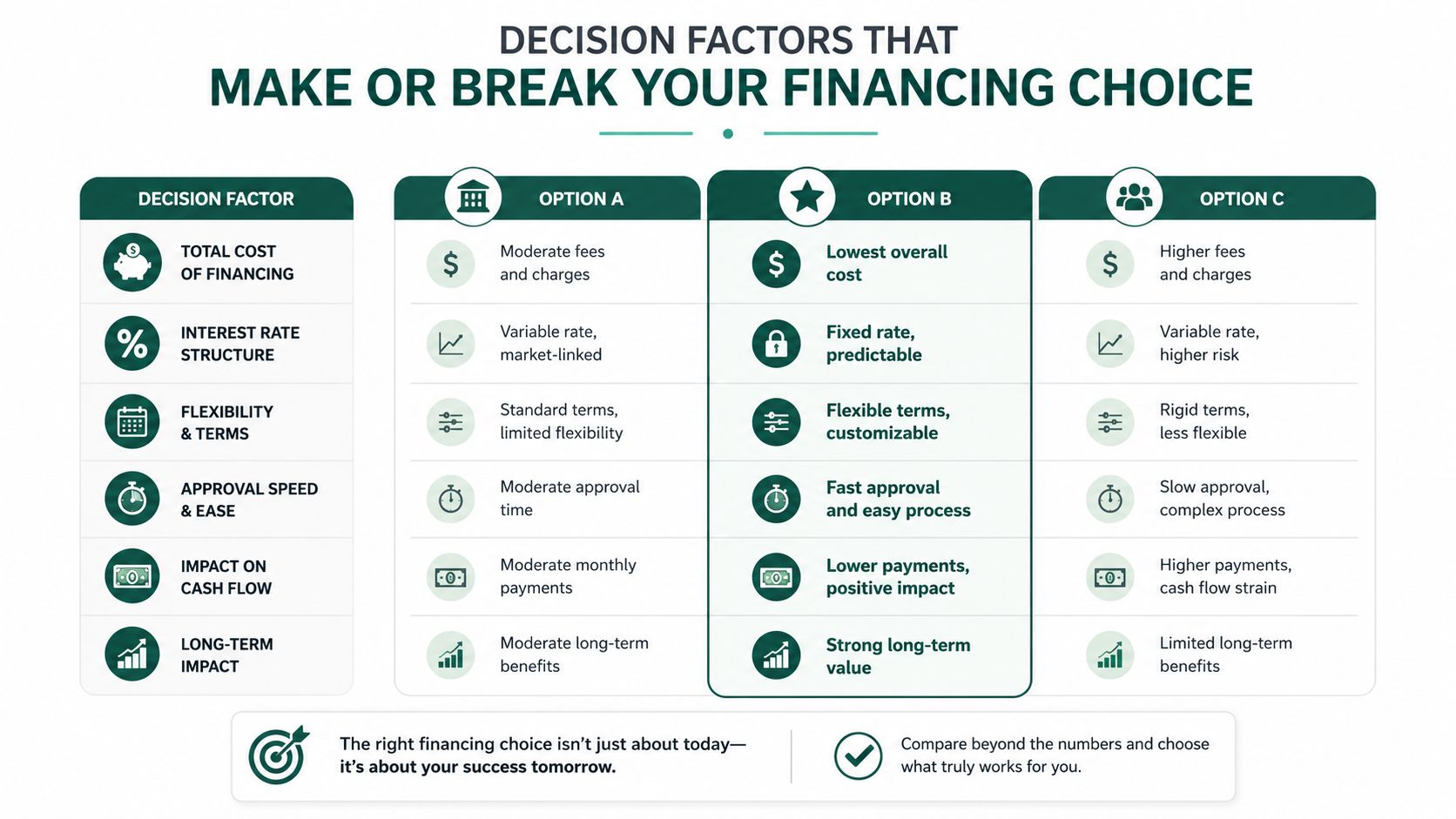
The cheapest-looking loan can be the most expensive one if the structure is wrong. That's especially true in veterinary ownership, where repayment flexibility, covenants, and timing can matter as much as rate. A loan that seems manageable on day one can become a burden if it leaves no cushion for payroll swings, doctor turnover, or delayed ramp.
Start with cost of capital, but don't stop there. A lower coupon doesn't help if the deal comes with a repayment structure that chokes the practice's working capital. A more flexible loan can be worth more even if the headline cost is higher, because the core value is survival through the transition period.
The factors that deserve real attention
- Cash flow coverage, because the loan has to fit the practice's actual collections, not the seller's best year.
- Covenant pressure, because tight requirements can limit hiring, equipment purchases, or owner draws.
- Liquidity after closing, because a clinic that starts life with no buffer is exposed to every staffing or collection hiccup.
- Timing risk, because delayed underwriting can push a deal into a worse market or create stress around a seller's transition window.
- Collateral structure, because assets that support the loan should be clear, clean, and understandable.
- Transition realism, because the practice has to function after the seller steps back, not just on the closing date.
For a broader look at lender positioning and underwriting style, the best lenders for veterinary practice loans in 2026 discussion is useful because it reinforces a simple point, the best structure is the one that preserves operating flexibility while still satisfying the lender.
The right question isn't “Which loan is cheapest?” It's “Which loan leaves the practice able to hire, stock, and adapt after closing?”
That mindset matters more in a market shaped by consolidation pressure. If large groups are already forcing stricter credit thinking, the buyer who preserves the most flexibility usually has the strongest long-term odds.
Application Steps and Alternative Financing Pathways
The application process is usually more predictable than buyers expect, as long as the file is organized. It starts with pre-qualification, moves into document collection, then underwriting review, and ends with closing and funding. Some lenders can move fast when the file is clean, while more complex acquisitions take longer because the buyer, seller, and lender all need the same story to hold together.
The fastest way to slow a deal is to submit incomplete records. Missing tax returns, inconsistent production reports, vague valuation support, or a weak transition narrative can turn an otherwise fundable practice into a revolving series of follow-up requests. That's not just annoying. It can change the deal timeline enough to affect staffing decisions, lease negotiations, and seller confidence.
Where alternative pathways fit
Traditional practice loans aren't the only way to finance an ownership move. Seller financing can bridge valuation gaps. Earn-out structures can align part of the price with future performance. Transition support from a larger group can also help smooth the handoff if the deal structure is negotiated well.
Those alternatives work best when they solve a specific problem. Seller financing can reduce the buyer's upfront cash burden. Earn-outs can protect both sides when future revenue is uncertain. Transition support can help keep the schedule stable while the new owner builds trust with the team and clients.
The problem is using too many moving parts without a clear operating plan. If the financing stack is complicated, the practice still needs one person accountable for collections, staffing, inventory, and post-close liquidity. Without that, the deal may close cleanly and still feel unstable by month two.
A practical ownership transition is less about finding a perfect funding source and more about combining the right ones in a way the practice can survive. If you're comparing structures, ask whether the loan supports the business you're buying, not the one everyone hopes it will become.
If you're sorting through a practice purchase, expansion, or buy-in and the financing story feels more complicated than it should, Veterinary Practice Loans can help you compare ownership structures against real clinic cash flow and transition risk. Visit Veterinary Practice Loans to start a focused conversation about a loan that fits your practice, not just the lender's checklist.
