

Dr. Maya has a familiar problem. She's a fourth-year associate at a three-doctor hospital, has enough clinical experience to want ownership, and has three very different offers in front of her. She could buy into her current practice, build a new clinic in a neighboring suburb, or join an ownership-linked group that supplies capital in exchange for operational alignment.
Those choices may look like career decisions, but they're also financing decisions. An acquisition usually points toward SBA or conventional debt. A startup requires funding for construction, equipment, staffing, and the slow revenue ramp that follows opening day. A group-backed arrangement may reduce the cash Maya needs upfront, but it can also limit autonomy and create a longer-term economic relationship with the capital provider.
The right question isn't, “Which option has the lowest rate?” The better question is, which structure can survive the practice's weakest months without forcing a bad operational decision? This guide examines GoodVets-style ownership-linked capital alongside SBA 7(a), conventional loans, equipment financing, and working capital structures. The focus is repayment mechanics, ownership trade-offs, and cash-flow stress during the ramp period.
The Ownership Decision Every Veterinarian Faces
Three paths, three financing conversations
Maya's first option is a purchase of her existing hospital for $850,000. She already knows the staff, client base, medical systems, and local referral patterns. That familiarity can make an acquisition easier to underwrite, but the lender still needs to understand the hospital's historical cash flow, goodwill, equipment, lease obligations, and transition plan.
Her second option is a startup in a nearby suburb. A new clinic offers more control over layout, culture, scheduling, and service mix. It also removes the comfort of established revenue. The financing package must support buildout and equipment while leaving enough liquidity for payroll, inventory, marketing, and operating losses during the ramp.
The third option is an ownership-linked group. Maya receives capital and infrastructure, but she may also accept brand standards, governance requirements, centralized systems, or limits on future transfer. That arrangement is closer to an equity partnership than a conventional loan, even if some of the funding carries debt-like repayment terms.
Advisor's view: The cheapest capital on paper can become the most expensive choice if the payment schedule forces you to delay hiring, cut inventory, or postpone essential equipment.
Why ownership structure matters
GoodVets provides a useful example of how ownership-linked capital can be designed. The company has been cited as receiving investment from General Atlantic, SkyKnight Capital, and Dixon Midland Company, while its model allows veterinarians to own a percentage of their practices and receive financial backing. A 2024 report also described doctors choosing their location, designing their hospital, and managing the practice without corporate interference, according to the Evanston RoundTable report on GoodVets.
That model matters because veterinary ownership is no longer a simple choice between “independent” and “corporate.” Corporate ownership of U.S. veterinary practices was reported to have risen from about 10% in 2017 to roughly 30% by late 2022, while independent ownership in the UK was reported to have fallen from 89% in 2013 to about 40% in 2024. Those figures come from an industry summary covering independent veterinary practices for sale in 2026.
For a buyer, the practical lesson is clear. Ownership-linked capital may solve an equity and infrastructure problem that a bank loan can't solve alone. But Maya still needs to compare control, repayment obligations, buyout rights, and ramp-period cash flow before she signs.
What GoodVets-Style Ownership Loans Actually Fund
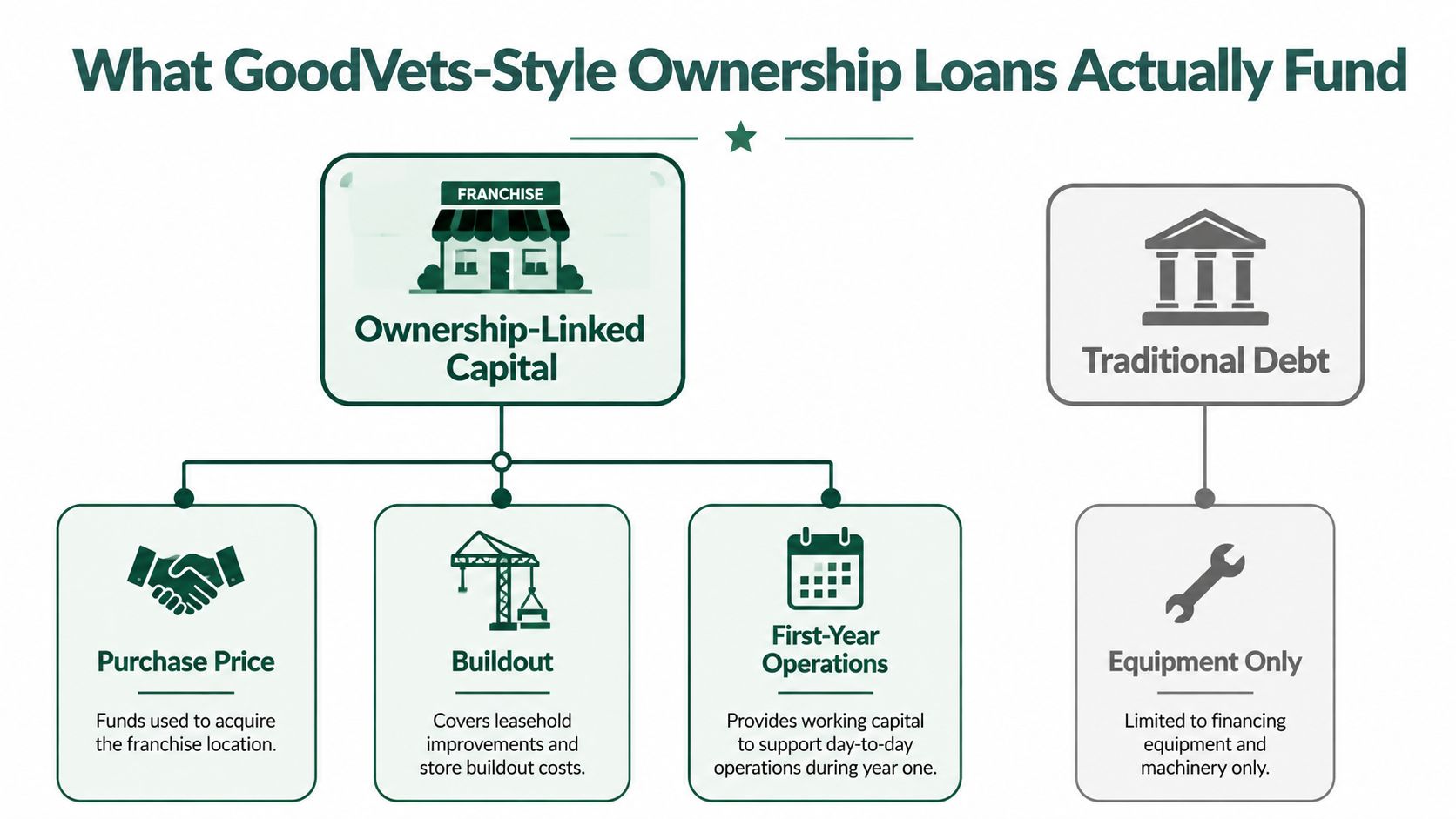
GoodVets-style backing is best understood through a franchise analogy. A traditional lender provides debt against a defined repayment schedule. An ownership-linked capital provider may fund the purchase price, buildout, equipment, and early operating needs while taking a stake or structured economic position in the business.
The difference is not cosmetic. Debt gives the lender repayment rights and often collateral protection. Equity or a structured ownership position gives the capital partner an economic interest and may create governance, reporting, or operational expectations.
Start with the use of proceeds
A buyer should separate funding needs into distinct buckets:
- Acquisition financing: Pays for an existing hospital, including goodwill, equipment, and approved transition expenses.
- Partner buy-in financing: Funds the purchase of a partial ownership interest from an existing owner or partner.
- Startup capital: Covers construction, equipment, initial staffing, inventory, and early operating liquidity.
- Working capital: Supports payroll, supplies, rent, pharmaceuticals, and other recurring costs while revenue develops.
- Expansion financing: Funds renovations, additional exam rooms, a relocation, or another clinic.
Ownership-linked capital can combine several of these uses under one relationship. Traditional debt usually requires more precise allocation and may separate equipment, real estate, working capital, and acquisition proceeds into different products.
Understand what the capital provider receives
The phrase “ownership-linked loan” can hide several different structures. An equity partnership gives the provider an ownership stake. A seller-financed transaction leaves the seller with a note and repayment rights. A revenue-share arrangement ties payments to business performance rather than using only a fixed principal-and-interest schedule.
Those structures aren't interchangeable. Ask whether the capital provider receives voting rights, board rights, management approval rights, referral obligations, brand requirements, or a right to buy out a minority interest. Also ask what happens if you want to sell, refinance, open another location, or leave the group.
Ownership-linked capital can reduce the cash you contribute at closing, but it rarely reduces the economic cost of capital. You're trading some combination of autonomy, future upside, and flexibility for access to funding and support.
The core distinction is simple. Traditional debt is primarily a repayment relationship. Ownership-linked capital is a repayment and ownership relationship. Treat it accordingly during negotiations.
The Five Loan Types Behind Practice Ownership
Veterinary practice ownership rarely fits into one neat loan product. A buyer may use acquisition financing for the purchase, equipment financing for a surgical suite, and a working capital line for the first operating cycle. Ownership-linked capital often complements those products rather than replacing them.
| Loan Type | Primary Use | Typical Term | Stage |
|---|---|---|---|
| Acquisition financing | Existing hospital purchase, goodwill, transition expenses | Structured around business assets and cash flow | Buying an established practice |
| Startup financing | Buildout, equipment, staffing, inventory, early operations | Structured around ramp risk and project needs | Opening a new clinic |
| Partner buy-in financing | Purchase of a partial ownership interest | Based on the stake, cash flow, and buyout terms | Becoming a co-owner |
| Equipment financing | Imaging, surgery, laboratory, and technology equipment | Often aligned with useful life | Upgrading or replacing assets |
| Working capital or expansion line | Payroll, supplies, renovations, relocation, new sites | Revolving or term structure | Stabilizing or growing operations |
Acquisition financing
This is the central product for buying an established hospital. The lender underwrites historical revenue, normalized owner compensation, operating expenses, goodwill, equipment, lease terms, and the buyer's transition plan.
SBA 7(a) is especially relevant because it can finance goodwill, unlike many equipment-only products. Veterinary acquisition guidance commonly describes goodwill as 60% to 80% of transaction value, with funding also available for equipment, working capital, and transition costs. The same guidance describes typical buyer equity of about 10%, with up to half of that injection sometimes supported by a seller note, and financing of up to 90% over a 10-year amortization for business assets in qualifying structures. See the veterinary practice acquisition loan guidance for the stated mechanics.
Startup loans
A startup loan carries the most operational uncertainty. The lender isn't relying on an established practice's full operating history, so the business plan, local demand analysis, owner experience, projected staffing, and cash reserve become decisive.
Don't borrow only for construction and equipment. A clinic that opens with a beautiful buildout but insufficient operating liquidity can fail before its clinical model matures.
Partner buy-ins
A partner buy-in can be smaller than a full acquisition, but it isn't automatically easier. The lender must understand how the ownership percentage was valued, whether distributions will cover debt service, and what rights the buyer receives.
The operating agreement matters as much as the loan agreement. Review transfer restrictions, future capital calls, voting rights, and the process for valuing the interest at exit.
Equipment and working capital
Equipment financing is appropriate for identifiable assets such as imaging, surgical, laboratory, and information technology equipment. It generally offers a cleaner collateral position because the financed asset is defined.
Working capital and expansion lines address a different problem. They preserve liquidity for payroll, inventory, renovation, relocation, or a new site. A complete ownership transaction often stacks two or three products because one loan shouldn't be forced to carry every risk.
How SBA Conventional and Alternative Loans Compare
The three main paths serve different buyers. SBA 7(a) is usually the most flexible acquisition structure because it can include goodwill. Conventional debt can be cleaner and faster for a strong practice with substantial cash flow. Ownership-linked capital can reduce the buyer's equity burden, but the buyer gives up some independence or future economics.
One important correction is necessary. The precise ranges sometimes repeated in marketing materials aren't all supported by the verified data available here. Current veterinary financing references describe SBA acquisition pricing around prime plus 2.0 to 2.75 percentage points, while broader acquisition loan rates are described around 6.5% to 11%, depending on credit quality, profitability, and debt-service coverage. The veterinary acquisition financing market update also notes that goodwill may receive up to 10-year amortization, with 25 years available when real estate is included.
| Feature | SBA 7(a) | Conventional Bank | Ownership-Linked or Group-Backed |
|---|---|---|---|
| Best fit | Existing-practice acquisition and goodwill | Strong cash-flowing practice or real estate-backed transaction | Buy-in, expansion, or group-aligned ownership |
| Equity | Often about 10% buyer equity | Usually higher equity expectations | May reduce upfront cash through an ownership position |
| Amortization | Up to 10 years for business assets, longer when real estate is included | Negotiated with the bank | May combine debt, equity, earn-out, or other structures |
| Underwriting focus | Tax returns, personal credit, cash flow, guarantee | Stronger cash flow and collateral profile | Ramp tolerance, strategic fit, and operational alignment |
| Main trade-off | Documentation and personal guarantee exposure | Higher equity and stricter cash-flow standards | Reduced autonomy and possible future buyout limits |
SBA borrowers should also examine guaranty fees, collateral requirements, personal guarantees, and prepayment provisions. Conventional borrowers need to focus on covenants, minimum cash balances, and refinancing risk. Group-backed borrowers must read the ownership documents with the same care they apply to the loan documents.
For a veterinary-specific overview of SBA structures, review SBA loans for veterinary practice financing. The recommendation is straightforward. Use SBA debt when goodwill and acquisition flexibility matter, conventional debt when your financial profile is unusually strong, and ownership-linked capital when the operating support and equity flexibility justify the loss of control.
Underwriting Standards and Documents Lenders Require
Lenders underwrite the person, the practice, and the transition. A polished presentation won't rescue weak cash flow or an unrealistic ramp forecast.
The four underwriting pillars
Personal credit affects both eligibility and pricing. SBA lenders commonly look for strong personal credit, while conventional lenders usually expect an even stronger profile. Clean up revolving balances, late payments, tax issues, and unexplained liabilities before submitting an application.
Debt-service coverage is the central cash-flow test. The lender wants to know whether normalized practice earnings can cover required principal and interest after owner compensation and operating expenses. A forecast that works only at full utilization isn't a financing plan. It's a wish.
Veterinary experience supports the transition case. Clinical skill matters, but lenders also want evidence that you can manage staff, client retention, inventory, scheduling, compliance, and financial controls.
Collateral and guarantees protect the lender if the practice underperforms. Hard assets may support part of the request, but buyers should expect personal guarantee exposure in many structures. Review the lender's collateral expectations alongside the assets commonly required for a veterinary practice loan.
Build the file before requesting terms
Stage these documents early:
- Tax returns: Personal and business returns covering the requested historical period.
- Financial statements: Year-to-date profit and loss statements, balance sheets, and margin reports.
- Debt schedule: Every existing loan, lease, guarantee, maturity, and monthly payment.
- Transaction documents: Letter of intent, purchase agreement, operating agreement, and proposed transition terms.
- Forecast package: Pro forma income statement, cash-flow forecast, ramp assumptions, staffing plan, and working capital needs.
- Asset support: Equipment list, appraisals where required, and real estate valuation when property is part of the deal.
- Professional background: Resume, state license, ownership history, and written business plan.
- Market evidence: Demographic and trade-area analysis supporting the clinic's location and growth assumptions.
Underwriters red-flag declining revenue, excessive dependence on one owner or clinician, undisclosed litigation, weak transition planning, and balloon maturities that depend on an optimistic refinance. Explain problems before the lender discovers them. Transparency preserves credibility; surprise destroys it.
Real Cost Scenarios and Repayment Stress Tests
A payment model is useful only when it reflects the practice's weak months. The verified data supports a range of acquisition rates and terms, but it doesn't provide enough information to calculate defensible monthly payments for three specific deal sizes across multiple structures. Producing exact principal, interest, total-interest, and revenue figures would require assumptions that aren't verified here, including the financed percentage, actual interest rate, fees, equity injection, and whether real estate is included.
That limitation doesn't make stress testing optional. It makes the assumptions more important. Build the model with the actual lender term sheet, then test the following cases:
| Deal Size | Loan Structure | Rate | Amortization | Monthly P&I | Revenue Needed at 15% Margin |
|---|---|---|---|---|---|
| $650,000 satellite acquisition | SBA, conventional, or ownership-linked structure | Use the quoted term-sheet rate | Use the quoted amortization | Calculate from financed principal and quoted terms | Monthly debt service divided by 15% |
| $1.2 million solo practice purchase | SBA, conventional, or ownership-linked structure | Use the quoted term-sheet rate | Use the quoted amortization | Calculate from financed principal and quoted terms | Monthly debt service divided by 15% |
| $2.5 million multi-doctor buy-in | SBA, conventional, or ownership-linked structure | Use the quoted term-sheet rate | Use the quoted amortization | Calculate from financed principal and quoted terms | Monthly debt service divided by 15% |
The stress test that matters
For each scenario, reduce projected revenue by 20% for six months. Don't reduce expenses by the same percentage. Payroll, rent, software, insurance, and many equipment obligations won't fall just because appointments slow.
Then compare three outcomes:
- Fully amortizing debt: Principal and interest remain due every month, so the practice absorbs the entire payment during the ramp.
- Longer amortization: The monthly payment may be lower, but the borrower pays interest for longer and may carry more debt into a later refinancing.
- Ownership-linked flexibility: An earn-out, interest-only period, or performance-linked payment may reduce early cash pressure, but the buyer must price the surrendered ownership and control.
The veterinary practice loan terms and repayment options guide is useful for organizing these variables, but don't accept a range as a final answer. Insert the proposed principal, rate, amortization, fees, and payment schedule into a monthly cash forecast.
Stress-test rule: If the practice can't cover debt service after the six-month revenue reduction without delaying payroll, maintenance, hiring, or essential inventory, the deal is too aggressive.
A conservative planning rule is to keep annual debt service below 25% of projected stabilized revenue, but treat that as a decision guardrail rather than a substitute for a full forecast. The correct test includes owner compensation, taxes, capital expenditures, working capital swings, and the obligations created by any ownership partner.
Matching Loan Structure to Your Practice Goals
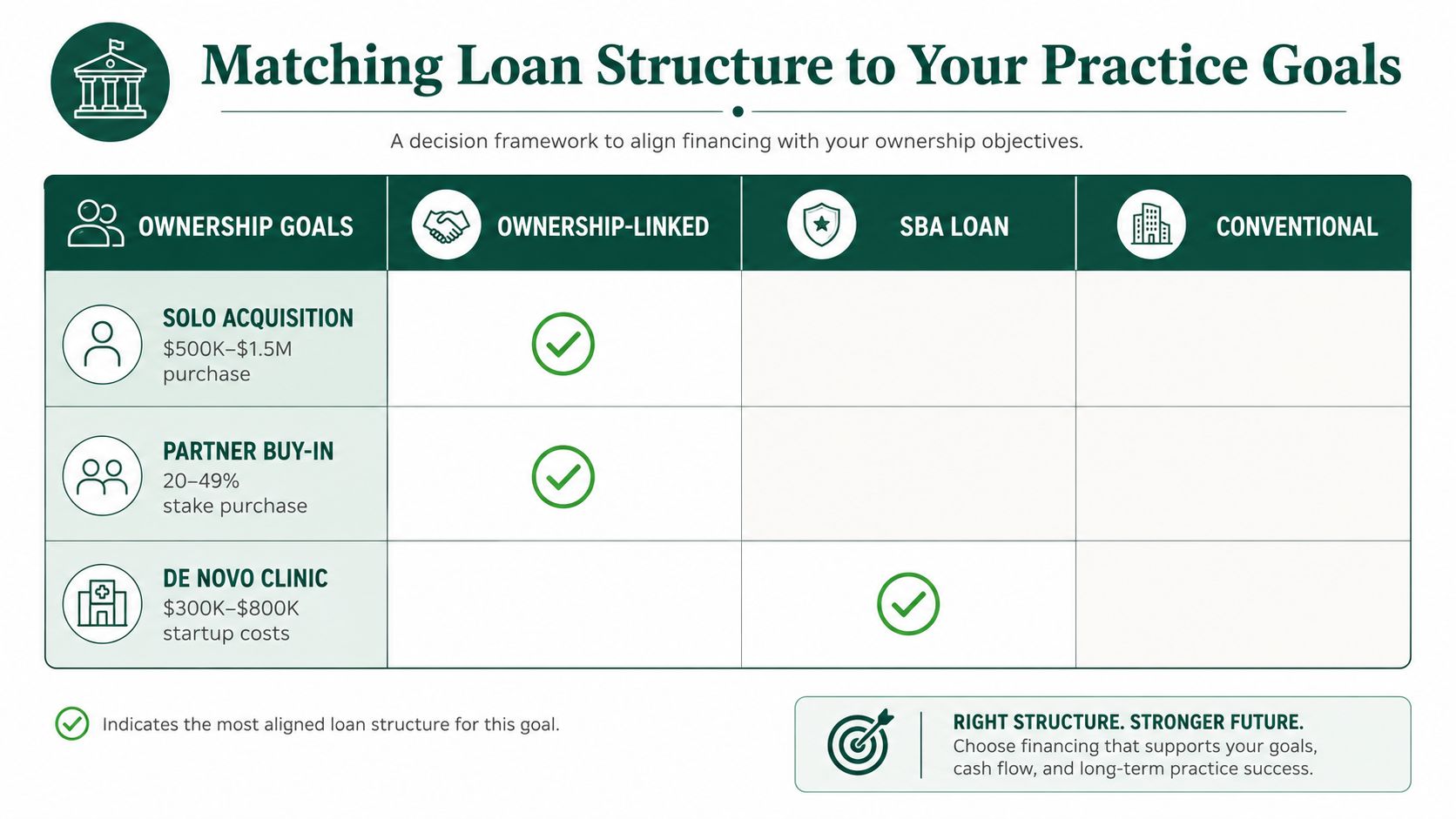
Don't choose the loan first. Choose the ownership goal, then design the capital stack around the risk.
| Ownership Goal | More Suitable Starting Point | Main Negotiation |
|---|---|---|
| Solo acquisition | SBA acquisition debt, possibly supplemented by equipment or working capital financing | Goodwill valuation, transition support, and seller note terms |
| Partner buy-in | Ownership-linked capital or targeted buy-in financing | Voting rights, distributions, transfer rights, and buyout formula |
| De novo clinic | Startup financing with separate equipment and working capital planning | Ramp-period liquidity, draw schedule, and construction contingency |
| Expansion | Conventional or expansion debt when existing cash flow supports it | Covenants, collateral release, and future-location flexibility |
| Exit bridge | Shorter-term structure only with a documented refinance or sale path | Balloon maturity, prepayment, and personal guarantee release |
Size the debt against ramp-period EBITDA, not the optimistic stabilized forecast. Negotiate seller financing when it improves the equity requirement or keeps the seller economically involved in a clean transition. Consider an equity kicker only when you understand exactly how it affects future distributions and exit value.
The long-term cost isn't limited to the interest rate. Review financial covenants, prepayment penalties, balloon maturities, personal guarantees, and refinancing restrictions. A slightly higher rate with flexible repayment can be safer than a lower rate that traps you during a weak operating period.
A visual explanation of the financing decision is also available in this veterinary practice ownership financing video.
Application Timeline Common Mistakes and Next Steps
A veterinary loan can stall even after the buyer has chosen a structure. Missing tax returns, unresolved lease terms, delayed appraisal work, environmental review, or a credit committee meeting can push closing beyond the original target.
Use the usual planning windows as working assumptions: 60 to 120 days for SBA, 45 to 90 days for conventional financing, and 30 to 60 days for ownership-linked structures. These are not commitments. A disputed practice valuation or incomplete financial package can extend any timeline.
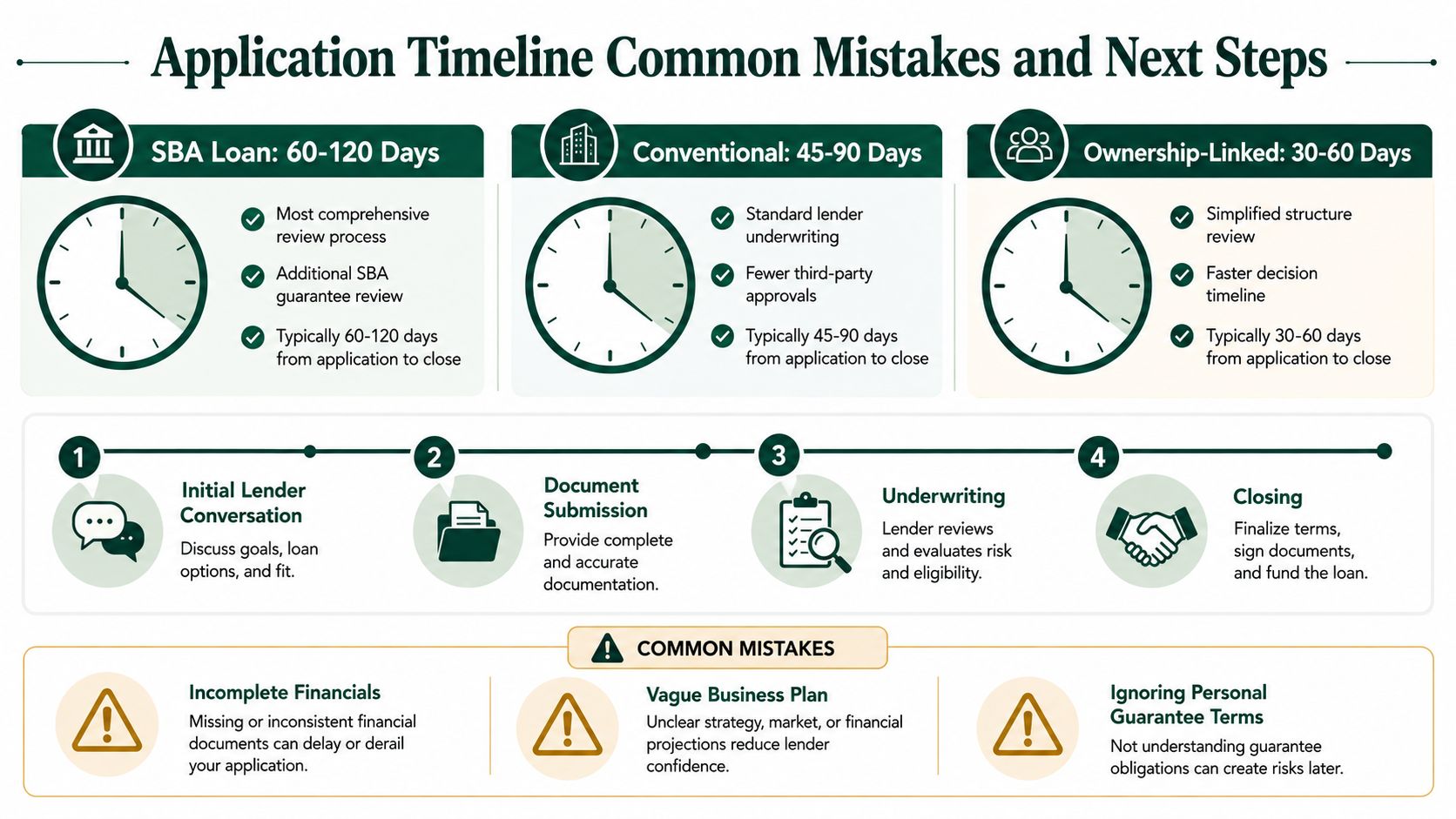
Avoid four deal-breaking errors:
- Overstated revenue: Base the forecast on documented appointment capacity, doctor production, staffing, and a credible ramp.
- Underfunded operations: Budget payroll, drugs and supplies, rent, relief coverage, and working capital alongside construction or equipment.
- Unprepared personal finances: Resolve credit issues before underwriting, not after a lender requests explanations.
- Unplanned balloon debt: Do not accept a short maturity without a realistic refinance or sale path.
Before meeting a lender, pull the practice's trailing-twelve-month P&L, identify months where EBITDA fell below 15%, and document the owner compensation adjustment you would make during a ramp. Then separate recurring clinical revenue from one-time items, confirm the lease term supports the loan maturity, and map debt payments against the first months of projected cash flow. Bring that package and the proposed transaction to Veterinary Practice Loans for financing guidance on acquisitions, partner buy-ins, equipment, working capital, startups, and expansion.
