
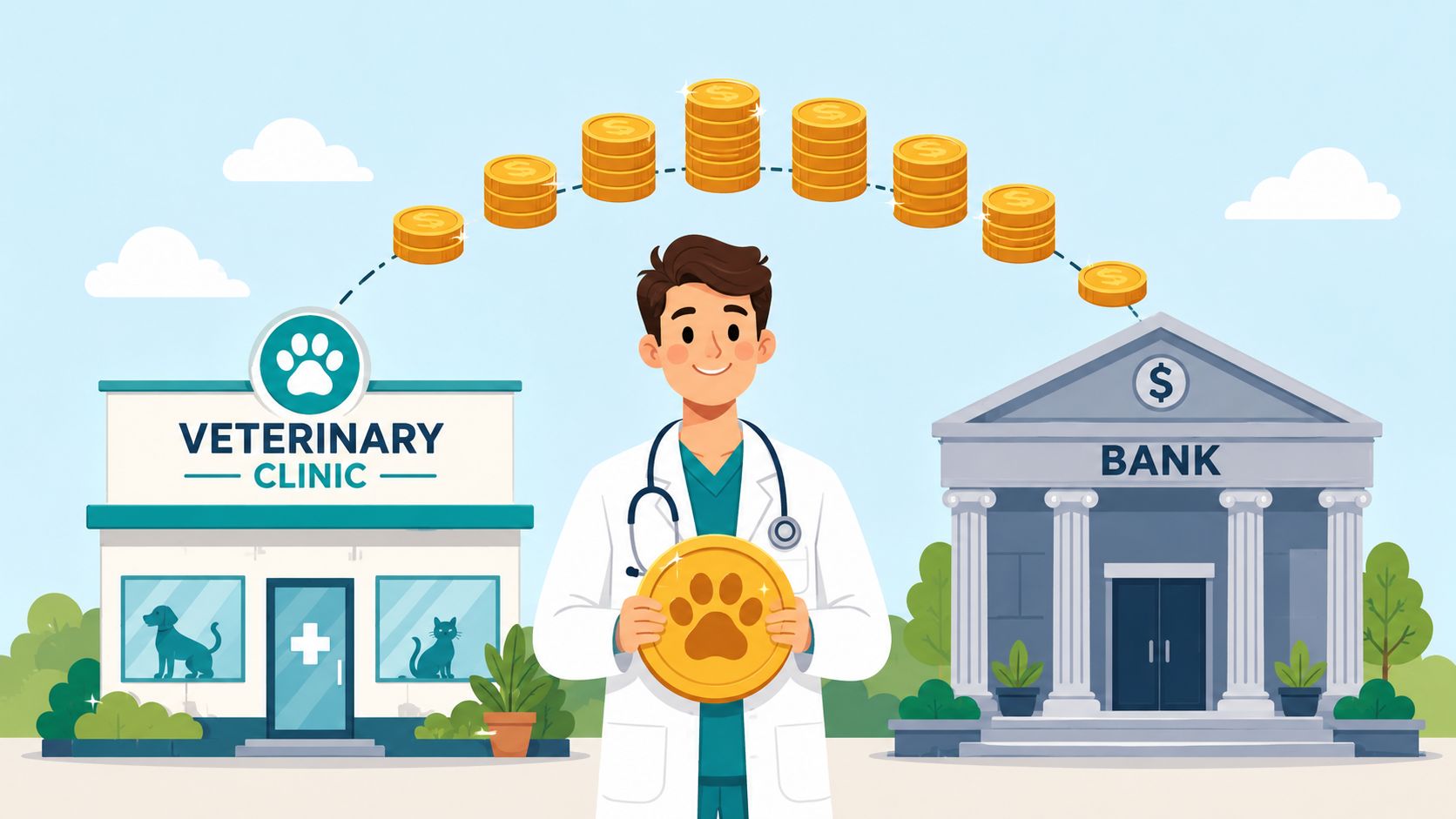
A two-doctor veterinary practice can look profitable on paper and still face a financing problem. One partner may want to buy out the other, a planned renovation may run over budget, or an aging term loan may no longer fit the clinic's cash flow. The owner needs capital, but the right lender depends on the deal, not the logo on the application.
PNC Bank veterinary practice financing deserves consideration because its veterinary lending program covers more than one ownership event. PNC describes financing for starting, purchasing, expanding, improving, and building out a practice, along with operating expenditures and transition expenses. That breadth makes it a credible option beside SBA lenders, credit unions, and veterinary-focused financing firms.
The decision starts with three questions: How large is the transaction? How quickly must the money close? How heavily should the lender weigh operating cash flow compared with credit history and collateral? Those answers will tell you whether a national bank's broader platform fits better than a more specialized relationship.
Why PNC Enters the Vet Lending Conversation
Consider a two-doctor clinic preparing for an ownership change. The incoming owner wants financing for the buy-in, while the practice also needs equipment and additional working capital. One lender may understand veterinary operations thoroughly but offer a narrower structure. PNC may offer a broader banking relationship, but the owners still need to determine whether its process and underwriting fit the transaction.
That's why PNC belongs on a serious shortlist, not automatically at the top of it. The bank's veterinary practice loan program addresses startup, acquisition, expansion, construction, equipment, real estate, renovation, operating expenditures, and transition expenses. It also describes support for growth-related gaps in collections and manageable payments during transition periods.
Start with the deal, not the lender
A startup founder, an associate buying into an established clinic, and a multi-location owner are asking for different kinds of risk. A startup needs capital before a dependable revenue history exists. An acquisition has operating records but may include goodwill, seller transition work, and complicated cash-flow projections. An expansion usually depends on whether existing operations can support new debt while the owner funds construction, staffing, and equipment.
PNC's broader healthcare-professional platform includes veterinarians, so the bank isn't treating veterinary practices as an isolated product category. That can matter when the financing request combines multiple assets or ownership needs.
Practical rule: If the project includes real estate, construction, equipment, and liquidity, evaluate the lender's ability to coordinate the entire capital plan, not just quote a single interest rate.
The three questions that narrow the field
- Deal size: A larger acquisition or real-estate-heavy project may favor a bank with substantial lending capacity.
- Timeline: A closing tied to a seller's deadline requires early diligence and a lender that can move at the needed pace.
- Underwriting priority: Decide whether your strongest argument is documented practice cash flow, strong collateral, personal credit, clinical experience, or a combination.
For a broader lender-screening framework, review this guide to the best banks for veterinary practice loans. The right conclusion may be PNC, but it may also be a specialized lender whose process better matches a smaller or more unusual deal.
The Loan Products PNC Offers Veterinary Practices
PNC's product stack makes the most sense when mapped to the practice lifecycle. Owners shouldn't begin by asking which loan sounds attractive. They should identify the ownership stage, the assets being financed, and whether the repayment source is existing clinic cash flow or projected performance.
Startup and first ownership
A new clinic may need financing for construction, renovation, equipment, real estate, initial operating expenses, and transition-related costs. PNC's veterinary lending page explicitly identifies startup financing and construction-related uses, which makes the bank relevant to a de novo hospital with a defined build-out plan.
Startup borrowers need a disciplined budget. Separate hard construction costs, equipment purchases, professional fees, opening inventory, staffing, and working capital. Combining everything into one vague “startup funding” request makes it harder for a lender to understand the use of proceeds and the timing of cash needs.
Acquisition and ownership transition
For an acquisition, SBA-backed structures can support the purchase of an existing practice, while real-estate components may require a structure designed around commercial property. An associate buying into a practice should also ask whether the financing can address transition expenses and the liquidity needed while ownership responsibilities change.
PNC states that its veterinary financing can support purchasing a practice, buying into a practice, and transition expenses. That's important because a buy-in isn't only a purchase-price event. It can involve legal work, ownership restructuring, debt replacement, equipment needs, and short-term operating pressure.
Expansion, renovation, and real estate
An established owner adding exam rooms, relocating, renovating, or building a larger hospital may need a secured small-business loan, a commercial real estate loan, or an SBA structure. PNC identifies construction, equipment, real estate, renovation, and growth-related collections gaps among its financing uses.
The best structure depends on what creates value. Real estate and major construction usually call for longer-term financing. A technology refresh or equipment purchase should be evaluated against the asset's productive life and expected revenue contribution.
Working capital and equipment
Operating expenditures, payroll, supplies, inventory, and collections timing can create liquidity gaps even in a healthy clinic. A line of credit may be more appropriate than term debt when the need rises and falls, while equipment financing may fit a defined purchase with a clear repayment source.
This lifecycle approach is also useful when reviewing the main types of loans for veterinary practices. PNC's structural advantage is the possibility of coordinating build-out, equipment, real estate, and working capital with one banking relationship. That's a planning benefit, not proof that one lender will always offer the lowest total cost.
Loan Sizes, Terms, and How Underwriting Actually Works
The published thresholds place PNC in the market for meaningful practice investments. Independent coverage of the product reports financing beginning at $100,000, with $100,001 to $3 million available through a secured small-business loan or small-business commercial real estate loan. It also reports $100,000 to $5 million through SBA 504 or 7(a) structures, while noting that third-party SBA fees still apply despite a 100% waiver of PNC's standard origination fee. See the reported PNC veterinary financing thresholds and fee treatment for the published details.
| Structure | Loan Size Range | Typical Use Case | Key Trade-Off |
|---|---|---|---|
| Secured small-business loan | $100,001 to $3 million | Acquisition, expansion, equipment, or other secured practice needs | Requires acceptable collateral and secured underwriting |
| Small-business commercial real estate loan | $100,001 to $3 million | Property acquisition, construction, or substantial build-out | Real estate diligence and appraisal add complexity |
| SBA 504 | $100,000 to $5 million | Real-estate-heavy projects and major fixed assets | SBA process and third-party fees remain part of total cost |
| SBA 7(a) | $100,000 to $5 million through the reported PNC range | Practice acquisition, working capital, equipment, and mixed uses | Flexible, but documentation and SBA packaging can lengthen execution |
Why the SBA ceiling matters
The SBA 7(a) structure is a central benchmark for acquisition financing. Approved lenders can originate up to $5 million, with repayment terms up to 10 years for working capital and equipment and up to 25 years for real estate. The SBA can guarantee up to 85% of the loan amount, as described in this veterinary SBA acquisition financing guide.
That guarantee changes the lender's loss exposure. It doesn't eliminate underwriting, and it doesn't turn weak cash flow into a bankable deal. It can, however, make an acquisition more workable when the borrower has strong operating evidence but personal credit isn't flawless.
Match equipment debt to the asset
Veterinary equipment financing commonly runs 36 to 84 months, while useful life often falls around 8 to 12 years, according to veterinary clinic equipment financing guidance. That gap can protect liquidity because the clinic pays the debt over a shorter period than the asset remains productive, assuming the equipment generates sufficient billable capacity.
Underwriting also commonly examines roughly 1.25x debt service coverage, meaning operating cash flow should exceed annual debt obligations by 25%. Treat that as a planning benchmark, not a guaranteed PNC approval standard. Build the proposed payment into a conservative cash-flow forecast before requesting financing.
Eligibility Signals PNC Looks For in a Vet Borrower
A lender doesn't approve a veterinary deal because the owner is clinically excellent or because the practice has valuable equipment. PNC will need evidence that the proposed debt can be repaid from reliable business performance, supported by the borrower's experience, financial records, and transaction logic.
Existing revenue and deposit behavior
For an operating clinic, historical revenue, deposits, collections, expenses, and owner distributions matter more than a personal income snapshot. Assemble clean financial statements and make sure the bank can reconcile reported revenue with deposits and tax filings.
If the practice has uneven collections, explain the cause instead of hoping the underwriter overlooks it. A written explanation of payer timing, staffing changes, expansion disruption, or unusual expenses is more useful than a polished but unsupported forecast.
Debt service capacity
The proposed payment must fit after payroll, inventory, rent, taxes, existing debt, and owner compensation. Use a monthly forecast that separates historical performance from projected improvements. If the transaction depends on immediate growth, show the operational steps, not just the expected revenue.
The roughly 1.25x debt service coverage benchmark is a useful stress test, as discussed in the veterinary practice asset guide. Test the model with slower collections, delayed hiring, and higher operating costs. A deal that works only under ideal assumptions is not ready for submission.
Operator experience and transaction credibility
Clinical credentials, management history, ownership experience, and familiarity with the practice all strengthen the file. A first-time owner can still present a credible request, but the business plan must explain staffing, referral relationships, pricing, systems, and the path to stable operations.
PNC may be a weaker fit when the startup has no experienced operator, the borrower has recent serious credit events, or the transaction relies mainly on goodwill without enough supporting cash flow or hard assets. Self-screening early saves time and prevents a lender conversation built on the wrong premise.
A Realistic Application Timeline and Document Checklist
Start with a prequalification conversation before ordering every appraisal or submitting a formal request. Explain the ownership stage, total project, requested structure, available cash, and required closing date. A banker can then identify whether the request is better suited to conventional secured financing, commercial real estate financing, or an SBA-backed structure.
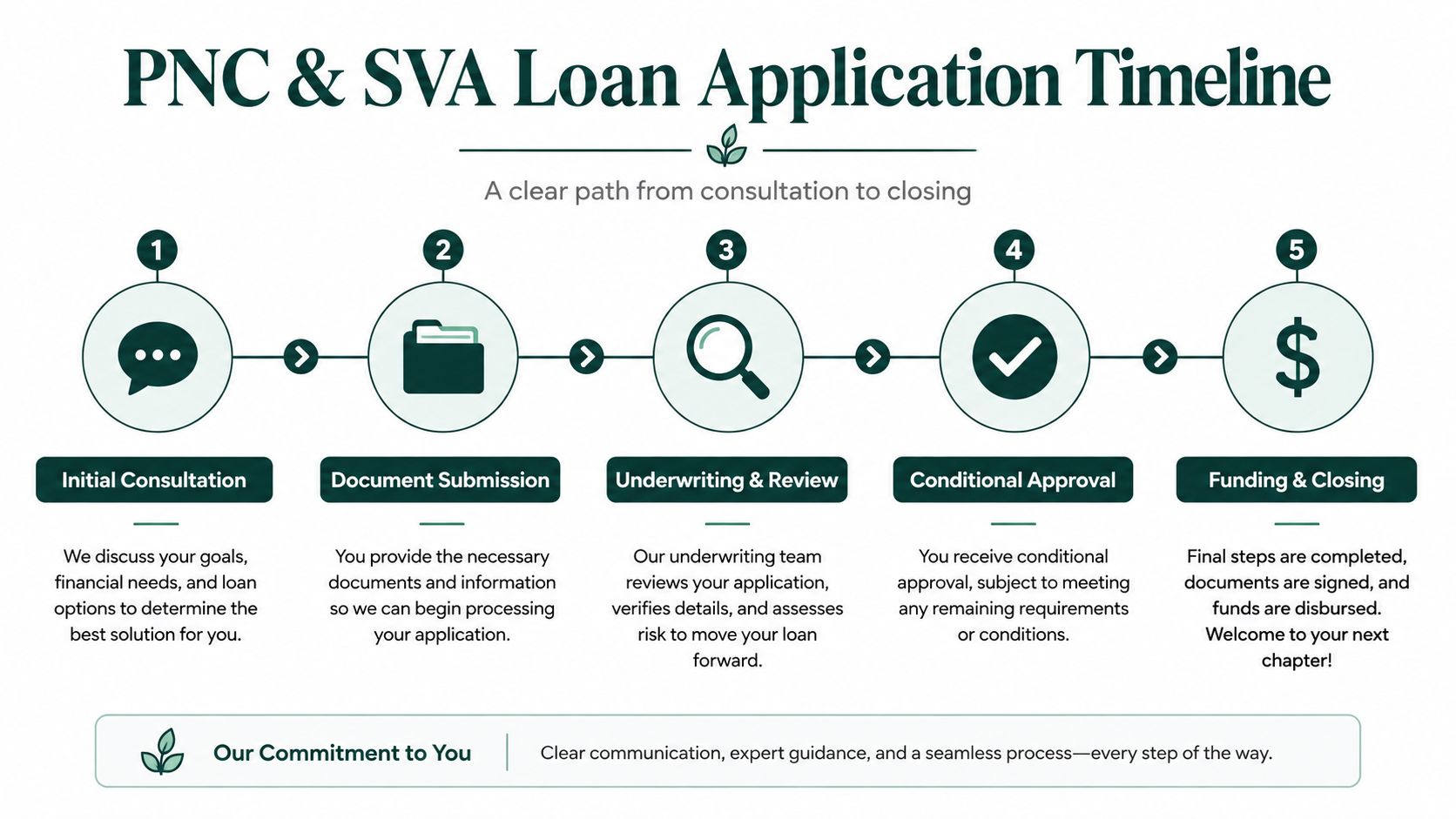
The application sequence
- Initial consultation: Discuss the transaction, ownership, use of proceeds, timing, and likely loan category.
- Document submission: Provide personal and business tax returns, interim financial statements, debt details, ownership information, and transaction documents.
- Underwriting and diligence: The lender reviews cash flow, debt service, collateral, management experience, practice goodwill, and projected performance.
- Conditional approval: The approval identifies conditions such as updated statements, insurance, appraisal, legal documents, or SBA requirements.
- Funding and closing: Final documents are signed, closing conditions are satisfied, and proceeds are released.
PNC's materials use language around fast decisions and funding timelines that can be as short as within 24 hours when documentation is clean and criteria are met. That possibility shouldn't be confused with a guaranteed timeline, especially for SBA transactions.
Where files slow down
SBA packaging can require additional forms and review. Real estate appraisals depend on third-party scheduling. Equipment valuations may require invoices, specifications, and confirmation of the asset being financed. Goodwill is also harder to evaluate than a building or piece of equipment, so acquisition files should clearly explain historical cash flow and the seller's transition role.
Prepare these items before the formal application:
- Business records: Tax returns, year-to-date profit and loss statements, balance sheets, and deposit information.
- Owner records: Personal tax returns, personal financial information, resume, and clinical or management credentials.
- Deal documents: Purchase agreement, ownership terms, construction budget, equipment quotes, leases, and real estate details.
- Repayment support: Existing debt schedule, proposed sources and uses, and a cash-flow forecast tied to the requested payment.
The cleanest file gives the lender one consistent story across tax returns, financial statements, deposits, purchase documents, and projections.
PNC Versus Specialized Veterinary Lenders
PNC and specialized veterinary lenders solve different financing problems. PNC is strongest when the transaction is large, asset-heavy, or likely to benefit from one broad banking relationship. A specialized lender is often stronger when the deal is smaller, the ownership story is unconventional, or the borrower needs a financing team that routinely interprets veterinary-specific cash flow.
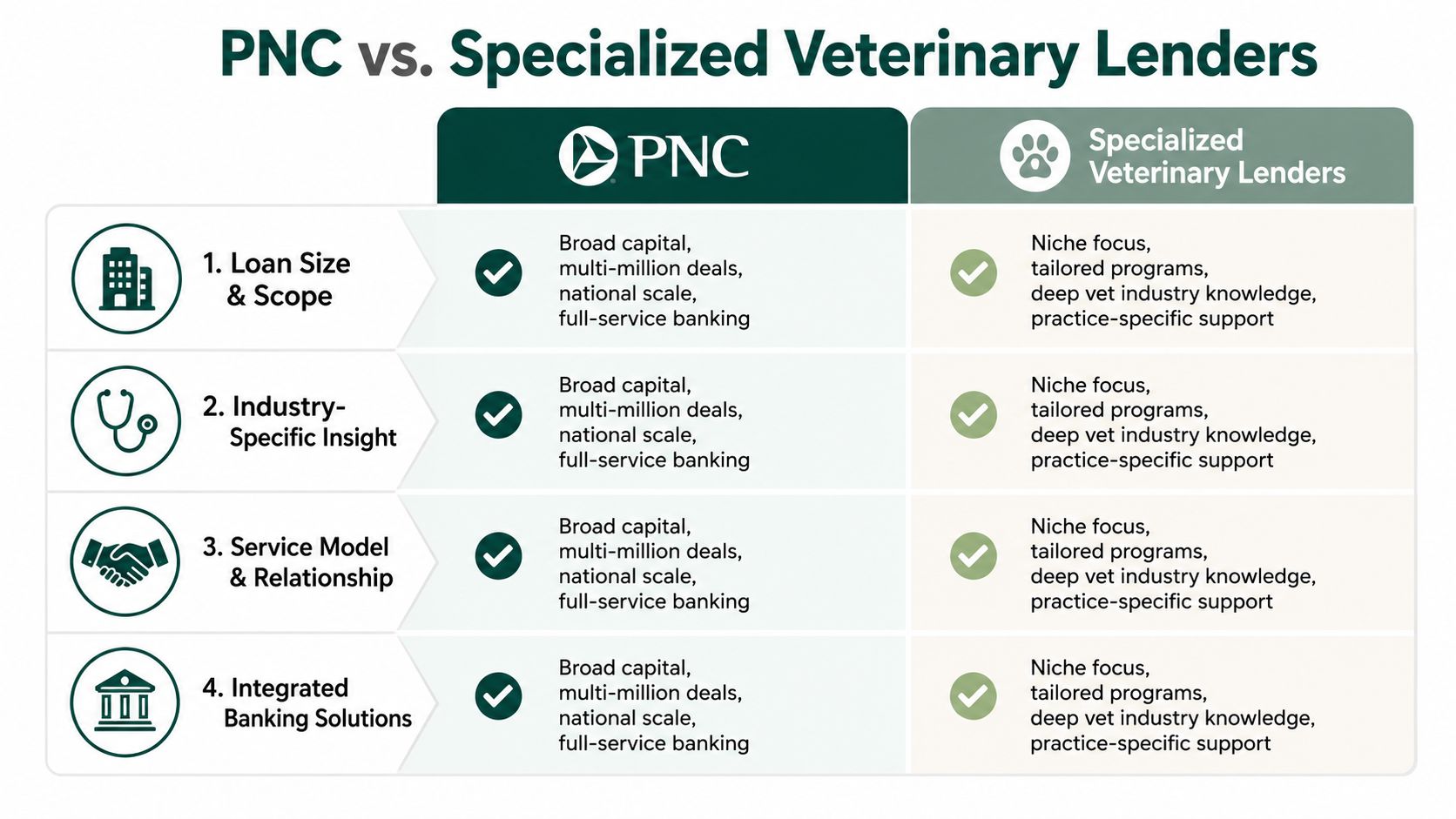
Compare the four decision factors
Deal size and scope favor PNC when the request includes substantial real estate, construction, acquisition value, and multiple asset classes. Its reported structures reach the multi-million-dollar range, giving the bank room to coordinate a larger capital plan.
Industry-specific insight often favors a specialized lender. Veterinary-focused underwriting may place more practical weight on collections, production, staffing, equipment utilization, and the economics of a partner buy-in rather than treating the clinic like a generic small business.
Speed and service model depend on file quality and structure. A clean conventional request may move efficiently through a bank, while a specialized lender may be more responsive to a smaller or urgent transaction. SBA deals generally require more process regardless of who originates them.
Total cost of capital requires more than comparing the interest rate. Include origination treatment, third-party SBA fees, appraisal costs, legal expenses, collateral requirements, covenants, and any prepayment terms. PNC's reported waiver of its standard origination fee doesn't remove third-party SBA charges.
The cheapest quote isn't automatically the lowest-cost financing. A delayed closing, mismatched amortization, or inflexible structure can cost more than a visible fee.
Use PNC for scale, real estate execution, and integrated banking needs. Use a specialized veterinary lender when practice-specific judgment, speed, or flexibility is the deciding factor.
Choosing the Right Path for Your Deal
Choose PNC when the financing plan is broad and substantial. A multi-million-dollar acquisition that includes real estate, an SBA 504 project centered on property and construction, or an expansion requiring equipment plus operating liquidity can benefit from a lender with a wide product platform.
PNC also makes sense for owners who want one banking relationship across the practice lifecycle. Coordinating treasury services, equipment financing, commercial real estate, and working capital can reduce the need to manage separate lender relationships. That convenience has value when the practice is growing across locations or adding major assets.

When specialization wins
A veterinary-focused lender is the stronger choice for a small equipment-only request, a startup with limited operating history, an intangible-heavy partner buyout, or an owner who needs a fast answer. These deals can fail at a general lender because the file doesn't fit conventional collateral logic, even when the practice opportunity is sound.
Don't force a small, unusual transaction into a large-bank process. Conversely, don't split a complex real-estate acquisition across several narrow lenders just because one offers a familiar veterinary program.
Make the decision operational
Write down the primary risk in the deal. If the risk is property valuation or project size, prioritize PNC's broader capacity. If the risk is limited history, goodwill, or an unusual ownership structure, prioritize industry-specific underwriting.
Then request proposals using the same sources and uses, repayment assumptions, collateral description, and projected cash flow. Comparing different structures with different assumptions creates noise instead of clarity.
Practical Steps Before You Contact Any Lender
Prepare the file before you start rate shopping. A lender can't evaluate a transaction efficiently when the owner has only a purchase price and a rough idea of monthly payment. Your first objective is to show exactly what the money will fund and how the clinic will repay it.
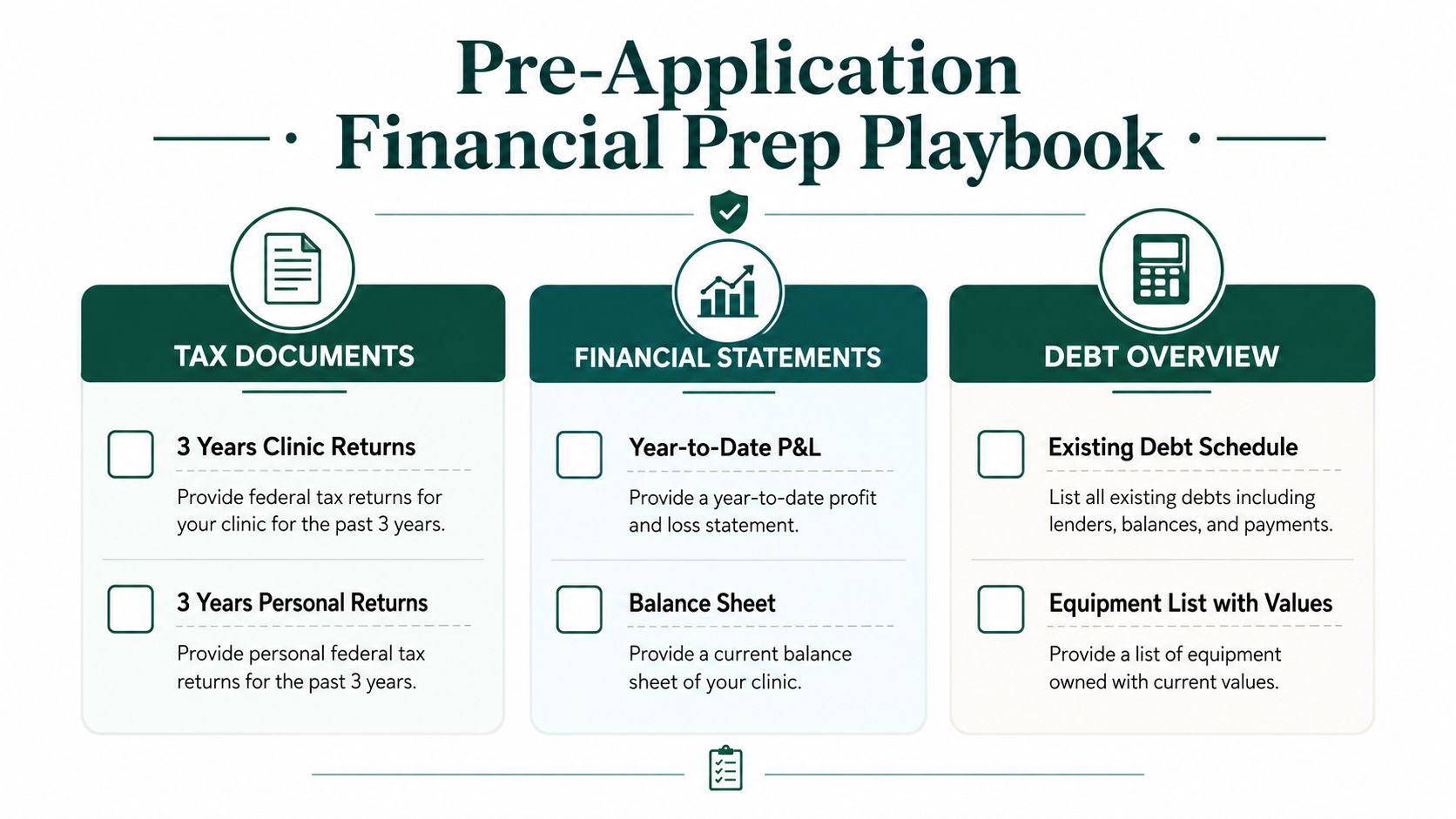
Assemble the financial package
Gather the following:
- Tax documents: Three years of clinic tax returns and three years of personal tax returns.
- Current performance: Year-to-date profit and loss statement, balance sheet, and recent deposit information.
- Debt overview: Existing debt schedule, payment obligations, maturity dates, and equipment list with values.
- Cash-flow forecast: Monthly projection showing the proposed loan payment, payroll, supplies, rent, taxes, owner compensation, and expected collections.
Keep the numbers consistent. If the purchase agreement shows one price, the sources-and-uses schedule shows another, and the forecast assumes a third amount, underwriting will slow down.
Prepare the deal narrative
Write one page explaining the practice, the ownership plan, the operator's credentials, the reason for financing, and the expected operational changes. For an expansion, connect each construction or equipment expense to capacity, efficiency, service mix, or patient demand without claiming revenue that the evidence can't support.
Bring supporting documents, including the purchase agreement or letter of intent, construction budget, real estate information, equipment quotes, lease terms, and ownership documents. A lender should be able to trace every requested dollar to a defined use.
Ask the decisive question
Before contacting PNC or any other lender, answer this: Does this deal need balance-sheet strength and SBA pricing, or does it need industry-specific underwriting and speed?
If the answer is scale, real estate, and an integrated relationship, start with PNC. If the answer is flexibility around an early-stage or goodwill-heavy transaction, speak with a veterinary-focused lender first. Make the choice from the deal's risk profile, then compare written proposals using total cost, timing, collateral, and repayment structure.
Veterinary Practice Loans helps veterinary owners evaluate financing for acquisitions, equipment, working capital, startups, and expansion projects using structures built around clinical operations. Visit Veterinary Practice Loans to discuss your transaction, prepare the lender package, and compare the path that best fits your practice.
