

You finish a busy week at the clinic, but the cash hasn't caught up with the work. Payroll is due, pharmaceutical suppliers expect payment, and a corporate client or insurance payer still has invoices outstanding. The practice is profitable on paper, yet the bank balance feels tight because revenue earned today may not become usable cash for weeks.
That mismatch is the problem accounts receivable financing is designed to address. It converts eligible unpaid invoices into working capital, either by borrowing against them or selling them to a financing company. For veterinary practices, the decision isn't only whether to access cash faster. You also need to weigh collection control, client relationships, recourse risk, concentration limits, reporting requirements, and the true cost of capital.
The Cash-Flow Gap in Veterinary Practices
A clinic owner can make every sensible operating decision and still face a cash shortage. The team has completed appointments, delivered treatment, dispensed medication, and issued invoices to business clients or payers. Meanwhile, staff wages, rent, inventory, utilities, and supplier bills follow their own schedule.
That's especially difficult when the clinic is investing in growth. A new veterinarian may require recruiting and onboarding before the added revenue arrives. A seasonal demand increase can require more medication and supplies before collections accelerate. A renovation or additional treatment capacity can create an immediate cash requirement while the resulting revenue builds gradually.
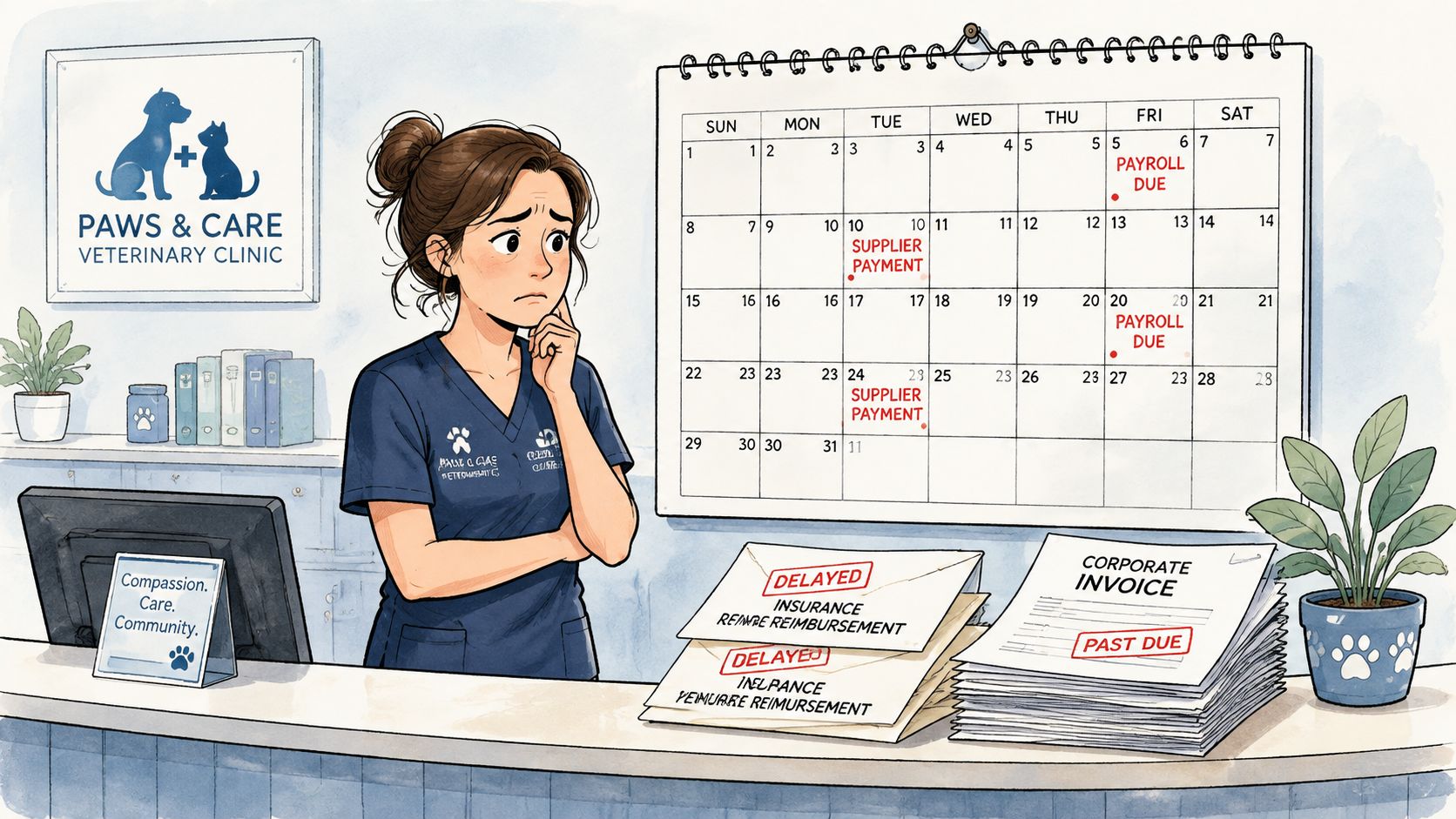
Revenue earned is not cash collected
Suppose a practice has completed billable work for several corporate accounts. The invoices are valid, but payment won't arrive until the agreed terms expire. The clinic still has to fund the care that created those invoices, and it may need to purchase more inventory before the original receivables are collected.
Accounts receivable financing addresses that timing gap by using outstanding invoices as the funding base. The provider reviews the invoices, the parties that owe them, and their payment quality. Eligible receivables can then support an advance or a sale, giving the practice cash before the customer pays.
Practical rule: Use receivables financing to solve a timing problem, not to conceal a pricing, collection, or profitability problem.
Why a traditional loan may miss the issue
A term loan usually provides a fixed amount and follows a scheduled repayment structure. That can be appropriate for a build-out, acquisition, or major equipment purchase, but it may be poorly matched to a short-lived gap between clinical service delivery and invoice payment.
A working-capital facility may offer a better fit when the clinic needs broader flexibility for payroll, supplies, and recurring expenses. Practices evaluating that route can review working capital financing for veterinary clinics, while keeping the central question in view: how quickly will the financing solve the gap, and what will it cost while the invoices remain unpaid?
How Accounts Receivable Financing Works
The simplest way to understand the structure is to treat an invoice as an asset that has value but hasn't matured into cash. Accounts receivable financing lets the clinic access part of that value before the customer pays. The arrangement can take the form of a loan secured by receivables or an outright sale of receivables, with the underlying invoices serving as the foundation for funding availability (NBER's explanation of continuing receivables financing arrangements).
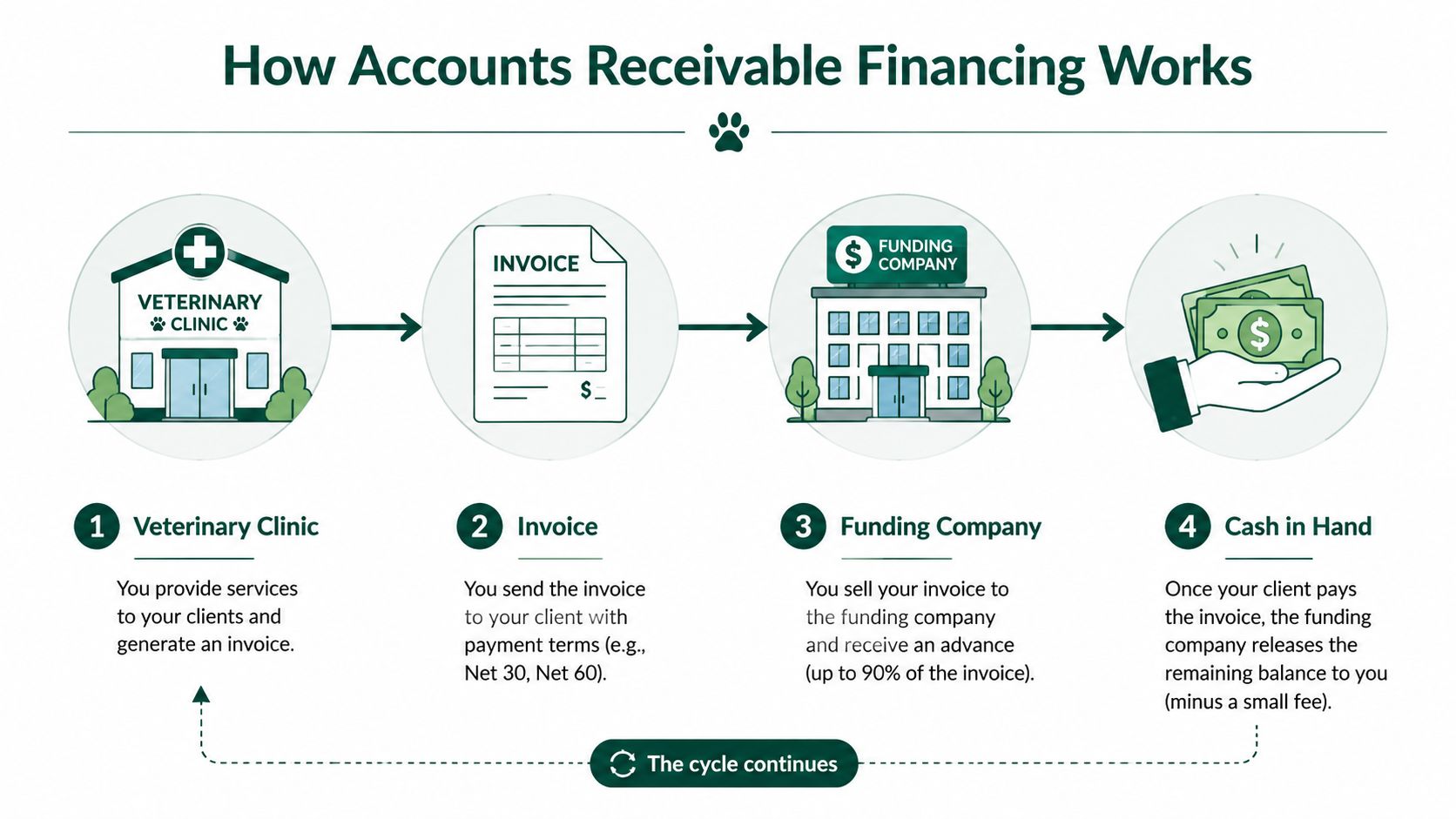
The two paths
Factoring means selling the invoice. The clinic transfers the receivable to a factor at a discount. The factor provides funding and generally takes responsibility for collecting from the customer. Depending on the agreement, the customer may be notified and directed to pay the factor.
A receivable line means borrowing against the invoice. The clinic retains ownership and usually continues managing collections. The lender advances funds against eligible receivables, and the clinic repays or settles the draw when customers pay.
The distinction affects more than terminology. Selling an invoice can reduce collection work and may avoid recording the arrangement as conventional debt, depending on the structure and accounting treatment. Borrowing against invoices preserves more control over customer communication, but the practice retains repayment obligations and collection responsibilities.
Why invoice quality controls availability
A provider doesn't treat every invoice as equally financeable. Availability depends on whether the invoice is genuine, undisputed, properly documented, current, and owed by a customer with a reliable payment profile. Aging matters because an invoice that remains unpaid for an extended period presents more uncertainty than a newly issued receivable.
The historical record shows that this mechanism predates modern digital finance. A 1940 National Bureau of Economic Research chapter describes factoring as developing as early as the fourteenth century, initially supporting foreign trade before expanding into textile manufacturing and other receivables purchases. The same chapter estimates U.S. accounts receivable financing at about $2 billion in 1940 and about $2.6 billion in 1941, demonstrating that businesses used receivables as a major commercial-credit resource long before current technology existed.
Factoring Versus Receivable Lines of Credit
Factoring and receivable lines can both produce faster liquidity, but they place responsibility in different hands. That difference becomes important in veterinary medicine, where the payer may be a corporate client, institutional account, insurer, or another organization with an established relationship with the practice.
| Feature | Factoring | Receivable Line |
|---|---|---|
| Basic structure | The clinic sells eligible invoices to a financing company. | The clinic borrows against eligible invoices as collateral. |
| Collections | The factor commonly manages collection activity. | The clinic generally continues collecting. |
| Customer contact | Customers may be notified and may pay the factor directly. | Customer payment may continue through the clinic, depending on the arrangement. |
| Recourse risk | The clinic may remain responsible if the agreement is recourse. | The clinic normally remains responsible for repayment under the lending agreement. |
| Cash-flow effect | Funding follows the sale and settlement terms. | Draws and availability follow the eligible receivables pool. |
| Best operational fit | A practice that wants to reduce collection administration. | A practice that wants to protect direct client relationships and retain control. |
When factoring makes sense
Factoring is attractive when the clinic's finance staff spends too much time chasing business invoices. A factor can take over that administrative burden, which may help an owner stay focused on patient care, staffing, and operations. It can also fit a practice that values speed and accepts third-party involvement in customer payment.
The trade-off is relational. A corporate client may have questions when payment instructions change or a third party begins contacting its accounts-payable team. That doesn't automatically make factoring inappropriate, but the clinic should prepare its clients and review the communication process before assigning invoices.
When a receivable line is better
A receivable line usually suits a practice that wants to preserve the existing billing relationship. The clinic keeps collection responsibility, controls the tone and timing of follow-up, and can maintain a familiar payment process for customers.
That control comes with work. The practice must keep aging reports accurate, monitor disputes, document invoice status, and comply with borrowing-base reporting. A line also doesn't eliminate the risk that a customer pays late or refuses payment. Under a recourse structure, the clinic may still have to repay the advance.
The cheapest structure isn't automatically the best structure if it damages a valuable client relationship or creates collection work your team can't manage.
Understanding the Cost Structure
The headline fee rarely tells the whole story. You need to understand how much cash arrives initially, how the provider calculates its charge, what happens when payment is late, and which administrative costs sit outside the advertised rate.
Plan around the components rather than a single quoted percentage:
- Advance rate: The provider advances a portion of the invoice value and holds the rest in reserve. Industry guidance commonly places advance rates around 70% to 90%, as described in the receivables financing background from the University of Arizona law review.
- Discount fee or interest charge: The provider charges for access to the funds. The calculation may depend on invoice value, the amount advanced, or the time outstanding.
- Origination and processing charges: Setup, underwriting, verification, and document-review fees can increase the effective cost.
- Monitoring and reporting charges: A revolving arrangement may require ongoing receivables reporting or account administration.
- Termination provisions: Some agreements charge for ending the facility early, failing to meet volume expectations, or leaving invoices unresolved.
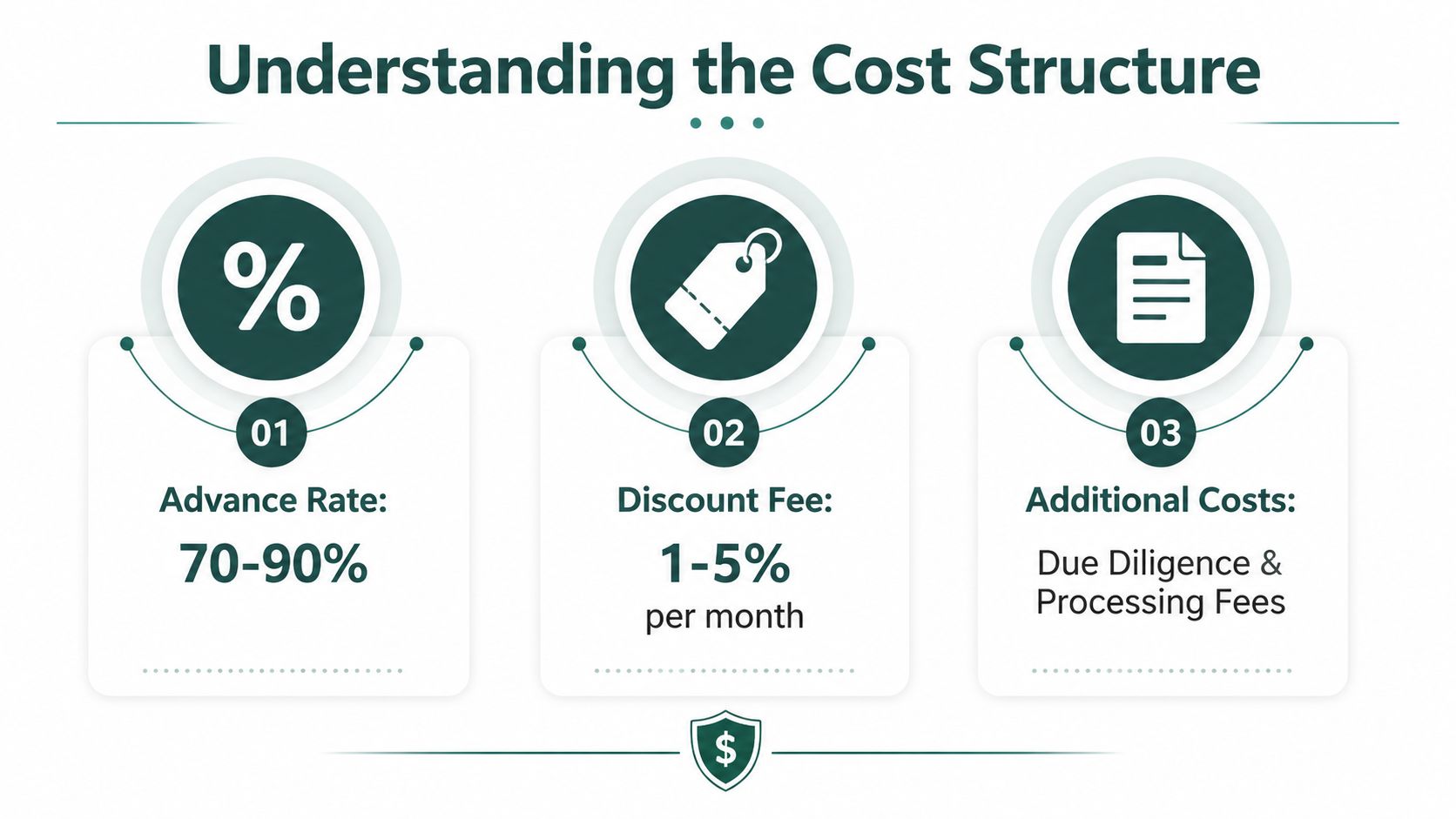
A $50,000 invoice example
Assume a clinic submits a $50,000 invoice. At a 70% advance, it receives $35,000 initially, with the remainder held back until settlement. At a 90% advance, it receives $45,000 initially, leaving a smaller reserve.
The advance rate changes the clinic's immediate liquidity, but it doesn't by itself reveal the total cost. To compare offers, ask whether the fee applies monthly, whether it continues while the customer is late, and whether the provider deducts charges from the reserve or adds them to the repayment obligation.
The figures listed in the plan for fee ranges, including a 1% to 5% monthly discount fee, aren't part of the verified data available for this article, so don't treat them as a universal market standard. Providers can price differently based on invoice quality, customer strength, structure, and monitoring requirements.
Compare the full obligation
Technology can speed document collection, data connections, and underwriting. Industry coverage describes rising expectations for faster funding and technology-driven streamlining, but speed shouldn't distract you from concentration limits, reporting duties, or recourse language.
Before signing, request a written illustration that shows:
- The initial advance.
- The reserve amount.
- Every fee and when it accrues.
- The treatment of late payment and disputes.
- The clinic's responsibility if the customer doesn't pay.
- Any minimum usage, monitoring, or early termination charge.
For broader borrowing comparisons, review veterinary practice loan terms and repayment options and compare total cost, not just the amount deposited on day one.
Benefits and Risks for Veterinary Clinics
Receivables financing can be useful, but only when the clinic has collectible invoices and a clear reason to accelerate cash. It's not a substitute for correcting weak margins, uncontrolled inventory spending, or poor billing discipline.
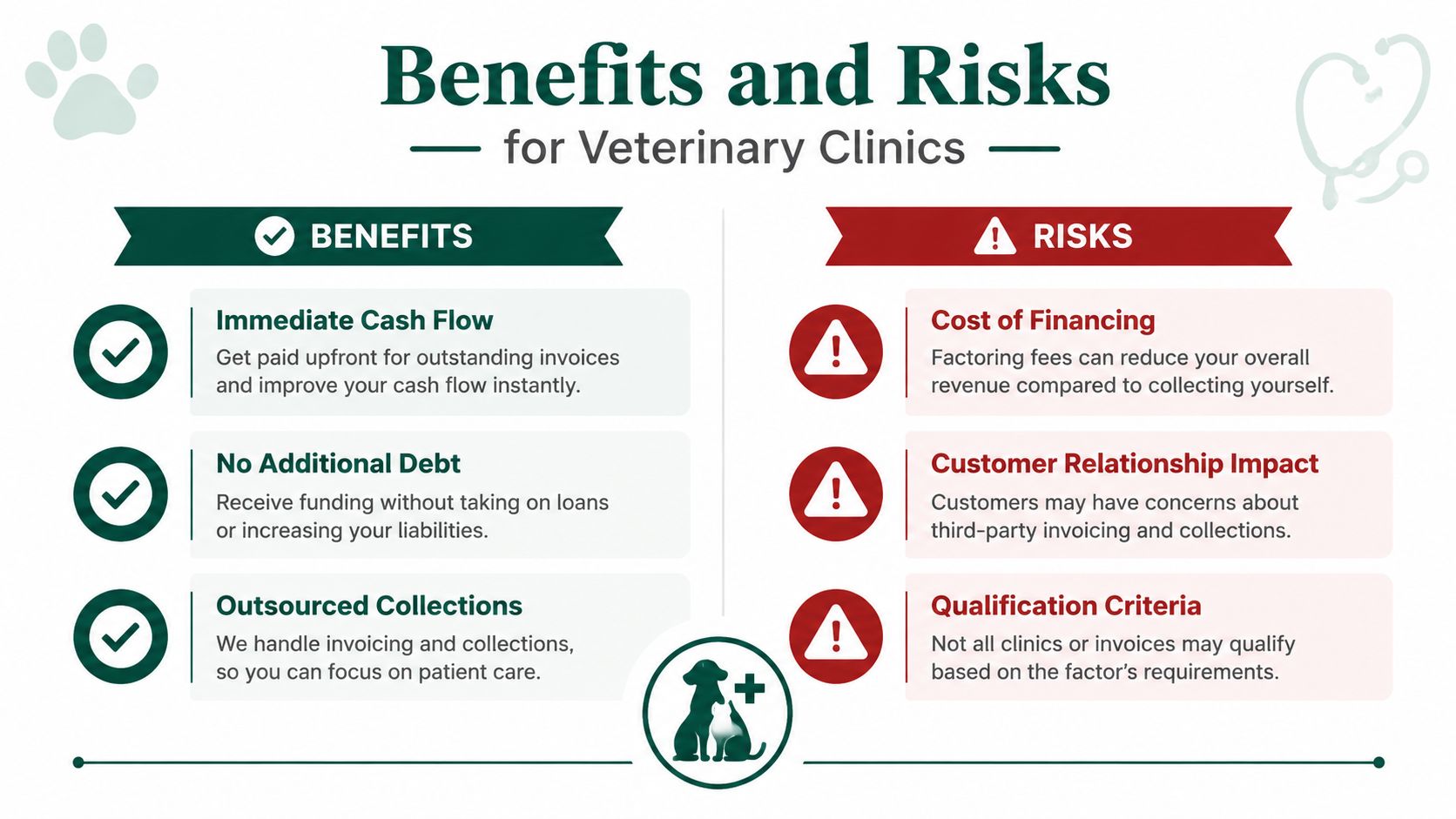
What the clinic gains
The main advantage is timing. The practice can use eligible receivables to fund payroll, pharmaceutical inventory, supplier obligations, or an opportunity that can't wait for the customer's normal payment cycle.
Other advantages depend on the structure:
- Factoring can reduce collection workload because the financing company handles assigned invoices.
- A receivable line can preserve billing control because the clinic continues communicating with customers.
- Availability can expand with receivables when the practice grows and produces more eligible invoices.
- Underwriting can focus on payer quality rather than relying only on the clinic's own credit profile.
- Factoring may avoid conventional debt treatment because the clinic sells an asset, although the exact accounting result depends on the agreement and professional advice.
What can go wrong
Cost is the obvious concern, but operational risk deserves equal attention. A late-paying customer can extend the fee period, reduce available borrowing capacity, or trigger repayment under a recourse arrangement.
Concentration is another constraint. If one corporate account represents a large share of the receivables pool, the provider may limit how much funding it will advance against that customer. A practice can have substantial invoices and still receive less liquidity than expected because the payer mix is too concentrated.
Ongoing monitoring also changes the owner's workload. The clinic may need to provide aging reports, reconcile payments, report disputes, and maintain eligibility standards. Factoring can reduce collection duties, but it introduces customer-contact considerations that should be handled carefully in a relationship-driven healthcare setting.
The decision I'd give an owner
Choose this tool when the clinic has a short, identifiable delay between completed work and reliable payment, and when the resulting liquidity will protect operations or produce a clear business benefit. Look elsewhere when invoices are disputed, customers routinely pay unpredictably, or the financing cost will consume the margin on the services being funded.
Eligibility and Application Process
Providers usually begin with the receivables, not just the clinic owner's personal credit. They'll want to know who owes the money, whether the work has been completed, whether the invoices are disputed, and how reliably those customers pay.
A strong application typically includes:
- An accounts receivable aging report: This shows current invoices and how long each balance has remained unpaid.
- A customer or payer list: Include contact details, balances, payment terms, and any known disputes.
- Financial statements: Providers use these to understand profitability, liabilities, and operating stability.
- Business bank statements: These help verify deposits, cash movement, and the clinic's current liquidity.
- Invoice support: Contracts, service records, or delivery documentation may be needed to validate the receivables.
What improves the application
Clean billing records matter. Separate disputed invoices, credit memos, related-party balances, and invoices dependent on future performance before submission. A provider can evaluate a smaller pool of strong receivables more effectively than a larger ledger filled with unclear or aged balances.
The payer's creditworthiness also matters. A clinic with modest borrowing history may still be considered if its business customers are reliable, while a practice with stronger owner credit may struggle if its receivables are difficult to verify or collect.
How the process usually unfolds
The clinic submits its business information and receivables schedule. The provider reviews the practice, verifies selected customers and invoices, sets eligibility rules, and presents the advance, fees, reserve, and recourse terms. Once the agreement is executed and required documentation is complete, funding can move quickly, with some veterinary financing processes designed to fund within 24 hours when lender criteria and documentation are satisfied, as described by veterinary practice financing guidance.
Don't apply with incomplete records and expect speed to compensate. Preparation is often the difference between a clean approval and a request for repeated clarification.
When to Choose Accounts Receivable Financing
Start with the cash-flow cause, not the product name. If the clinic's problem is that customers pay after the practice has already incurred the clinical and operating costs, receivables financing may fit. If the practice lacks adequate margin or has no dependable receivables, it won't solve the underlying issue.
Choose receivables financing for a timing gap
This structure is most useful when:
- Payroll arrives before customer payment: The clinic has completed billable work, but collections lag behind staffing obligations.
- Inventory demand moves ahead of cash: The practice needs medication and supplies to support growth or seasonal volume.
- A short-term opportunity has a clear payback: The clinic needs liquidity now and expects the assigned invoices to settle predictably.
- Traditional borrowing isn't available: The payer quality may support funding even when the clinic has limited collateral or a complicated credit history.
The arrangement should have an exit logic. Identify which invoices will repay the advance, how long settlement is expected to take, and what happens if the customer disputes the bill.
Use another structure for a different need
A working-capital line or term loan may be better when the clinic needs cash for recurring expenses that aren't tied to specific invoices. Equipment financing is usually more appropriate for imaging, surgical, laboratory, or information-technology purchases because the repayment can be matched to the asset's useful life.
An SBA-style or conventional term loan is generally better suited to an acquisition, build-out, ownership transition, or expansion project. Those uses require a longer repayment horizon than a receivables facility should carry.
My recommendation: If the need is temporary and invoice-backed, price receivables financing. If the need is structural, finance the structural asset or project with a facility built for that purpose.
Before choosing, compare advance mechanics, total cost, repayment responsibility, customer involvement, reporting, and the consequences of late payment. Individualized guidance can help clarify the trade-offs among SBA-style, conventional, alternative, equipment, and working-capital products. Visit Veterinary Practice Loans to discuss how accounts receivable financing compares with funding designed for your clinic's actual cash-flow need, and prepare your receivables aging report, payer list, and recent financial records before requesting an evaluation.
