
The SBA does not require collateral for standard 7(a) loans of $50,000 or less, but lenders will secure larger loans with available business assets to the maximum extent possible. For a veterinary practice acquisition, build-out, or equipment purchase, insufficient collateral alone can't be the reason for declining the loan.
You may be sitting across from a practice seller with a strong client base, reviewing a promising lease for a new clinic, or pricing out imaging and surgical equipment while wondering whether you need to pledge your home. The answer depends on the loan program, loan size, assets being financed, and lender policy. SBA rules create flexibility, but they don't eliminate underwriting.
For veterinarians, collateral is only one part of the financing story. Cash flow, practice value, equipment ownership, existing liens, and the purpose of the loan all affect how a lender structures the request. The practical question isn't, “Does SBA loan require collateral?” It's, “What collateral will this lender expect for this specific veterinary transaction, and what happens if the package doesn't fully cover the loan?”
The Short Answer on SBA Collateral Rules
A veterinarian buying an established hospital, opening a leased clinic, or replacing critical equipment needs to separate two questions: whether the SBA requires collateral and what the lender can reasonably secure. For a standard SBA 7(a) loan of $50,000 or less, collateral isn't required under the SBA's stated policy. The SBA also says a lender can't decline a loan solely because collateral is insufficient. The SBA's lender guidance sets out this baseline.
That rule gives borrowers room, especially when a young practice has few fully owned assets or the requested financing supports a focused project. It does not remove underwriting. The lender still needs a credible repayment plan, documented cash flow, and a clear explanation of how the acquisition, build-out, or equipment purchase will strengthen the clinic.
What the rule means in practice
A lender typically reviews the assets connected to the business and the assets being acquired, improved, or refinanced. For a veterinary clinic, the collateral package may include:
- Clinical equipment: Imaging systems, laboratory equipment, anesthesia machines, treatment tables, and surgical equipment.
- Business property: Furniture, fixtures, inventory, pharmaceutical supplies, and technology.
- Receivables: Amounts owed to the practice, subject to the lender's eligibility and valuation standards.
- Real estate: Commercial property owned by the practice or available to the borrower.
- Acquired practice assets: The operating business, equipment, and other assets included in an acquisition.
The lender may file security interests against available business property. That creates a legal claim to pledged assets if the borrower defaults. It does not automatically require every veterinary borrower to pledge a residence or other personal property.
Practical rule: A lender still needs to understand how the clinic will generate enough cash to service the debt. Collateral only mitigates loss if repayment fails.
The financing purpose changes the collateral discussion. A smaller working-capital request may rely on limited business assets while the lender concentrates on near-term operating performance. An acquisition loan may include the hospital's equipment, receivables, and other transferred practice assets. Equipment financing usually gives the lender a direct asset to identify and secure, while a build-out can leave less recoverable value if the improvements are tied to leased premises.
In every case, prepare an accurate asset schedule, disclose existing liens, and show which assets the transaction creates or acquires. That preparation helps the lender distinguish a genuine collateral shortfall from an incomplete financing package.
How SBA 7(a) Policies Scale with Loan Size
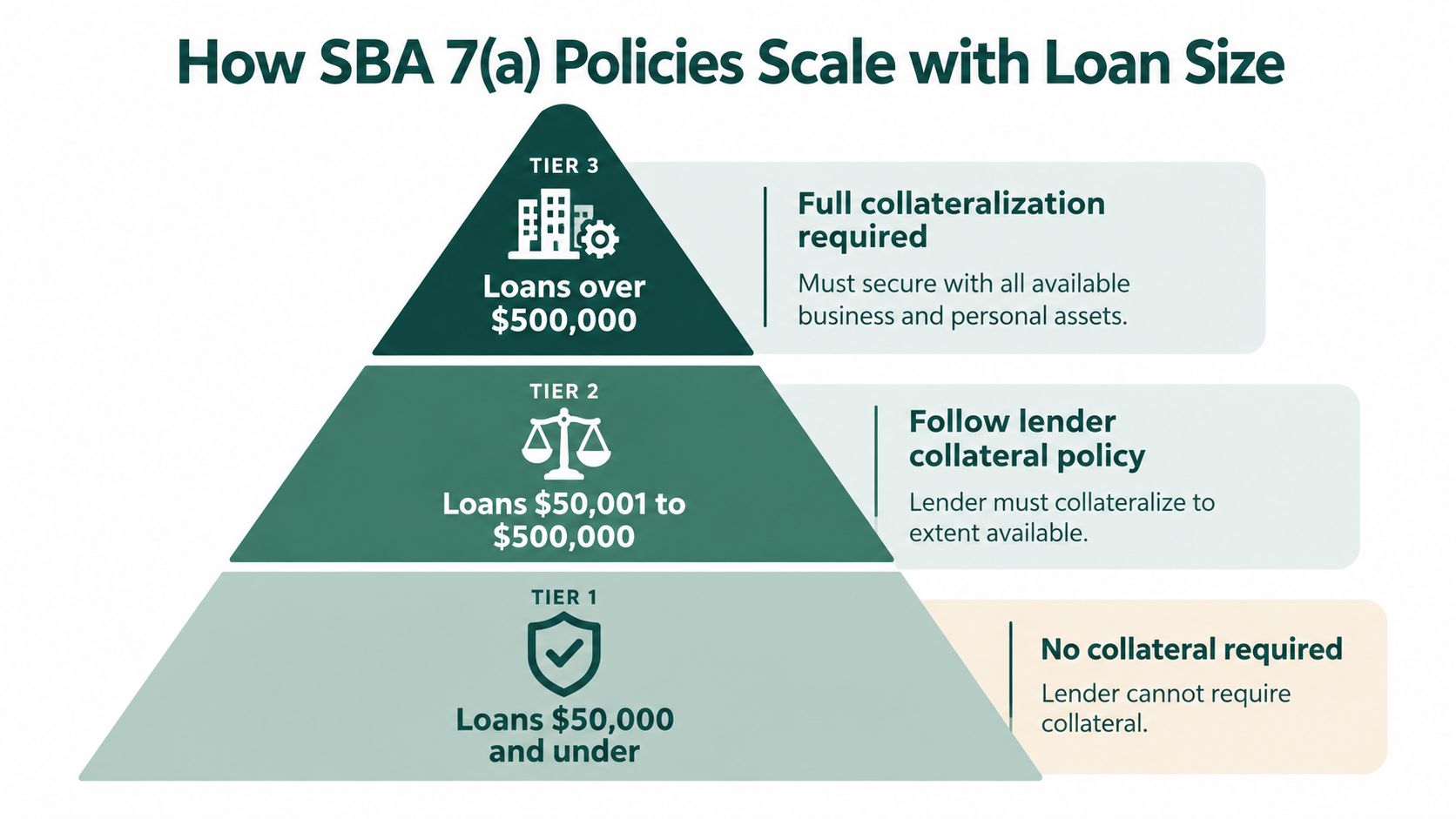
A veterinarian financing a modest equipment purchase faces a different collateral review from a buyer funding a full hospital acquisition. SBA 7(a) rules create loan-size tiers, then give lenders room to apply their written commercial-loan policies within those tiers. The key thresholds are $50,000, $500,000, and loans above $500,000.
Loans at $50,000 or less
The SBA does not require collateral for standard 7(a) loans of $50,000 or less. That makes this tier practical for a focused equipment purchase, a short operating gap, or a modest improvement to an established clinic. The lender will still review the practice's financial condition, ownership, repayment capacity, documentation, and closing requirements. The SBA rule does not make pledged collateral mandatory at this level.
Insufficient collateral alone also cannot justify a decline. For a veterinarian seeking a smaller request, the stronger application is the one that clearly explains use of proceeds and shows how the practice will repay the debt.
Loans from $50,001 to $500,000
For loans from $50,001 through $500,000, the lender applies its written collateral policy for similarly sized non-SBA commercial loans. Requirements can vary significantly between lenders, so veterinarians should compare collateral expectations before choosing where to submit an application.
One lender may concentrate on the assets financed and a general security interest in business property. Another may place greater weight on owned equipment, receivables, or available real estate. The lender must follow its written policy, while that policy may still allow flexibility when the clinic has strong financial performance and a credible repayment plan.
A $75,000 working-capital request and a $500,000 practice improvement loan sit within the same broad tier but can produce different underwriting decisions. Loan purpose, asset availability, ownership structure, existing obligations, and operating results all affect how the lender documents security.
Larger 7(a) loans
For larger 7(a) loans, SBA policy expects the lender to take security interests in assets being acquired, refinanced, or improved, along with available fixed assets of the applicant. The loan is considered “fully secured” when those assets have a combined adjusted net book value up to the loan amount. That framework matters most for acquisitions, major renovations, and multi-location expansion.
A buyer pursuing a hospital acquisition should expect a formal collateral review. The lender may assess the practice's equipment, accounts receivable, inventory, and real estate, then determine how much adjusted value those assets provide. Build-outs require closer judgment because improvements attached to leased premises may have limited recovery value.
Review SBA loans for veterinary practices for veterinary-focused financing examples and program considerations.
The practical rule is straightforward. Larger financing generally requires the lender to secure available assets as fully as possible, but collateral remains one part of the approval decision. If assets do not cover the full exposure, the lender must assess the complete credit and repayment case rather than treating the shortfall as an automatic rejection.
Standard Lender Practices for Veterinary Clinics
SBA policy establishes the boundaries, but lenders determine how those boundaries operate in a real underwriting file. A veterinary lender usually wants to understand what the clinic owns, what the loan will purchase, whether another creditor already has a claim, and how quickly each asset could support recovery after a default.
The strongest collateral is usually the asset directly connected to the loan. If loan proceeds purchase equipment, the lender will normally look first to that equipment. If the borrower acquires an operating practice, the lender may evaluate the broader business asset package, including equipment, receivables, inventory, and real estate when available.
How lenders view common clinic assets
| Asset Category | Lender Perspective and Valuation | Common Lien Type |
|---|---|---|
| Equipment | The lender reviews ownership, condition, remaining useful life, and resale market. Specialized equipment may receive more conservative treatment than broadly marketable equipment. | Security interest in the financed or owned equipment |
| Accounts receivable | The lender examines the quality, age, collectability, and concentration of receivables. Receivables aren't valued simply at their face amount. | Assignment or security interest in eligible receivables |
| Inventory | Pharmaceutical and medical inventory can support the collateral package, but expiration, turnover, and liquidation concerns affect its usefulness. | General security interest or inventory lien |
| Furniture and fixtures | These assets may be included, though their resale value can be limited, particularly for custom clinic installations. | Blanket business-asset lien |
| Real estate | Owned commercial property can provide a more durable collateral source when the lender can verify ownership, value, and existing debt. | Mortgage or deed of trust |
| Leasehold improvements | Improvements attached to leased premises may have limited standalone value because the clinic doesn't own the underlying property. | Security interest where legally available, subject to lease terms |
The lender's valuation isn't the same as the clinic's purchase price or the owner's estimate. A digital radiography system may be essential to clinical operations, yet its liquidation value can differ materially from its original cost. A custom surgical suite may support the practice's revenue while offering limited value outside that location.
Cash flow can matter more than an asset list
A lender doesn't want a beautifully organized equipment schedule with no credible repayment source. It wants to see how patient volume, collections, staffing, payroll, inventory purchases, and owner compensation interact with the proposed debt.
That matters most when a clinic has imperfect collateral coverage. Recurring clinical revenue and disciplined expense management may strengthen the credit case, while weak cash flow can undermine a loan even when the borrower owns valuable equipment. The right financing conversation therefore pairs an asset inventory with a clear operating narrative.
A lender should understand not only what the clinic owns, but why the clinic can repay the loan without selling those assets.
Ask the lender how it treats leased equipment, equipment subject to existing liens, receivables, and assets included in a seller-financed transaction. Those details often determine whether the collateral package is clean, duplicated, or less valuable than it first appears.
Collateral Implications for Common Vet Use Cases
Collateral looks different depending on what you're financing. A veterinary practice acquisition usually includes an operating business with established assets and revenue. A de novo clinic may have leasehold improvements, newly purchased equipment, and projected cash flow, but little existing collateral. A partner buyout may rely heavily on business value and goodwill rather than transferable hard assets.
Buying an established practice
An acquisition often produces the most complete collateral story. The transaction may include medical equipment, furniture, fixtures, inventory, receivables, and the ongoing operations of the hospital. The lender will still separate tangible assets from goodwill and evaluate whether the practice's cash flow supports the total debt.
Don't assume the seller's purchase-price allocation equals collateral value. A substantial portion of a veterinary practice's value may come from client relationships, reputation, trained staff, location, and future earnings. Those factors can support the repayment case, but they aren't the same as liquid collateral.
Your preparation should include an asset schedule that identifies:
- Owned equipment: Include serial numbers, purchase information, condition, and current liens.
- Leased equipment: Identify the lessor and explain whether the lease can be assumed or transferred.
- Receivables and inventory: Provide an understandable view of what transfers with the practice.
- Real estate: Separate owned property from leased premises.
- Goodwill: Explain how the practice generates revenue, while recognizing that goodwill may not provide the same recovery value as equipment.
De novo build-outs and expansions
A startup or new location creates a different problem. Leasehold improvements may be expensive but difficult to remove or sell, and leased equipment isn't an owned asset available for the same security structure as purchased equipment. The lender will focus heavily on the build-out budget, lease terms, equipment ownership, projected collections, staffing plan, and the experience of the veterinary owners.
For a build-out, negotiate the financing structure before signing irreversible contracts. The lender may want invoices, contractor documentation, equipment quotes, landlord consents, and evidence that the lease supports the intended clinic use.
Partner buyouts and heavy equipment purchases
A partner buyout often has limited new tangible collateral because the borrower is purchasing an ownership interest or economic rights. The lender must understand the practice's existing assets, the departing partner's interest, the post-closing ownership, and the cash flow available for debt service.
Heavy equipment financing is more straightforward when the equipment is identifiable, owned by the practice after closing, and useful beyond a narrow application. Aligning repayment with the equipment's expected productive life can help protect operating liquidity, but the lender still evaluates condition, ownership, and existing liens.
The more a transaction depends on goodwill or future growth, the more important it becomes to present a credible operating plan alongside the collateral package.
Exceptions and Personal Guarantee Realities
A personal guarantee and collateral create different obligations. Collateral gives the lender rights in identified business or personal assets. A personal guarantee makes the signer responsible for repayment if the practice fails to pay. One can apply without the other.
That distinction matters in a smaller SBA 7(a) request. The borrower may avoid pledging a specific asset while still accepting personal repayment responsibility under the loan documents. Owners holding 20% or more of the business generally face personal-guarantee requirements under standard SBA practice. Review the assets required for a veterinary practice loan alongside the proposed guarantee before signing.
Personal real estate isn't automatically required
A lender may ask about your home, investment property, or other personal assets when business collateral does not fully support a larger request. That inquiry does not automatically mean the lender will place a lien on your residence.
The applicable policy depends on the loan program, loan size, available business assets, and the lender's written procedures. For standard 7(a) loans, insufficient collateral alone cannot be the sole reason for declining credit. As noted earlier, review the SBA's lender guidance and ask the lender to identify the policy supporting any personal-asset request.
A lender may still request additional security when it is available and appropriate. Ask exactly what the lender wants, whether the item will secure the debt or support a guarantee structure, and whether another creditor already has a claim. Those answers can change the risk of an acquisition, build-out, or equipment purchase.
Questions to ask before signing
Use closing to clarify personal exposure. Treat the loan documents as a negotiation and verification point, not routine paperwork.
- Which assets are specifically pledged? Request a plain-English list.
- Is there a blanket lien on business assets? Confirm its scope, exclusions, and priority.
- Who must guarantee the loan? Review ownership percentages and guarantor requirements.
- Is personal real estate being requested? Ask why and whether the lender's written policy requires it.
- What happens if an asset is sold or replaced? Confirm release and substitution procedures.
- Are existing liens being refinanced or subordinated? A prior claim can reduce the lender's collateral position.
Do not pledge personal property casually. At the same time, a collateral shortfall does not automatically end the financing request. Present the lender with a clear asset schedule, existing lien information, realistic cash-flow projections, and a repayment plan. The right structure depends on the lender's policy, the available asset package, and the practice's ability to repay.
The Advantage of Veterinary-Focused Lending
General commercial lenders may understand the mechanics of a secured loan while missing the economics of a veterinary hospital. A clinic's most important value drivers often include professional reputation, recurring client relationships, provider capacity, appointment demand, staff stability, and collections discipline. Only part of that value appears as traditional hard collateral.
A lender familiar with veterinary practices can ask better questions about how the hospital operates. It can distinguish equipment that directly supports production from equipment that has limited resale value, evaluate the effect of associate staffing, and connect deposits and collections to the proposed debt structure.
Why specialization changes the conversation
A generalist approach may focus first on property and equipment. A veterinary-focused approach can evaluate the whole operating picture:
- Revenue quality: Are collections consistent with the services and provider capacity?
- Cash flow: Can the clinic support debt payments after payroll, inventory, rent, and owner compensation?
- Equipment needs: Does the requested equipment solve a production or capacity constraint?
- Transaction purpose: Is the financing for an acquisition, partner buy-in, build-out, expansion, or working capital?
- Risk trade-offs: Does a lower payment require a longer repayment period or greater total cost?
This doesn't remove underwriting requirements. It improves the quality of the information used to make the decision.
Veterinary Practice Loans provides financing options for acquisitions, working capital, equipment purchases, startup funding, and clinic expansion. A specialized lender can also help you compare SBA-style and other commercial structures in plain English, including collateral expectations, repayment design, and the trade-off between preserving liquidity and pledging additional assets.
Choose transparency over a headline rate
A lower quoted rate doesn't tell you the full risk or cost of a loan. Review the collateral package, personal guarantee, fees, amortization, prepayment provisions, and required equity together. Ask what happens if collections take longer to reach projections or if an equipment purchase doesn't immediately produce the expected capacity.
The right lender should explain the structure before you commit. If the collateral request doesn't match the transaction, ask for a written explanation and consider whether another lender's policy better fits the practice.
Preparing Your Practice for the Underwriting Process
A clean application starts with a clean asset file. Don't wait for the lender to discover missing ownership records, unresolved liens, or unclear equipment leases. Assemble the information before submitting the request, then use it to explain both the collateral and the clinic's repayment capacity.
Build the file in a deliberate order
Define the transaction. State whether you're buying a practice, purchasing a partner's interest, opening a location, renovating, buying equipment, refinancing debt, or funding working capital. The lender can't evaluate collateral properly until it knows what the loan will accomplish.
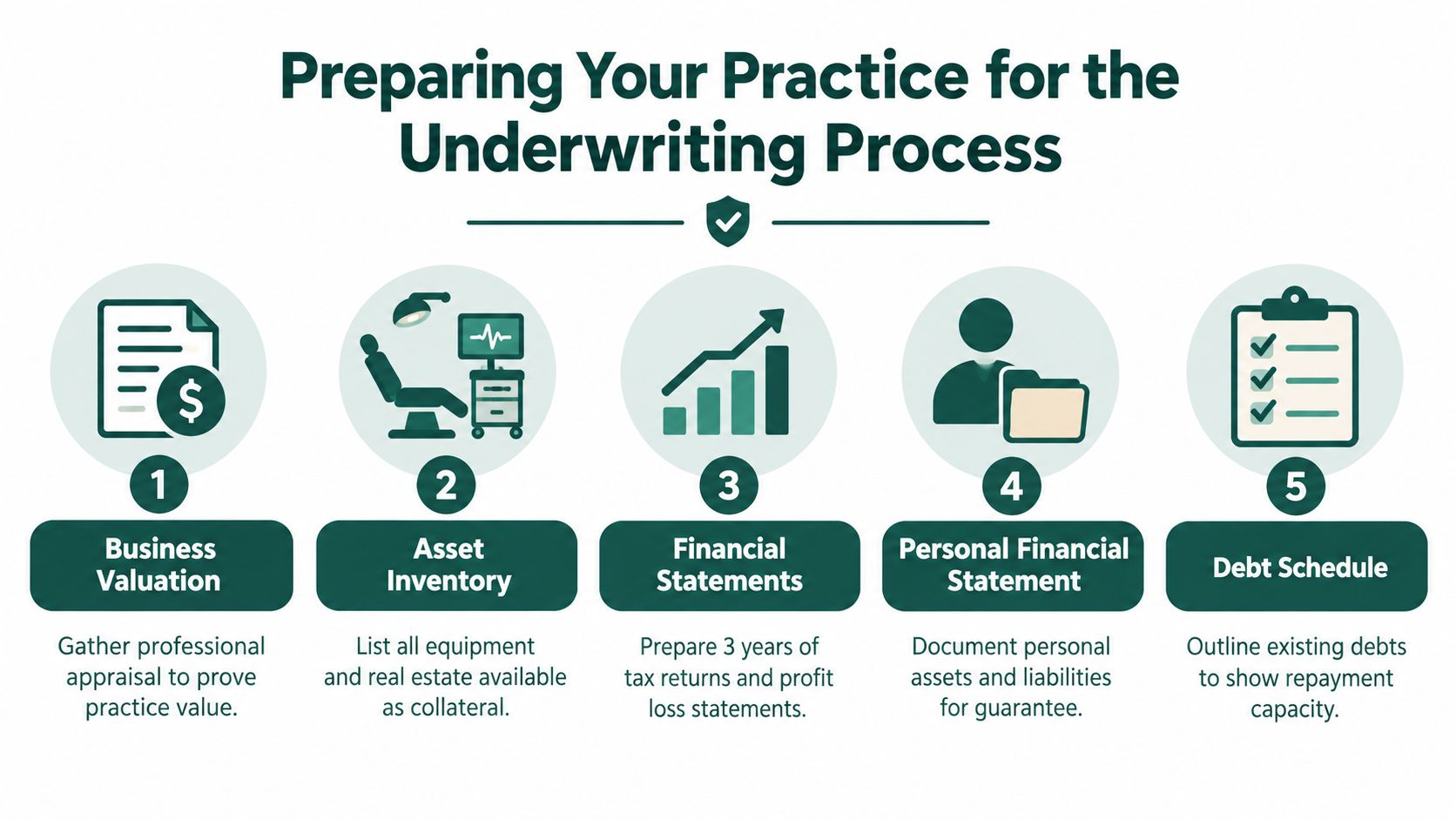
Inventory owned assets. List equipment, furniture, fixtures, inventory, receivables, vehicles, and real estate. Include ownership documents, serial numbers where applicable, purchase records, current condition, existing liens, and lease details.
Separate owned from leased property. A leased imaging system isn't the same as an owned system. Provide lease agreements, payoff information, transfer requirements, and contact details for current creditors.
Organize financial records. Gather business tax returns, profit-and-loss statements, balance sheets, bank statements, debt schedules, and the financial information requested for owners and guarantors. Consistency matters. Differences between tax filings, management reports, and bank deposits create avoidable questions.
Explain repayment capacity. Show how the clinic will cover debt after payroll, rent, inventory, insurance, taxes, and normal operating costs. For a startup or expansion, connect projections to appointment capacity, staffing, pricing, service mix, and the timing of the build-out.
Resolve problems before submission
Search for existing UCC filings and other liens before the lender does. Determine whether a previous equipment loan still encumbers assets that you plan to include. If a seller's records are incomplete, make the documentation a closing condition rather than relying on a verbal assurance.
For acquisitions, prepare a clear purchase-price allocation and identify which assets transfer. For build-outs, collect construction bids, equipment quotes, lease documents, and landlord approvals. For working capital, explain the specific operating need and how the funds preserve stability rather than just filling an unexplained deficit.
Use veterinary practice loan underwriting guidelines to organize the conversation, but ask your lender for its current checklist and collateral policy. Requirements can differ by lender even within the SBA framework.
The strongest application doesn't pretend that every asset has full value. It identifies limitations early, documents what is available, and makes a convincing case that the clinic can repay the loan. That approach gives the lender fewer unanswered questions and gives you a clearer view of your personal and business risk.
Veterinary Practice Loans helps veterinarians evaluate financing for acquisitions, partner buyouts, equipment, build-outs, working capital, and expansion while clarifying collateral and repayment trade-offs. Visit Veterinary Practice Loans to discuss your transaction and organize a financing strategy around the assets and cash flow your practice has.
