
You've found a clinic building, negotiated the purchase, and started picturing exam rooms, treatment areas, pharmacy storage, and a reception desk that finally belongs to your practice. Then the banker says your application is for bank commercial real estate lending, not a standard business loan. That label can make a familiar project feel complicated, but the underlying idea is straightforward: the bank is evaluating both the property and the veterinary business expected to support the debt.
For a practice owner, the important question isn't whether a bank will lend. It's how the lender values the building, tests clinic cash flow, structures repayment, and protects itself if the plan changes. Once you understand that process, the application becomes easier to prepare and the differences between conventional, SBA, and veterinary-focused financing become clearer.
What Bank Commercial Real Estate Actually Means
You may already have signed a purchase agreement for a clinic building when the terminology changes. The banker asks for an appraisal, environmental review, property insurance, zoning information, and business projections. You expected a mortgage. Instead, you're told the request falls under commercial real estate, or CRE.
CRE means real estate used for business. A building occupied by a veterinary practice is commercial property, even when you own and operate the clinic yourself. The bank isn't financing someone's personal residence. It's financing a property whose value and repayment depend partly on a business using the space successfully.
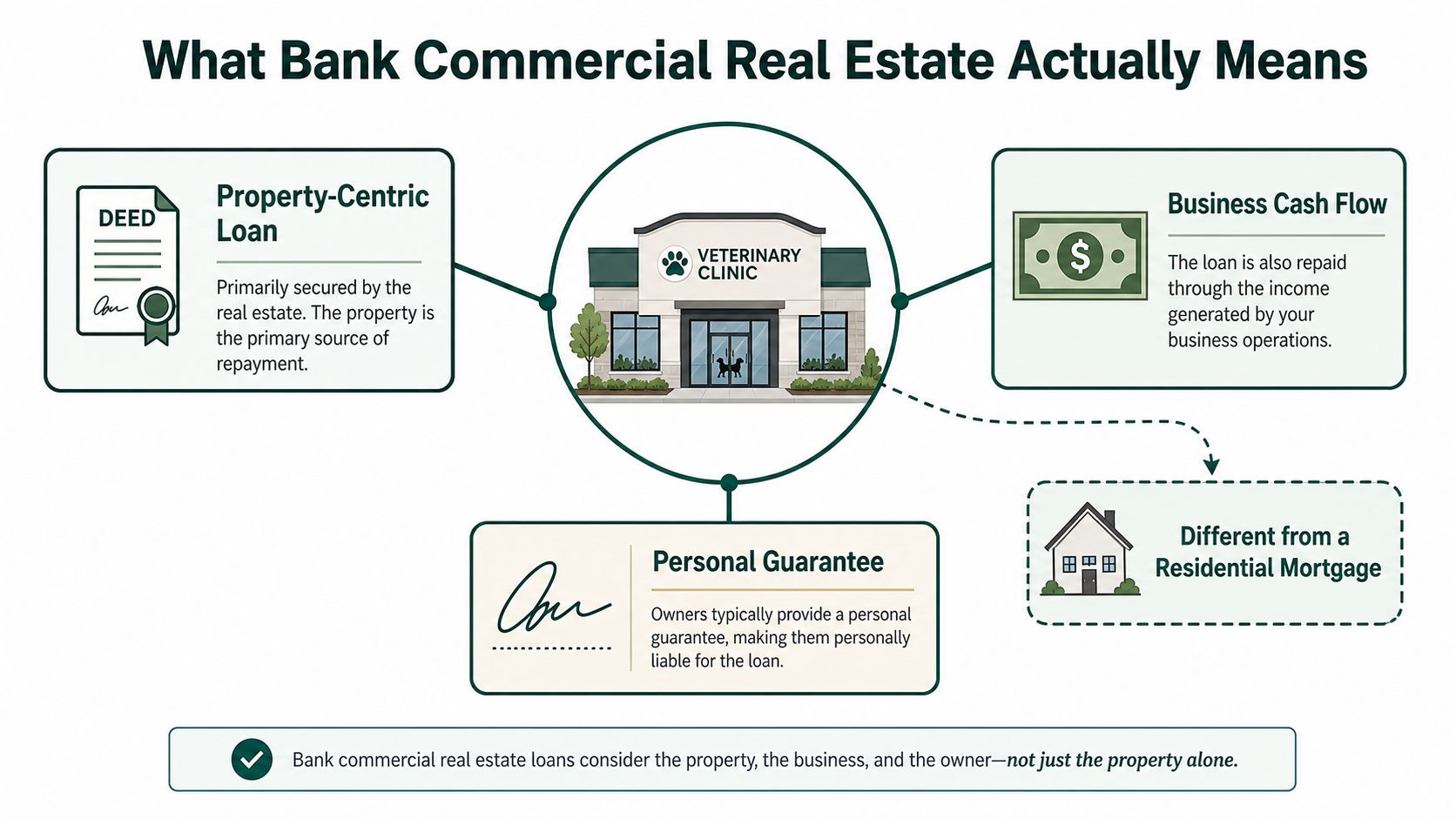
The three parts of the loan
A clinic CRE loan usually combines three forms of support:
- Property security: The building serves as collateral. If the borrower stops paying, the bank has rights against the property.
- Business cash flow: The clinic's operating income must support loan payments after payroll, inventory, taxes, rent-related costs, and other expenses.
- Personal support: Owners commonly provide a personal guarantee, which makes the borrower responsible if the business and collateral don't fully repay the debt.
That's why an owner-occupied clinic still receives deeper review than a personal mortgage. The bank must understand the building, the practice, and the owner's overall financial position.
Who provides CRE financing
A veterinary owner might approach a community bank, regional bank, credit union, or national lender. Each institution has its own lending limits, preferred property types, documentation standards, and appetite for veterinary practices.
Many banks also value an established deposit relationship because account history helps them understand how money moves through the business. That relationship doesn't replace underwriting. It may make communication easier, but the bank still needs evidence that the property is suitable, the clinic can repay the loan, and the requested structure fits its credit policy.
The broader scale of this market explains why banks treat CRE carefully. The Federal Reserve reported that commercial real estate loans at U.S. commercial banks reached roughly $3.13 trillion in August 2026, while the broader real estate loan category was about $5.82 trillion. The FDIC's 2026 Risk Review also reported that bank CRE portfolios grew 3.1% in 2025 and reached a new peak, while delinquency and net charge-off ratios remained low. CRE isn't a niche lending category. It's a core part of bank balance sheets, so lenders apply structured risk controls even to healthy clinics.
The Main Loan Products Banks Offer
The right loan structure depends on what you're doing with the property. Buying a stabilized clinic, constructing a new hospital, and renovating an existing location may all involve CRE, but they create different timing and repayment risks.
Matching the product to the project
| Product | Best Use Case | Typical Term | Typical LTV |
|---|---|---|---|
| Owner-occupied acquisition loan | Buying a building where your clinic will operate | Often structured as a long amortization with a shorter reset or maturity | Banks commonly finance a portion of property value, often around 70% to 80% |
| Permanent loan | Refinancing or purchasing a stabilized property with predictable cash flow | Commonly five to ten years fixed, with longer amortization | Based on appraisal, cash flow, and lender policy |
| Mini-permanent or bridge loan | Acquiring or improving a property before refinancing into permanent debt | Short interim period, often until operations stabilize | Depends on project risk and expected takeout financing |
| Construction or build-out loan | Ground-up construction, major renovation, or clinic relocation | During construction, followed by conversion or refinance | Based on project cost, completed value, and progress |
| SBA 504 structure | Owner-occupied real estate or major fixed assets where a longer structure is useful | Structured through participating lenders and program rules | Depends on the complete project structure |
An owner-occupied acquisition loan fits a practice owner buying a building for the clinic's own use. The bank considers the real estate, but it also wants confidence that the practice can pay the debt. A building with attractive features won't compensate for weak operating cash flow.
A permanent loan is more suitable after the clinic has predictable revenue and expenses. The phrase “permanent” doesn't necessarily mean the debt lasts forever. It usually describes a stabilized financing structure with a longer repayment schedule and a maturity or rate reset that must be addressed later.
Temporary and construction structures
A mini-permanent loan or bridge loan can help when the property needs time to reach its intended performance. For example, you may purchase a location, complete renovations, add staff, and build patient volume before refinancing. The bank will want a credible plan for the later refinance, not just optimism about growth.
Construction and build-out loans work differently because the bank usually doesn't release all funds on the first day. Instead, it advances money in draws after inspections or documentation confirm that work has progressed. A contractor's budget, permits, plans, contingency assumptions, and completion timeline become central parts of the file.
For owner-occupied veterinary space, an SBA structure may also belong in the comparison. The SBA loan options for veterinary practices can help you assess whether a government-supported structure fits better than a conventional bank CRE loan. Compare the complete structure, including equity contribution, collateral, fees, repayment flexibility, and how the financing treats goodwill.
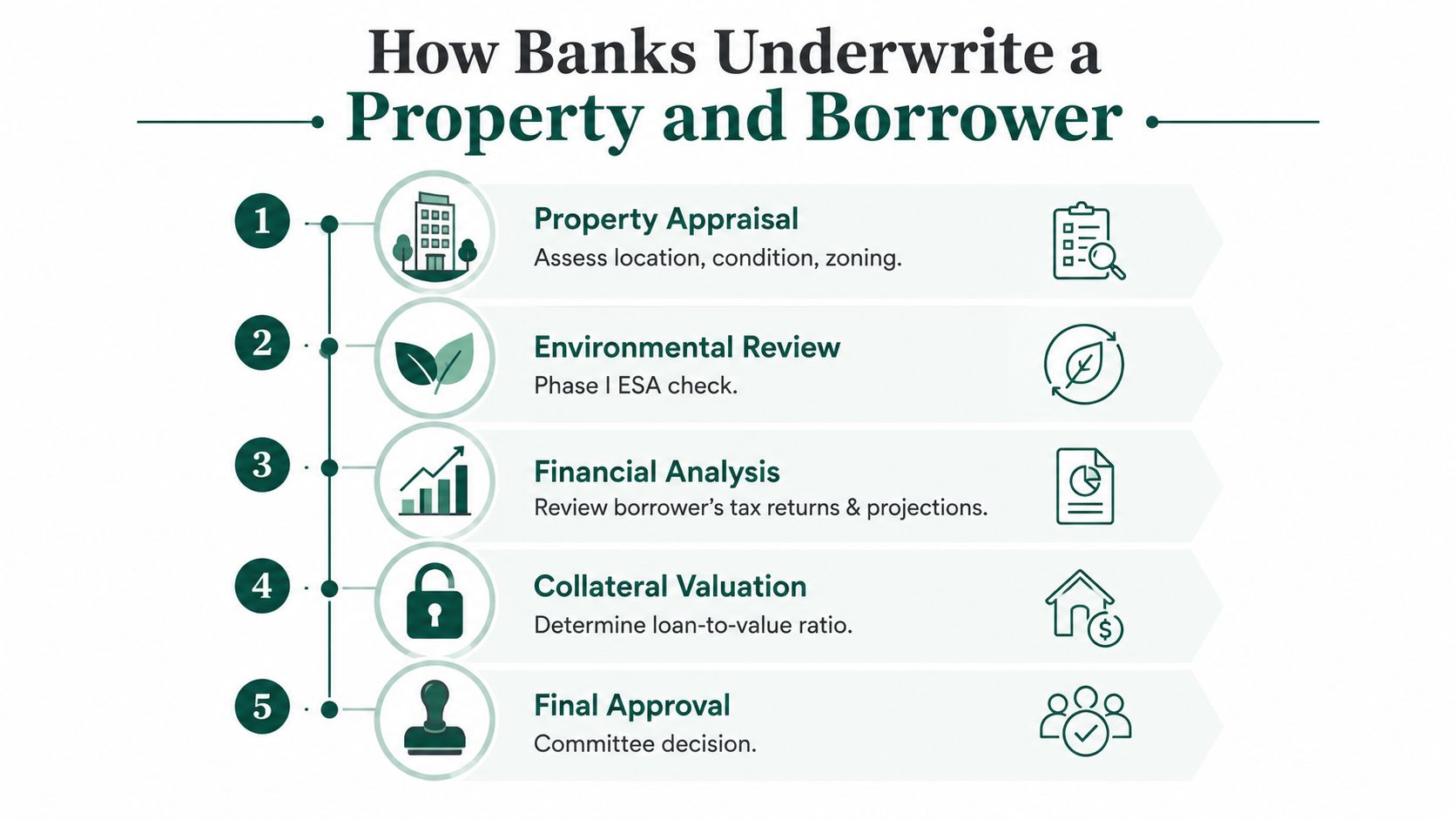
How Banks Underwrite a Property and Borrower
A bank underwriter doesn't review a clinic loan as one large question. The file is broken into smaller tests. Each test answers a specific concern: Is the property sound? Can the business repay? Does the owner have the capacity to manage the plan? What happens if the original assumptions fail?
Starting with the property
The review often begins with location, condition, zoning, access, parking, visibility, and suitability for veterinary use. A building may look ideal operationally but still create lending concerns if it needs major repairs, has restrictive zoning, or depends on improvements that aren't yet approved.
A third-party appraisal gives the bank an independent view of value. The appraiser may review comparable sales and, where relevant, the income characteristics of the property. For an owner-occupied clinic, the bank is still asking whether the collateral would retain reasonable value outside your exact operating plan.
Environmental review can identify historical uses or site conditions that require additional investigation. The bank may also evaluate title, surveys, insurance, building systems, and any leases affecting the property.
Testing cash flow
The next question is whether the clinic generates enough cash to pay its obligations. The underwriter reviews historical financial statements, tax returns, current results, projections, existing debt, owner compensation, and unusual expenses.
A common tool is the debt service coverage ratio, or DSCR. It compares cash available for debt repayment with scheduled principal and interest. A DSCR of 1.25, for example, means the lender is testing whether available cash equals 1.25 times the required debt payment. Bank policy determines the required level, and the calculation may change depending on whether the clinic is established, newly acquired, or still under construction.
For a veterinary practice, the underwriter may examine whether projected exam-room capacity, doctor schedules, staffing, pricing, and referral patterns support the revenue forecast. A projection that assumes more appointments must connect to actual operating capacity.
Reviewing the sponsor and the exit
The sponsor is you, the practice owner and guarantor. The bank reviews experience, personal credit, liquidity, existing practice ownership, tax obligations, and management depth. It also asks how the loan will be repaid if the clinic underperforms. That repayment path is the exit strategy, which may involve normal amortization, refinancing, a property sale, or another documented source.
A useful veterinary practice loan asset checklist can help you organize the personal and business information a lender may request before the file reaches final review.
Loan Terms Rates and Covenants You Will See
A term sheet is a map of the deal, not just an interest rate. It tells you how much the bank will lend, how long repayment is calculated, when the rate can change, and what conditions you must continue meeting after closing.
Permanent and construction structures side by side
| Term Feature | Permanent Acquisition Loan | Construction / Build-Out Loan |
|---|---|---|
| Primary purpose | Purchase or refinance a stabilized clinic property | Fund construction, renovation, or relocation work |
| Funding method | Often funded at closing | Usually released through documented draws |
| Amortization | Commonly 20 to 25 years | May begin with interest-only payments during construction, then convert |
| Maturity or reset | May include a balloon or rate reset date | Often tied to completion and conversion into permanent debt |
| Rate choice | Fixed or floating, depending on policy | Often floating during the project, with later permanent pricing |
| Main bank concern | Stable cash flow and collateral value | Budget control, completion risk, and post-project performance |
| Prepayment | May include a penalty or declining charge | Depends on the construction and takeout structure |
Amortization is the schedule used to calculate periodic payments. A longer amortization can reduce the required payment, but it may leave a larger balance at maturity. A balloon or reset date means the loan doesn't fully disappear through scheduled payments. You'll need to refinance, repay, or renegotiate the remaining balance when that date arrives.
Fixed rates offer payment predictability. Floating rates can change as the underlying benchmark changes, which may matter during a long construction period. Ask exactly when the rate is set and whether the loan converts after completion.
Covenants and flexibility
Covenants are promises in the loan agreement. A bank may require you to maintain a minimum DSCR, preserve a liquidity reserve, provide financial statements, or obtain permission before taking on additional borrowing. These conditions help the bank identify trouble before missed payments occur.
You may be able to negotiate pricing, fees, reporting frequency, rate-lock timing, or prepayment terms. Minimum coverage standards, collateral requirements, and certain approval conditions may be fixed by credit policy. The veterinary practice loan terms and repayment options provide useful context for comparing payment structure with the clinic's operating cycle.
A Clinic Acquisition Seen From the Banker Side
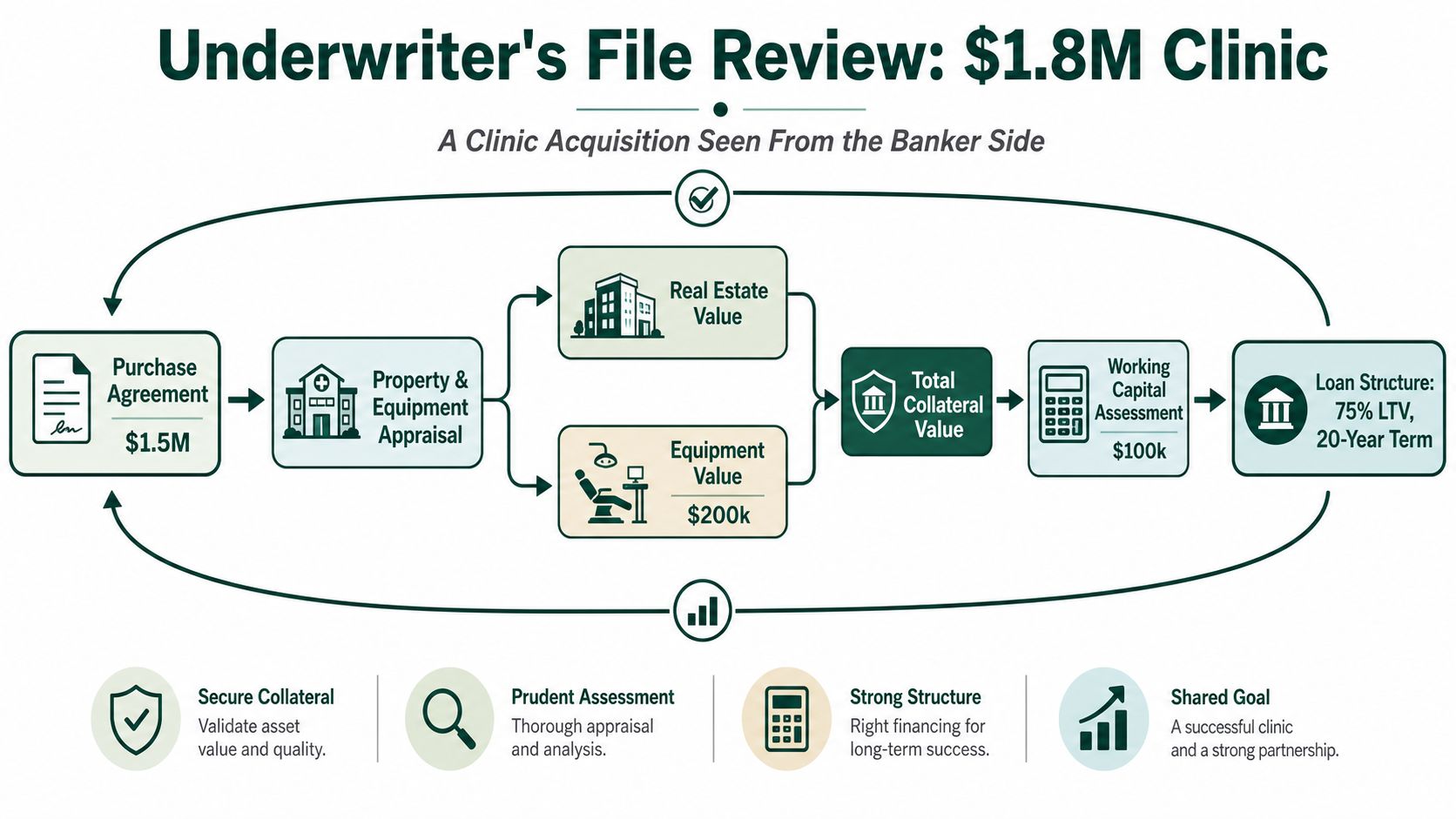
Consider a representative clinic acquisition with a $1.8 million total financing request. The number itself doesn't guarantee approval. The underwriter first separates what you're buying and why each dollar belongs in the request.
The purchase agreement may allocate value among the real estate, equipment, practice assets, and working capital. In the illustrative structure shown below, the purchase agreement identifies $1.5 million for the property and operating business, equipment is evaluated separately at $200,000, and the request includes $100,000 for working capital. These figures describe a file-review example, not a standard lending formula.
What the underwriter tests
The bank orders an appraisal and reviews the equipment list. If the appraisal supports the property value but the equipment is outdated or difficult to resell, the bank may assign less collateral value than the buyer expects. Goodwill receives separate attention because the bank generally can't treat client relationships like a building that can be easily sold after default.
Next comes global cash flow. The bank combines the proposed clinic debt with the owner's existing obligations and tests whether the practice can support the total payment. The underwriter may reduce projected revenue, increase expense assumptions, or remove one-time benefits to see how much room remains.
The file may also be structured around a 75% loan-to-value target and a 20-year repayment term, as illustrated in the supplied scenario. LTV compares the loan amount with the value of the collateral. It isn't the same as the percentage of the purchase price financed, especially when the appraisal differs from the contract allocation.
Why questions and outcomes vary
A request for a management resume doesn't necessarily signal a problem. The bank may need evidence that you can operate the clinic after the seller leaves. Letters of intent from referral practices, staffing plans, production reports, or explanations for an unusual expense may answer questions raised by the projections.
The outcome can be:
- Full approval: The request fits policy, valuation, cash flow, and documentation requirements.
- Conditional approval: The bank approves subject to added equity, reserves, covenants, appraisal clarification, or other conditions.
- Decline: The collateral, repayment capacity, sponsor profile, or structure falls outside the bank's risk tolerance.
The banker's role isn't to validate the purchase emotionally. It's to determine whether the proposed repayment story survives independent review.
Common Misconceptions About Bank CRE Lending
Bank CRE lending often looks simpler from the outside than it feels inside the credit file. A rate quote can sound attractive, and a profitable clinic can appear obviously financeable. Neither fact settles the decision.
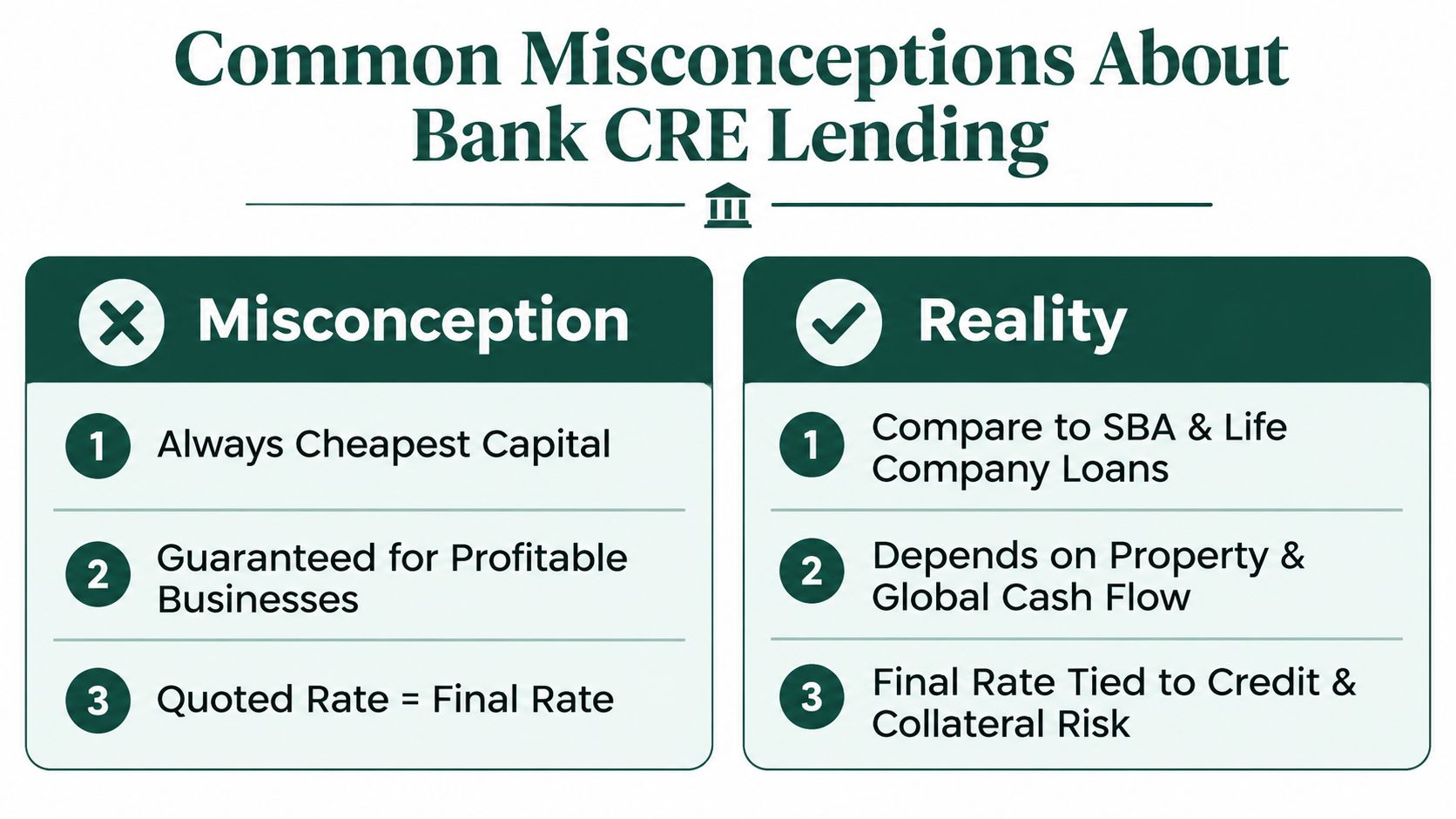
Misconception one, bank debt is always cheapest
A bank may offer a competitive interest rate, but total borrowing cost also includes origination fees, appraisal and legal expenses, required reserves, covenant administration, and prepayment penalties. A lower rate with restrictive terms can be less useful than a slightly higher rate that gives the clinic more operating flexibility.
Compare the complete structure against other appropriate categories of financing. Don't compare rates until you know whether each option uses the same amortization, equity contribution, collateral package, and repayment protections.
Misconception two, an established clinic is guaranteed approval
Profitability helps, but the bank still evaluates the property, debt load, borrower liquidity, management plan, and requested use of funds. A strong clinic can receive a conditional approval if the building appraises below the contract price or if the proposed debt makes the cash-flow cushion too narrow.
Bank CRE risk also varies sharply by property type and lender type. The Federal Reserve's banking-system conditions report reported that large-bank office loan delinquency reached 11.0% in the second quarter of 2024, while broader CRE delinquency remained below the highest historical crisis levels. That contrast helps explain why lenders examine the exact asset and repayment story rather than relying on a portfolio-wide average.
Misconception three, the quoted rate is the deal
The final cost may depend on credit quality, collateral, rate type, fees, and future adjustments. Ask whether the quote is fixed, floating, or subject to a later reset. Ask how a prepayment charge works if you sell the building or refinance after the practice grows.
Practical rule: Read the loan as an operating agreement with the bank, not as a single number attached to a payment.
Relationship banking also doesn't eliminate documentation. Banks must verify information, monitor risk, and satisfy internal and regulatory requirements. The GAO discussion of CRE concentration risk notes historical risk triggers at exposure above 300% of total capital or construction-and-land-development loans at 100% of total capital. Those thresholds apply to bank risk management, but they show why institutions treat CRE exposure as a measured portfolio decision.
How to Prepare Before You Approach a Bank
Preparation changes the first banker meeting from a general conversation into a financeable request. Treat the process like preparing a clinic for inspection. You want the records organized, the operating story consistent, and the unresolved issues visible before someone else discovers them.
Build the file
Gather these materials:
- Business tax returns: Provide the requested historical returns and explain unusual income or expenses.
- Current financial results: Include a year-to-date profit and loss statement and balance sheet.
- Occupancy information: Show how much of the building the clinic will use, plus any tenant or sublease details.
- Equipment and leasehold list: Identify existing equipment, proposed purchases, useful condition, and related debt.
- Purchase or construction documents: Supply the purchase contract, contractor bids, plans, permits, or a detailed construction budget.
- Operating narrative: Summarize patient volume, revenue mix, doctor production, staffing, referral patterns, and the reason for the project.
- Personal financial information: Prepare a personal financial statement, liquidity evidence, and details of other guarantees or obligations.
The bank requests personal information because the owner is often part of the repayment support. Liquidity can provide breathing room during a relocation, delayed opening, staffing transition, or slower-than-expected ramp.
Ask questions that expose the structure
Bring specific questions to the first conversation:
- What maximum LTV does the bank allow for owner-occupied veterinary space?
- How does the bank calculate DSCR, and which owner expenses or add-backs will it accept?
- What prepayment charge applies if you refinance or sell?
- What covenant flexibility is available during the build-out year?
- How does the bank value goodwill, equipment, and real estate separately?
- Which costs must be paid from equity rather than loan proceeds?
- What conditions must be completed before closing and before each construction draw?
A clean request doesn't mean every number must be perfect. It means the lender can trace each assumption back to a document, an operational decision, or a clearly explained estimate.
Choosing the Right Financing Path for Your Clinic
There isn't one universally correct source of clinic financing. The best path depends on whether you're buying a building, acquiring goodwill, building from the ground up, adding a location, or protecting working capital while the practice grows.
Three paths, three different priorities
| Lender Type | Best Fit Scenario | Typical Down Payment | Owner Occupancy | Treats Goodwill Favourably | Closing Speed |
|---|---|---|---|---|---|
| Conventional bank | Established owner buying or refinancing an owner-occupied building | Based on appraisal, policy, and total project structure | Commonly important for owner-occupied real estate | Often more conservative | Depends on relationship, documentation, and approval process |
| SBA 504 or 7(a) structure | Owner-occupied real estate, equipment, or goodwill-heavy acquisition requiring a structured government-supported solution | Depends on program and lender structure | Program and project rules apply | Can be useful when business assets matter alongside real estate | May involve additional coordination and documentation |
| Specialized veterinary lender | First-time owner, goodwill-heavy acquisition, startup, expansion, or urgent project | Depends on credit, cash flow, collateral, and project | Varies by product | Underwriting is designed around veterinary practice operations | Depends on documentation and lender criteria |
A conventional bank CRE loan may fit an established owner with strong financial records, substantial liquidity, and a straightforward building purchase. The trade-off can be tighter collateral and cash-flow requirements, along with more attention to covenants and maturity risk.
An SBA 504 or 7(a) structure may fit a buyer whose transaction includes significant goodwill, equipment, or operating assets rather than only real estate. It can also be relevant when a longer-term structure or different equity design matters more than obtaining the lowest quoted rate.
A specialized lender such as Veterinary Practice Loans may be relevant when the request involves acquisition financing, equipment, working capital, startup costs, or a build-out and the lender needs to understand veterinary operating economics. Its published focus is financing for veterinary practice owners, including acquisitions, equipment, working capital, and expansion projects.
Choose for the next phase, not just closing day
A second-location project may need more liquidity than a building-only loan allows. A first acquisition may need goodwill financing and transition support. An established owner may prioritize rate certainty, prepayment flexibility, and a covenant package that won't restrict future equipment purchases.
Bank CRE is therefore a strategic choice. The structure affects how much cash remains for staff, inventory, technology, repairs, and future growth. Compare the full repayment plan, collateral requirements, timing, and treatment of goodwill before selecting the lender that offers the most appealing headline rate.
Veterinary Practice Loans offers financing options for veterinary practice acquisitions, equipment, working capital, startups, and expansion projects, with underwriting focused on clinic operations. Visit Veterinary Practice Loans to discuss your project, organize the financing request, and compare a structure that fits your clinic's next stage.
