

You've just received a quote for a new diagnostic system. The equipment will improve patient care, expand your service mix, and remove a daily operational bottleneck. The price, however, forces a harder question than “Can the clinic afford the payment?”
The better question is: What will it cost to put the equipment into service, and which financing structure protects the practice while the asset earns its keep? That includes the machine, delivery, installation, calibration, training, maintenance obligations, taxes, and the working capital you'll still need for payroll, inventory, and surprises.
The right choice among the financing options for veterinary practice equipment depends less on finding the lowest advertised rate and more on matching debt to the equipment's useful life, technology cycle, and revenue contribution.
Why Equipment Financing Decisions Matter More Than They Look
A clinic owner receives a $45,000 ultrasound quote and starts comparing three familiar choices: pay cash, lease the system, or borrow through an equipment loan. Paying cash looks simple, but it immediately reduces liquidity. A lease may preserve cash, but the clinic needs to understand ownership, renewal, maintenance, and end-of-term conditions. A term loan creates a predictable obligation while allowing the practice to own the asset.
That decision affects the clinic long after the equipment arrives. Cash purchases can leave less room for payroll or inventory. Leases can make technology replacement easier but may cost more over the full relationship. Loans can build ownership, yet an unsuitable term can leave the practice paying for outdated technology.
Practical rule: Choose the structure that keeps the equipment productive without making the clinic financially brittle.
The payment is only one part of the decision
Veterinary equipment financing is commonly structured around the asset's useful life. Industry guidance describes repayment periods from 24 to 84 months, while high-cost equipment can include digital X-ray systems priced around $20,000 to $60,000, ultrasound systems around $15,000 to $50,000, and surgical suites around $30,000 to $100,000. Those ranges illustrate why many clinics finance rather than pay cash, according to industry guidance on veterinary equipment financing.
The monthly payment matters, but so does the cash left after closing. A clinic that spends its reserves on equipment may struggle with an unexpected repair, staffing need, inventory purchase, or slower revenue month. Before comparing offers, review the broader economics and use a resource on veterinary practice loan rates to understand how pricing fits into the overall financing conversation.
The structures worth comparing are equipment loans, leases, SBA-backed loans, working capital lines, and vendor financing. Each behaves differently when technology changes, the equipment underperforms, or the clinic wants to pay early.
The Five Main Ways Veterinary Clinics Finance Equipment
A clinic may need a new imaging system before its current loan ends, while a surgical table can remain productive for years. Those purchases should not use the same financing logic. Match the repayment structure to the equipment's technology cycle and expected in-service life, then compare ownership, flexibility, and speed.
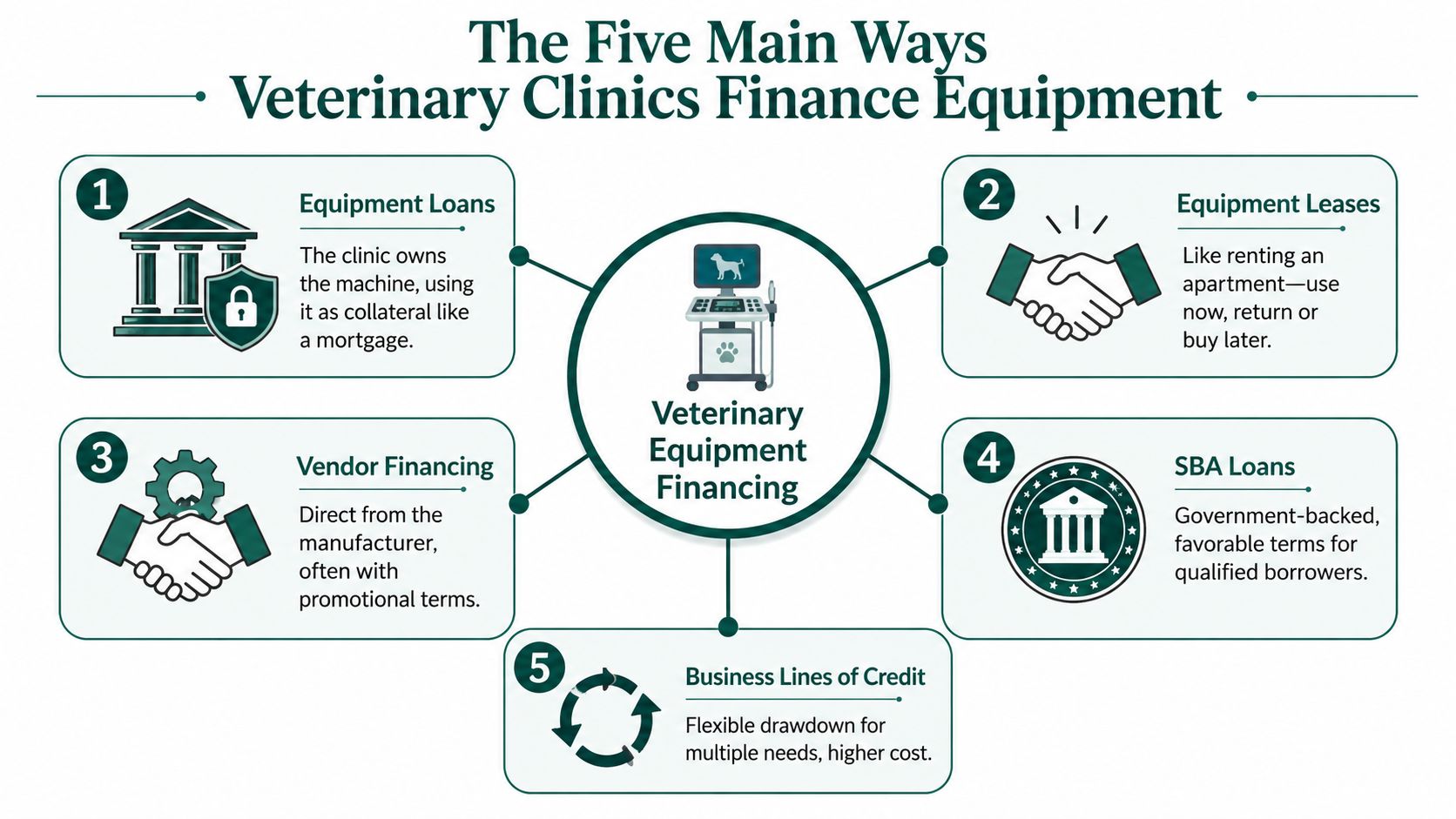
Equipment loans
An equipment loan gives the clinic ownership while the lender takes a security interest in the machine. It fits durable clinical assets that should continue producing value after the debt is repaid, including surgical infrastructure, treatment equipment, and longer-lived laboratory assets.
Ownership gives you control over maintenance, modifications, replacement timing, and resale, subject to the loan documents. The trade-off is responsibility. The clinic absorbs repair costs, obsolescence, and any gap between the equipment's useful life and its repayment term.
Equipment leases
A lease lets the practice pay for use while the lessor retains ownership during the term. Depending on the contract, the clinic may return the equipment, renew the lease, or purchase it at the end.
Leasing often suits technology-refresh assets, such as digital imaging or software-connected systems, when replacement may be necessary before a traditional loan matures. Review the purchase option, early termination terms, maintenance duties, and return conditions. A lower monthly payment can still produce a higher total in-service cost.
SBA-backed loans
SBA-backed financing can support qualified borrowers purchasing equipment as part of a startup, build-out, or expansion. The government support may reduce lender risk, but the application typically demands more documentation and underwriting than a straightforward equipment approval.
SBA 7(a) equipment loans generally run for 10 years or less, with a possible longer period when the equipment's useful life exceeds 10 years. An installation period of up to 12 months may also be added when needed, according to the SBA lender guidance. This structure makes more sense for a broader project than for a small, isolated purchase.
Business lines of credit
A business line of credit provides a revolving reserve. The clinic draws what it needs, repays the balance, and may draw again under the approved facility. It can cover smaller purchases, installation gaps, or bundled costs that do not fit one equipment invoice.
The flexibility has limits. Variable pricing, renewal conditions, and shorter repayment expectations can make a line expensive for a long-lived asset. Use it for durable equipment only when the repayment plan is explicit.
Vendor financing
Manufacturer or dealer financing keeps the seller involved in the transaction and may speed up a time-sensitive purchase. Promotional terms can help, but convenience should not replace an independent comparison.
Ask whether the equipment price changes with financing, whether installation and training are included, what happens if delivery is delayed, and whether the financing covers the complete in-service package. For a broader comparison of loan types for veterinary practices, evaluate the equipment obligation alongside the clinic's other capital needs.
What Equipment Really Costs and How Long It Lasts
The equipment invoice is rarely the complete financing requirement. A clinic must budget for the asset to become operational, not merely to arrive at the loading dock.
Digital radiography is commonly cited in the $20,000 to $60,000 range. Portable ultrasound systems may fall around $15,000 to $25,000, while surgical suites can reach $30,000 to $100,000, depending on configuration. These ranges are summarized in veterinary equipment build-out guidance.
Separate refresh assets from durable assets
The most important classification is not the department name. It's the technology cycle.
Technology-refresh assets include digital imaging, software-connected systems, and some laboratory analyzers. These products can change quickly, and a clinic may want an upgrade path before the original debt would naturally mature.
Durable clinical assets include core surgical infrastructure, treatment furniture, and basic anesthesia equipment. These items may remain useful for longer, so a short repayment period can create unnecessary monthly pressure.
Industry guidance places practical useful life around 7 to 10 years for some imaging and analyzer systems, 5 to 7 years for rapidly evolving digital imaging, and longer for surgical and basic anesthesia equipment. The useful-life discussion appears in SBA 504 equipment financing guidance.
Match the term to the asset
A 24-month obligation may be sensible for an asset likely to be replaced quickly, but it can strain cash flow if the equipment's value extends much longer. Conversely, stretching short-lived technology over a long term can leave the clinic paying for obsolete equipment.
SBA 504 rules require at least 10 years of remaining useful life for eligible longer-lived equipment, and maturities can extend to 10 years or longer depending on the asset class, according to the same guidance. Don't treat that as an invitation to maximize term. Treat it as a reminder to align repayment with economic usefulness.
Before accepting a quote, ask the lender to show the payment under a term that matches the equipment's expected service life, then compare that with the replacement timeline your clinical team expects.
For larger renovation or equipment packages, an equipment and fit-out loan resource can help frame the purchase as part of the clinic's full capital plan rather than as an isolated machine.
Comparing SBA, Conventional Loans, Leases, and Vendor Financing
The best structure depends on what you value most. A startup may need broad eligible uses and room for installation. An established clinic may need speed and clean collateral treatment. A fast technology refresh may justify flexibility over ownership.
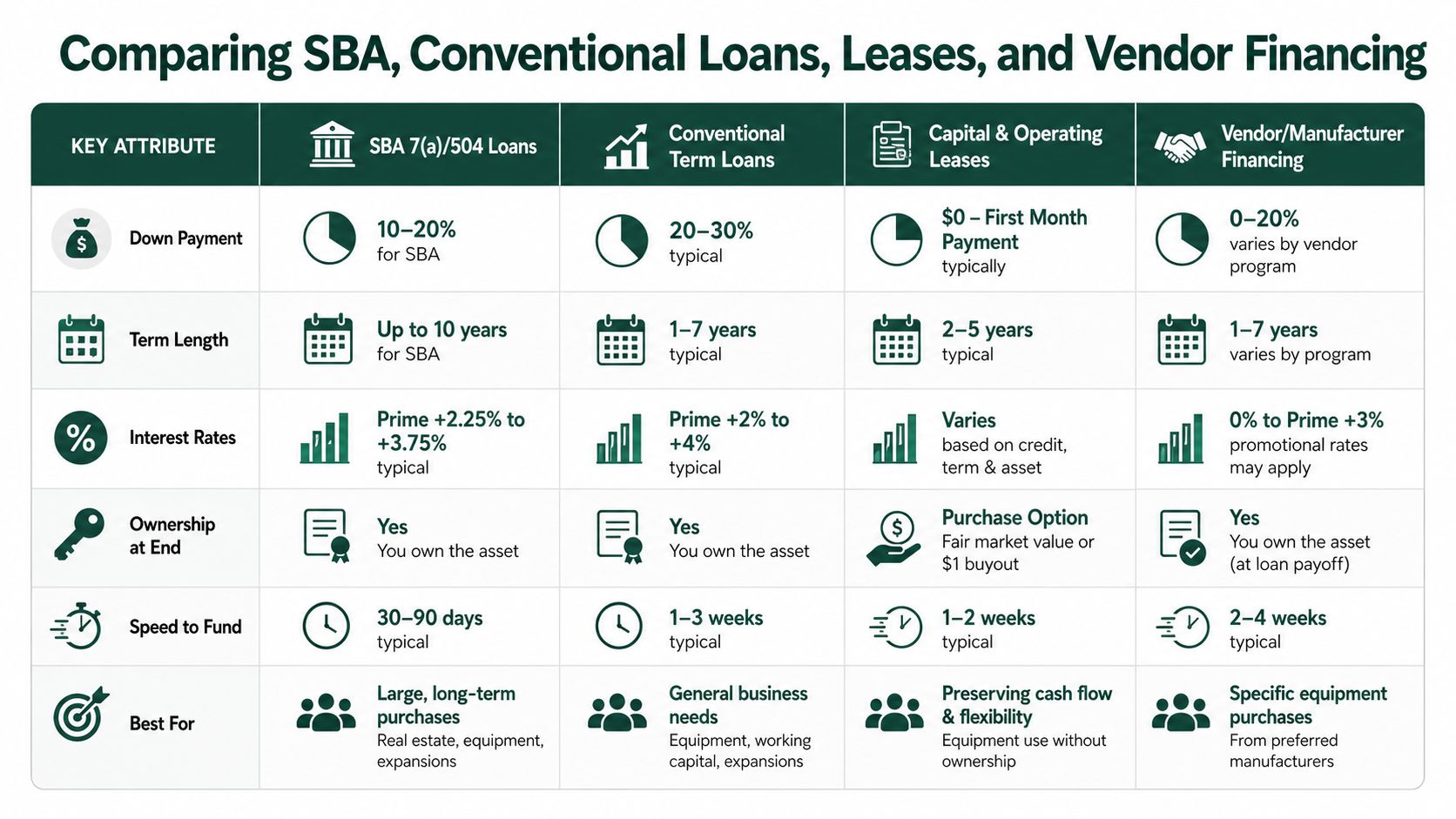
Use this decision table
| Structure | Best fit | Main strength | Main trade-off |
|---|---|---|---|
| SBA 7(a) or 504 | Larger purchases, startups, build-outs, or combined uses | Can support broader financing needs and asset-life alignment | More documentation and slower underwriting |
| Conventional term loan | Established clinics buying a defined asset | Straightforward ownership and predictable repayment | May require stronger financial performance or additional collateral |
| Capital lease | Clinics that expect to retain the equipment | Can provide a path toward ownership | Contract terms and end-of-term purchase provisions require close review |
| Operating lease | Technology likely to be replaced | Easier refresh planning and less ownership exposure | The clinic may not own the asset and may pay more over repeated cycles |
| Vendor financing | Time-sensitive purchases with a clear seller package | Convenience and potentially quick coordination | Terms may be less flexible, and bundled costs may be unclear |
Where each structure wins
SBA financing deserves serious consideration when the equipment is part of a startup, expansion, or broader facility project. The SBA states that 7(a) equipment loans generally mature within 10 years or less, with an extension possible when useful life exceeds that period. The same guidance allows an installation period of up to 12 months when necessary, which can matter when equipment requires site work before it produces revenue.
Conventional equipment loans usually work best when the clinic has stable operations, a defined quote, and a clear ownership goal. They're especially attractive when the equipment should remain productive after repayment.
Leases are strongest when replacement timing matters more than permanent ownership. Don't select an operating lease just because the initial payment looks comfortable. Calculate the total payments, renewal expectations, maintenance obligations, and purchase rights.
Vendor financing can win when a clinical need is urgent and the vendor has already assembled the equipment, delivery, and installation package. Still, obtain an independent financing comparison before signing. The seller's convenience isn't the same as the clinic's best long-term economics.
Eligibility, Documentation, and What Lenders Evaluate
A clinic owner may need equipment quickly, yet the lender's decision rests on more than the credit score. Underwriting typically reviews revenue patterns, deposit activity, cash-flow stability, time in business, owner credit history, and the asset being financed.
The equipment determines what secures the transaction and whether the repayment period matches its useful life. That fit matters for total in-service cost. Technology-refresh assets may need a shorter structure because replacement arrives sooner, while durable clinical assets can support longer repayment. A strong application connects the purchase to both repayment capacity and clinical operations.
Build the file before you apply
Prepare these items before requesting formal terms:
- Financial statements: Provide recent profit and loss statements and balance sheet information where available.
- Tax returns: Include the business and owner returns requested by the lender.
- Bank statements: Supply complete statements so deposits, balances, and cash movement can be reviewed.
- Equipment quote: Require an itemized quote covering the machine, accessories, delivery, installation, calibration, training, warranty, and applicable taxes.
- Use-of-funds summary: Explain how the equipment will support services, workflow, capacity, and the revenue plan.
- Business plan or projections: Startups and expansion projects should document assumptions, ramp-up, staffing, and expenses.
Do not submit a quote that shows only the machine price. Installation, calibration, training, and related costs affect the amount needed to place the asset in service and the cash the clinic must contribute.
Address weaknesses directly
A weak month does not automatically end the conversation. An unexplained weak month creates a harder underwriting problem. If revenue fell because of relocation, staffing disruption, renovation, or temporary closure, document the event and show the operating change afterward.
Owner credit history carries more weight for newer clinics, but operating evidence matters too. Clean deposits, controlled expenses, and a credible equipment plan strengthen the file.
Lenders can work with a problem they understand. They struggle with a problem the application doesn't explain.
Submit a complete, consistent package. Missing statements, mismatched equipment quotes, and unclear ownership structures create avoidable questions, delay approval, and can obscure whether the proposed structure fits the asset's working life.
A Decision Framework for Common Equipment Scenarios
A startup buying its first digital X-ray faces different constraints than a ten-year-old clinic replacing an aging anesthesia machine. Choose the financing structure by total in-service cost, ownership goal, cash-flow capacity, and how quickly the asset may need replacement. The lowest monthly payment is not automatically the lowest-cost decision.
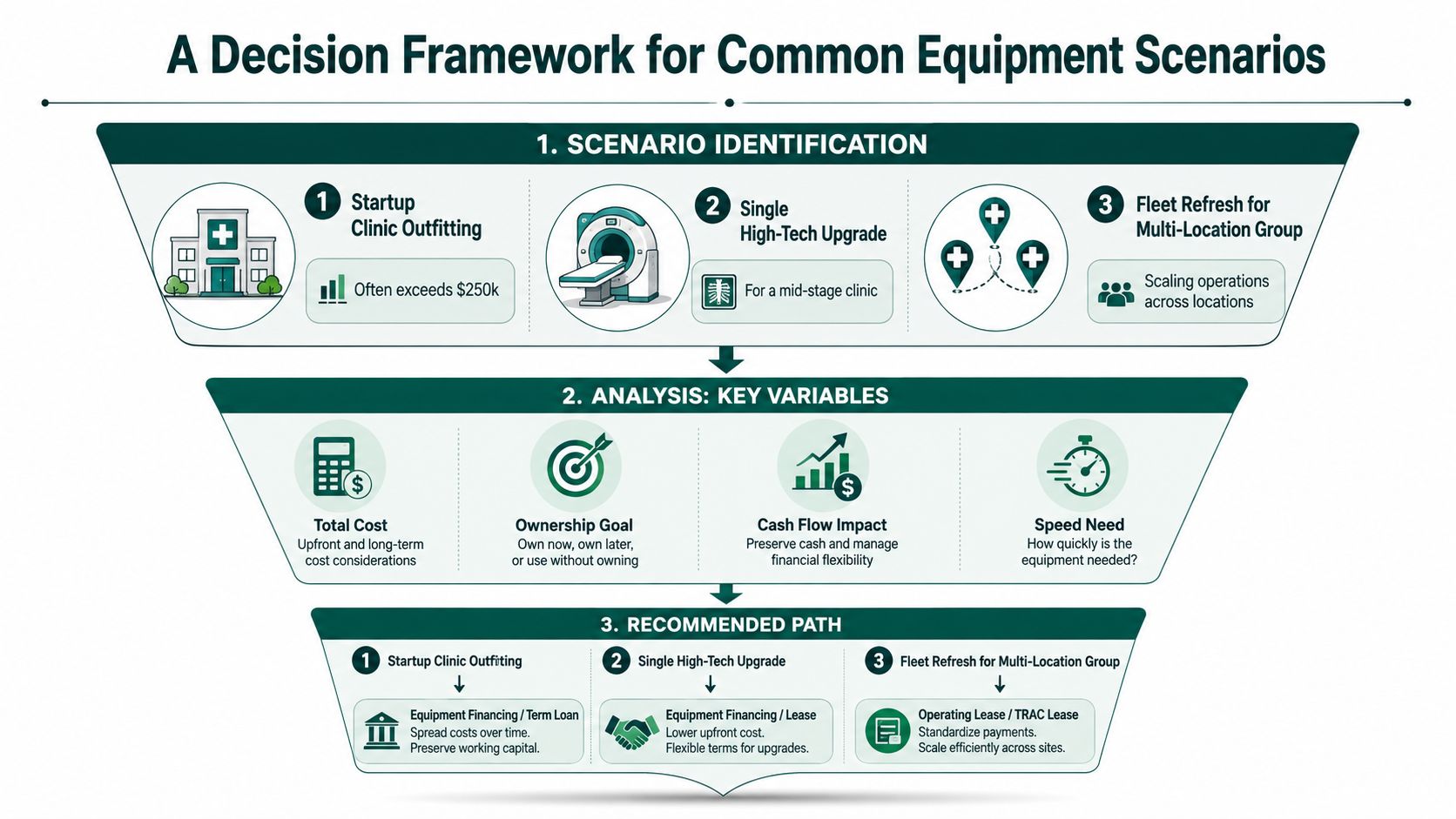
A startup clinic needs a complete package
A new owner rarely needs only a machine. The project may include imaging, laboratory equipment, surgical infrastructure, treatment areas, technology, installation, calibration, training, initial inventory, and opening expenses.
Bare-bones general-practice equipment budgets can start around $100,000 to $150,000, according to veterinary clinic build-out guidance. A startup should usually investigate SBA or conventional financing that covers the complete project instead of assembling several short-term obligations.
The test is simple: does the financing get the clinic operational? Funding only the equipment price can leave the owner unable to pay for installation or training, delaying the revenue the debt was intended to support. Include every cost required to place the asset in service, then protect enough working capital for the opening period.
An established clinic is replacing one system
For a durable clinical asset, match the repayment term to its expected useful life. An equipment loan fits a clinic that wants ownership and expects years of use. A lease deserves consideration when the technology changes rapidly, upgrades are frequent, or the replacement cycle is uncertain.
Technology-refresh assets and durable clinical assets should not receive the same structure by default. A system likely to be replaced soon should not carry payments long after its clinical relevance declines. Ask whether the equipment will remain useful and commercially productive when the final payment is due, not merely whether today's payment fits the budget.
A multi-location group needs staged access
A group refreshing several sites may benefit from a line of credit or master equipment facility that permits draws as each location becomes ready. This limits the risk of borrowing the full amount before the rollout schedule is known and keeps interest tied more closely to actual deployment.
Set clear draw conditions, repayment expectations, and procedures for equipment that arrives late or performs differently than expected. Coordinate funding with site readiness, staffing, training, and go-live dates.
Decision test: If the equipment cannot operate on day one because installation, calibration, or training remains unfunded, the financing is too small.
Application Timeline and How to Speed Up Funding
Equipment financing moves fastest when the clinic treats the application like a project, not a last-minute request. Start with a complete quote and a realistic installation schedule, then prepare the financial file before asking for final terms.
The practical sequence
- Confirm the equipment package. Ask the vendor to identify every required component, service, accessory, and implementation cost.
- Pre-qualify with lenders. Share the basic clinic profile and equipment need before authorizing a full application.
- Assemble documents. Provide financial statements, tax returns, bank statements, ownership information, and the final quote in one organized package.
- Review underwriting questions quickly. Delays often arise when the lender has to request missing pages, clarify deposits, or reconcile different figures.
- Read the closing documents. Confirm collateral, insurance, payment dates, prepayment language, fees, and funding conditions before signing.
A conventional equipment request may move more quickly than a broad SBA or expansion transaction. Vendor financing can also be faster when the seller has a complete package, while complex projects require more review because the lender must assess the business, collateral, and total uses together.
The SBA notes that 7(a) equipment loans generally run for 10 years or less, with a possible extension when useful life exceeds 10 years. That asset-life analysis can add underwriting time, but it prevents a mismatch between the debt and the equipment.
Remove avoidable bottlenecks
- Send complete statements: Don't provide partial pages or screenshots when full statements are requested.
- Use one equipment quote: Ensure the lender and vendor are working from the same version.
- Explain unusual deposits: Identify transfers, owner contributions, grants, or one-time receipts.
- Clarify installation timing: State when the equipment will be ready to generate revenue.
- Prepare ownership details: Have entity documents and ownership information available.
Same-day or next-day decisions become realistic only when the lender's criteria fit the request and the documentation is complete. They aren't a substitute for choosing the right structure.
Next Steps and Questions to Ask Before You Sign
Paying cash can be sensible when the clinic has ample reserves and the equipment is durable. It isn't sensible if the purchase leaves no room for payroll, inventory, repairs, or planned growth. Financing can preserve liquidity, but only when the repayment term fits the asset and the clinic can support the obligation in a slower period.
Before signing, ask the lender these questions:
- What is the total cost of capital? Request interest, origination fees, documentation charges, closing costs, and any required deposits.
- What exactly is collateralized? Confirm whether the lender takes the equipment only or requires a broader lien or guarantee.
- What happens if the equipment underperforms? Review warranty responsibility, service obligations, replacement procedures, and payment duties during downtime.
- Can the clinic prepay? Ask about penalties, minimum interest, and the process for obtaining a payoff statement.
- Who owns the asset at the end? For a lease, clarify return conditions, renewal terms, and purchase options.
- How does the structure interact with taxes? Have your CPA review depreciation, expensing, interest deductions, and lease treatment. In the U.S., Section 179 allowed up to $1.16 million of qualifying equipment expensing for 2024, alongside 60% bonus depreciation on qualifying equipment, as described in veterinary equipment financing guidance on tax treatment. Tax rules change, so confirm the applicable treatment for your purchase year.
Get at least two or three financing comparisons when the timeline allows. Compare total repayment and flexibility, not just the lowest monthly payment. Then fund the complete in-service cost, so the equipment can begin working when the debt begins.
Veterinary Practice Loans helps clinic owners evaluate equipment financing, working capital, startup funding, build-outs, and expansion loans around the practice's actual cash flow. Visit Veterinary Practice Loans to discuss the full in-service cost of your equipment package and identify a structure that fits the asset's useful life.
