
Veterinary Ultrasound Equipment: A Smart Buyer’s Guide
 Reviewed by Marie Lokmanyan, Senior Loan Consultant · Updated
Note: Rates, fees, down payments, valuation multiples and lender details below are general market information gathered from public sources, not a quote or offer. Your actual terms depend on the lender, your credit, the practice's financials and market conditions. Confirm current terms with the lender before you rely on them.
Dr. Patel's old console dies in the middle of a busy shift, and the quote for a replacement lands on her desk before lunch. The temptation is to compare screen size, probe count, and software bundles, then pick the system that looks most advanced. That's the wrong starting point. Veterinary ultrasound equipment is a capital asset, a workflow tool, and a revenue generator, so the question is whether the purchase fits the clinic's case mix, payment capacity, and useful life.
The market is large enough that this decision deserves discipline. Major estimates place the global veterinary ultrasound market at USD 474.9 million in 2024 with growth to USD 899.1 million by 2034 at a 6.8% CAGR, while another report puts it at USD 0.44 billion in 2025 and USD 0.68 billion by 2031 at 7.6% CAGR. A U.S.-focused estimate values the American animal ultrasound market at USD 132.72 million in 2024, rising to USD 245.08 million by 2033 Mordor Intelligence. That's not a niche purchase. It's a meaningful line item in veterinary medicine and a serious financing decision.
Why Veterinary Ultrasound Equipment Is a Strategic Purchase
Dr. Patel's ten-year-old console still powers on, but it slows appointments, frustrates staff, and sends borderline cases to referral. Each referral removes imaging revenue from the clinic and gives clients one less reason to stay.
Buy veterinary ultrasound equipment as a business asset, not a feature package. In-house imaging keeps abdominal studies, reproductive scans, and cardiac follow-up within the practice. It can also improve daily capacity, provided the clinic has trained operators, a suitable room, a workable cleaning process, and a clear path from intake to interpretation.
The financial test is total cost of ownership. The purchase price is only the first obligation. Add probes, software, installation, training, service coverage, repairs, and the interest created by the financing structure. A lower monthly payment can still produce a higher total cost if it stretches amortization too far. A clinic should approve the system only after matching those costs to realistic exam volume and cash flow.
Ultrasound has become a routine practice investment across portable and cart-based formats. That gives clinics more ways to fit imaging into their workflow, but it also makes overbuying easier. A system with capabilities the team rarely uses ties up capital, while an under-specified system creates referral leakage and may force an earlier replacement.
Practical rule: buy for the cases you already see, plus the cases you can keep in-house after training. Do not finance features that will sit unused.
Start with a practice plan that connects expected ultrasound demand to case volume, staffing, training, and repayment capacity. A veterinary practice business plan can place imaging on the revenue side of the budget while accounting for its full ownership and financing costs. That document should support a purchase decision, not justify a showroom demo.
See what your practice could qualify for
Tell us what you are funding and we’ll connect you with a financing partner who works with veterinary practices. Free, and checking options won’t affect your credit. Compare options in our guide to veterinary equipment financing.
How Ultrasound Imaging Works Inside the Clinic
Ultrasound works like sonar, only in soft tissue. A crystal in the probe sends sound waves into the body, then listens for the echoes that bounce back from tissue boundaries. The console measures how long each echo takes to return, and that timing becomes the image on the screen.
Why frequency changes what you can see
Frequency is the tradeoff everyone needs to understand before buying. Higher-frequency probes give sharper detail, but they fade faster as they travel through tissue. Lower-frequency probes go deeper, but the picture is less precise. A bright focused beam reveals fine detail close to you, but the light doesn't travel as far once the fog thickens.
That's why transducer choice matters more than most buyers expect. Consensus guidance for small-animal abdominal imaging recommends a 5 to 18 MHz transducer set, with linear probes for superficial structures and smaller patients, and curvilinear probes for deeper organs and larger animals Wiley consensus guidance. Veterinary physics data make the same point in hard numbers. At 2.0 MHz, reported depth can reach about 30 cm with axial resolution around 0.77 mm, while at 10.0 MHz, depth drops to about 6 cm but axial resolution improves to about 0.15 mm Veterinary ultrasound physics review.
Match the probe to the job
A clinic that scans tendons, eyes, or superficial soft tissue needs a different setup than a clinic that spends most of its time in the abdomen of a large dog. The same is true for cardiac windows, where detail and depth both matter, but the usable frequency range shifts with patient size. The wrong probe doesn't just lower image quality, it forces the doctor to work harder for a less reliable answer.
The clinic that buys a single fixed-purpose probe usually ends up replacing it sooner than expected.
That's why the smartest systems are the ones with a multifrequency probe family. They let you shift between superficial and deep work without buying a second machine too early.
Cart-Based, Portable, and Handheld Systems Compared
A clinic that scans throughout the day should treat ultrasound as infrastructure, not a gadget. A mobile practice may need a lighter system that travels between sites. A veterinarian performing bedside triage may get better financial results from a handheld probe than from a console that sits unused. The correct form factor follows workload, room layout, operator skill, and the financing payment the practice can support.
The tradeoffs that actually matter
Cart-based systems suit hospitals, referral settings, and specialty services with sustained scanning demand. Their larger displays, multiple probe connections, stronger ergonomics, and broader clinical functions support repeated examinations without constant repositioning. The tradeoff is ownership cost. Floor space, service contracts, transport within the building, and a larger financed balance all affect the monthly economics.
Portable laptop-style units occupy the middle ground. They move between rooms, fit mixed-practice workflows, and store more easily than carts. Their smaller screens and battery limits become noticeable during long scanning blocks or back-to-back examinations. Before choosing one, confirm how long the unit can operate in the actual rooms where it will be used, not only under showroom conditions.
Handheld systems prioritize access and speed. They work well for bedside triage, emergency assessment, exotic-animal care, and occasional scanning. They are a poor primary purchase for a team performing demanding cardiac examinations or detailed abdominal work every day. A lower acquisition price does not make a handheld economical if clinicians quickly need a second system.
Use case fit, not brand prestige
Start with the workflow. Record the examination types, typical scan duration, number of trained operators, room locations, and expected weekly use. Then compare the total cost of ownership, including probes, charging equipment, training, warranty coverage, service, software access, and replacement timing. A cheaper unit can produce the higher cost if it requires early replacement or leaves a clinician waiting for access.
| Ultrasound Form Factor Comparison | Typical Price Band | Best-Fit Clinic Type | Key Limitation |
|---|---|---|---|
| Cart-Based | Higher upfront capital requirement | High-volume hospitals, referral settings, specialty use | Floor space and higher ownership cost |
| Portable | Mid-range acquisition | Mixed practice, mobile, equine, multi-room clinics | Smaller interface and battery constraints |
| Handheld | Lowest entry cost | Bedside triage, emergency, exotic, occasional scanning | Limited depth, modes, and advanced workflow |
If your team scans often enough to create a queue, finance the system that removes the bottleneck, not the one with the lowest sticker price.
The market supports all three formats, but that does not make them interchangeable. Choose the system whose utilization can cover its loan payment, service costs, and eventual replacement reserve. Form factor is a capital-allocation decision before it is a specification decision.
Matching Features to Clinical Use Cases
先把臨床工作流程定清楚,再決定功能。不要為了規格表上的選項付款。基礎 2D B-mode imaging 已能支援許多一般診所的腹部快速掃描與例行生殖檢查。對資金有限的診所,先確認這些檢查能否穩定產生收入,再安排升級與融資。
升級路徑應跟著病例量走
心臟病例增加後,Doppler 通常是下一項合理投資。Color and spectral Doppler 可支援心臟評估、血管檢查、門脈血流問題與分流篩查。市場資料指出,2D 仍占最大份額,而 Doppler 的成長速度高於整體類別。這也符合診所常見的採購順序,先證明超音波使用量穩定,再為更高階功能承擔付款與訓練成本 MarketsandMarkets。
更高階功能必須由病例需求支撐。Tissue harmonics 可改善肥胖病患或影像窗困難時的成像。Elastography 適合經常需要判讀軟組織病灶,且能承擔學習時間與設備成本的診所。Contrast-ready platforms 則應留給專科或轉診機構,不適合每月只掃描少量病灶的診所。
把每項功能放進投資回收計算。軟體費、探頭成本、訓練、服務合約與貸款攤還期,都要和預計檢查量一起評估。
依臨床觸發條件採購
診所應在某項功能能改善決策品質或減少重複影像檢查時升級,而不是因為展示效果吸引人。心臟科病例稀少時,Doppler 可以延後。若診所負責牲畜生殖監測或急診床邊掃描,升級理由更充分,設備也較快形成可計費檢查。
| Feature Tier | Core Capabilities | Clinical Trigger |
|---|---|---|
| Baseline 2D | Routine grayscale imaging at the right frequency range | General abdominal, reproductive, and screening work |
| Doppler Tier | Color and spectral flow assessment | Cardiac referral volume, vascular questions, shunt work |
| Advanced Imaging | Harmonics, elastography, specialty functions | Obesity, lesion characterization, referral or oncology follow-up |
| Specialty Platform | Higher-end workflows and advanced modes | Heavy cardiology, referral imaging, or complex case mix |
過早買滿功能層級,會讓診所長期攤還未使用的軟體。市場正朝向可攜式、人工智慧支援與雲端連線系統發展,但只有具備足夠病例量與受訓人員,這些功能才會轉化為可計費檢查。對多數診所,先買能被每週使用的功能,再把剩餘資金留給維護、服務與日後升級。
Realistic Price Bands and Useful Life
MSRP is not the number that matters. The number that matters is what you pay, what you spend to keep the machine working, and how long it stays useful before it becomes a drag on workflow. For most buyers, the choice is between paying less today and paying more through downtime, service, or an early replacement.
What clinics usually pay
New mid-range cart systems typically land between $18,000 and $45,000. Premium platforms with full cardiac packages can run $60,000 to $120,000. Portable laptop-style machines usually cluster around $8,000 to $25,000, and handheld units sit between $2,500 and $10,000. Refurbished and demo systems can reduce those prices by 30 to 50 percent. Those are practical buying bands, not marketing fantasy.
Useful life should drive the term
Useful life is also different by format. Cart-based systems often last 7 to 10 years with proper service, portables usually last 5 to 7 years, and handhelds often last 3 to 5 years because probe life becomes the limiting factor. That means the financing term should follow the asset, not the other way around.
| Category | Price Range (New) | Useful Life | Typical Term |
|---|---|---|---|
| Cart-Based System | $18,000 to $120,000, depending on configuration | 7 to 10 years | 60 to 72 months |
| Portable System | $8,000 to $25,000 | 5 to 7 years | 36 to 60 months |
| Handheld System | $2,500 to $10,000 | 3 to 5 years | 24 to 36 months |
A useful way to think about this is monthly burden versus productive life. A $35,000 cart spread over 60 months can be easier to live with than a cheaper portable on a shorter term if the cart stays productive for twice as long. That's the logic behind financing around depreciation, not sticker price.
If you're deciding how to structure that purchase, use a dedicated veterinary practice equipment loans resource to compare repayment to the actual lifespan of the asset, not the excitement of the showroom quote.
Calculating ROI by Exam and Utilization
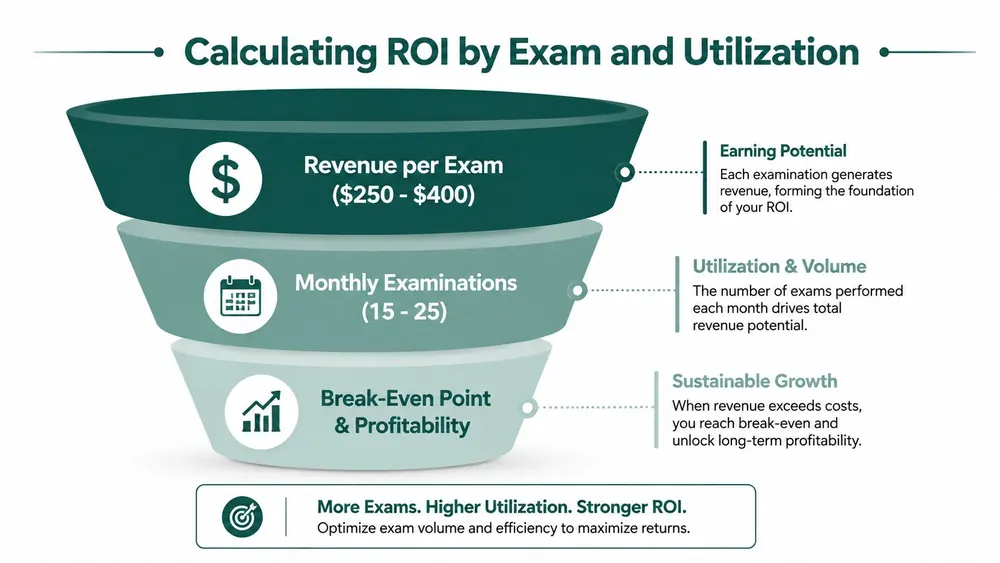
ROI on ultrasound is simple if you stay honest. Stop asking, “What does the machine cost?” and ask, “How many billable scans will we perform?” A clinic charging $250 to $400 per ultrasound session typically needs about 15 to 25 exams per month to cover a $1,200 monthly payment including service reserves, before you even count technician time and consumables.
Volume beats price
That number changes the whole conversation. A practice that performs fewer than ten scans per month shouldn't rush into ownership. It should rent, lease short term, or share a mobile sonographer. Once utilization stabilizes above roughly twenty-five scans, ownership usually beats rental because the fixed cost gets spread across enough exams to matter.
Best shortcut: if the machine won't be used often, don't finance it like a core asset.
Case mix matters as much as raw volume. A general practice may see abdominal and reproductive work as the base. Add cardiac or urgent-care scanning, and both exam count and per-exam value tend to rise because the machine is doing more than screening. That's why two clinics can buy the same system and get completely different returns from it.
The math should be boring
The best ultrasound purchase is the one that looks boring on paper and productive in practice. If a unit can be booked consistently, billed cleanly, and supported by trained staff, the asset will usually justify itself. If the team has to chase cases just to keep the machine busy, the purchase is too early.
Financing Options for Equipment Purchases
A clinic can choose the right ultrasound and still make a poor investment through the wrong financing structure. Judge the purchase by total cost of ownership, monthly cash demand, and the time required to repay it, not by the equipment price alone. The loan should support realistic scan volume without forcing the practice to sacrifice payroll, inventory, or operating reserves.
Match the loan to the clinic stage
An equipment loan is usually the cleanest structure for an established practice. The machine serves as collateral, and the repayment schedule can match its useful life. That alignment often matters more than pursuing the lowest advertised rate, because a slightly cheaper loan is not helpful if approval takes too long or repayment terms strain cash flow.
Dedicated equipment financing commonly uses 36 to 72 month terms, while established practices commonly see 6 to 10 percent rates in the market context provided. A multi-doctor clinic with steady collections can use that structure to preserve working capital while paying for an asset that produces revenue. Conventional term loans or SBA structures may reduce long-run borrowing cost, but they usually require stronger financials and more underwriting time.
A startup or satellite clinic needs more flexibility. SBA-style financing can preserve cash for payroll, inventory, and the early ramp-up period. A working capital line can fund a time-sensitive purchase, but it is a poor default for long-term ownership. Variable costs and lower capital ceilings can make the line less efficient than a dedicated equipment loan.
Read every clause that changes total cost
Lease structures require close review. An FMV lease and a $1 buyout lease create different ownership outcomes, and a balloon payment can increase the machine's final cost. Prepayment penalties deserve equal attention. A clinic that grows faster than expected should be able to repay early and reduce interest without an expensive penalty.
| Structure | Typical Term | Rate Range | Best Fit For |
|---|---|---|---|
| Equipment Loan | 36 to 72 months | About 6 to 10 percent for established practices | Clinics that want ownership and predictable amortization |
| Working Capital Line | Shorter and flexible | Variable | Time-sensitive purchases or temporary cash needs |
| Conventional Term Loan or SBA | Longer underwriting and term options | Often competitive, but qualification is stricter | Startups, acquisitions, or expansion projects |
Build the decision around utilization. Start with the number of scans the clinic can reasonably schedule, then test whether routine revenue covers the payment after staffing and operating costs. If the machine needs optimistic volume to break even, postpone the purchase or choose a lower-cost structure.
Review these financing options for veterinary practice equipment before applying. Compare amortization, total repayment, collateral requirements, prepayment terms, and the cash reserve left after closing. Approval speed matters, but loan structure determines whether the ultrasound strengthens the practice or restricts it.
Maintenance, Service, and a Final Buying Checklist
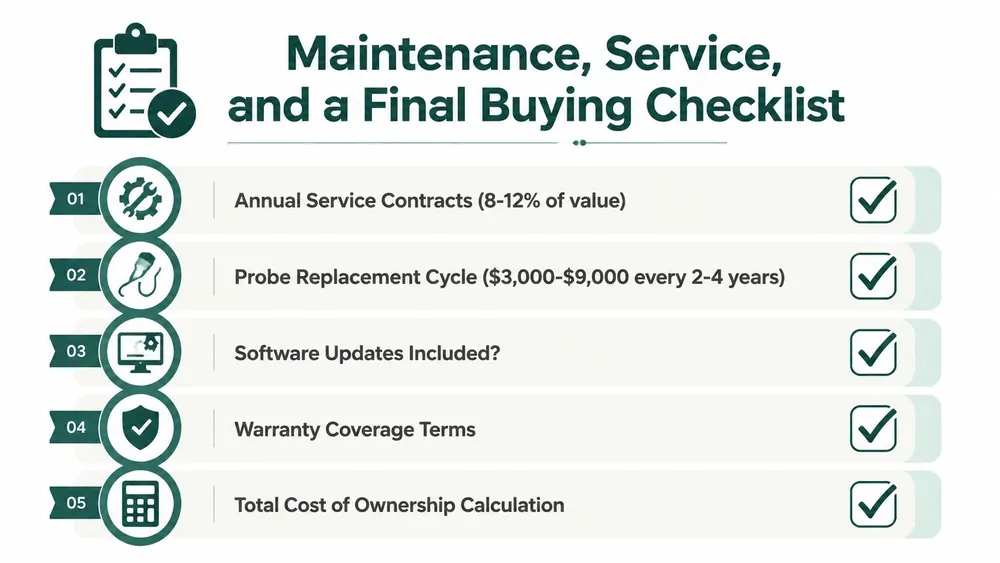
A cheap ultrasound can become an expensive one the moment service is ignored. Annual service contracts commonly run 8 to 12 percent of equipment value, and probe replacements can cost $3,000 to $9,000 every 2 to 4 years depending on use. If a warranty lapses and the machine goes down, the revenue loss can be worse than the service invoice.
Service is part of the asset cost
Manufacturer plans and third-party coverage are not interchangeable. Manufacturer service usually wins on software updates, parts access, and response consistency. Third-party service can be cheaper, but you need to check response time, probe repair coverage, and whether software updates are included or billed separately. The wrong service plan turns a working system into a budget drain.
Use this checklist before you sign
- Case mix fit: Confirm the probe set matches the exams you do, not the exams you hope to add someday.
- Utilization fit: Make sure the machine will be used often enough to justify ownership.
- Payment fit: Keep the monthly payment under a level the practice can absorb from routine revenue.
- Service fit: Check what the contract covers, including probes, software, and turnaround time.
- Training fit: Verify who will scan, how they'll be trained, and how competency will be maintained.
- Workflow fit: Plan where the machine lives, where it's cleaned, and how it moves between rooms.
- IT fit: Confirm image storage, sharing, and any integration requirements before closing.
- Exit fit: Ask about resale value, lease end options, and upgrade paths.
- Probe risk: Budget for replacement, because probes are wear items, not forever assets.
- Downtime risk: Ask what happens if the machine fails outside warranty.
- Reprocessing fit: Make sure the room setup supports safe and fast turnover.
- Cardiology readiness: If heart work is in your future, don't buy a system that caps you early.
- Specialty creep control: Avoid advanced features that won't be used often enough to matter.
- Total cost view: Add purchase price, service, probes, training, and financing together before deciding.
The final rule is simple. The cheapest ultrasound is rarely the cheapest ultrasound. Buy the machine that matches your case mix, finance it on terms that respect its useful life, and budget for service from day one. If you need help structuring that purchase so the payments, term, and asset life line up, visit Veterinary Practice Loans and compare financing built for veterinary clinics.