

You can have three loan proposals on your desk and still not know which one will protect the clinic. One lender may advertise a lower rate, another may stretch payments far enough to ease monthly pressure, and a third may hide the expensive parts in the fine print, where fee schedules, payment timing, covenant language, and collateral terms subtly alter the true nature of the agreement you are accepting. That is the main problem with comparing veterinary practice loans. The headline number rarely tells the whole story.
The better comparison protects your clinic's cash flow, preserves room to make operating decisions, and supports growth without burying the practice under a payment structure that looks manageable on paper but becomes a drag month after month. The actual cost of borrowing can shift when origination fees, closing costs, prepayment penalties, balloon payments, and account requirements are folded into the structure. A practical framework matters because lenders evaluate the practice against measurable performance, not hope.
| Loan factor | What to compare | Why it matters |
|---|---|---|
| Interest rate | Stated rate and how it's applied | Sets the starting cost, but not the full cost |
| Term length | How long repayment lasts | Affects monthly pressure and total interest over time |
| Fees and charges | Origination, closing, servicing, account costs | Can change the economics of the deal |
| Repayment structure | Monthly timing, balloons, amortization | Determines how predictable the loan feels in real life |
| Prepayment terms | Penalties or restrictions for early payoff | Matters if you expect to refinance or pay down fast |
| Covenants | Financial and operational limits | Can restrict decisions after funding |
| Collateral | What assets secure the loan | Influences risk if the business underperforms |
| Cash-flow fit | Whether payments match clinic generation | The best rate still fails if the payment is too heavy |
| Documentation burden | Financials, projections, debt schedule | Affects speed, approval odds, and lender confidence |
Navigating Your Veterinary Practice Loan Options
A vet owner rarely gets one clean offer. More often, the inbox fills with proposals that look similar at first glance, then split into different financial outcomes once the payments begin. One quote can look attractive because the rate is lower. Another can be easier to live with because the structure leaves more room in the monthly budget and less strain on day-to-day operations.
A good comparison starts with the purpose of the money, then moves to repayment fit, then to price.
Start with the use case, not the rate
The first filter is simple, what is the money for. Acquisition financing, equipment financing, renovation capital, and working capital all serve different business needs, and the wrong match can create avoidable pressure. A short-term structure can work for a temporary need, but it becomes a problem if the project takes longer to pay back than the loan allows.
That is why disciplined comparison starts with purpose, then moves to repayment fit, then to price. A lower rate does not rescue a loan that pulls cash out too quickly, and a longer term does not help if the overall structure is loaded with costs that build over time. Lenders are looking at how much debt the clinic can safely carry, and the owner has to decide whether that debt still leaves the practice healthy after funding.
Practical rule: compare the payment schedule against the clinic's actual cash generation, not against the most optimistic month on your P&L.
Read beyond the lender's headline
Many owners stop at rate and term because those are the easiest parts to compare. That shortcut is risky. The total cost can shift when non-rate items are layered in, including balloon payments, prepayment penalties, covenant limits, ACH fees, deposit requirements, and bank relationship costs. Read more about common veterinary loan cost factors in this guide to veterinary practice loans, which helps frame how those terms affect the full borrowing picture.
The real question is whether the loan behaves like a simple financing tool or a long-term operating constraint. A structure that looks modest on day one can become expensive if it limits future flexibility or forces cash to sit in accounts you did not plan to fund. Comparing veterinary practice loans has to include the economics of the whole package, not just the quoted percentage.
An Overview of Common Veterinary Loan Types
Different loans solve different problems, and that's where many borrowers waste time. A practice owner seeking acquisition capital doesn't need to review every product in the market, only the ones that fit the transaction and the practice's financial profile. The same is true for equipment upgrades and operating cash, which are better served by tools designed for those jobs.
Match the loan type to the need
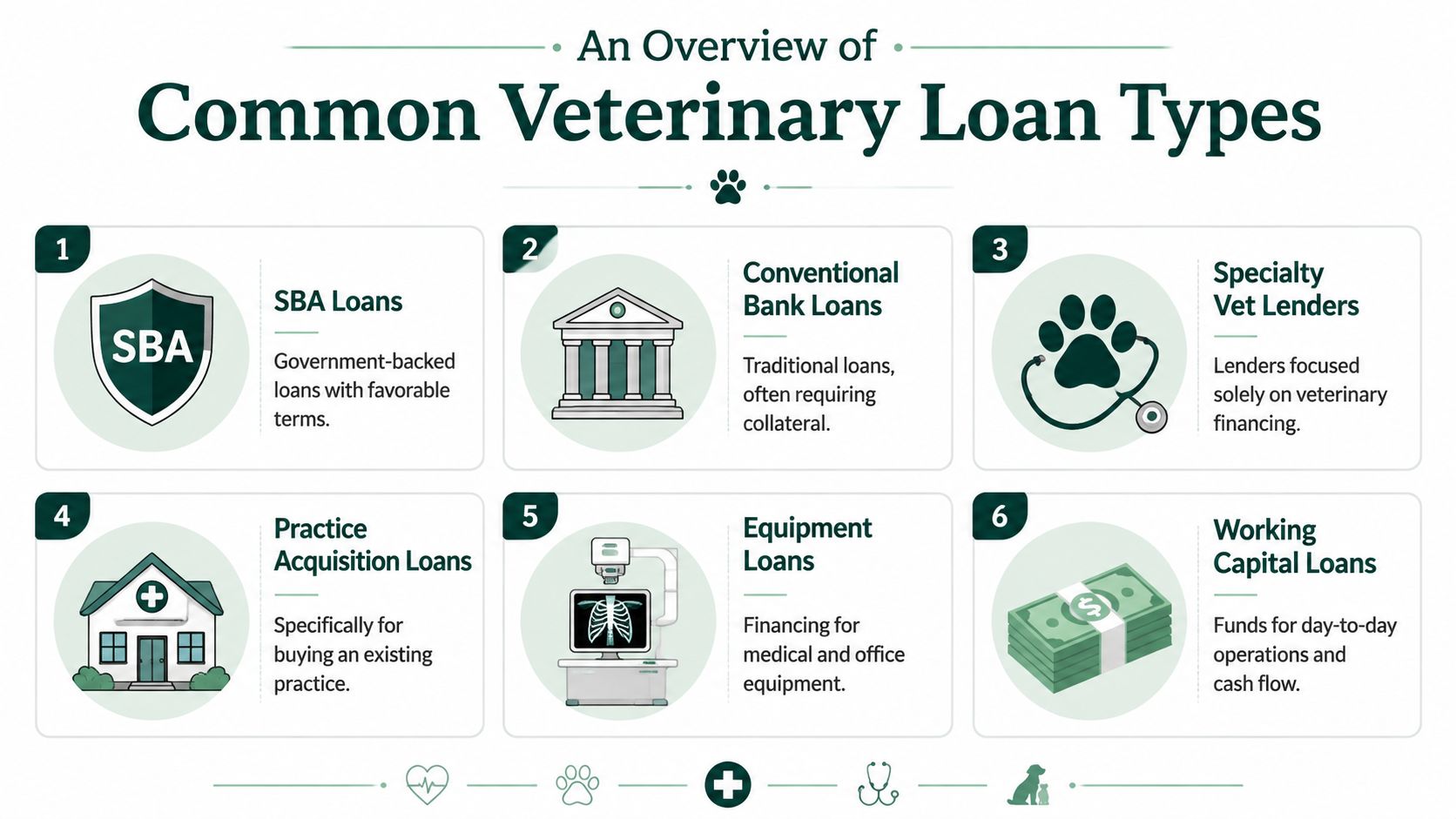
SBA loans are often used when the goal is an acquisition or a larger growth project, because lenders typically lean on business performance and repayment capacity when sizing the deal. Conventional bank loans can work well for established practices with strong records, but they often require more conservative underwriting and more direct collateral discussion.
Specialty vet lenders focus on practice financing and usually understand the rhythms of clinic cash flow better than a generalist lender. Practice acquisition loans are built for buying an existing clinic, which means they're evaluated with an eye toward the stability of the target business. Equipment loans make sense when the asset itself is the point of the borrowing. Working capital loans are better when the goal is payroll, supplies, temporary liquidity, or bridging a cash-flow gap.
If you want a broader starting point on the structures commonly used in this market, the internal guide on types of loans for veterinary practices is a useful companion piece.
Why lender type changes the comparison
Lender type matters because it changes the conversation around risk, documentation, and timing. A lender who specializes in veterinary financing may be more comfortable interpreting clinic-specific revenue patterns, while a traditional bank may be more focused on balance-sheet strength and collateral. That affects not just approval odds, but also how much debt you can take on without stressing the practice.
The practical takeaway is to eliminate mismatched options early. A strong borrower still benefits from choosing the right lane, because fewer unnecessary applications mean less time spent collecting documents and less risk of comparing offers that were never meant for the same business need.
Beyond the Interest Rate 9 Factors to Compare
The interest rate matters, but it's only one piece of the deal. A loan with a decent rate can still be expensive if the structure is rigid, the fees are layered, or the repayment schedule forces the clinic to absorb more monthly pressure than it should.
Compare the economics, not just the quote
Think of the rate as the entry point, not the verdict. A thorough comparison considers how the loan behaves over time, whether it gives the practice breathing room, and whether it preserves optionality if business conditions change. A loan can be “cheap” in a narrow sense and still be the wrong move if it creates a payment spike, restricts refinancing, or makes early payoff costly.
A vet loan should fit the clinic's cash cycle, not force the clinic to reshape itself around the lender's schedule.
The nine factors that deserve attention
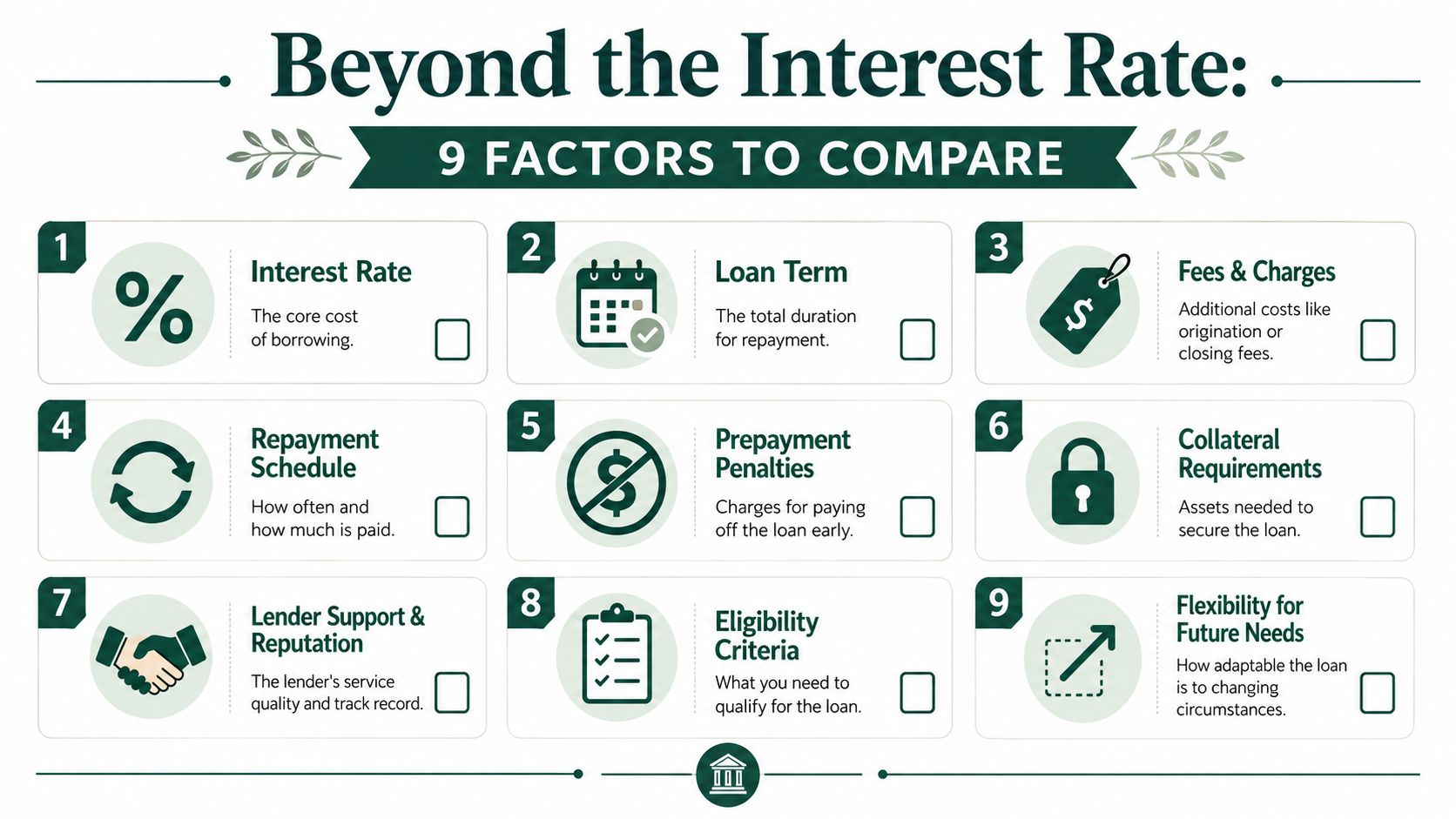
- Interest rate. This is the visible cost, but it's only the beginning.
- Loan term. A longer term usually reduces the monthly burden, but it can change the long-run cost profile.
- Fees and charges. Origination, servicing, and closing costs can move the total upward.
- Repayment schedule. Monthly timing, interest-only periods, or uneven payment structures can help or hurt liquidity.
- Prepayment penalties. If you plan to refinance or pay early, this clause matters a lot.
- Collateral requirements. The more assets pledged, the more risk sits on the practice's side.
- Covenants. Restrictive terms can limit borrowing, distributions, or other business decisions after funding.
- Lender support and reputation. Service quality matters when you need a waiver, clarification, or future modification.
- Flexibility for future needs. A good loan doesn't just solve today's problem, it leaves room for tomorrow's growth.
Cash-flow quality changes the answer
For acquisition, expansion, or renovation borrowing, lenders look hard at cash-flow stability and revenue quality, not just the headline rate. They review expense structure, revenue growth trends, future growth likelihood, and bottom-line cash flow, and they may also examine A/R aging, payer mix, and documents such as 3 years of financials, YTD results, projections, and a debt schedule to determine the maximum debt service and terms they can offer Today's Veterinary Practice on lending and capital funding.
That means a better offer on paper can lose out if the payment profile doesn't fit the clinic's operating reality. Comparing options side-by-side proves useful because it forces you to ask which lender is financing the business you operate, not the business you hope to have someday.
Bottom line: compare the full structure, then measure whether the monthly obligation fits the practice's real cash generation.
For rate-focused shopping, the internal page on veterinary practice loan rates can help you anchor the starting point before you compare the hidden parts.
What Lenders Look for in a Veterinary Practice
Underwriting is less about whether a veterinarian is competent and more about whether the practice can support added debt without destabilizing itself. That's why lenders zoom in on operating performance, historical trends, and the consistency of cash generation.

DSCR is the number that keeps showing up
One of the most important benchmarks is debt service coverage ratio, or DSCR. Veterinary lenders commonly look for at least 1.20x coverage, while SBA-oriented lenders often require about 1.25x coverage, meaning the practice must generate at least $1.20 to $1.25 of available income for every $1.00 of debt service OMNI practice loan underwriting guidance.
That number matters because lenders use cash-flow strength, not just credit score, to decide how much debt a clinic can safely take on. A strong DSCR doesn't guarantee approval, but weak coverage makes an otherwise attractive request much harder to underwrite. In practical terms, the borrower comparing offers should ask whether the payment works after the normal operating swings of the business, not just during its best month.
What else underwriters review
A lender isn't looking at one line on a spreadsheet. The underwriting review also emphasizes historical operating performance, expense structure, revenue growth trends, future growth likelihood, and bottom-line cash flow. Late vendor payments, defaults, and failed business-debt payments are negative indicators because they suggest the practice may already be stretched.
Clean books don't just improve approval odds, they make negotiation easier because the lender can see how the business actually behaves.
A clear file also helps the lender determine whether the requested debt matches the practice's capacity. For that reason, organized financial statements and a simple explanation of how the borrowed funds will be used matter more than many owners expect. If the lender has to guess, the deal gets harder to size and slower to close.
The internal overview of veterinary practice SBA loans can help borrowers understand how one common lending path fits within those underwriting expectations.
Putting It All Together Real-World Scenarios
Loan terms make more sense when they're attached to actual decisions. The same structure that works for one clinic can be a poor fit for another, because the money is solving a different problem.
The first-time buyer
A veterinarian buying an existing practice usually cares most about repayment stability, lender confidence, and the ability to close without unnecessary friction. The loan has to support ownership transition, preserve enough cash for early operating needs, and avoid a payment structure that becomes punishing if the first few months run slower than expected.
In that scenario, the best offer isn't necessarily the one with the lowest rate on the front page. It's the one that lines up with the acquired clinic's actual cash generation and gives the new owner room to settle in. If the seller's business has healthy, repeatable performance, the borrower can focus more on term, covenants, and closing certainty.
The established clinic upgrading equipment
An owner replacing old diagnostic or surgical equipment usually values speed, asset alignment, and limited disruption. The key question is whether the repayment schedule tracks the useful life and revenue contribution of the equipment closely enough to avoid straining the rest of the practice.
A heavy monthly obligation can be tolerable for a short stretch, but it becomes a problem if the device hasn't yet had time to earn its keep. A structure that fits the asset can leave the rest of the business healthier because it keeps operating cash available for payroll, maintenance, and inventory.
The growing practice managing uneven cash flow
A practice that needs working capital is usually solving a timing problem, not a buying problem. The owner may need flexibility to cover payroll, supplies, or temporary slowdowns without locking the clinic into debt that behaves like a long-term drag.
That's where covenants, fees, and draw rules matter more than many borrowers expect. A seemingly modest line of credit can become expensive if it carries relationship requirements or account minimums that don't fit the practice's banking style. For this use case, the winning loan is the one that protects liquidity without adding unnecessary operational friction.
An Actionable Checklist for Choosing Your Loan
Start with the documents, because incomplete files slow everything down and weaken your negotiating position. Gather recent financial statements, tax returns, projections if the deal is forward-looking, and a debt schedule if existing obligations are already in place.
Then compare the offer beyond rate. Ask these questions in order:
- What is the payment structure? Make sure the monthly obligation fits the clinic's cash cycle.
- What fees or extra costs are built in? Don't stop at the stated rate.
- Are there prepayment penalties or balloon features? These can reshape the actual cost later.
- What covenants apply after funding? Restrictions matter more than many owners expect.
- What collateral is required? Know what's exposed if the business underperforms.
- What performance did the lender use to size the deal? DSCR, historical cash flow, and revenue quality should all make sense together.
- What happens if your growth plan changes? Flexibility is part of the price.
If a loan only works when everything goes right, it probably isn't the right loan.
Finally, compare each offer against the clinic's actual goals. A good loan should support operations, not dominate them. If two proposals look close, choose the one that leaves more room for the practice to absorb surprises, invest later, and keep making decisions on business terms instead of lender terms.
Veterinary Practice Loans helps veterinary owners compare financing options for acquisitions, equipment, working capital, and expansion projects in one place. If you're weighing loan structures and want a clearer way to think about true borrowing cost and cash-flow fit, visit Veterinary Practice Loans to review options that match your clinic's next step.
