
You're probably in one of two places right now.
You're either an associate veterinarian staring at someone else's P&L for the first time, realizing ownership is possible but financially intimidating. Or you're already thinking like an owner, studying modern clinic models like Petfolk and asking the harder question: how do I finance this without making a bad deal that traps my future cash flow?
That's the core issue with Petfolk veterinary practice ownership loans. It isn't just about getting approved. It's about choosing a structure that fits veterinary economics, where the medicine is predictable, the staffing pressure is constant, and much of a clinic's value sits in goodwill rather than hard assets.
Most veterinarians are excellent clinicians before they're seasoned borrowers. That gap causes expensive mistakes. Buyers fixate on rate, ignore loan structure, underestimate working capital, and trust loose seller terms that would never survive real underwriting. Then they inherit a practice that looks profitable on paper but strains cash the minute payroll, inventory, and debt payments collide.
Ownership still makes sense. You just need to finance it like an operator, not like a first-time borrower hoping the lender will protect you.
From Associate to Owner The Dream and the Financial Reality
A veterinarian spends years building the skills to diagnose, treat, lead technicians, and earn client trust. Then the real ownership moment arrives. A seller is ready to exit, the numbers hit your inbox, and you realize the hard part is no longer medicine. It is structuring the deal well enough to protect your future cash flow.
That shift catches many associates off guard.
Buying a practice usually means borrowing against far more than equipment and leasehold improvements. In veterinary medicine, a large share of the price is goodwill. You are paying for active clients, referral habits, team continuity, online reputation, and the fact that the phones already ring. That is why veterinary acquisition loans matter so much for first-time buyers. They are built for transactions where the business value sits largely in earnings and transferability, not hard collateral.
The financial reality is simple. A good clinic can support debt. A poorly structured deal can still crush the owner.
That is the part many buyers miss. They focus on getting approved and stop asking better questions. How much of the purchase price is goodwill? How much cash needs to stay in the business after closing? What happens if payroll rises before revenue does? If the answer is owner financing, earnout language, or a thin working capital cushion, you need to slow down and fix the structure before you sign.
Why smart buyers feel stuck
Capable associates do not get stuck because they lack ambition. They get stuck because practice finance is full of bad shortcuts dressed up as flexibility.
Seller financing is the best example. It can help in the right deal, but buyers often accept it without enough scrutiny because it feels personal and convenient. That is a mistake. Poorly drafted seller notes can create repayment spikes, vague default terms, and misaligned incentives once the seller is gone from day-to-day operations. If the senior debt, seller debt, and working capital plan do not fit together, the clinic starts life under pressure.
The same problem shows up in goodwill financing. Buyers are often comfortable valuing equipment and exam rooms. They are less comfortable borrowing for client retention and recurring revenue, even though that is where much of the true value sits. Lenders who understand veterinary transactions underwrite that reality. Buyers should too.
Ownership changes how you think. You stop looking only at compensation and schedule. You start looking at debt service coverage, post-close liquidity, staffing risk, and whether the practice can produce enough free cash flow after payroll, rent, inventory, and taxes.
That is the financial reality. The dream still works. You just need a deal structure that respects how veterinary clinics earn, spend, and absorb risk.
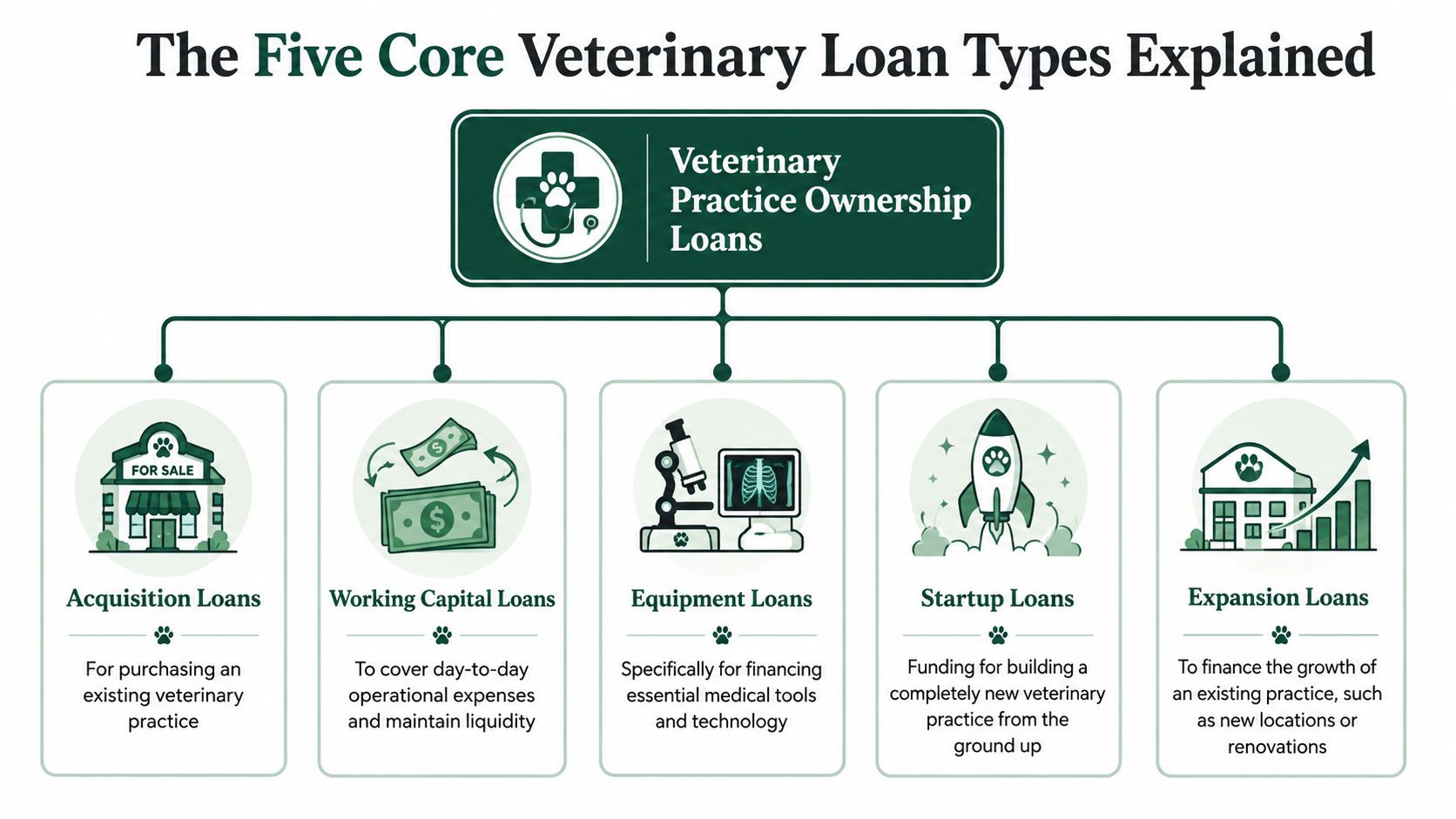
The Five Core Veterinary Loan Types Explained
One bad financing decision can turn a healthy clinic into a cash flow problem on day one. The fix is simple. Match each loan to the job it is supposed to do.
Buyers get into trouble when they treat all debt like one interchangeable bucket. It is not. A loan used to buy goodwill should not be structured the same way as a loan used to replace radiology equipment or cover payroll during a transition.
If you're considering equipment financing for veterinary practices, keep that decision separate from a full ownership transfer. The underwriting, collateral, and repayment logic are different.
Acquisition loans
Acquisition loans fund ownership transfers. That includes buying a full clinic, purchasing a partner's shares, or acquiring another location.
This is the loan category that matters most for first-time buyers because it has to carry more than furniture and equipment. It often has to finance goodwill, which is where many veterinary deals are won or lost. If your financing structure does not properly account for the earnings power of the client base, the doctors, and the existing referral patterns, you are not solving the actual transaction.
Use this when:
- You're buying an existing practice and need financing tied to the total purchase price
- You're buying out a partner and need documented terms instead of an informal side agreement
- You're acquiring a second clinic and want debt built around the transfer of a business, not monthly operating expenses
Working capital loans
Working capital protects the practice after closing.
That matters more than buyers want to admit. Ownership changes your cash timing immediately. Payroll, inventory, software subscriptions, vendor terms, and tax deposits do not wait for a smooth transition. If you spend every available dollar on the purchase and leave no cushion, you create pressure where there should be flexibility.
Use this when:
- Cash reserves will be tight after closing
- The clinic needs extra inventory or staffing support during the handoff
- You want a reserve for transition hiccups instead of relying on credit cards or late vendor payments
Equipment loans
Equipment loans fund specific assets. Keep them focused.
That means imaging systems, lab analyzers, dental units, surgical equipment, or major technology upgrades. The strength of this loan type is simple. The repayment period can be matched to the useful life of the asset, which is far cleaner than stuffing every upgrade into the main acquisition note.
As noted in a veterinary equipment financing overview, practices often pair an acquisition loan with a separate equipment facility when post-close upgrades are needed. That approach usually gives owners better visibility into what the asset costs, how long it should be financed, and whether the purchase is producing a return.
Practical rule: Finance business value with acquisition debt. Finance hard assets with equipment debt. Do not blur the two unless the structure clearly improves cash flow.
Startup loans
Startup loans are for veterinarians building from zero. No inherited client base. No transferred revenue. No proven cash flow.
That makes this the hardest loan to underwrite well and the easiest to underestimate. You are funding leasehold improvements, equipment, technology, opening inventory, hiring, marketing, and the months it takes to build a stable appointment base. A weak startup budget does not fail because the medicine is bad. It fails because the ramp was too optimistic and the cash reserve was too thin.
Use this when:
- You're opening a brand-new clinic
- You need funds for build-out, launch costs, and early operating losses
- Your business plan depends on a realistic ramp, not immediate production
Expansion loans
Expansion loans fund growth inside an existing business. That can mean a renovation, added exam rooms, a relocation, a satellite office, or new service lines.
Good expansion debt solves a specific constraint. More capacity, better workflow, stronger margins, or access to unmet demand. Bad expansion debt usually starts with a vague growth story and ends with fixed payments that arrived before the revenue did.
Use this when:
- Your current space limits appointments or service mix
- A project has a clear revenue or efficiency case
- You're growing a clinic that already shows consistent performance
Here is the clean way to separate the five loan types:
| Loan type | Best use |
|---|---|
| Acquisition | Buying ownership in an existing practice |
| Working capital | Protecting liquidity and covering post-close operating pressure |
| Equipment | Financing specific clinical assets and technology |
| Startup | Opening a new clinic and funding the ramp-up period |
| Expansion | Growing an existing practice with a defined business case |
Decoding Your Financing Options SBA vs Conventional Loans
You agree on a purchase price, review the tax returns, and feel ready to buy. Then the financing structure exposes a key issue. You are not just borrowing against tables, computers, and X-ray units. You are borrowing against goodwill, and that is where many veterinary deals are won or lost.
Goodwill is the economic engine in an established clinic. It is the client base that comes back every year, the appointment demand already in place, the referral relationships, and the local reputation that keeps the schedule full. If your loan structure does not fund that value properly, the deal starts with a hole in it.
Why SBA 7(a) usually wins
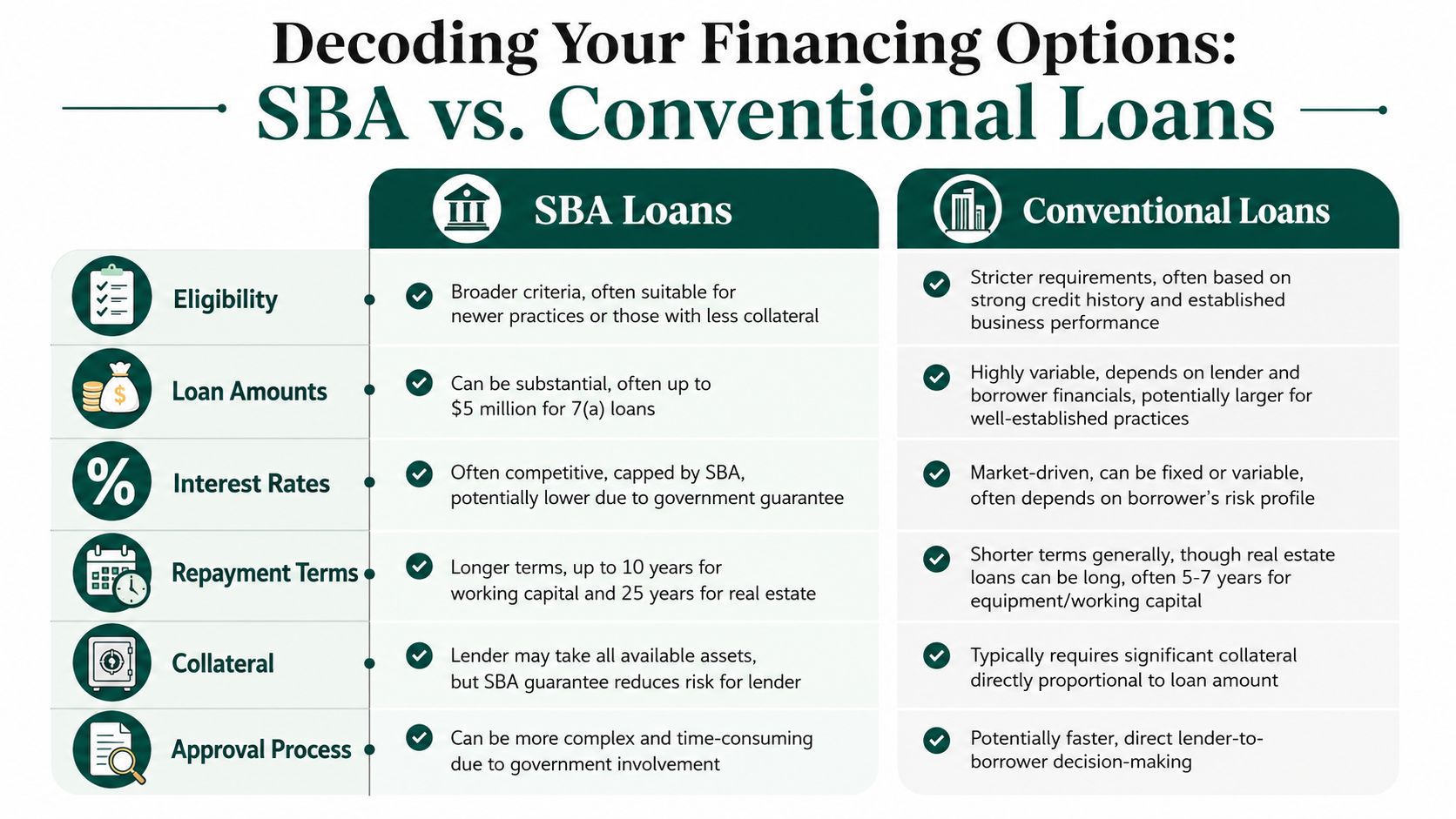
For a full practice acquisition, SBA 7(a) is usually the right first option because it can finance goodwill. Conventional bank loans often prefer harder collateral such as real estate and equipment. That difference matters more than the interest rate debate buyers tend to fixate on.
A veterinary acquisition loan analysis notes that goodwill often makes up the majority of a practice purchase price. The same analysis explains that SBA 7(a) is commonly used for acquisitions because it can cover that intangible value, while conventional structures often limit or exclude it. It also notes that SBA loans can support larger acquisition amounts, longer repayment terms depending on the collateral mix, and lender requirements such as a lien on business assets and a personal guarantee.
That is the strategic decision. If the lender will not fund goodwill, you must cover that gap with more cash, more collateral, or a second layer of financing. First-time buyers rarely benefit from any of those options.
Conventional loans still fit some deals
Conventional debt works best when the transaction is asset-heavy and the borrower is financially stronger.
If the deal includes a large real estate component, substantial equipment value, or a buyer with significant liquidity, a conventional bank may offer a cleaner path. Approval can be faster. Documentation can be lighter. Those are real advantages. They just do not solve a goodwill-heavy purchase by themselves.
Use the structure that matches the deal, not the one that sounds simpler.
| Feature | SBA 7(a) Loan | Conventional Bank Loan |
|---|---|---|
| Goodwill financing | Commonly part of the structure | Often restricted |
| Down payment pressure | Usually lower | Usually higher |
| Timeline | More paperwork and often slower | Often faster |
| Best fit | Full practice purchase with meaningful intangible value | Asset-heavy transactions and borrowers with stronger liquidity |
Owner financing is where buyers get hurt
Seller financing can help close a gap, but it should rarely be the foundation of the deal.
The risk is not just the interest rate. The risk is structure. A poorly drafted owner-financed note can saddle the buyer with short repayment terms, weak transition obligations, vague performance assumptions, or payment schedules that ignore the clinic's actual cash flow after closing. That is how a deal that looked flexible becomes expensive and unstable.
Institutional underwriting forces discipline. Seller paper often does not. If owner financing is part of the plan, keep it limited, document every transition obligation, and test the repayment schedule against realistic post-close cash flow, not the seller's best-case story.
If the deal only works because the repayment terms are optimistic, the deal does not work.
My recommendation for Petfolk veterinary practice ownership loans
Start with the purchase price composition. Separate hard assets from goodwill before you spend time comparing lenders.
If goodwill drives the valuation, SBA 7(a) should be your primary path. If the deal is heavily supported by real estate or equipment and you bring strong liquidity, conventional debt is worth testing. If seller financing appears in the structure, treat it as a supplement, not a shortcut.
The right loan does one job well. It funds the underlying financial structure of the practice and leaves enough cash flow after closing to run the clinic without constant pressure.
What Lenders Look for in a Veterinary Practice
You find a clinic that looks perfect on paper. Solid revenue, loyal clients, a fair location, and a seller who insists the practice “has always done well.” The lender ignores the sales pitch and goes straight to the file. That is the right approach, and you should do the same before you ever submit an application.
Lenders approve veterinary practice acquisitions based on one question. Will this clinic produce enough dependable cash flow to cover debt, pay the team, replace equipment, absorb normal surprises, and still leave you breathing room?
Your clinical skill matters. Your personal credit matters. But the practice itself carries the case.
The documents that drive the decision
Underwriting starts with records. A veterinary lending documentation guide shows the usual first request set includes recent business bank statements, business tax returns, a current profit and loss statement, personal financial information, and credit history.
That document list is not paperwork for paperwork's sake. Each item answers a specific risk question.
- Bank statements show whether collections are steady and whether cash is consistent with P&L statements.
- Tax returns test whether reported earnings hold up over time.
- Current P&L statements show whether the practice is still performing now, not just last year.
- Personal credit and liquidity show whether you manage obligations well and can absorb a rough start after closing.
If a seller gives you polished summary numbers but drags their feet on source documents, slow down. Lenders do.
Cash flow matters more than the story
Veterinary practices are attractive to lenders because demand tends to repeat. Clients come back for exams, vaccines, chronic care, dental work, surgery, and pharmacy purchases. That recurring revenue helps. It does not excuse weak margins or sloppy operations.
A lender studies whether cash flow is durable after the transition. That means they are looking past headline revenue and asking harder questions. How much of production sits with the departing owner? Are associate doctors stable? Is staff payroll already stretched? Are inventory costs controlled? Is the clinic relying on one unusually strong year to justify a high goodwill number?
Many buyers often get too optimistic about goodwill. Goodwill is financeable if earnings support it. Goodwill becomes dangerous when buyers treat it as a belief system instead of an earnings-based asset. If the seller's relationships, personal production, or referral habits drive too much of the income, the lender will discount the file, and they should.
Good underwriting is simple. Verifiable earnings, normal add-backs, consistent collections, and a transition plan that does not depend on wishful thinking.
What gets a file approved faster
Clean files move. Messy files stall.
Before you apply, review the practice the way a credit officer will review it:
- Check deposit consistency. Sharp swings in collections need a real explanation.
- Pressure-test add-backs. Personal auto expense is one thing. Half the overhead is not.
- Look at doctor concentration. If the seller produces a disproportionate share of revenue, post-close cash flow may fall.
- Review margins, not just revenue. Strong top-line production with weak profitability is a debt problem waiting to happen.
- Confirm working capital needs. Clinics do not run on goodwill alone. You need cash for payroll, drugs, and the first months of ownership.
That last point gets missed all the time. Buyers focus on getting the acquisition approved and forget that the clinic needs liquidity on day one. A deal can close and still be poorly structured.
My advice to future owners
Do not ask, “Will a lender approve this practice?” Ask, “Should this practice be financed at this price, with this much goodwill, under this transition plan?”
That is the sharper question.
A lender wants a clinic with stable earnings and manageable risk. You should want the same thing, but with even less tolerance for weak structure. If the file depends on aggressive add-backs, thin cash reserves, or an owner-financed patch over a weak operating picture, step back and rework the deal. The best veterinary loans support ownership. They do not force you to spend the first three years defending a bad purchase.
The Step-by-Step Loan Application and Funding Timeline
You sign a letter of intent on a clinic that looks profitable, the seller wants a quick close, and your lender says the deal is workable. That does not mean you are weeks away from ownership. It means the intensive work starts now.
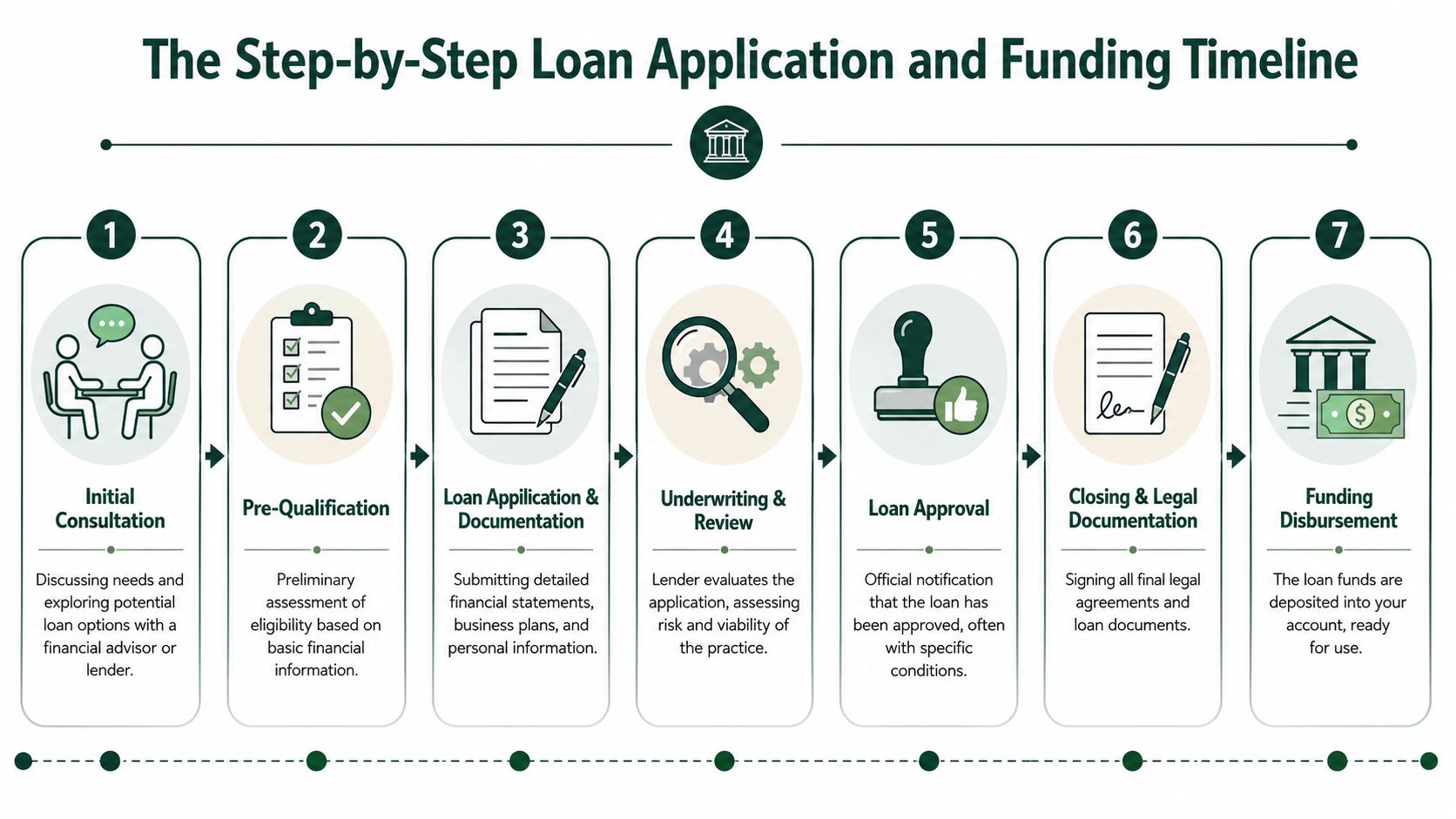
Veterinary acquisitions usually follow a predictable sequence, but the timeline changes based on loan type, deal complexity, and how clean the file is. Conventional loans often move faster than SBA loans. SBA loans usually ask for more documentation and more back-and-forth before funding. If you need context on how lenders price these deals while you build your timeline, review these current veterinary practice loan rates.
The practical rule is simple. Start early, expect conditions, and assume goodwill-heavy deals will get more scrutiny than buyers expect.
How the process actually moves
Most practice purchases go through the same seven stages:
Intro call and deal screen
The lender looks at the purchase price, your background, the clinic's earnings, and the rough structure. This step should answer one question fast. Is this a financeable deal, or does the structure need work before a full application?Pre-qualification
You provide basic personal and practice information. A good pre-qual review should flag obvious problems early, especially thin liquidity, weak debt coverage, or a price that depends too heavily on goodwill without enough cash flow support.Full application
At this stage, speed starts to separate prepared buyers from frustrated buyers. Tax returns, personal financial statements, production history, and deal documents need to match. If they do not, underwriting slows down.Underwriting
The lender tests repayment strength, collateral, buyer experience, and transition risk. In a veterinary acquisition, underwriting is not just about equipment and real estate. It is about whether the clinic can carry debt tied to goodwill after the seller leaves.
A useful walkthrough sits below if you want a visual explanation of how lenders and borrowers move through the process.
The stages that stall deals
Buyers rarely get stuck at the first call. They get stuck after the lender says yes in principle.
- Conditional approval means the lender is interested, but the file is still incomplete. Expect requests for updated bank statements, insurance, entity documents, lease details, and final purchase terms.
- Closing preparation is where legal and financial loose ends become expensive. Guarantees, liens, entity formation, insurance, landlord consents, and seller documents all need to line up.
- Funding happens after every condition is cleared. “Almost ready” does not fund a loan.
This is also where weak owner-financing structures create problems. If seller paper is vague, interest-only for too long, or subordinate in a way the bank does not like, it can delay approval or force a rewrite late in the process. Owner financing can help bridge a gap. It should not be used to hide an overpriced goodwill number.
What to gather before you apply
Prepare these items before you submit anything:
- Personal financial records such as tax returns and a current personal financial statement
- Practice financials including profit and loss statements, bank statements, and balance sheet information if available
- Deal documents such as the purchase agreement or letter of intent, business summary, and revenue breakdown
- Explanations for adjustments covering add-backs, unusual expenses, staffing changes, or doctor production shifts
- Legal and entity documents including formation records, lease information, and closing paperwork
One blunt truth. Documentation problems are usually borrower problems.
A clean package does more than save time. It gives the lender fewer reasons to question the price, the goodwill allocation, or your ability to manage the clinic after closing. That matters, because the best loan timeline is not the fastest one. It is the one that gets the right deal funded without forcing you into bad structure at the last minute.
Understanding Loan Costs Terms and Repayment Scenarios
You close on a clinic, take over payroll, order inventory, and then the first loan payment hits harder than expected. That is how bad loan structure shows up in real life. Ownership does not break because of the headline rate alone. It breaks because the repayment terms were wrong for the asset you financed, especially when too much goodwill is stuffed into a weak structure.
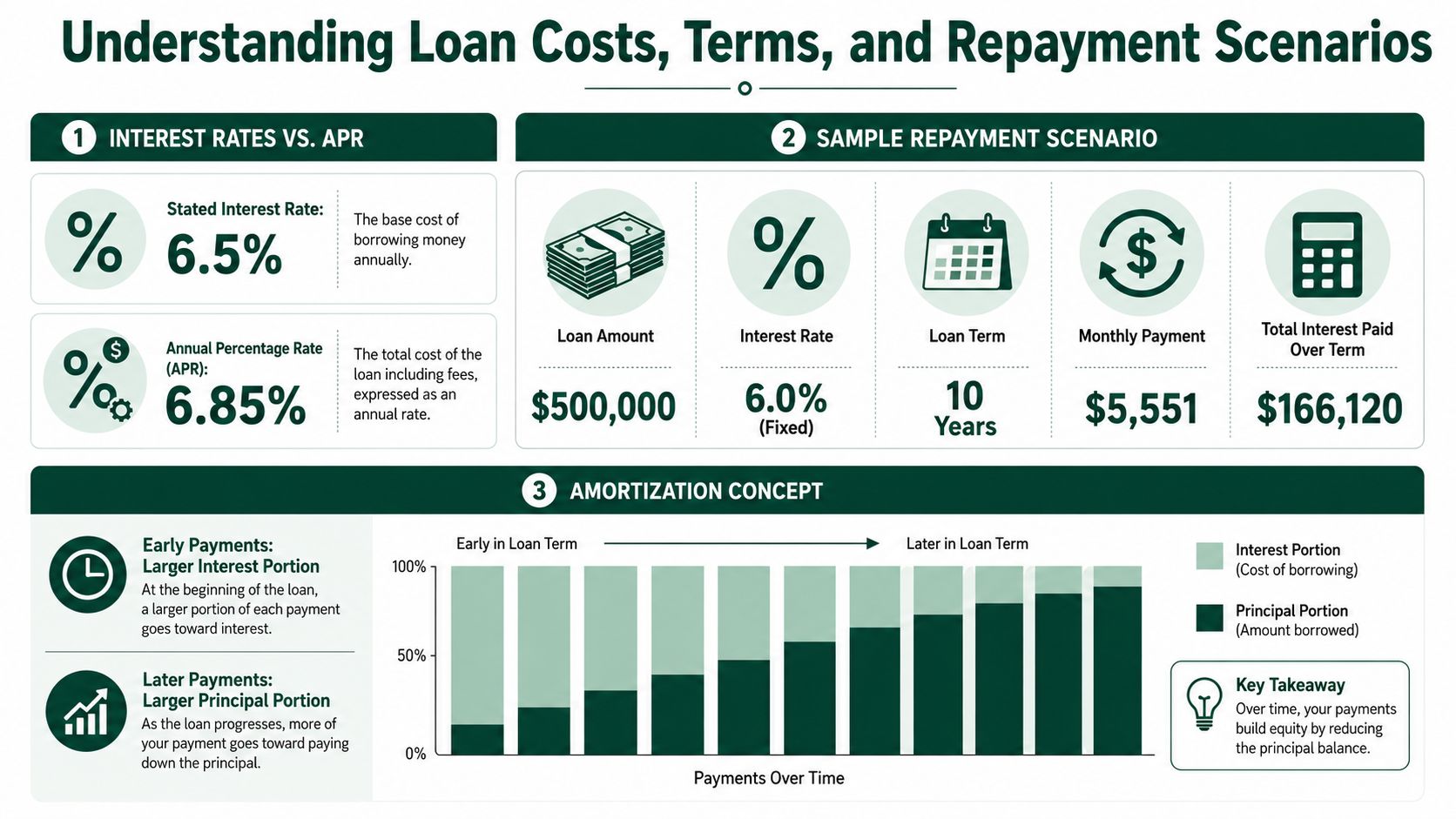
Veterinary acquisition loans usually land in a fairly wide pricing range, and alternative short-term capital usually costs more. A veterinary practice financing market overview shows that pricing, amortization, and repayment structure can vary enough to change the deal completely. That is why buyers should review current veterinary practice loan rates for context, then underwrite the monthly payment against the clinic's actual cash cycle.
The terms that deserve your attention
Four terms drive the risk:
- Interest rate tells you the base cost of the money.
- APR captures a broader annualized borrowing cost, including certain fees.
- Amortization determines how long the balance is spread for payment purposes.
- Term tells you when the lender expects the debt repaid or refinanced.
Buyers get in trouble by treating those words like paperwork. They are operating decisions. A loan with an acceptable rate can still strain the practice if the amortization is too short, the payment steps up too quickly, or the structure forces goodwill to amortize on a schedule the clinic cannot support.
Scenario one: financing a goodwill-heavy acquisition
This is the main event in veterinary ownership. You are usually not buying real estate or hard assets alone. You are buying patient demand, doctor production, client retention, referral patterns, and team stability. In plain terms, you are financing goodwill.
That means the monthly payment must fit the earning power of an intangible asset that only holds value if the clinic performs after closing. If the debt service leaves no room for slower collections, a doctor departure, or a temporary drop in visits during transition, the loan is too tight. Approval does not make it safe.
Use a simple screen before you accept terms:
| Test | What you want to see |
|---|---|
| Owner pay after closing | Enough to live on without draining the practice |
| Debt service coverage | Clear cushion, not a razor-thin pass |
| Working capital after close | Cash left for payroll, inventory, repairs, and normal surprises |
| Goodwill support | Earnings strong enough to justify the price and payment |
Scenario two: mixing acquisition debt with post-close upgrades
A lot of buyers roll every need into one pile because it feels easier. It usually is not smarter.
If you are buying a clinic and also planning a radiology upgrade, new dental equipment, or software conversion, separate the uses of funds when possible. Acquisition debt should handle the ownership transfer. Equipment debt should match equipment life. That keeps your repayment schedule cleaner and protects cash in the first year, when transition risk is highest.
This matters even more in deals where goodwill already makes up most of the purchase price. Long-term acquisition debt has a job. It should not also carry every post-close project that the seller postponed.
Scenario three: owner financing that looks flexible but creates risk
Owner financing can help bridge a valuation gap or solve a specific structuring issue. It should not become the default answer for financing overpriced goodwill.
Here is the problem. Seller paper often comes with loose documentation, odd repayment triggers, short balloons, or interest-only periods that delay the pain rather than reducing it. That may help the deal close. It does not help the buyer operate the clinic. If bank debt and seller debt hit the income statement at the wrong time, cash gets squeezed fast.
I advise buyers to treat owner financing as a support layer, not the foundation. If a deal only works because the seller is carrying weakly structured paper behind the bank, revisit the price and the goodwill assumptions.
A good repayment schedule supports the clinic through average months, not just strong ones.
My advice on cost discipline
Do not judge a loan by rate alone. Judge it by what it leaves your practice able to do after closing.
Ask these questions before you sign:
| Question | Why it matters |
|---|---|
| Does the repayment period match what you are financing? | Goodwill, equipment, and working capital should not all be forced into the same logic |
| Can the clinic carry the payment during a soft production month? | Veterinary revenue is steady over time, but it is not flat every week |
| How much cash is left after closing? | Low liquidity turns normal operating issues into borrowing problems |
| Is seller paper helping the structure or hiding a pricing problem? | Poor owner financing often masks unsupported goodwill |
| Are you solving a long-term need with short-term debt? | High payments create pressure immediately |
The best loan is the one that lets you run the hospital well, keep staff paid, handle ordinary volatility, and still build equity. That is the standard.
Your Path to Practice Ownership and Smart Financing
You close on a clinic on Friday. Monday morning, payroll hits, a dental unit needs repair, and collections come in lighter than expected. That is the definitive test of a loan structure. Ownership works when the debt fits the clinic after closing, not just the purchase agreement at signing.
Treat financing as part of the acquisition strategy, not an administrative step. In veterinary deals, the hard part is usually goodwill. That is where buyers overpay, lenders get cautious, and weak structures start to look attractive. If you do not address goodwill directly, you can end up using seller paper to cover a pricing gap instead of building a sound capital stack.
The smartest moves to make now
Start with four decisions that improve your odds immediately:
- Match the loan to what you are purchasing. Goodwill should be financed with a structure built for intangible value and longer repayment pressure, not squeezed into terms better suited for equipment or short-term needs.
- Pressure-test the clinic before the bank does. Review revenue quality, doctor production, client retention, payroll load, and cash left after closing. A practice can look profitable on paper and still be tight on cash in ordinary months.
- Build your file early and build it clean. Organized financials, tax returns, production data, and a clear transition plan give you speed and negotiating power.
- Treat owner financing with caution. Seller notes can help a deal, but they often hide unsupported goodwill, weak repayment design, or a price the bank would not fully support.
That last point matters more than many buyers realize. Owner financing is often presented as flexible because it helps bridge valuation gaps. In practice, it can leave the buyer carrying layered debt with weak protections and bad timing on repayments. Use seller financing as a support piece only when the bank structure is already sound and the purchase price is defensible.
The bottom line on Petfolk veterinary practice ownership loans
Petfolk veterinary practice ownership loans should give you room to operate well after the transaction closes. You need enough liquidity to absorb normal variability, enough term to keep payments reasonable, and a structure that respects how a veterinary hospital generates cash.
Do not chase approval alone. Chase a deal that still looks smart in an average month, with real payroll, real inventory costs, and real staffing pressure.
Protect post-close cash flow first. That is how ownership becomes an asset instead of a strain.
Ownership remains one of the strongest ways for a veterinarian to build equity and control their career. The winners are not the buyers who accept the fastest money. They are the buyers who finance goodwill correctly, reject poorly structured seller debt, and close with a plan they can live with for years.
If you're ready to evaluate acquisition, equipment, startup, expansion, or working capital options, Veterinary Practice Loans offers veterinary-specific financing guidance built around how clinics operate. Reach out to discuss your goals, compare structures in plain English, and find a loan strategy that fits your practice instead of forcing your practice to fit the debt.
