
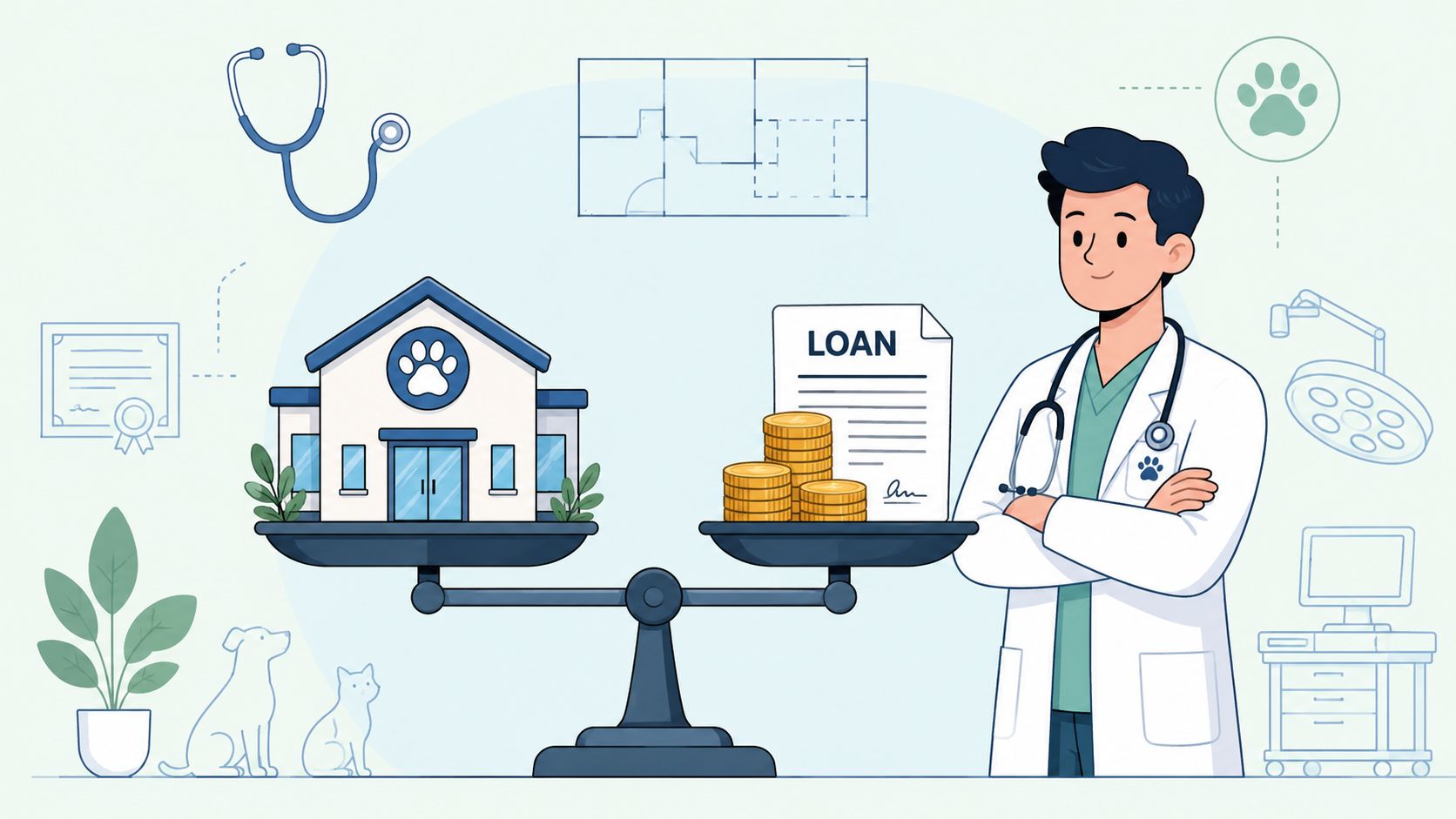
You're in a common spot if you're a veterinarian with a real decision in front of you, not a hypothetical one. Maybe you're buying a practice with a heavy goodwill component, opening your first clinic, replacing equipment that can't wait, or trying to keep payroll calm through a weak month. The wrong loan makes all of that harder. The right one matches the situation, the timing, and the amount of risk you can carry.
Professional practice loans for veterinarians should be judged by fit, not by the largest number a lender is willing to print on an offer sheet. That's especially true in a profession where practice purchases often lean on goodwill, and where cash flow, staffing, inventory, and build-out timing matter as much as the asset itself. A loan that looks flexible on paper can become a burden if it ignores ramp-up risk, while a structure that looks conservative can be exactly what keeps a clinic alive through the first year.
What Determines the Right Veterinary Practice Loan
A buyer sits across the table from a lender with two very different questions in mind. One is, can I get approved? The other is, can I live with this debt once the clinic owns it? Those are not the same question, and veterinarians get hurt when they treat them as if they are.
The deal type matters more than the product name
Buying an existing clinic is not the same as starting from zero. A practice acquisition usually carries goodwill, historic revenue, and a going-concern value that matters as much as equipment or leasehold improvements. Historical practice lending through SBA 7(a) became important because it could finance acquisitions, goodwill, equipment, build-outs, and working capital with loans up to $5 million, and underwriting could lean on cash flow rather than only hard collateral. In that same sector, goodwill can represent 70% to 90% of a change-of-ownership valuation, which is exactly why a lender has to understand the business, not just the balance sheet. Source data on veterinary practice lending
A startup is a different animal. You are funding a concept, a location, a build-out, and a ramp period before the books settle. Expansion sits between those two, because the clinic already has history, but the new debt still has to be serviced before the new rooms or satellite site fully earn their keep.
Practical rule: if the money is paying for a clinic that has not stabilized yet, the payment schedule needs to be conservative enough to survive slower-than-expected volume.
Stop asking only what you can borrow
The better question is what the clinic can service without starving payroll or inventory. That is where a lot of veterinarians get tripped up by marketing that celebrates maximum financing and ignores the operating reality. If the repayment plan leaves no room for a late receivable cycle, a seasonal dip, or a new hire who takes longer to produce, the loan is too aggressive.
That is why the rest of this guide is organized around actual clinic situations. Acquisition, startup, equipment, expansion, and short-term liquidity all point to different debt structures. Treat the transaction first, then the loan.
Five Loan Types Every Veterinarian Should Understand
A clinic owner who calls every financing request “a loan” ends up comparing the wrong things. The better move is to match the debt to the job it has to do, because buying a practice, replacing a dental unit, and covering a payroll gap create very different repayment pressures.
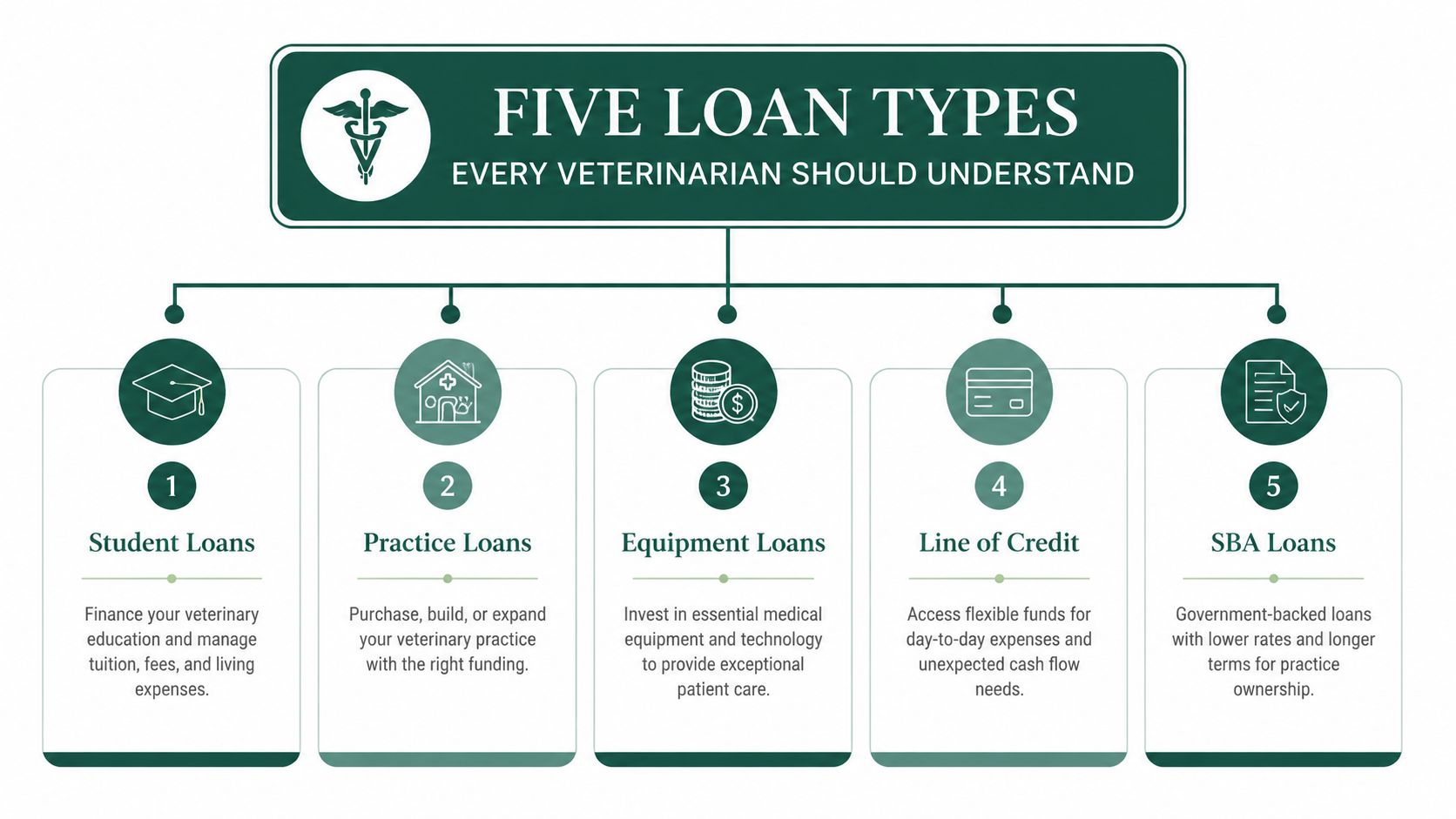
1. Acquisition financing
Use this structure to buy an existing practice, buy into ownership, or purchase a partner's share. The lender is looking at enterprise value, cash flow, and goodwill, not only hard assets. For larger transactions, SBA-backed financing can reach $5 million and is commonly used when the deal includes the clinic itself, not just a single piece of equipment.
2. Equipment financing
Use this for a specific purchase such as imaging, surgical, laboratory, or IT equipment. The debt should match the useful life of the asset, because paying off a machine long after it has stopped supporting revenue is poor allocation of cash. This works best when the purchase is discrete and the equipment improves efficiency or production in a clear way. Veterinary practice loan use cases
3. Working capital lines
Use this for payroll, inventory, and other short-term operating needs. Working capital guidance for veterinary practices says these lines are often less than $200,000, and they are usually revolving, so you draw only what you need and pay interest only on the balance. They fit cash-flow gaps, not long-term projects. Working capital guidance for veterinary practices
4. Startup funding
A de novo clinic needs money for build-out, first hires, equipment, inventory, and the slow climb to steady utilization. Early revenue usually looks better on a spreadsheet than it does in the first months of operations, and cash gets tied up before the schedule fills. Startup funding should be large enough to survive the ramp, not merely to open the doors. A professional infographic titled Five Loan Types Every Veterinarian Should Understand outlining financing options for veterinary practices.
5. Expansion and build-out loans
Use this category for remodels, added exam rooms, relocations, satellite sites, and major upgrades. These loans also show up when a clinic is starting, buying, improving, building out, buying into, or funding operating expenditures, which is why the structure has to fit the project, not just the headline amount. Veterinary practice financing guidance
SBA vs Conventional vs Alternative Lenders Compared
A veterinarian choosing financing is really choosing how much debt the clinic can carry while it is still proving itself. The wrong structure can squeeze cash flow in the exact months when a purchase, startup, or expansion needs breathing room. That is why rate alone is a poor decision rule. Structure sets the repayment pressure, not just the monthly bill.
| Channel | Typical Max Size | Term Range | Speed to Fund | Underwriting Focus |
|---|---|---|---|---|
| SBA 7(a) | Up to $5 million | Up to 10 years for the business portion, up to 25 years when real estate is included | Slower than simple working-capital debt | Cash flow, going-concern value, acquisition structure, and collateral mix |
| Conventional bank loans | Varies by bank and deal size | Often matched to the asset or property | Usually moderate, depending on diligence | Financial statements, collateral, borrower history, and clinic performance |
| Alternative or specialty lenders | Usually smaller than large SBA-capacity deals, but can be flexible | Often shorter or more specialized | Usually faster | Current cash flow, recent deposits, liquidity, and transaction fit |
For acquisitions and de novo clinics, SBA 7(a) is usually the first structure to examine because it can package real estate, build-out, equipment, working capital, and soft costs in one facility. Independent guidance also notes that pricing is tied to prime plus a spread, which gives the borrower more protection against rate shocks than many private variable-rate structures. SBA financing details for veterinary practices
Lenders are willing to do that because veterinary practices have historically performed well as borrowers. Veterinary-services SBA 7(a) loans have been observed at roughly 4.1% charge-off on a resolved-loan basis versus about 15.4% across all industries, which is a strong signal that the sector has been viewed as comparatively resilient. Historical veterinary SBA charge-off data
Conventional bank debt fits best when the clinic already has clean financials, collateral that supports the request, and a transaction that does not need SBA-style packaging. It is often a better fit for a straightforward asset purchase or an established operation with stable numbers. Alternative or specialty lenders make sense when speed matters more than the lowest administrative friction, or when the deal has enough quirks that a plain-vanilla bank file would slow everything down. None of those channels wins by default. The right choice is the one that matches the size of the deal and the stress the clinic can absorb while revenue ramps.
Bottom line: for a large, goodwill-heavy, time-sensitive transaction, start with SBA. For a smaller, cleaner need, a simpler bank or specialty structure can be the better move.
How Lenders Underwrite a Veterinary Practice Specifically
A lender does not underwrite a veterinary clinic the way it underwrites a generic storefront. It has to judge whether the practice can keep producing cash after ownership changes, staffing shifts, and the normal churn of a real clinic.
Goodwill and going concern matter
That is the central difference. In a practice sale, the lender is often financing a business that already has clients, staff, referral patterns, recurring demand, and a revenue base that equipment alone never captures. As noted earlier, a large share of a change-of-ownership valuation can sit in goodwill, so underwriters focus on going-concern value and cash flow, not just what could be sold off in a liquidation. Veterinary practice valuation and lending context
A lender will want to see how the clinic earns. That means revenue trends, deposit behavior, payer mix for specialty or large-animal work, debt service capacity, and whether the books show collections that hold together over time. If the clinic depends on a few volatile income sources, the underwriter notices fast.
Cash flow beats cosmetics
A polished profit and loss statement means little if collections are weak. Bank statements, receivable behavior, and steady deposits show whether the clinic can produce the cash needed for debt service. Working capital lines are often asset-based for that reason, because the lender wants a quick read on liquidity and draw capacity, not a long story about future growth.
If you want a straight answer from a lender, bring straight books. Clean monthly financials, clear expense categories, and a story that matches the numbers matter more than a polished pitch deck.
If the file does not explain how the practice converts appointments into cash, the lender will fill in the blanks with caution.
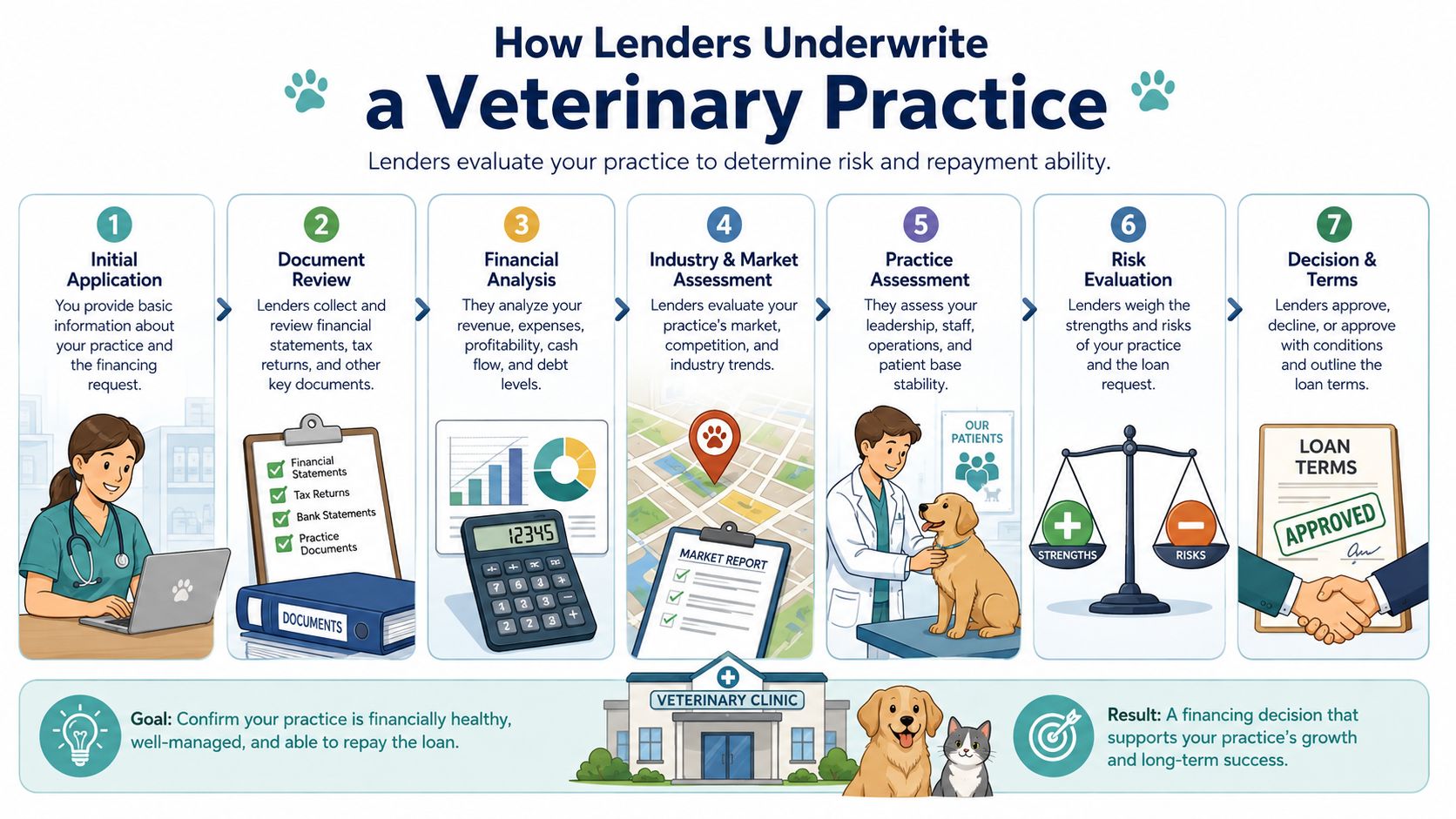
What the underwriter is really looking for
- Stable revenue: Not just growth, but consistency that can support a payment.
- Healthy deposits: Bank activity that matches the clinic's reported income.
- Realistic collateral: Enough support to reduce lender risk, even when goodwill is a big part of the transaction.
- Debt service capacity: A business that can pay the loan without starving operations.
- Clear ownership structure: Especially in partner buy-ins or partial transfers.
The more clearly the lender can see the clinic's performance, the more that performance can shape the decision. That matters for owners who run solid operations but do not have a perfect collateral package.
What to Gather Before You Apply
A good application is mostly preparation. The borrower who arrives organized often gets a better response than the borrower who asks a lender to help assemble the story from scratch.

For acquisitions
Bring the target clinic's financial statements, a valuation report, and a clear explanation of the ownership structure. If it's a partial buy-in, the lender needs to know exactly what changes and who stays involved. Without that, the file reads like uncertainty, and uncertainty slows decisions.
For equipment financing
Have the invoice, installation details, and anything that explains the asset's useful life. If software or setup costs are part of the purchase, decide up front whether they belong in the same request. Lenders like clean, documented equipment requests because the asset itself helps support the credit decision.
For working capital lines
Recent bank statements matter here. So does a simple cash flow projection that shows why the line is needed and how it gets repaid. If you're asking for a revolving facility, don't hand over a term-loan narrative.
For SBA-backed deals
Expect a longer prep window and assemble tax returns, a personal financial statement, projections for the combined entity, and the purchase or build-out package. That paperwork is not busywork. It gives the lender enough evidence to underwrite the transaction as a real business transition instead of a guess.
Best time-saver: complete documentation is often the difference between a quick decision and a drawn-out stall.
If you want a lender to move quickly, give them fewer reasons to ask follow-up questions. The cleanest files are usually the fastest files.
When Maximum Financing Becomes a Risk
A larger loan is not automatically the better loan. Too many veterinarians confuse access to capital with the ability to service debt, and that mistake gets expensive fast.
Debt service has to survive the ramp
A long-term SBA-backed loan can cover a big purchase price or a build-out, and real estate debt can stretch over a long repayment period. That sounds reassuring until the payment arrives every month, whether the clinic is full or still building volume. The structure works when the plan is stable. It becomes a problem when the practice is new, short-staffed, or still waiting for demand to catch up. SBA financing terms for veterinary practice acquisitions
The same logic applies to a revolving line. It can cover payroll, inventory, and timing gaps, but if the clinic keeps drawing on it without a real paydown path, it turns into costly oxygen. Veterinary working-capital line guidance
Use the stress test that lenders should be using
Take projected monthly debt service and compare it with projected steady-state EBITDA. Then ask what happens if the ramp is slower than planned or rates reset higher. If the clinic cannot absorb a bad quarter without cutting staff, skipping maintenance, or delaying inventory, the financing is too tight.
That is the test lenders often gloss over when they advertise maximum financing. They focus on what the market will support on paper, not on what the clinic can survive in a messy operating year. The worst plausible quarter matters more than the best projected year.
When to say no to more leverage
- Startup with unproven demand: If patient flow has not stabilized, borrowing to the ceiling is reckless.
- Expansion before operational readiness: More rooms do not help if staffing, scheduling, and inventory systems are not ready.
- Acquisition with fragile margins: Heavy debt can erase the benefit of buying an existing book of business.
- Cash-flow squeeze with no fix: A line of credit can bridge timing gaps, but it cannot rescue a broken operation.
Disciplined borrowing beats aggressive borrowing every time. A clinic that can breathe after debt service is in better shape than one that looks impressive on the application and panics in month seven.
Three Case Examples That Bring the Framework to Life
Dr. A is buying a two-doctor small animal practice with a meaningful goodwill component. SBA 7(a) financing fits because the debt structure matches the acquisition, and a small working capital line gives breathing room for the first payroll and inventory cycle after closing. The mistake would be taking only the largest possible term loan and ending up with no liquidity cushion when the transition gets messy.
Dr. B needs to replace an ultrasound unit and digital X-ray system. Equipment financing makes sense because the debt follows the assets, the paperwork is simple, and repayment lines up with the equipment's useful life. A larger general-purpose loan would be looser and more expensive over time.
Dr. C runs a multi-site group and is adding exam rooms plus a build-out. The cleaner structure blends SBA real-estate financing with conventional equipment debt, because the building work and the machines should not carry the same repayment terms. Stuffing everything into one oversized facility would leave the clinic hoping cash flow sorts itself out later, which is the wrong bet.
Choosing the Right Structure and Your Next Step
Map the situation to the structure. Acquisition, startup, expansion, equipment refresh, and cash-flow squeeze each point to a different primary loan type. If month-to-month volatility is real, add a working capital line on top, but only if the clinic can pay it down.
The federal side matters too. The USDA Veterinary Medicine Loan Repayment Program can change the math for rural buyers or veterinarians willing to serve shortage areas, because repayment incentives can affect what level of private debt makes sense. That decision shouldn't be made in a vacuum.

Gather the documents, run the stress test, and bring a complete package to two or three lenders, not just one. That turns the conversation into a comparison, which is where you regain control.
Veterinary Practice Loans works with veterinarians who need financing for acquisitions, startup clinics, equipment, working capital, and build-outs. If you're weighing professional practice loans for veterinarians and want a clearer read on structure and trade-offs, visit Veterinary Practice Loans and start with the kind of financing that fits your clinic instead of forcing your clinic to fit the loan.
