
You're in the chair with a lender term sheet in front of you, and the numbers don't quite make sense. The bank you've used for deposits for years is happy to talk about a small line of credit, but your actual need is bigger, messier, and tied to a practice that generates cash in very specific ways. That's where most owners get stuck, because the best bank for a veterinary practice loan depends on the deal, not on who smiles first on the phone.
Veterinary financing is not a generic small-business exercise. A clinic acquisition, a de novo startup, an MRI or dental suite upgrade, and a building purchase all point to different lenders, different structures, and different approval standards. The right choice can mean a cleaner term sheet, better repayment fit, and less wasted time chasing banks that were never going to touch your deal.
| Lender Category | Typical Deal Size | Best For | Typical Timeline | Key Trade-off |
|---|---|---|---|---|
| SBA-heavy specialty lenders | Larger acquisitions, startups, expansions | Complex veterinary deals that need structure | Often faster than a traditional bank once packaged | More documentation, more underwriting detail |
| Large national banks | Larger practice loans and broader healthcare lending | Owners who want scale and broad product menus | Slower unless you already have a relationship | Less tailored to veterinary operations |
| Regional and community banks | Mid-sized practice loans, local relationships | Owners who want a banker who knows the market | Moderate | Smaller balance sheet can limit ticket size |
| Conventional lenders | Straightforward term debt and lines | Established clinics with strong financials | Usually faster than SBA | Less flexibility on structure |
| Equipment-focused lenders | Smaller, asset-backed purchases | Imaging, dental, lab, and IT equipment | Fast | Best for equipment only, not full practice buyouts |
If you want the rate context before you call anyone, start with the rate guide at veterinary practice loan rates. It'll help you separate a fair offer from a lender using confusion as a sales tactic.
Why Choosing the Right Bank Matters for Your Veterinary Practice
The moment most owners realize their bank is the wrong fit is simple. They walk in asking about an acquisition or build-out, and the lender starts talking like the deal is a generic working-capital request. That is a bad sign, because a veterinary practice loan is not one product, it is a family of products that needs to match how the practice makes money.
The choice of bank affects more than the headline rate. It changes how much you can borrow, how the payments are structured, how much paper the underwriter demands, and whether the deal gets a yes at all. A lender that understands veterinary cash flow can look at practice revenue, goodwill, staffing ramp, and licensing timing without forcing everything into a one-size-fits-all small-business box.
Match the lender to the transaction
For a $200,000 equipment refresh, a broad lender or equipment-focused lender may be enough. For a clinic acquisition, a specialty SBA lender is usually the smarter first call, because it knows how to underwrite goodwill, transition risk, and practice cash flow. For real estate, you need a lender that can separate the building from the operating business instead of treating those as the same decision.
Practical rule: if the lender cannot explain how it handles acquisitions, startups, equipment, and real estate differently, skip it.
Owners also need to think about speed. A clean, smaller equipment deal can move quickly, while a larger acquisition or real estate package usually takes more coordination. That is not a flaw in the bank. It is the cost of getting a structure that fits the transaction instead of just pushing paper.
The core takeaway is blunt. Pick the lender that funds your type of deal every week, not the lender that merely says it “does business lending.” That one decision usually matters more than brand familiarity, especially in veterinary finance, where specialization changes approval odds.
| Lender fit | What it is good at | Where it usually falls short |
|---|---|---|
| Specialty veterinary lenders | Acquisitions, startups, and larger practice buy-ins | Can be less customized to veterinary operations |
| Large national banks | Bigger balance sheets and broader credit capacity | Less customized to veterinary operations |
| Regional and community banks | Local relationships and simpler, straightforward loans | May not have the appetite for larger tickets |
| Equipment lenders | Imaging, dental, lab, and IT purchases | Not the right fit for full practice purchases |
| Real estate lenders | Building purchases and owner-occupied property | Often separate from the practice loan itself |
If you want a rate benchmark before you call anyone, review veterinary practice loan rates. It helps you separate a fair offer from a lender using confusion as a sales tactic.
How the Veterinary Lending Market Works
Veterinary lending is concentrated in a small group of banks that have decided this niche is worth the work. The PeerSense SBA veterinary services dataset shows 14,610 approved loans to veterinary services businesses totaling $9.0 billion, with an average approved loan size of $616,000. That average sits well above the national average of $340,000, which tells you this market is already built around larger, more complex transactions rather than tiny operating loans.
The same dataset shows why the same names keep appearing. Live Oak Banking Company has funded 2,109 loans worth $2.7 billion, while Wells Fargo has funded 1,378 loans worth $730.0 million. Those totals explain why those banks are treated as core lenders in veterinary practice finance. They have already built underwriting patterns around the sector, and that experience matters when the deal is larger, messier, or tied to a practice transition.
The signal behind the concentration
The concentration is not just about market share. Analysts at PeerSense also report 1,121 active lenders serving the industry and a 4.1% default rate for the matured 2018 to 2021 cohort. That combination points to a broad lender base with measurable credit performance. Veterinary lending is open to many banks, but only a few are set up to handle the deal flow well and price the risk correctly.
The newer SBA veterinary clinic guide points in the same direction. It shows $1.8 billion in approved loans across 1,469 loans, with Live Oak again leading at 372 deals and $825.7 million in volume, for an average loan size of $2.2 million. The sector's 0.2% charge-off rate is a strong historical sign that underwriting veterinary clinics has produced low realized losses. That is one reason specialty lenders keep returning to this space with confidence.
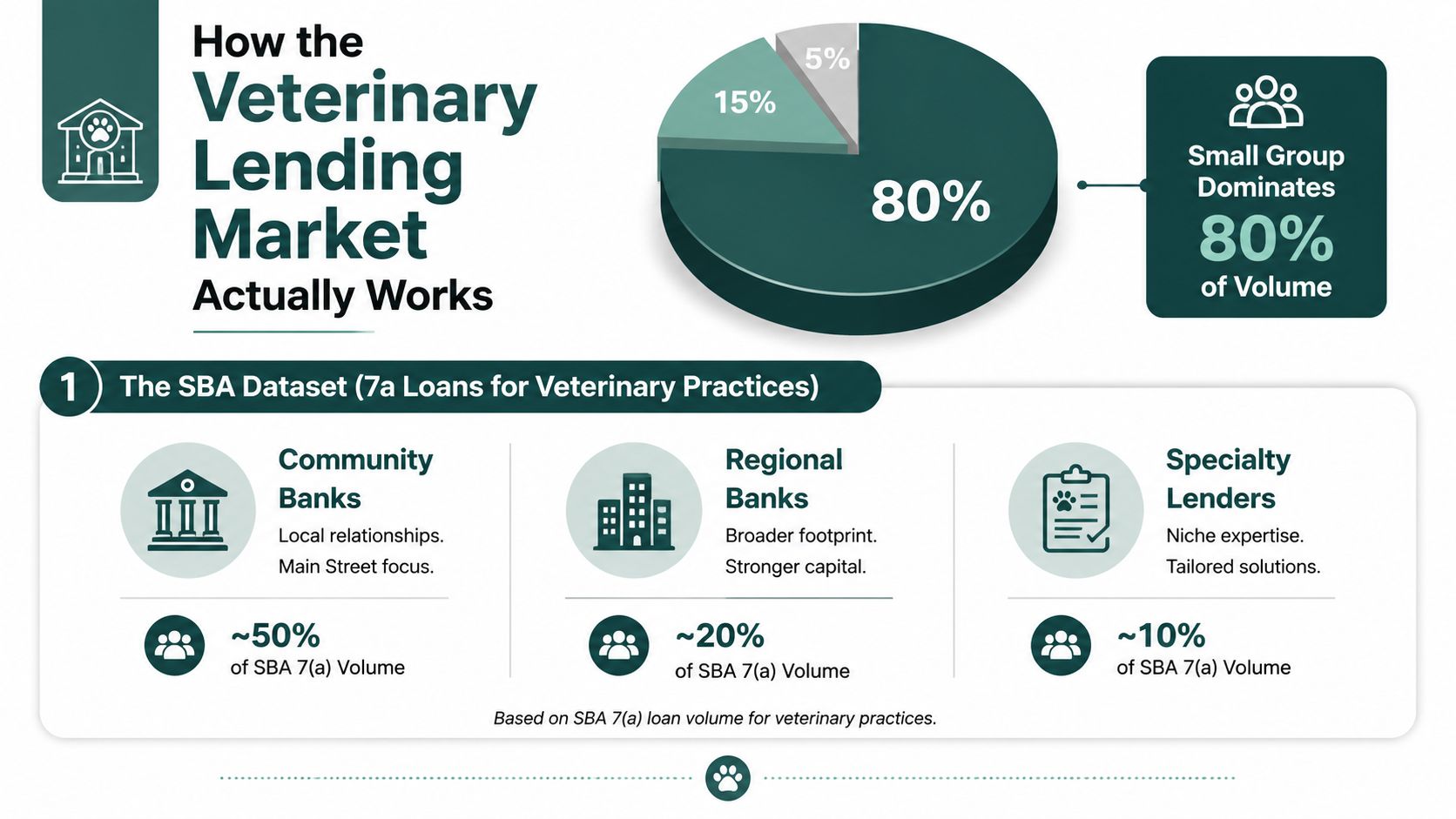
That concentration is good news for borrowers who prepare properly. It means there are lenders who already understand the sector's economics, and it means you do not have to educate a generalist from scratch. Use that to your advantage, and go straight to the banks that already live in this market.
If you want a broader lender map, the guide to loans for veterinary practices is a useful starting point, but the core lesson is simple. The market rewards specialization, and the lenders with the deepest veterinary track records are usually the ones worth prioritizing first.
The Main Loan Structures Available to Veterinary Practices
The first mistake owners make is shopping for a lender before they've matched the structure to the need. A building purchase, a practice acquisition, and an equipment purchase are not interchangeable just because they all involve debt. The structure should follow the purpose of the money.
Pick the structure that fits the asset
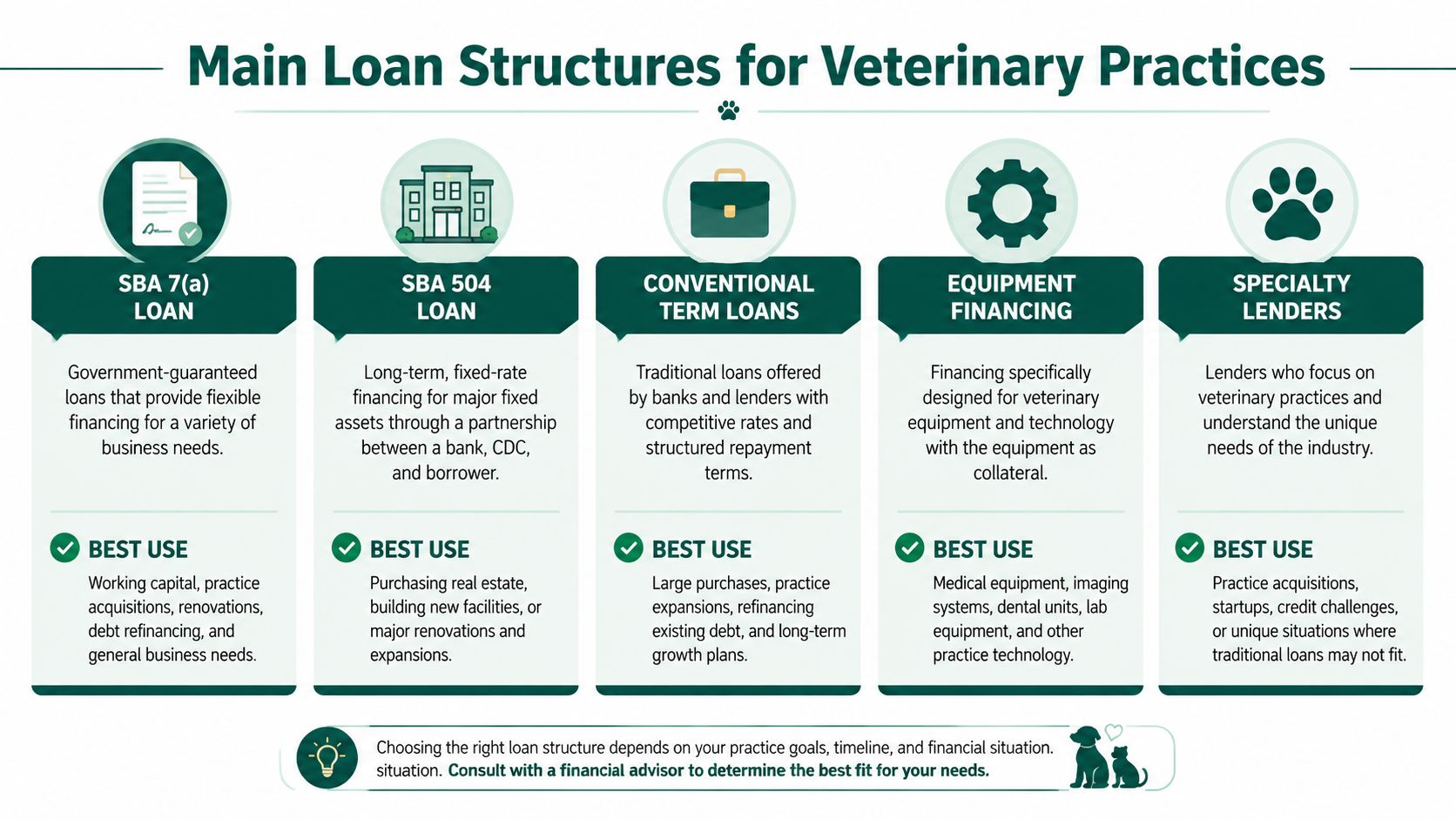
SBA 7(a) is the flexible workhorse. It can support up to $5 million in borrowing, with terms up to 25 years for real estate and 10 years for working capital and equipment. On loans above $700,000, the maximum rate is typically prime + 2.75%, which was about 10.25% to 11% in early 2026. That makes it the most obvious candidate for acquisitions, startups, and mixed-use requests where the clinic needs room to breathe. (Launch Advisor veterinary SBA cash flow guide)
SBA 504 is the cleaner answer for owner-occupied real estate. It's the structure most often associated with property and long-term fixed assets, which is why it comes up when the building itself is part of the plan. If the property is central to the economics, don't force that into an operating-company loan just because it feels simpler.
Conventional term loans fit straightforward, established borrowers who want speed and already have strong financials. They're often easier to understand than SBA debt, but they can be less forgiving on financing and repayment shape. For clinics with stable profitability, that trade-off can make sense.
Equipment financing is the right call when the asset is the collateral. It works well for imaging, surgical, laboratory, and information technology purchases because the repayment is tied to the useful life of the equipment. If the equipment is essential and you don't want to drain cash reserves, this is the cleanest path.
Specialty veterinary lenders are the practical choice when the deal has moving parts. Acquisitions, startups, and cash-flow-sensitive transactions need an underwriter who knows goodwill valuation, revenue ramp, and licensing timing. That's where specialist lenders usually beat generic bank products.
The borrower who wins is the one who knows what the capital is for before applying. If the money buys revenue-producing assets or fills a timing gap, use the structure that matches that job. If you want a quick primer on SBA fit, the guide to SBA loans for veterinary practice is the right place to start.
Lender Categories and Their Real Strengths and Weaknesses
The lender category matters because each group underwrites from a different instinct. Some want scale, some want relationships, some want the cleanest collateral, and some want the deal to fit a narrow box. Choose the wrong category, and you can waste weeks on a polite no.
Large banks and regional banks
Large national banks can work for established borrowers with broad banking needs, especially when the practice already has operating accounts and a long history. Their strength is product depth, not intimacy. Their weakness is that veterinary lending can get treated like one small slice of a much larger commercial portfolio, which makes some deals feel generic.
Regional and community banks are often better when you want a banker who knows the local market and can still move with some flexibility. They are usually stronger than giant banks on relationship, but they can be limited on maximum loan size and specialty underwriting depth. If your deal is complicated, they may need help from the SBA side, or they may not have the appetite.
SBA-heavy specialists
Live Oak Banking Company belongs in the conversation. Analysts at PeerSense SBA veterinary services dataset identify it as the most active veterinary lender by volume and as one of the clearest examples of a bank built around this niche. If your deal is an acquisition, startup, or larger expansion, this category should be on your short list immediately.
Wells Fargo deserves a different read. Analysts at PeerSense SBA veterinary services dataset show broad SBA participation, which makes it a credible option for owners who want a major-bank platform with meaningful veterinary reach. Breadth is not the same as deep specialization, so I'd prefer it for cleaner deals where the borrower profile is already strong.
Credit unions and dedicated veterinary lenders
Credit unions can be useful when you value local decision-making and already have an existing relationship. Their weakness is consistency, because underwriting can vary widely and specialty veterinary knowledge is uneven. I'd use them as a relationship play, not as the first stop for a complex acquisition.
Dedicated veterinary or medical lenders are the closest fit when the deal has moving parts. They understand practice revenue, licensing, and how vets deploy capital. The downside is that they can be more selective, so the borrower needs a cleaner package and a sharper story.
Skip any lender that can't tell you, in plain language, whether it prefers acquisitions, startups, equipment, or real estate. If they can't answer that in one conversation, they are not a serious match for your deal.
The blunt recommendation is this. For big or complex veterinary debt, start with specialty SBA lenders first. For clean, established borrowers with local ties, test a regional bank or credit union. For general national-bank shopping, only proceed if the loan officer can show real veterinary experience, not just a healthcare label.
Matching Lenders to Common Veterinary Loan Scenarios
The right lender depends on what you're doing with the money. Buying a practice is a different underwriting story than opening a brand-new clinic, and both are different again from swapping out old equipment or trying to smooth payroll. One-size-fits-all shopping is why owners end up with clunky terms.
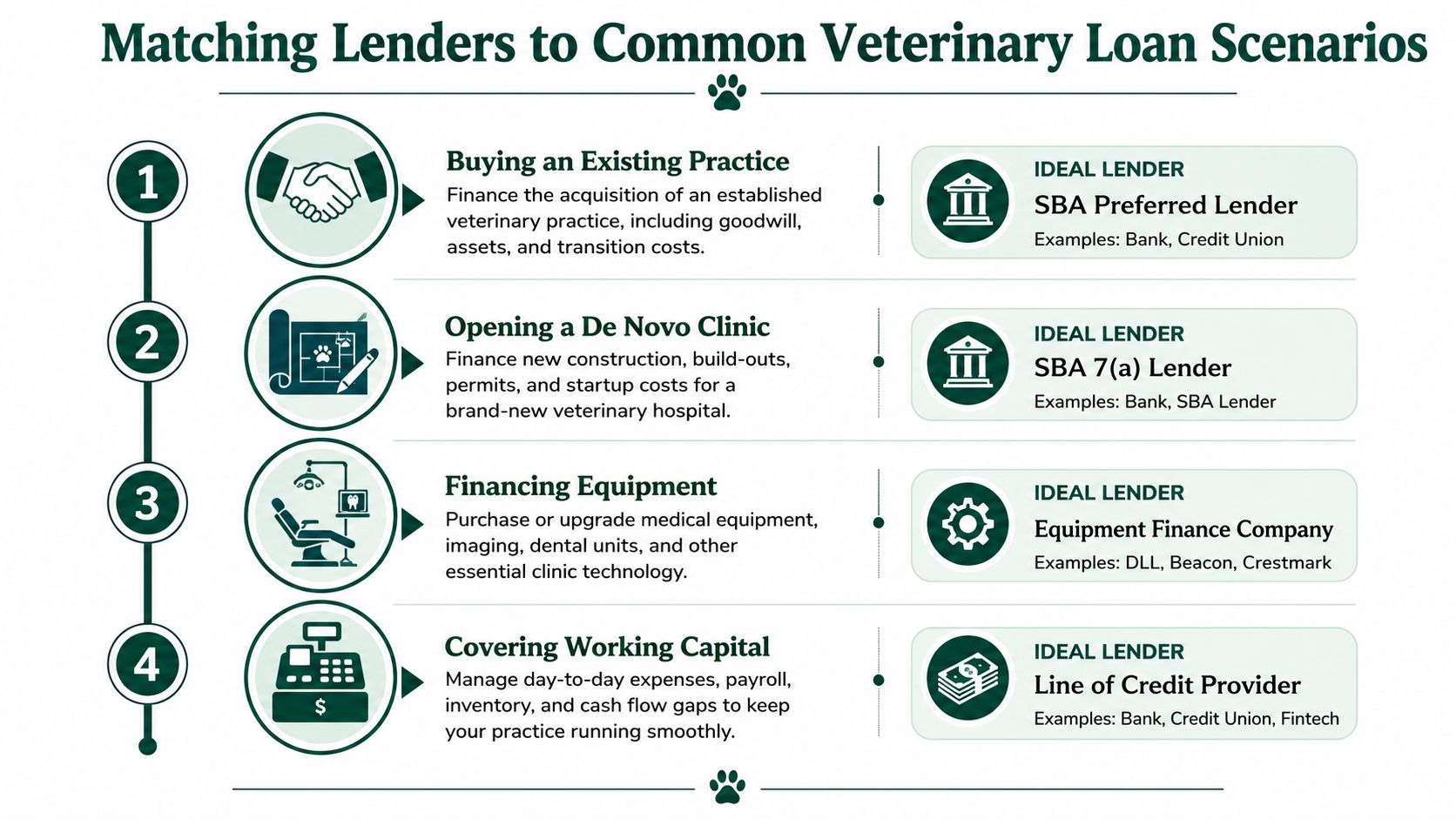
Buying an existing practice
SBA-heavy specialty lenders should usually lead. Acquisitions bring together goodwill valuation, transition risk, and cash flow underwriting, and specialty lenders are better equipped to handle that mix. A lender that understands practice transfer mechanics is far more useful than one that only likes hard collateral.
Opening a de novo clinic
For a startup, you need a lender that respects ramp-up time and doesn't panic because the first few months won't look like a mature clinic. Specialty veterinary lenders and SBA lenders are the natural fit here. The approval question is less about whether the idea is sound and more about whether the package proves you've thought through staffing, location, and early cash needs.
Financing equipment
If the need is imaging, surgical, laboratory, or information technology gear, equipment financing should be near the top of the list. It's the cleanest match because the asset itself supports the debt. That makes the deal simpler and often easier to approve than a full practice loan.
Covering working capital
Working capital is where flexibility matters most. A revolving line or term structure from a bank or specialty lender can help cover payroll, supplies, or uneven collections without forcing you to sell the whole story as a long-term acquisition. The lender should care about cash flow, not just tax returns.
The single most important variable is not the bank, it's the repayment source. If repayment comes from stable clinic earnings, you can justify longer debt. If repayment depends on a ramp or transition, the lender has to be comfortable with uncertainty.
For scenario-based shopping, keep the shortlist tight. Acquisition and startup borrowers should speak with specialty SBA lenders first, then a regional bank with real healthcare experience. Equipment buyers can compare equipment financing and conventional bank options. Working-capital borrowers should focus on flexibility, not just the lowest advertised rate.
Separating Building Financing from Practice Loans
Owners usually ask about the clinic loan first, but the better question is whether the building should be financed separately from the practice. That decision changes the down payment, the repayment structure, and how much property risk sits inside the operating company. In a high-cost market, that is not a side issue, it is a core strategy choice.
When separate real estate financing makes sense
If you expect to stay in the location for the long haul, owner-occupied real estate can bring stability. It also lets you separate the hard asset from the operating company, which makes sense if the practice needs liquidity for staff, equipment, and inventory. The business keeps its capital focused on medicine and operations instead of absorbing a building payment too.
That is why SBA 504 and similar real estate structures matter. They are built for the property side of the deal, while the clinic business can keep a cleaner operating balance sheet. That separation matters more when you are thinking like an owner, not just a tenant.
When to keep the building off the operating entity
If the clinic is still young, cash flow is tight, or expansion is likely, putting the building inside the same debt stack can choke flexibility. A real estate purchase raises fixed obligations and cuts into the room you have for hiring, inventory, and equipment. In plain terms, the building can be a good long-term bet and a bad short-term burden.
That is the part most lender roundups skip. The right answer is not always to finance everything. Sometimes the better move is to finance the practice one way and the property another way, so each asset gets the structure it deserves.
You also need to think about lease economics. If buying the property would stretch the business too far, staying in a well-negotiated lease can preserve liquidity and keep the operating company nimble. If the market is expensive and you plan to stay there for years, ownership can improve long-term control even if the upfront load is heavier.
The decision comes down to where you want your advantage to sit. Put it on the building if you want permanence and can carry the burden. Keep it off the operating company if flexibility matters more right now.
Qualification Checklist Before You Approach Any Lender
Lenders don't approve a story, they approve a package. If you walk in with incomplete financials or a fuzzy use of funds, expect delays even if the deal is good. The fastest path to a yes is showing up organized.
Bring the documents that let the underwriter work fast
Start with your practice financials, because the lender wants to see how the business performs. Add personal and business credit information, a detailed business plan, and a clean explanation of the collateral if the deal uses one. For SBA-style loans, be prepared to show down payment proof and enough liquidity to survive the close.
A strong package usually includes:
- Three years of practice financials, so the lender can see trend, not just one good year.
- Personal and practice credit scores, because underwriting still starts with borrower quality.
- A detailed business plan, especially for acquisitions and startups where the lender needs to understand the operating model.
- Collateral valuation, when the loan is secured by equipment or property.
- Down payment proof, because an underwriter wants to know you're committed and can close.
If you can assemble those items before the first meeting, you'll shorten the back-and-forth. That matters because veterinary lenders move faster when they don't have to guess at the shape of the deal. It also signals that you're a serious borrower, not someone shopping blindly.
Bring a debt schedule too, even when nobody asks for it upfront. It keeps the conversation honest and shows you know what the new payment will sit on top of.
A lender can say yes only after it understands the full obligation. Your job is to make that understanding easy. The cleaner the file, the less likely the bank is to treat your request like a risky mystery.
Choosing the Best Fit for Your Practice
If you're buying a practice, start with an SBA-heavy specialty lender and then compare one regional bank with real healthcare experience. If you're opening a startup, do the same, because the lender has to understand ramp-up risk. If you're buying equipment, go straight to the structure that matches the asset, not the lender with the flashiest marketing.
For working capital, don't chase the biggest number first. Chase the repayment shape that won't suffocate payroll and supply ordering. A clean line or short-term facility can be better than a larger, awkward term loan if it protects day-to-day flexibility.
One rule applies to every deal. Talk to at least one specialty lender and one SBA-heavy bank before you sign anything. The difference in structure often matters more than the difference in rate, and structure is what determines whether the loan fits your practice or strains it for years.
Veterinary Practice Loans works with financing options built around veterinary acquisitions, equipment, working capital, startups, and expansion needs, so the conversation starts with the deal you're trying to close. If you're comparing banks for a practice loan and want a straight answer on structure, terms, and fit, visit Veterinary Practice Loans and start with the financing path that matches your clinic.
