
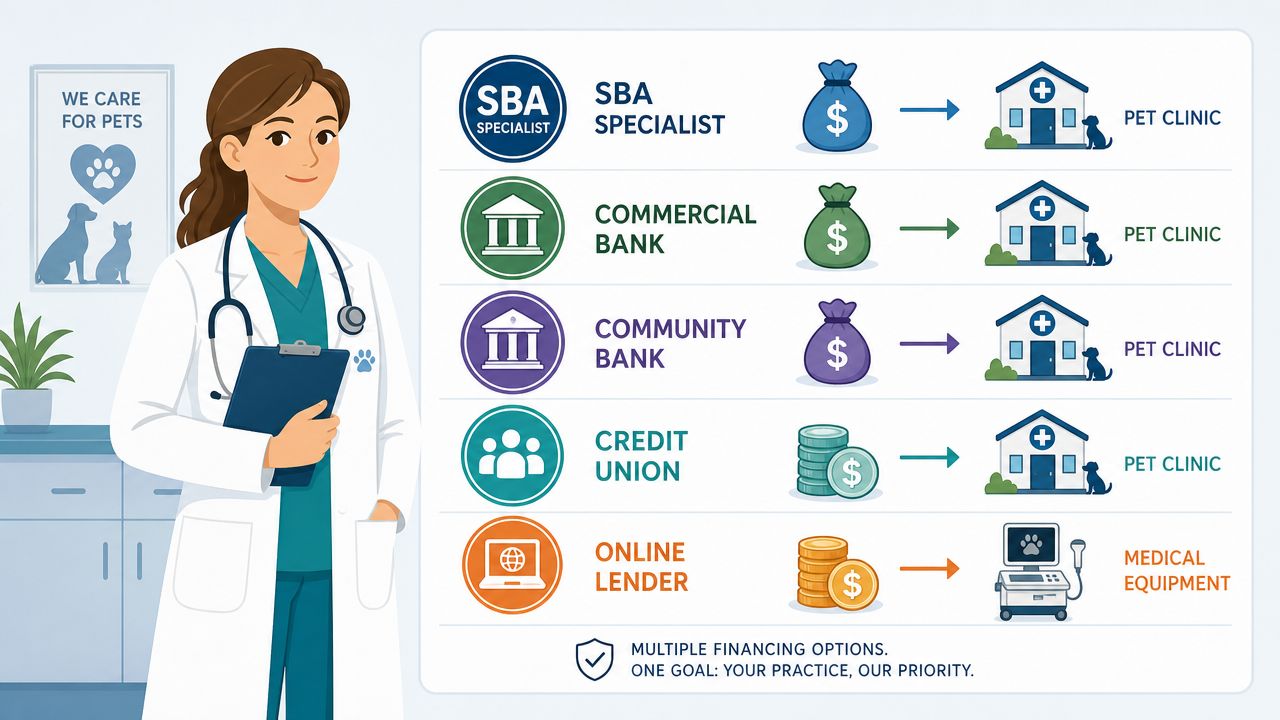
Veterinary practice lending is not a tiny side market. In one SBA loan-level dataset covering FY2021 to FY2026, veterinary clinics received 1,469 approved SBA 7(a) loans totaling $1.8 billion, and Live Oak Banking Company alone handled 372 deals and $825.7 million in volume, with an average loan size of $2.2 million. That concentration tells you something important; the primary question isn't “who lends to vets,” it's which lender fits which deal. Veterinary Practice Loan Rates
| Lender Category | Typical Deal Size | Core Products | Speed-to-Fund | Best Fit |
|---|---|---|---|---|
| SBA specialists | Multi-million-dollar | Practice acquisition, real estate, buy-ins | Slower | Ownership transitions and complex purchases |
| Large commercial banks | Larger loans with structure flexibility | SBA 7(a), real estate, expansion | Moderate | Buyers who need one lender across multiple uses |
| Regional and community banks | Smaller to mid-sized | Acquisition, equipment, working capital | Moderate | Local relationships and straightforward deals |
| Credit unions | Mid-sized, relationship-driven | Practice loans, real estate, refinance | Moderate | Borrowers with strong local ties |
| Alternative online lenders | Smaller, faster | Working capital, equipment, bridge capital | Fast | Urgent cash needs and newer clinics |
The blunt truth is this. Rate is only one variable. A cheap quote on the wrong structure can leave you undercapitalized, over-borrowed, or stuck with a payment schedule that doesn't match a clinic's actual cash flow. If you're comparing lenders for a purchase, a de novo build, equipment, or short-term working capital, start with the deal structure, then compare pricing.
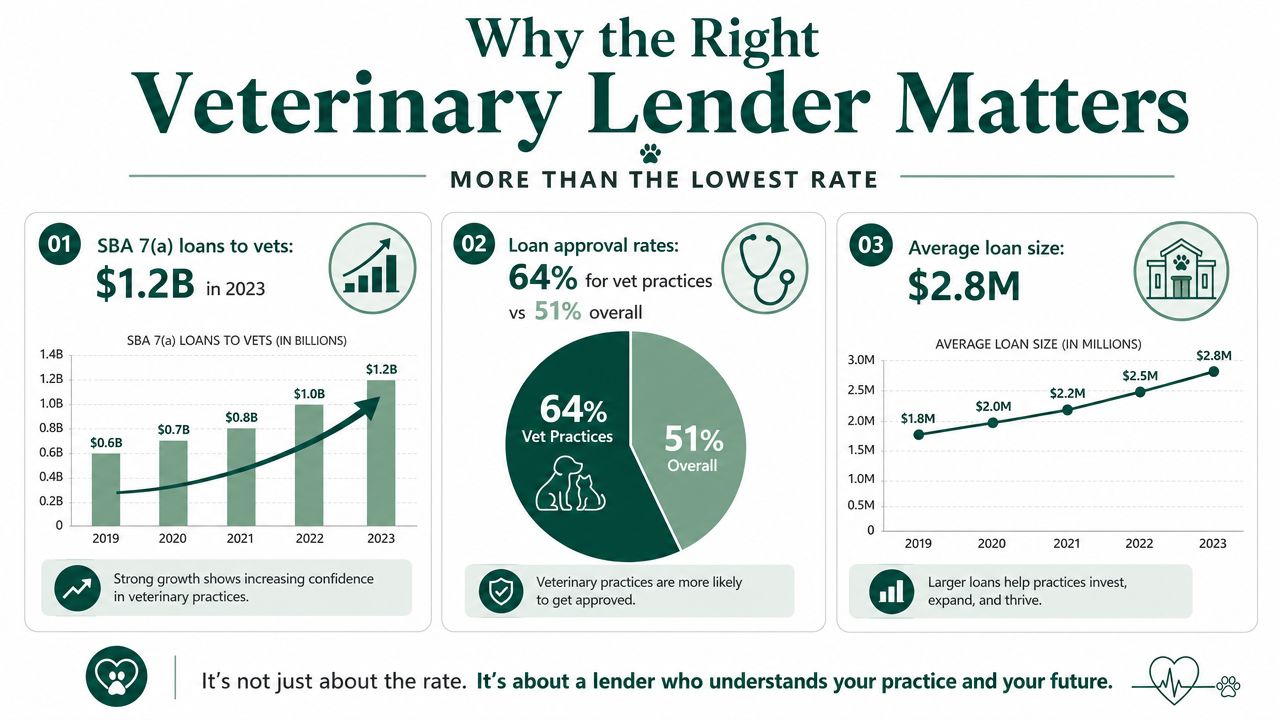
Why the Right Veterinary Lender Matters More Than the Lowest Rate
The veterinary lending market is large enough that you should not shop it like a quick APR hunt. In 2025, veterinary clinics received $383 million across 307 SBA 7(a) loans, with 67 active lenders and an average loan size of $1.2 million at an average rate of 8.75% according to the industry dataset cited in the brief. Those approvals are repeated business, not random exceptions. They show a lending segment where underwriters know clinic cash flow, ownership transfers, and the difference between a good structure and a bad one.
A practice acquisition has a different job than equipment financing, and both are different from working capital. Buying a clinic usually means handling ownership transfer, cash flow, and sometimes real estate in one package. Working capital solves a timing problem. It covers payroll, inventory, and other short-term gaps, so it should not be forced into a long amortization schedule that outlives the problem it was meant to solve.
Practical rule: Match the debt to the thing it finances. Long-life assets can carry long repayment. Short-term cash gaps should stay short.
That is why a lender that looks expensive on paper can still be the right answer. If the lender will fund the structure you need, close on schedule, and avoid an awkward collateral package, it often beats a cheaper quote that strips out working capital or delays the deal. The wrong loan is the one that leaves the clinic undercapitalized or saddled with a payment schedule that makes the first year harder than it already is.
For a close look at pricing mechanics, see Veterinary Practice Loans rate guidance. Rate matters, but it should never be the first filter.
Owners usually get this wrong in the same way. They ask one lender to cover everything, then wonder why the answer misses the clinic's actual use of funds. Strong borrowers split the request into pieces, acquisition, real estate, equipment, and operating cushion, then decide which debt should cover each one.
Lender Categories at a Glance
A veterinary buyer with a real acquisition in front of them does not start by asking who has the flashiest rate sheet. They start by asking which lender can fund the deal they need. A clinic transfer, a real estate purchase, an equipment buy, and a short-term cash squeeze belong in different buckets, and the wrong bucket costs time, flexibility, or both.
| Category | Typical Deal Size | Core Products | Speed-to-Fund | Best Fit |
|---|---|---|---|---|
| SBA specialists | Large | Practice acquisition, owner-occupied real estate, buy-ins | Slower | Buyers who need long repayment and structure |
| Large commercial banks | Medium to large | SBA, expansion, real estate, refinance | Moderate | Borrowers with stronger financial profiles |
| Regional and community banks | Small to medium | Equipment, working capital, practice purchase | Moderate | Owners who want local underwriting |
| Credit unions | Small to medium | Real estate, refinance, practice lending | Moderate | Borrowers with an existing relationship |
| Alternative online lenders | Small | Working capital, equipment, bridge capital | Fast | Short timelines and flexible qualification |
Veterinary lending is active enough that category choice matters. The 2025 industry brief reports 1,121 active SBA-approved lenders funding veterinary services businesses, with 14,610 SBA loans totaling $9.0 billion and an average approved loan of $616K, which the source says is 81% above the national SBA average as reported in the industry brief. The point is simple. This market is broad, but the best lenders still sort themselves by the kind of deal they are built to close.
A lender that works for a real estate-heavy acquisition can be the wrong lender for a small equipment order. The reverse is true too. That is why the first filter should be deal fit, not headline pricing. SBA specialists are the right lane for complex ownership transactions. Banks and credit unions make sense when the borrower is already financially solid and the deal is cleaner. Alternative lenders belong in conversations where speed matters more than cost.
If the deal is conventional, local, and relationship-driven, the article on best banks for veterinary practice loans is the next place to look.
SBA Specialists and Bank Leaders for Veterinary Acquisitions
Veterinary acquisition deals reward lenders that know how to close messy transactions, not just lenders that advertise low rates. In the SBA loan-level summary cited earlier, veterinary clinics showed heavy activity in SBA 7(a) lending, and Live Oak Banking Company stood out with a large share of deal volume and an average loan size above the rest of the field. That concentration matters. It tells you where the market already trusts real underwriting skill.
What these lenders do well
SBA specialists are built for transactions, not just loans. They handle practice value, goodwill, owner-occupied real estate, and the paperwork that comes with a purchase or partner buyout. Their edge is simple. They are willing to underwrite the whole deal, not just one clean slice of it.
The same SBA loan-level source shows a very low charge-off rate in the veterinary clinic sector over the review period. That helps explain why lenders keep funding the category even with the operating strain that comes with clinic ownership. It also explains why these lenders can support longer amortizations and larger acquisition checks without flinching.
Where the fit is strongest
Use an SBA specialist when you are buying an existing practice, buying into a partnership, or financing real estate alongside the acquisition. Use a larger commercial bank when the transaction is bigger, the borrower is already strong, and you want one institution to handle more than one part of the capital stack. If the deal is clean, the financials are solid, and the lender understands veterinary cash flow, a bank can move fast enough to stay useful.
The structure still decides the outcome. Industry guidance makes clear that SBA 7(a) is the main program for practice acquisitions, partner buyouts, expansion, and refinance, while active veterinary clinic lenders also support owner-occupied real estate, equipment, and working capital structures. That means the right lender is usually the one that can combine the practice purchase and the real estate without forcing you into awkward separate loans.
For acquisition-focused borrowers, the SBA loans for veterinary practice guide is the right place to pressure-test the structure before you commit.
Alternative and Non-Bank Lenders for Speed and Flexibility
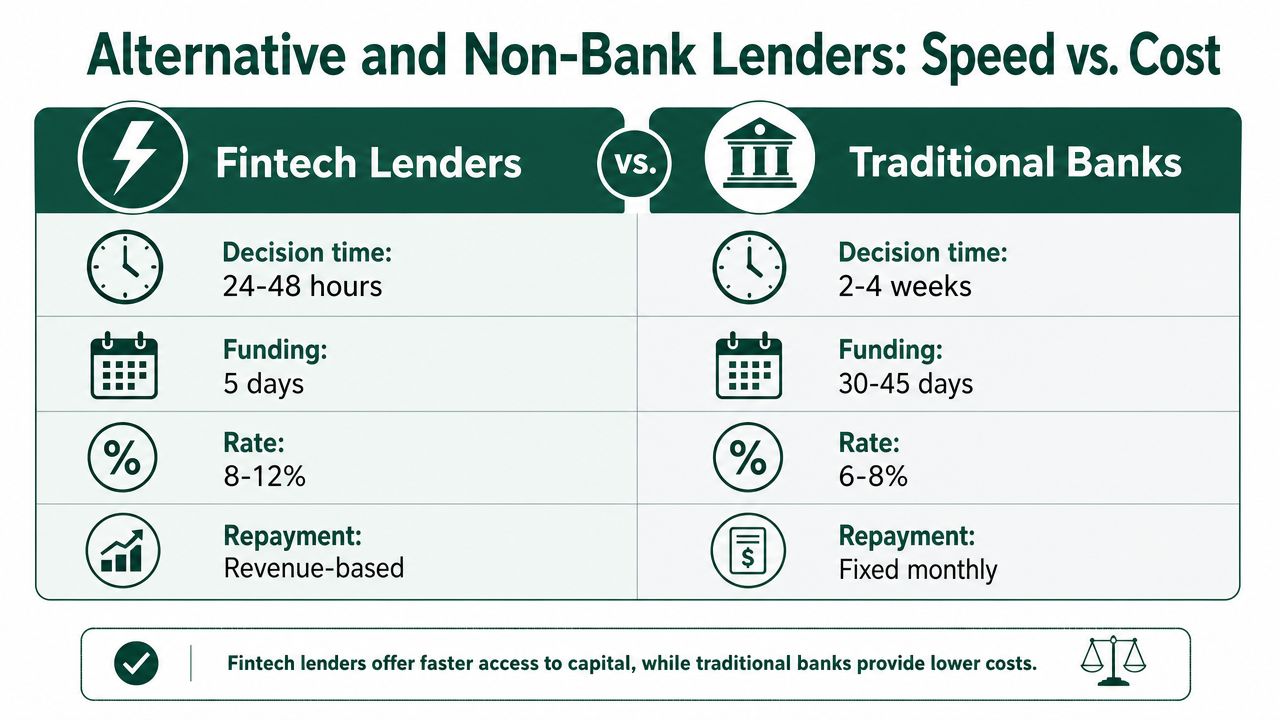
Alternative lenders are not the cheapest capital in the room, and they are not meant to be. They win when a clinic needs speed, when the file is too small for a traditional bank to prioritize, or when the owner needs bridge funding while a larger financing package is still being assembled. That makes them useful, but only if you accept the price for what it is.
When speed beats price
Use this category for smaller equipment purchases, temporary working capital, or a clinic that cannot wait for a slower underwriting process. If payroll is due, inventory is tight, or a time-sensitive opportunity is in front of you, a fast decision can matter more than shaving a little off the rate. In that setting, the primary metric is cost of delay.
The trade-off is structural. Fast money often comes with daily or frequent repayment pulls, tighter monitoring, and less room for error. Put those payments on top of existing debt, and you can create a cash flow problem that did not exist before the loan closed.
What to watch before you sign
Never use short-duration credit to solve a long-duration problem.
That rule matters in veterinary practices because expenses cluster. If the money is covering a recurring working capital gap, make sure the repayment pattern will not drain the same cash you are trying to preserve. If the capital is for equipment, match the repayment to the useful life of the asset, not just the lender's preferred schedule.
The market is also widening beyond bank term loans. Recent payment-solution coverage in the veterinary space shows that clinics are increasingly using shorter-duration credit tools and patient financing options for smaller amounts, with various products offering limits up to $35,000 in coverage of veterinary payment solutions. That does not replace traditional practice lending, but it does show where the financing stack is headed, toward more segmented tools for smaller cash needs.
The right way to use this category is with discipline. Know exactly what the money is for, how fast it needs to be repaid, and what happens if collections slow down for a month.
Matching Lenders to Real Veterinary Scenarios
A good lender fit starts with the transaction, not the institution. If you know the scenario, you can usually narrow the financing structure before you ever look at pricing. That saves time and prevents the common mistake of forcing one lender to stretch across three different jobs.
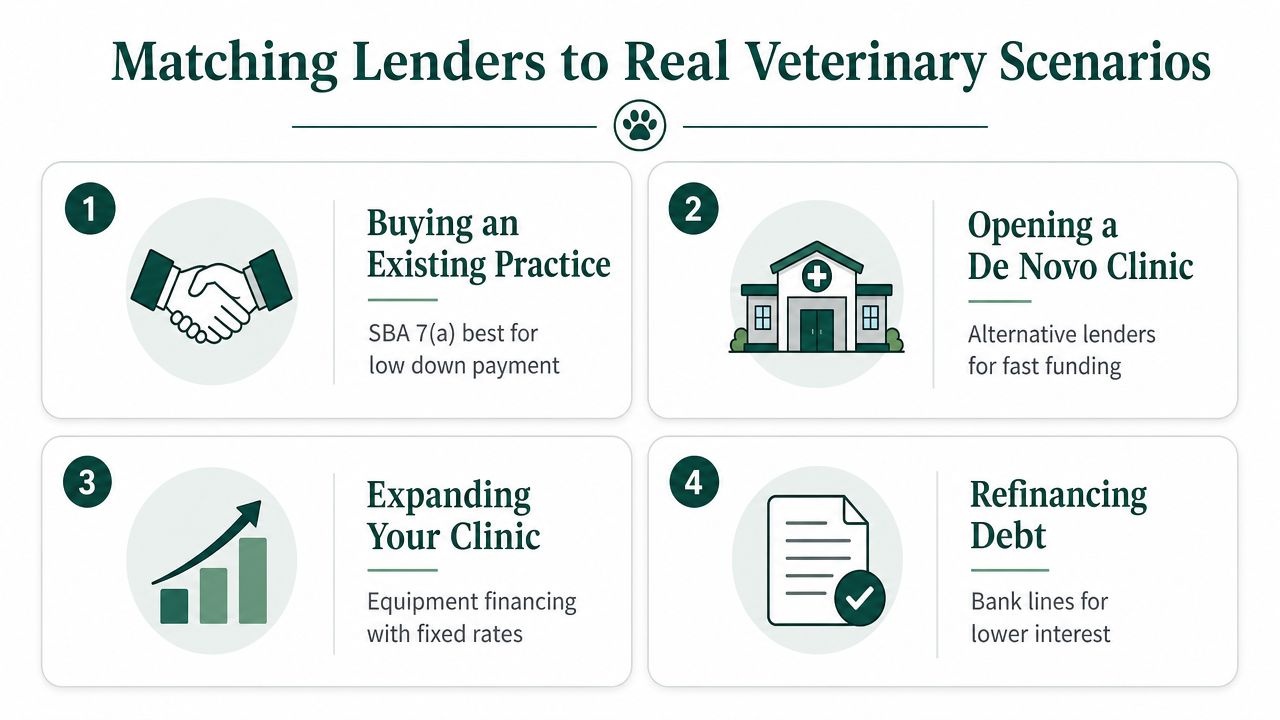
Buying an existing practice
An SBA 7(a) structure is usually the first thing to evaluate. It's the cleanest fit for a buyer who wants a lower cash injection and a long runway to absorb the transition. If the seller owns the building too, a lender that can combine the acquisition and real estate is often the practical winner.
Opening a de novo clinic
Many owners get stuck, because a new clinic has no operating history to lean on. In that case, bank-backed startup lending or an alternative lender for bridge capital can make sense, depending on how quickly the build-out needs to start. The deciding factor is whether the lender understands startup cash burn and can fund the early months without choking the clinic's first working cycle.
Expanding your clinic
Equipment financing is the most natural fit for imaging, surgical, and lab upgrades. It keeps the debt tied to the asset and avoids pulling long-term acquisition debt into a short-life equipment purchase. If the expansion includes leasehold improvements or extra rooms, a broader bank or SBA structure can be layered in, but the equipment piece should stay separate if possible.
Refinancing debt or stabilizing cash flow
Working capital lines and refinance structures belong here, not on the same shelf as an acquisition loan. If the practice's stress point is payroll timing, inventory purchasing, or uneven receivables, a lender that understands cash flow smoothing is the one you want. The goal is to reduce friction, not to take on a loan that looks elegant on paper and punishes the monthly budget.
The best lender for a scenario is usually the one that solves the problem with the fewest structural compromises.
If you're still unsure, start by asking whether the debt is buying an asset, funding a transition, or bridging a timing gap. That answer usually points you to the right lender category faster than any rate sheet will.
How to Prepare and Apply Without Delaying Funding
Lenders move faster when your file looks complete on day one. That means bringing the core documents in a clean package, not dribbling them out over three weeks. The basics are essential: tax returns, profit and loss statements, debt schedule, personal financial statement, and whatever production or clinic performance reports your lender asks for.
Build the file like a lender will read it
You want your numbers to tell one coherent story. If the acquisition is healthy, the debt service should make sense against current cash flow and projected post-close performance. If the loan is for expansion, the lender should be able to see how the added capacity, equipment, or real estate use supports repayment.
A few questions deserve direct answers in the first conversation:
- Prepayment terms: Ask whether there's a penalty, when it applies, and how it's calculated.
- Equity injection: Confirm how much cash you need to bring in and whether any portion can come from seller carry or structured support.
- Covenants: Ask what reporting or performance triggers come with the loan.
- Real estate inclusion: Make sure the lender will finance owner-occupied property if that's part of the deal.
If a lender won't explain the repayment structure in plain English, keep shopping.
Timing matters too. SBA loans usually take longer than fast alternative credit, and that's fine if the structure fits the transaction. The mistake is letting the clock dictate the product. A good application package can shorten the process, but it won't make the wrong lender right for the deal.
One practical move is to line up the financing path before you go too far in negotiations. That gives you an advantage at the closing table and keeps you from signing a purchase agreement that assumes money you haven't secured yet.
Choosing Your Veterinary Lender with Confidence
The decision process is simpler than most owners make it. First, identify the deal type. Second, choose the lender category that naturally fits that deal. Third, compare the term sheets side by side. Fourth, negotiate the structure, not just the rate.
That order matters because structure drives survivability. A practice can handle a fair rate and still struggle if the amortization is too short, the cash injection is too high, or the lender refuses to finance the piece that makes the acquisition viable. Owners who focus only on APR end up overpaying in a much bigger way, through missed cash flow flexibility.
The lending market for veterinary practices is mature enough that you have options, but that doesn't mean the options are interchangeable. A lender that closes acquisitions well may be mediocre at small equipment deals. A lender that moves fast on working capital may be a poor fit for a partner buyout. Fit beats rate because fit determines whether the loan supports the business you're buying or building.
If you're narrowing your list, bring two or three indicative term sheets into the same room and test them against the clinic's actual cash flow, not the lender's pitch. Ask what happens in month six, month twelve, and at renewal or refinance. That's where differences show up.
Frequently Asked Questions About Veterinary Practice Financing
How long do SBA veterinary loans take to fund?
They usually take longer than fast online capital because the file is larger and the underwriting is deeper. That's the trade-off for a structure that can fit acquisitions, buy-ins, and real estate more cleanly.
Can a startup veterinarian qualify without two years of ownership history?
Yes, but the lender category matters. Startup cases usually need stronger documentation, clearer projections, and a lender that works with new-ownership structures instead of only established cash flow.
What credit score do most lenders require?
There isn't one universal cutoff, and I wouldn't trust anyone who pretends there is. Stronger credit helps across every category, but the lender will also look at clinic cash flow, deal structure, and how much capital you're bringing in.
Can owner-occupied real estate be rolled into the practice loan?
Often, yes, especially with SBA specialists and some banks. That's one of the first questions to ask, because real estate inclusion can change the whole financing structure.
Veterinary Practice Loans helps veterinarians compare financing for acquisitions, startup clinics, expansion, equipment, and working capital. If you're trying to match the right capital structure to a real deal, visit Veterinary Practice Loans and get a financing path that fits the way your clinic operates.
