
You're sitting in the chair with two numbers in your head. One is the deal price. The other is how much cash you can afford to part with without starving payroll, inventory, or your own peace of mind. That's the question behind lowest down payment options for veterinary practice loans. The right answer changes fast depending on whether you're buying a clinic, building one from scratch, or financing equipment that should've been replaced last year.
| Loan Purpose | Lowest Realistic Down Payment | What Usually Makes It Possible |
|---|---|---|
| Practice acquisition | 0% to 5% buyer cash in qualified cases | SBA-style structure, seller financing, strong cash flow |
| Conventional practice loan | 10% to 20% down | Lender wants more borrower equity and cleaner risk |
| Equipment financing | 0 down on smaller-ticket deals | The equipment itself secures the loan |
| Working capital | Often bundled into a larger structure | Strong borrower profile and repayment support |
The mistake most owners make is treating “low down payment” like a single product. It isn't. A clinic acquisition, a startup build-out, an ultrasound purchase, and a working capital line all live under different underwriting rules. Lenders care about who's taking the risk, what collateral exists, and whether the business already produces cash flow.
If you're an associate looking at ownership, your cheapest upfront path is usually not the same as a startup founder's. If you're replacing equipment, your floor can be zero. If you're opening a de novo clinic, the lender is underwriting hope, not history, so the cash requirement jumps. Keep that difference in mind, because the wrong structure can make a loan look affordable while draining the clinic before month one is over.
Why Down Payment Floors Vary by Loan Purpose
A low down payment only works when the lender can point to something solid that reduces risk. For a practice acquisition, that might be established revenue, transferable goodwill, seller support, or an SBA-backed structure. For equipment, the collateral is obvious, the asset has a defined use, and the lender can tie repayment to something tangible instead of projecting a brand-new clinic's future.
The lender is not just pricing the loan, it's pricing the risk
That's why acquisition loans and equipment loans sit at different ends of the spectrum. A veterinary practice purchase can sometimes be structured with 0% down in qualified cases under SBA 7(a)-style financing, because the SBA's partial guarantee of 75% to 85% can support 100% financing when the deal is strong and seller financing or other credit support is in place. Conventional loans, by contrast, more often want 10% to 20% down from the buyer, because the lender is carrying more of the downside risk.
That difference matters because the best deal on paper isn't always the cheapest to close. A lender can accept a thinner down payment when the borrower has history, collateral, or another party sharing risk. Without those supports, the floor rises fast.
Practical rule: if the clinic already exists and produces cash flow, low-down structures are realistic. If the clinic doesn't exist yet, the lender will ask you to prove more of the risk with cash.
Match the loan purpose to the underwriting logic
Equipment financing is the cleanest example of why purpose changes the floor. The equipment itself gives the lender direct collateral, so the upfront cash requirement can be much lower, and in some cases the structure can reach 0 down. Working capital sits in between. The lender may be willing to fund it as part of a larger package, but it usually depends on the clinic's operating history and repayment strength, not just the existence of a purchase order.
This is also why older veterinary financing guidance around practice goodwill still matters. Industry guidance has long tied deposits to going-concern value, including deposits as low as 10% of going-concern value for veterinary practices, and that logic still shows up in modern structures (vet finance guide). The mechanics have changed, but the principle hasn't. The stronger the business and the better the risk-sharing, the lower the buyer cash can go.
The Four Loan Structures That Allow the Lowest Down Payments
The structures that actually get you closest to zero
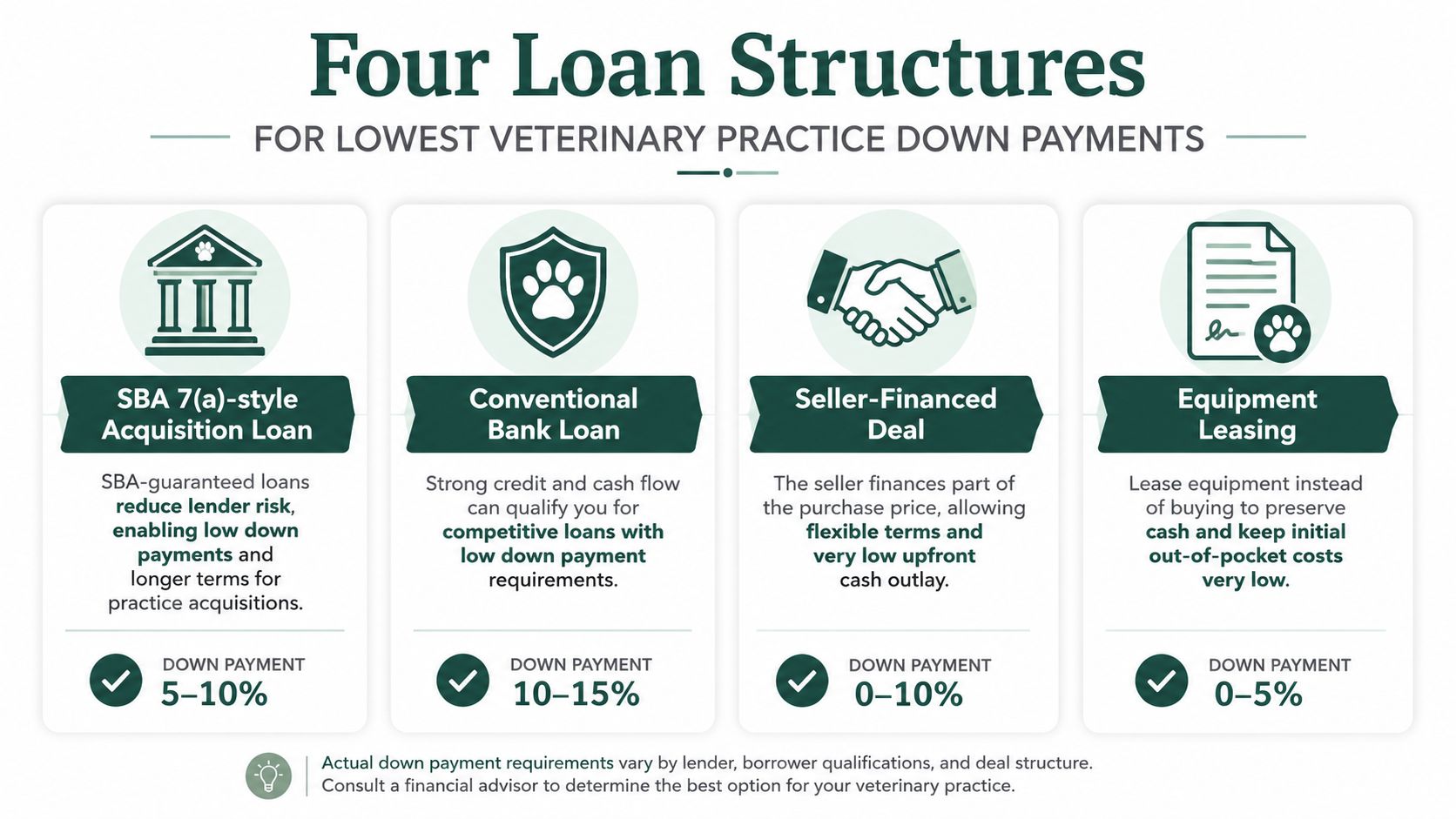
The lowest borrower cash requirements usually come from four structures: SBA 7(a)-style acquisition loans, conventional bank loans, seller-financed deals, and dedicated equipment financing. They do not behave the same way, and you should stop comparing them as if they do.
An SBA-style acquisition loan is usually the most flexible path for buying a clinic. The partial guarantee gives the lender cover, which is why it can support very low buyer cash in the right deal. A conventional bank loan is less forgiving, and it usually wants more equity from the buyer up front. Seller financing can bridge the gap in a near-zero-down acquisition, because the seller's note replaces some of the cash the lender would otherwise demand. Dedicated equipment financing is the simplest route to 0 down, because the asset itself is the lender's safety net.
Where those supports exist, the floor drops. Where they do not, the requirement climbs fast.
Read the trade-off before you chase the headline
If you want the lowest down payment, do not stop at “Can I get 0% down?” Ask what the lender takes in exchange for that lower cash commitment. The usual answer is more paperwork, more guarantees, or a higher total financing cost over time.
For a practice buyer, that trade-off is often worth it if keeping cash in the business matters more than shaving a little interest. For equipment, the math is usually cleaner because the asset is tied to the loan and the deal is smaller. For startups, the trade-off gets harder, because a lender is financing a business that has not proved itself yet.
If you are comparing structures for a purchase, this SBA loan resource for veterinary practice buyers is the right place to start. It sits squarely in the acquisition lane, where low-down-payment structures are most often assembled.
Typical Down Payment Ranges by Loan Purpose
The best way to compare these deals is by purpose, not by sales pitch. An equipment lender doesn't underwrite like an acquisition lender, and a startup lender is staring at a very different risk profile than someone buying a clinic with established clients.
| Loan Purpose | Lowest Typical Down Payment | Typical Term | Key Eligibility Lever |
|---|---|---|---|
| Acquisition financing | 0% to 5% buyer cash in qualified cases | Longer practice terms are common in this space, and SBA 7(a) working-capital terms can run up to 10 years | Strong cash flow, seller financing, SBA-style support |
| Conventional practice acquisition | 10% to 20% down | Standard term loan structure | More borrower equity and stronger credit profile |
| Equipment financing | 0 down on loans up to $150,000 | 24 to 60 months | Asset collateral and at least 2 years in business |
| Working capital or growth capital | Usually bundled into broader financing | SBA 7(a) maximum loan size is $5 million with terms up to 10 years for working capital and 25 years for real estate (SBA 7(a) guidance) | Operating history, repayment capacity, and lender confidence |
What each row really means in practice
The equipment row is the cleanest. A veterinary equipment-financing comparison notes no down payment required for loans up to $150,000, with terms of 24 to 60 months and a minimum time in business of 2 years. That's why an established clinic replacing imaging gear can often preserve cash entirely.
The acquisition row is where the lowest down payment gets most interesting. U.S. sources show that SBA-backed structures can push borrower cash very low, especially when seller financing covers part of the price and the lender finances the rest. That's where you see deals land in the 0% to 5% buyer-cash zone in qualified cases.
For startups, don't chase the same floor. A de novo clinic doesn't have the operating history that makes a zero-down structure easy to justify, so the realistic cash ask is usually higher. If your opening plan depends on a thin down payment, the lender is probably going to push back hard.
How Lenders Support Low Down Payments
The three levers behind low cash at closing
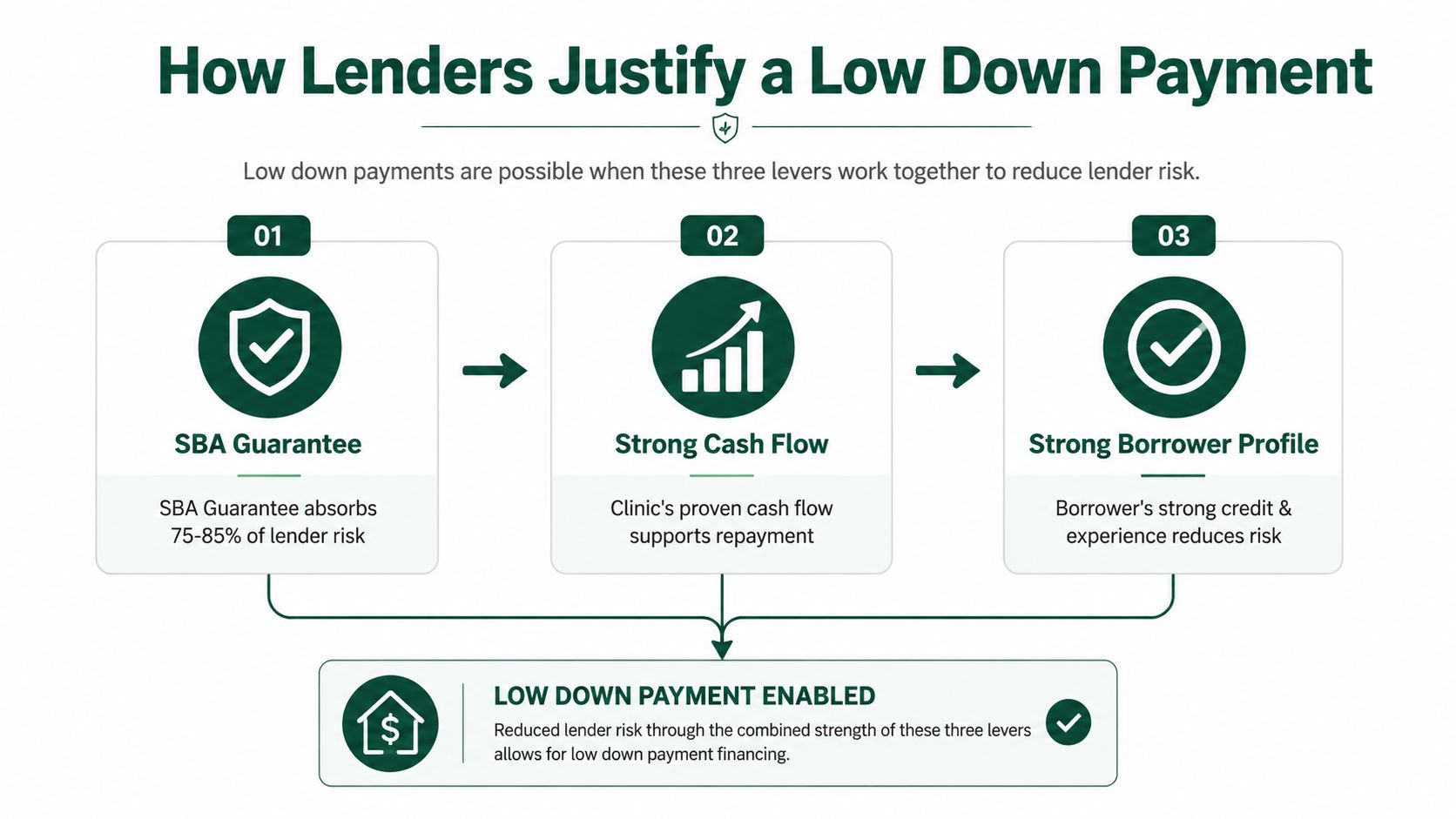
Lenders justify a low down payment with risk sharing, collateral, and repayment strength. If one lever is weak, the others have to carry more of the load. If two are weak, the lender usually raises the cash requirement or walks away.
The first lever is the SBA partial guarantee, which can cover 75% to 85% of the lender's risk in qualified structures. The second is seller financing, often around 10% to 15% of the purchase price in practice acquisitions, which acts like a credit substitute because the seller stays tied to the deal. The third is equipment collateral, where the loan is secured by the asset itself.
How a borrower can sometimes close with very little cash
A simple acquisition example shows how the pieces fit. If a practice is priced at $1.2 million, and seller financing covers $150,000, the buyer may only need a small cash injection if the senior lender can finance the rest under an SBA-style structure. That is the kind of setup that can produce 0% to 5% buyer cash when the clinic's revenue and credit story are strong enough.
The hidden cost is that the lender will usually want more from you somewhere else. That can mean a personal guarantee, stricter reporting, more documentation, or a longer amortization that lowers the upfront payment but raises the lifetime cost. Lower cash down is never free. It just moves the pressure point.
Direct advice: if the lender says the deal works only with more seller paper, more collateral, or a stronger guarantor, that is not a rejection. That is the price of low cash at closing.
For equipment, the logic is simpler. The machine or system is the collateral, so the lender can support a lower down payment if the business is stable enough to service the debt. That is why cash-preserving equipment loans are often easier to secure than cash-light startup loans.
Three Realistic Clinic Scenarios With Worked Numbers
A low down payment can look brilliant until you test it against real clinic behavior. The right question is not “Can I get this done?” It's “Can I get this done without choking the practice's cash flow?”
Acquisition scenario
An associate buys into an existing practice for $1.2 million. The deal is structured with 5% buyer cash and 15% seller financing, which leaves the rest to senior debt. That's a classic low-down-payment acquisition setup because the clinic already has revenue, the seller is helping carry part of the risk, and the lender has enough comfort to lean into an SBA-style structure.
The monthly payment burden is lower than a startup would face for the same purchase price, but the buyer is also accepting a longer commitment and more documentation. That trade is usually sensible when the clinic is already stable and the buyer needs to preserve cash for staffing, capex, and transition issues.
Equipment scenario
A three-year-old clinic finances a $250,000 imaging package with 0 down over 60 months. Zero-down financing shines here. The clinic has operating history, the asset is identifiable, and the loan purpose is narrow.
That structure is attractive because it protects working capital. It's also the rare place where chasing the lowest down payment usually doesn't create the same level of long-term regret you'd see in a major acquisition. Equipment should support revenue, not drain reserves.
Startup scenario
A first-time owner opens a de novo small-animal clinic. The down payment floor is much higher, often in the 20% to 30% range, because there's no existing cash flow to anchor the lender's decision. Even with SBA-style support, a startup doesn't get the same easy path to low cash at closing as an acquisition or equipment deal.
The hard truth is that startup borrowers often want the headline number more than they need it. A slightly higher down payment that gets approved is better than a fantasy structure that never closes. If the clinic can't survive the first stretch of rent, payroll, and inventory, the “cheap” loan was never cheap.
The True Cost of a Low Down Payment
Low cash now usually means more cost later
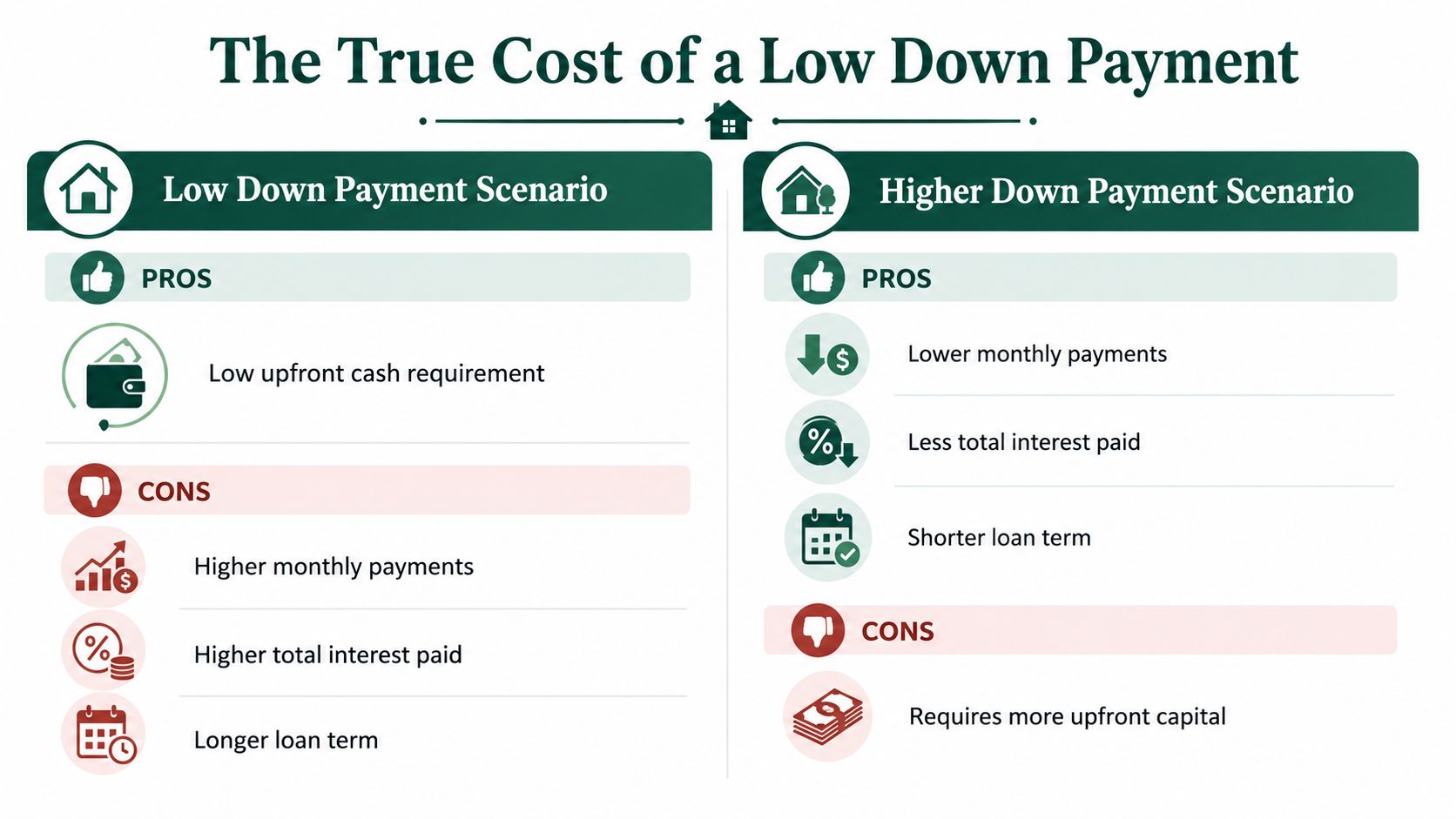
A low down payment helps preserve cash, but lenders rarely give that money for free. The usual price is a higher rate, a longer term, tighter guarantees, or some combination of all three. That tradeoff matters most when the buyer is trying to close a deal without draining the clinic's operating reserve.
For an acquisition, keeping cash in the bank can protect payroll, inventory, and repairs during the transition. That can be the right call if the clinic needs room to absorb ownership changes or early improvements. If the business is already stable and the buyer can comfortably inject more equity, a better-priced loan usually makes more sense over the life of the debt.
Compare liquidity to total cost, not just monthly payment
A lower down payment protects short-term cash. A higher down payment usually reduces monthly pressure and total interest. Those goals point in different directions, so the right structure depends on which problem you are solving.
A clear example helps. On a $1,000,000 practice acquisition financed for the same term, a low-down structure at a higher rate can easily add tens of thousands in extra interest compared with a larger equity injection that earns a better rate. The borrower with more cash out of pocket may dislike that move on day one, but the loan can cost less over time and leave less debt hanging over the clinic.
That does not make the lowest down payment a bad choice. It means the borrower should want it for a clear reason. If cash preservation is what keeps a transition on track, accept the higher total cost and protect liquidity. If the clinic has solid reserves and the lender rewards more equity with better pricing, take the cheaper debt and stop paying for money you do not need to borrow.
The same logic applies to working capital and equipment. A clinic that needs every dollar for staffing may prefer zero-down equipment financing even if the overall financing cost is higher. A clinic with surplus cash and steady income can usually afford to put more in and cut the long-term cost.
Negotiation Tactics to Get the Lowest Acceptable Down Payment
Start with the documents. Lenders lower cash requirements when the file looks tight, organized, and believable. Pull together tax returns, production reports, deposit history, and a plain written growth plan that explains how the clinic will service the debt.
Ask for structure, not just approval
If the seller is part of the deal, push for seller financing to cover 10% to 15% of the price when the transaction allows it. That piece matters because it helps substitute for buyer cash and gives the lender another sign that the seller believes the business will perform after closing.
Then ask the lender direct questions. What down payment would lead to better pricing? Would a larger SBA-guaranteed tranche reduce buyer cash? Can equipment collateral or additional guarantees bridge the gap if you're short? Those are real negotiations, not polite small talk.
If you're financing equipment, reference the collateral directly and keep the ask narrow. A lender is more likely to accept a thin down payment when the asset is specific, the business has history, and the repayment plan is obvious. If you're buying a practice, bring the numbers that prove the clinic already throws off cash.
One practical option in the market is Veterinary Practice Loans, which focuses on financing for practice acquisitions, equipment, working capital, and build-outs. Use that kind of specialist conversation to pressure-test whether your deal is a low-down-payment fit or just being marketed that way.
Matching the Right Structure to Your Situation
An existing practice with steady cash flow calls for an SBA 7(a)-style acquisition loan, and seller financing should sit beside it if the deal allows. That is the cleanest path to a 5% to 10% cash outlay, and qualified borrowers can sometimes push lower. If you want the acquisition structure laid out in plain language, review the acquisition options before you assume the seller price alone tells you what the deal will cost in cash.
Equipment upgrades in an established clinic deserve a different answer. Go straight to dedicated equipment financing and push for 0 down when the collateral is specific and the business has enough operating history to support the repayment. For a startup, stop chasing the headline number and accept the higher down payment that gets the loan approved without starving the clinic of cash.
The lowest down payment is the one that leaves enough working capital to keep the clinic operating through the first year.
That rule should drive the choice. Protect liquidity when the business is changing hands or still unproven. Focus on cost only when the clinic can already handle the debt without strain.
If you are comparing acquisition, equipment, working capital, or startup structures, get a specialist view before you sign. A direct financing conversation can show you the actual cash requirement, the weak points in the file, and which structure gives you the lowest acceptable down payment without setting up a cash crunch later.
