

You're reviewing a clinic purchase agreement, the seller wants a quick answer, and your search results keep pointing to “Wells Fargo veterinary practice loans.” Then you see another Wells Fargo page offering a pet care loan. That confusion matters. One product is designed for a veterinary business owner financing a clinic, while the other is a personal loan for a consumer paying a veterinary bill.
The practice-finance decision affects acquisition price, goodwill, equipment, working capital, collateral, repayment structure, and the cash your clinic will retain after closing. This guide separates the two Wells Fargo products, explains where SBA financing fits, and gives you a practical way to decide whether a large bank or a veterinary-focused lender deserves the first call.
Why Wells Fargo Often Shows Up First in Vet Practice Searches
The first step is identifying which Wells Fargo product matches your situation. Wells Fargo Practice Finance serves veterinarians and provides financing for practice-related borrowing, including startup, acquisition, expansion, equipment, and working capital needs. Its program materials state that qualifying clients may access up to 100% financing for practice-related borrowing, as described on the Wells Fargo Practice Finance platform.
The separate Wells Fargo pet care personal loan is for consumers paying veterinary bills. The bank's consumer page lists loan amounts from $3,000 to $100,000 and repayment terms from 12 to 84 months. That product isn't a clinic acquisition facility, a construction loan, or a working capital line for payroll and inventory. A veterinarian shouldn't assume a consumer pet-care loan can fund a business expense because both products relate to veterinary care.
Why the search results overlap
Wells Fargo appears prominently because it combines a recognizable national banking brand with a dedicated practice-finance division and SBA lending capabilities. Its practice-finance materials identify veterinarians alongside other healthcare professionals, and the bank describes itself as an SBA-preferred lender on its business lending pages.
The division has also been publicly associated with veterinary medicine for years. In October 2010, a PR Newswire announcement about Matsco becoming Wells Fargo Practice Finance identified veterinary medicine as one of the division's core focus areas and described the lender as a preferred provider of practice financing for members of the American Animal Hospital Association.
Practical rule: Start with the use of proceeds, not the brand name. If the funds buy, build, expand, or operate a clinic, you need commercial practice financing.
What to expect from the practice side
The relevant Wells Fargo path is built around business transactions, not household medical expenses. Expect the conversation to focus on the practice's cash flow, purchase structure, assets, real estate, equipment, owner experience, and post-closing liquidity.
That distinction also shapes the rest of your lender search. A large bank may be a strong fit for a sizable acquisition with real estate or a borrower who already has a commercial banking relationship. A smaller or veterinary-focused lender may fit better when the deal is equipment-heavy, modest in size, unusually structured, or operating under a tight closing deadline.
For a broader starting point, review this guide to the best banks for veterinary practice loans. Keep the categories separate, compare written term sheets, and don't let a consumer loan page steer a clinic transaction.
Wells Fargo Loan Products Built for Veterinary Practices
Wells Fargo's practice-finance offering is most useful when you treat it as a set of transaction structures rather than one generic loan. The right structure depends on what you're buying, how much cash the practice generates, whether real estate is included, and how quickly the clinic must support the new debt.
Acquisition and buy-out financing
An acquisition loan can fund the purchase of an existing veterinary hospital, including the operating business, equipment, inventory, and goodwill. It can also support a partner buyout or the purchase of an associate's ownership interest. Goodwill-heavy transactions require careful cash-flow analysis because the lender is financing an income-producing business, not a piece of equipment that can be sold separately.
The lender will want the purchase agreement, historical financial statements, tax returns, debt schedule, and a clear allocation of the purchase price. Your advisor should test whether the practice can pay debt service, provide you with a reasonable owner income, and retain enough cash for normal operating needs.
Startup and de novo financing
A startup loan can cover construction, leasehold improvements, equipment, initial inventory, staffing, and early operating liquidity. The underwriting challenge is straightforward. A new clinic has no established revenue history, so the lender must rely more heavily on your business plan, market analysis, management experience, projected cash flow, and the quality of the build-out budget.
Don't submit a startup request with a vague equipment list and optimistic revenue assumptions. A credible project budget should distinguish construction costs, medical equipment, technology, furniture, opening inventory, hiring costs, and working capital.
Expansion, relocation, and refinancing
Expansion financing can fund additional exam rooms, renovations, a relocation, a satellite site, or major equipment upgrades. Wells Fargo's practice-finance materials also describe financing for expansion and relocation, making the platform relevant to established owners pursuing capital-intensive growth.
Refinancing can consolidate existing business debt, but refinancing only helps if the new structure improves cash-flow pressure, maturity risk, or administrative complexity. Replacing debt without analyzing prepayment costs, collateral releases, and total interest can create a cleaner statement without creating a better financial outcome.
Working capital and equipment
Working capital financing supports recurring operating needs such as payroll, supplies, pharmaceuticals, and other expenses that fluctuate during the operating cycle. A line of credit is generally more suitable for short-term timing gaps than a long-term acquisition loan. Equipment financing, by contrast, should match repayment to the useful life and expected utilization of the asset.
Wells Fargo positions its practice loans as fixed-rate, practice-specific financing. A fixed rate can make debt-service modeling more predictable across revenue cycles, while a higher financing percentage may preserve cash for staffing, inventory, and post-closing reserves.
SBA-supported structures
Wells Fargo states that its SBA 7(a) and 504 programs can support acquisitions, buy-outs, expansion, real estate, and equipment. The bank identifies repayment periods of up to 25 years for commercial real estate and up to 10 years for other purposes on its medical and dental practice-finance information. Product availability, pricing, collateral requirements, and approval standards still depend on the transaction and underwriting review.
| Product | Typical use | Representative amount | Term length | Collateral |
|---|---|---|---|---|
| Acquisition financing | Existing clinic, goodwill, equipment, partner buy-out | Deal-dependent | Often matched to business assets and cash flow | Business assets, personal support, and other required collateral |
| Startup financing | Build-out, equipment, opening costs, working capital | Project-dependent | Structured around startup ramp and asset mix | Business assets and other required collateral |
| Expansion or refinance | Renovation, relocation, new site, debt consolidation | Project-dependent | Based on use of proceeds | Existing and newly financed assets |
| Working capital facility | Payroll, inventory, and operating-cycle needs | Based on working-capital requirement | Revolving or short-term structure | Business assets and lender requirements |
| SBA 7(a) or 504 | Acquisition, expansion, real estate, equipment | SBA and lender limits apply | Up to 25 years for commercial real estate, up to 10 years for other purposes | SBA and lender collateral standards |
The table is a planning framework, not a promise of approval. Ask for the proposed collateral package, fixed or variable pricing, fees, covenants, prepayment terms, and required equity before comparing offers.
How SBA 7(a) and SBA 504 Terms Apply to Vet Clinics
SBA financing is a structure, not an automatic bargain. It can help a veterinary owner align repayment with the assets being financed, especially when a project includes commercial real estate, a substantial build-out, or a business acquisition.
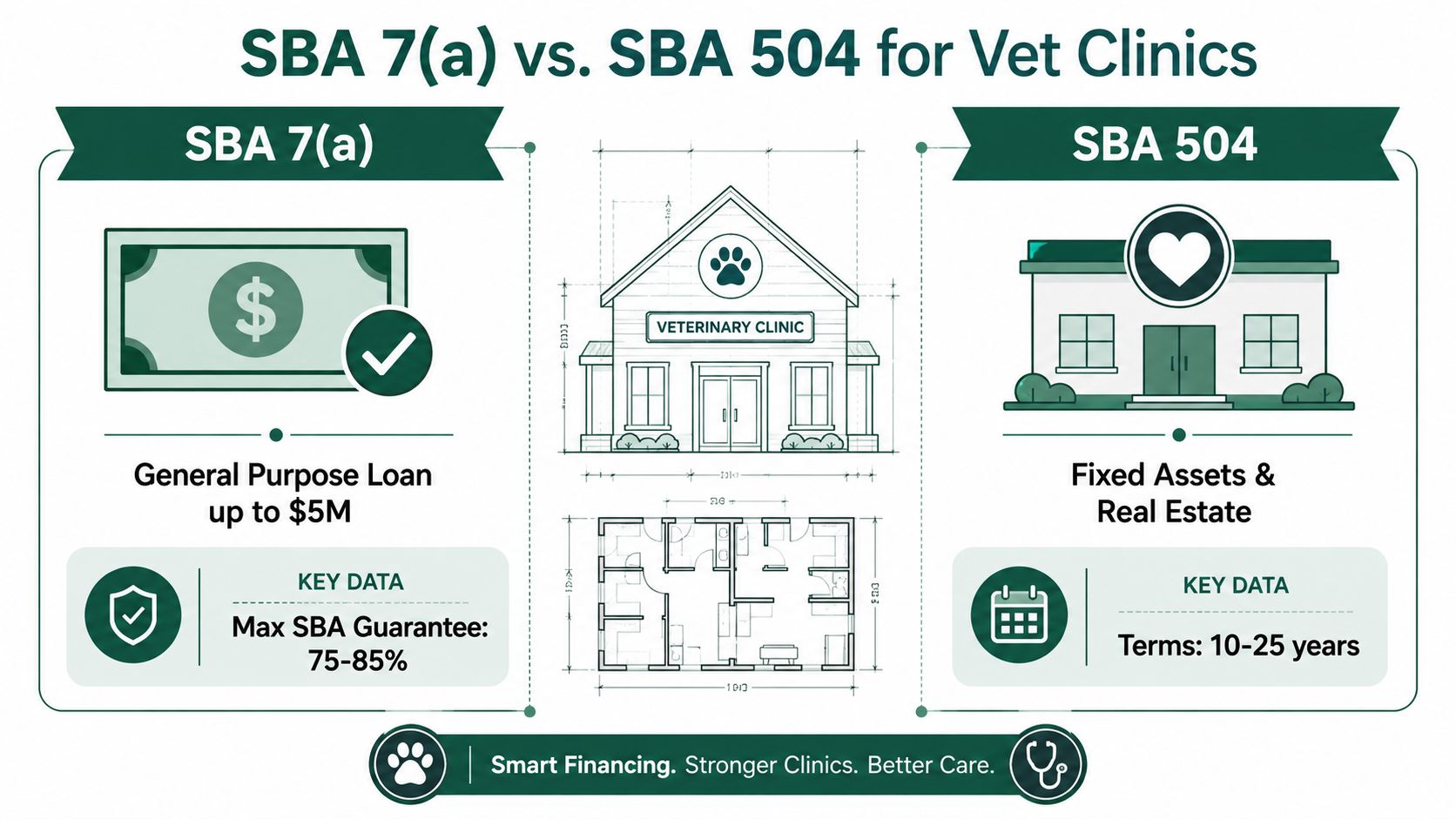
The SBA 7(a) program is the more flexible option. It can support a broad mix of uses, including acquisitions, working capital, equipment, and real estate, subject to program and lender requirements. SBA 7(a) loans can reach up to $5 million, while the SBA guarantee percentage varies by the transaction and program rules. For a veterinary borrower, the practical benefit is flexibility across several uses of proceeds in one financing package.
The 504 structure is oriented toward fixed assets and commercial real estate. It can be useful when the project centers on an owner-occupied building, a major facility project, or substantial fixed equipment. The structure requires closer coordination among the bank, the certified development company, the borrower, the appraiser, and the closing professionals.
Match the amortization to the asset
Wells Fargo's SBA materials identify terms of up to 25 years for commercial real estate and up to 10 years for other purposes on its SBA lending page. That difference affects cash flow. A building or long-lived build-out can be spread over a longer repayment horizon, while equipment and other non-real-estate uses generally carry a shorter schedule.
Shorter amortization raises required periodic payments. Longer amortization lowers the scheduled payment but extends the period over which interest accrues. For a clinic ramping after an acquisition or de novo opening, the longer real-estate schedule may provide more room for staffing, inventory, and revenue stabilization.
Don't compare SBA structures only by interest rate. Compare total fees, equity requirements, collateral exposure, amortization, prepayment provisions, and projected debt-service coverage. A structure with a slightly higher all-in cost can still be the safer choice if it protects operating liquidity during the early years of ownership.
For a deeper veterinary-specific discussion of these structures, review SBA loans for veterinary practices. The key question is whether the financing keeps the clinic financially functional after closing, not whether the loan label sounds inexpensive.
Eligibility, Documentation, and Realistic Funding Timelines
Wells Fargo doesn't approve a veterinary practice loan because the borrower has a veterinary license. The lender needs a financeable business, a credible repayment source, complete documentation, and a transaction that fits its credit policy.
For an existing clinic, the file normally starts with historical financial performance. The lender will examine tax returns, profit and loss statements, balance sheets, bank activity, existing debt, owner compensation, and the purchase or expansion plan. For a startup, the business plan and projections carry more weight because there isn't an operating history to validate the forecast.
Build the file before you negotiate the closing date
Prepare a digital package containing:
- Tax returns: Gather personal and business returns requested by the lender.
- Current financials: Include year-to-date profit and loss statements and a current balance sheet.
- Debt schedule: List each business and personal obligation, payment, maturity, and outstanding balance.
- Ownership resumes: Show clinical, management, and practice-ownership experience for every principal.
- Transaction documents: Include the purchase agreement, lease, real-estate documents, or expansion scope.
- Asset support: Provide equipment quotes, contractor bids, and a detailed use-of-proceeds schedule.
- Cash-flow model: Show revenue assumptions, staffing, rent, supplies, owner compensation, taxes, and proposed debt service.
The bank may request additional materials as underwriting progresses. A clean package won't guarantee approval, but an incomplete package will slow the process and create avoidable questions.
Think in stages, not one promised date
A conventional practice-finance file and an SBA file don't move at the same pace. SBA transactions often require additional review of eligibility, collateral, real estate, environmental matters, ownership, and closing documentation. Appraisals, contractor estimates, title work, and lease approvals can become critical-path items.
Closing advice: Don't sign a purchase agreement that assumes financing will be complete in a few weeks unless the lender has confirmed the timeline in writing.
Build financing contingencies that allow the lender to complete its review. Get the core documents ready before you make an offer, and ask the lender to identify every third-party report required for closing. Your seller may want certainty, but a rushed financing schedule can force bad concessions or leave you without adequate working capital.
The practical test is whether your lender has reviewed the actual transaction, not whether someone gave you a preliminary verbal indication. Treat prequalification as an initial screen. Treat a written commitment, with conditions you understand, as the meaningful milestone.
Wells Fargo Compared to Specialized Veterinary Lenders
Wells Fargo is a sensible starting point for a large, conventional transaction, especially when the project combines acquisition financing with commercial real estate or the borrower already maintains a relationship with the bank. It isn't automatically the right answer for every veterinary owner.
Specialized veterinary lenders generally build their process around clinic economics. They may understand revenue by service line, specialist credentials, referral patterns, appointment capacity, production mix, and the difference between owner compensation and true operating cash flow. A general commercial bank can analyze these issues, but the borrower may need to explain more of the practice's operating model.
The comparison below uses qualitative distinctions. Wells Fargo's public materials confirm its veterinary practice-finance and SBA capabilities, but they don't establish universal minimum loan sizes, approval thresholds, closing speeds, or pricing for every applicant.
| Factor | Wells Fargo and SBA | Specialty veterinary lender |
|---|---|---|
| Transaction size | Often strongest for larger, capital-intensive projects and combined business-real-estate needs | May be more comfortable with smaller or narrowly defined veterinary projects |
| Underwriting | Uses commercial and SBA credit standards, with practice-specific financing available | Usually centers the review on veterinary operating metrics and practice history |
| Closing process | Can involve bank, SBA, appraisal, title, and other closing requirements | May offer a more streamlined veterinary-focused process, depending on the file |
| Real estate | Strong fit for owner-occupied commercial real estate and build-outs through SBA structures | Some lenders prefer business assets and may be less focused on real-estate-heavy deals |
| Relationship banking | Useful when deposits, treasury services, and commercial banking matter | Often concentrates more narrowly on the practice loan |
| Pricing | Can be competitive on larger, well-documented transactions | May justify different pricing through speed, flexibility, or sector expertise |
Where each option usually wins
Start with Wells Fargo when the deal includes a building, major renovation, acquisition goodwill, and a need for a coordinated commercial banking relationship. Its fixed-rate practice-finance positioning and SBA capabilities can make long-term debt modeling easier, subject to the final offer.
Start with a specialty lender when the request is equipment-focused, the structure is unusual, the clinic is early-stage, or the seller won't tolerate a complicated closing process. You should still request a full term sheet. A quick answer isn't valuable if the lender can't finance the complete use of proceeds.
For a focused look at one veterinary-specific financing path, review Live Oak Bank veterinary practice loans. The point isn't to choose a lender by reputation. It's to send the same fact pattern to lenders that are equipped to underwrite it, then compare proceeds, equity, collateral, covenants, fees, amortization, and timing.
Common Misconceptions and Practical Traps to Watch For
The biggest mistake is treating an SBA maximum as a personal approval target. A program may permit a large loan, but your transaction still has to support the debt, satisfy lender policy, document the use of proceeds, and fit the bank's appetite.
Wells Fargo's public practice-finance materials state that practice-management and milestone support are typically available only when financing reaches a minimum of $300,000. That doesn't establish a universal minimum loan size for every Wells Fargo product, but it does signal that the platform is oriented toward relatively large practice transactions rather than small personal loans.
The traps that change the economics
SBA doesn't remove personal risk. SBA-backed financing can still require personal guarantees and collateral under applicable lender and program rules. Ask exactly who must guarantee the loan, which assets secure it, and how releases work if you sell the practice or repay part of the balance.
The lowest quoted rate may not be the lowest-cost structure. SBA financing can involve guarantee fees, packaging charges, appraisal expenses, legal costs, and other closing expenses. Compare the total cost of capital and the required cash injection, not just the stated interest rate.
Real estate can create repayment restrictions. A fixed-asset structure may include prepayment provisions. Ask the lender to show the prepayment schedule in writing and model what happens if you refinance, sell the building, or sell the practice before maturity.
A consumer pet-care loan isn't practice financing. The Wells Fargo pet-care product is a separate personal loan for veterinary bills. It doesn't replace a commercial acquisition, startup, expansion, or working capital facility.
Treat SBA as a design choice
SBA financing can solve a structure problem when conventional credit doesn't provide the right combination of term, collateral, and equity. It isn't a discount coupon. The right question is whether its repayment schedule and requirements produce a stronger post-closing cash position than the alternatives available for your transaction.
Before you commit, request a written schedule of fees, required equity, guarantee obligations, collateral, amortization, rate adjustments if applicable, and prepayment terms. Those details matter more than a headline loan maximum.
A Pre-Application Checklist and Decision Framework for Practice Owners
A lender can only evaluate what you provide. Before requesting a term sheet, organize the financial and deal information that determines whether the proposed debt is supportable.
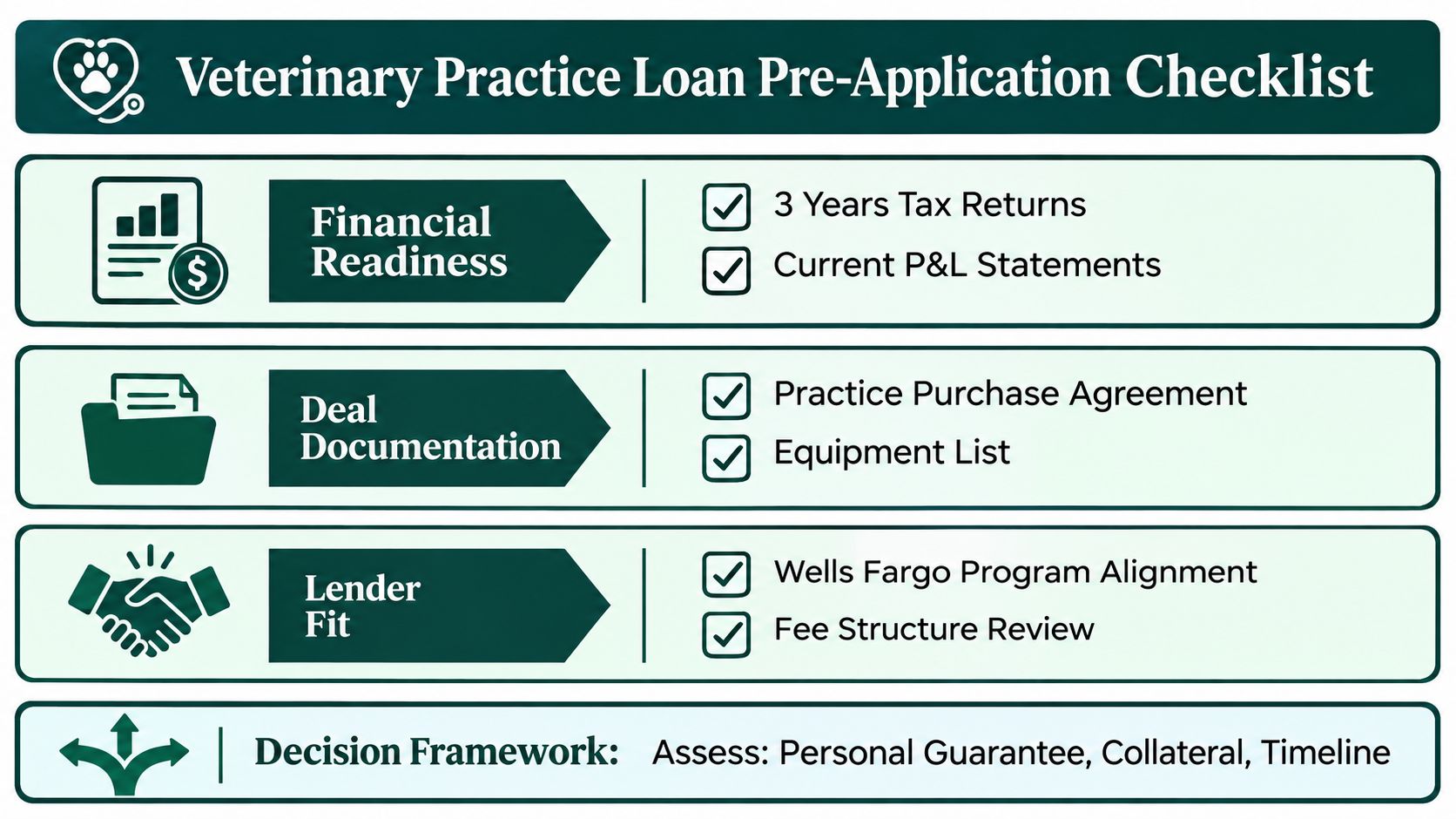
Financial readiness
Pull the latest trailing financial statements and reconcile them to bank deposits. Separate personal and business credit records so you can identify errors, undisclosed obligations, or utilization issues before underwriting begins. Review owner compensation, add-backs, taxes, rent, staffing, inventory, and existing debt as a lender will review them.
Deal documentation
Prepare the purchase agreement or letter of intent, lease, real-estate information, equipment list, vendor quotes, contractor budget, and use-of-proceeds schedule. If the transaction includes a building, order the appraisal process early enough to avoid making the closing date depend on an unstarted valuation.
Lender-fit validation
Ask each lender these questions before submitting a full application:
- Minimum size: Does the requested amount fit the lender's practice-finance threshold?
- Collateral: Will the lender require a blanket lien, real estate, personal assets, or all of these?
- Equity: How much cash must remain in the project and in the clinic after closing?
- Timing: Which approvals, appraisals, environmental reviews, and legal documents control the closing date?
- Structure: Should the request use conventional financing, SBA 7(a), SBA 504, equipment financing, or a combination?
- Operations: Will the lender offer a line of credit for working capital, or only a term loan?
Use Wells Fargo first when your transaction is large, includes commercial real estate, or benefits from a full-service bank relationship. Seek a veterinary-focused lender first when the request is smaller, equipment-led, unusually structured, or time-sensitive. If you want help comparing acquisition, equipment, working capital, and SBA-style structures, Veterinary Practice Loans provides financing options for those veterinary practice uses. Visit Veterinary Practice Loans with your financials and transaction details ready, and request a lender-fit review before you accept a term sheet.
