

You're a veterinarian with a strong income, a good clinical reputation, and a practice opportunity that looks attainable until the financing model lands on the page. The purchase price is only the opening number. Your loan structure will determine how much cash you bring, what you can offer the seller, how much monthly cash flow remains after closing, and whether the seller can stay involved long enough to protect the client transition.
That's why Live Oak Bank veterinary practice loans deserve a practical review rather than a brochure summary. Live Oak has deep experience in veterinary lending, but the right question isn't whether the bank can fund a transaction. It's whether the proposed SBA, conventional, real estate, equipment, and seller-financed pieces leave your clinic durable after the deal closes.
A Real Moment in the Life of a Practice Buyer
Dr. Reyes sat across from a practice broker reviewing a two-doctor small-animal clinic listed at $2.4 million. The practice had a stable client base, an established team, and enough earnings to make ownership feel like the logical next step. She already had a letter of interest in hand.
Her uncertainty wasn't clinical. She knew how to practice medicine and manage a busy day. The problem was that the financing conversation changed every part of the offer. A lower equity requirement would preserve more of her cash, but it would also create a larger amortizing balance. A conventional structure might reduce long-term interest expense, yet require more collateral or a larger cash contribution. Seller financing could help bridge the gap, but it might affect the seller's willingness to remain involved.
The broker wanted to discuss price. Dr. Reyes needed to understand debt service, transition control, and bargaining power.
She asked four questions that every buyer should ask before negotiating seriously:
- What can the clinic safely pay each month?
- How much cash should remain outside the closing funds?
- What does the seller need in order to accept the offer?
- How long can the seller stay involved without conflicting with the loan structure?
Those questions are more important than a headline approval. A buyer who focuses only on qualifying may win the practice and still create unnecessary pressure during the first year. A buyer who models the complete capital stack can often negotiate more intelligently, protect working capital, and identify an offer price that reflects the clinic's actual cash flow.
Live Oak Bank can be a serious option for this type of transaction. The bank's specialty history matters, but the structure matters more. The rest of this guide looks at the financing choices through the lens of a real buyer, not a marketing page.
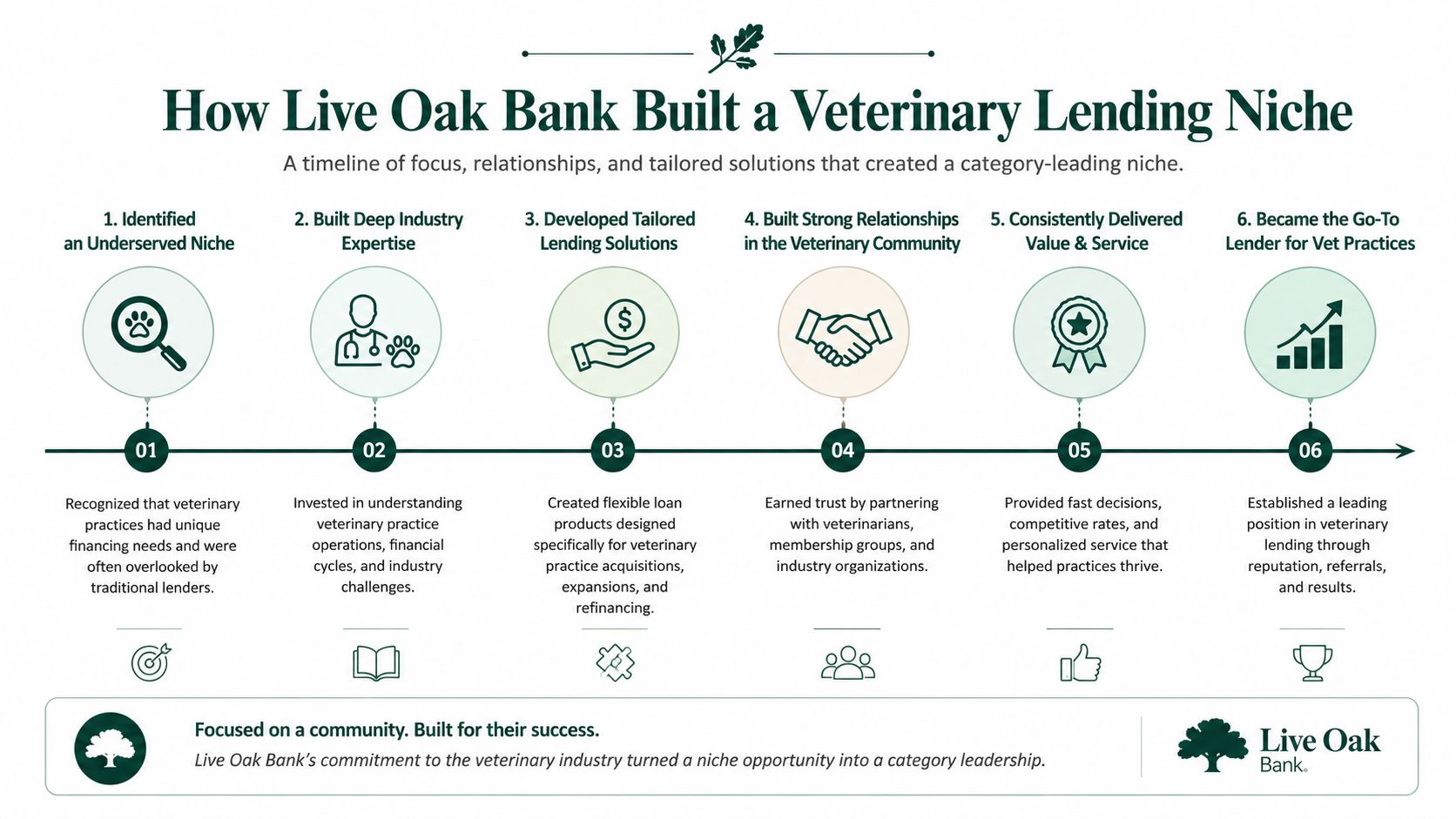
How Live Oak Bank Built a Veterinary Lending Niche
Live Oak Bank began its veterinary lending business in 2007, at a time when many lenders treated veterinary clinics as ordinary small businesses. An AVMA account of veterinary lending in 2008 reported that a typical Live Oak veterinary loan was about $1.3 million for a one- or two-veterinarian practice, and that the SBA 7(a) structure allowed repayment terms as long as 25 years.
That early specialization matters because veterinary practices have financial characteristics that generic underwriting can miss. Revenue depends on doctor capacity, appointment flow, client retention, pharmacy and laboratory activity, payroll discipline, and equipment availability. A lender that understands those operating drivers can ask more useful questions about the clinic's cash flow instead of relying only on broad small-business categories.
Live Oak's reported scale has expanded substantially. By fiscal year 2025, the bank was reported as the leading U.S. SBA 7(a) lender, with 2,280 approved loans totaling more than $2.8 billion nationwide, as summarized by Cobalt Intelligence's SBA lending report. A separate SBA-loan database cited in that report listed 18,078 SBA loans across FY2007 to FY2026, with $23.4 billion in total approved volume and veterinary services as the top industry by count, at 2,224 loans.
What the SBA guarantee changes
Think of the SBA guarantee as a partial co-signer for the lender. It doesn't erase your repayment obligation, and it doesn't make a weak practice bankable. It can, however, support a structure with longer amortization or higher loan-to-value ratios than a lender might offer using only conventional credit standards.
The same database reported a median Live Oak SBA loan size of $850,000 and a median term of 10 years. Those figures fit common clinic needs, including acquisitions, equipment-heavy operations, working capital, and expansion projects. The guarantee helps the lender manage risk, while the buyer receives a payment schedule that can better match the time required for a practice investment to produce returns.
That benefit comes with a cost. Higher leverage leaves less room for an operating mistake, a doctor departure, a payroll spike, or a temporary decline in collections. Before requesting terms, review this guide to the best lenders for veterinary practice loans and compare the structure, not just the lender's name.
The Five Loan Types and When Each One Fits
Veterinary financing isn't one product. It's a group of structures built around different uses of capital. The wrong structure can force short-lived assets, such as equipment or inventory, into a payment schedule that doesn't match how the clinic generates cash.
Acquisition financing
An acquisition loan funds the purchase of an existing practice, a partner buyout, or an additional location. It's the most sensitive structure because the lender is underwriting both the buyer and the clinic being acquired. The central question is whether the practice can pay its new debt while still funding doctor compensation, payroll, inventory, taxes, maintenance, and reserves.
For acquisitions, separate the purchase of goodwill from equipment and real estate whenever possible. That makes it easier to understand which assets create cash flow and which assets require replacement capital.
Working capital
Working capital financing supports payroll, pharmaceutical inventory, supplies, rent, and other operating needs. It's useful when collections fluctuate or when an owner wants to preserve cash after closing rather than spend every available dollar at the transaction table.
Don't use a working capital line to hide an acquisition that is too expensive. It should provide operating flexibility, not subsidize an unsustainable debt load.
Equipment financing
Equipment financing fits imaging, surgical, laboratory, dental, anesthesia, and information technology purchases. The structural question is simple: will the asset generate enough clinical capacity or revenue during its useful life to justify the payment?
Match the repayment period to the equipment's expected economic contribution. A clinic shouldn't finance an aging asset for longer than it can reasonably keep that asset productive.
Startup funding
Startup financing covers build-out, initial staffing, inventory, furnishings, equipment, and the early ramp period. A startup has no established revenue history, so the lender relies more heavily on the owner's experience, business plan, projections, location analysis, and available liquidity.
The strongest startup request identifies what must be funded before opening and what the owner can delay until revenue supports it. Overbuilding the clinic at launch creates payment pressure before the schedule is full.
Expansion and growth loans
Expansion financing supports renovations, relocations, additional exam rooms, satellite clinics, and other growth projects. Use it when the existing practice has a clear operational reason to expand, such as capacity constraints or documented demand.
A renovation that improves workflow may protect cash flow. A larger facility without a staffing and client-acquisition plan increases fixed costs.
For a broader review of structures, use this overview of veterinary practice loan types.
| Loan Type | Primary Use | Typical Fit |
|---|---|---|
| Acquisition | Practice purchase, partner buyout, or added location | Existing clinic with verifiable cash flow |
| Working capital | Payroll, supplies, inventory, and operating liquidity | Established clinic with uneven cash cycles |
| Equipment | Imaging, surgical, laboratory, dental, or IT assets | Practice replacing or adding productive equipment |
| Startup | Build-out, staffing, inventory, and opening costs | First-time owner launching a clinic |
| Expansion | Renovation, relocation, added rooms, or satellite site | Existing clinic with capacity or demand support |
SBA Versus Conventional Versus Seller Financing
A buyer can have a profitable clinic, a fair purchase price, and still choose the wrong debt structure. SBA financing may reduce the cash required at closing. Conventional financing can produce a tighter repayment profile or demand more collateral. Seller financing can fill a funding gap, but it also keeps the seller involved after closing. Treat these choices as risk decisions, not interchangeable ways to fund the same deal.
Qualified SBA-backed veterinary acquisitions may finance up to 90% of the purchase price with as little as 10% down, according to Today's Veterinary Practice's discussion of practice funding. Terms can extend to 10 years for goodwill and business assets, and up to 25 years when owner-occupied real estate is included. That structure can preserve cash for payroll, repairs, and transition costs. It also puts more of the clinic's future performance behind the debt.
Monthly payment risk
Market discussions place veterinary loan rates in 2025 and 2026 commonly around 4.5% to 7.5% for SBA and conventional loans, with some fixed-rate conventional offers around 8% to 10%, as described in the Colorado veterinary market outlook. The rate matters, but amortization and structure often determine whether the payment remains manageable after the transition.
A longer SBA schedule can reduce the required monthly payment compared with a shorter loan. A conventional structure may offer a different rate, collateral requirement, or repayment profile. Seller paper can reduce the bank's funding requirement, while still requiring payments during the handoff. Model all obligations together, including owner compensation, staffing changes, and working capital.
Collateral and approval odds
SBA financing can support a larger debt balance, but approval still depends on repayment capacity, equity injection, collateral, credit, and the quality of the practice being acquired. Conventional lenders generally require a stronger overall credit case and may place more weight on collateral and liquidity.
Lenders in this market often look for DSCR around 1.25x to 1.4x, according to the veterinary market outlook. DSCR is the practical gate. If the clinic does not generate enough cash flow above required debt service, a smaller down payment will not repair the deal.
Practical rule: Use the highest debt level the clinic can safely carry, not the highest debt level the lender will approve.
For more detail on SBA structure and veterinary transactions, review these SBA loans for veterinary practices.
Seller financing, often 10% to 20% of the transaction, can bridge the gap between the seller's price and the bank's proceeds, as noted in the 2026 veterinary industry report. Negotiate repayment, subordination, interest, default rights, and transition duties as one package. The seller's note affects conduct after closing, not just the funding stack.
Eligibility, Underwriting, and the Path to a Decision
Live Oak evaluates more than a veterinarian's personal credit profile. The clinic's revenue, deposits, and cash flow help determine whether the proposed debt fits the business. That's important for borrowers carrying substantial personal obligations, because the practice itself may provide the repayment source.
Bring a complete file to the first serious conversation. Missing documents don't create a minor administrative delay. They interrupt the lender's ability to validate earnings, normalize expenses, and test the proposed payment.
What the lender needs to see
Prepare these materials before requesting a final structure:
- Personal financial information: Personal credit history, assets, liabilities, tax returns, and existing debt obligations.
- Business records: Historical tax returns, year-to-date financial statements, a current balance sheet, bank statements, and a debt schedule.
- Transaction documents: Letter of intent, purchase agreement when available, equipment list, lease information, and a clear allocation of the purchase price.
- Operating plan: Projections, staffing assumptions, doctor compensation, working capital needs, and the specific use of proceeds.
- Professional background: Licensure, clinical experience, management history, and evidence that you can operate the type of practice being financed.
First-time owners should expect more questions about staffing, delegation, appointment capacity, and financial controls. Clinical ability helps, but ownership requires a credible operating plan.
The underwriting sequence
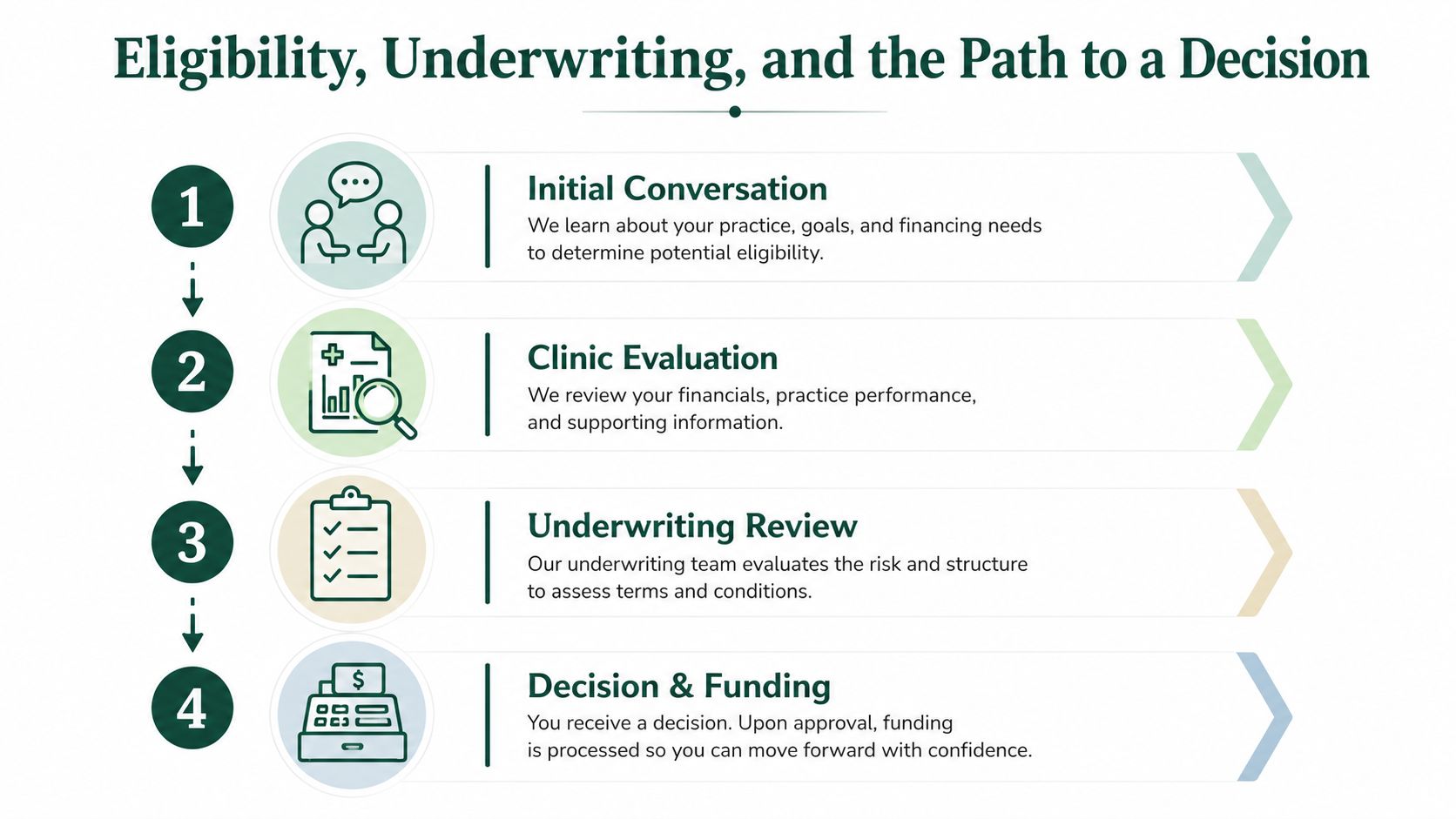
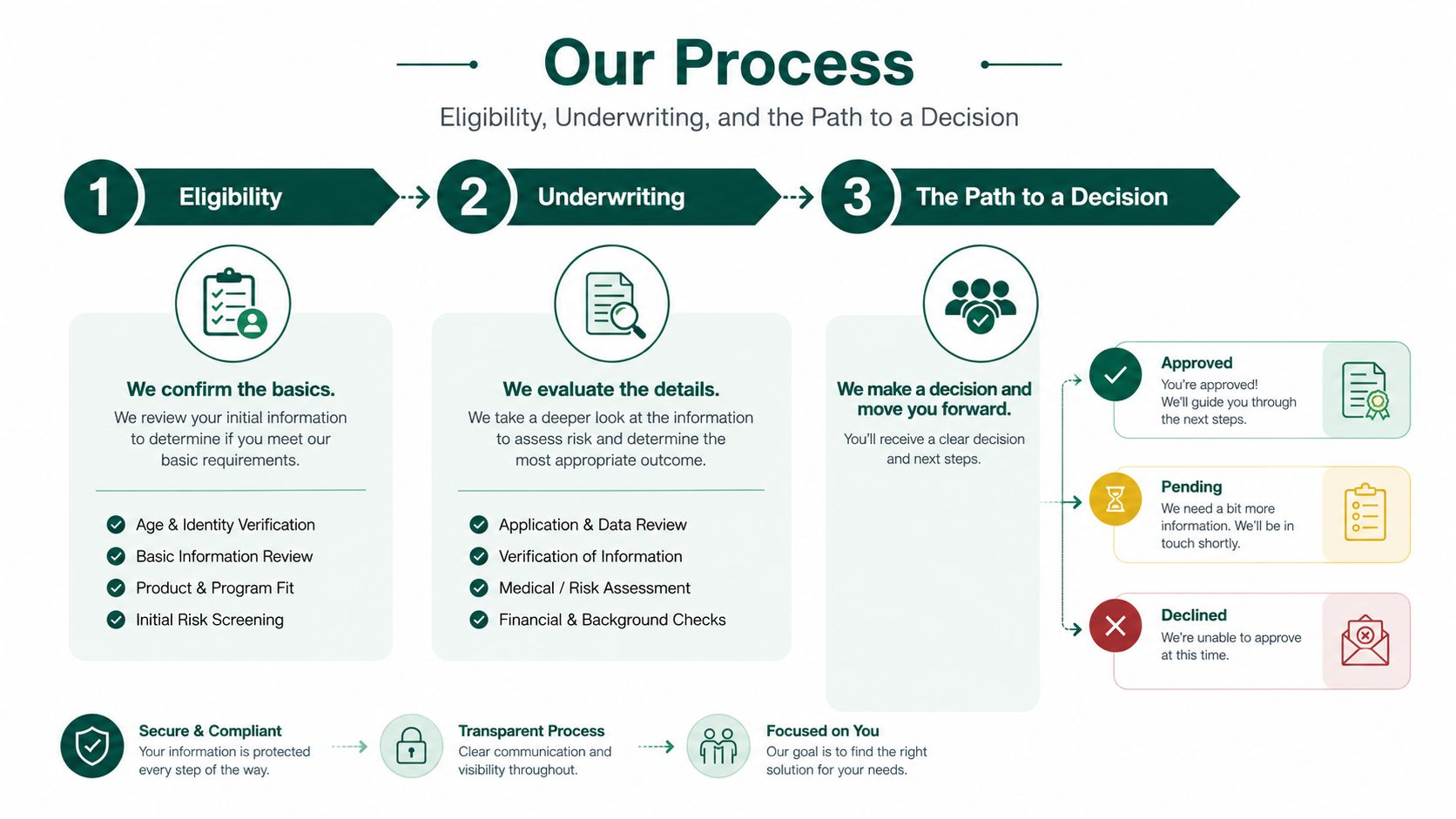
The process typically moves through an initial conversation, clinic evaluation, underwriting review, conditional approval, due diligence, commitment, and funding. Each step depends on the prior file being accurate and internally consistent.
Underwriters will test whether adjusted cash flow supports the proposed debt service. They'll also review the buyer's equity injection, collateral, industry experience, lease obligations, seller transition plan, and any assumptions that materially affect the forecast.
Where buyers lose time
The most common delays come from unexplained differences between tax returns, internal financial statements, bank deposits, and the purchase model. Unclear owner compensation, undocumented add-backs, incomplete debt schedules, and lease problems create additional review.
Give the lender one coherent story. If revenue changed, explain why. If expenses were unusual, document the reason. If the seller plans a transition, put the duties and timing in writing rather than leaving them to a verbal understanding.
Why a Fast Yes Is Not Always the Right Yes
A lender may move quickly when documentation is complete and the request fits its criteria. Some veterinary financing providers offer decisions and funding timelines that can be as fast as 24 hours when documentation is complete. That speed helps when a seller is running a competitive process, but it says nothing about whether the loan fits your long-term plan.
An approval can hide an inconvenient amortization period, a variable rate, aggressive prepayment terms, broad collateral requirements, or a personal guarantee extending beyond the practice. Those terms affect monthly payment risk and bargaining power more than the first response time.
Stress-test the offer
Before signing, require written answers from the lender and your advisors:
- Payment pressure: What happens to debt service if collections fall during a weak quarter?
- Rate exposure: Is the interest rate fixed, variable, or tied to a defined adjustment formula?
- Collateral scope: What assets secure the loan beyond the acquired practice and financed equipment?
- Guarantees: Which owners, spouses, or entities must provide guarantees?
- Future flexibility: What happens if you refinance, sell, add a partner, or move the clinic?
- Transition requirements: Does the structure limit how long the selling veterinarian can remain involved?
Review the financing structure alongside the purchase agreement. A seller who must exit operational control within 12 months in an SBA-backed deal may seek a different price, note structure, or consulting arrangement than a seller expecting a longer handoff, as discussed earlier.

A quick approval is a milestone. Read the documents before treating it as a good deal.
A Worked Acquisition Scenario for 2026
Return to Dr. Reyes and the two-doctor clinic listed at $2.4 million. For this representative model, assume the transaction includes $400,000 of goodwill and equipment and no real estate. The purpose isn't to predict a payment or declare a winner. It's to show how the same clinic can produce very different negotiations depending on the financing stack.
Path one with SBA leverage
An SBA 7(a) structure with 10% down would reduce the buyer's initial equity contribution compared with a lower-loan-to-value conventional deal. The buyer preserves more cash for working capital, but the loan carries a larger amortizing balance. That means the clinic must maintain strong cash flow after doctor compensation, payroll, inventory, taxes, and ordinary repairs.
The seller may prefer this route if the buyer can close cleanly, but SBA requirements can constrain the seller's operational role. The seller's transition plan must be designed around the requirement to exit operational control within 12 months, as noted in the 2026 veterinary industry report.
Path two with conventional financing
A conventional loan with lower debt may require more cash at closing. In exchange, the buyer could reduce the outstanding balance and potentially limit monthly payment risk, depending on the final rate, amortization, collateral, and fees.
This path makes sense when Dr. Reyes has substantial liquidity and the practice's cash flow is strong enough to support a tighter repayment schedule. It becomes less attractive if the larger equity check leaves no reserve for equipment failures, staffing changes, or an uneven opening year.
Path three with seller financing
A blended SBA-plus-seller structure can bridge a valuation gap or reduce the bank's required proceeds. The seller receives part of the consideration over time, while Dr. Reyes avoids funding the entire gap with personal cash.
That flexibility has a price. The seller note adds another payment, and the documents must coordinate senior lender rights, subordination, transition duties, and default remedies. If the seller wants a long overlap but the SBA structure limits operational control, the parties may need to separate clinical consulting from ownership authority.
The best offer isn't automatically the one with the smallest down payment. Dr. Reyes should compare cash remaining after closing, required monthly debt service, DSCR under conservative assumptions, seller transition terms, and the clinic's ability to fund the first 12 to 24 months of operations.
Next Steps, Decision Criteria, and Common Questions
Start with the use of proceeds. Write down exactly how much funds the practice purchase, goodwill, equipment, real estate, build-out, working capital, and closing costs. A vague request produces vague financing advice.
Then build the deal around four decisions:
- Payment capacity: Model the payment the clinic can survive during a weak quarter, not only during its best historical period.
- Equity contribution: Decide how much cash you can invest without draining post-closing reserves.
- Seller transition: Define the seller's clinical, training, consulting, and ownership role before you negotiate price.
- Asset allocation: Separate goodwill, equipment, real estate, and working capital so each obligation matches the asset or operating need.
Gather the financial file, request term sheets from more than one qualified lender, compare total structure rather than headline rate, and negotiate the offer only after the debt model is clear.
Common questions
How long does SBA approval take? The timeline depends on documentation, due diligence, lender review, and transaction complexity. Missing or inconsistent records can add substantial time.
Does an SBA guarantee mean less paperwork? No. The guarantee supports the lender's risk position, but the lender still needs financial, legal, ownership, collateral, and operating documentation.
How should I finance a partner buyout? Treat it like an acquisition. Verify the practice cash flow, define the departing partner's transition duties, and test whether the remaining owner can carry the new obligation without weakening operations.
What if the practice includes real estate? Ask for separate analysis of the practice and property. Owner-occupied real estate can support a longer amortization period, but it also increases the transaction's total debt and concentrates more of your financial exposure in one location.
Veterinary Practice Loans offers guidance and financing options for acquisitions, equipment, working capital, startups, and expansion projects. Visit Veterinary Practice Loans to compare structures before you commit to an offer, and bring a complete cash-flow model to the financing conversation.
