
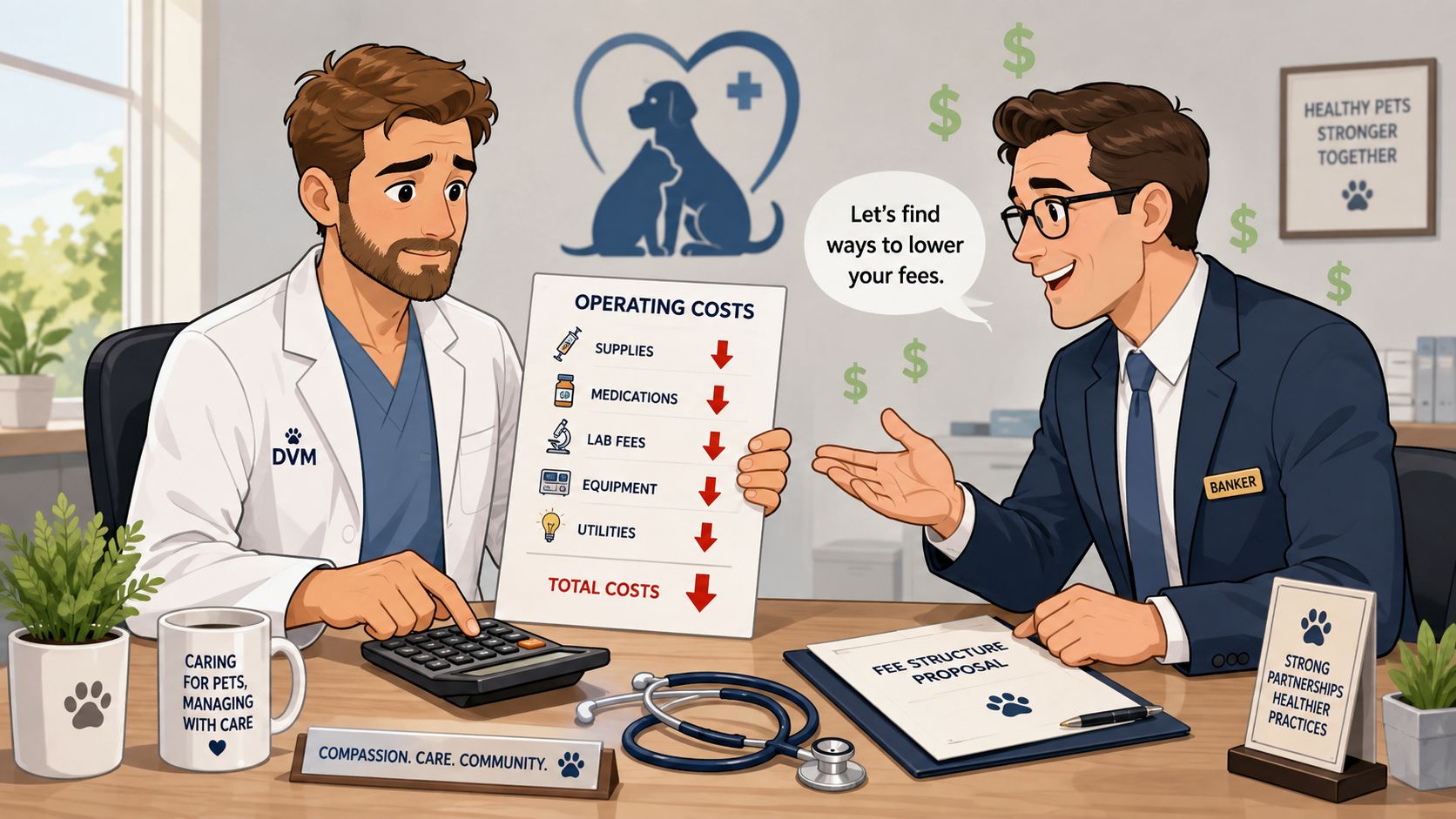
You're three weeks from buying a veterinary practice. The purchase price is settled, the seller is ready, and your lender has sent a preliminary fee sheet that seems to turn a straightforward acquisition into another major cash requirement. You're staring at origination charges, appraisal work, environmental review, title services, legal fees, prepaid interest, and government filings, wondering which items you can change.
The answer isn't to argue over every line. The fastest way to lower closing costs is to separate negotiable fees from fixed pass-through charges, then choose a loan structure that doesn't create unnecessary fees in the first place. A practice acquisition, real estate refinance, equipment purchase, and tenant improvement loan each produce a different cost profile. Treating them as the same transaction is how owners waste time and cash.
What Closing Costs Actually Include on a Veterinary Loan
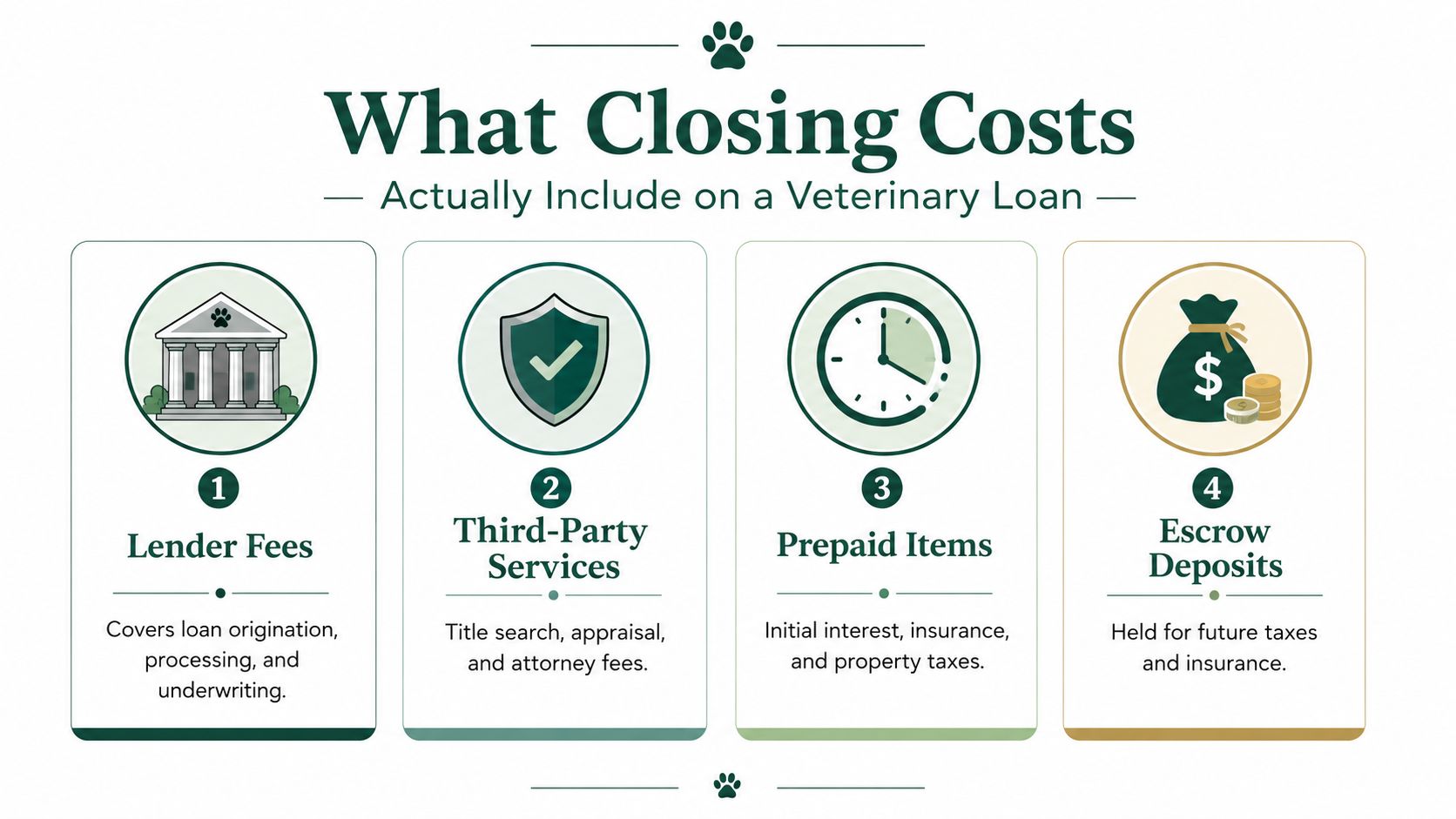
Closing costs on a veterinary loan are not one fee. They're a collection of charges paid to the lender, service providers, government offices, and sometimes the loan program itself. Before negotiating, put every charge into one of four buckets.
The four fee buckets
| Cost bucket | What it may include | How much control you have |
|---|---|---|
| Lender charges | Origination, processing, underwriting, packaging, and commitment fees | Often negotiable |
| Third-party pass-throughs | Appraisal, environmental review, title insurance, escrow, recording, flood certification, and business valuation | Some are shopable or structure-dependent |
| Prepaid items | Per diem interest, hazard insurance, property taxes, and prepaid loan expenses | Usually timing or requirement-driven |
| Program charges | SBA guarantee fees for qualifying 7(a) or 504 structures | Governed by program rules, with structure and pricing still worth reviewing |
A lender's origination fee pays for assembling and underwriting the credit request. That's a real service, but the amount may be open to negotiation. Title insurance, appraisal, and valuation work are different. The lender may require them, yet you can often question the provider, request a waiver where permitted, or ask the seller to pay an eligible charge.
Government recording fees and flood certifications generally aren't bargaining items. Don't spend your negotiating energy there. Focus first on the charges controlled by the lender, title company, appraiser, and deal structure.
Why the transaction type matters
A practice acquisition may require business valuation, goodwill analysis, title work, environmental review, and extensive legal documentation. A real estate refinance emphasizes title, appraisal, recording, and payoff costs. Equipment-only financing may have fewer third-party charges because the equipment itself secures the loan, while a tenant improvement loan may involve construction monitoring, inspections, and draws.
The Consumer Financial Protection Bureau's loan-cost guidance makes the broader principle clear: closing charges vary by transaction and must be understood before commitment. For a veterinary practice, ask the lender to identify each fee as required, estimated, negotiable, or refundable.
Practical rule: Never approve a fee sheet that only shows a total. You need the underlying categories before you can lower closing costs intelligently.
A Realistic Closing Cost Breakdown on a Practice Acquisition
Consider an $850,000 SBA 7(a) acquisition. The following example uses realistic planning figures, not a promise of what any lender must charge. The mix changes with the state, the amount of goodwill, whether real estate is included, the lender's pricing, and the complexity of the practice.
The point is to read your own estimate line by line. A fee that looks small by itself can become meaningful when combined with several other charges.
Sample Closing Cost Breakdown on an $850,000 SBA 7(a) Acquisition
| Fee Category | Typical Range | % of Total Costs | Negotiable? |
|---|---|---|---|
| Origination fee | $8,500 in this example | 17% to 19% | Often |
| SBA guarantee fee | Approximately $15,300 in this example | 31% to 34% | Limited, structure-dependent |
| Practice appraisal | $3,500 in this example | 7% to 8% | Sometimes |
| Phase I environmental review | $4,000 in this example | 8% to 9% | Sometimes, requirement-dependent |
| Title insurance and endorsements | $6,500 in this example | 13% to 14% | Often shopable |
| Escrow services | $1,800 in this example | 4% | Sometimes |
| Recording charges | $1,200 in this example | 2% to 3% | Generally no |
| Business valuation | $2,400 in this example | 5% | Sometimes |
| Prepaids and per diem interest | Approximately $2,200 in this example | 4% to 5% | Timing-dependent |
| Legal and packaging fees | Varies by scope | Varies | Often |
| Estimated total | Approximately $45,000 to $50,000 | Approximately 5.3% to 5.9% of the loan | Mixed |
The origination and SBA guarantee charges dominate this example. That's where a lender conversation can matter more than arguing over a courier charge or a small filing fee. The veterinary practice acquisition loan process also shows why acquisition financing needs a broader review than a simple equipment note.
Read the estimate like an operator
Ask three questions about every line:
- Who receives the money? Lender, government office, title company, appraiser, attorney, or escrow agent.
- What triggers the charge? The loan program, the property, the transaction type, or the lender's internal process.
- Can the charge be eliminated, reduced, delayed, or paid by the seller?
A $45,000 to $50,000 planning range can feel alarming, but the useful question isn't whether every dollar disappears. It's whether the lender has included a fee that belongs in another product, duplicated a service, or failed to credit a seller-paid expense.
Choosing the Right Loan Product to Minimize Fees
The cheapest closing table usually starts with the right loan product. Negotiation matters, but it can't fully repair a structure that combines goodwill, equipment, real estate, and working capital under a program that charges for features you don't need.
Compare the structures before you negotiate
| Product | Typical Fees | Down Payment | Closing Speed | Best For |
|---|---|---|---|---|
| SBA 7(a) | SBA guarantee charge, lender fees, third-party diligence | Can support high financing levels when approved | Usually slower than conventional financing | Acquisitions involving goodwill, working capital, and flexible uses |
| SBA 504 | Program and CDC-related charges across a more structured arrangement | Depends on project and lender structure | More involved because of the two-part structure | Eligible fixed assets and real estate-heavy projects |
| Conventional bank loan | Lender origination, appraisal, title, legal, and other diligence | Often requires a larger equity contribution | Often faster than SBA structures | Strong borrowers with conventional cash flow and collateral |
| Equipment financing | Equipment documentation and lender fees, often fewer transaction-level services | Depends on equipment and credit structure | Often faster for a defined asset purchase | Imaging, surgical, dental, laboratory, and information technology equipment |
SBA 7(a) financing can be attractive because it accommodates goodwill and working capital, but it carries a guarantee charge and more documentation. SBA 504 financing may fit a real estate or fixed-asset project, yet its use-of-funds rules are less flexible. Conventional financing avoids the SBA guarantee charge, but the lender may require more equity and stronger collateral.
Equipment financing solves a different problem. It can reduce closing friction for chairs, imaging systems, and laboratory equipment, but it usually won't fund practice goodwill or broad working capital.
Split the financing when the math supports it
A $600,000 acquisition made up mostly of goodwill, paired with a separate $120,000 equipment note, can be more efficient than forcing every use into one blended SBA loan. The separate equipment structure may reduce the amount of broad acquisition diligence attached to the equipment portion, while preserving acquisition financing for the asset that needs it.
Don't choose based on the lowest stated fee alone. Compare total cash required, rate, amortization, prepayment terms, collateral, and the cost of preserving liquidity. The SBA loan options for veterinary practices should be evaluated against conventional and equipment structures before you ask a lender to discount fees.
Negotiating Lender Fees, Title Charges, and Appraisals
Three categories deserve your attention first: origination, title, and appraisal. These charges have genuine flexibility, unlike government filing fees and other mandatory pass-throughs.
Start with the lender
Ask the lender to reduce or cap the origination fee, particularly when the file is clean, the practice has strong cash flow, or you're providing a well-organized package. A lender may be more willing to adjust pricing at the commitment stage than after the appraisal is ordered and closing documents are drafted.
Get the concession in writing. A verbal statement that “we can probably help with fees” has no value until the commitment or fee schedule identifies the exact reduction.
Audit the title quote
Request the title company's complete fee sheet. It should separate the insurance premium from endorsements, searches, escrow charges, courier fees, wire fees, and administrative items.
Title work can be one of the larger third-party expenses on a transaction involving real estate. On a refinance, ask whether a reissue rate is available. On an acquisition, ask which coverage the lender requires and whether the seller's existing title work can support any permitted efficiency.
Independent guidance places appraisal costs around $300 to $700 and title search or title insurance around $500 to $2,500, while also noting that waivers and reissue discounts may be available in the right circumstances through this closing-cost reduction guidance. Those are planning benchmarks, not guaranteed prices for a veterinary loan.
Challenge the appraisal requirement carefully
Ask whether the lender will accept an automated valuation, a recent appraisal, or a waiver. Some lenders may consider those alternatives when the collateral and credit profile satisfy their requirements. Don't assume a waiver is available, and don't order an independent appraisal without confirming that the lender can use it.
The strongest negotiation happens before the lender orders the service. After the invoice arrives, your leverage is mostly gone.
Timing, Documentation, and Seller Concessions That Move the Needle
The biggest savings often come from controlling the process, not shaving a small amount from one fee. A delayed closing can create new diligence, revised rate terms, expired commitments, and repeated legal work. Clean documentation protects both your timeline and your pricing.
Submit a complete file once
Give the lender a coherent package on the first submission. Include practice financial statements, production reports by doctor, tax returns, equipment schedules, the purchase agreement, entity documents, and a clear explanation of the sources and uses.
Missing documents create more than administrative frustration. Each resubmission can restart questions, delay third-party orders, and expose the transaction to a different rate sheet or revised underwriting condition. Use the lender's checklist as a closing-control document, not a casual request list.
Negotiate concessions in the purchase agreement
Seller concessions reduce the cash you need at closing when the seller agrees to pay eligible transaction costs. The Consumer Financial Protection Bureau's explanation of loan costs states that buyers negotiate directly with the seller for seller-paid closing costs. That distinction matters. The lender can approve the structure, but the seller must agree to the concession.
Older HUD policy materials have capped seller concessions in some FHA contexts at 3% or $6,000, whichever is greater, while some HUD homes and programs have allowed up to 6%. Those figures don't establish the limit for a veterinary acquisition, so your lender and counsel must confirm the applicable SBA or conventional rules.
A few percentage points on a $450,000 purchase can shift thousands of dollars of eligible fees away from your cash at closing, as the verified consumer guidance illustrates. Fannie Mae's 1.1 million-loan sample also found that low-income first-time buyers had median closing costs 13% higher than all homebuyers and 19% higher than non-low-income repeat buyers, which reinforces the value of concessions for buyers with less liquidity. Those housing findings aren't veterinary-loan underwriting rules, but the cash-flow lesson applies directly to a new practice owner.
Don't wait until signing. Put the concession amount, eligible uses, and responsible party into the purchase agreement and related addenda before underwriting is complete. Use the veterinary loan process timeline to work backward from the intended closing date.
When Lender Credits and Points Quietly Cost More Than They Save
A lender credit reduces the cash you bring to closing, but it isn't free. The CFPB's explanation of lender credits and discount points explains the trade-off plainly. Lender credits lower upfront costs in exchange for a higher interest rate, while discount points increase upfront costs in exchange for a lower rate.
The right decision depends on how long you'll keep the loan and how much liquidity the practice needs after closing. A credit may be sensible when your cash reserve is thin and the higher payment fits the practice's projected cash flow. It may be a poor choice when you expect to refinance, sell, or restructure before the higher-rate cost has been recovered.
Run the breakeven calculation
Compare the upfront savings with the additional monthly cost created by the higher rate. Then divide the upfront savings by the monthly increase. That gives you the approximate number of months required to break even.
For discount points, reverse the calculation. Compare the upfront payment with the monthly savings from the lower rate. If the practice may outgrow the facility, add a second location, or refinance after a relatively short ownership period, paying points can be especially inefficient.
Don't judge the loan by the settlement statement alone. Review total interest, cash retained, monthly debt service, prepayment provisions, and your realistic holding period. A structure that preserves cash for payroll, repairs, inventory, or expansion can be valuable, but only if the long-term rate cost remains acceptable.
A Pre-Closing Checklist for Practice Owners
Run this checklist two to four weeks before signing the loan commitment. You're looking for written answers, not informal assurances.
Product selection
- Confirm the financing split: Recheck whether acquisition, equipment, real estate, and working capital still belong in the same loan.
- Compare total cash required: Review equity, lender fees, third-party costs, reserves, and prepaids together.
- Review the exit terms: Confirm the rate structure, amortization, prepayment provisions, and any balloon or renewal risk.
- Test liquidity after closing: Make sure the structure leaves enough cash for payroll, supplies, repairs, and operating volatility.
Lender and third-party negotiation
- Request an origination cap: Ask for the exact fee in writing before commitment.
- Obtain two appraisal quotes within 48 hours: Confirm whether both appraisers meet lender requirements and whether a waiver is possible.
- Demand a complete title fee sheet: Separate premiums, endorsements, escrow, search, wire, and administrative charges.
- Challenge environmental scope: Ask whether the review is required for the property and whether the lender accepts an existing report.
- Confirm valuation requirements: Determine whether the business valuation duplicates work already completed for underwriting.
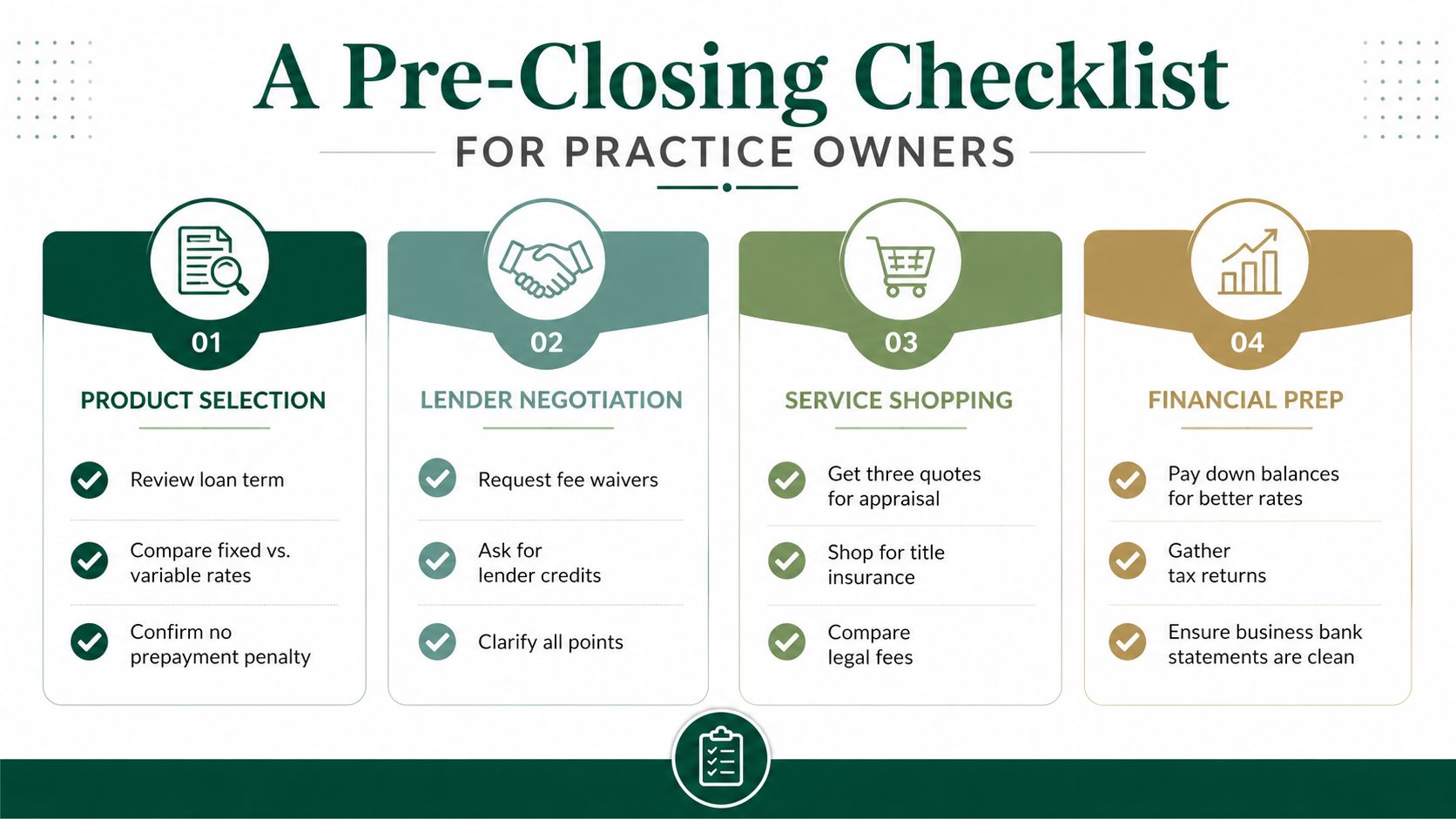
Deal structure and documentation
- Lock the rate deliberately: Compare the lock period with the expected closing date and identify the cost of an extension.
- Choose credits or points using breakeven math: Put the calculation beside your expected ownership period.
- Capture seller concessions in writing: Add the amount, eligible expenses, and deadlines to the purchase documents.
- Reconcile the sources and uses: Make sure every fee appears once and that the seller credit is applied correctly.
- Refresh entity documents: Confirm that formation records, ownership information, resolutions, and authority documents are current.
- Clean up financial support: Provide final tax returns, practice statements, bank statements, production reports, and equipment lists in the lender's requested format.
Three failures appear repeatedly at the last minute: unsigned seller-concession addenda, stale entity paperwork, and rate-lock expirations. Each can force a revised approval, a delayed closing, or a new fee stack.
The best way to lower closing costs on a veterinary loan is to make the major decisions before the lender orders services. Send your deal structure, fee sheet, and purchase documents to Veterinary Practice Loans for a veterinary-focused review, then ask for a clear comparison of SBA, conventional, and equipment financing so you can preserve cash without accepting a more expensive loan by accident.
