

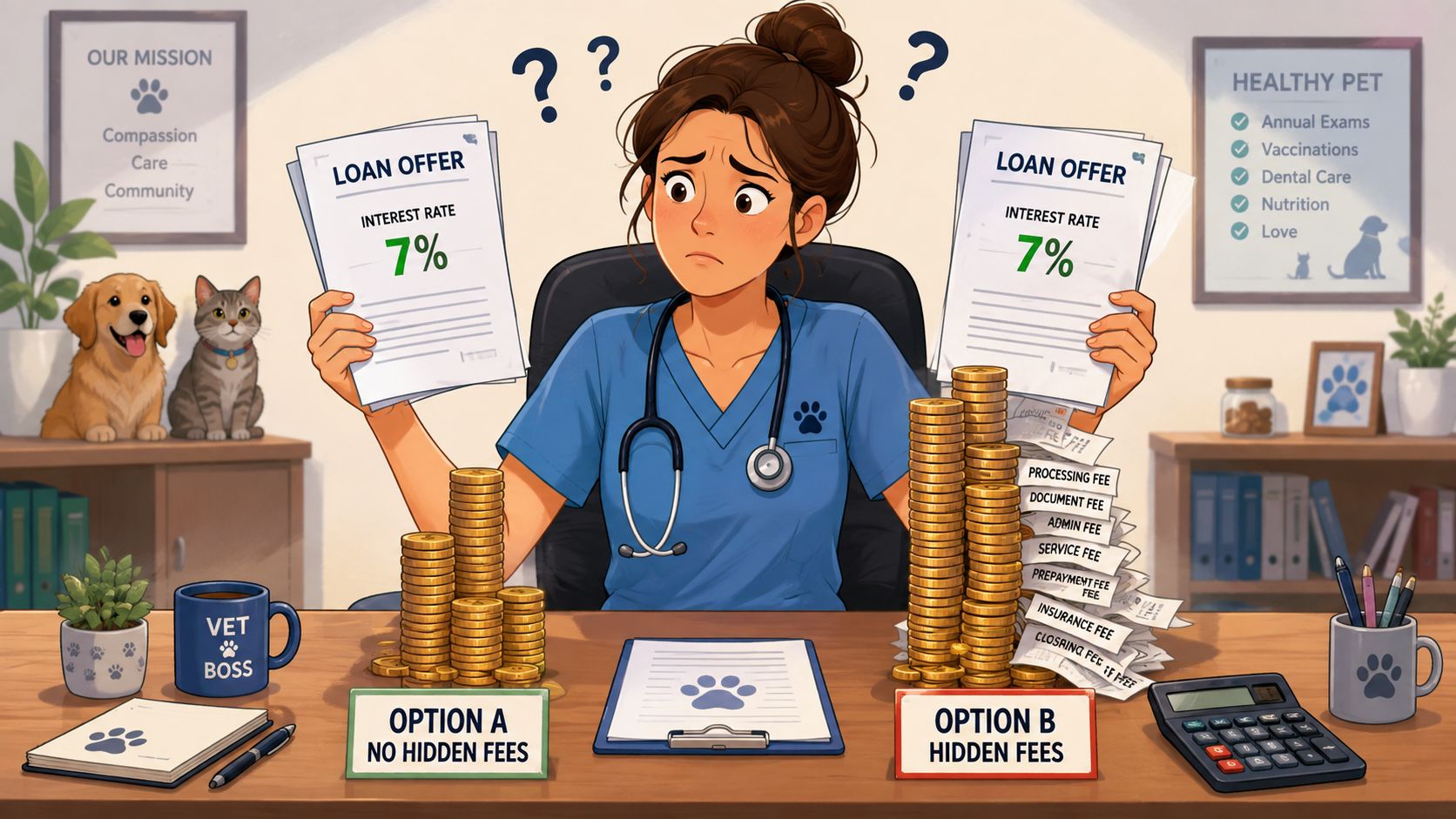
You're reviewing two term sheets for the same veterinary practice acquisition. Both advertise the same interest rate, require a similar down payment, and appear to produce manageable monthly payments. One lender, however, charges an origination fee, amortizes the balance faster, requires additional collateral, and imposes a prepayment penalty. The other has a slightly more restrictive covenant package but gives you a longer repayment schedule and greater flexibility to refinance.
The advertised rate doesn't tell you which loan protects your clinic's cash flow. Total cost of capital does. It captures the price of debt, the return expected on owner capital, tax effects, fees, repayment timing, collateral demands, and the risk that the financing structure creates for payroll, inventory, equipment, and expansion.
Why Two Identical Loan Offers Can Cost You Very Differently
A practice owner I'll call Dr. Morgan recently faced this exact decision. The acquisition target was attractive, the seller wanted a timely closing, and two lenders returned offers that looked nearly interchangeable at first glance. The headline interest rate was the same, and each lender described the loan as a practical fit for an established clinic.
The first offer required an upfront fee and placed that amount into the financed balance. It also used a faster amortization schedule, so the monthly payment consumed more operating cash. The loan could be paid off early, but only after a penalty period. The second offer carried a similar rate, yet its repayment schedule better matched the practice's expected cash generation and permitted an earlier payoff without the same charge.
Dr. Morgan initially focused on the monthly payment. That's a common mistake. A lower payment can reflect a longer repayment period, which may preserve cash now but increase interest paid over the life of the loan. A higher payment may reduce total interest while creating too much pressure during a slow month or an acquisition ramp-up.
The rate is only one line on the offer
Your comparison should include:
- Upfront charges: Origination fees, closing costs, documentation charges, and any financed fee increase the amount you repay.
- Payment timing: A lender may calculate or collect interest differently depending on when funds are advanced and when payments begin.
- Amortization: Faster repayment can reduce interest but increase the monthly draw on clinic cash.
- Collateral: Pledging real estate or other assets can restrict future borrowing and increase the economic cost of the loan.
- Prepayment terms: A penalty can make refinancing, selling, or restructuring more expensive when the practice's needs change.
A loan also has an operational cost. If debt service leaves you unable to replace a critical anesthesia machine, maintain adequate pharmaceutical inventory, or hire a needed technician, the financing may be cheap on paper and expensive in practice.
Practical rule: Compare what leaves the clinic's bank account, when it leaves, and what flexibility disappears when you sign.
The right question isn't, “Which lender has the lowest rate?” Ask, “Which structure gives this practice enough liquidity to operate while creating an acceptable all-in return on the capital invested?”
The Total Cost of Capital Formula Explained for Clinic Owners
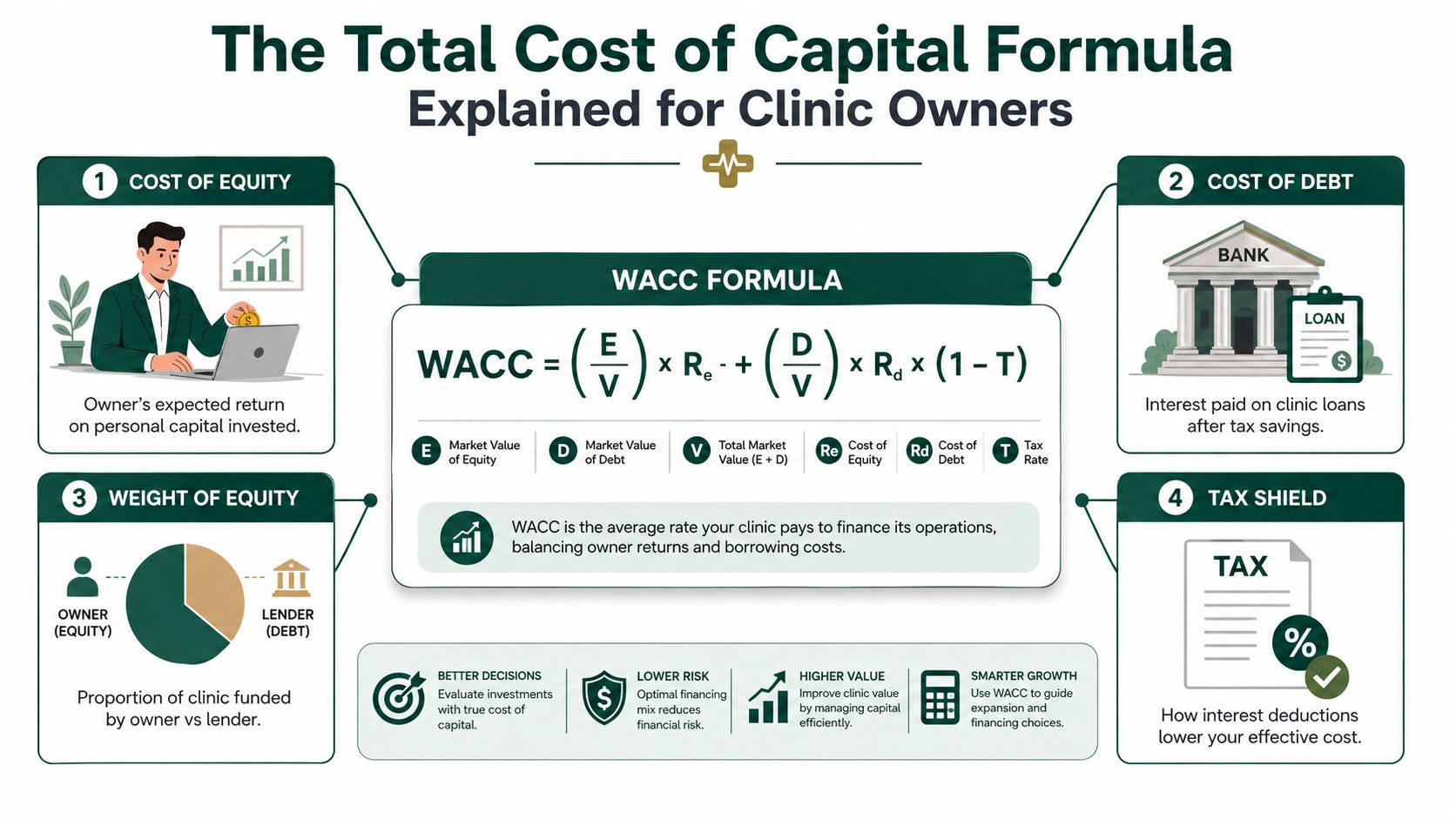
The concept is usually measured through weighted average cost of capital, or WACC. The standard formulation combines the cost of equity with the after-tax cost of debt according to each source's share of total financing:
WACC = E/V × Re + D/V × Rd × (1 − Tc)
The framework is described in the government reference on the cost of capital, which explains why a business funded entirely with equity could treat the expected equity return as its cost of capital. Most practices use a blend of owner capital and borrowed money, so the weighted measure is more useful.
Translate each variable into clinic language
- E means equity. This is the owner's capital, including money invested into an acquisition, startup, renovation, or expansion. The related cost is Re, the return the owner expects for committing personal capital and accepting business risk.
- D means debt. This includes an acquisition loan, equipment loan, working capital facility, or other borrowing. Rd is the lender's interest cost before considering tax effects.
- V means total financing. It equals the combined equity and debt funding used for the investment.
- Tc means the corporate tax rate. Interest may create a tax benefit, so the after-tax debt cost can be lower than the stated interest rate when the practice can use that deduction under its tax circumstances.
The formula doesn't say that debt is always cheaper or that more use of borrowed funds is always better. It shows how financing sources interact. Debt may lower the weighted cost because interest is contractually priced and may receive a tax benefit, but excessive debt creates fixed payments that the practice must meet even when visits, procedures, or collections soften.
A simplified acquisition example
Suppose a clinic acquisition and related investment require $1.2 million, funded with $300,000 of owner equity and $900,000 of debt. Equity represents one-quarter of the financing, while debt represents three-quarters. If the owner's required return is 12%, the loan's stated cost is 8%, and the applicable tax rate is 25%, the calculation is:
WACC = 25% × 12% + 75% × 8% × (1 − 25%)
That produces a weighted figure of 7.5% before considering loan fees, prepayment charges, timing effects, collateral restrictions, and other terms. Those omitted items matter. A loan with an 8% stated rate can have a higher effective cost if fees are substantial or the repayment schedule forces cash out of the clinic before revenue arrives.
The industry WACC dataset published by NYU Stern reinforces an important point: cost of capital varies by industry, beta, debt cost, tax rate, and capital structure. A veterinary practice shouldn't copy a public-company benchmark and call the decision complete.
The formula is a starting point. Your underwriting decision must convert it into a cash-flow schedule that reflects how the clinic collects revenue and pays expenses.
Hidden Cost Drivers That Change Your Real Borrowing Price
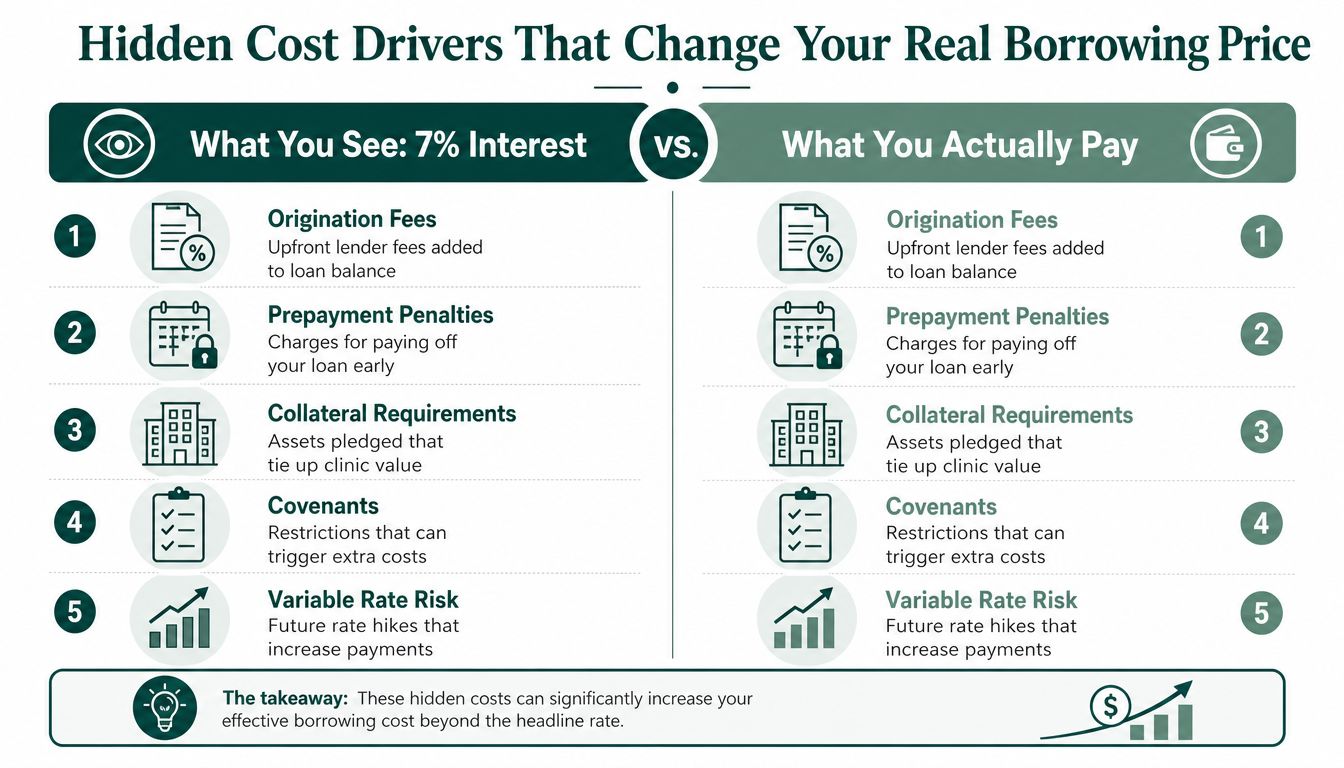
Headline interest rates are useful for screening loan offers. They're not enough for choosing between them. A practical 2026 small-business financing snapshot lists bank term loans around 6.3%–11.5%, SBA loans around 9.75%–14.75%, lines of credit around 10%–28%, and alternative financing around 10%–40%, as reported in this 2026 small-business rate snapshot. Those ranges are broad because the product, borrower, collateral, repayment structure, and risk profile all affect the price.
Fees turn a stated rate into an all-in cost
An origination fee reduces the proceeds you receive or increases the balance you repay. If you need a specific amount at closing, a fee deducted from proceeds may force you to borrow more. A fee added to the balance increases interest charges because you're paying to finance the fee itself.
Closing charges deserve the same treatment. Legal review, appraisal requirements, lender documentation, and other transaction costs may not appear in the advertised rate, but they still reduce the economic value of the financing.
Payment timing also changes the result. A practice that receives acquisition proceeds immediately but doesn't generate its normal collections until later may need interest-only time, a delayed first payment, or a working capital reserve. Those features can be worth more than a small rate difference if they prevent the owner from draining operating cash.
Amortization and penalties affect flexibility
A shorter amortization schedule usually means faster principal reduction and potentially less interest over time. It also creates a larger fixed payment. For a veterinary clinic, that payment competes with payroll, laboratory supplies, pharmaceuticals, rent, repairs, and planned equipment purchases.
A prepayment penalty has an opportunity cost. It can discourage refinancing when rates improve, limit the owner's ability to sell, or make a partner buyout harder to structure. Collateral requirements can have a similar effect by tying up assets that might otherwise support a future expansion loan.
Use the guide to veterinary practice loan terms and repayment options to organize the comparison. Put every economic term into one schedule, including the amount funded, net proceeds, payment dates, fees, collateral, covenants, and payoff cost.
Cash-flow test: If the offer looks attractive only because you ignored the fee, shortened payment window, or payoff restriction, it isn't an attractive offer.
Comparing SBA, Conventional, and Alternative Loan Structures
A clean comparison requires the same transaction assumptions. Consider a $1.2 million practice acquisition funded with $300,000 of owner equity and $900,000 of borrowing. The figures below are an analytical illustration, not a quotation or promise of terms. The purpose is to show how structure changes the result, not to predict a lender's approval or pricing.
| Metric | SBA 7(a) | Conventional Bank | Alternative Lender |
|---|---|---|---|
| Acquisition price | $1.2M | $1.2M | $1.2M |
| Owner equity | $300,000 | $300,000 | $300,000 |
| Borrowed amount before fees | $900,000 | $900,000 | $900,000 |
| Illustrative stated rate | 10% | 8% | 14% |
| Illustrative fee treatment | Fee financed into balance | Fee paid at closing | Fee deducted from proceeds |
| Repayment emphasis | Longer amortization | Faster amortization | Shorter, heavier repayment |
| Primary cash-flow benefit | Lower initial payment pressure | Lower rate and faster principal reduction | Speed and flexibility |
| Primary risk | Higher stated debt cost | Larger scheduled payment | High all-in cost and refinancing pressure |
The SBA structure may carry the highest rate among the traditional options, but a longer amortization can reduce the monthly burden during the transition. That matters when the buyer expects staffing changes, retention work, or a gradual handoff from the selling veterinarian. The trade-off is that the practice may pay interest for longer and face program-related fees or documentation requirements.
The conventional bank structure may offer the lowest stated rate, yet faster amortization can create the largest scheduled payment. It can be the best economic choice for a clinic with reliable collections, strong reserves, and predictable operating margins. It's a poor fit if the owner must use operating cash to cover the payment during a ramp-up period.
An alternative structure may close faster or require less conventional documentation, but the rate range is often wider and the repayment method can create more pressure. A short term, frequent payment schedule, or factor-based charge can make the APR-equivalent cost much higher than the marketing language suggests.
Read the table through the clinic's cash account
The decision comes down to three questions:
- How much cash arrives at closing? A fee deducted from proceeds may leave you short of the funds needed for inventory, payroll, renovations, or working capital.
- How much cash leaves each payment period? The scheduled payment must fit the clinic's low-revenue periods, not only its strongest months.
- What happens if the plan changes? Review the payoff amount, restrictions on refinancing, collateral release, and consequences of missed covenants.
For owners evaluating a government-backed structure, the SBA loan options for veterinary practices can provide a useful starting point for understanding how that financing category may fit an acquisition.
A lower WACC on paper doesn't automatically win. The winning structure is the one that produces an acceptable all-in cost without creating a payment schedule the practice can't comfortably support.
Adjusting Capital Cost Decisions for Practice-Specific Risks
Generic WACC benchmarks can mislead veterinary practice owners because a private clinic doesn't behave like a diversified public company. The industry benchmark discussion notes that sector WACC varies widely and places the U.S. market cross-check around 6.96% in 2026. It also reports KPMG's increase from 7.9% to 8.3% in its 2024 study, while Australian regulated WACC estimates rose 40 basis points to 4.4% in 2025. Those figures provide context, not a borrowing target for your clinic.
A practice has concentrated operational risk. Revenue may depend on a small number of doctors, a local referral pattern, one facility, and a specific staffing model. A private acquisition also carries transition risk that a broad industry index won't capture.

Match repayment timing to revenue timing
Seasonal cash flow should influence the structure. If collections soften during predictable periods, a loan with rigid payments may have a higher practical cost than a more flexible facility, even when its stated rate is lower. Preserve enough liquidity for payroll and medical inventory before using excess cash for optional principal reduction.
An acquisition ramp-up creates another mismatch. Patient records may transfer smoothly, but staff retention, doctor productivity, appointment utilization, and client acceptance can take time to stabilize. Financing that assumes immediate peak performance forces the buyer to fund the transition personally or draw additional debt.
Multi-location expansion adds a different risk. The first clinic may support the second location eventually, but the new site can require build-out, recruiting, equipment, and marketing before it produces dependable cash flow. Don't use a short repayment schedule for a long-ramp asset unless you have a separate liquidity plan.
Let asset life guide the debt
A diagnostic imaging system and a facility renovation don't create value on the same timetable. Financing a long-lived improvement with very short debt can make the clinic pay for the asset before the asset has generated its expected revenue. Financing a quickly obsolete piece of equipment over an unnecessarily long period can leave debt outstanding after the equipment has lost utility.
You may rationally accept a higher capital cost for:
- Flexible draws: Useful when working capital needs arrive unevenly.
- Delayed payments: Helpful during acquisition handoff or construction.
- Lower collateral demands: Valuable when preserving borrowing capacity matters.
- Clear payoff rights: Important if a future refinance or sale is likely.
The benchmark is a reference point. Your actual decision should reflect the practice's concentration, seasonality, expansion schedule, asset life, and cash reserves.
Running Sensitivity Analysis on Your Loan Scenarios
A loan model should show what happens when the plan misses. Don't build a forecast that assumes steady collections, immediate staffing stability, and no equipment surprises. Build a base case, then deliberately weaken the assumptions that matter most to clinic cash flow.
Start with a transparent base case
Create a month-by-month schedule containing:
- Operating cash flow: Collections, payroll, rent, supplies, taxes, and other recurring expenses.
- Debt service: Interest, principal, fees financed into the balance, and any line-of-credit draws.
- Working capital: Cash required for inventory, payroll timing, repairs, and planned purchases.
- Owner distributions: Amounts you expect to remove after debt service and reserve requirements.
- Exit or refinance assumptions: Payoff balance, prepayment charge, and expected timing.
The working capital line deserves special attention. Use this working capital needs guide for veterinary practices to separate operating reserves from acquisition funds and equipment budgets.
Test the failure points
Run separate scenarios rather than burying several changes in one vague downside case:
- Volume decline: Model patient volume dropping 15% and assess whether payroll, debt service, and inventory remain funded.
- Rate movement: Increase the borrowing cost on any variable-rate balance and recalculate each payment period.
- Delayed ramp-up: Push the expected revenue stabilization later and measure how long reserves last.
- Working capital draw: Add a line-of-credit draw during a slow month, including its fees and repayment schedule.
- Early payoff: Calculate the payoff amount under each offer and include any penalty or required notice period.
Rank the results by severity. A scenario that slightly raises interest expense may be tolerable. A scenario that forces the owner to miss payroll, delay a critical repair, or refinance under pressure is a structural problem.
Decision standard: Choose financing that survives a reasonable downside case without forcing a distressed decision.
Sensitivity analysis doesn't predict the future. It shows which assumptions can break the deal and whether the loan gives you enough room to respond.
Making Your Final Financing Decision
Choose the offer that balances all-in cost, payment capacity, flexibility, collateral exposure, and strategic fit. Don't select a loan because its rate is lowest, its payment is smallest, or its approval arrived first.
Before signing, ask the lender:
- What is the exact net amount funded after every fee?
- Which fees are financed, and do they accrue interest?
- How does the payment change if the rate changes?
- What is the full payoff amount on specific future dates?
- Are there prepayment penalties, covenants, or required deposits?
- Which assets are pledged, and when are they released?
- Can the structure support a ramp-up, expansion, or equipment purchase?
Accept a higher cost when it buys flexibility that protects clinic cash flow during a transition. Optimize for the lowest total cost when collections are stable, reserves are strong, the payment schedule fits comfortably, and you don't expect to refinance or expand soon. The right loan is the one your practice can operate through, not merely the one that looks cheapest in a term-sheet comparison.
Veterinary Practice Loans helps veterinarians evaluate financing for acquisitions, equipment, working capital, build-outs, and expansion while comparing amortization, fees, repayment terms, and total cost of capital. Visit Veterinary Practice Loans to review financing options and start a conversation about the structure that fits your clinic's cash flow.
