

Tuesday morning, the clinic looks busy and healthy. Appointments are full, the pharmacy shelves are stocked, and the team is preparing for Friday payroll. Then you notice the problem: a dermatology order is due now, while a corporate wellness-plan receivable won't arrive until the middle of the month. The practice may be profitable on paper and still face a cash shortage before the next deposit clears.
That's the operating reality behind how to calculate working capital needs for a veterinary clinic. You're not just measuring cash on hand. You're measuring how long money remains tied up in inventory and receivables before it becomes available to pay staff, suppliers, and other operating bills. The calculation should lead directly to a financing decision sized around that gap.
What Working Capital Really Means for a Veterinary Clinic
Working capital starts with a straightforward balance-sheet equation:
Working capital = current assets − current liabilities
Current assets generally include cash, accounts receivable, and inventory. Current liabilities include accounts payable, accrued expenses, and short-term obligations. The related working capital ratio is:
Current assets ÷ current liabilities
That ratio helps you assess whether the clinic has enough short-term assets to cover upcoming obligations. The dollar figure tells you how much is left after subtracting those obligations. Both are useful, but neither shows the timing of cash movement by itself.
A veterinary clinic has distinctive pressure points. Payroll may arrive on a recurring schedule before wellness-plan payments do. Vaccines, pharmaceuticals, prescription diets, and consumable supplies can absorb cash well before the clinic dispenses them. A practice also may carry receivables from employer programs or third-party arrangements that follow billing schedules different from ordinary client payments.

Use the balance sheet first
Pull the clinic's operating current assets and operating current liabilities from the same reporting date. Exclude items that don't support the daily conversion of services and inventory into cash. For an operating view, use:
Operating working capital requirement = operating current assets − operating current liabilities
That distinction matters. A clinic can show positive working capital because of a one-time cash balance while still having a recurring payroll and inventory timing problem.
Then measure the timing gap
The cash conversion cycle adds the missing operational context. It measures the period between paying suppliers and collecting customer cash, using:
CCC = DIO + DSO − DPO
A longer cycle usually means more working capital is tied up in operations, while a shorter cycle releases cash sooner. Working capital metrics guidance describes this framework as a practical way to connect short-term assets and liabilities to the cash gap.
Practical rule: A positive balance-sheet figure doesn't guarantee that Friday payroll is funded. Review the calendar, not just the balance sheet.
The Cash Conversion Cycle Formula Explained
The cash conversion cycle has three moving parts. Each one reflects a different decision inside the clinic.
Days Inventory Outstanding, or DIO, measures how long inventory remains in the business before it's sold or used. For a veterinary practice, that includes vaccines, controlled medications, prescription diets, parasite treatments, and procedure supplies. The formula is:
DIO = average inventory ÷ COGS × 365
Use average inventory rather than a single month-end balance when possible. A month-end count can look unusually high after a large pharmaceutical delivery and unusually low after a busy dispensing period.
Days Sales Outstanding, or DSO, measures how long it takes to collect receivables:
DSO = average accounts receivable ÷ revenue × 365
Pet-owner payments may arrive quickly, while corporate wellness plans or third-party arrangements may follow a scheduled billing cycle. Separate those receivable streams in your analysis. A blended DSO can hide the payer responsible for the delay.
Days Payable Outstanding, or DPO, measures how long the clinic takes to pay suppliers:
DPO = accounts payable ÷ COGS × 365
Supplier terms affect this number, but stretching payments without agreement can damage supply relationships. The goal isn't to pay late. It's to use the available payment window responsibly.

Work the example
Suppose inventory sits for 45 days, receivables collect in 30 days, and supplier bills are paid in 20 days. The calculation is:
CCC = 45 + 30 − 20 = 55 days
The clinic must finance a 55-day cash gap through retained cash, credit, or a loan. To convert that gap into dollars, multiply the cycle by average daily operating cost. If annual operating cost is represented by a chosen annualized cost figure, calculate:
Daily operating cost = annual operating cost ÷ 365
Then:
Working capital funding need = CCC ÷ 365 × annual operating cost
The cash conversion cycle guide explains why this approach is useful for comparing inventory, collection, and supplier-payment timing. A clinic with faster collections or leaner inventory needs less funding. A clinic with slower collections and heavy stock commitments needs more.
A Companion Animal Clinic Walkthrough
Consider a fictional three-doctor companion animal clinic with annual revenue of $1.6 million. The practice is profitable, but its cash position changes sharply as payroll, inventory orders, laboratory bills, and wellness-plan collections move on different schedules.
The owner begins with a monthly cash-flow view rather than relying on annual profit. February includes a large payroll obligation. March brings vaccine and parasiticide restocking ahead of spring wellness visits. April carries laboratory send-out costs, while receivables arrive in staggered batches from corporate plans.
| Month | Payroll | Drug Inventory | AR Inflows | AP Outflows | Net Cash Position |
|---|---|---|---|---|---|
| February | High | Moderate | Moderate | Moderate | Tight |
| March | High | High | Delayed | Moderate | Deficit |
| April | Moderate | Moderate | Stronger | High | Recovering |
| May | Moderate | Lower | Regular | Moderate | Surplus |
The table uses qualitative labels because the clinic's actual dollar requirement depends on its payroll register, inventory ledger, receivable aging, supplier terms, and operating-cost base. Don't replace those records with a round estimate. The purpose of the walkthrough is to show why a profitable practice can still run short in a particular month.
Balance-sheet method
At the March pressure point, the owner totals operating current assets, including cash available for operations, collectible receivables, and usable inventory. The owner then subtracts operating current liabilities, including supplier payables and accrued payroll.
Operating working capital requirement = operating current assets − operating current liabilities
This figure gives a snapshot. It shows the amount invested in the operating cycle at that date, but it can be distorted by the timing of a delivery, payroll run, or receivable deposit.
Operating-cycle method
The owner separately calculates DIO, DSO, and DPO from balance-sheet averages and period flows. The resulting CCC is then multiplied by average daily operating cost, following the operating-cycle method described in this working capital calculation framework.
The two methods should be reconciled, not forced to match perfectly. If the balance-sheet method shows a much larger need than the cycle method, investigate uncollectible receivables, excess stock, accrued payroll, prepaid items, or liabilities omitted from the operating view.
A cash shortage in March doesn't prove the clinic is unprofitable. It proves that the clinic has to finance activity before the related cash arrives.
The owner should identify the months in which external funding is required and the months that generate surplus cash. A revolving facility can cover the deficit months and be repaid during stronger collection periods. A term loan may be less suitable if the need rises and falls with the operating cycle.
Building a Working Capital Spreadsheet Template
Build the spreadsheet on one tab so the owner, manager, accountant, and lender can review the same logic. Keep assumptions visible and separate from calculated fields.
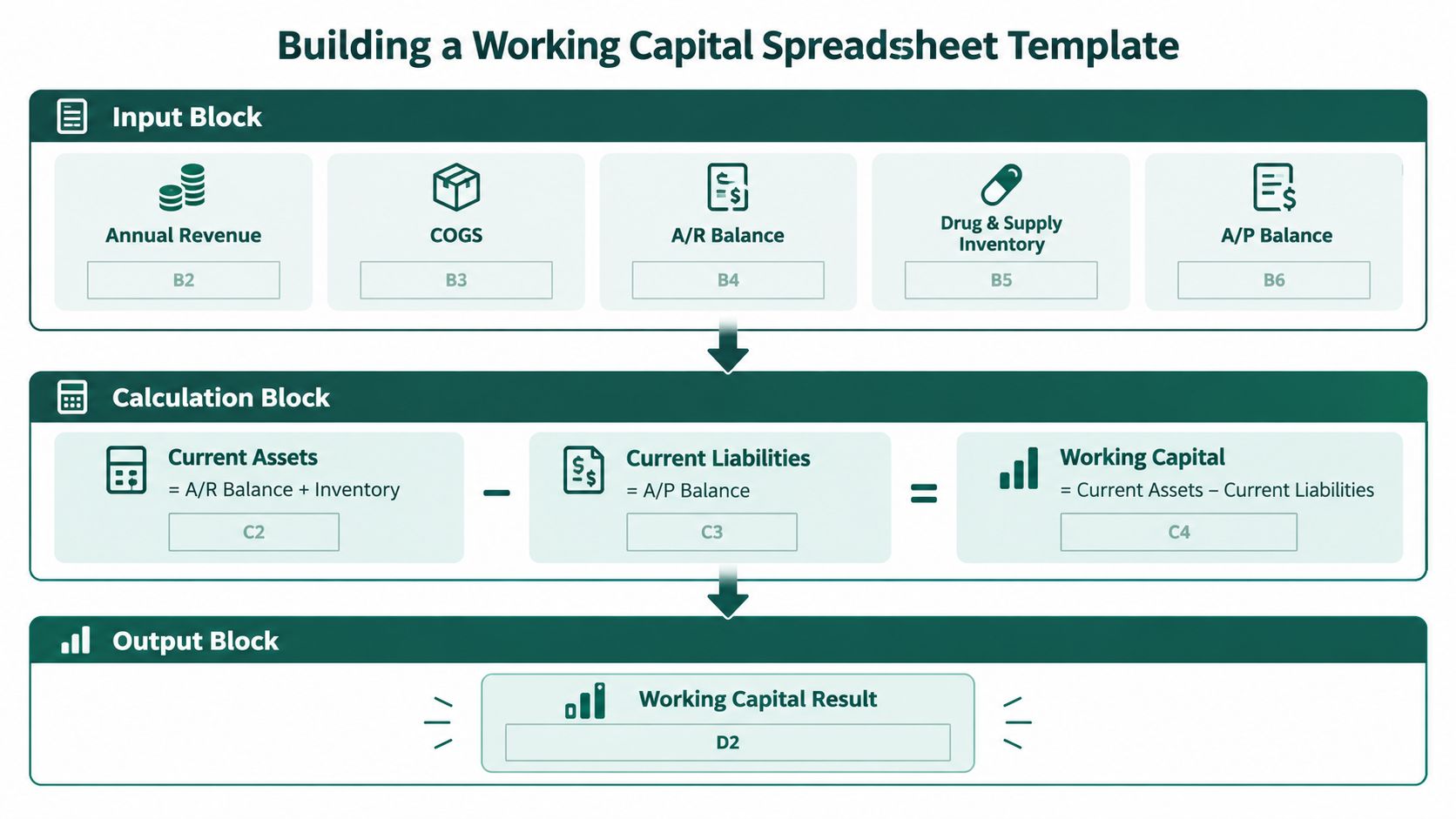
Create the input block
Assign clear cells to the operating inputs:
- Annual Revenue: Enter the annual revenue used for the DSO calculation.
- Annual COGS: Enter the annual cost of goods sold used for DIO and DPO.
- Average AR: Use the average accounts receivable balance for the selected period.
- Average Inventory: Include drug and supply inventory that supports operations.
- Average AP: Include supplier payables tied to the operating cycle.
- Annual Operating Cost: Use the cost base selected for the funding-gap calculation.
Use blue font for inputs and black font for formulas. Add the reporting period beside each input. A lender should be able to tell whether the figures represent a month, a quarter, a trailing period, or a forecast.
Add the calculation block
If annual revenue is in B2, annual COGS in B3, average AR in B4, average inventory in B5, average AP in B6, and annual operating cost in B7, use:
- DIO:
=B5/B3*365 - DSO:
=B4/B2*365 - DPO:
=B6/B3*365 - CCC:
=DIO+DSO-DPO - Daily operating cost:
=B7/365 - Dollar funding gap:
=CCC/365*B7
For the balance-sheet view, add current operating assets and liabilities in separate cells:
- Operating current assets:
=Cash+AR+Inventory - Operating current liabilities:
=AP+AccruedPayroll+OtherOperatingCurrentLiabilities - Net operating working capital:
=OperatingCurrentAssets-OperatingCurrentLiabilities
A minimum cash buffer should cover one to two months of fixed costs, as a management policy rather than a universal benchmark. Keep that buffer separate from the cash conversion gap so you don't mistake reserve cash for cycle funding.
For additional tax and profitability context, review net operating profit after taxes separately. Profitability and working capital overlap, but they aren't interchangeable.
Add controls and refresh monthly
Use conditional formatting to flag a negative CCC in green and a cycle exceeding 60 days in red. Those flags aren't verdicts. A negative cycle may reflect strong upfront payment timing, while a longer cycle may be normal for a particular operating model.
Refresh the inputs monthly from the practice-management software export, accounting records, inventory reports, and receivable aging. The most useful template is the one the owner updates consistently.
Scenario and Sensitivity Analysis for Your Numbers
A single working-capital calculation is a starting point, not a borrowing decision. Test the model against changes in collections, inventory, and supplier timing. The JPMorgan working-capital research recommends using historical operating data and scenario changes to make CCC analysis more actionable.
The base case uses 45 DIO, 30 DSO, and 20 DPO, producing a 55-day CCC. From there, change one operational assumption at a time before combining several pressures.
| Scenario | DIO | DSO | DPO | CCC (days) | Working Capital Need | Incremental vs. Base |
|---|---|---|---|---|---|---|
| Base case | 45 | 30 | 20 | 55 | Model using daily operating cost | Baseline |
| Downside collection case | 45 | 55 | 20 | 80 | Model using daily operating cost | 25 additional days |
| Growth inventory case | 57 | 35 | 20 | 72 | Model using daily operating cost | 17 additional days |
| Supplier and inventory stress | 52 | 30 | 30 | 52 | Model using daily operating cost | 3 fewer days |
The table deliberately leaves the dollar need as a model output. Without the clinic's annual operating-cost figure, a dollar amount would be invented. Multiply each CCC by the same daily operating cost to compare financing requirements consistently.
Rank the levers
Collections policy is usually the first lever to address. Tighten invoicing, separate corporate billing from client receipts, follow up on aging balances, and identify approval delays before they become a recurring cash need.
Inventory ordering comes next. Review slow-moving drugs and diets, set reorder points, and avoid buying more stock because a supplier promotion makes the order look attractive. Spring demand can justify higher inventory, but the purchase should fit the expected dispensing pattern.
Supplier terms can help, provided the clinic negotiates rather than delays payment without agreement. A longer agreed payment window lowers the cycle, but it shouldn't become a substitute for fixing weak collections.
Client payment behavior and drug-price inflation are less controllable. Model them as risks instead of pretending the clinic can eliminate them.
Matching the Funding Need to the Right Loan Structure
A clinic can show a funding gap and still choose the wrong loan. Match the structure to the cash-conversion problem: payroll due before client payments arrive, pharmaceutical inventory purchased before dispensing, or equipment that will support the practice for years.
A working capital line of credit is the default choice for recurring receivable and inventory timing gaps. Draw only when payroll or stock purchases come before collections, then repay as deposits clear. Interest generally applies to the amount used. Review fees, renewal terms, reporting requirements, repayment expectations, and whether the lender requires a clean-up period.
A short-term working capital term loan fits a defined trough with a visible recovery pattern. Fixed payments can fund a seasonal gap, but they continue during a weak collection month. Use this structure only when the clinic can support the payment from realistic cash flow, not from its strongest month.
Equipment-driven needs require separate treatment. An imaging system, surgical unit, or laboratory purchase creates a long-lived asset, not an ordinary payroll-cycle gap. Use equipment financing or a sale-leaseback so routine working capital does not carry an investment that will be repaid over a longer period. A sale-leaseback can release cash from equipment the practice already owns, subject to the asset's value and the agreement's terms.
An SBA 7(a) working capital loan may suit an established clinic that needs to combine several costly balances into one facility, subject to eligibility, underwriting, and lender terms. It is less suitable for a need that repeatedly rises and falls. A revolving line provides better access for that pattern.
| Loan Structure | Flexibility | Typical Cost (APR) | Approval Speed | Collateral | Best-Fit Scenario |
|---|---|---|---|---|---|
| Working capital line of credit | High | Depends on lender and borrower profile | Varies | May be required | Receivable and inventory timing gaps |
| Short-term working capital term loan | Moderate | Depends on lender and structure | Varies | May be required | Defined seasonal trough |
| Equipment financing | Limited to asset need | Depends on lender and asset | Varies | Equipment-focused | Imaging, surgical, or laboratory purchase |
| Sale-leaseback | Moderate | Depends on asset and terms | Varies | Asset-based | Releasing cash from owned equipment |
| SBA 7(a) working capital loan | Moderate | Depends on program, lender, and borrower profile | Varies | May be required | Consolidation or established-practice funding |
For clinics whose gap sits mainly in unpaid receivables, evaluate accounts receivable financing when approved receivables are the primary source of repayment.
Financing rule: Match the loan tenor to the cycle driving the gap, not to the calendar year.
Do not use long amortization to solve a short collection delay unless the economics support it. Do not use a daily-payment product to fund inventory that turns slowly. Compare total cost, payment timing, collateral, covenants, and the consequences of a slower month before signing.
Putting It All Together and Avoiding Common Mistakes
A veterinary clinic's working-capital need is a cash-conversion problem. Payroll leaves on a fixed schedule, while receivables and pharmaceutical inventory may convert to cash later. Size financing around that timing, not around a convenient annual figure.
Use this four-step process:
- Pull operating current assets and liabilities from the balance sheet.
- Calculate net operating working capital by subtracting operating current liabilities from operating current assets.
- Cross-check the result against the cash conversion cycle translated into a funding gap.
- Stress-test the estimate against a slow-revenue month, delayed collections, and seasonal inventory purchases.
The balance-sheet method shows the clinic's current position. The cycle method explains the cash pressure behind it. A material difference between the two requires a records review before you approach a lender.
| Mistake | Why It Distorts the Number | Correct Treatment |
|---|---|---|
| Counting prepaid rent as operating liquidity | The payment has already left the bank and may not return as cash | Track it separately from cash available for payroll and suppliers |
| Treating owner draws as operating liabilities | Draws are distributions, not normal supplier or payroll-cycle obligations | Keep owner distributions outside the operating-cycle calculation |
| Ignoring seasonal drug inventory | A stock build ties up cash before dispensing occurs | Use average inventory and stress-test seasonal peaks |
| Forgetting accrued payroll | Payroll earned but not yet paid remains an operating obligation | Include accrued payroll in operating current liabilities |
| Sizing from the strongest month | Peak collections can hide the recurring trough | Model the slowest realistic collection period |
| Mixing operating and non-operating balances | One-time items can make the cycle appear healthier or weaker than it is | Define operating accounts before calculating |
A revolving credit facility fits a clinic that needs repeated draws and repayments instead of one lump sum. Review understanding a revolving credit facility and examine repayment mechanics, fees, collateral, and any borrowing-base requirements. Flexibility still requires disciplined cash forecasting.
Pull trailing monthly balance-sheet and income-statement data this week. Complete the spreadsheet and test three revenue and collection scenarios. Then prepare a one-page summary covering operating balances, DIO, DSO, DPO, CCC, peak funding gap, requested facility size, and repayment source. Bring that summary to lender conversations so financing reflects the clinic's actual payroll, inventory, and receivables cycle.
Veterinary Practice Loans helps veterinary owners evaluate working capital lines, term loans, equipment financing, and other structures against those timing pressures. Visit Veterinary Practice Loans with your completed working-capital summary to discuss financing sized to the clinic's operating gap.
