

A lot of clinic owners reach the same point at the worst possible time. A radiography unit starts failing, an ultrasound is too outdated to keep up with current casework, or a lab analyzer is costing staff time every day. At the same moment, cash is already committed to payroll, drug inventory, and routine operating expenses.
That's where an equipment financing loan usually enters the conversation. Not as a theoretical funding product, but as a practical decision about whether the equipment should be paid for all at once, spread over time, leased, or replaced through a newer service model. For a veterinary clinic, that choice affects more than the monthly payment. It affects reserves, workflow, upgrade flexibility, and what the equipment really costs over its useful life.
What an Equipment Financing Loan Means for a Vet Clinic
A vet owner often starts with a simple question: “Can I afford this machine?” The better question is usually, “What's the right way to pay for this machine without putting stress on the rest of the practice?”
An equipment financing loan is a business loan used for a specific asset, such as digital imaging equipment, a surgical table, an ultrasound system, or in-house lab hardware. The loan is tied to that purchase, and the equipment itself usually serves as the main collateral.
How this differs from general borrowing
That structure matters. A general business loan gives broader use of funds. A line of credit is meant for flexible, recurring needs like short-term cash flow gaps. An operating lease focuses more on access to the equipment than long-term ownership.
An equipment financing loan is narrower and more targeted:
- Defined use: The funds are meant for one identified piece of equipment or a bundled equipment project.
- Asset-backed: The lender looks closely at the equipment because that asset helps secure the loan.
- Life-matched repayment: Terms are often set to line up with how long the equipment should remain useful in the clinic.
- Operational fit: Approval usually depends on practice revenue, owner credit, and the equipment's value more than on real estate.
A clinic buying a new dental unit doesn't need the same financing structure as a clinic replacing an imaging platform used every day. That's why equipment financing tends to be more practical than using working capital for long-life assets.
Practical rule: If the equipment will serve the clinic for years, it usually deserves a financing structure built for years, not a short-term cash tool.
Why this decision feels harder now
Many explainers make equipment financing sound easy if the practice is profitable. The market is more mixed than that. Industry reporting noted record U.S. equipment finance activity of $10.6 billion in December 2025, but approval rates were 76.8% in January 2026, and bank approvals dropped 1.7 points, which shows that strong demand and broad access aren't the same thing, according to recent equipment financing trend reporting.
For a veterinary buyer, that means timing, lender type, and loan structure can matter as much as the headline rate.
How an Equipment Financing Loan Works Step by Step
Most clinic owners first see only the quote. The lender sees a transaction with an asset, a repayment plan, and a risk profile. Understanding that process helps you ask better questions before you sign.
A simple process view helps:
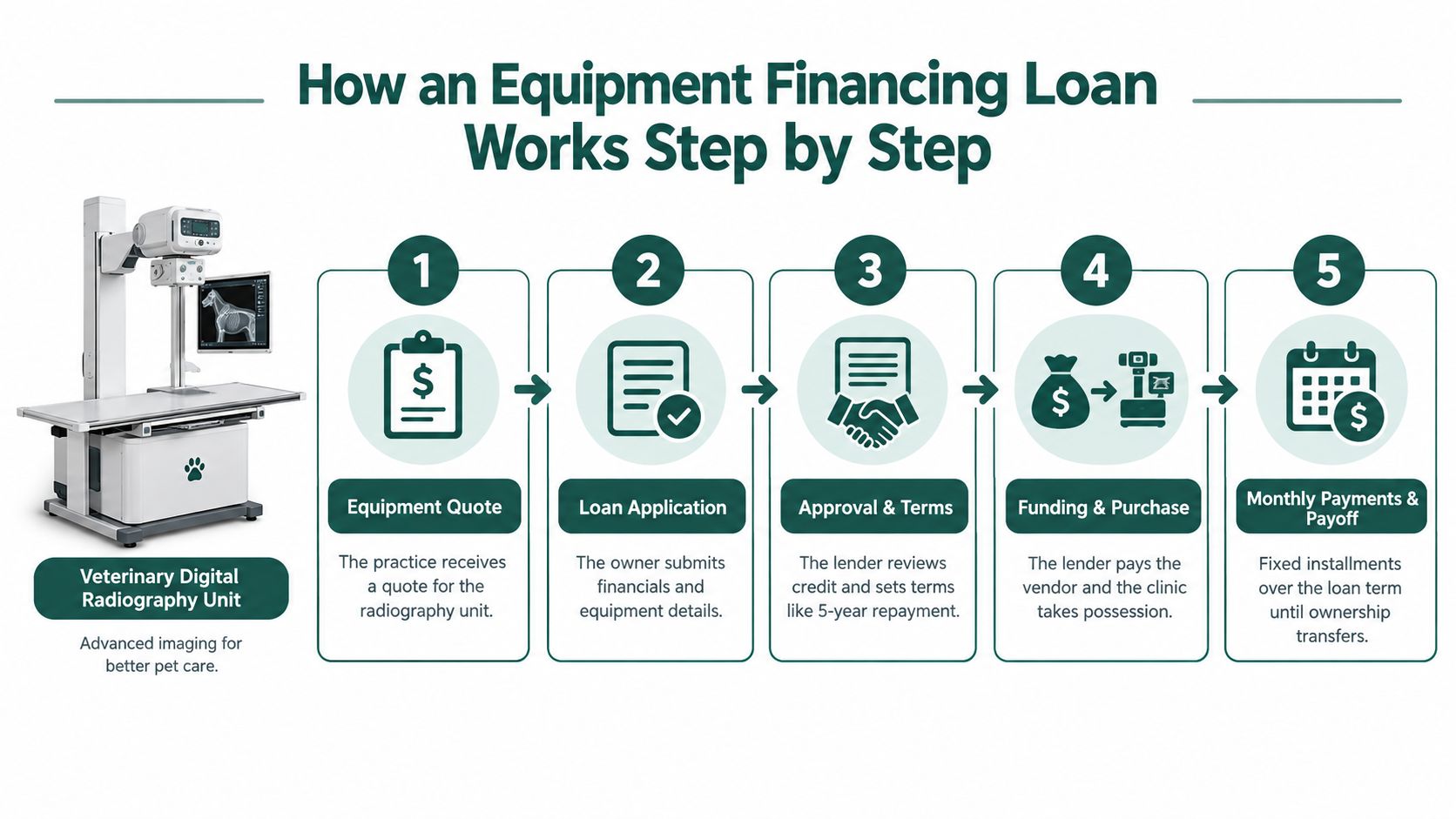
Step 1 through Step 3
Choose the equipment
The process starts with a vendor quote. That quote should identify the equipment clearly and show what's included. For a radiography project, that may include the unit, installation, software, and training.
Submit the application
The lender usually reviews the practice's revenue, time in business, owner credit profile, and the nature of the asset. A durable imaging unit is easier to underwrite than a loosely defined technology package because the collateral is clearer.
Underwriting and loan terms
Many owners get surprised. The lender isn't only asking whether the clinic can pay. The lender is also asking what the equipment is worth, whether it can be identified by model or serial number, and whether soft costs can be financed with it.
The cleaner the equipment quote, the easier it is for the lender to structure the loan accurately.
A short video can make that lender view easier to visualize.
Step 4 and Step 5
Funding and documentation
Once approved, documents are signed and the lender perfects its lien on the specific asset. In plain English, that means the lender records its security interest in the equipment. Funds often go directly to the seller, though some deals allow reimbursement for a completed purchase.
Repayment and final payoff
The clinic makes scheduled payments, often monthly. During the term, the equipment remains collateral, and the lender may require insurance coverage. At payoff, the lien is released and the clinic owns the asset free of that claim.
Where owners usually get confused
The most common points of confusion are these:
- Soft costs: Some lenders include installation, training, and software tied to the equipment. Others draw the line more narrowly.
- Prepayment: Not every agreement treats early payoff the same way.
- Ownership timing: In a loan, ownership is typically with the clinic from the start, even though the lender has a secured interest.
- Insurance obligations: If the asset is critical and expensive, the lender wants it protected.
That's why reading the documents matters as much as comparing payment size.
Common Loan Terms, Rates, and Repayment Structures
Two owners can finance equipment at the same purchase price and still end up with very different outcomes. The structure drives that difference.
Matching term to equipment type
Longer-lived assets usually justify longer repayment periods. Equipment with faster wear, lower resale value, or quicker technology turnover often calls for shorter repayment.
| Typical Equipment Loan Terms by Veterinary Equipment Type | |||
|---|---|---|---|
| Equipment Type | Typical Term | Amortization | Common Rate Structure |
| Digital imaging systems | Longer end of the usual range | Often fully amortizing | Fixed or variable |
| Ultrasound equipment | Mid-range to longer term | Often fully amortizing | Fixed or variable |
| In-house lab analyzers | Shorter to mid-range | Fully amortizing or sometimes structured around upgrade timing | Fixed more often when payment stability matters |
| Dental units | Shorter term | Fully amortizing | Fixed |
| Surgical suite equipment | Mid-range term, sometimes aligned to phased installation | Fully amortizing, occasionally customized | Fixed or variable |
Typical equipment financing structures often fall in the two- to seven-year range, and borrowers usually choose between fixed and variable pricing depending on risk tolerance and budgeting priorities. If you want a closer look at how the contract language handles that structure, this overview of an equipment financing agreement for veterinary clinics is a useful reference.
Fixed versus variable pricing
A fixed-rate structure gives the clinic the same scheduled payment throughout the term. That's often easier for a practice manager because the payment doesn't move with market rates.
A variable-rate structure may start attractively, but the payment risk shifts back to the borrower. That matters more when rates remain high. Mid-2026 reporting noted prime was still around 7.5%, well above early-2022 levels, as described in this industry discussion of borrowing conditions. If your loan floats with a benchmark, your equipment decision and your rate decision are no longer separate.
Other repayment patterns
Some clinics don't fit a flat monthly pattern neatly. A lender may offer alternatives such as:
- Seasonal payments: Useful when revenue tends to be heavier in certain months.
- Step payments: Lower early payments that rise later.
- Balloon structures: Smaller scheduled payments during the term, followed by a larger amount due at the end.
A low monthly payment can hide a poor structure if it pushes too much cost or risk to the end of the loan.
A balloon can make sense when the clinic expects to trade the asset or refinance before term end. It can also create pressure if the equipment's value falls faster than expected.
End-of-term choices
At the end, the clinic may pay off the balance, refinance, trade into newer equipment, or in some structures return the asset. Those options change the true ownership math. A lower payment today isn't automatically cheaper if it leads to a large final obligation or an upgrade cycle you didn't fully price out.
Benefits and Trade-offs for Veterinary Practices
The strongest reason to use an equipment financing loan is simple. It lets a clinic acquire a needed asset without draining operating cash. That benefit is real, but so are the costs attached to it.
The upside and the exposure
A balanced view helps more than a sales pitch.
| Benefits vs Trade-offs of Equipment Financing for Vet Clinics | ||
|---|---|---|
| Factor | Benefit | Trade-off |
| Cash reserves | Preserves liquidity for payroll, supplies, and routine overhead | Total borrowing cost is higher than paying cash |
| Predictability | Fixed payments can simplify budgeting | Variable or customized structures can add uncertainty |
| Collateral | The equipment itself supports the transaction | The lender has a claim on that asset until payoff |
| Speed of acquisition | The clinic can install needed equipment sooner | Faster decisions don't remove the need to review terms carefully |
| Tax treatment | Ownership may support depreciation and interest deductions, depending on the clinic's tax situation | Tax value doesn't erase financing cost |
| Growth support | Equipment can begin producing revenue while being repaid | If utilization disappoints, the payment still remains |
| Upgrade path | Some structures can align with future replacement plans | Ownership creates obsolescence risk when technology changes quickly |
Where financing helps most
Financing tends to work well when the equipment is essential, durable, and likely to contribute to revenue or efficiency for longer than the repayment period. Imaging, surgical, and core lab equipment often fall into that category when the clinic has stable demand.
It also helps when ownership itself matters. Some practices want complete control over service choices, replacement timing, and long-term use after the loan is gone.
Where owners should slow down
The weak spot is obsolescence. Diagnostic and IT equipment can age faster than many owners expect. A long amortization schedule may look affordable, but it can trap the clinic in paying for hardware that no longer fits the workflow.
Recent reporting also points to a broader shift in demand. Coverage of 2026 equipment finance trends describes equipment-as-a-service and pay-per-use models moving more mainstream, while small-ticket volume was reported up 5.5% and captives were outperforming banks in early 2026, as noted in this discussion of changing equipment finance demand. For some veterinary purchases, especially diagnostic and IT systems, the better question isn't “loan or cash.” It may be “ownership or usage.”
Comparing Equipment Financing to Other Funding Options
A clinic usually doesn't choose between financing and doing nothing. It chooses between several funding paths that solve different problems.
Where each option fits
| Funding Options for Veterinary Equipment Purchases | |||
|---|---|---|---|
| Funding Option | Typical Term | Collateral / Approval | Best Fit For |
| Equipment financing loan | Often matched to equipment life | Equipment usually serves as primary collateral | Identified equipment purchases with clear useful life |
| SBA loan | Often longer and more document-heavy | May involve broader underwriting and added collateral review | Large projects or borrowers seeking longer repayment runway |
| Working capital line of credit | Short-term and revolving | Often tied to general business strength and liquidity | Inventory, payroll gaps, and recurring operating needs |
| Conventional term loan | Structured around lender policy and borrower profile | Often requires stronger overall credit support | Broader business uses beyond a single asset |
| Equipment-as-a-service or pay-per-use | Ongoing service-style commitment rather than classic ownership repayment | Underwriting varies and ownership may stay with provider | Technology that changes fast or has uncertain utilization |
If you're comparing loan and lease style paths side by side, this guide to equipment financing and leasing for vet clinics lays out the distinction clearly.
Why equipment financing often wins
For a single, defined equipment purchase, asset-specific financing often has three practical advantages:
- Clear purpose: The lender knows exactly what is being bought.
- Matched repayment: The obligation can be shaped around the asset's working life.
- Operational discipline: The clinic doesn't use working capital for a long-life purchase.
That last point matters more than owners sometimes realize. A line of credit can feel easier because it's already available. But using short-term liquidity for a long-term asset can create strain later when payroll, inventory, or slower seasonal collections need that line.
Where alternatives can be better
An SBA structure may fit better when the project includes more than equipment, such as build-out costs or broader expansion. A general term loan may fit if the clinic wants one pool of capital for several needs at once.
Usage-based models deserve special attention for veterinary technology. If utilization is uncertain, or if the equipment may become outdated quickly, paying for access rather than ownership can reduce replacement risk. That doesn't make it cheaper in every case. It changes what you're buying. You're buying flexibility and service structure, not just hardware.
Real Scenarios Where a Vet Clinic Uses This Loan
The easiest way to judge an equipment financing loan is to place it in a real clinic decision.
Digital radiography replacement
A practice moves from film to digital because staff time, turnaround, and image workflow are holding the clinic back. This is the kind of purchase that often fits a medium-length loan well. The equipment has a meaningful useful life, the clinical need is clear, and the owner wants the payment to sit inside normal monthly operating cash flow instead of wiping out reserves in one purchase.
The key question isn't whether digital imaging is valuable. It's whether the repayment term is shorter than the period in which the clinic expects the system to remain clinically and financially useful.
Choose a term based on useful life first, and budget second. If you reverse that order, the loan can outlive the equipment's real value.
Surgical suite expansion
A clinic adds a surgical table, monitoring equipment, lighting, and related setup as part of a room upgrade. Here, financing may need to follow the installation process rather than one simple delivery date. Some deals work better when funds are released in phases tied to setup milestones.
This is less about gadget buying and more about coordinating timing. The clinic wants the repayment to begin in a structure that matches when the room becomes usable.
In-house analyzer replacement
Lab equipment creates a different decision. The workflow value can be strong, but technology turnover can be faster. If the clinic expects another upgrade sooner rather than later, a shorter financing term may make more sense. In some cases, a usage-based arrangement may fit better than ownership.
That's especially true when the owner isn't sure whether testing volume will remain stable enough to justify long-term ownership. The wrong move isn't always financing. Sometimes it's financing a fast-aging asset for too long.
How to Decide if an Equipment Financing Loan Is Right for You
A clinic owner doesn't need a perfect forecast before applying. But you do need a decision standard. The best one is alignment. Does the loan line up with the equipment's life, the clinic's cash flow, and the way you want to use the asset?
A practical checklist helps keep emotion out of the purchase.
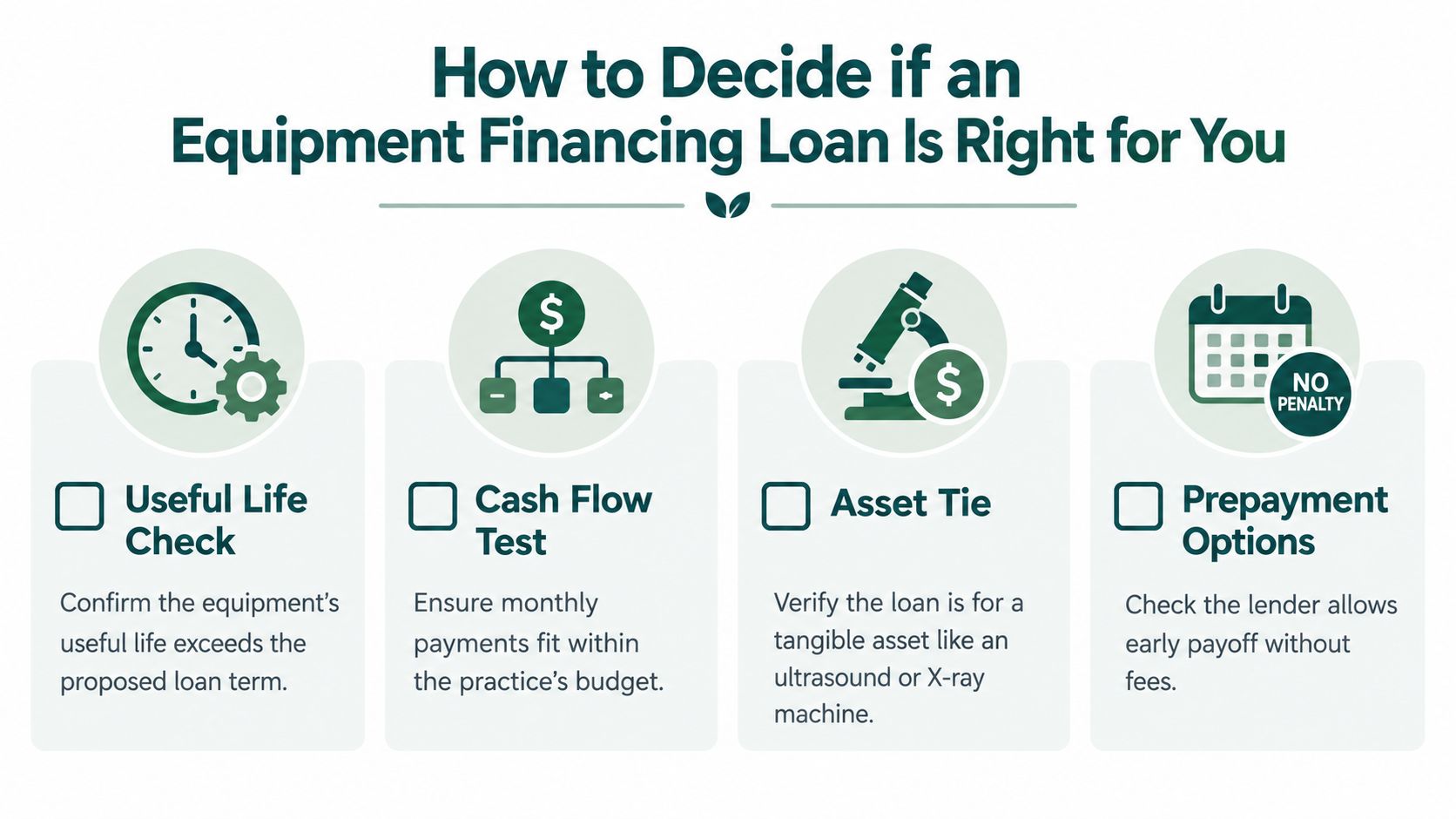
Run these tests before signing
- Useful life test: The equipment should remain valuable to the clinic longer than the proposed repayment period, with room for error.
- Cash flow test: The monthly payment should fit not only in a good month, but also during slower periods.
- Ownership test: Be clear whether you want to own this equipment long term, or whether access and replaceability matter more.
- Contract test: Review prepayment terms, lien terms, insurance requirements, and any end-of-term obligations.
For clinics that want lender options focused on this asset class, equipment financing lenders for veterinary practices can provide a starting point for comparison.
Gather the right documents
Most owners speed up the process when they prepare these items early:
- Vendor quote: Include model details and any installation or training line items.
- Business financials: Recent statements help the lender evaluate current performance.
- Tax returns and bank statements: These support cash flow and operating history.
- Ownership information: Be ready for questions about credit and existing debt.
One practical option in this market is Veterinary Practice Loans, which offers financing structures for veterinary equipment purchases and evaluates clinic operations in addition to credit history.
Deal-breakers to respect
Some warning signs should stop the process until the numbers are reworked:
- Rapidly aging technology: Long terms can become expensive mistakes.
- Weak operating margins: A new payment can magnify existing stress.
- Term longer than practical use: That usually means the structure is wrong, even if the payment feels manageable.
Model the decision both ways. One version assumes you finance. The other assumes you pay cash and lose that liquidity. The right answer is the one that leaves the clinic stronger, not just the one with the easier monthly payment.
Key Takeaways for Vet Practice Owners
An equipment financing loan works best when it's treated as a tool, not a default. It's built for tangible assets, usually secured by the equipment itself, and often structured around the period that asset should remain productive in the clinic.
That makes it useful for veterinary practices buying core diagnostic, surgical, or laboratory equipment without draining reserves. It also means the loan deserves the same scrutiny you'd give the equipment purchase itself.
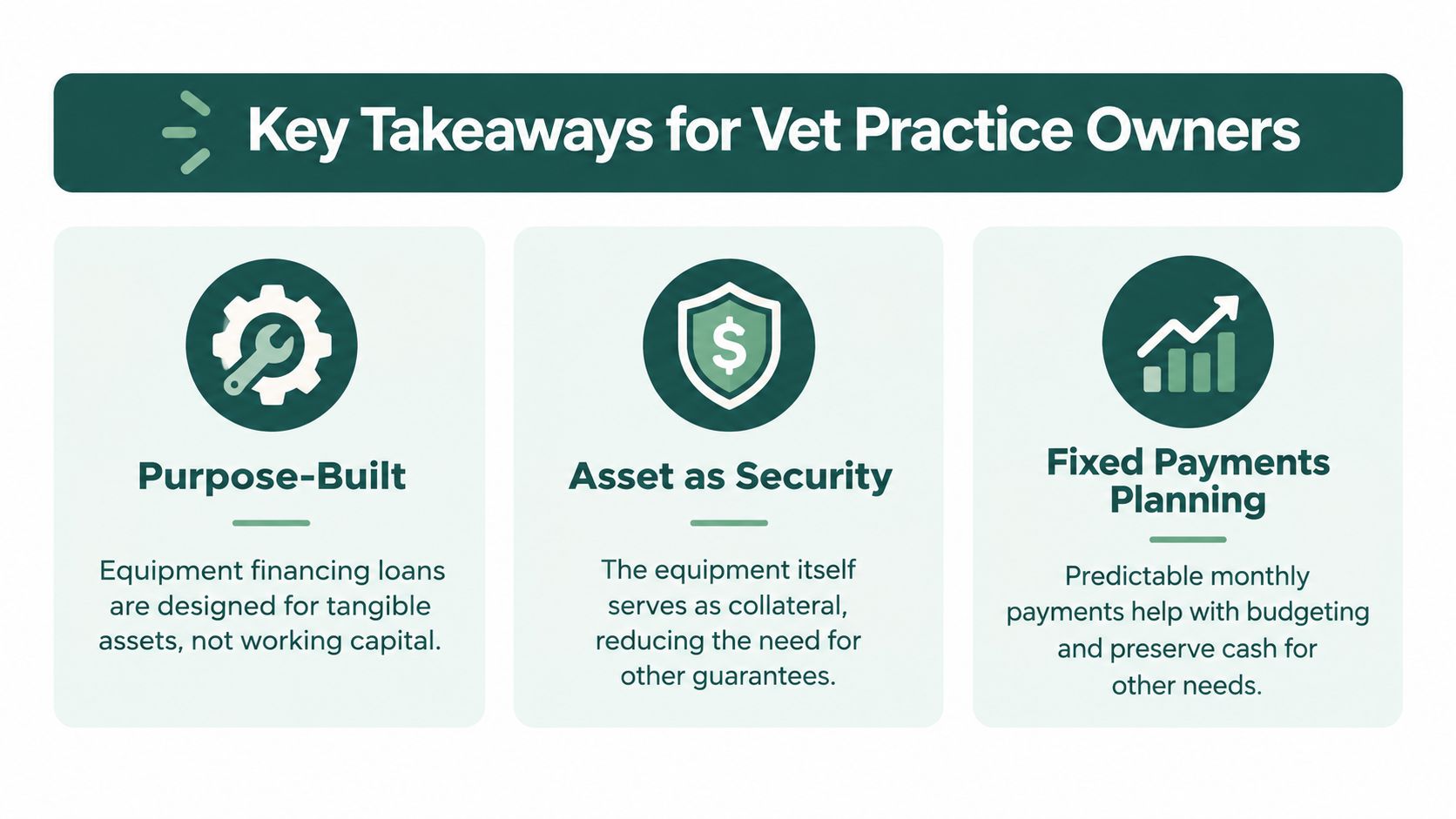
The short version
- Use equipment financing for true asset purchases: It fits best when the clinic is buying equipment meant to serve the practice over time.
- Match the term to the useful life: Don't stretch repayment just to make the monthly number look comfortable.
- Protect working capital: Preserving cash can be smart, but only if the payment remains manageable in ordinary operations.
- Watch technology risk: Fast-changing diagnostic and IT systems may fit a shorter term or a usage-based model better than long ownership financing.
If the equipment will generate value longer than the repayment period, financing can be sensible. If the equipment may become outdated before the debt is gone, pause and rethink the structure.
The strongest decisions usually come from asking three grounded questions. Will this asset still matter to the clinic years from now? Can the practice absorb the payment without strain? Do we want ownership, or do we really want flexibility?
If you can answer those clearly, you're in a much better position than someone comparing rate quotes alone.
Veterinary Practice Loans helps veterinarians evaluate funding for equipment purchases, practice growth, working capital, and clinic build-outs with structures suited to veterinary operations. If you're weighing whether an equipment financing loan fits your cash flow, asset life, and ownership goals, visit Veterinary Practice Loans to review your options.
