

Your X-ray system is slow, your lab equipment is overdue for replacement, and your team keeps working around limitations that should've been solved already. You know better equipment would improve care and likely increase production. You also know draining cash to buy it outright could leave the practice exposed the next time payroll, inventory, or a repair bill hits at the wrong time.
That's the key decision. Not “loan or no loan.” It's whether you'll treat equipment as a strategic asset or as a cash-flow threat.
Most veterinarians get pulled into the wrong comparison. They fixate on the advertised rate. That matters, but it's not the whole job. A slower loan with a lower rate can cost you more in practice if the machine sits unfunded while cases go elsewhere. A faster approval at a slightly higher rate can win if it gets the equipment in service sooner and producing revenue.
The Crossroads of Advanced Care and Clinic Capital
A common scene plays out in veterinary hospitals every week. A doctor has outgrown older equipment, the team knows it, and clients can feel it. Images take too long. Diagnostics get referred out. Procedures get delayed. Staff efficiency suffers because everyone is compensating for tools that no longer fit the standard of care the practice wants to deliver.
That's where many owners freeze. They don't doubt the clinical value. They doubt the timing.
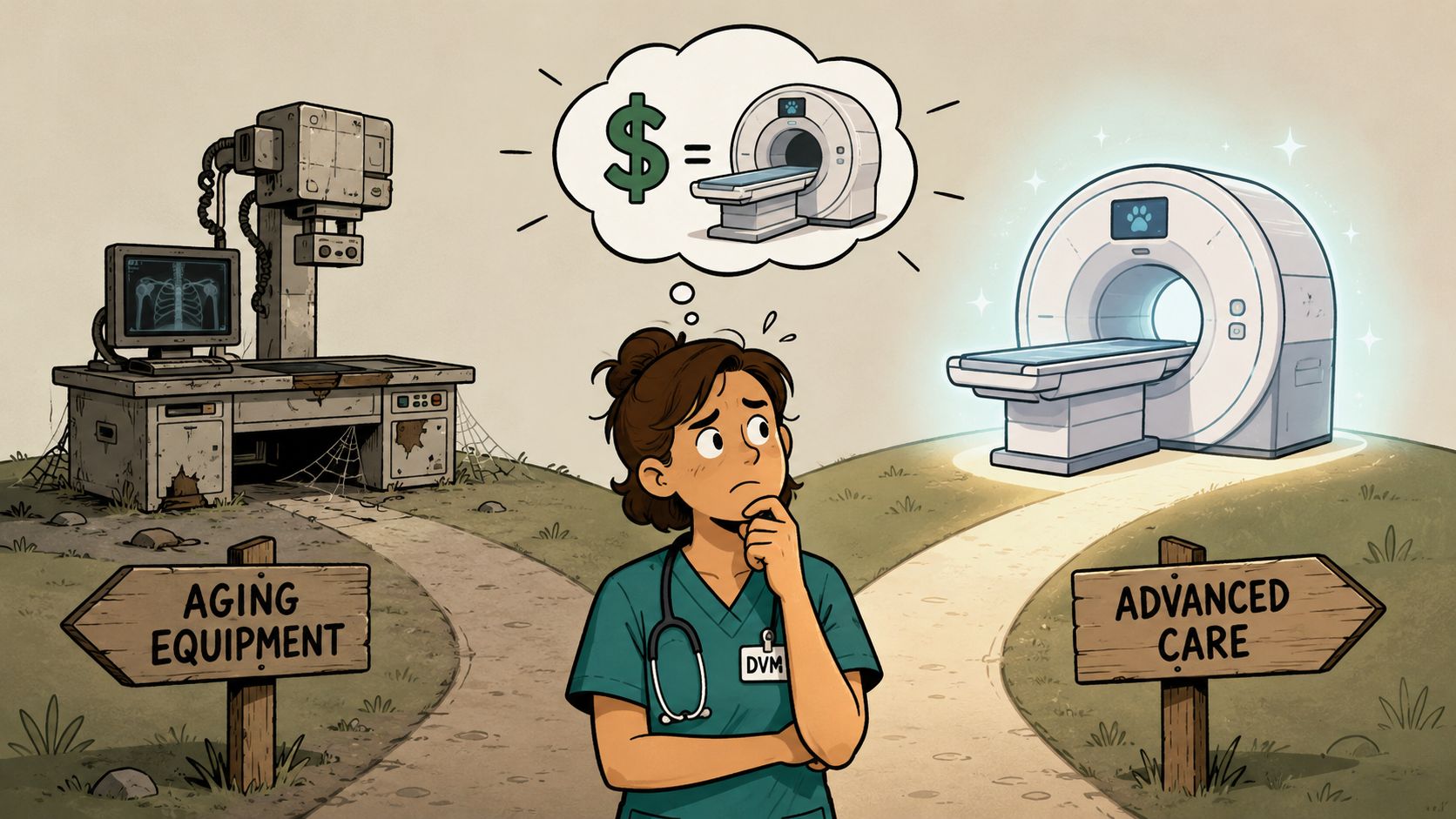
A veterinary practice owner might be looking at a new imaging unit, an updated analyzer, or a treatment room overhaul and thinking the same thing: “We need this, but I don't want to choke the practice to get it.” That instinct is healthy. Cash is oxygen. If you spend too much of it in one move, the business gets less resilient, not more advanced.
Loans are a tool, not a compromise
Veterinary practice equipment loans exist for this exact problem. They're built to let the practice acquire equipment now and repay it over time while the asset is being used. Done right, the loan isn't a burden. It's a matching mechanism. You're pairing the cost of the asset with the period in which the asset helps the clinic.
Consider anesthetic monitoring: You don't make decisions off one number in isolation. You look at the whole picture. Equipment financing works the same way. Rate matters. So do term length, speed to funding, monthly payment pressure, and how quickly the equipment starts contributing to production.
For owners weighing larger strategic moves beyond equipment, the same logic applies to broader veterinary practice ownership financing. Capital decisions shape what the clinic can become.
Good financing doesn't just buy equipment. It buys time, preserves liquidity, and keeps growth from colliding with operations.
The decision you're actually making
You're choosing between two paths:
- Delay the purchase: Keep cash intact, but continue operating with equipment that may be limiting care, efficiency, or revenue.
- Finance the upgrade: Protect reserves and put the asset to work sooner, with a payment structure the clinic can absorb.
The right answer usually comes down to one question. Will this equipment help the practice enough, soon enough, to justify putting capital to work now?
If the answer is yes, hesitation gets expensive.
Comparing Your Veterinary Financing Options
A practice owner needs a new digital radiography unit now, not three months from now. One financing option offers a lower rate but moves slowly. Another costs more on paper and funds fast enough to get the machine installed and producing revenue this month. That is the real decision.

The mistake is comparing loan options by interest rate alone. You need to compare them by job, speed, and total return to the practice. A slower loan with a lower rate can still cost more if it delays diagnostics, dentistry, surgery, or in-house services that should already be generating cash flow. For a broader look at current veterinary practice loan rates and financing structures, start there, then come back to the use case.
The four common funding paths
Equipment financing is usually the best first option for a defined equipment purchase. The equipment itself commonly secures the loan, and the repayment period is often matched to the useful life of the asset. That makes it a clean structure for imaging systems, dental units, lab analyzers, ultrasound, and other revenue-producing tools.
Term loans are broader. They make more sense when the project includes several moving parts, such as equipment plus buildout, software, installation, or other non-equipment costs. You get flexibility, but flexibility is not free. If the loan structure is too broad, you can end up repaying a machine on terms that are not well matched to how long it will produce value.
Business lines of credit work best for short-term needs and uneven spending. Repairs, inventory swings, minor add-ons, and temporary operating pressure fit here. Long-lived equipment usually does not. Putting a five- to ten-year asset on revolving credit is like funding a building improvement with a credit card. It can be done. It is usually a bad idea.
SBA loans can be strong for larger strategic projects. If you want equipment plus working capital, tenant improvements, or a longer amortization period, SBA financing deserves a look. The trade-off is time. More paperwork, more underwriting steps, and slower funding can be perfectly acceptable for a planned expansion. It is a poor fit for an urgent purchase where every delayed week means lost production.
Practical rule: If the equipment will start producing revenue quickly, speed matters almost as much as price.
A quick comparison makes the trade-offs clearer:
| Financing type | Best fit | Strength | Main drawback |
|---|---|---|---|
| Equipment financing | One or more defined equipment purchases | Direct structure tied to the asset and usually faster than broader loans | Limited use outside the equipment purchase |
| Term loan | Expansion, remodel, bundled capital needs | Flexible use of proceeds | May be less well matched to equipment life |
| Line of credit | Cash flow gaps, repairs, smaller recurring needs | Borrow only what you need, when you need it | Poor fit for long-lived equipment |
| SBA loan | Larger projects, long-term growth, bundled uses | Longer repayment periods and broad use of funds | Slower approval and funding |
A lot of owners also benefit from seeing the options explained out loud before they compare offers. This overview is useful:
How to self-select quickly
Use this filter.
- One specific machine or system? Start with equipment financing.
- Equipment plus construction, install costs, or working capital? Look at a term loan or SBA structure.
- Short-term flexibility for recurring needs? Use a line of credit.
- Need the equipment operating fast because revenue starts fast? Favor the lender and structure that can fund on the clinic's timeline, even if the nominal rate is higher.
- Able to wait because the project is larger and the longer term improves cash flow? SBA can make sense.
My recommendation is straightforward. If you are buying a discrete piece of clinical equipment and expect it to contribute revenue soon, start with equipment financing and compare that against any slower option on speed-to-ROI, not just rate. A lower-rate loan that arrives too late can be the more expensive choice.
Decoding the Total Cost of Your Equipment Loan
A clinic owner chooses between two offers for the same ultrasound unit. One has the lower rate. The other funds fast enough to get the machine installed next week. If that unit starts producing revenue immediately, the slower loan can cost more even with the better rate.
That is the mistake too many buyers make. They price the debt and ignore the cost of waiting.

What actually matters
Start with APR, but do not stop there. APR tells you the stated borrowing cost. It does not capture every dollar the decision will cost the practice.
A proper review includes four moving parts:
- Interest and fees: The stated rate, origination fees, documentation fees, and any prepayment terms.
- Time to funding: How long it takes to get approved, close, install, and start using the equipment.
- Monthly payment pressure: Whether the payment fits your cash flow with room to spare.
- Revenue start date: How quickly the equipment reduces referrals, adds cases, or improves throughput.
For a broader look at pricing structures, review current veterinary practice loan rates.
Rate shopping can produce the wrong answer
Owners often compare a lower nominal rate against a higher one and assume the lower rate wins. That shortcut works for a refrigerator in your break room. It fails for a revenue-producing clinical asset.
A delayed loan works like buying cheaper airfare for a conference after the keynote is over. You saved on the ticket. You lost the reason for the trip.
If funding drags, the clinic keeps sending cases out, keeps waiting on diagnostics, or keeps operating below capacity. That lost production has a price. Put a number on it.
A lower-rate offer can still be the more expensive business choice if it delays the equipment from producing income.
Speed to ROI changes the math
The most critical comparison is usually not bank rate versus specialty rate in isolation. It is total cost of capital versus speed to ROI.
A slower option may offer a lower stated rate and longer repayment. That helps monthly payment. It does not help if the equipment sits unfunded while demand is already in your exam rooms. A faster specialty structure may carry a higher nominal rate, yet still win because the machine starts generating revenue sooner.
Use this framework:
- Calculate full borrowing cost over the expected life of the loan, including fees.
- Estimate the cost of delay for every week the equipment is not in service.
- Test the monthly payment against conservative cash flow, not best-case production.
- Measure the upside after installation from added procedures, better case capture, or improved efficiency.
Here is the plain-English rule. If the equipment is tied directly to revenue or case retention, speed has financial value. Treat it like part of the purchase price.
If the equipment is less time-sensitive and the project is broader, a slower low-rate structure can make sense. But for income-producing equipment, comparing rate alone is amateur hour. Compare how fast the debt turns into cash flow.
How to Qualify and Prepare Your Application
A practice owner picks out a new ultrasound on Monday, wants it ordered by Friday, and then spends two weeks hunting down tax returns, bank statements, and a usable equipment quote. That is how good deals stall. Approval problems usually start before the lender reviews the file.

Lenders fund equipment for one reason. They believe the practice can make the payment and the equipment has clear business value if something goes wrong. If you want a fast yes, present the deal that way.
What lenders care about
Specialty equipment financing is usually more practical than owners expect because the equipment itself supports the credit decision. A lender is not judging the purchase as a wishlist item. A lender is judging whether the machine is financeable, whether your clinic uses cash responsibly, and whether the payment fits real operating performance.
Focus on five areas:
- Credit history: Late payments, charge-offs, and tax issues matter more than a perfect score target.
- Cash flow: The lender wants to see that the clinic can carry the new payment during ordinary months, not only peak months.
- Liquidity: Cash reserves still matter after closing. Draining the account for deposits, freight, installation, and training is a bad look.
- Collateral quality: New, widely used equipment is easier to finance than highly customized or thinly traded items.
- Practice stability: Time in business, ownership structure, and a clear clinical use case all strengthen the file.
If the project is larger, bundled with working capital, or tied to a broader expansion, compare that path with SBA loans for veterinary practice growth. SBA financing can offer strong terms, but the process is usually slower. For equipment that starts producing revenue quickly, speed often has monetary value of its own.
What to gather before you apply
A lender should not have to assemble your story from scraps. Give them a clean file the first time.
Use this checklist:
- Equipment quote: A formal vendor quote with model details, pricing, delivery costs, and any soft costs such as installation or training.
- Recent business financials: Profit and loss statements plus a balance sheet, even if they are internally prepared.
- Business bank statements: These show average balances, deposit activity, and whether cash management is disciplined.
- Business and personal tax returns: These help explain earnings history and ownership income.
- Practice ownership documents: Articles, operating agreement, and any ownership breakdown the lender may need.
- Licenses: Current professional licenses and facility documentation.
- Use-of-funds summary: A short written explanation of what the equipment does, which procedures it supports, and how it affects revenue, case retention, or efficiency.
That last item matters more than many owners realize.
A use-of-funds summary works like a treatment plan. The lender needs to see diagnosis, intervention, and expected outcome. “We want a dental unit” is weak. “We are replacing an unreliable unit that is limiting procedure days and referred case capture” is a credit story.
How to improve approval odds
Start with the payment, not the equipment. If the monthly obligation strains cash flow on paper, approval gets harder and the loan becomes riskier even if you get it.
Do three things before you submit:
- Ask for the full project cost. Include freight, installation, software, training, tax, and any required down payment.
- Stress-test the payment. Run it against an average month and a soft month.
- Show the revenue logic. Tie the purchase to procedure volume, retained cases, labor savings, or faster throughput.
Owners often make one of two mistakes. They either send a thin file and hope speed will make up for it, or they overexplain everything except repayment capacity. Both approaches waste time.
Clean files get faster decisions. Clear repayment logic gets better decisions.
If timing matters, say so at the start. A lender can structure around urgency only if you are upfront about delivery deadlines, expiring quotes, or immediate production needs.
Aligning Loan Terms with Equipment Lifespan
A clinic buys a new digital radiography system, signs a short repayment term to chase lower total interest, and then spends the next year feeling every payment. The equipment is productive. The loan structure is the problem.
Fit the term to the asset and to the practice's cash cycle.
Why term matching matters
Equipment earns over time. The debt should be repaid over time too. If you force a long-lived asset into a repayment window that is too short, you pull working capital out of the practice faster than the equipment can replace it.
That mistake gets expensive in ways owners often miss. A strained monthly payment can leave less room for payroll, inventory, marketing, and routine surprises. It can also make a lower-rate loan the more expensive business decision if the tight payment slows growth or forces you to keep too much cash on standby.
This is the standard. Match the repayment period to the period in which the equipment produces revenue, savings, or retained cases.
A practical framework
Use these rules:
- Short term: Best for equipment with fast payback, strong margins, and a practice that can absorb higher payments without squeezing operations.
- Medium term: Often the best balance for core clinical equipment that should start producing within months and remain useful for years.
- Longer term: Best when preserving liquidity matters more than minimizing interest expense on paper, especially if the equipment supports growth but ramps gradually.
- Mismatched term: Any structure where the payment arrives faster than the return.
A treatment plan has to fit the patient's condition. A loan term has to fit the practice's financial health. The strongest-looking structure on paper can still be the wrong one if it drains cash while the equipment is still ramping up.
Repay the debt on the same timeline the equipment earns its keep.
That does not mean stretching every loan to the maximum available term. It means using a term long enough to protect cash flow, but not so long that you are still paying for equipment after its economic value has faded.
Total cost of capital matters more than rate alone. A slower, lower-rate option can look cheaper until delayed funding keeps the equipment offline for months. A faster loan at a higher nominal rate can win if it gets the machine installed, producing revenue, and improving case retention sooner. Owners who focus only on rate miss the more important question. How quickly does this equipment start paying back the practice, and can the loan structure give it time to do that?
Example Scenarios and Your Next Steps
A practice owner signs for a lower-rate loan, waits weeks for funding, and keeps referring profitable cases out the door while the new machine sits on a quote sheet instead of in an exam room. That is not cheap capital. It is delayed return dressed up as savings.
Scenario one for a startup owner
A first-time owner opening a clinic has one job at this stage. Protect cash while getting the doors open with the right equipment mix.
That usually points to a structure with lower upfront strain, even if the headline rate is not the absolute lowest available. A startup rarely gets paid for picking the prettiest rate quote. It gets paid for staying liquid long enough to build volume, tighten operations, and turn new equipment into actual revenue. If the project includes equipment, tenant improvements, software, and working capital, use financing built for a full launch instead of forcing everything into a narrow equipment-only loan.
The right question is simple. How do you keep the practice fed while production ramps?
Scenario two for an established single-location clinic
An established clinic upgrading imaging, dental, or in-house diagnostics has a clearer decision. The equipment should either produce revenue quickly, reduce referral leakage, improve workflow, or do all three.
In this case, speed to installation matters more than many owners admit. A slow approval at a lower rate can still cost more if it postpones case capture for a month or two. Rate is the sticker price. Timing is the carrying cost. If the machine can start paying for itself soon after delivery, fast funding often makes more financial sense.
Scenario three for a growing multi-location group
A multi-site group adding advanced diagnostics or treatment capacity has a broader capital problem. Equipment is only one part of it. Training, staffing, room readiness, and rollout timing all affect return.
That means the loan decision should be made at the operating level, not just the asset level. A slower, cheaper structure can look disciplined on paper and still hurt performance if it delays implementation across multiple locations. A faster option with a higher nominal rate can produce the better outcome if it gets units installed, teams trained, and revenue online sooner. In a group setting, every month of delay multiplies across sites.
Your next steps
Do these in order:
- Define the purchase in plain terms. List the exact equipment, full installed cost, and the clinical use.
- Estimate how the equipment earns back its payment. Use retained cases, added procedures, time saved, and referral reduction.
- Set a real payment limit. Base it on cash flow after payroll, rent, inventory, and a bad month, not on the maximum a lender might approve.
- Put a price on delay. If every week without the equipment means lost procedures or slower growth, count that in the cost of capital.
- Match the financing to the project. Use equipment financing for a clean asset purchase. Use broader financing when the project includes multiple moving parts.
- Submit a tight file. Clean financials, vendor quotes, bank statements, and a clear use of funds shorten the path to funding.
Good borrowing improves the practice twice. It gets the equipment in place, and it protects the cash flow needed to turn that equipment into profit.
Frequently Asked Questions About Vet Equipment Loans
Can I finance used or refurbished equipment
Yes. Lenders usually view used equipment as a higher-caution asset, so expect tighter terms, a larger down payment, or both.
That does not make used equipment a bad buy. It can be the smarter move if the savings are meaningful, the service history is solid, and the machine will produce revenue fast. A discounted ultrasound that starts paying for itself in weeks is often a better capital decision than a brand-new unit that strains cash flow.
Can a startup practice qualify
Yes, if the file is strong.
Startups face more scrutiny because the lender is underwriting the owner and the plan, not just the equipment. Bring clean personal credit, available liquidity, a clear budget, vendor quotes, and a practical explanation of how the equipment will generate cash. If the practice is new and the request is aggressive, expect to contribute cash up front.
How fast can funding happen
Fast enough to matter, if you choose the right lender and submit a complete package.
Specialty equipment financing can move quickly. Bank and SBA-style options usually move slower. Owners often get distracted by rate alone. A lower rate loses its shine if the equipment sits in a vendor warehouse for a month while you keep referring cases out or postponing profitable procedures. Speed has a price. Delay does too. Compare both.
Should I choose a loan or a lease
Choose a loan when you want to own the equipment and expect to use it for years. That fits durable assets like imaging, dental systems, and core surgical equipment.
Choose a lease when upgrade flexibility matters more than ownership. That fits technology that may date faster or equipment you may want to replace on a shorter cycle.
The easiest way to frame it is this. A loan is closer to buying the building blocks of the practice. A lease is closer to renting flexibility. Pick the structure that matches the asset's working life and the speed at which that technology becomes outdated.
If you're evaluating equipment financing and want a lender that understands veterinary operations, Veterinary Practice Loans is built for that conversation. They help practice owners compare structures, weigh total cost against speed to ROI, and choose financing that fits the clinic's cash flow instead of straining it.
