

You're trying to do two things at once, and the clock is already on you. Buy the practice, fund the build-out, keep payroll steady, and make sure the transition doesn't choke cash flow in month one. That's why trusted lenders specializing in veterinary practice loans matter so much. A generic loan that looks fine on paper can fail the test, which is whether it funds the full project without forcing you to patch the rest with expensive side capital.
If you're a veterinarian weighing a buy-in, a relocation, or a second site, the central question isn't just “Who will lend?” It's who will cover the complete deal structure, from acquisition price to renovation costs to working capital, under one approval path. That's the standard I use when I look at veterinary financing, because headline rate alone doesn't tell you whether the loan solves the problem in front of you.
Why Veterinary Practice Financing Deserves Specialized Lenders
A vet owner rarely needs one simple check. The deal usually includes a practice purchase, maybe a partner buyout, plus furniture, equipment, transition expenses, and enough working capital to carry the first stretch after closing. Generic small-business lenders often miss that a clinic's economics are tied to appointment volume, procedure mix, and collections timing, not just a balance sheet snapshot.
That is why veterinary lending has been its own category for years. The AVMA reported that Live Oak Bank's typical veterinary loan was an SBA 7(a) loan of about $1.3 million for a one- or two-veterinarian practice, while Bank of America Practice Solutions offered loans of up to $5 million with terms as long as 15 years for buyouts, relocations, and second clinics. Those figures matter because they show veterinary financing had already moved beyond generic credit into practice-specific underwriting.
What specialization changes
Specialized lenders do more than look at credit scores and collateral. They examine clinic cash flow, recurring client demand, and the structure of the deal itself. That is why the strongest veterinary lenders can size loans around real ownership events, not just around what is easiest to pledge as security.
Practical rule: if the lender cannot discuss the transition, the renovation, and the ramp period in the same conversation, they are probably not funding the full project.
Today, that specialization still matters. The U.S. market had about 59,000 veterinary practices as of June 2022, which is large enough to support lenders that know the category well. In plain terms, you want a lender that understands veterinary operations first, and lending product second.
The Five Loan Products Every Veterinary Lender Should Offer
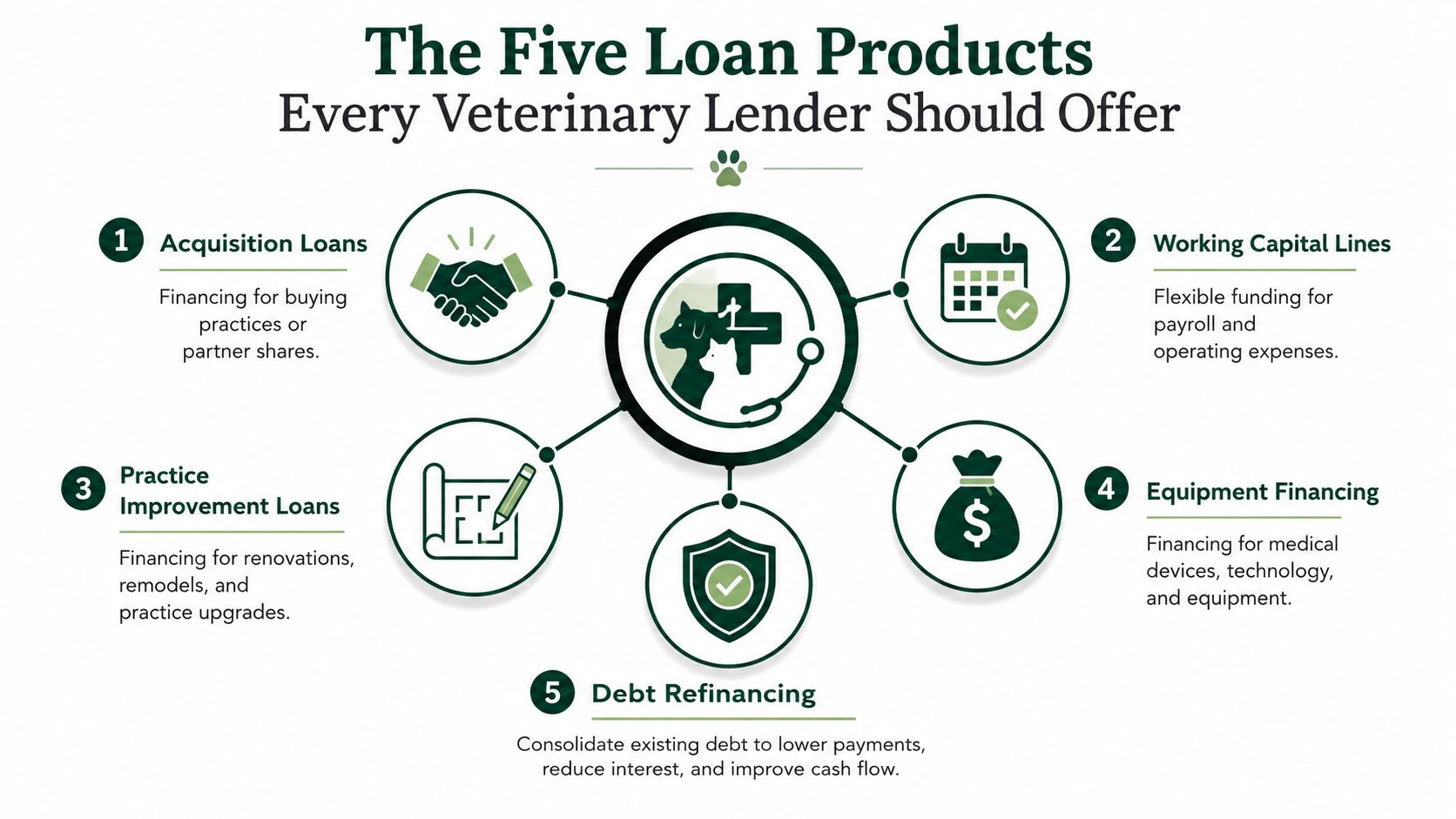
A good veterinary lender should fund the full project, not just the headline purchase price. If the lender only covers one piece, you end up layering in separate approvals for build-out, equipment, and working capital. That creates delays, extra closing costs, and more chances for the deal to stall.
The five products that matter
- Acquisition loans. These finance the purchase of an existing clinic, a partner's share, or a location add-on. If you are buying into ownership, this should be the anchor of the structure because it carries the main transfer cost.
- Working capital lines. These cover payroll, supplies, and operating expenses while revenue settles after closing. They matter when collections lag or the practice needs breathing room during the handoff.
- Equipment financing. This fits imaging, surgical, lab, and technology purchases. Repayment should track the useful life of the asset, so you are not still paying for gear that is already outdated.
- Startup funding. This supports de novo clinics that need build-out, initial inventory, staffing, and early ramp capital. If you are opening from scratch, the lender should have a structure for that use.
- Expansion and build-out loans. These pay for renovations, relocations, extra exam rooms, satellite clinics, and similar growth projects. They separate a concept on paper from a practice that can take on more patients.
A lender that cannot speak clearly about all five categories is usually forcing your project into one box and leaving the rest of the cost stack unresolved.
The structure has to fit the job. Veterinary Practice Loans lays out acquisitions, working capital, equipment, startup, and growth uses in one place on its veterinary practice loan options page, which is the kind of menu a lender should understand before underwriting starts. If your project touches more than one category, ask whether one approval can cover the full transaction, not just the easiest piece to finance.
Profiles of Trusted Veterinary-Focused Lenders
A practice sale with relocation costs, buy-in payments, and equipment refreshes needs a lender that can fund more than one piece of the deal. The names that belong in this niche do not all solve the same problem. Some are built for larger acquisition structures, some are better at clean bank-style underwriting, and some are useful when you need speed without giving up too much flexibility. The first question is simple, how much of the total project cost can each lender cover under one structure.
Comparison of Trusted Veterinary Practice Lenders
| Lender | Primary Product Focus | Typical Max Loan | Term Length | Distinctive Feature |
|---|---|---|---|---|
| Live Oak Bank | Veterinary acquisitions and practice expansion | About $1.3 million was reported as a typical veterinary loan in 2008 | Not specified in the verified data | Early institutional focus on veterinary practice finance |
| Bank of America Practice Solutions | Buyouts, relocations, second clinics | Up to $5 million | As long as 15 years | Big-ticket practice-specific lending with transition support |
| PNC Healthcare Business Banking | Startup, acquisition, expansion, buy-in, operating expenditures, transition expenses | Not specified in the verified data | Not specified in the verified data | Packages several project needs in one relationship |
| Huntington National Bank | Practice and property financing | Up to 100% financing | Not specified in the verified data | Strong for full-project coverage when property is involved |
| First Merchants Bank | Practice financing, working capital lines, equipment, owner-occupied commercial property | Up to 100% financing | Not specified in the verified data | Useful when debt, equipment, and property need to sit together |
| Panacea Financial | Acquisitions and veterinary practice loans | SBA 7(a) loans up to $5 million | Up to 25 years for property, 10 years for working capital and equipment | Fast acquisition closings, commonly 20 to 40 days |
The pattern here is funding completeness, not rate. PNC's product language is broad, Huntington explicitly discusses up to 100% financing, and First Merchants says the same while adding working capital lines and owner-occupied property coverage. That is the right way to judge a veterinary lender, because a lower rate does not help if you still need another source to finish the deal.
SBA-backed lending also tells a useful story. Veterinary clinics received $1.8 billion in SBA 7(a) loans across 1,469 approved loans from FY2021 through FY2026, and the sector's charge-off rate was 0.2% (SBA industry data). That low realized loss rate explains why specialized lenders keep working this segment, even when the transaction is complicated.
Bottom line: shortlist lenders by how much of the project they can fund in one structure, then compare terms. If one lender can cover the clinic, the property, and the working capital together, that beats a nicer rate on a loan that leaves gaps.
How Specialized Lenders Compare to General Small Business Lenders
A clinic purchase, relocation, or partner buy-in rarely fits neatly inside a generic small-business loan. Specialized veterinary lenders are built for that reality. They usually make better sense when the deal has property, equipment, working capital, and transition costs all sitting in the same stack, because they underwrite the whole project instead of treating each piece like a separate problem.
Where general small-business lenders can work is the simple stuff. A single equipment buy, a modest build-out, or a narrow working-capital need can fit their model if the collateral is clean and the request is easy to document. Once the project gets more complicated, the advantage shifts fast to a lender that knows how a practice changes hands.
Where the specialized model wins
Veterinary-focused lenders are more likely to look at clinic deposit patterns and recurring revenue instead of forcing the file through a generic small-business template. They understand what a practice transition looks like, so you spend less time explaining why a deal includes the owner's buyout, the equipment refresh, and the cash needed to keep the clinic running after closing. That matters when the goal is to close without stalling the transaction.
Specialized lenders also tend to process veterinary files faster because they know which documents matter. A 2026 industry guide says these lenders commonly close acquisitions in 20 to 40 days, and it describes minimum FICO expectations around 660 to 680, with stronger pricing usually going to borrowers at 720+. That is the practical takeaway. These lenders are set up for practice deals, and their underwriting reflects that.
Where general lenders can still fit
A general lender can still make sense if the borrowing need is narrow and the project is clean. If you are financing one machine or a small renovation, the process may be simpler and the approval path shorter. The trade-off is obvious. You may get a workable loan, but you lose the ability to bundle multiple project pieces under one approval.
Cost is only part of the decision. A lower rate does not help if the loan only covers part of the project and forces you to fill the rest somewhere else. The better comparison is how much of the total transaction one lender will finance in a single structure, then whether the terms still work for your cash flow. For a rate-focused reference point, the veterinary practice loan rates guide is a useful starting place, but the central question is whether the lender can finish the deal.
Specialized lenders usually justify a slightly higher cost if they cover the full project. A cheaper loan that leaves you scrambling for the rest of the capital is not a better loan. It is just a partial answer.
Trust Signals That Separate Reputable Lenders From the Rest
A good lender doesn't just say yes. It tells you what it's underwriting, what it will fund, and what it won't. If you don't get that clarity early, you're probably dealing with a lender that's selling convenience first and structure second.
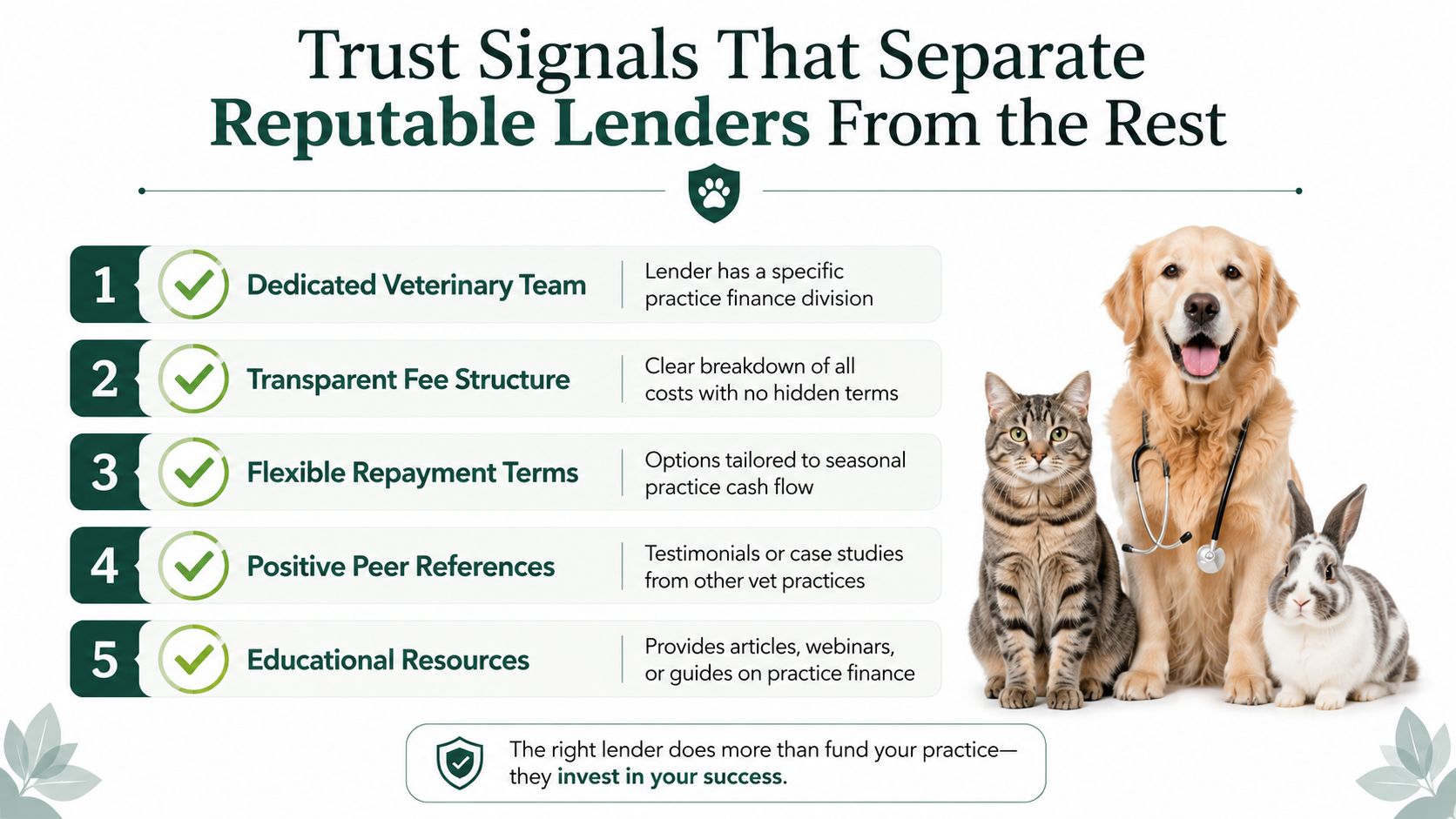
The trust signals I'd verify before a term sheet
- Dedicated veterinary team. Ask whether the lender has a practice finance division or a healthcare team that regularly closes veterinary deals.
- Transparent fee structure. You want the full cost of capital up front, including any origination charges, prepayment language, and closing costs.
- Flexible repayment terms. Ask whether the structure matches practice cash flow, especially during transition or seasonal swings.
- Positive peer references. Speak with other practice owners who've closed similar deals.
- Educational resources. Good lenders explain the process in plain English instead of hiding behind jargon.
The biggest trust signal is not the rate, it's whether the lender can explain how much of the true project cost it will finance. PNC says its practice loans can cover startup, acquisition, expansion, buying in, operating expenditures, and transition expenses. Huntington says it can provide up to 100% financing for practice and real estate needs. First Merchants says its programs include 100% financing, working capital lines, equipment, and owner-occupied commercial real estate.
That's the bar. If a lender can't tell you whether it funds the whole package, it's not helping you make a decision, it's only helping you get started.
Ask one direct question on the first call, “What percentage of my total project cost can you finance under one structure?” If the answer is vague, keep shopping.
Should You Borrow Now or Wait
A clinic can have a strong loan option on the table and still be a bad borrower at the moment. If staffing is thin, appointment volume is uneven, or collections are already under pressure, the financing decision has to start with cash flow, not optimism.
The AVMA's 2024 to 2025 workforce reporting points to persistent concerns about staffing capacity. That does not mean growth should stop. It does mean every expansion plan needs to be tested against a tighter operating assumption, because fewer people on the floor can mean fewer visits, slower collections, and less room for debt payments.
Stress test the deal before you borrow
Run the deal under a tougher case. If collections slip, labor costs rise, or a new location takes longer to stabilize, the practice still has to cover debt service without strain. If it cannot, the issue is loan size, not lender type.
Trailing cash flow should drive the decision. A lender that underwrites from what the clinic has already produced usually gives you a cleaner read than one that relies too heavily on future growth. Growth can still happen, but the debt has to fit the business you run today, not the one you hope to build later.
That is also why I watch how a lender treats transition costs and collections gaps. The Bank of America veterinary loans material points to support around those pressure points, which is exactly where many veterinary deals get tight. If staffing is thin, keep the borrowing conservative and make sure the structure covers the full project without assuming perfect execution.
Application Tips and a Final Checklist for Choosing the Right Lender
Get your file in order before you talk to anyone. Lenders move faster when they can see a clean package, and veterinary practice deals almost always get better when the owner brings the full story instead of scattered documents.
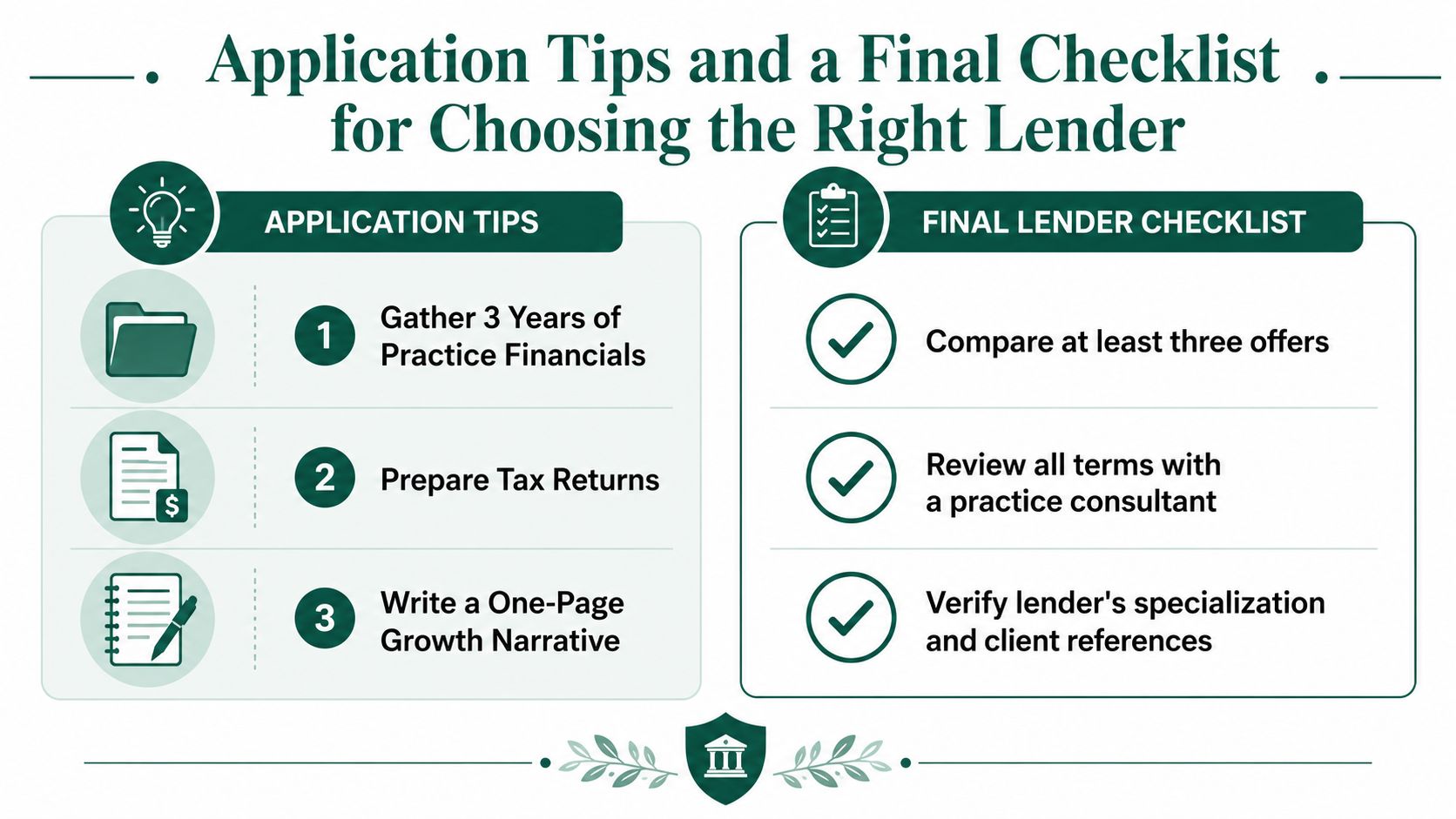
What to prepare first
Bring three years of practice financials, your tax returns, and a one-page growth narrative that explains what you're buying, what it costs, and how the practice will absorb the debt. If the deal includes real estate, equipment, or a transition period, say so clearly. The cleaner the package, the less likely the lender is to guess.
If you're comparing structures, the site's SBA resource page is a useful starting point for how veterinary practice financing is often packaged (veterinary practice SBA loan). I'd still insist on multiple offers side by side before signing anything.
Final checklist before you commit
- Compare at least three offers. One term sheet is not enough to judge the market.
- Check total project coverage. Ask how much of the full cost, not just the purchase price, the lender will fund.
- Review term length and flexibility. Make sure the payment schedule matches the practice's actual cash flow.
- Ask about prepayment terms. Early payoff can be a good thing if it doesn't come with hidden penalties.
- Verify similar-deal experience. A lender that has closed practice acquisitions is different from one that mostly handles generic small-business loans.
The right lender should be able to fund your deal, explain the structure clearly, and stay consistent from first call to closing. If you can't get those three things, keep looking.
Veterinary Practice Loans helps veterinarians compare financing paths for acquisitions, equipment, working capital, real estate, and expansion. If you're lining up a practice purchase or a growth project, visit Veterinary Practice Loans to review financing options built around veterinary operations and project structure.
