

Dr. Alvarez has a familiar problem. After four years as an associate, she's considering a $1.4 million acquisition of an established small-animal practice, while her partner is evaluating a greenfield startup. Both projects may be clinically sound, but they create completely different lending risks. One has existing revenue, staff, equipment, and patient records. The other has construction costs, hiring risk, and no operating history.
That distinction matters more than the headline interest rate. The right loans for veterinarians must account for ownership transition, debt repayment, equipment life, working-capital timing, and the owner's personal obligations. This guide maps each financing product to the stage your clinic is in, from first acquisition to expansion, modernization, refinancing, or stabilization.
Why Veterinary Borrowing Deserves Its Own Playbook
Generic small-business lending advice misses the operating reality of veterinary medicine. A clinic can have strong annual revenue and still experience uneven cash flow because wellness visits, preventive care, surgery, staffing, and inventory purchases don't arrive evenly throughout the year. A repayment schedule that looks manageable on an annual spreadsheet can become uncomfortable during a slower operating period.
Veterinary practices also require meaningful investment in fixed assets. Digital radiography, ultrasound, anesthesia systems, surgical equipment, laboratory systems, information technology, and facility improvements can all compete for the same cash that must fund payroll and pharmaceuticals. Financing the entire project with one long-term loan often creates the wrong repayment profile.
The financial statements need interpretation
A lender doesn't just read the bottom line and approve or decline the request. Owner-doctor compensation, personal draws, discretionary expenses, depreciation, and clinic debt service can blur the difference between reported profit and cash available for repayment. The underwriting process must normalize those items before calculating sustainable earnings.
That's especially important for veterinarians carrying educational debt. The 2025 AVMA Economic State of the Veterinary Profession report states that average DVM debt for all new graduates in 2024 was $168,979, while graduates with at least some DVM loans averaged $202,647. Among new graduates entering full-time work, the average debt-to-income ratio was 1.4, and 74.9% had ratios below 2.0. Those figures make personal repayment capacity a central part of any ownership discussion.
Practical rule: A lender isn't only asking whether the clinic can repay the loan. The lender is asking whether the clinic can repay the loan while the veterinarian remains financially functional outside the practice.
The product must fit the next event
A generic “best small-business loan” ranking fails because a partner buyout, acquisition, startup, equipment replacement, and payroll cushion aren't the same transaction. A product built for speed may be too short for a clinic acquisition. A long amortization may preserve cash flow but become expensive if used for short-lived equipment.
Practice ownership has also become less common. AVMA census data reported that 21.3% of all veterinarians identified as practice owners in 2018, down from 47% of veterinarians who identified as owners or associates in 2008. Among veterinarians aged 39 or younger, ownership fell from 14.5% in 2008 to 9.0% in 2018, as documented in the USDA National Institute of Food and Agriculture annual report. Financing therefore plays a larger role in helping qualified veterinarians enter ownership.
The practical framework is simple: identify the clinic's lifecycle stage, separate the uses of funds, test the transition plan, and then choose the debt structure. Rate shopping comes after that work, not before it.
The Main Loan Products Veterinarians Can Use
Veterinary borrowers typically encounter several lending categories, but each one solves a different problem. The mistake is treating them as interchangeable.
| Product | Typical Use | Term Length Band | Defining Feature |
|---|---|---|---|
| SBA 7(a) | Acquisitions, buy-ins, startups, working capital, selected equipment | Often medium to long term | Partial government guarantee and flexible use of proceeds |
| SBA 504 | Owner-occupied real estate and major fixed-asset projects | Long-term real-estate structure with separate project components | Fixed-asset financing with a structured capital stack |
| Conventional bank term loan | Established practices, refinances, partner buyouts | Medium to long term | Stronger borrower and cash-flow requirements, usually less government-program structure |
| Alternative online term loan | Speed-sensitive needs or weaker credit profiles | Short term | Fast process, higher cost, and compressed repayment |
| Merchant cash advance | Emergency liquidity tied to receivables or card volume | Very short term | Repayment linked to sales rather than traditional amortization |
| Equipment financing | Imaging, surgical, laboratory, and IT purchases | Usually matched to asset life | Specific equipment collateral supports approval |
| Working-capital line of credit | Payroll, inventory, and timing gaps | Revolving, renewable structure | Borrower draws only what the clinic needs |
| Veterinary-focused lender or transition specialist | Acquisitions, startups, refis, and customized ownership events | Varies by transaction | Underwriting designed around veterinary operations and transitions |
What each product is built to do
SBA 7(a) is the default starting point for many first acquisitions because it can combine acquisition costs, eligible working capital, and selected project expenses in one structure. Veterinary practice acquisition guidance describes SBA 7(a) loans reaching up to $5 million, with repayment terms of up to 10 years for business assets and up to 25 years when real estate is included. The SBA guarantee is typically 75% to 85%, which reduces lender risk and can support high-debt transactions, including 90% financing and, in some qualified acquisitions, near-zero-down structures. These terms and structures are described in this veterinary practice SBA lending guide.
SBA 504 is more specialized. It's best suited to owner-occupied real estate and substantial fixed assets, not a simple partner buy-in or a short-term payroll need.
Conventional bank term loans can be cleaner and less program-driven for established clinics with strong cash flow, good collateral, and a proven repayment record. The trade-off is tighter qualification and potentially more restrictive covenants.
Alternative term loans and merchant cash advances prioritize speed or access. They can fill an urgent gap, but short repayment periods can put pressure on a clinic before the investment has had time to produce revenue.
Equipment financing places the focus on the asset. A lender may evaluate the equipment's resale value, useful life, and clinical purpose separately from the broader acquisition structure.
Working-capital lines are revolving facilities. They're designed for timing gaps, not permanent investment.
Veterinary-focused lenders and transition specialists can help when the deal involves seller carry, earn-outs, mentorship, staged ownership, or unusual practice economics. Veterinary Practice Loans provides financing options for acquisitions, equipment, working capital, startups, and expansion projects, with an approach focused on veterinary clinic operations.
SBA, Conventional, and Alternative Loans Compared
The principal term-debt decision usually comes down to SBA structure, conventional bank debt, or alternative financing. Each can work, but they solve different borrower problems.
SBA 7(a) generally fits an acquisition where the buyer needs flexibility, longer amortization, and a financing structure that can account for business assets and eligible working capital. Acquisition guidance commonly places veterinary borrowing in ranges of about $300,000 to $700,000 for solo general practices, $700,000 to $1.5 million for multi-doctor practices, and $1 million to $3 million or more for specialty or emergency practices. New-build and major build-out projects frequently fall around $500,000 to $2 million or more. These ranges and the related practice-finance discussion appear in this veterinary practice SBA loan overview.
SBA 7(a) requires full amortization and may include prepayment penalties depending on the structure. That can make the monthly payment more predictable, but it may reduce flexibility if you expect to refinance quickly or sell soon.
Conventional debt rewards clean cash flow
A conventional bank term loan is often the better choice for a mature practice with consistent financial reporting, strong debt-service coverage, and sufficient collateral. The lender may offer a cleaner prepayment structure, but the bank may also demand tighter covenants, stronger guarantees, and a more conservative financial structure.
Alternative online loans sit at the opposite end. They can close faster and may be available when conventional underwriting doesn't work, but they typically use shorter terms and higher total costs. A clinic shouldn't use short-duration debt to fund a long-duration acquisition merely because the approval process feels easier.
| Loan Type | Example Deal Size | All-In Rate, Illustrative | Term | Estimated Monthly P&I | Best Fit |
|---|---|---|---|---|---|
| SBA 7(a) | $1.1 million acquisition | WSJ Prime + 2.75%, approximately 10.5% all-in | 10 years | Approximately $14,800 | Acquisition with flexible proceeds and longer amortization |
| SBA 504 | $600,000 fixed-asset project | Approximately 6.5% on the 20-year real-estate piece and 7% on the 10-year equipment piece | Split 20-year and 10-year structure | Depends on the allocation between components | Owner-occupied real estate and major fixed assets |
| Conventional bank term loan | $400,000 refinance or acquisition | Prime + 1.5% | 7 years | Depends on the lender's Prime rate and structure | Established practice with strong DSCR |
| Alternative online term loan | $150,000 short-term need | Factor rate of 1.18 to 1.32 | 18 to 24 months | Depends on factor rate and payment frequency | Speed-sensitive or credit-constrained need |
The sample structures above are illustrative rather than quotes. For a deeper look at SBA acquisition structures, borrowers can review SBA loans for a veterinary practice.
The cheapest loan isn't the one with the lowest advertised rate. It's the one whose payment schedule leaves the clinic enough cash to operate, hire, repair, and transition successfully.
One important transition issue often gets overlooked. Independent market guidance notes that SBA 7(a) acquisition structures commonly expect the seller to exit operationally within 12 months, while many associate veterinarians want a longer mentorship or earn-out period. That conflict can require a seller note, carefully drafted consulting terms, or a different acquisition structure. A recent industry dataset cited in market guidance reports about $1.9 billion in SBA 7(a) loans across 1,508 approvals from FY2021 through FY2026, illustrating how concentrated veterinary acquisition financing can be in a limited set of structures. The relevant question isn't just whether you qualify. It's whether the loan, seller transition, and working-capital reserve all fit together.
Equipment Financing, Working Capital, and Startup Funding
The headline acquisition loan isn't the whole capital plan. Most clinics need an operational layer that handles equipment replacement, payroll timing, inventory, and early startup costs without distorting the primary debt.
Equipment financing is usually tied to a specific asset such as digital X-ray, ultrasound, anesthesia equipment, laboratory systems, or information technology. The lender focuses on the asset's value, expected useful life, and the borrower's ability to make payments. That collateral-based structure can protect the acquisition loan from being overloaded with short-life purchases.
For example, a $150,000 equipment package should be tested against a repayment period that reflects how long the equipment will remain productive. A five-year note at 8% produces a payment of roughly $3,041 per month and approximately $32,500 in total interest. Those are illustrative calculations, not a quoted offer. The central decision is whether the equipment can generate enough capacity, revenue, or efficiency to support that payment.
Working capital is a timing tool
A working-capital line of credit should cover timing mismatches, not permanent losses. Clinics draw on a line when payroll, pharmaceuticals, or inventory payments arrive before receivables and patient collections. They repay the balance as operating cash comes in.
A $100,000 line may be useful when the clinic has a temporary cash gap, but the lender will evaluate borrowing-base rules, receivables quality, deposit activity, and repayment behavior. Industry guidance emphasizes that higher borrowing costs make cash-flow timing more important, particularly when payroll, pharmaceuticals, imaging, surgery, and information technology upgrades compete for liquidity. Current market guides cite note-rate estimates ranging from the mid-single digits to the low double digits, with one 2026 snapshot near 6.1% and another placing current SBA 7(a) pricing around 9.0% to 13.25%, depending on structure and borrower profile. Those estimates are discussed in this veterinary SBA lending resource.
| Product | Typical Term | Rate Range | Collateral / Approval Anchor | Best Use Case |
|---|---|---|---|---|
| Equipment financing | Matched to useful life, often medium term | Often above the rate on a comparable SBA structure | Specific equipment and borrower cash flow | Imaging, surgical, laboratory, and IT purchases |
| Working-capital line | Revolving and renewable | Variable or lender-specific | Receivables, deposits, and operating performance | Payroll and inventory timing |
| Startup financing | Long-term business debt with project-specific components | Depends on program and borrower profile | Personal guarantees, project feasibility, and available equity | Build-out, staffing, inventory, and ramp period |
| Seller financing | Negotiated transition instrument | Negotiated | Seller note, subordinated position, or earn-out terms | Bridging valuation and lender constraints |
Startups need more than construction money
Startup financing must cover build-out, initial staffing, inventory, technology, marketing, and the period before revenue stabilizes. SBA 7(a) and USDA B&I structures remain common options, but startup borrowers should expect meaningful equity requirements. The verified market guidance provided for this topic describes down payments in the 25% to 30% range for startup funding, though the exact requirement depends on the lender, project, collateral, and borrower profile.
Owner carry and seller financing can also close gaps, especially when the seller wants a longer transition or the buyer needs to preserve cash. Don't bury every use of funds inside one loan. Put equipment, liquidity, real estate, and acquisition consideration into separate schedules wherever possible. Borrowers can review veterinary practice equipment loans when evaluating that parallel track.
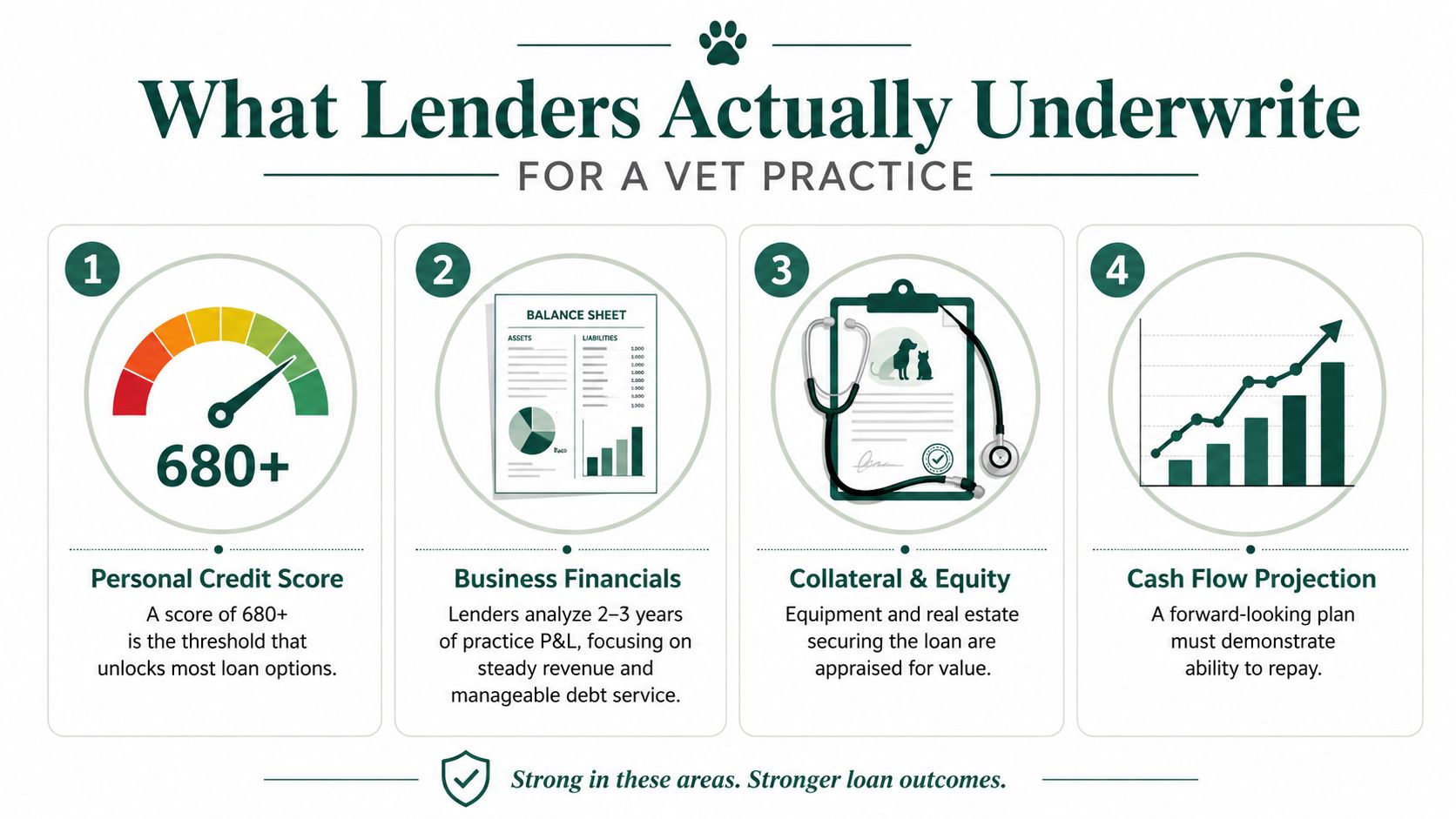
What Lenders Actually Underwrite for a Vet Practice
Approval depends on more than the clinic's gross revenue. Lenders examine the veterinarian, the practice, the assets, and the transition plan as one repayment system.
Personal profile and professional readiness
Personal credit is an early filter. A score of 680 or higher generally opens more conventional and SBA options, while a lower score can narrow the field toward alternative or credit-union structures. Credit history also reveals unresolved tax liens, recent delinquencies, excessive utilization, and whether the borrower has handled obligations consistently.
The borrower's resume matters. Lenders look at clinical experience, management responsibility, board examination status where relevant, associate history, and prior ownership exposure. An associate buying into an existing clinic may present less operational risk than a first-time owner launching a new facility, but the lender still needs evidence that the buyer can manage staffing, collections, inventory, and vendor relationships.
Practice cash flow and operating signals
For an existing clinic, lenders analyze historical profit and loss statements, balance sheets, tax returns, bank statements, debt schedules, and normalized owner compensation. The most important question is whether adjusted operating cash flow can cover the proposed debt while leaving room for ordinary repairs and working-capital fluctuations.
Clinic-specific signals provide additional context:
- Veterinarian-to-revenue ratio: A sharp change can indicate staffing pressure, doctor productivity issues, or an owner compensation distortion.
- Average transaction charge: This helps lenders understand service mix and revenue quality, especially when paired with patient volume.
- Patient count growth: A growing client base can support expansion, but lenders need to see whether the growth converts into collected cash.
- Referral concentration: Dependence on one referral source can create a fragile revenue base.
- Lease duration: A lease that expires before the loan is repaid can weaken the lender's collateral and continuity assumptions.
- Tax compliance: Unresolved tax liens can delay or derail an otherwise viable request.
The forecast must connect operational assumptions to repayment. Show doctor schedules, staffing changes, pricing, inventory, rent, equipment payments, and the expected timing of the seller's exit. A polished projection without a credible transition plan won't rescue a weak application.
Cost of Capital and Why Term Structure Matters
The lowest interest rate is rarely the cheapest loan once you plot the payment schedule. A short note can carry a lower nominal rate and still consume more monthly cash than a longer facility with a higher rate.
Consider two illustrative structures for $150,000 of equipment. A five-year note at 8% requires approximately $3,041 per month and produces about $32,500 in total interest. A 10-year note at 9.5% requires approximately $1,942 per month and produces about $83,000 in total interest. The longer note saves roughly $1,099 per month, but it costs substantially more if held to maturity. These calculations are illustrative and don't represent a lender quote.
That difference creates a practical choice. If the clinic is acquiring a productive asset and needs liquidity during a transition, the lower payment may protect operations. If the asset has a short useful life, stretching the debt too far creates the risk of making payments after the equipment has already been replaced.
Separate long-life debt from short-life debt
Acquisition goodwill and owner-occupied real estate can support longer amortization. Equipment, software, and short-cycle working capital shouldn't automatically receive the same treatment.
| Loan Component | Principal | Rate | Term | Monthly Payment | Total Interest |
|---|---|---|---|---|---|
| Equipment example | $150,000 | 8% | 5 years | Approximately $3,041 | Approximately $32,500 |
| Equipment example | $150,000 | 9.5% | 10 years | Approximately $1,942 | Approximately $83,000 |
| Acquisition debt example | $500,000 | SBA pricing | Long-term acquisition structure | Depends on rate and term | Depends on rate and term |
| Working-capital line example | $100,000 | Variable or lender-specific | Revolving | Depends on drawn balance | Depends on usage and repayment |
The $500,000 acquisition and $100,000 working-capital examples should be modeled separately from the equipment note. A line of credit accrues cost only on the amount drawn, while a fully funded term loan charges interest on the outstanding balance according to its amortization schedule.
Borrower rule: Match debt life to asset life. Use long-term debt for long-lived value, dedicated equipment financing for equipment, and a revolving line for temporary operating gaps.
The correct breakeven question is not “Which rate is lower?” Ask how much monthly cash the clinic must retain to fund payroll, inventory, repairs, hiring, and transition expenses. Longer amortization pays for itself when the liquidity it preserves allows the practice to maintain or expand operating earnings. Review veterinary practice loan rates as one input, but compare total interest and cash-flow impact before selecting a structure.
Matching the Right Loan to Your Practice Stage
Loan selection should follow the clinic's lifecycle. A product that works for a first acquisition may be wrong for a second location or an equipment refresh.
| Practice Stage | Primary Loan | Secondary Product | Term Anchor | Key Trade-off |
|---|---|---|---|---|
| Associate buying into an existing clinic | SBA 7(a) | Working-capital line or conventional support | Acquisition asset term | Flexibility versus program requirements |
| First-time owner acquiring a practice | SBA 7(a) | Seller note and equipment refinance | Business-asset term | Lower initial payment versus total interest |
| Established owner opening a second location | SBA 504 for eligible real estate | Working-capital line | Long real-estate term and separate operating liquidity | Strong structure, but more complex capital stack |
| Mature clinic modernizing equipment | Dedicated equipment financing | Revolving line if timing requires | Match to equipment life | Keeps existing term debt clean |
| Practice refinancing legacy debt | Conventional term loan when cash flow supports it | Equipment or working-capital facility | Rebuilt around current assets and cash flow | Tighter underwriting may produce cleaner debt |
Early-career buy-ins
An associate buying a partner's share should start with a transition map, not a loan application. Define the purchase price, seller's ongoing role, voting rights, clinical schedule, compensation, and exit date. SBA 7(a) is often the default financing route for the ownership purchase, while a separate liquidity facility can prevent the buyer from using personal reserves for payroll or inventory.
First acquisitions
For a first-time owner acquiring an established practice, SBA 7(a) is usually the strongest starting point because it can accommodate acquisition needs and longer business-asset amortization. If the seller wants an extended handoff, add a seller note or negotiated consulting structure rather than assuming the primary lender will accept an open-ended transition. Any older equipment should be evaluated separately, especially if refinancing it inside the acquisition loan would create an inefficient repayment period.
Second locations and renovations
An established owner opening a second location should separate the project from operating liquidity. SBA 504 can fit eligible owner-occupied real estate and major fixed assets, while a working-capital line can support staffing, inventory, and the ramp period. Don't use the real-estate facility as a substitute for a cash reserve.
Modernization and refinancing
Mature clinics replacing imaging, surgical, or laboratory equipment should use dedicated equipment financing where possible. That preserves the existing term loan and aligns repayment with the asset's useful life. For a refinance, conventional debt can be attractive when the practice has strong current cash flow and clean reporting, but the new structure must account for every legacy obligation, lease, guarantee, and equipment lien.
Decision test: If the use of funds has a different useful life or repayment pattern, it deserves a separate schedule in the financing plan.
Before applying, assemble normalized financial statements, tax returns, bank statements, debt schedules, lease documents, equipment quotes, purchase agreements, seller-transition terms, personal financial information, and a monthly cash-flow forecast. Then stress the model around payroll, inventory, collections, and the transition date. Approval is useful only when the clinic can operate comfortably after closing.
Final Takeaways for Veterinary Borrowers in 2026
The best loans for veterinarians solve a transition-and-cash-flow problem, not merely an approval problem. Match the tenor to the asset's life, separate acquisition debt from equipment debt, and protect liquidity for payroll, pharmaceuticals, staffing, repairs, and the seller handoff.
For most first acquisitions, keep SBA 7(a) as the default starting point unless seller carry or an extended earn-out changes the economics. Use dedicated equipment financing for asset renewal, working-capital lines for operating timing gaps, and conventional term debt when an established practice can meet tighter bank underwriting.
Borrowing-cost guidance for 2026 indicates that SBA and other veterinary financing can carry materially different pricing depending on loan size and borrower profile, so every spread matters. Don't choose a product because it closes quickly or advertises the lowest rate. Choose the structure that leaves the practice able to repay debt and keep functioning through the transition.
Veterinary Practice Loans helps veterinarians evaluate financing for acquisitions, startups, equipment purchases, working capital, expansion, and refinancing. If you're weighing a purchase price, seller transition, equipment plan, or liquidity reserve, visit Veterinary Practice Loans to discuss a financing structure built around your clinic's actual cash flow.
