
You're not shopping for a loan in a calm market. You're trying to decide whether to buy into a clinic, take over a partner's share, or walk away from a corporate offer while your inbox is full of lender questions, payroll worries, and a seller who wants a clean close. That's the setting for VCA Animal Hospitals veterinary practice ownership loans, and the mistake most buyers make is thinking the hard part ends when the purchase agreement gets signed.
The hard part starts after closing. Payroll doesn't wait. Staff retention can wobble. Clients notice even small changes. If you're the veterinarian with eight years of clinical experience trying to decide between a buy-in and staying an associate, you're not just choosing ownership. You're choosing a capital structure that has to survive the first 6 to 12 months after the keys change hands.
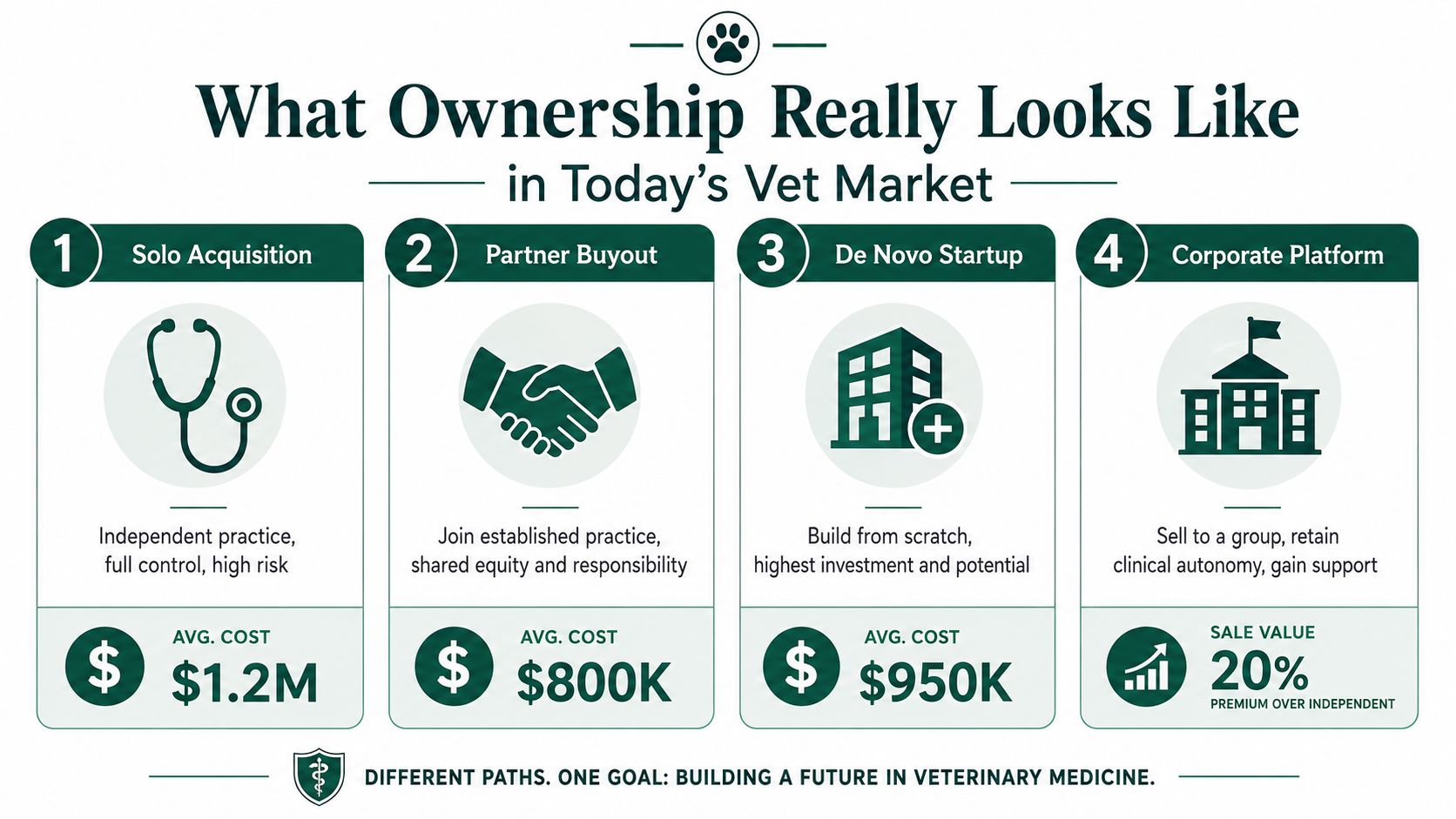
What Ownership Really Looks Like in Today's Vet Market
A typical buyer starts with a simple question, then quickly discovers the answer is messy. You're an associate, you like the practice, the owner is nearing exit, and a corporate platform is also circling. One path keeps you independent, one ties you to a partner buyout, one means starting from scratch, and one means selling into a larger group and deciding how much clinical autonomy you still want.
The deal isn't one event, it's three cash events
The purchase price gets the attention, but it's only one piece of the capital stack. You also need working capital to get through the transition, and you may need money for the first year of capex, especially if equipment, software, or rooms need upgrades after closing. Buyers who ignore those follow-on needs usually end up scrambling for credit after the ink is dry.
The consolidation trend makes that mistake more expensive. In the UK veterinary market, independent ownership fell from 89% in 2013 to roughly 40% in 2024, which tells you how much the ownership dynamic has shifted toward larger groups. In the U.S. and abroad, VCA's footprint has also mattered as a consolidation marker, with DVM360 reporting more than 925 hospitals by 2017 and a later industry reference describing 1,000+ hospitals across the U.S., Canada, Brazil, and Japan, with about 90% primary care and 10% specialty care, plus 59 specialty hospitals in October 2019. That scale shows why ownership, sale, and expansion financing keeps getting strategic in major markets. VCA corporatization data
Practical rule: don't ask, “Can I buy the practice?” Ask, “Can I carry the practice through the transition and still service debt without starving payroll?”
If you're comparing your path against a sale into a larger platform, the decision isn't only about price. It's about control, speed, post-close support, and how much execution risk you want to carry alone. For a useful contrast on how a corporate-style buyer thinks about ownership transitions, see this related overview of Banfield veterinary practice ownership loans.
Loan Structures Available for Veterinary Practice Buyers
Four financing structures show up again and again in veterinary acquisitions, and the wrong one can choke the deal or leave the practice short on cash after closing. The best structure depends on transaction size, timeline, and how much transition risk the buyer is absorbing. Buyers who focus only on the purchase price usually miss the core issue, which is whether the clinic can carry payroll, retention, and day-to-day continuity once ownership changes hands.
The four structures buyers use most often
Conventional commercial loans are the simplest on paper. They can move quickly when the borrower is clean and the lender already understands the clinic's revenue pattern. The tradeoff is tighter underwriting and little patience for weak financial records or missing detail.
SBA-style loans usually fit ownership transitions well, especially when the buyer needs more financing or wants a longer repayment runway. For a closer look at how these structures work in veterinary deals, review SBA loans for veterinary practice. The drawback is heavier paperwork, slower processing, and a longer path to closing.
Seller financing fills the gap when the buyer and lender cannot quite cover the full price on their own. It also shows that the seller has confidence in the transition, because part of the deal remains tied to how the practice performs after closing.
Veterinary-focused lenders underwrite the clinic itself, not just a balance sheet on paper. That matters when the practice has steady client flow, strong deposits, or a transition that needs a lender who understands veterinary cash patterns and the pressure that shows up in the first months after close.
| Structure | Typical Buyer Down Payment | Best-Fit Scenario | Speed to Close |
|---|---|---|---|
| Conventional commercial loan | Varies by deal | Clean borrower, strong financials, simple acquisition | Faster when files are complete |
| SBA-style loan | Lower cash needed upfront | First ownership, larger acquisition, greater borrowing capacity need | Slower, more documentation |
| Seller financing | Often used to fill a gap | Price gap, transition alignment, buyer needs flexibility | Depends on seller responsiveness |
| Veterinary-focused lender | Structure varies | Clinic revenue fits veterinary underwriting and speed matters | Often faster for established clinics |
Working capital lines and equipment financing usually sit beside the acquisition loan, not inside it. Treat them as separate tools. If the clinic needs payroll cushion or equipment replacement, do not force those needs into the purchase note and hope the numbers sort themselves out later. That mistake shows up fast in the first few months, when payroll still has to clear and the new owner is already carrying debt service.
A lender that knows veterinary operations will ask different questions than a generalist bank. That is the difference between a file that gets understood and a file that gets stuck.
What Lenders Actually Evaluate
Most buyers think approval starts with the purchase agreement. It doesn't. It starts with how clean your personal credit looks, how much operating experience you've got, and whether the clinic can support debt after the transition. If you are weak in one area, the rest of the file has to be stronger.
What lenders care about first
For first-practice buyers, independent veterinary-finance guidance says lenders often look for 2 to 3 years of work experience, clean credit, and ideally a FICO score above 700. Those borrowers can often obtain 80% to 100% financing from commercial lenders, depending on the deal. If financing covers only 90% of the purchase and the buyer contributes 1% to 2% of price, seller financing commonly fills the remaining 8% to 9%. First-practice buyer guidance
That experience threshold matters because lenders want proof you can run more than a schedule. They want evidence you can manage staff, handle case flow, and make decisions when the owner is gone. Buyers with only clinical skill but no management maturity usually hit a wall during underwriting.
The other filter is simple. Lenders want to see that you can survive the first 6 to 12 months after close, when payroll, retention, and patient continuity put pressure on cash flow. If you are too thin on liquidity, even a good acquisition can turn into a restructuring conversation before the loan has a chance to season. If you are building a veterinary practice acquisition loan, that post-close cushion matters as much as the purchase price.
Use the clinic's scale as a reality check
VCA's historical acquisition criteria are a useful benchmark for what large buyers target. The company's acquisitions page says it looks for practices with at least $1.3 million in annual revenue and at least two full-time DVMs, and that purchases are paid 100% with cash. VCA acquisition criteria That doesn't mean your smaller clinic is unfinanceable. It means strategic buyers tend to pursue established, scaled practices, so your financing story has to prove durability, not just potential.
Borrower rule: know your FICO, your liquidity, and your years of experience before you ask for terms. It saves weeks of back-and-forth and gives the lender fewer excuses to stall.
For specialty or equipment-heavy deals, a larger loan amount doesn't automatically mean a worse risk profile. If the assets are specific, useful, and tied to revenue-producing procedures, the lender may still like the deal. The key is to show the debt maps to cash flow, not optimism.
Building the Documentation Packet Lenders Expect
A strong file gets a serious answer. A sloppy file gets a slow one. If you submit a complete packet on day one, you shorten the approval cycle and force the lender to react to your deal instead of chasing missing records for two weeks.
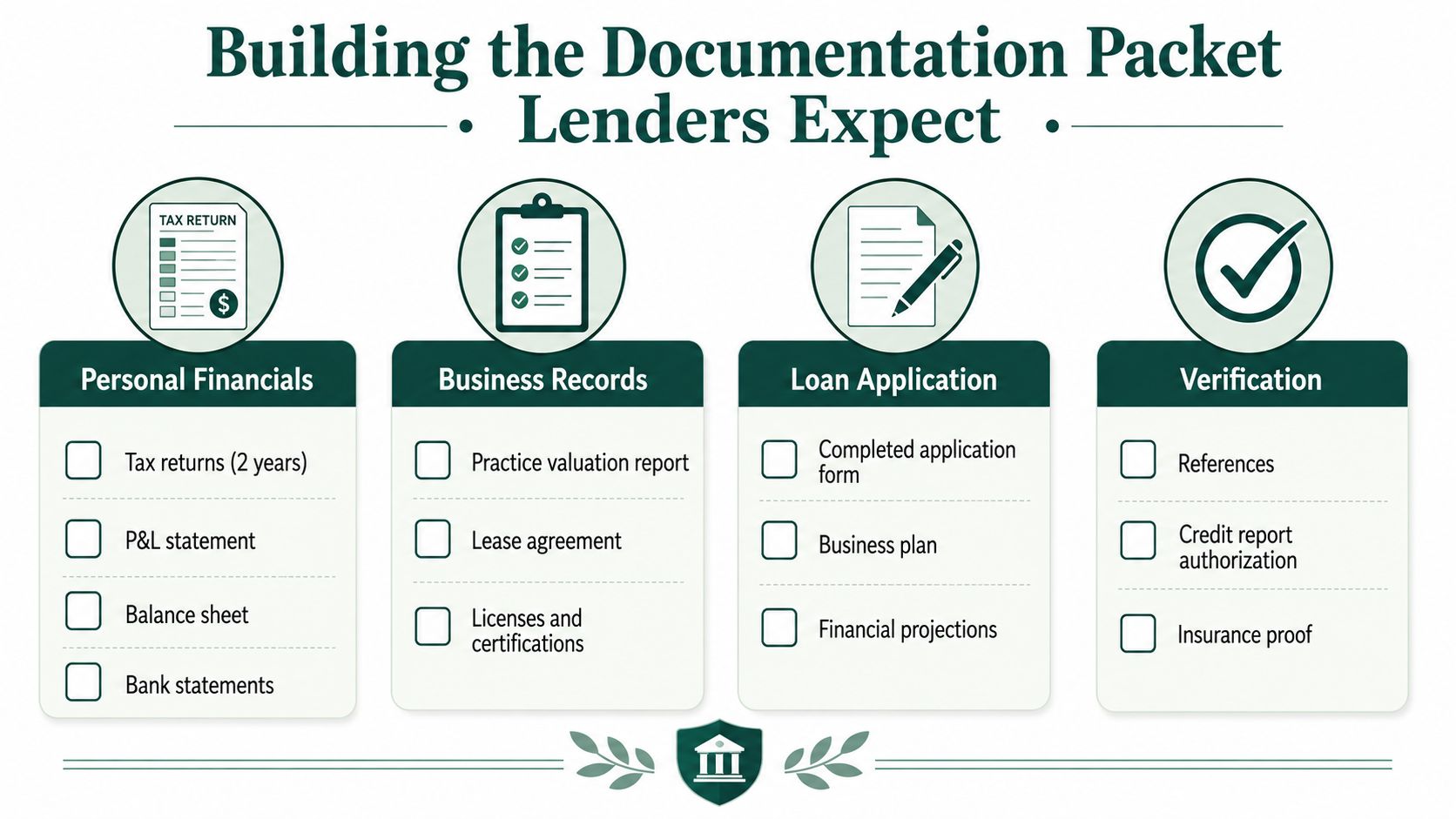
Personal, practice, and deal documents belong in separate folders
Your personal financials should be ready before the first lender call. That means tax returns, a profit and loss statement, a balance sheet, and bank statements. Add statements of personal liquidity if you have them, because lenders care about how much breathing room you'll have after closing.
Your practice records need to be clean and current. Build a package with three years of profit and loss statements, year-to-date numbers, production reports by DVM, and accounts receivable aging. If the seller can't produce those cleanly, that's not an admin issue. It's a warning sign.
Your deal documents carry the actual story. Include the purchase agreement, due diligence findings, lease or purchase terms for the property, and any seller notes. If the transaction includes a transition plan, put that in the packet too.
Don't forget equipment addenda
If the acquisition includes equipment financing, gather serial numbers, vendor quotes, and useful-life estimates. Equipment lenders want to know what they're financing and how long the asset will earn its keep. Veterinary-focused lenders often ask for fewer standard SBA forms because they underwrite against clinic revenue and deposits, not just a generic small-business profile.
The lender doesn't need perfection. It needs completeness. A tidy packet tells the underwriter you're organized, the seller is responsive, and the deal won't collapse because someone forgot a lease exhibit or a current bank statement.
Timeline From First Conversation to Funded Close
Most buyers underestimate how long the process takes because they focus on the term sheet and ignore the back end. The path runs in stages, and each stage can stall for a different reason. If you plan backward from your target close date, you stop treating lender timelines like wishful thinking.
A workable week-by-week sequence
Week 1 is the discovery call. The lender hears the story, the structure, and the target close date. If the deal is clearly out of range, you want that answer now, not after a stack of paperwork.
Weeks 2 to 3 are for pre-qualification and the term-sheet request. The lender reviews the basics, checks whether the borrower profile fits, and starts shaping terms. You should surface any seller note, transition issue, or lease complication.
Weeks 3 to 5 are the full application and document submission phase. Weak files get exposed here. Incomplete tax returns, slow seller responses, and missing production reports are the usual delay points.
Weeks 5 to 7 are underwriting and appraisal. If equipment, real estate, or practice value needs outside review, scheduling can slow the file. Weeks 7 to 8 are committee and final approval, then weeks 8 to 10 are closing prep and funding.
Know the fast lane and the slow lane
Veterinary-focused lenders can sometimes fund within 24 to 72 hours for established clinics with clean documentation, according to the publisher's financing guidance. That's a useful benchmark, but it's not the normal path for a complex ownership transfer. SBA-style deals still deserve at least 12 weeks of planning, conventional loans about 4 weeks, and vet-focused lender processes about 2 weeks when the file is already tight and complete.
Keep one rule in mind, if the seller is slow, you are slow. Your lender can't close around missing signatures, unsigned lease consents, or last-minute changes to the purchase agreement.
The cleanest deals are the ones where the buyer starts collecting documents before the purchase agreement is final. That feels aggressive to some owners. It isn't. It's how you avoid paying for a deal with a missed closing date and a growing stack of legal fees.
Why the First 6 to 12 Months After Close Decide Everything
A practice can clear underwriting and still stumble after funding. Payroll starts immediately, inventory gets reordered on the new owner's schedule, a few staff members get nervous, and clients often notice the ownership change before the lender sees any pressure in the numbers.
Veterinary practice loans are reported to have among the lowest default rates in commercial lending. That is one reason lenders can support stronger financing when the file is clean. Those low defaults come from disciplined underwriting, stable collections, and enough liquidity to carry the practice through the handoff.
Underwrite the transition, not just the purchase
The first 6 to 12 months are where repayment capacity gets tested. A working capital line sized to 8 to 12 weeks of operating expenses gives the buyer room if revenue dips while the team settles in. That cushion can cover payroll, replenishment, and the small expenses that show up right after closing.
Buyers get caught when they assume approval is the hard part. The harder part is keeping patient volume continuity, holding staff confidence, and stopping a small decline in collections from turning into a debt problem. If payroll feels tight in the transition period, the capital stack is too thin.
Corporate support helps, but it does not run the hospital
When a clinic moves into a corporate platform, the integration may bring HR, IT, finance, accounting, and marketing support after closing. That support matters. It cuts down administrative drag. The local team still has to execute, and the lender still gets repaid from the clinic's cash flow, not from a slide deck.
That is why strong lenders ask about staffing stability, reorder timing, and who owns the handoff plan. They care less about the closing-day celebration and more about whether the practice can absorb the change without a revenue wobble.
If the first quarter after closing looks tight on paper, build the cushion before you close. Waiting until cash is already strained is too late.
Negotiation Tips That Move the Term Sheet
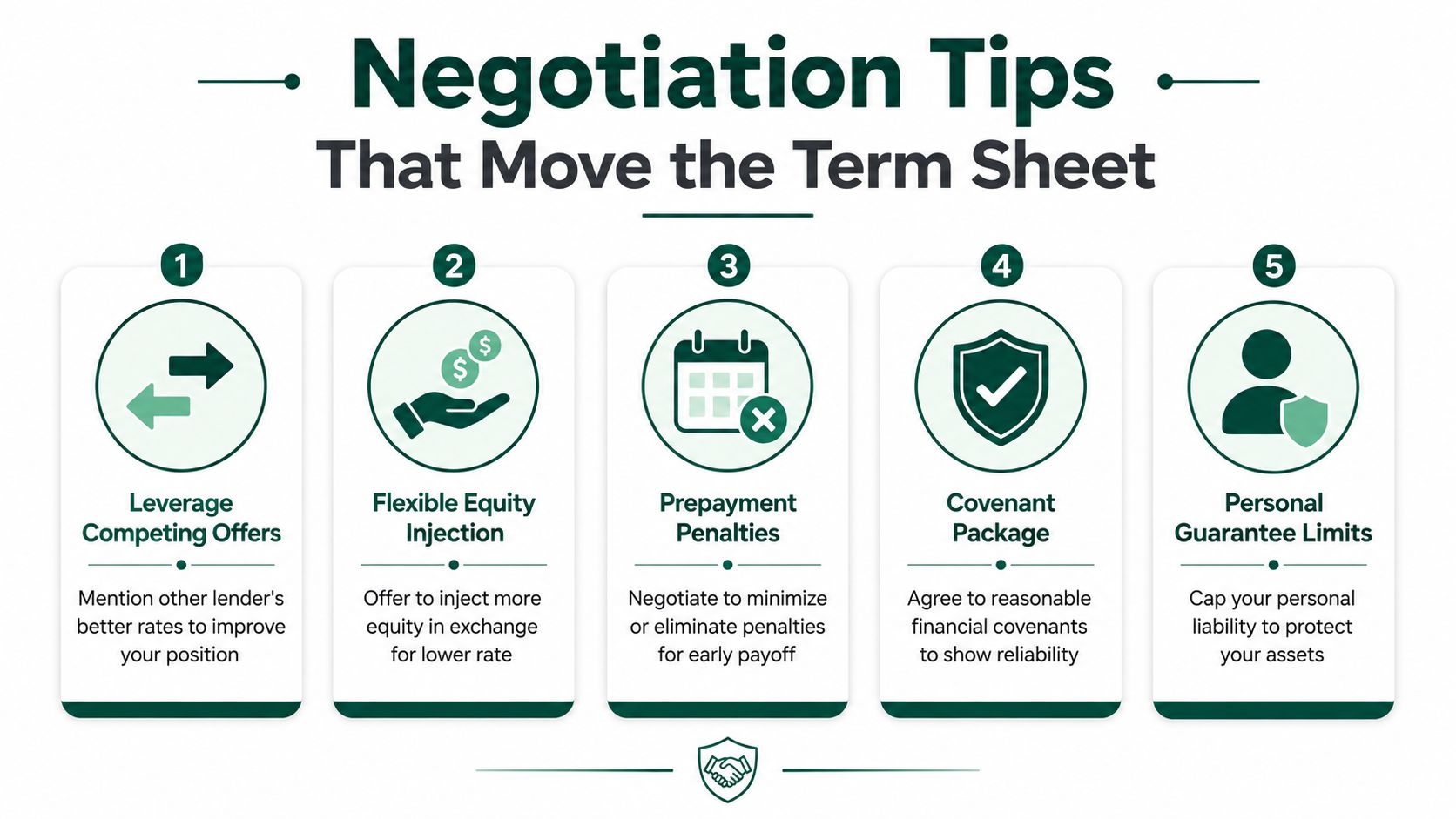
A term sheet is a negotiation document, and buyers who treat it like a formality leave money and flexibility on the table. Vet-specific lenders usually have more room to adjust structure than a generalist bank, especially when the deal is sound and the buyer comes prepared.
Focus on terms that affect survival, rate, covenants, prepayment language, and nothing cosmetic
Start with competing offers if you have them. Do not bluff. Use real alternatives to improve your position and ask directly whether the lender can match a better rate, soften covenants, or improve the prepayment language.
If you can inject more equity, use that as a bargaining chip. Say, “If I put in more cash at close, can we reduce the rate or improve the amortization structure?” That question gets attention because it links borrower commitment to lender comfort.
Push hard on the prepayment penalty before you sign anything. Ask whether it can be reduced or eliminated, especially if you plan to refinance once the practice stabilizes. Also push on the covenant package, because overly tight covenants can turn a solid deal into a constant compliance exercise.
Confirm the details in writing
Before you sign, lock down the rate-lock period, exit fees, any equipment-loan cross-default language, and the refinancing window. If part of the price is contingent on future performance, ask how earn-out financing will be documented and when the contingent payments trigger.
A useful phrase is simple, “I'm comfortable with a fair structure, but I need the post-close runway to manage retention and collections.” That tells the lender you are not trying to avoid discipline, you are trying to avoid a cash squeeze during the first 6 to 12 months after close, when payroll, staffing confidence, and patient continuity decide whether the loan stays on track or gets reworked.
If you want financing built around the operating risks of an ownership transition, Veterinary Practice Loans offers acquisition loans, working capital lines, equipment financing, startup funding, and expansion financing for veterinary clinics in the United States. Visit Veterinary Practice Loans if you want a lender conversation that starts with the deal structure, not a generic small-business script.
