

You've probably already had the conversation. The clinic needs a new imaging system, a second location is on the table, or a partner buy-in is finally in reach. The problem isn't whether the opportunity makes sense, it's whether the loan structure will let the practice breathe once the ink is dry.
That's where veterinarian practice loans stop being a paperwork exercise and become a management decision. If the debt service lands before the revenue ramp, or if the down payment drains the cash you need for payroll and inventory, a “good” deal turns into an operating problem. The right financing should match the way a veterinary clinic earns money, not just the way a lender prices risk.
Why Veterinarian Practice Loans Require a Specialized Approach
A generic small-business loan misses the point when the buyer is stepping into a clinic with goodwill, retained clients, equipment already in place, and a transition period that affects revenue from day one. For that kind of purchase, the debt has to fit the practice's cash flow, not just the lender's checkbox. In a 2026 financing comparison, SBA 7(a) loans were described as the most common tool for individual veterinary practice acquisitions, with qualified buyers able to put down as little as 10% and finance up to 90% of the purchase price. That same source notes that SBA 7(a) loans can reach $5 million and usually offer 10-year repayment for working capital and equipment, or up to 25 years for real estate, which is exactly why they fit acquisition economics better than a plain commercial note. Veterinary financing comparison for 2026
The core challenge isn't the interest rate; it's ensuring sufficient runway for revenue to stabilize.
A clinic does not just buy a building or a machine. It also absorbs transition support, goodwill, inventory, staffing overlap, and working capital after closing. If the loan terms ignore that ramp, the owner gets squeezed by payments before the practice stabilizes.
That is why I tell owners to stop asking, “What's the cheapest loan?” and start asking, “What payment can this clinic support while revenue settles?” If the answer is unclear, the structure is wrong. The mistake is obvious in hindsight. Strong assets do not fix weak timing.
Practical rule: if the debt is tied to an asset that will not produce revenue immediately, the payment schedule needs room for the delay.
Independent veterinary finance guidance says conventional acquisition loans are often structured over 10 years, with newer options extending to 15 years or more, which shows how much the market has shifted toward longer amortizations. For owners comparing structured acquisition financing, the details in this SBA loan guide for veterinary practices make the trade-offs clear, especially when the deal includes transition risk and slower early cash flow.
Understanding the Five Core Loan Types for Veterinary Practices
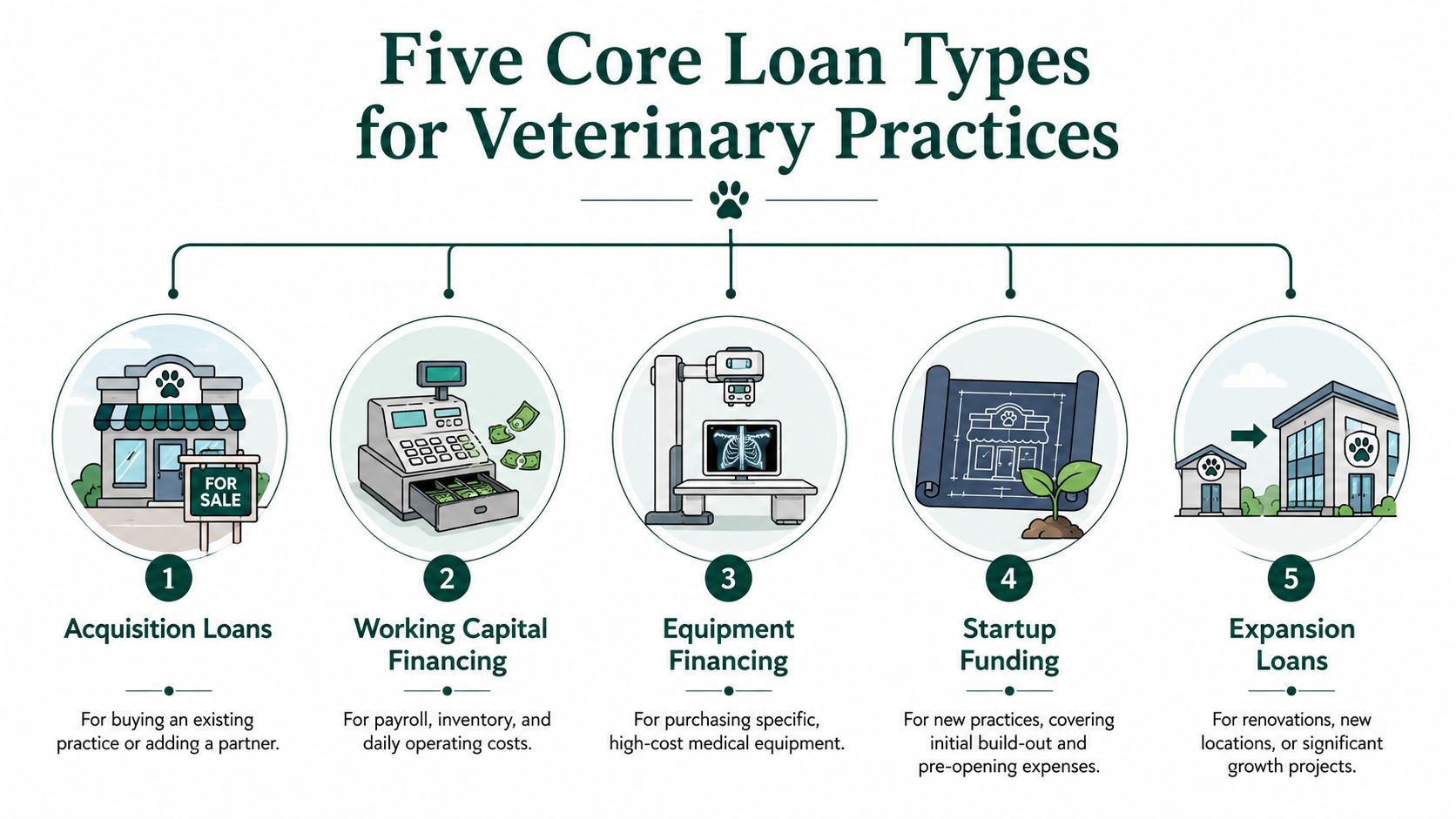
Veterinary financing works best when you match the loan to the job. A practice that needs payroll relief should not use the same structure as a buyer funding a partner buyout, and a clinic replacing diagnostic equipment should not borrow like it's opening a de novo site.
Acquisition loans and working capital are not the same animal
Acquisition loans are for buying an existing practice, adding a partner, or purchasing a share of ownership. SBA-backed structures are the benchmark here because they can support larger transactions, longer terms, and lower down payments when the deal is underwritten properly. For owners buying into a clinic, that matters more than shaving a small amount off the headline rate. SBA veterinary acquisition guide
Working capital financing is different. It covers the day-to-day gaps, payroll, inventory, and operating volatility that show up whether a practice is growing or trying to stay steady. Industry guidance says lines of credit used for ongoing operating needs are usually less than $200,000 and based on practice assets, while short-term funding products for veterinarians can range from $5,000 to $1.5 million. Veterinary practice lending and capital funding guidance
Equipment financing should follow utilization, not excitement
Equipment financing is for imaging systems, surgical gear, lab equipment, and IT infrastructure. The lender is usually looking at the asset itself and the useful life of that asset, which is why these loans are often built to track the equipment's wear and revenue contribution. Some lenders also structure startup and acquisition financing with up to 100% financing, six-month interest-only periods, and practice-loan terms up to 15 years. Veterinary practice lending and capital funding guidance
Startup funding covers build-out, pre-opening expenses, and initial staffing. Expansion loans sit in the middle, because they're for renovations, new locations, and larger growth projects that can be funded by a combination of real estate, equipment, and operating capital.
For a broader breakdown of SBA structures, see this veterinary SBA loan resource.
Quick way to think about the five categories
- Acquisition loans: Buy the practice.
- Working capital financing: Keep the lights on and payroll covered.
- Equipment financing: Fund a specific asset that will earn its keep.
- Startup funding: Cover the opening phase before the doors fully open.
- Expansion loans: Finance growth that takes time to convert into revenue.
The point isn't to pick one forever. Most owners end up using a capital stack, and the smartest version of that stack is the one that keeps monthly pressure aligned with actual clinic activity.
Comparing SBA, Conventional, and Alternative Financing Options
Veterinary owners usually compare three lanes: SBA 7(a), conventional bank financing, and alternative lending. That's the right comparison, but many focus too hard on rate and not hard enough on timing, available capital, and how long the business can carry the debt.
| Loan Type | Down Payment | Max Amount | Term Length | Approval Speed | Best For |
|---|---|---|---|---|---|
| SBA 7(a) | As little as 10% in qualified acquisitions | Up to $5 million | Up to 10 years for working capital and equipment, up to 25 years with owner-occupied real estate | Slower, documentation-heavy | Acquisitions, mixed-use growth, owner-occupied real estate |
| Conventional financing | Usually higher than SBA structures | Varies by lender and deal size | Commonly 10 years, with newer options extending to 15 years or more | Moderate | Established practices with strong financials |
| Alternative financing | More flexible on structure | Varies widely | Shorter to mid-range, depending on product | Faster | Time-sensitive equipment, working capital, bridge needs |
SBA is the benchmark for acquisitions, not the universal answer
The SBA 7(a) structure dominates acquisitions because it can support a higher proportion of debt financing, longer repayment, and, in some cases, near-zero-down structures when the deal includes strong cash flow and seller financing. The trade-off is paperwork and time. If you need to close a practice purchase, a modest delay might be acceptable. If you need to replace a broken machine next week, it probably isn't. SBA veterinary acquisition modeling guide
Conventional loans fit stronger borrowers who want cleaner terms
Conventional acquisition loans have moved longer, which is useful, but they usually don't give you the same borrowing power as an SBA structure. They can work well for established clinics with clean books and predictable cash flow. The upside is simplicity. The downside is that they often ask the owner to shoulder more upfront capital.
Alternative lenders win on speed, not always on elegance
Alternative financing is the lane for owners who can't wait. That includes urgent equipment replacement, payroll gaps, and short-term working capital needs. The cost of that speed is usually less flexibility or a shorter runway, so you should use it for problems that need speed, not for a deal that deserves patient underwriting.
For rate context and structure trade-offs, review veterinary practice loan rates.
What Lenders Actually Look For in Veterinary Practice Applications
Lenders don't fund hope. They fund repayment capacity, and for veterinary practices that means the story has to show how the clinic will carry the debt without starving operations.
Revenue and cash flow do most of the talking
The first thing underwriters want to see is whether the practice throws off enough cash to support the new obligation. That means clean financials, visible deposits, and a believable projection for how the debt will be paid from operations rather than from wishful thinking.
Lenders like boring cash flow. If the deposits are steady and the owner can explain the numbers without spinning a story, the file gets easier to approve.
Personal credit still matters, but in veterinary lending it should be treated as one piece of the file, not the whole file. A strong practice can offset a less-than-perfect personal profile more easily than a weak practice can hide behind a good score.
Documentation needs to be ready before you ask for money
Owners slow themselves down by applying before they've gathered the basics. Lenders typically want business tax returns, profit and loss statements, balance sheets, bank statements, proof of licensing, and a clear explanation of how the funds will be used. If the request is for acquisition or expansion, the plan has to show how revenue will cover the debt after close.
Industry underwriting also pays attention to practice-specific stability, not just generic small-business metrics. That means associate veterinarian retention, client continuity, and service mix can matter because they influence whether the revenue base will stay intact after the loan closes.
Use this checklist before you submit
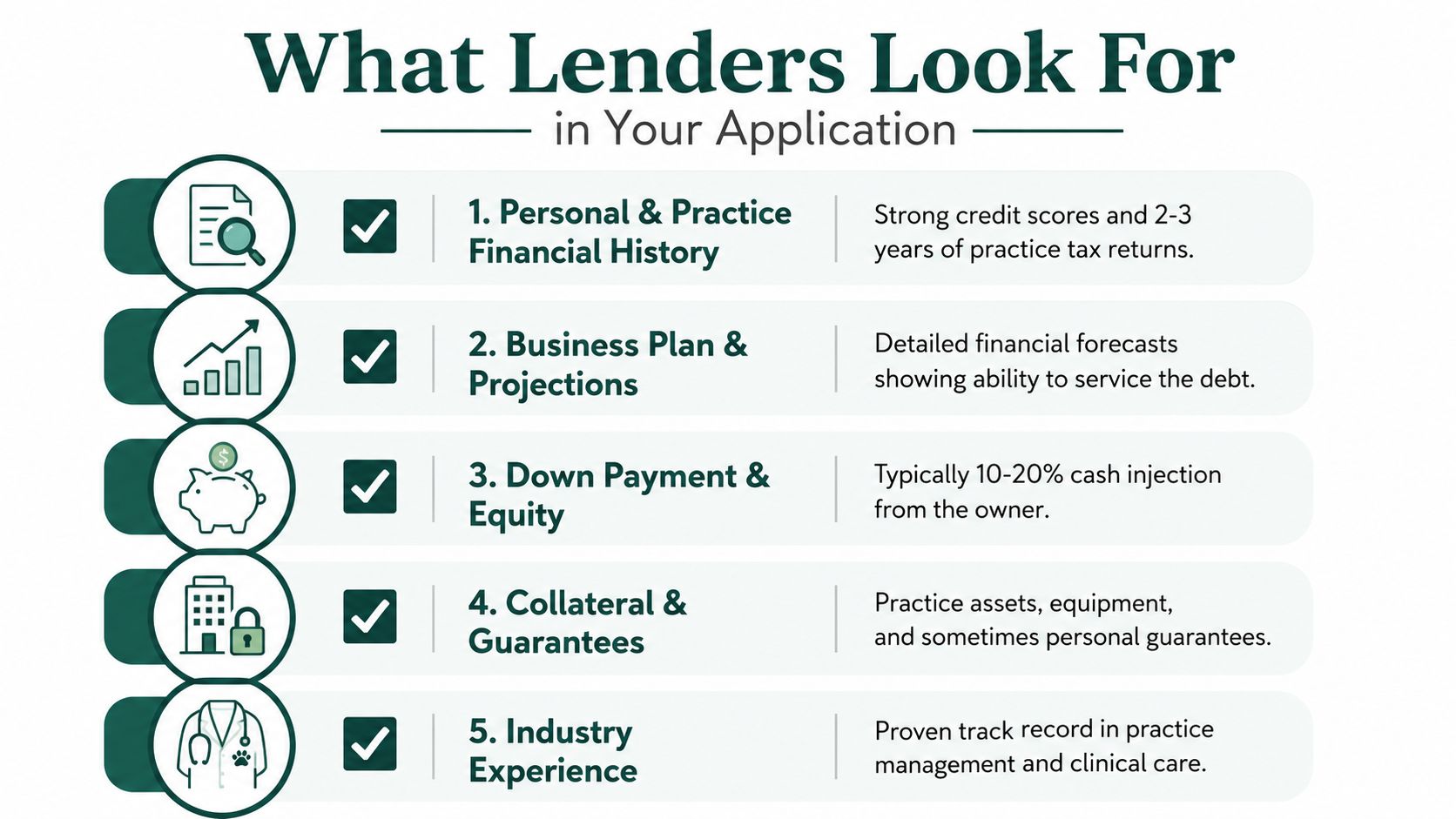
- Personal and practice financial history: Make sure your records are clean, current, and internally consistent.
- Business plan and projections: Show how the debt gets paid from actual clinic operations.
- Down payment and equity: Be ready to show your cash injection or ownership stake.
- Collateral and guarantees: Know what the lender can secure and what you're personally signing.
- Industry experience: Spell out why your background reduces execution risk.
The more organized the application, the less room there is for a lender to assume the worst. That alone can improve the tone of the underwriting conversation.
The Hidden Risk of Overleveraging During Expansion and Equipment Upgrades
The biggest mistake I see is simple, owners finance the largest amount they can get, then assume the clinic will grow fast enough to absorb it. That assumption is dangerous when the asset takes time to convert into billable work.
A practice can absolutely justify new imaging, a surgical suite, or a second location. The question is whether the debt service starts before the utilization does.
Use debt only where revenue can catch up
If a clinic buys high-cost equipment, the payment schedule should be tied to how quickly that equipment will be used. A machine that sits idle or underused doesn't magically become profitable because it was fully financed. The same is true for a new site, where staffing, build-out, and supplies arrive before the appointment book fills up.
That is the core trade-off. Longer amortization can make a project look affordable, but if the new capability doesn't ramp fast enough, the balance sheet is carrying the stress while the revenue base is still forming.
Direct advice: never let an interest-only period lull you into thinking the project can support permanent debt. It only delays the pain if utilization stays soft.
The equity question matters here too. If a lender offers substantial debt financing, the owner still has to ask whether the business can absorb an unexpected slowdown, a staffing miss, or a slower-than-planned referral pattern. In expansion projects, those misses are common enough to plan for, not rare enough to ignore.
Stage the investment when the ramp is uncertain
Sometimes the right move is to delay part of the spend. Buy the core asset first, prove utilization, then add the next layer once case volume justifies it. That approach is less flashy, but it protects liquidity and keeps debt aligned with real demand rather than projected demand.
For equipment-focused financing examples and structure choices, see veterinary practice equipment loans.
The hidden danger is cash flow compression
A clinic can look healthy on paper and still get squeezed if every dollar is committed to fixed obligations. Build-outs are especially vulnerable because the revenue ramp tends to lag the cost ramp. If you're opening a second location, the rent, payroll, and inventory start before the schedule fills.
The right financing decision keeps the practice flexible enough to handle a slower opening month, a delayed hire, or a seasonal dip without forcing a rushed refinance.
Your Step-by-Step Application Process and Timeline
Borrowing gets easier when you treat it like a project instead of a reaction. The owners who move fastest are usually the ones who prepare before they ask for a quote.
Start with your documents, not the lender call
Get your most recent tax returns, bank statements, profit and loss statements, balance sheet, and a plain-language explanation of why you need the money. If the goal is acquisition or build-out, include the purchase or construction context so the lender understands the timeline and the revenue ramp.
A clean file gives you an advantage. A messy file gives the lender room to slow-walk the process.
Then compare offers on more than price
Don't stop at rate. Look at term length, collateral requirements, down payment, prepayment terms, and whether the structure makes the payment fit the asset. A fast offer that strains operations is worse than a slower offer that gives the practice room to breathe.
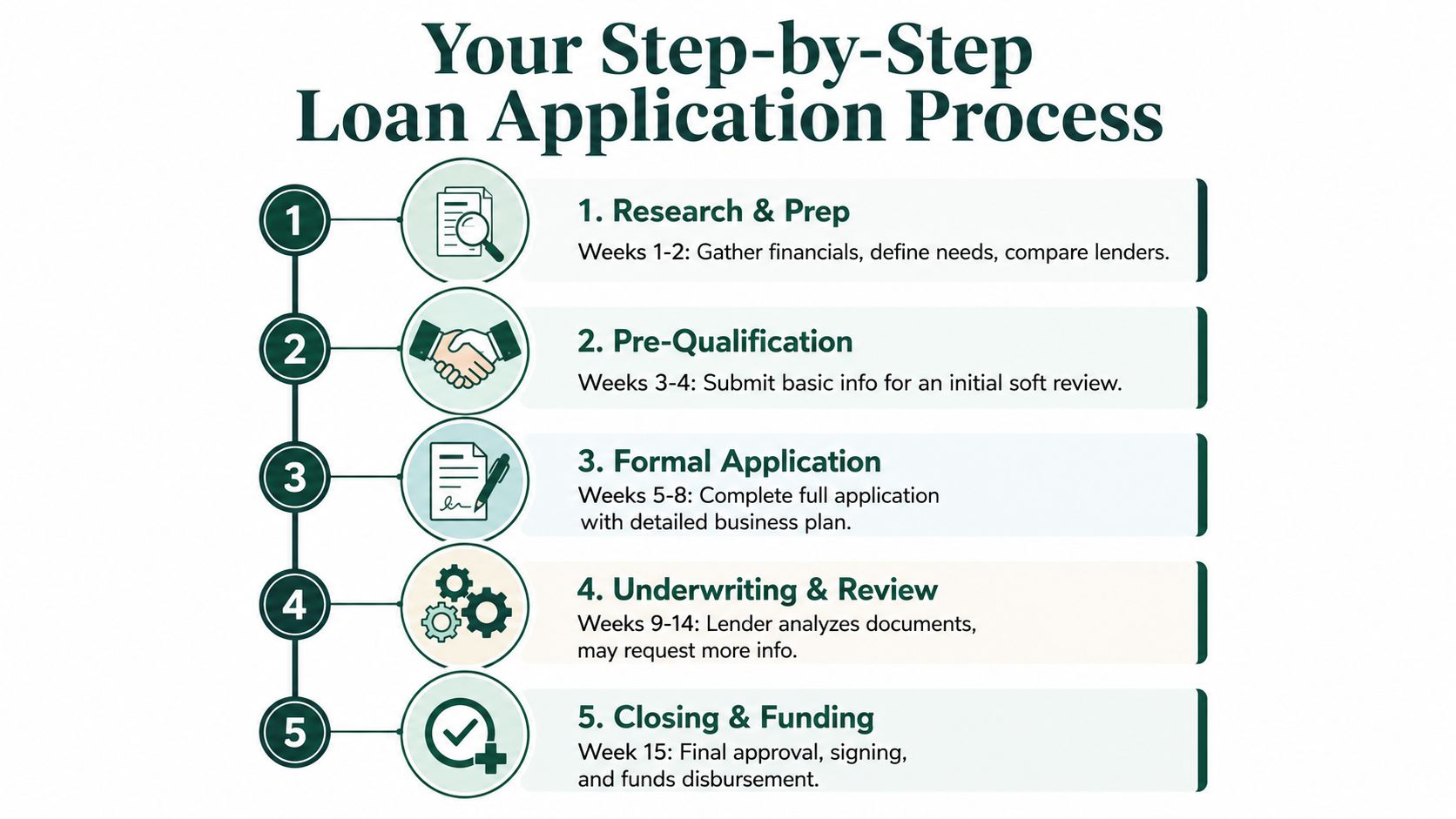
A practical comparison process looks like this:
- Pre-qualify early. Ask whether the lender is comfortable with your practice stage and use of funds.
- Submit the full package. Don't drip documents out one by one if you can avoid it.
- Push for clarification. If the lender asks for more information, answer directly and quickly.
- Compare the monthly obligation. That's the number that affects payroll and owner distributions.
- Close only when the use of funds matches the repayment schedule.
Expect the timeline to move in phases
Preparation takes the longest when the owner is disorganized. Underwriting slows down when the lender has to chase missing information. Closing is usually the easiest part if the file is complete and the money has a clearly defined purpose.
If you need financing around an acquisition date, equipment delivery, or a build-out milestone, start early enough to absorb delays. A rushed borrower usually pays for the rush somewhere else, either in cost, flexibility, or both.
Making the Right Financing Decision for Your Practice Stage
The right loan depends on where the practice sits today, not where you hope it will be in three years. First-time buyers need a structure that protects the transition. Established owners need financing that doesn't choke daily operations. Multi-site groups need capital that scales without creating a cash trap.
First-time buyers should favor control over aggressiveness
If you're buying into ownership, the deal should leave room for working capital after closing. That means the lowest possible down payment is not automatically the smartest move, but neither is loading the clinic with oversized monthly obligations just to feel conservative. The sweet spot is a structure that preserves liquidity and gives the practice time to stabilize.
Established owners should finance assets, not anxiety
If the clinic already has a steady base and you're adding equipment or renovating space, the loan should fit the asset life and the expected revenue contribution. Don't use short debt for long-lived assets unless the cash flow can easily absorb it. That mistake forces good operators into bad decisions later.
Multi-location groups need discipline, not just access
A group with multiple sites can borrow more, but that doesn't mean every growth idea deserves debt. Expansion should be staged against real demand, staffing capacity, and a believable ramp. If one location is still digesting its last project, piling on another one can turn a growth story into a liquidity problem.
My recommendation: choose the financing that still looks tolerable in a slow month, not just in the optimistic forecast.
If the offer seems vague, the collateral is too broad, or the monthly payment only works under best-case assumptions, walk away and regroup. Veterinary financing is supposed to support practice health, not compromise it.
Veterinary Practice Loans helps owners compare acquisition, equipment, working capital, and expansion funding in one place, so you can match the structure to the clinic's real cash flow needs. If you're planning a buy-in, build-out, or equipment upgrade, visit Veterinary Practice Loans and review the options before you commit to a loan that outpaces your revenue ramp.
