

You're likely in one of two places right now. You've spent years building clinical skill as an associate, and ownership has started to feel less like a distant ambition and more like the obvious next step. Or you already found a clinic, a partner buy-in, or a startup location, and now the financing side is slowing everything down.
That's where most veterinarians get stuck. Not because the opportunity is weak, but because the loan structure doesn't match the deal as it stands.
A veterinary practice ownership loan isn't just a way to get approved. It's the framework that determines how much cash you keep, how much monthly pressure you carry, and how stable the practice feels in the first phase of ownership. A flashy approval means very little if the payment structure leaves you exposed when collections wobble, staffing costs rise, or the transition takes longer than expected.
From Associate to Owner Your Path to a Veterinary Practice Loan
A common scenario looks like this: an associate veterinarian finds a solid small-animal clinic with a retiring owner, strong community reputation, and room to grow. The buyer knows the medicine. The seller knows the client base. The deal makes sense on paper. Then the important questions begin.
How much cash needs to go in up front?
Can the loan cover goodwill?
Will the monthly payment leave enough room for payroll, inventory, and a few surprises?

Those questions matter more than the headline rate. Ownership succeeds when the financing supports the clinical and operational ramp, not when the buyer only gets to closing fastest.
What ownership financing really does
At its best, a veterinary practice ownership loan creates a bridge between your professional readiness and the business asset you want to control. It can fund the purchase of an existing practice, help with startup costs, include real estate, or provide room for transition expenses that hit before the practice fully stabilizes.
For many veterinarians, the emotional part is straightforward. They want autonomy, equity, and the chance to build something that reflects how they practice medicine.
The financial part is less intuitive.
Practical rule: The best loan is rarely the one with the biggest approval. It's the one that gives the practice enough breathing room to perform after closing.
The shift from employee mindset to owner mindset
Associates often think first about qualifying. Owners have to think about durability.
That means asking better questions early:
- How much liquidity stays in the business: Closing with little cash left can create stress immediately.
- What the first year could feel like: Transition periods often look uneven even when the clinic is fundamentally healthy.
- Whether the debt fits the asset: Long-life assets deserve long enough repayment structures. Short-term debt on long-term needs can create avoidable strain.
The loan process isn't a side task. It's part of the ownership strategy itself.
Matching the Loan Structure to Your Practice Goals
Veterinarians sometimes shop loans before they define the actual project. That's backwards. Financing works best when you treat it like choosing the right instrument for a specific procedure. The purpose of the capital should drive the structure.

Five common borrowing goals
Most veterinary borrowing falls into five buckets.
- Buying an existing practice: This is usually the most financing-intensive move because the loan may need to cover hard assets, working capital, and goodwill.
- Starting a de novo clinic: Startup financing has to support build-out, equipment, early hiring, and the slower first phase before patient volume matures.
- Expanding a current location: Renovations, added exam rooms, and service-line growth need debt that matches the timeline for revenue payoff.
- Upgrading equipment: This works best when the repayment term lines up with the useful life of the equipment.
- Buying real estate: Real estate financing changes the monthly structure and often improves long-term control, but it's a different analysis than financing the practice itself.
Each goal produces a different underwriting story. A lender will read an acquisition differently than a startup, and should.
Why the wrong structure causes problems
Trouble usually starts when owners use the fastest available loan instead of the best-fit loan. If you use short-term capital for a long-term project, the monthly burden rises before the project has time to mature. If you use acquisition debt but forget to include enough operating cushion, the practice can look profitable on paper and still feel tight every month.
That's one reason working capital matters so much. According to veterinary practice financing market data, working capital financing represented 19.8% of total market revenue, with about $416 million in loan volume recorded in 2025. The same source notes that these facilities are built to help practices manage payroll, inventory, and seasonal fluctuations without draining reserves.
A practice can survive an imperfect month. It struggles when the loan structure assumes every month will be perfect.
Match the tool to the job
A practical way to sort your needs is to write down the use of funds in plain English, then separate it into categories.
| Practice goal | Best structural focus | Main caution |
|---|---|---|
| Acquisition | Cash flow support and goodwill financing | Don't underfund transition liquidity |
| Startup | Ramp-period flexibility | Don't assume revenue arrives on schedule |
| Expansion | Term matched to build-out payoff | Don't borrow too short |
| Equipment | Asset-life alignment | Don't finance consumable needs this way |
| Real estate | Long-term occupancy control | Don't ignore total occupancy cost |
If you're comparing structures and want context around pricing mechanics, it helps to review current veterinary practice loan rates before talking to lenders. Not to chase the lowest quote blindly, but to understand what kind of structure you're being offered.
SBA vs Conventional vs Alternative Loans What Is the Difference
Most practice buyers end up evaluating three paths. SBA 7(a), conventional bank financing, and alternative or fintech-style lending. Each can work. Each solves a different problem. The mistake is assuming they're interchangeable.
Where SBA usually wins
For individual veterinary acquisitions, the SBA 7(a) program is often the baseline because it handles the practical aspects of practice purchases better than many other structures. According to this 2026 veterinary financing comparison, the SBA 7(a) loan program is the dominant financing vehicle for individual veterinary practice acquisitions, allows qualified buyers to borrow up to $5 million, and typically requires a minimum down payment of 10%. That same source notes repayment can extend up to 10 years for the business portion and up to 25 years for included real estate.
That matters because veterinary acquisitions aren't only about equipment and furniture. A large part of the value often sits in goodwill, patient relationships, and the earnings power of the clinic.
Where conventional financing fits
Conventional loans can work well when the borrower is strong, the deal is straightforward, and the bank likes the asset mix. In many cases, though, conventional structures ask for more borrower equity and tighter repayment schedules on the practice portion. That can be perfectly reasonable for some buyers, especially if they want to avoid certain SBA process requirements, but it can also create more pressure on early cash flow.
The trade-off is simple. Conventional financing may feel cleaner. It often feels less forgiving too.
Where alternative lending fits
Alternative lenders are often used when speed matters more than long-term cost, or when the borrower doesn't fit a bank credit box. They can be useful for smaller operational needs, bridge situations, or highly time-sensitive projects.
They are usually not the first place I'd want a veterinarian to build a long-term ownership structure unless there's a specific reason.
For buyers evaluating acquisition financing options, this overview of a veterinary practice acquisition loan can help frame the differences before applications begin.
Veterinary Loan Comparison SBA vs Conventional vs Alternative
| Feature | SBA 7(a) Loan | Conventional Bank Loan | Alternative/Fintech Loan |
|---|---|---|---|
| Typical use | Practice acquisition, working capital, real estate | Acquisition, refinance, real estate | Fast capital, short-term operational needs |
| Down payment | Often 10% minimum, with some structures allowing zero-down when paired with seller financing and strong borrower profile | Typically higher borrower equity requirement | Varies widely |
| Loan size | Up to $5 million | Varies by bank and deal | Varies by lender |
| Repayment structure | Up to 10 years for business, up to 25 years for included real estate | Often shorter amortization on practice portion, longer for real estate | Usually shorter-term |
| Best fit | First-time buyers and ownership transitions | Strong borrowers with solid liquidity | Borrowers prioritizing speed or flexibility |
| Main trade-off | More documentation and process | Higher equity and less flexibility on goodwill | Higher cost and more payment pressure |
If the deal depends on the shortest possible closing timeline, that's not automatically a strength. It can be a warning that structure is being sacrificed for speed.
Navigating the Underwriting Process What Lenders Evaluate
Underwriting feels opaque until you realize lenders are trying to answer one basic question: can this practice support the debt without putting the borrower or the bank in a weak position?
They don't answer that from enthusiasm. They answer it from documents, cash flow, and consistency.
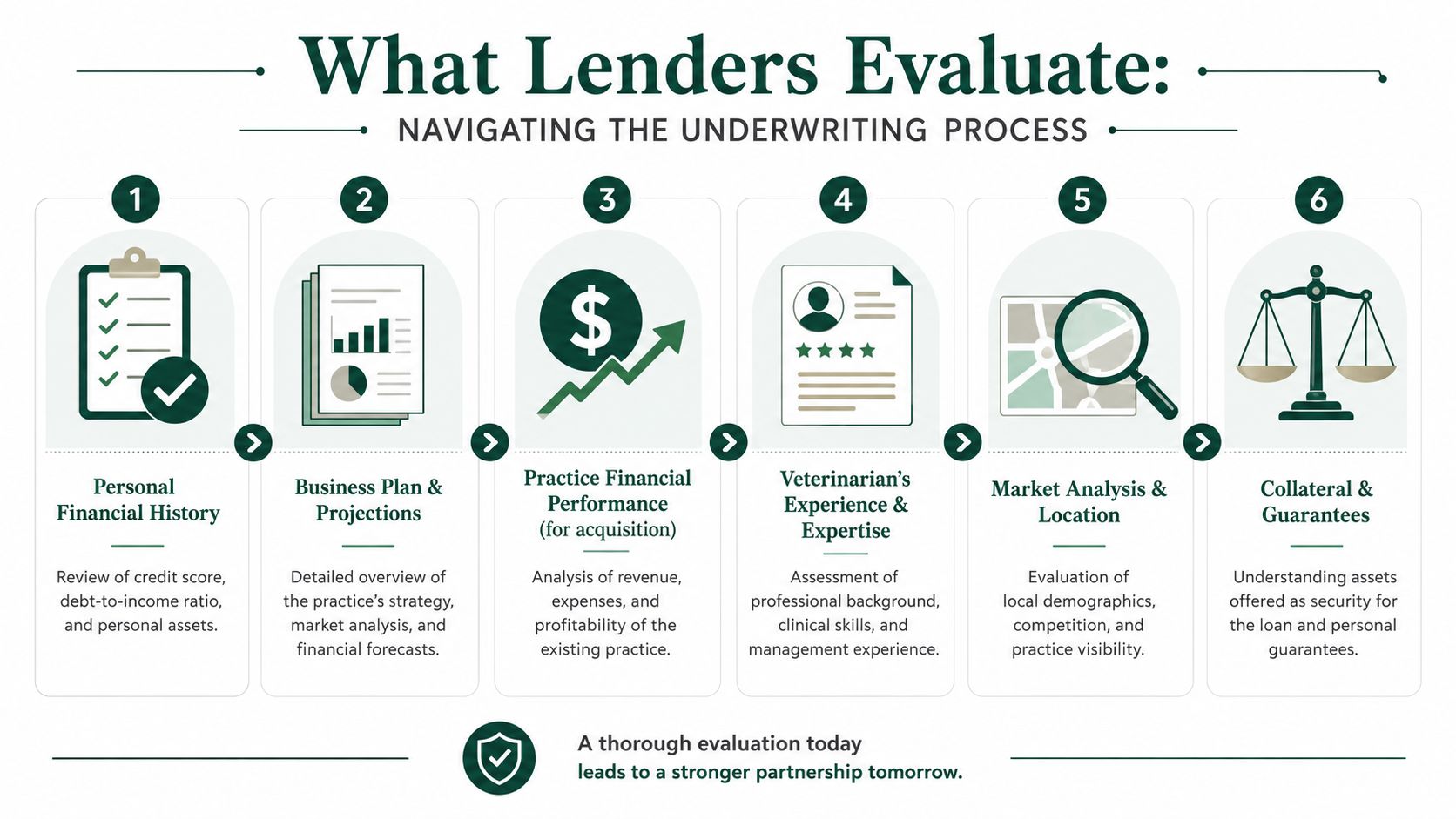
What underwriters look for
A lender usually starts with the same broad credit lens used across business lending, then applies it to the specific realities of a veterinary clinic.
- Character: personal credit history, repayment habits, and overall financial discipline
- Capacity: whether practice cash flow can support the proposed debt
- Capital: how much liquidity or equity the borrower brings
- Collateral: business assets, equipment, and sometimes real estate
- Conditions: the context of the deal, including transition plan, location, and intended use of funds
Capacity is the center of the file. That's where debt service coverage comes in. Lenders use cash flow analysis to determine whether the practice generates enough income to carry the proposed obligation with room for normal operating volatility. In practice, that means they care more about usable cash flow than about a polished pitch deck.
The documents that actually matter
According to this overview of veterinary acquisition underwriting requirements, lenders often ask for three years of business and personal tax returns, year-to-date P&L, balance sheets, and a current debt schedule. The same source notes that equipment financing under $150,000 can be much simpler, often requiring six months of bank statements and a one-page application.
That difference tells you something important. Complexity follows risk.
If you're exploring government-backed structures, this page on SBA loans for veterinary practice financing is useful as a checklist reference because it mirrors what lenders tend to ask for in the actual process.
What clean underwriting looks like
The strongest applications usually share a few traits:
Clear use of funds
The borrower can explain exactly what the capital will do.Credible financial story
The returns, deposits, and operating statements all point in the same direction.Transition realism
The applicant doesn't assume a perfect handoff from seller to buyer.
Here's a helpful overview of the lending workflow before approval and closing:
Underwriters trust applicants who understand their own numbers. They hesitate when the borrower only knows the headline revenue and not the moving parts underneath it.
Common Pitfalls and the Hidden Risk of 100% Financing
The most expensive loan mistakes usually happen before closing. Buyers get focused on getting approved, then overlook the operating strain that starts right after the papers are signed.
That's why I'm cautious whenever a veterinarian treats 100% financing as the ideal outcome by default. It can work in the right file. It is not automatically the smartest structure.

Common errors that weaken a deal
Some problems show up again and again.
- Thin working capital planning: Buyers fund the purchase but not the operational cushion.
- Incomplete diligence: They accept reported earnings without digging into expense normalization and transition assumptions.
- Ignoring loan terms beyond rate: Prepayment restrictions, amortization fit, and collateral structure all matter.
- Optimistic early projections: They assume collections and case flow stay smooth during ownership transition.
These aren't technical mistakes. They're judgment mistakes.
Why zero-down can be riskier than it sounds
According to this analysis of first-acquisition veterinary lending risk, 100% financing offers are often marketed for access but correlate with higher default rates. The same source notes that practices with no initial owner equity may struggle to absorb the common 60 to 90 day revenue dip during transitions, and that requiring 10% to 20% equity often improves loan performance by aligning owner and lender risk.
That's the hidden issue. Zero-down sounds efficient because it preserves cash at closing. But if it leaves the owner with no real equity buffer and very little emotional or financial room to maneuver, the first rough quarter becomes much harder.
Lender mindset: A buyer with some equity in the deal usually behaves differently under pressure than a buyer who started with none.
When a smaller equity injection helps
A modest cash contribution can do more than satisfy a lender. It can improve the psychology and resilience of the ownership transition.
Consider what equity can accomplish:
- It lowers the debt burden from day one: That gives the payment structure more tolerance.
- It preserves optionality: The owner may have an easier time refinancing or expanding later.
- It changes decision quality: Owners under less immediate debt pressure tend to make better operating calls.
That doesn't mean every buyer should rush to put in the maximum possible amount. Draining personal liquidity to make a down payment can create a different kind of danger. The point is balance. A healthy ownership structure usually includes enough borrower commitment to create stability, without stripping away the reserves needed to run the clinic well.
Your Step-by-Step Loan Preparation Checklist
If you want better loan options, prepare like an owner before you apply. Strong files close faster because the lender doesn't need to guess.
Start with the project, not the application
Define the transaction in plain terms. Are you buying a clinic, funding a startup, renovating space, adding equipment, or layering in real estate? Then separate the budget into purchase cost, fixed project cost, and operating cushion.
A surprising number of weak applications fail here. The borrower asks for “enough to get started” instead of a disciplined number supported by actual use of funds.
Build your file in the order lenders think
Use this sequence:
Review personal financial health
Pull together your credit profile, current debts, liquid assets, and any likely questions about past issues.Gather business financials
For an acquisition, collect seller financial statements, tax returns, debt information, and current operating reports. For a startup, assemble realistic projections and assumptions.Write a practical business plan
Keep it grounded. Lenders prefer realistic staffing, production, and ramp expectations over polished but inflated forecasts.Get valuation support where needed
For an acquisition, an outside valuation or formal deal support can keep pricing discipline in place.
Stress-test the deal before the lender does
A good preparation exercise is to ask what happens if revenue starts slower than expected, hiring takes longer, or payroll comes in heavier in the first phase. You don't need dramatic modeling. You need honest sensitivity thinking.
Use a short internal checklist:
- Cash on hand after closing: Don't focus only on down payment and fees.
- Payment comfort: Ask whether the debt payment still feels manageable in a softer month.
- Transition strength: Be specific about seller handoff, staff continuity, and client retention.
- Purpose fit: Confirm the debt term fits the asset or project being financed.
The buyer who wins long term isn't the one who submits first. It's the one whose numbers still make sense after optimism is stripped out.
Talk to lenders after your story is coherent
Approach lenders once you can explain the deal clearly, document the need, and defend the repayment logic. That's when conversations improve. You'll get sharper feedback, cleaner structuring ideas, and fewer last-minute surprises.
A veterinary practice ownership loan should support the next decade of ownership, not just the next closing date.
Frequently Asked Questions About Vet Practice Loans
Can I qualify as an associate veterinarian with no ownership history
Yes, you can. Many first-time buyers become owners without prior ownership experience. What matters most is whether the lender believes you can operate the clinic successfully and whether the cash flow supports the debt. Strong clinical background, clean personal finances, and a well-structured transaction go a long way.
Ownership experience helps, but it isn't the only form of credibility. Leadership experience, production history, and a realistic operating plan all matter.
What timeline should I expect from application to funding
There isn't one universal timeline because the answer depends on the loan type, the complexity of the deal, and how organized the borrower is. A simple equipment request moves very differently from a full acquisition with real estate and multiple parties involved.
The fastest borrowers are usually the most prepared. They have clean documents, a clear use of funds, and quick answers when underwriting asks follow-up questions.
Are rural veterinary buyers at a disadvantage
Not always. In fact, some rural buyers overlook a financing path that may fit their situation very well. According to this overview of rural veterinary real estate financing, the USDA B&I Loan Program can be a strong but underused option for practices in communities with population under 50,000. The source notes that the government guarantee can encourage lenders to support rural real estate acquisition and development even where local demand is perceived as weaker.
That won't replace every SBA solution, but it can expand the conversation for a rural clinic buyer who assumes standard options are the only path.
Is the lowest down payment always the best choice
Usually not. Lower cash in at closing can preserve liquidity, which is useful. But if the structure leaves you financially stretched and underbuffered, the benefit disappears quickly. Good financing balances access, payment durability, and enough owner commitment to keep the deal stable under normal operating stress.
The best loan is the one that still works when the transition is imperfect.
If you're evaluating a veterinary practice ownership loan and want guidance grounded in loan structure, cash flow, and long-term stability, Veterinary Practice Loans helps veterinarians compare financing options for acquisitions, startups, equipment, working capital, and expansion. Their focus on veterinary-specific lending can help you sort through the trade-offs clearly before you commit.
