

“Borrow as much as the lender will approve” is some of the most expensive advice in veterinary practice finance. Approval proves that a lender can structure a loan around its underwriting assumptions. It doesn't prove that your clinic can absorb a slower quarter, a veterinarian's departure, a rate increase, or an expansion that takes longer than planned to produce cash.
Veterinary medicine is a substantial service-sector business. The American Veterinary Medical Association's economic analysis estimated that private-practice veterinary activity generated 458,800 direct jobs, supported 135,000 indirect jobs and 231,500 induced jobs, and produced a total economic effect of 825,353 jobs. The same analysis estimated $18.8 billion in value added, $38.4 billion in direct output, and federal and state revenues of $4.6 billion and $4.7 billion, respectively, as reported in the AVMA economic analysis. That scale deserves disciplined financing, not rate-sheet optimism.
The right question isn't, “How much can I borrow?” It's, “What debt can this practice carry while protecting clinical quality, owner flexibility, and cash reserves?” The answer depends on the loan product, the asset being financed, the clinic's operating discipline, and what happens when the forecast is wrong.
Why More Available Capital Is Not Always Better
More approved borrowing capacity can make an owner feel safer. In practice, it can create the opposite result. Debt that looks manageable under a lender's base assumptions may leave a clinic with no room for payroll pressure, inventory needs, repairs, hiring costs, or a temporary decline in appointments.
A thinly margined clinic with variable-rate debt is especially exposed. A rate increase raises required payments or reduces cash available for distributions, hiring, and reinvestment. A practice with diversified services, consistent deposits, strong operating controls, and substantial reserves has more ways to respond. The facility may be identical on paper, but the risk is not.
The three tests that matter first
Before discussing lenders, I want an owner to answer three operating questions:
- Debt service coverage cushion: How much cash remains after required debt payments under a conservative operating case, not just the expected case?
- Break-even patient volume: How many appointments, procedures, or diagnostic services must the clinic produce after a rate shift to cover payroll, overhead, and debt?
- Owner attention cost: Will the new location, renovation, or equipment project consume management time that the existing clinic currently depends on?
That last test is routinely ignored. An expansion can be financially profitable in a spreadsheet and still weaken the original location if the owner spends too much time recruiting, solving construction problems, or covering staffing gaps.
Lenders generally protect themselves by modeling a repayment floor. Owners experience the median week, including delayed collections, uneven demand, and expenses that arrive earlier than expected. The dangerous gap sits between those two views.
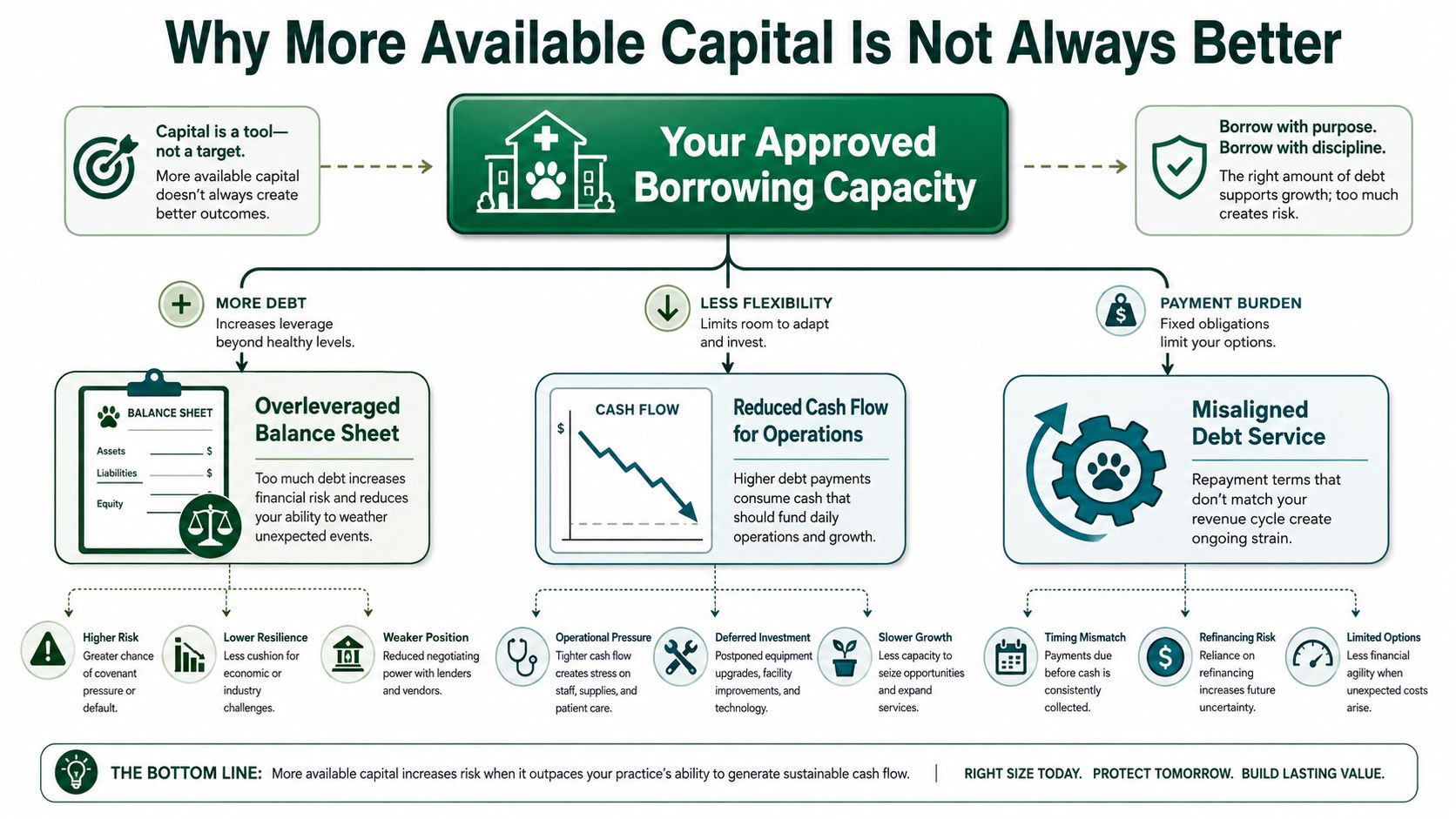
Practical rule: Treat approved leverage as a ceiling for negotiation, not a target for borrowing.
A sensible structure reduces asymmetry between approved leverage and safe leverage. That usually means matching repayment to the useful life of the asset, preserving liquidity after closing, and testing variable-rate debt against a more expensive scenario. It also means refusing to finance long-term assets with short-cycle operating credit merely because the application is faster.
The best loan isn't the one that maximizes proceeds. It's the one that lets the practice keep operating well when revenue arrives later than planned.
The Main Loan Products and What Each Is Built For
The largest approval is often the wrong financing choice. Each loan category solves a specific problem, and using a convenient product for an unrelated need can leave the practice paying for an asset after its useful life has ended. A working-capital line may be fast to arrange, but it is a poor match for a long-lived imaging system. Acquisition debt should not be stretched across every later project.
| Product | Designed For | Typical Size | Watch Out For |
|---|---|---|---|
| SBA-style acquisition loan | Buying an existing clinic, buying into ownership, or funding a qualifying acquisition | Varies by transaction and repayment capacity | Longer underwriting, guarantees, fees, and limited flexibility if the deal changes |
| Conventional term loan | Established practices with documented cash flow, acquisitions, renovations, or expansion | Varies by borrower strength and project | Stronger equity expectations and tighter covenants |
| Equipment financing or leasing | Imaging, surgery, laboratory, dental, information technology, and other identifiable assets | Usually tied to the equipment invoice and useful life | Don't extend repayment far beyond the asset's productive life |
| Working-capital line of credit | Payroll, inventory, insurance delays, seasonal cash timing, and operating needs | Revolving amount based on cash flow and lender policy | Poor fit for permanent assets or recurring structural losses |
| Startup loan | Build-out, initial staffing, inventory, launch costs, and early ramp needs | Based on owner contribution, projections, and project budget | No operating history means personal strength and assumptions matter more |
Acquisition debt carries a different burden
An acquisition loan purchases an income-producing operation. Underwriting centers on historical cash flow, normalized owner compensation, transferable client relationships, and the cash remaining after the transaction. Expansion debt depends more heavily on future performance, so size it from demonstrated debt headroom and a realistic ramp, not an optimistic narrative.
Rate sensitivity matters here. A payment that fits only under today's rate can consume the cash needed for staffing, inventory, and routine repairs after conditions change. Model the proposed payment against a higher-rate case before accepting the lender's maximum approved credit.
Equipment financing is narrower and easier to evaluate when the asset can be identified, valued, and matched to repayment. For diagnostic or surgical equipment, compare an equipment loan with operating and capital lease structures. Review ownership, tax treatment, maintenance obligations, and end-of-term conditions, then keep the repayment period aligned with the equipment's productive life.
Working capital is for timing. If payroll is due before insurance proceeds arrive or inventory must be replenished before collections catch up, a revolving facility can protect daily operations. It should not fund weak pricing, missed charges, excess staffing, or an expansion that has not reached break-even. Recurring shortfalls require an operating correction, not a larger line.
A startup loan has a different underwriting story. Without operating history, the lender relies more on owner liquidity, clinical experience, a detailed pro forma, signed lease terms, construction documentation, and proof that the opening budget includes staffing, inventory, and launch costs. Owners should keep a cash reserve after closing rather than commit every available dollar to the project.
Real estate financing belongs in its own category. A loan secured by the clinic building generally has a different collateral base, repayment horizon, appraisal process, and covenant package from a practice acquisition or equipment facility.
Write down the exact use of proceeds before contacting a broker or bank. Then compare it with the main types of loans for veterinary practices. The right intention can still produce an expensive outcome when it is paired with the wrong product.
What Lenders Actually Underwrite in a Veterinary Practice
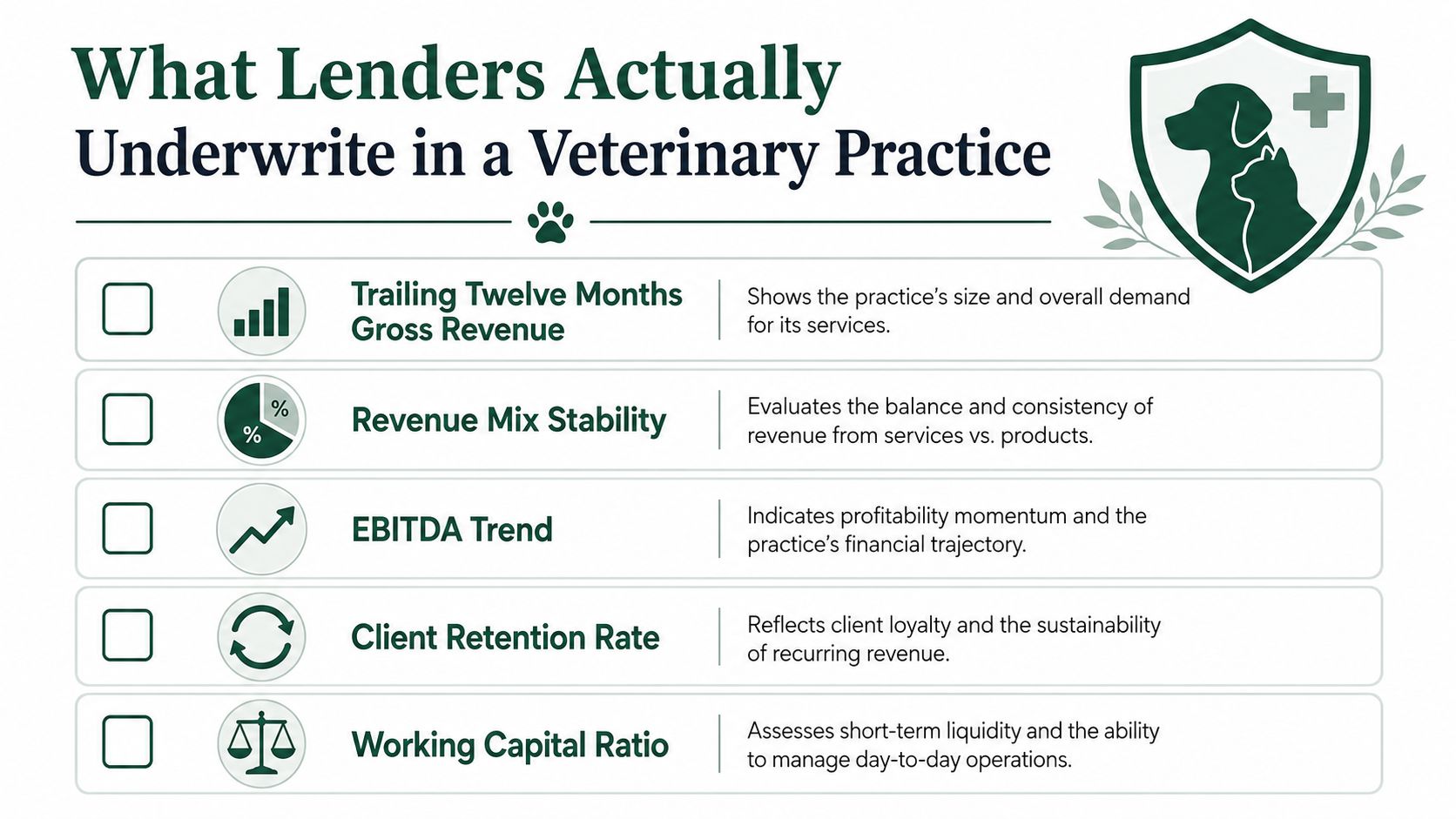
Credit score matters, but it rarely explains the whole decision. A veterinary lender wants to understand how reliably the clinic turns clinical work into collected cash and how much of that cash remains after operating costs and owner compensation.
Historical revenue is the starting point. Underwriters review the trailing twelve months of gross revenue, monthly patterns, production by doctor, and deposits into operating accounts. Deposits matter because they help confirm that reported revenue is reaching the bank rather than remaining trapped in receivables or inconsistent billing processes.
The operating signals behind the numbers
Revenue mix tells a lender whether performance depends on one narrow service. Wellness, surgery, boarding, retail, diagnostics, and other services behave differently across seasons and staffing conditions. A stable mix can make repayment more predictable, while concentration around one referral source or one clinician creates a fragile forecast.
Profitability requires normalization. Veterinary practice benchmarks indicate that healthy practices often operate around 10% to 18% EBITDA margins, with high-performing practices sometimes exceeding 20%. The same benchmark source places staff compensation commonly at 42% to 48% of revenue and total overhead at 55% to 65% before owner compensation, which is why veterinary practice benchmark guidance emphasizes labor and overhead control rather than top-line revenue alone.
Lenders also look for direction:
- Patient count trends: A growing revenue line with weakening patient activity may depend on pricing or a few high-value cases.
- Production by doctor: One clinician producing most of the revenue creates transition and retention risk.
- Client concentration: Heavy dependence on one referral channel can expose the clinic to a sudden volume decline.
- Working-capital behavior: Inventory purchases, receivables, payroll timing, and insurance delays reveal whether the owner manages cash deliberately.
- Existing obligations: Equipment leases and personal debt affect the cash available for new repayment.
Expect requests for tax returns, monthly profit-and-loss statements, practice-management reports, bank statements, production reports by doctor, lease documents, and a current debt schedule. A startup applicant will usually need a detailed pro forma, personal financial statement, owner cash injection evidence, construction budget, and signed landlord terms instead of historical clinic results.
The covenant package deserves equal attention. A DSCR floor, owner guarantee, restricted distribution clause, reporting requirement, or borrowing-base test can change how much freedom you have after closing. These terms aren't boilerplate. Ask what triggers a default, whether there is a cure period, how distributions are limited, and whether the lender can require additional equity.
For a document-by-document preparation guide, review the assets required for a veterinary practice loan.
Comparing SBA-Style Conventional and Alternative Options
The right comparison isn't the quoted interest rate alone. Evaluate each financing track across total cost, funding speed, collateral, guarantees, amortization, reporting, and the consequences of a weak quarter.
| Dimension | SBA-Style (7(a) / 504) | Conventional Bank | Alternative / Specialty Lender |
|---|---|---|---|
| Best fit | Acquisition, ownership transition, or projects needing a structured amortizing facility | Established practice with strong documented cash flow | Time-sensitive needs, thinner documentation, or specialized situations |
| Cost profile | Can offer structured pricing, but fees and guarantee requirements affect total cost | Often competitive for strong borrowers | Usually higher cost, especially when repayment is short |
| Funding speed | Underwriting can take longer and requires extensive documentation | Moderate, depending on lender and file quality | Often faster, with more automated review |
| Collateral posture | Personal guarantees and available collateral remain important | May require stronger collateral and equity support | May rely more heavily on cash flow, deposits, or guarantees |
| Flexibility | Defined program rules can limit changes | Negotiable, but covenants may be tight | Flexible access can come with frequent payments or restrictive terms |
| Quiet failure point | Delay can disrupt a purchase timeline | Thin or inconsistent files may be declined | Short terms can compress cash flow and raise effective borrowing cost |
SBA-style financing
SBA-style structures can be useful when the transaction needs a lower equity requirement or a longer amortizing profile. They aren't free flexibility. The process can require more documentation and coordination, and a guarantee can expose the owner personally if the practice fails.
Conventional bank debt
Conventional debt is often the cleanest option for an established clinic with repeatable EBITDA, consistent deposits, and a strong balance sheet. The trade-off is that the bank may expect more equity, stronger collateral, and tighter financial reporting. A practice with thin or volatile cash flow shouldn't assume a conventional relationship will overcome weak repayment capacity.
Alternative and specialty capital
Alternative financing can solve a timing problem. It can also create a cash-flow problem if the lender offers short repayment periods, frequent debits, or pricing that looks reasonable only when expressed as a simple periodic rate. Revenue-based structures, fintech facilities, and specialized veterinary lenders require a full effective-cost review.
Use an amortization schedule and a downside cash-flow model for every offer. A faster approval isn't valuable if the payment structure leaves no operating room after funding.
Interest-rate sensitivity deserves special attention. Independent 2026 guidance reported U.S. prime at 6.75% and SBA 7(a) pricing around prime plus 2.25% to 6.5%, implying borrowing costs of roughly 9.0% to 13.25% in those examples. The same guidance estimated that a $1.2 million acquisition at about 10.5% over 10 years would cost roughly $16,200 per month, about $3,200 more than comparable debt at a 2021-era rate near 5.5%, as described in this 2026 veterinary practice loan rate analysis. The lesson is straightforward: a deal can remain financeable while becoming materially less affordable.
Matching Repayment Terms to Equipment and Build-Out Life
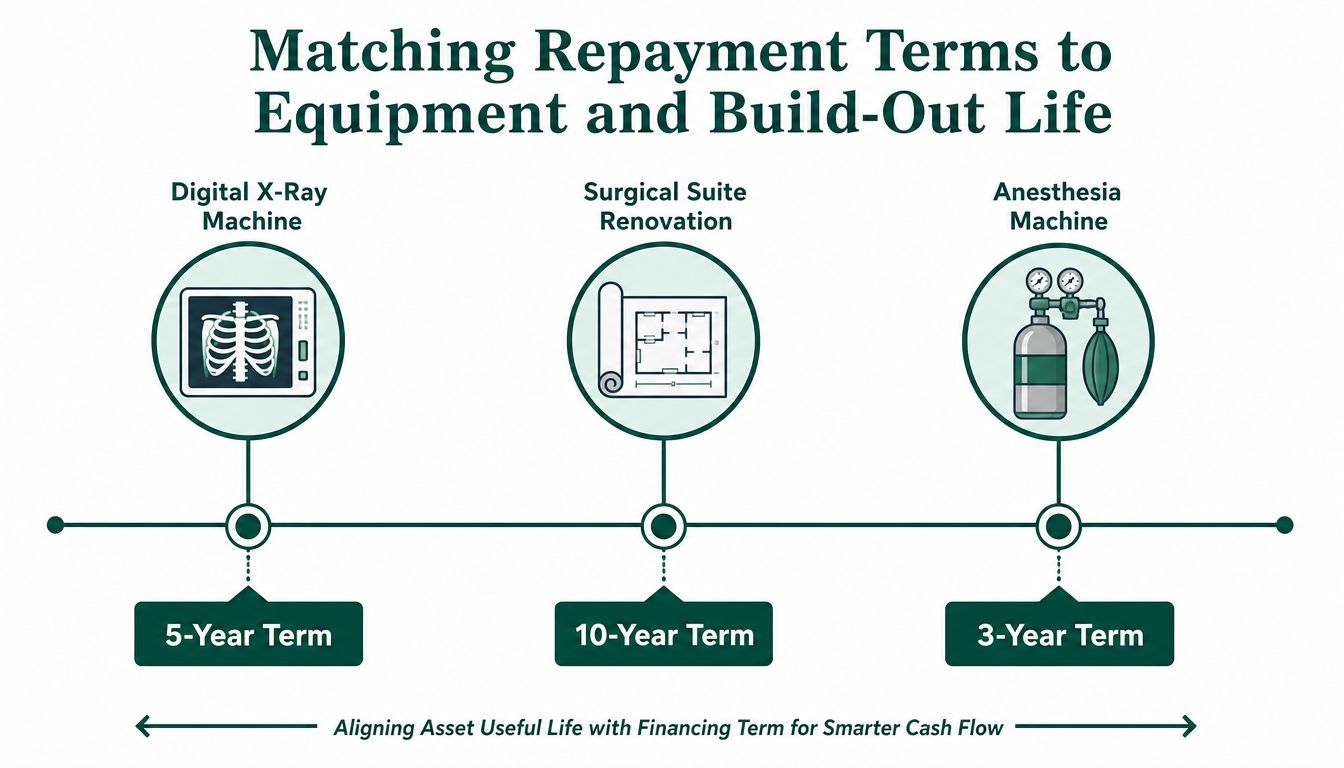
Debt tenor should follow the asset's useful life, not the owner's desire for the lowest monthly payment. Financing a short-lived technology over a long period can leave you paying for an obsolete asset. Financing a durable improvement over an unnecessarily short period can consume cash that the clinic needs for staffing and patient care.
For equipment-heavy clinics, practical assumptions commonly treat imaging and analyzer systems as having about 7 to 10 years of useful life. Faster-evolving digital imaging may be closer to 5 to 7 years, while longer-lived surgical and anesthesia equipment may support longer amortization. Those assumptions and the underlying matching principle are discussed in veterinary equipment financing options.
Use the asset, not the payment, as the starting point
For each project, document four items:
- Expected productive life: How long will the equipment remain clinically useful and support revenue?
- Replacement risk: Could software, sensors, or imaging technology make the asset less valuable before the debt ends?
- Utilization: Will the clinic use the asset enough to generate predictable cash, or is the purchase mostly a convenience?
- Exit value: Can the equipment be resold, transferred, or traded if the practice relocates?
A shorter repayment term can fit handheld ultrasound or dental radiography when the asset is expected to be replaced sooner. A longer structure may make sense for a substantial surgical suite or durable building improvement, but only if the lease or ownership horizon supports it.
Build-out debt creates a separate risk. Plumbing, cabinetry, flooring, electrical work, and leasehold improvements may have value only at the current location. If the loan extends beyond the lease, the borrower may face a balloon, refinance, or relocation problem. Price that risk before signing.
Choose an operating lease when preserving cash and flexibility matters more than ownership, and evaluate a capital lease or equipment loan when ownership and long-term use justify it. For a broader discussion of amortization structures, review veterinary practice loan terms and repayment options.
Financing discipline: A low payment isn't a low-cost decision. It may simply move the risk to the end of the term.
For renovation versus relocation, compare the existing site's lease security, parking, workflow, and expansion potential against the cost of rebuilding elsewhere. Don't borrow for a cosmetic renovation when the premises create a structural operating constraint.
How Financing Decisions Play Out Across a Growing Group
Consider a representative group that begins with one established clinic. The owner uses acquisition financing because the purchase depends on historical cash flow and an ownership transfer. The initial structure works because the acquired clinic produces enough repeatable operating cash to service its debt while the owner learns the business.
The second location is different. The owner uses conventional expansion debt supported by consolidated results from both clinics. That structure can work when the first site remains stable, the second site has a credible staffing plan, and management reporting separates location-level performance. Consolidation helps only if the owner can see which site is generating cash and which site is consuming it.
The third location opens during a period of strong demand. The owner adds alternative capital to move quickly, equipment financing for diagnostics, and a working-capital facility for payroll and inventory timing. The financing appears efficient because each facility has a stated purpose. The problem arrives when the forecast demand doesn't materialize.
The stress arrives in layers
Revenue softens at the new location while the original clinic loses a key veterinarian. The owner shifts attention to recruitment and patient retention, which delays operational improvements. Meanwhile, construction costs rise and the group needs more cash to complete the site than the original budget allowed.
The working-capital line helps cover timing, but it can't repair a location that lacks repeatable demand. The equipment facility remains payable even when utilization is below plan. The alternative facility becomes the most painful obligation because its shorter repayment profile removes cash during the same period that the group needs flexibility.
Then variable-rate facilities reprice. A payment increase that looks manageable at the group level becomes serious when combined with the veterinarian departure, the construction overrun, and weaker appointments. The owner may still have positive EBITDA, but the cushion has narrowed enough to threaten distributions and hiring.
What held and what cracked
The acquisition structure held because it was tied to an existing income stream and had been sized around the original practice. The equipment financing was defensible where utilization remained strong and the repayment period matched the asset. The expansion stack cracked because the owner treated projected demand as if it were historical capacity.
A better plan would have required:
- Location-level reporting: Consolidated EBITDA can hide a weak site.
- Rate scenarios: Variable debt should be modeled at more than the initial quote.
- Contingency liquidity: Construction and ramp periods need cash beyond the base budget.
- Clear facility hierarchy: Permanent assets should not depend on short-cycle working capital.
- Trigger points: A delayed opening, missed hiring milestone, or softer revenue trend should prompt renegotiation before liquidity becomes urgent.
Growth should be financed in stages. A regional footprint isn't a single transaction. It's a sequence of commitments that interact with staffing, collections, equipment replacement, and the owner's limited attention.
A Decision Checklist Before You Sign
A term sheet is only useful if you can explain how the practice behaves after funding. Put the answers in a one-page memo and require every owner or partner to sign off before accepting the structure.
Ask these questions directly
- Does the debt service coverage ratio have a real cushion? If the answer works only under the base forecast, mark it “not yet.” The lender's minimum isn't your operating target.
- Have you stress-tested cash flow for higher rates and weaker revenue? Model a rate increase, a softer quarter, delayed collections, and a staffing gap. Independent guidance on current borrowing costs shows why the initial quote can understate the payment burden, particularly for variable-rate debt.
- Is the down payment source clear? Document whether equity comes from savings, a partner, a seller arrangement, or another facility. Don't use short-term operating credit to disguise inadequate equity.
- Do you understand every personal guarantee? Identify who guarantees the debt, what collateral supports it, and what happens after a default or ownership change.
- Does the repayment term match the asset? Use shorter structures for rapidly evolving technology and longer structures only when the asset and premises justify them.
- Will the lease outlast the build-out debt? If not, price the relocation and refinance risk.
- Can the practice retain liquidity after signing? A post-close operating reserve protects payroll, inventory, and repairs. The decision-checklist concept often uses a six-month operating reserve as a threshold, but apply it to your actual expense base and risk profile rather than treating it as a universal rule.
- What would make you delay or renegotiate? Define the trigger before emotions rise. Examples include a rate moving beyond the modeled case, construction costs exceeding the approved budget, or a key hire remaining unresolved.
- Does the growth story rely on repeatable EBITDA? If projected revenue grows faster than demonstrated production, deposits, and collected cash, the lender may be financing an assumption rather than a business.
Two warning signs deserve immediate attention. First, a lender quotes only the lowest possible rate and refuses to show payment scenarios. Second, the growth narrative is detailed while the EBITDA evidence is thin, inconsistent, or dependent on one doctor.
Veterinary Practice Loans offers financing options for acquisitions, equipment, working capital, startups, and expansion projects, with structures designed around veterinary clinical operations. If you're evaluating a term sheet or sizing a purchase, visit Veterinary Practice Loans with your cash-flow forecast, debt schedule, and intended use of proceeds so you can compare affordability, repayment terms, and rate sensitivity before committing.
