

You're sitting at a kitchen table with a seller's packet open, a rough pro forma on one side, and your own savings account on the other. The clinic looks solid. The question is whether the financing lets you close cleanly without starving the practice on day one. That's where most buyers get it wrong, because the best loan options for buying a veterinary practice aren't the ones with the prettiest headline rate, they're the ones that fit your equity, your timeline, and how much of the purchase price is really tied up in goodwill.
| Loan Type | Best For | Typical Speed |
|---|---|---|
| SBA 7(a) | Buyers who need flexible acquisition financing and goodwill coverage | Slower, but structured for acquisitions |
| Conventional bank loan | Buyers with stronger collateral and a cleaner balance sheet | Moderate |
| Seller financing | Bridging the equity gap and aligning the seller with the transition | Fast if the seller agrees |
| Equipment financing | Deals with major hard assets needing separate funding | Moderate |
| Working-capital loan | Post-close liquidity and short-term gaps | Fast |
| Alternative short-term lender | Buyers who need speed more than low cost | Very fast |
The Real Decision Behind Buying a Veterinary Practice
A first-time associate looks at a two-doctor clinic and sees a familiar pattern. The caseload is steady, the staff knows the clients, and the owner is ready to exit. On paper, it feels like a straightforward purchase. In reality, the financing choice decides whether that deal is smooth or messy.
The clinic is only half the deal
What you're really buying is a mix of tangible assets, goodwill, and transition risk. If most of the price sits in goodwill, a loan that only likes hard assets will feel too tight, even if the clinic itself is healthy. That's why acquisition financing matters more than many buyers expect, because the loan structure can shape the seller note, the cash you need at closing, and whether the deal survives lender review.
Practical rule: If the financing doesn't match the asset mix, the seller can still say yes and the lender can still kill the deal.
This is also why buyers who focus only on the purchase price get surprised. A lower price with a weak structure can be harder to close than a slightly higher price with financing that fits the clinic. The right loan doesn't just fund the sale, it helps preserve working capital so payroll, supplies, and client service don't get squeezed right after transition.
Financing decides your leverage
The smartest buyers think in terms of equity required, closing speed, and how much goodwill the lender will accept. If you have limited cash but a strong seller relationship, you'll usually want a structure that spreads risk across the lender, the seller, and you. If you already have collateral and want fewer moving parts, a simpler bank deal may be cleaner.
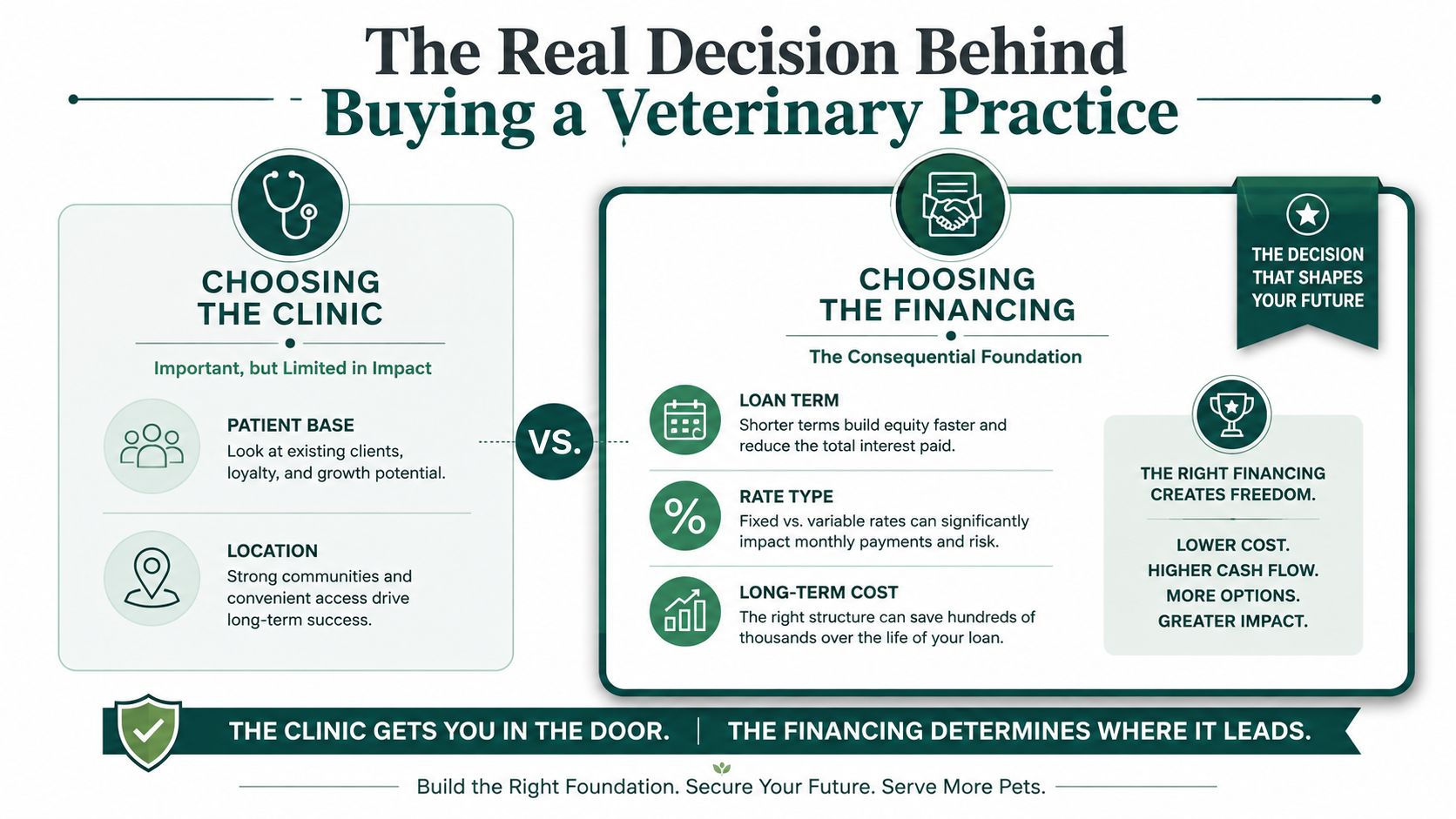
Mistake is treating financing like a later step. The loan choice influences how much seller carry you need, whether the lender accepts the goodwill value, and how fast you can credibly move from offer to close. If you're serious about ownership, you should be comparing deal structures before you fall in love with the clinic.
The Six Core Loan Types Explained
SBA 7(a) and SBA 504 structures
The SBA 7(a) loan is the acquisition workhorse because it can finance goodwill, equipment, working capital, and real estate in one structure. It's the cleanest fit when you're buying an established clinic and the purchase includes more than just fixtures and ultrasound machines. One acquisition guide says the program can support up to $5 million, with terms of up to 10 years for business-only deals or 25 years when real estate is included, and it's commonly used for clinic purchases that include intangible value. SBA loan overview for veterinary practice buyers
A CDC/SBA 504 structure is narrower. It's generally better when the deal is really about real estate and long-lived hard assets, not a broad acquisition package with substantial goodwill. If you're buying the building and the business is heavily asset-backed, it can make sense. If goodwill dominates the deal, it's usually the wrong tool.
Conventional bank, seller, equipment, and short-term funding
A conventional bank loan is usually the cleaner but less flexible route. It tends to work best for buyers with stronger collateral and a simpler transaction. Seller financing is different, it isn't a standalone answer so much as a bridge, because it fills the equity gap and signals the seller has skin in the transition.
Equipment financing isolates hard assets, which is useful when the purchase includes newer equipment you want financed separately from the acquisition. A term loan gives you a fixed lump sum and predictable payments, while a working-capital loan or revolving line is built for payroll, supplies, and the early post-close cash crunch. Alternative short-term lenders exist for buyers who need speed over price, and that trade-off should be deliberate, not accidental.
If goodwill is the core value driver, choose a structure that can actually finance goodwill. If hard assets dominate, don't pay for flexibility you won't use.
How the Loan Types Compare on the Criteria That Matter
Down payment, goodwill, and repayment terms
The first question is simple. Does the loan fit the purchase price you are really buying, including goodwill, or is it built mainly for hard assets and extra collateral? SBA 7(a) is designed for acquisition math that includes goodwill, while conventional bank financing works better when the deal is collateral-heavy and the buyer can contribute more equity. That is why so many veterinary acquisitions center on SBA and add seller financing beside it.
Goodwill changes the deal structure fast. In a veterinary practice purchase, it can make up a large share of the price, which is why a loan that can finance intangible value is usually more useful than a hard-asset-only facility. Why goodwill pushes buyers toward SBA structures
Repayment length matters just as much. Longer amortization lowers monthly pressure, which helps right after closing, when you are absorbing transition costs and learning the practice's real cash flow. Shorter structures may look clean on paper, but they can put too much debt service on a clinic that is still adjusting to new ownership.
If you want a quick benchmark on pricing and structure, start with current veterinary practice loan rates. The rate is only one piece of the decision, but it helps you see how much room you really have for down payment, seller carry, and monthly debt service.
Speed to close and total cost of capital
Speed is where buyers get punished for being careless. A buyer with time can often get a better structure, better terms, and a cleaner approval process. A buyer who needs to close fast usually gives something up, either in price, repayment flexibility, or total cost of capital.
The practical order is straightforward.
- Fastest: alternative or short-term lenders, useful when you need to move before another buyer steps in.
- Middle ground: seller financing and conventional bank lending, depending on the seller's willingness and the bank's internal process.
- Most structured: SBA, which gives broad use of proceeds but asks for patience and documentation.
A short-term loan can get the deal done, but it should be a deliberate choice. Use it when speed matters more than price, not because the buyer ran out of planning time.
Bottom line: the cheapest loan is not the best loan if it cannot close on time or finance the part of the practice you are actually buying.
Matching Loan Types to Real Buyer Scenarios
First-time buyer with limited cash
An associate buying a first clinic usually does not have much equity sitting idle. That buyer needs a structure that can handle a mixed purchase price, cover goodwill, and avoid draining personal reserves. The cleanest fit is usually SBA 7(a) paired with seller financing, because the lender handles the acquisition structure while the seller helps bridge the gap and smooth the transition.
The typical acquisition structure in veterinary deals often uses 80% to 90% lender financing, 10% to 15% seller financing, and 0% to 5% borrower cash, and some lenders note qualified buyers can get in with as little as 10% down. Typical veterinary acquisition deal structure
That is the profile where patience pays. You are not trying to win on speed, you are trying to preserve liquidity and keep the practice stable after closing. If the clinic has real goodwill and a loyal client base, SBA plus seller carry is usually the strongest route, because it fits the part of the practice you are buying and the intangible value you are acquiring.
Experienced owner buying a second location
A buyer who already owns a clinic and has stronger collateral can often take a more conventional route. That buyer usually wants less complexity, fewer moving parts, and a process the bank can move through internally without a lot of custom structuring. In that case, a conventional acquisition loan can be a sensible fit.
The reason is simple. The buyer already understands operations, has more financial depth, and may not need the same level of flexibility around goodwill. A bank loan can be the better choice when the transaction is straightforward and the borrower's balance sheet helps make the file easy to approve. It is a practical choice for buyers who care more about clean execution than about stretching every possible dollar of seller carry.
Buyer who has to close fast
If the seller wants speed, or there is another bidder in play, the calculus changes. Buyers who need to close inside a tight window often turn to alternative short-term lenders or a working-capital facility to avoid losing the deal. That choice costs more than SBA, but it can be the right move when timing is the constraint.
A fast-close loan works best when the buyer has a clear refinance path and can tolerate a higher carry cost for a short period. It is a bridge, not a forever solution. Use it when the deal will disappear without speed, or when the seller will not hold paper and the bank process would take too long.
Buyer who is mostly paying for goodwill
Some acquisitions are really about buying the client base, the staff, and the referral stream. In those deals, goodwill matters more than hard assets, so the loan has to fit an intangible-heavy purchase. SBA financing usually handles that better than a pure asset-based bank loan, because the structure is built for acquisitions where the value is not sitting in equipment and inventory alone.
That matters because a lender that focuses only on hard collateral will underwrite the clinic too narrowly. A buyer in this scenario needs a lender that recognizes recurring revenue, transition support, and the value of continuity after the handoff. If the clinic is producing steady cash flow and the seller is staying involved long enough to protect the transition, the borrower should push for a structure that reflects the business being acquired, not just the assets on the balance sheet.
Underwriting Factors Unique to Veterinary Clinics
Veterinary lenders don't just look at your personal credit and call it a day. They look at whether the clinic produces steady deposits, whether revenue is durable, and whether the business can support debt after the transition. Veterinary-focused lenders often weigh clinic revenue, deposits, and cash flow alongside credit history, and some short-term working-capital products can fund in 24 to 72 hours when documentation and lender criteria are met. How veterinary lenders evaluate cash flow and speed
What underwriters care about most
Lenders want to see that the clinic isn't dependent on one person for everything. If the current owner drives all the production, all the client relationships, and all the decision-making, risk goes up. They also want to see that deposits are consistent and that cash flow can handle debt service without starving payroll or inventory.
Before you apply, gather the documents that make the file easy to underwrite:
- Tax returns and financials: Bring the recent returns, year-to-date numbers, and a clean profit-and-loss statement.
- Production and deposit records: Show that revenue is real, recurring, and tied to the practice rather than one-off events.
- Staff and doctor continuity story: Explain who stays after the sale and how client relationships will transfer.
- Transition narrative: Spell out why the clinic should remain stable after closing.
Why documentation matters more than optimism
A strong story helps, but numbers carry the file. If the practice shows durable cash flow, stable deposits, and a transition plan that doesn't rely on wishful thinking, the lender has far less room to hesitate. That's especially true in veterinary deals, where the buyer may be financially strong on paper but still needs the practice itself to carry the debt.
A Decision Framework for Choosing the Right Loan
Start with your own balance sheet. If cash is tight, narrow the field to structures that do not demand a heavy borrower injection and look for seller participation to fill the gap. If you have more equity and stronger collateral, you can widen the search to conventional bank financing and simplify the path to approval.
Then separate the assets from the goodwill. A practice purchase built mostly on equipment or real estate can fit a hard-asset or property-backed structure. A deal with a large goodwill component needs financing that can carry intangible value without forcing you into a mismatched structure. If you are comparing options at that stage, a veterinary practice acquisition loan is often the right benchmark because it is built for the purchase itself, not just for post-close liquidity.
Speed comes next, and it changes the answer fast. A seller who is willing to wait gives you room to shop terms, compare fees, and press for better structure. A competitive deal does the opposite, and in that case you may accept a higher cost of capital to get the file closed before someone else takes the practice.
Use a simple scoring check before you choose a lender. Give each option a pass or fail on four points: borrower equity, goodwill coverage, closing speed, and post-close liquidity. If a structure fails on any of those points, it is the wrong fit even if the rate looks attractive. Buyers who score this way usually end up with one of two workable setups, SBA plus seller note when they need flexibility, or SBA plus a post-close working-capital line when the handoff will strain cash.
The cleanest loan is the one that fits the deal you have in front of you. Match the structure to the mix of equity, intangible value, timing pressure, and liquidity needs, then test whether the repayment can survive a slower-than-expected transition.
Practical Next Steps for Applying and Closing
Request the seller's last three years of tax returns, year-to-date profit and loss statements, the equipment list, the lease or property terms, and the transition plan before you contact lenders. That gives you the deal file you need, and it stops you from wasting time on lenders that cannot fund the structure in front of you. If the practice has goodwill in the price, make sure the financing can support that purchase, not just the hard assets.
Then ask for term sheets from two or three lenders and compare total cost of capital, repayment terms, required equity, closing fees, and any draw conditions. A lower stated rate does not matter if the lender forces a tighter equity injection or strips out working capital. Use the term sheet to answer one question, can this structure close the deal and leave the clinic with enough cash to operate?
If the purchase price and the early post-close cash need are both on the table, split the job into two pieces. Use the acquisition loan to buy the practice, then line up separate working-capital support if the transition will pressure cash flow in the first months after closing. That keeps the acquisition financing clean and prevents the purchase itself from draining the clinic.

Prepare the file early and expect underwriting to slow down when documents are missing. Unresolved seller liens on equipment, incomplete production reports, and missing tax returns are the usual reasons a deal stalls. A lender should be able to review the package without chasing basic items.
Use a simple closing checklist so nothing slips. Confirm the debt structure, collect the signed purchase agreement, verify the lease or property documents, review the asset schedule, and clear any title or lien issues before you set a closing date. If you are comparing a dedicated veterinary practice acquisition loan, ask the lender whether the file can cover goodwill, working capital, and any seller note in the same structure. That question saves time fast.
Speed matters, but only after the package is ready. SBA closings are commonly cited at 30 to 90 days, while short-term working-capital products can fund in 24 to 72 hours if you need money quickly and can accept the higher cost of capital. Closing speed and short-term funding timelines
Explore acquisition loan options for veterinary buyers
Veterinary Practice Loans helps buyers structure acquisition financing for established clinics, including deals that need seller carry, working capital, or equipment coverage. If you are sorting through the best loan options for buying a veterinary practice, visit Veterinary Practice Loans and compare a structure that fits your equity, your timeline, and the goodwill in the deal.
