
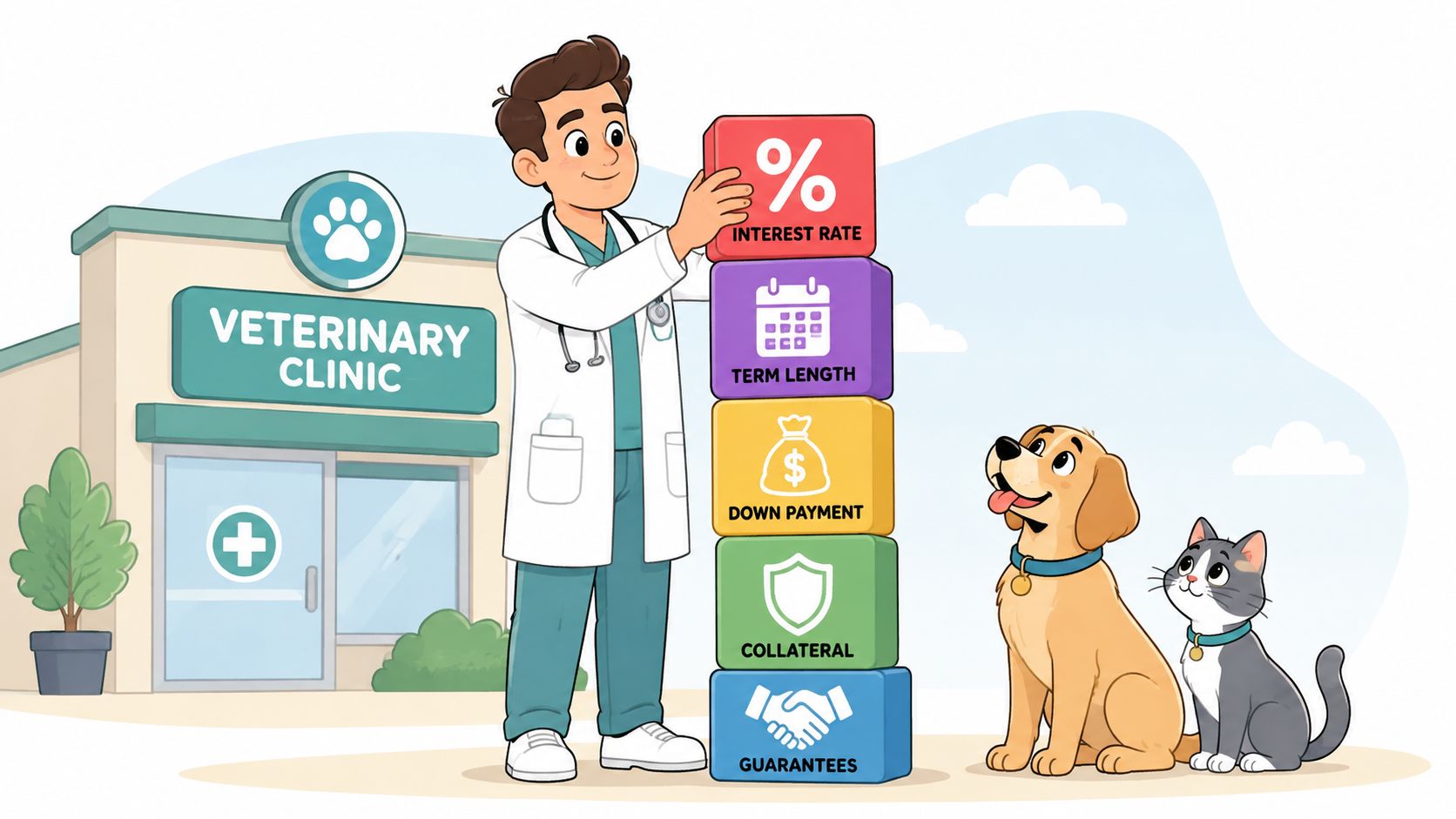
You're probably staring at two loan offers and trying to decode what matters. One lender is dangling a lower monthly payment, another is promising faster funding, and both term sheets look “standard” until you realize the term length is really a forecast of how your clinic's cash flow will behave over the next several years. That's the part owners miss when they compare only the rate and ignore how hard the payment will land during payroll, inventory restocks, and a slow ramp after an acquisition or build-out.
For U.S. veterinary clinics, the most common loan terms for veterinary practice financing usually fall into a few clear buckets. The big one is long-amortization debt for acquisitions and property, where the SBA 7(a) program is widely used as the default structure because it can cover acquisitions, partner buy-ins, build-outs, equipment, and working capital, with a maximum loan size of $5 million and common amortization of up to 10 years for business assets or up to 25 years if real estate is included, as outlined in the veterinary financing guide on SBA 7(a) practice loans. The other buckets are shorter, and they're built for working capital, equipment, and speed, not for carrying a clinic through years of ownership transition.
If you're trying to match debt to real operations, not lender jargon, that's the lens to use. A term should fit the asset, the revenue ramp, and the cash-cycle pressure point. Otherwise, you're not financing growth, you're just buying monthly stress.
Why Loan Terms Matter More Than the Rate
A clinic owner called me after comparing two offers for the same acquisition. One quote carried a slightly lower rate, but the payment assumed a much shorter payback window. The other looked more expensive on paper, yet it gave the business room to breathe while the seller's clients rolled over and the new owner stabilized staffing, scheduling, and collections.
That is why the most common loan terms for veterinary practice financing matter more than the headline rate alone. The rate matters, but the term decides whether the clinic can carry the debt through the first hard months after closing. A lower rate with a compressed amortization can still be the wrong deal if the practice is ramping slowly or if payroll and inventory are draining cash before revenue catches up.
Term length is a cash-flow decision
Veterinary debt should match the clinic's operating rhythm. Payroll hits on a schedule, inventory gets reordered before the last bottle or vial is gone, and collections often trail the work that generated them. A term that ignores that rhythm turns a financing decision into an operating strain.
That is why the typical structure for major practice debt runs on medium-to-long horizons, not consumer-style repayment. The baseline for acquisitions and real estate is long-amortization debt tied to tangible assets, goodwill, and property, with business portions commonly centered around 10 years and property portions around 25 years. If you want a clearer view of current pricing, start with our veterinary practice loan rates guide. Those longer terms fit assets that produce value over years, not in a single billing cycle.
Practical rule: if the borrowed money is tied to an asset that produces value for years, do not force it into a short repayment window just to make the headline rate look cleaner.
The trap is treating a loan like a one-time purchase instead of a repayment schedule that has to survive payroll, rent, lab bills, drug inventory, and the lag between treatment and collection. If the term is too short, the payment becomes an operating problem. If it is long enough, the debt behaves like part of the clinic's capital structure, which is where it belongs.
The Core Terms Every Lender Quote Will Include
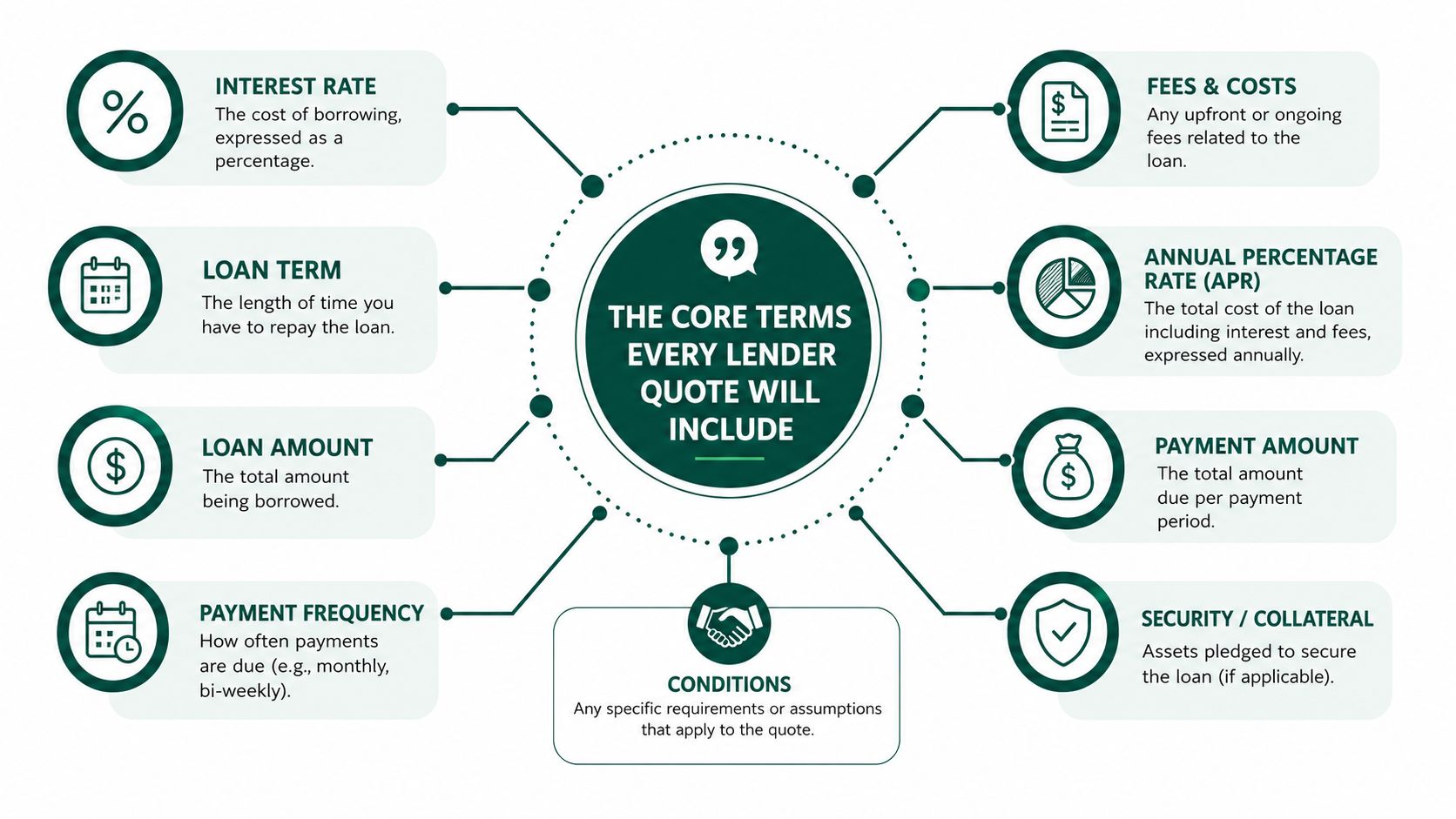
A lender's quote is a stack of moving parts, and the monthly payment only tells part of the story. For a veterinary clinic, the key question is whether the terms fit the way cash flows through the business, from payroll to inventory to collections.
Start with interest rate. That is the price of the money itself. A fixed rate stays predictable, which is easier to live with when you are protecting payroll and planning around steady clinic expenses. A variable rate can start lower, but it moves with the market, so the payment can drift when you least want it to.
Amortization period is the schedule used to calculate the payment, and it is where a lot of owners get misled. A loan can amortize over one horizon while still having a different end date. In a practice acquisition, a longer amortization usually fits better for goodwill and real estate because those assets support the clinic over years, not in a single billing cycle. A shorter amortization can make the payment look clean on paper and feel tight in the operating account.
Loan tenor is the actual life of the debt. It tells you when the balance has to be repaid or refinanced. If the tenor ends before the amortization does, you are staring at a balloon payment, and that can create refinancing pressure that has nothing to do with how well the practice is performing. That is a poor fit for owners who need breathing room while the clinic settles into its normal rhythm.
Down payment or equity contribution is the cash you put in at closing. Lenders read it as commitment, and owners should read it as a way to control your stake. More equity usually means less borrowed money and lower pressure on cash flow, but it also means more capital locked up on day one.
Collateral is what supports the loan if things go wrong. In veterinary financing, that can include equipment, real estate, or other business assets. The more durable the asset, the easier it is to match collateral to the debt.
Personal guarantee puts the owner on the hook if the business cannot pay. That is common in practice financing, especially for newer owners, but it should never be brushed aside as a formality. It ties the deal directly to your personal balance sheet.
Covenants are the operating rules attached to the debt. A debt-service coverage covenant, for example, can require the practice to keep enough cash flow in place to cover the payments. Those rules matter because they shape how much room the clinic has to breathe when receivables slow down or expenses spike.
Prepayment terms define what happens if you pay the loan off early. Some loans allow that with little friction, while others charge for it. If you expect a refinance, a sale, or a fast early payoff, this term matters more than owners usually expect.
Veterinary lenders also look closely at fees and documentation, but these are the terms that decide whether the debt fits the clinic's operating story. If you can read a term sheet without translating it in your head, you are already making a better financing decision than most first-time borrowers.
How the Major Loan Products Compare
Veterinary owners get pitched several loan structures, but each one serves a different cash-flow job. The right question is not which product sounds strongest on paper. The right question is which term profile fits how the clinic runs, from payroll to equipment replacement to ramp-up after a move or acquisition.
A quick side-by-side view
| Product | Typical Size | Typical Term | Best Use |
|---|---|---|---|
| SBA 7(a) | Up to $5 million | Commonly 10 years for business assets, 25 years with real estate | Acquisitions, partner buy-ins, build-outs, owner-occupied property, multi-purpose packages |
| Conventional bank practice loan | Varies by lender and deal size | Often about 10 to 15 years for the business portion and 20 to 25 years for real estate | Established practices with strong documentation and a clear repayment story |
| Equipment financing | Sized to the asset | Commonly 3 to 7 years, often 24 to 84 months | Imaging, surgical, lab, and IT equipment |
| Business line of credit | Often smaller revolving limits for operating capital | Revolving, not a standard fixed amortization | Payroll gaps, inventory, seasonal swings, short-term liquidity |
| Short-term working capital | Often $25,000 to $250,000 with some shorter structures, and some clinic lines sitting below $200,000 | Commonly 1 to 5 years, and faster structures can run 6 to 24 months or 3 to 18 months | Payroll, inventory, emergency repairs, bridge capital |
A lender can bundle several needs into one approval, but the repayment logic does not change. Long money belongs with long-lived assets. Short money belongs with temporary operating needs. If a clinic uses short-term debt to fund a long payoff, the monthly burden can crowd out hiring, marketing, and the extra staffing that a new owner usually needs right after closing.
The same logic is why owners should study the SBA 7(a) practice loan guidance before chasing the first approval they get. Speed matters less than fit. The best loan is the one that matches how the practice earns, spends, and grows.
Matching the Loan Term to the Purpose
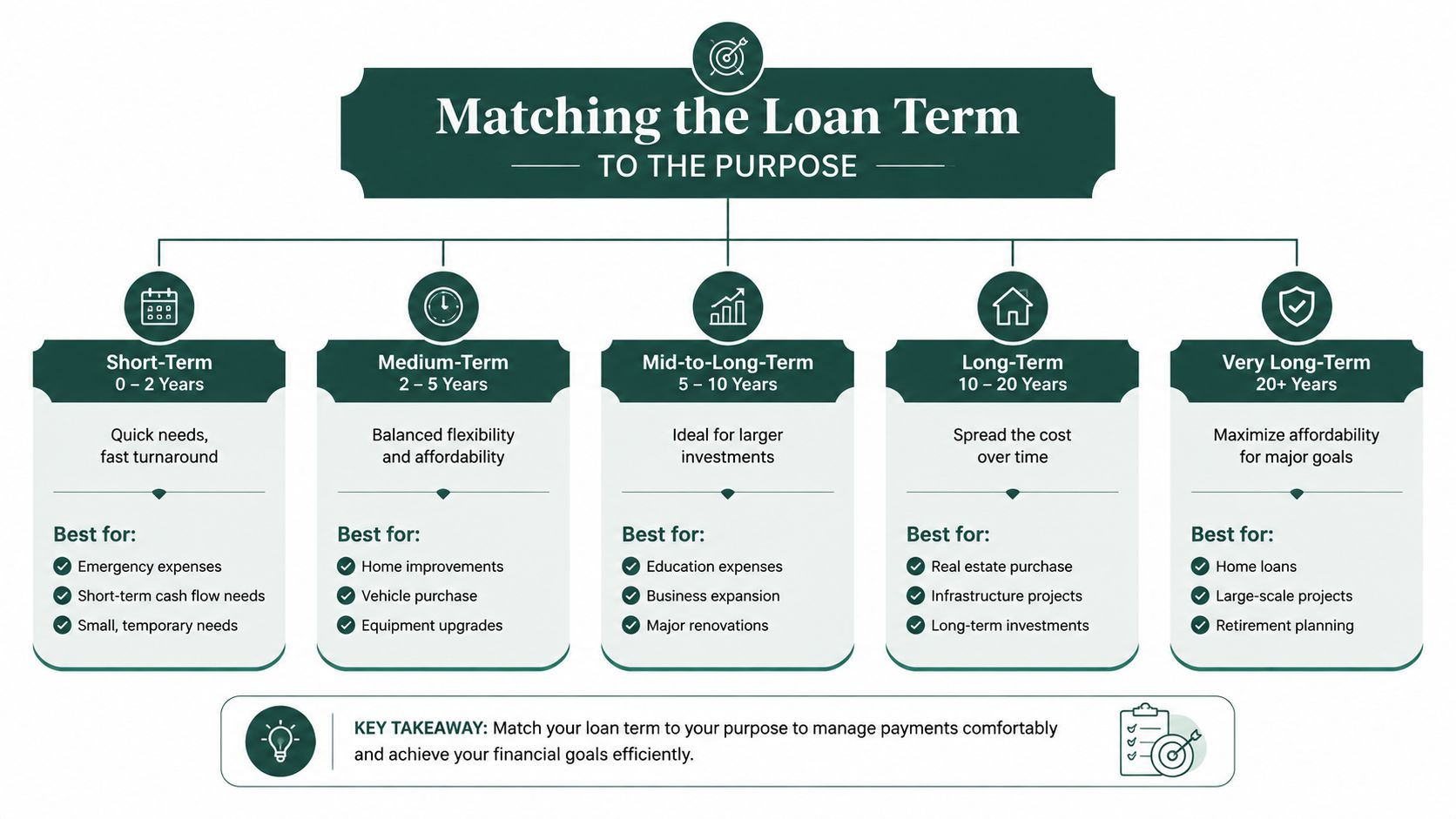
The right term is not the one with the lowest monthly payment. It is the one that fits how the clinic runs, from payroll timing to inventory turns to how long the asset keeps producing revenue.
Match the repayment horizon to the asset or operating need. Long-lived purchases belong on longer amortization. Temporary cash gaps belong on shorter repayment. If you mix those up, debt starts fighting the practice instead of supporting it.
Acquisition and real estate need long amortization
Buying a practice means paying for things that keep working for years, goodwill, client relationships, systems, and often the building itself. Those costs should sit on longer repayment schedules, with 10 years for business assets and 25 years when real estate is part of the deal (clinic financing guidance). That term profile fits the way the business earns back the purchase price.
Shortening that debt forces the clinic to act like the asset disappears faster than it does. The payment gets heavy, and that pressure lands in the worst possible place, right after closing, when a new owner still needs room for hiring, marketing, and operational cleanup.
Equipment should follow useful life
Equipment financing works best when the term mirrors the equipment's productive life. Diagnostic and surgical gear earns its keep while it is in use, so the repayment schedule should move in step with that use. Common equipment terms run 3 to 7 years, often 24 to 84 months, which is the right range for assets that generate billable services without freezing cash in the bank (veterinary equipment financing terms).
That is the clean fit for imaging systems, surgical upgrades, lab gear, and similar purchases. A shorter term can work if the machine is already throwing off cash, but forcing a long-lived asset into a short payoff just creates refinancing pressure before the equipment has paid for itself.
Working capital should stay short and flexible
Working capital is there to cover the rhythm of the clinic, payroll, pharmaceuticals, supplies, and the slow stretches between money going out and money coming in. These loans usually belong in the 1 to 5 year range, with some faster structures running 6 to 24 months or 3 to 18 months (working capital guidance). That kind of term gives the practice breathing room without turning a temporary need into permanent debt.
Use short-term money for short-term problems. If a clinic borrows working capital to fund something that takes years to pay back, the monthly burden can crowd out staffing, inventory, and the flexibility the owner needs to manage the business well.
Two Realistic Term Sheet Scenarios
A term sheet makes more sense when you see how it fits a real clinic. These examples are fictional, but they mirror the way veterinary financing is built around the business cycle, not just the headline rate.
Scenario one, acquisition with real estate
A three-doctor small animal clinic is buying the practice and the building at the same time. The lender structures the deal as an SBA 7(a) package with separate repayment treatment for the property and the business purchase.
- Loan amount. The total package is $1.4 million. Part of that funds real estate, part funds goodwill and the business purchase price.
- Amortization. The real estate piece runs on a 25-year schedule, while the business and goodwill piece runs on a 10-year schedule, which is a common structure in veterinary practice financing (clinic financing guidance).
- Guarantee. A personal guarantee is standard here. The lender wants the owners personally tied to repayment.
- Covenant. A debt-service coverage ratio covenant keeps the practice from overextending itself. If cash flow tightens, the owners need to know early.
- Prepayment. A five-year prepayment penalty that steps down over time can show up in some structures. That matters because a buyer may want flexibility if business ramps faster than expected.
This structure is balanced on purpose. The longer real estate amortization keeps the building payment manageable, while the shorter business amortization keeps goodwill from hanging around forever on the books. That split is not cosmetic. Land, buildings, and practice value do not behave the same way, and the term sheet should reflect that.
The fit here is operational as much as financial. A clinic acquisition brings immediate payroll, vendor, and patient-flow pressure, so the debt has to leave enough room for a normal month, not just a perfect one.
Scenario two, equipment plus working capital
A growing clinic needs a new diagnostic unit and extra liquidity for staffing and inventory. The lender splits the request into two pieces so each one matches its own cash-flow job.
- Equipment loan. $250,000 over 60 months for the machine itself.
- Working capital line. $75,000 to cover payroll, inventory, or a temporary cash gap.
- Draw structure. The line may start with an interest-only draw period before converting to regular repayment, which gives the clinic room to handle short-term volatility.
- Speed. Equipment financing can fund relatively quickly, and working capital can move even faster than a full acquisition package. Short-term working capital can fund in 24 hours to 3 days, while SBA loans often take 30 to 90 days.
This structure solves two different problems at once. The equipment loan should follow the useful life of the asset, because the machine is supposed to generate billable revenue over time. The line of credit covers the messy timing around payroll and supplies, where cash leaves before collections catch up.
That is the cleaner fit. Forcing both needs into one rigid installment note usually creates a bad compromise. The equipment gets underfinanced or the operating cushion gets stretched too thin, and either way the clinic feels the pressure in day-to-day cash flow.
Modeling the Cash Flow Impact of Term Length
The easiest way to test a loan is to stop looking at the rate and start looking at the payment. Same principal, different term, very different pressure on the clinic.
Use one number and compare the horizon
Take $400,000 and run it across three repayment horizons. A 5-year amortization creates the heaviest monthly burden. A 10-year structure is materially easier on cash flow. A 25-year schedule lowers the payment even more, but usually belongs with real estate or other long-lived assets rather than short-lived operating needs.
That's the key point. The monthly payment is not just a finance detail. It competes directly with payroll, vendor bills, and the month's slower collections. If the practice is still ramping after a launch or acquisition, a shorter term can force the owner into a refinance sooner than planned.
Ask one blunt question before you sign
Can the clinic make the payment in a soft month without panic?
If the answer is no, the term is too tight. A clinic doesn't need the cheapest possible debt on paper. It needs debt that survives the business cycle. Owners often discover too late that the “better rate” came with too much monthly stress and not enough operating margin.
A good lender will walk through the payment story with you before closing. A bad one will just hand you a schedule and let the stress land later.
Negotiating Better Terms on Your Veterinary Loan
Most owners assume the term sheet is fixed. It isn't. Some items are rigid, but several are open to discussion if you bring the right paperwork and a clear repayment story.
Push on the terms that affect flexibility
- Prepayment penalties. If you expect to refinance, sell, or pay down early, ask how the penalty steps down and whether it can be reduced.
- Covenants. Don't accept a ratio or reporting requirement that doesn't match how your clinic really operates.
- Reporting requirements. Keep them tight and practical. You should not need a mountain of extra admin just to keep the loan in good standing.
- Collateral scope. Lenders may want broad liens, but you can ask where the line is and what's necessary.
Know what isn't really negotiable
- Regulatory limits. SBA maximums and program rules set boundaries you can't bargain around.
- Lender policy. Some rate floors, guarantee requirements, and underwriting standards are baked into the credit box.
- Risk reality. If the deal is thin on cash flow, the lender is going to price for that.
Before the meeting, bring tax returns, recent production reports, business bank statements, and a clean explanation of how the money will be used. Lenders care less about your title and more about how the clinic's deposits and operating cash behave. If you can show that the payment fits the practice, you've got room to ask for better terms.
Frequently Asked Questions About Veterinary Loan Terms
How do prepayment penalties work? They're fees for paying a loan off early, and they matter most on longer-term practice debt. Read the step-down schedule carefully, because that's where flexibility lives.
When should I refinance? Refinance when the current payment is too tight, the practice has stronger cash flow, or the original structure no longer matches the asset or operating need. Don't refinance just to chase a small rate change.
Should I default to SBA or conventional? Use the structure that fits the deal. SBA is often the best fit for acquisitions and real estate, while conventional lending can make sense for established practices with a cleaner, faster path.
What should I bring to the lender meeting? Bring tax returns, recent bank statements, production reports, and a clear use-of-funds summary. The cleaner the story, the better the terms usually are.
If you're comparing acquisition debt, equipment financing, or working capital and want a structure that fits your clinic's actual cash flow, Veterinary Practice Loans can help you sort through the term sheet before you sign. Visit Veterinary Practice Loans to review financing options built for veterinary owners and get a clearer read on what term length makes sense for your practice.
