

You're at the closing table with two term sheets in front of you. One lender looks cheap on paper, but the reserve is thin and the handoff period feels exposed. The other asks for a little more, yet leaves the clinic with more breathing room, and in a veterinary acquisition, that difference usually decides whether the first 90 days feel controlled or chaotic.
That's why the top veterinary practice acquisition loan lenders shouldn't be ranked by rate alone. The question is which lender leaves you with enough working capital, the right underwriting for goodwill-heavy deals, and a funding timeline that matches the purchase agreement you've already signed. In this market, those details matter more than a slightly prettier APR.
| Lender | Typical Deal Size | Term Length | Rate Range | Speed to Close | Underwriting Focus |
|---|---|---|---|---|---|
| Live Oak Bank | SBA-sized veterinary acquisitions | Up to 25 years for real estate, up to 10 years for working capital or equipment | Around prime + 2.25% to +2.75% in 2026 for many SBA deals, and rates above $700,000 are capped at prime + 2.75% (launchadvisor guide, CT Acquisitions) | 20 to 40 days after a completed application is reported for direct healthcare lending, versus 45 to 90 days for SBA 7(a) loans | Veterinary-specific underwriting, goodwill, cash flow mechanics |
| Bank of America Practice Solutions | SBA-style practice acquisitions | SBA-aligned terms | SBA-style pricing | Conventional bank pace | Broader commercial underwriting |
| Wells Fargo Practice Finance | SBA-style practice acquisitions | SBA-aligned terms | SBA-style pricing | Conventional bank pace | Practice finance underwriting |
| Provide | Healthcare professional acquisitions | SBA-style or similar practice structures | SBA-style pricing | Digital, streamlined process | Healthcare-focused underwriting |
| Direct healthcare lenders | Larger, more complex acquisitions | Structure-dependent | Usually higher than SBA-style debt | Faster funding path | Private-credit style, more flexible structuring |
Why the Lender Choice Matters More Than the Rate
A buyer can sit at the closing table and focus on the lowest rate, then regret that choice the first week after closing. If the lender funds the deal but leaves the practice short on working capital, the monthly payment stops being the main problem. Payroll, vendor bills, and a shaky transition become the actual test.
Practical rule: Choose the lender that helps the clinic stay stable after closing, not the one that only looks cheapest on paper.
Veterinary acquisitions are usually goodwill-heavy, and that changes how the deal should be underwritten. A lender that understands practice cash flow, retention risk, and seller handoff timing will structure the financing differently from one that mainly wants a strong balance sheet and a large personal guarantee. The right lender can help shape a transaction so it closes cleanly. The wrong one can kill it early, or approve terms that break down as soon as the schedule changes or a key associate walks.
This specialization is already visible in the market. For solo-buyer acquisitions under $5 million, practice-specific lenders reportedly underwrite about 80% of deals, which shows how concentrated this work is among specialists rather than general small-business banks. Buyers at the larger end care about structure even more, because they are not just buying a clinic. They are buying transition risk, cash flow continuity, and enough post-close liquidity to keep growing instead of scrambling.
Rate alone misses the part that matters most. One lender may ask tougher questions before approval but leave enough cash in the business to absorb a slow transition. Another may present a cleaner term sheet and still leave the buyer exposed the moment the schedule shifts or the seller's production drops.
The Three Structures of Veterinary Acquisition Financing
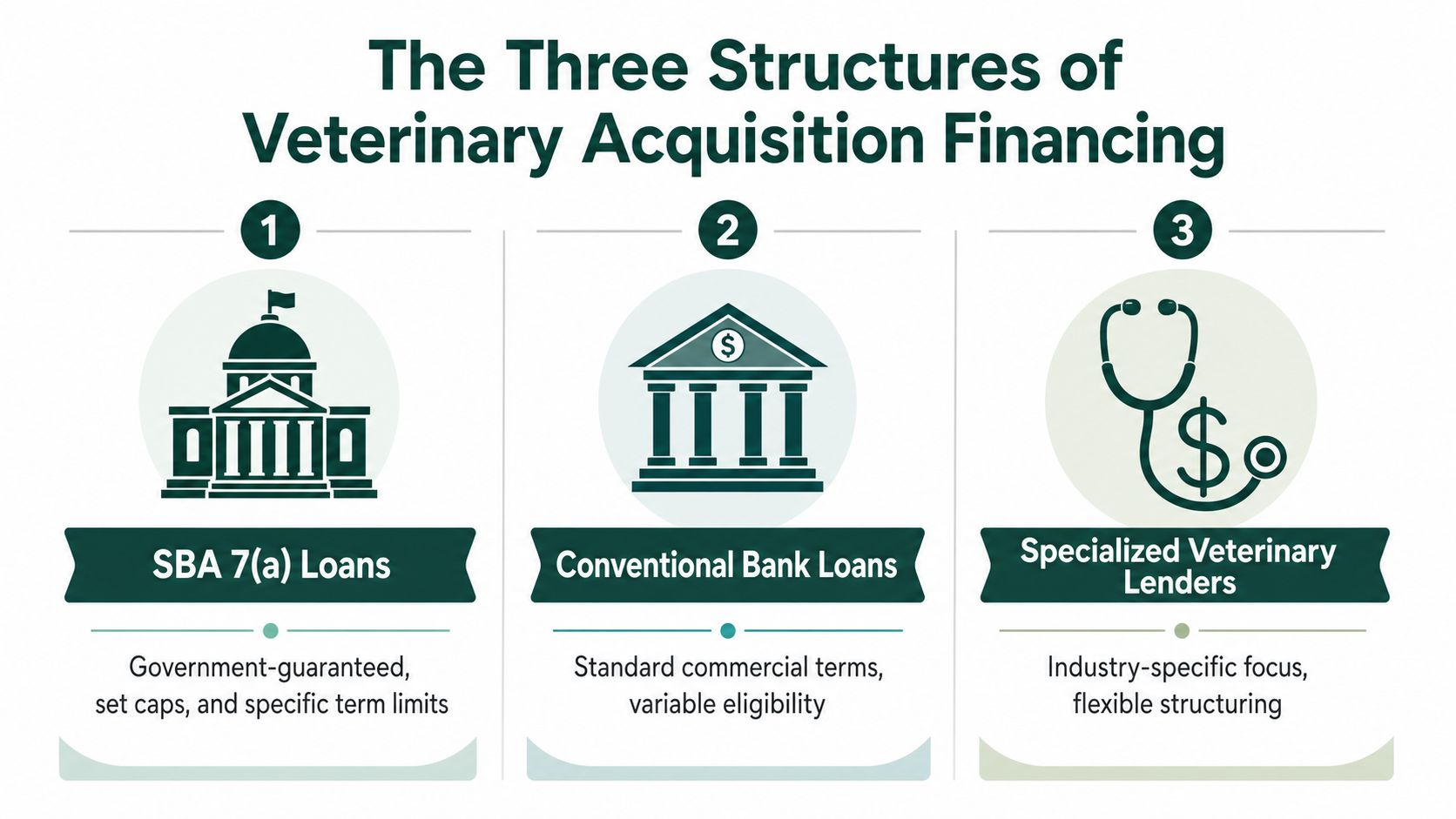
A buyer who compares lenders one by one without first sorting the financing structure is using the wrong yardstick. In veterinary acquisitions, the structure drives how much cash stays in the clinic after closing, how much goodwill gets financed, and how much room the business has if the transition runs slower than expected.
SBA 7(a) loans
SBA 7(a) loans are the default starting point for many veterinary buyers. For a practical overview of how these loans work in practice, see SBA loans for veterinary practice acquisitions. They can reach $5 million, with terms up to 25 years for real estate and 10 years for working capital or equipment. For loans above $700,000, rates are capped at prime + 2.75%, and in early 2026 that translated to roughly 10.25% to 11% for many borrowers.
This structure fits buyers who need a predictable framework and a lender willing to finance goodwill and transition costs. It also tends to leave a better post-close cushion than a tighter conventional structure, which matters when the clinic needs working capital to absorb a slow handoff. Buyers who want a lender comfortable with veterinary cash flow, not just hard collateral, usually start here.
Conventional bank loans
Conventional bank loans still make sense for stronger borrowers, larger groups, and repeat buyers. They can give you more room in how the deal is structured, but the trade-off is stricter credit standards and a more traditional view of risk. These lenders usually want the buyer to look very clean on paper before they relax into the transaction itself.
That can help in straightforward deals with strong financials and clear documentation. It can also leave less flexibility when the purchase price leans heavily on goodwill or when the buyer needs meaningful liquidity left in the business after closing. If the bank is focused on the balance sheet first, the acquisition structure usually reflects that.
Direct healthcare lenders
Direct healthcare lenders act more like private credit. They are usually the better fit when a buyer needs speed, a custom structure, or a deal that does not fit neatly inside SBA rules. The clearest timing edge is that direct healthcare lenders reportedly close veterinary practice acquisition loans in 20 to 40 days after a completed application, versus 45 to 90 days for SBA 7(a) loans.
That speed matters when the purchase agreement is tight or the seller wants certainty fast. It also matters in more unusual transactions, where a slower path can give the seller time to change terms or walk. Direct healthcare lenders can keep a deal alive when the clock is working against the buyer, but the buyer still needs to watch the total cost of that flexibility.
Comparing the Top Veterinary Acquisition Lenders Side by Side
The right comparison is not who advertises the lowest rate. It is who funds the deal, leaves enough cash in the clinic, and still understands how a veterinary acquisition works after closing.
| Lender | Best For | Deal Size Signal | Underwriting Style | Post-Close Fit |
|---|---|---|---|---|
| Live Oak Bank | Buyers who want veterinary-specific underwriting | Strong fit for SBA-sized acquisitions | Evaluates goodwill, practice cash flow mechanics, and transition risk | Usually the strongest starting point for liquidity-aware SBA deals |
| Bank of America Practice Solutions | Buyers who want a large bank with practice finance reach | Broader practice finance use case | More conventional commercial credit profile | Can work well when the buyer already has bank strength and documentation discipline |
| Wells Fargo Practice Finance | Buyers seeking a familiar bank platform for practice lending | Broad practice acquisition support | Practice lending inside a large-bank framework | Good for borrowers who fit standard underwriting cleanly |
| Provide | Healthcare professionals who want an efficient process | Practice acquisition use case | Healthcare-focused and process-driven | Useful when speed and simplicity matter |
| Direct healthcare lenders | Buyers needing faster or more flexible structures | Best for complex or time-sensitive transactions | Private-credit style, more custom | Often better for negotiated structures and tighter timelines |
Live Oak deserves the first look because it has become the dominant SBA veterinary lender and has originated more than $8 billion in cumulative veterinary practice loans. That scale matters because it usually means the lender has seen the deal patterns buyers face, not just the textbook version.
Bank of America Practice Solutions, Wells Fargo Practice Finance, and Provide belong in the conversation because they give buyers another path inside the SBA-style world. They are useful when the deal is well documented, the buyer's financial profile is clean, and the acquisition does not need highly bespoke structure. They are not usually the place I would start if the buyer is worried about transition liquidity, but they can be solid if the file is straightforward.
A lender can be perfectly respectable and still be the wrong fit for a goodwill-heavy clinic sale.
For large, multi-site, or platform-style transactions, a direct healthcare lender or a bank-led structure becomes more relevant. That is especially true when acquisition size, partner buyouts, or expansion plans push past the comfort zone of a standard single-clinic SBA file. The market on the upper end is tied to consolidation, with corporate-backed groups now owning about 22% of U.S. veterinary businesses, up from 16% three years earlier, and an estimated 75% to 80% of specialty and emergency hospitals.
SBA-Style and Bank Lenders for Veterinary Acquisitions
A clinic buyer can have strong earnings, clean paperwork, and a committed seller, then lose the deal's real value by choosing a lender that starves the business of cash after closing. SBA-style financing usually gives the best balance of approval odds, working capital, and long enough repayment terms to keep a new owner breathing.
Live Oak Bank
Live Oak deserves the first look because its veterinary underwriters work this niche every day. They look past personal credit and focus on goodwill valuation and practice cash-flow mechanics in the acquisition file, which is the right way to evaluate a clinic sale. The debt gets repaid from the business transition, so the lender has to understand how the practice will perform once the seller leaves. For a closer look at how SBA loans for veterinary practice acquisitions are structured, see Veterinary Practice Loans' SBA loan guide.
That makes Live Oak my starting point for buyers who need a true SBA acquisition solution with specialist underwriting. If the deal depends on seller transition, historical production, and a careful view of what survives after closing, this is the lender I would put first on the list.
Bank of America Practice Solutions, Wells Fargo Practice Finance, and Provide
These lenders sit in the SBA-style camp, but they operate more like large structured finance platforms than veterinary-native shops. They work best when the buyer wants a national bank footprint, a standard file review, and terms that fit a conventional acquisition process. For a buyer who is already bankable and wants discipline around documentation, they can be a solid fit.
The trade-off is flexibility. Messy goodwill-heavy deals, seller-dependent transitions, and files that need extra liquidity support can be harder to place here. When the paperwork is clean, these lenders can move efficiently. When the structure needs judgment, they are less forgiving than a veterinary-specialist lender.
What the pricing means in real life
SBA-style pricing in 2026 is typically around prime + 2.25% to +2.75%. On a $2 million veterinary acquisition, the buyer should care less about the headline rate and more about the monthly payment, the amortization, and the cash left in the account after closing. A slightly higher rate can still be the better deal if it preserves post-close liquidity and gives the buyer room to absorb payroll, inventory, and transition friction.
The right question is blunt. Will the lender fund the clinic the way it will operate after the seller walks out the door? If the answer feels generic, keep looking.
Direct Healthcare Lenders and Regional Banks Worth Knowing
Not every deal belongs inside an SBA box. Some acquisitions need speed, custom structure, or an appetite for risk that a standard file review won't allow.
Direct healthcare lenders are the best-known alternative because they can close faster, and that speed can preserve a deal when a seller wants certainty or when the timeline is tight. The reported 20 to 40 day close window for direct healthcare lending is the most obvious advantage over the slower SBA process. That doesn't make these lenders cheaper. It makes them useful when timing is part of the price of admission.
Regional banks and credit unions can also fit certain acquisitions, especially local owner-operator deals where the borrower already has a relationship on deposit or the bank knows the market well. Their strength is often relationship depth, not product breadth. They may be willing to look at a buyer as a long-term customer rather than only as a file.
If the transaction is complicated, the lender has to be comfortable funding the complexity, not just approving the borrower.
These options matter most for buyers who don't present as standard SBA files. That includes first-time owners with strong operational backgrounds but limited collateral, partner buyouts that need more bespoke treatment, and multi-site owners rolling up additional practices. In those cases, flexibility can matter more than a marginal pricing advantage.
The caution is straightforward. Flexibility usually comes with a trade-off in cost, and you should expect that. The reason to use these lenders is not because they're automatically better. It's because the deal needs structure that an SBA-only lender won't comfortably support.
How Long It Takes to Fund a Veterinary Acquisition
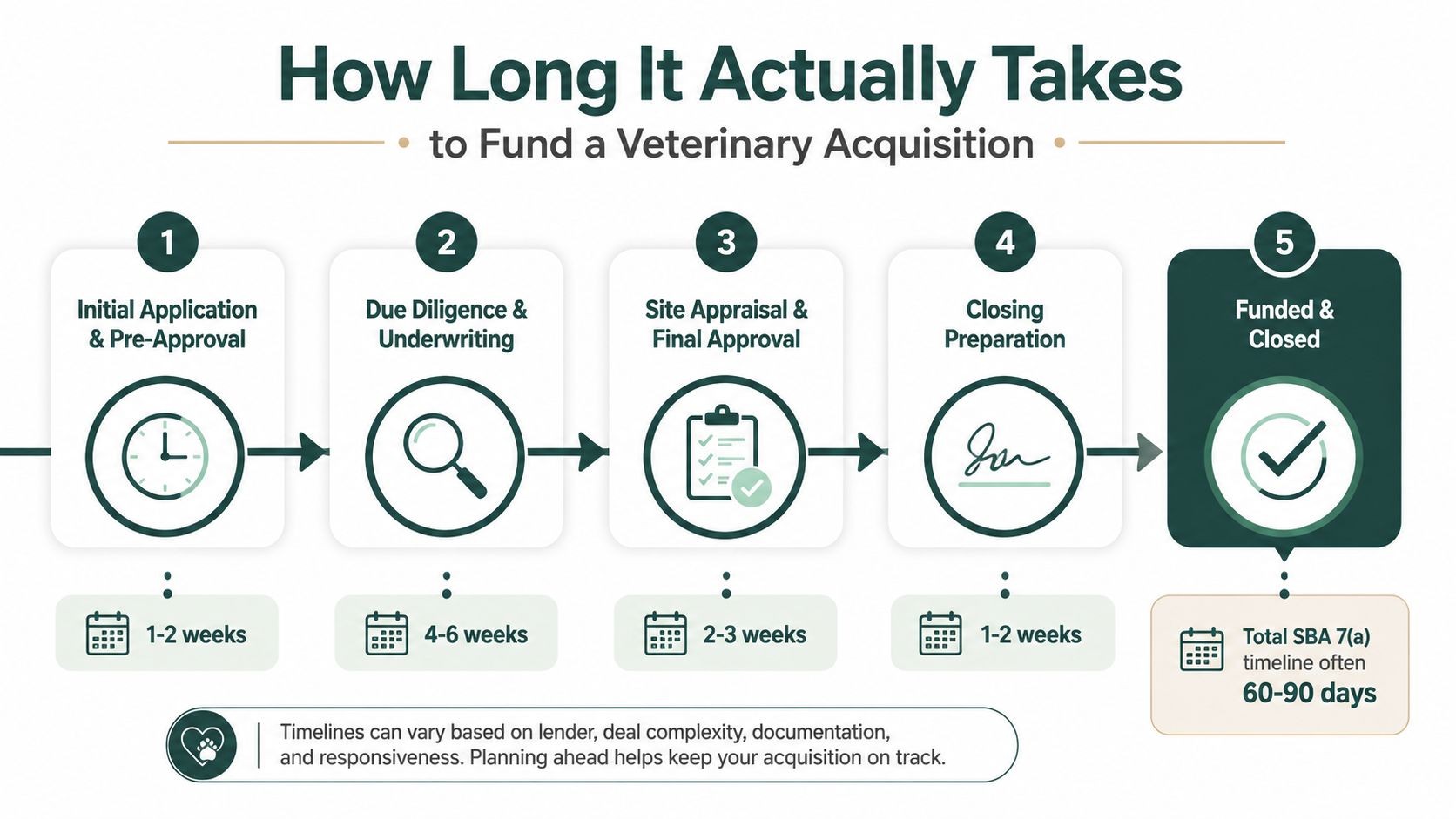
The biggest mistake buyers make is assuming every lender moves at the same pace. They don't, and that difference changes your position at the table.
For a veterinary buyer, the clock matters as much as the rate. SBA 7(a) acquisitions commonly take 45 to 90 days from completed application to close, while direct healthcare lenders are reported to fund in 20 to 40 days. If you want a starting point on structure and timing, review the veterinary practice acquisition loan guide. A seller who wants certainty will care more about that spread than about a small pricing gap on paper.
The documents that slow things down
Delays usually come from missing or late paperwork. Lenders typically ask for tax returns, balance sheets, practice financials, valuation reports, and real estate appraisals, and the valuation piece often becomes the pacing item because it has to support both the transaction value and the goodwill component. If the file is incomplete, the lender does not just pause, it loses momentum.
Buyers who choose the longer SBA path need a complete package before enthusiasm outruns documentation. That means a clean financial trail, not a stack of half-finished PDFs assembled after the seller has already started to mentally close the chapter.
Why timing changes the deal
A faster close can protect the transaction itself. Sellers care about certainty, and a financing path that closes on schedule can keep a deal from unraveling during diligence. A slower lender can still be the right lender, but only if the purchase agreement and transition plan were built around that delay.
The real question is whether the lender's clock matches the seller's patience. If it does not, the stronger rate quote may never matter.
Matching the Right Lender to Your Acquisition Scenario
The best lender depends on the shape of the buyer, not just the shape of the clinic.
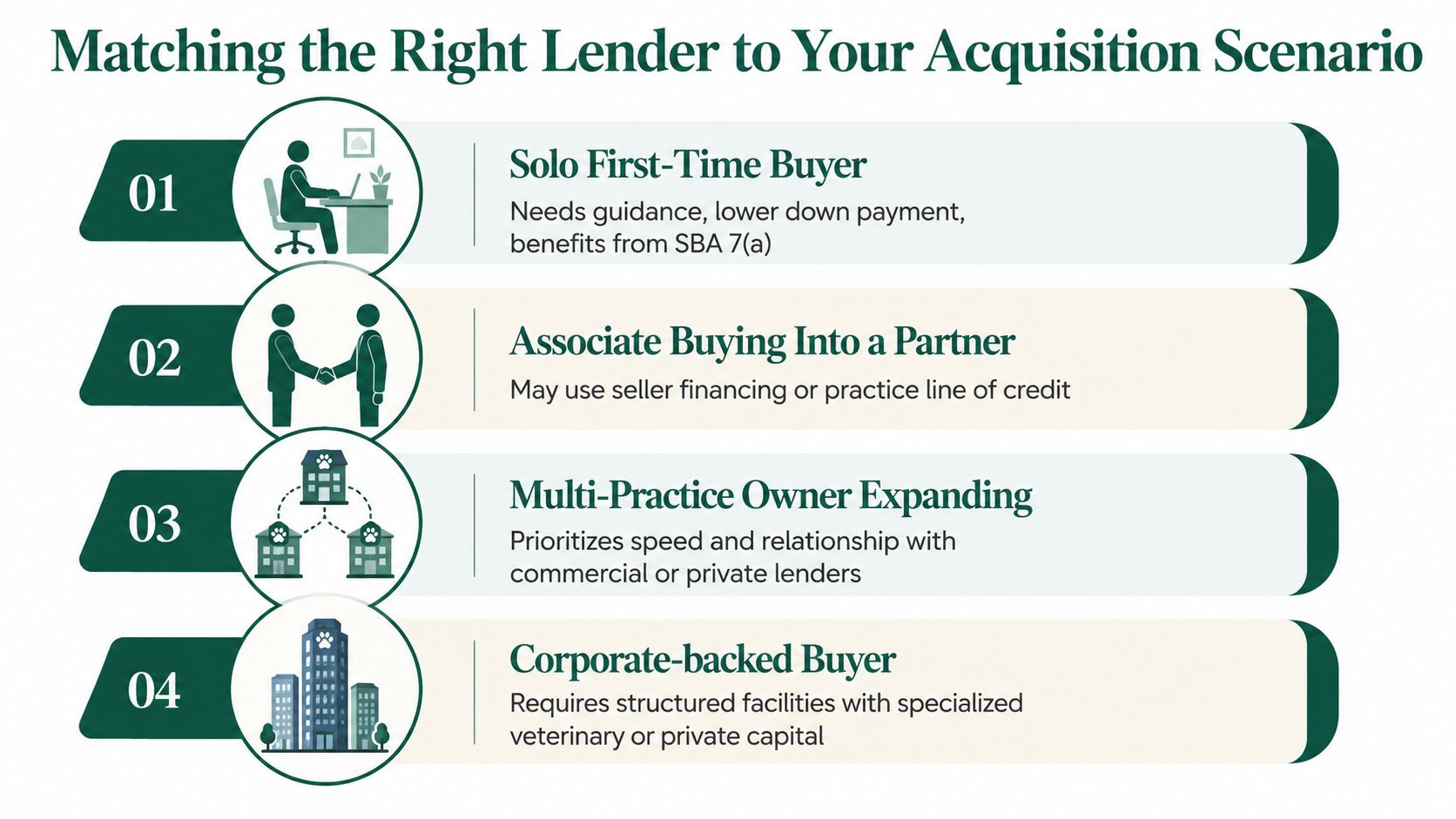
Solo first-time buyer
A solo first-time buyer purchasing a single-doctor practice usually fits best with Live Oak Bank or a strong regional SBA lender. The reason is simple. The borrower needs guidance, a workable structure, and enough post-close liquidity to handle transition friction without drowning in debt service. That's the profile where SBA-style lending is usually the right backbone.
Associate buying into a partner
A partner buyout or associate buy-in often benefits from a more customized conversation. Seller financing, practice line structure, or a lender that can blend acquisition debt with transition support may be a better fit than a rigid one-size-fits-all package. The lender's willingness to solve a partial ownership problem matters more than a canned acquisition template.
Multi-practice owner expanding
A buyer adding locations or rolling up additional clinics usually cares more about speed, relationship depth, and structure than about fitting a textbook first-clinic loan. Large-bank practice finance teams, direct healthcare lenders, and some regional relationship lenders tend to fit better here because the borrower is thinking about portfolio growth, not just a single closing.
Corporate-backed buyer
A platform or corporate-backed buyer needs a facility that can support structured growth, larger deal sizes, and repeated acquisitions. That usually points toward specialized veterinary capital or private-credit style lending, often with more advanced debt design than a standard SBA file allows. The bigger the buyer, the less useful a generic acquisition product becomes.
Choosing the Right Lender Beyond the Headline Rate
The cheapest rate is not the right answer if the lender leaves the clinic short on cash. What matters more is post-close working capital, transition support, and whether the lender's underwriting matches the actual cash-flow profile of the deal.
Here's the short checklist I'd use at the table.
- Post-Close Working Capital Treatment: Ask exactly how much liquidity stays in the business after closing and when reserves can be used.
- Transition Support: Ask how the lender thinks about seller handoff, retention risk, and early months of ownership.
- Fee Transparency: Ask for the full cost picture, not just the monthly payment.
- Flexibility for Future Growth: Ask whether the structure leaves room for expansion, equipment, or another acquisition later.
That lens is especially important because existing lender roundups usually stop at rate and loan size, while the danger lives in the weeks after funding. If the buyer underestimates payroll, inventory, or owner transition costs, a lower rate won't rescue the deal. The safer choice is the lender that underwrites the whole transition, not just the purchase price.
If you want a deeper look at pricing, review the current veterinary practice loan rates before you sign anything. Then compare that cost against the cash you'll still have on hand after closing, because that's the number that protects the clinic.
Veterinary Practice Loans helps buyers and owners compare acquisition loans, working capital, equipment financing, and expansion options with a focus on clinic realities, not generic small-business templates. If you're weighing lenders for a purchase, a partner buyout, or a growth move, visit Veterinary Practice Loans to talk through the structure before you lock in a term sheet.
