

You're at the point where the decision stops being theoretical. The clinic needs capital now, and the key question isn't whether you can borrow, it's whether you should trade speed for flexibility, or accept a slower closing in exchange for lower upfront strain and longer amortization.
That's the fault line in veterinary practice loans vs general small business loans. One path is built around clinic-specific needs, acquisitions, equipment, and real estate. The other is broader, often faster for simple working-capital needs, but usually less precise when the debt has to match a practice asset, a partner transition, or a build-out that won't pay you back overnight.
| Criterion | Veterinary Practice Loan | General Small Business Loan |
|---|---|---|
| Underwriting focus | Clinic revenue, deposits, practice cash flow, equipment, goodwill, owner experience | Personal credit, time in business, general business financials, collateral |
| Typical fit | Acquisitions, partner buyouts, build-outs, equipment, real estate | Shorter-term working capital, simpler financing needs |
| Term structure | Can bundle multiple project costs into one facility, with long repayment options for practice assets | Often shorter and more lender-discretionary |
| Approval speed | Usually slower, especially with SBA-style structures | Often faster for smaller, simpler needs |
| Cost profile | Often better amortization and lower upfront burden | Can price higher, especially when speed and flexibility are the priority |
| Best use case | When the debt needs to match a clinic asset or transaction | When the need is immediate and narrow |
The Financing Crossroads Every Clinic Owner Reaches
A practice owner usually doesn't sit down and say, “I need to compare loan categories.” The moment comes when a concrete need hits the calendar. Maybe a partner is ready to sell, maybe the leasehold build-out is due, or maybe the X-ray unit is limping along and the schedule can't absorb another delay.
That's when the choice gets real. One lender will talk about clinic economics, goodwill, and repayment aligned to the asset life. Another will care more about your personal credit, the paperwork on the business, and whether the file fits a standard commercial box. Those are not the same underwriting conversation.
For veterinary owners, the wrong loan usually looks attractive at first because it moves quickly. Then the payment lands too hard on cash flow, or the maturity is too short for the thing you bought. The right loan feels less exciting on day one, but it protects payroll, inventory, and the operating account when the new debt starts showing up every month.
Practical rule: finance the thing, not the panic. If the need is a long-lived clinic asset or ownership transition, the debt should behave like long-lived debt.
The sharper way to think about veterinary practice loans vs general small business loans is simple. Ask which structure gives you the better fit on speed-to-fund and total cost of capital. If those two variables are in tension, and they usually are, the right answer depends on whether the clinic's need is urgent, strategic, or both.
How Underwriting Actually Differs Between the Two
Clinic-specific metrics versus owner-centric screening
A veterinary lender looks at the clinic as an operating system. Revenue quality, deposit patterns, payroll cycles, equipment burden, and owner experience all matter because they tell the lender whether the practice can carry the payment without starving operations. General small business underwriting often leans harder on the owner's personal credit profile, broad business financials, and collateral position.
That difference matters more than most owners expect. A clinic with solid collections and stable operations can look healthy on paper even if the owner's personal file is less polished. In a veterinary-specific file, that business strength can carry more weight. In a generic file, the owner can get boxed out earlier because the lender doesn't know how to read practice economics as well.
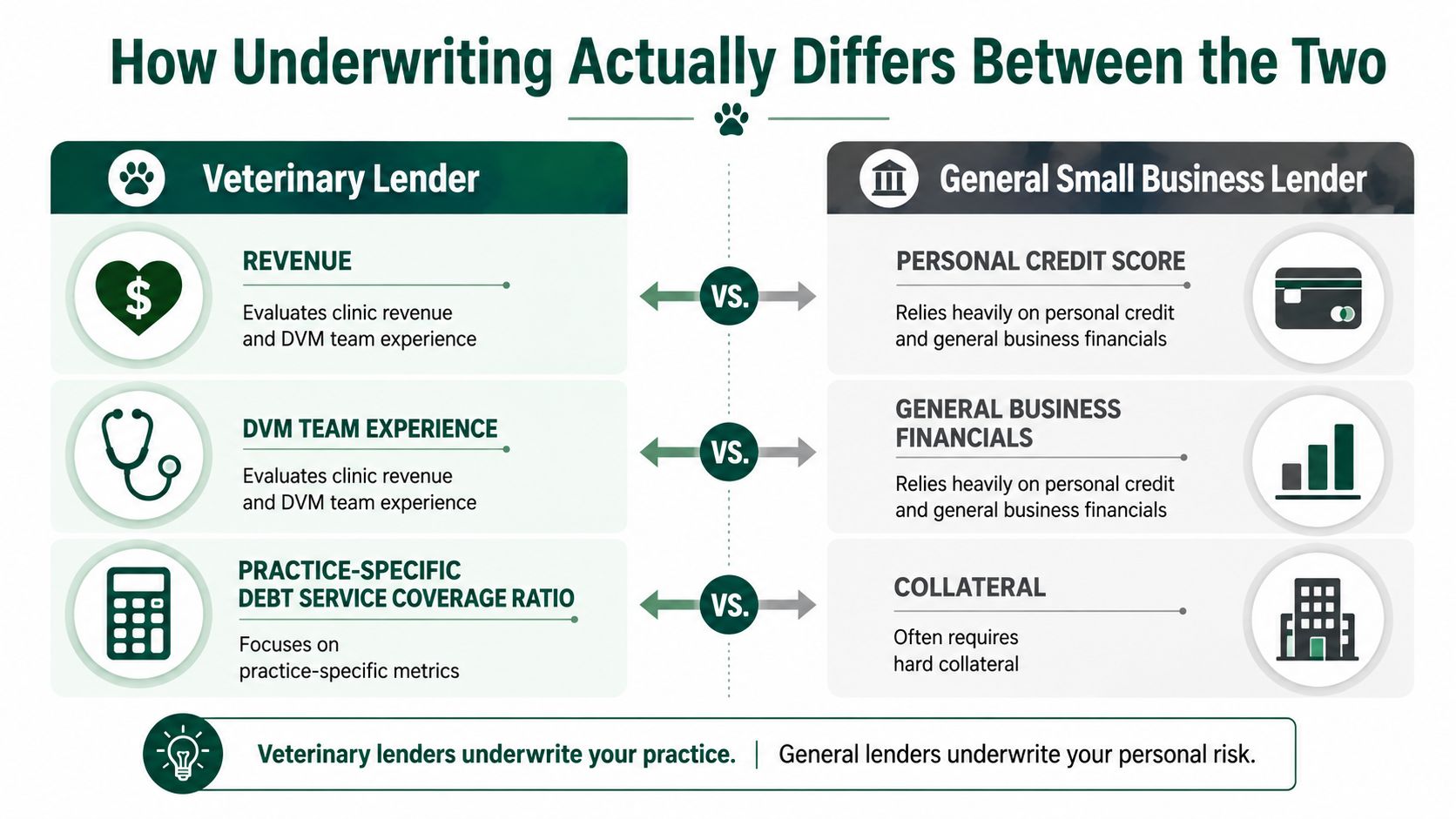
A lender that understands veterinary operations is usually looking for the story behind the numbers. Are deposits steady? Does payroll eat a predictable share of the month? Is there enough margin to absorb a lender payment after supplies, rent, and staff costs? Those questions get you closer to approval than a polished pitch deck ever will.
Who gets approved faster
The fastest approval is rarely the one with the prettiest rate sheet. It's the one that matches the lender's model to the clinic's actual strengths. If the business has strong practice cash flow but the owner wants to avoid over-explaining veterinary terminology to a generalist underwriter, a practice-focused lender can move more cleanly through the file.
If the need is small, simple, and short-term, a general small business lender can still be the better route. But once the request starts involving acquisition goodwill, partner equity, or equipment that should be repaid over years instead of months, generic underwriting often starts to look blunt.
A good application doesn't just show strength, it shows the lender how to measure that strength.
The recommendation is plain. Use the lender that already understands how a clinic runs. You'll spend less time teaching your business and more time negotiating the actual structure.
Terms Rates and Repayment Structure Compared
Why the repayment clock matters as much as the rate
The primary advantage of a veterinary-focused SBA-style loan is structure. It can bundle working capital, equipment, goodwill, acquisition costs, and real estate into one transaction, so the repayment schedule matches what the money purchased. The stated maximum terms in the brief are up to 7 years for working capital, up to 10 years for equipment, and up to 25 years for real estate. That is the kind of structure clinic owners should expect from a lender that understands how veterinary deals are built.
General small business loans are more flexible in theory, but that flexibility often means the lender sets the term around its own comfort, not the clinic's cash cycle. A short repayment clock can work for temporary borrowing. It becomes a bad fit when the debt is funding an asset or transaction that should pay itself down over several years. If you want a closer look at how specialist pricing is presented, review the current veterinary practice loan rates.
The issue is not only amortization. It is payment stress. A longer term lowers the monthly burden, which matters when payroll, supplies, and rent already claim a large share of monthly cash flow. Short financing can look inexpensive at first glance and still strain the clinic if the payment arrives faster than the asset produces income.
What rate structure is really telling you
SBA 7(a) pricing is usually tied to prime plus a fixed spread, while conventional loans are priced off the lender's own risk model. That is why a generic loan can appear more flexible and still end up more expensive, especially when the lender is pricing for speed, weaker documentation, or a higher perceived risk profile. The better comparison is payment, term, and equity burden together, not the headline rate by itself.
For readers comparing rate sheets, the point is simple. Focus on how the rate, term, and structure work together rather than chasing the lowest advertised number.
| Criterion | Veterinary Practice Loan | General Small Business Loan |
|---|---|---|
| Rate framework | Often tied to SBA-style pricing or specialist portfolio pricing | Set by lender risk model, can be fixed or floating |
| Term length | Can be long enough to fit acquisitions, equipment, and real estate | Often shorter or less standardized |
| Equity injection | Often lower upfront capital pressure in SBA-style structures | May require more owner cash, depending on lender |
| Collateral | Frequently structured around business assets and the transaction itself | Can lean harder on general collateral or personal guarantees |
| Payment fit | Better aligned to practice asset life | Better for shorter, narrower needs |
A debt schedule should match the life of the asset it finances. If the loan is funding a 10-year asset, a 10-year structure is the cleaner choice. If the need is temporary cash support, a general loan can do the job. If you want to know whether a payment will fit the clinic, stress test it against payroll, rent, supplies, and owner draws before you sign.
Eligible Uses and Which Loan Fits Which Scenario
Match the debt to the project, not to the label
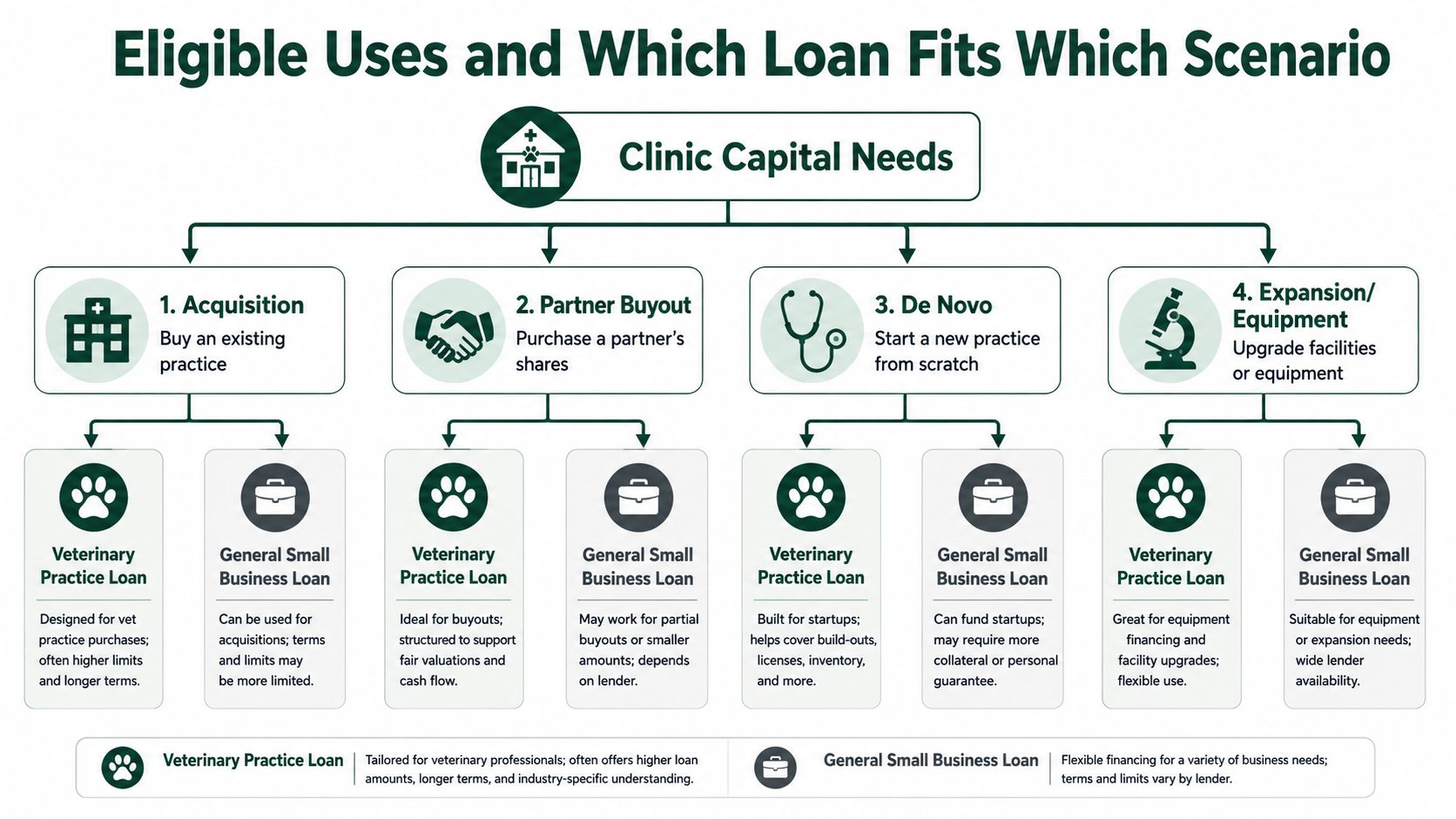
The cleanest way to sort this out is by use case. Acquisitions, partner buyouts, de novo startups, equipment-heavy upgrades, and commercial real estate all behave differently. A one-size loan usually creates friction because the cash need is really a bundle of different cash needs.
Veterinary-focused SBA structures can often cover multiple project pieces in one facility. That matters when you're buying goodwill, financing equipment, and funding a bit of working capital at the same time. General small business loans can still be part of the answer, but they usually work better when the funding need is narrow and short.
Best fit by scenario
- Acquisition: A veterinary practice loan is usually the cleaner choice because it can finance the transaction, the goodwill, and related costs without making you stack separate debt.
- Partner buyout: Use a veterinary-focused structure if the goal is to simplify the ownership transition and keep the payment aligned to the practice's ongoing cash flow.
- De novo startup: Consider both, but only after you've checked collateral, credit, and how much cash the clinic will need before it reaches operating stability.
- Equipment-heavy expansion: Tenure-matched equipment financing makes more sense than short-term general borrowing when the asset will produce value over years.
- Working capital gap: A general short-term product can be the practical answer if the need is urgent and temporary.
The point is not that every veterinary deal must use a specialized loan. It's that the borrowing structure should reflect the job the money is supposed to do. A short-term liquidity problem doesn't need long amortization. A buyout or build-out usually does.
For clinics focused on imaging, surgical upgrades, or equipment refreshes, this resource fits directly with the asset question: veterinary practice equipment loans.
Documentation and Approval Timelines in Practice
What lenders usually want on the desk
A fast close is only useful if the file is ready. Dragging out paperwork can kill a deal, but rushing an incomplete package usually creates the same problem by another route. For veterinary financing, lenders want the practice story, the debt picture, and the owner's ability to carry the payment, not just a signed application.
A strong package usually includes tax returns, current practice financials, deposit history, equipment quotes when there is a hard asset in the deal, lease or purchase documents, and personal financial statements. That mix lets the lender see how the clinic generates cash, where the new debt will sit, and whether the owner can keep the deal afloat if the practice runs into a rough patch.
Useful rule: if the lender keeps asking for missing documents, your timeline is already slipping.
Specialized loans usually require a cleaner package up front. Owners should prepare early, especially when the closing date is fixed, the seller has a deadline, or a contractor schedule is already in motion. A sloppy file does not just slow approval, it weakens the case for the structure you want.
Timing is part of the loan decision
Veterinary-specific SBA approvals are often slower, and This veterinary SBA loan guide explains why the process can take time. That delay is the cost of deeper underwriting and the guarantee process. General small business lines or short-term working capital loans can close faster, which keeps them in the running for urgent payroll support, equipment failures, or a gap that cannot wait for a formal review.
The decision is speed-to-fund versus total cost of capital. If you are buying a practice, financing a buyout, or funding a build-out with a real closing date, apply early and let the slower structure work for you. If the need is immediate and the clinic cannot wait for a longer approval cycle, take the faster general route and accept that convenience usually carries a higher cash-flow burden.
For owners comparing structure against urgency, veterinary practice financing guidance from this veterinary loan guidance points in the same direction, get the file in order before the clock starts working against you.
Worked Cost Examples for an Acquisition and an Equipment Purchase
Acquisition example
Assume a $1.2 million practice acquisition. If the clinic finances the full amount through an SBA-style veterinary loan with a 10-year repayment horizon, the monthly payment is naturally lower than a shorter conventional loan because the debt is stretched over more time. If the same deal is pushed into a faster, shorter conventional product, the payment rises and the clinic feels the strain earlier in the ownership transition.
That's the trade. The SBA-style structure usually asks for less upfront equity pressure relative to the overall transaction shape, while the conventional route can cost more in monthly cash flow even when the file closes quicker. In a buyout or acquisition, the wrong monthly payment can crowd out working capital right when the new owner needs it most.
Equipment example
Now take a $250,000 digital X-ray package. If you finance it with a structure that matches the equipment's useful life, the payment should track the period in which the machine creates billable value. If you instead put that purchase into a short-term general loan, you may pay it down too quickly and then turn around to refinance before the equipment has even settled into the workflow.
That's where the hidden cost shows up. A low headline rate isn't automatically cheaper if the term is too short and the loan has to be rolled over or refinanced. The better structure is the one that lets the machine pay for itself while the debt is still alive.
Bottom line: a lower monthly payment can be worth more than a slightly lower rate if the asset is large, long-lived, and tied to revenue generation.
The principle here is plain even without a detailed amortization model. Acquisitions need room to breathe. Equipment needs debt that doesn't outlast the business value it creates. When a loan mismatches the project, the clinic starts managing debt instead of running the practice.
Pros and Cons Beyond the Headline Comparison
The second-order trade-offs nobody wants to talk about
The surface comparison makes veterinary financing sound obviously better, but that's too simple. Specialized loans can bring a lender who understands practice economics, longer repayment, and a structure that fits the asset. They can also come with more documentation, more covenants, and less freedom to use the money however you want.
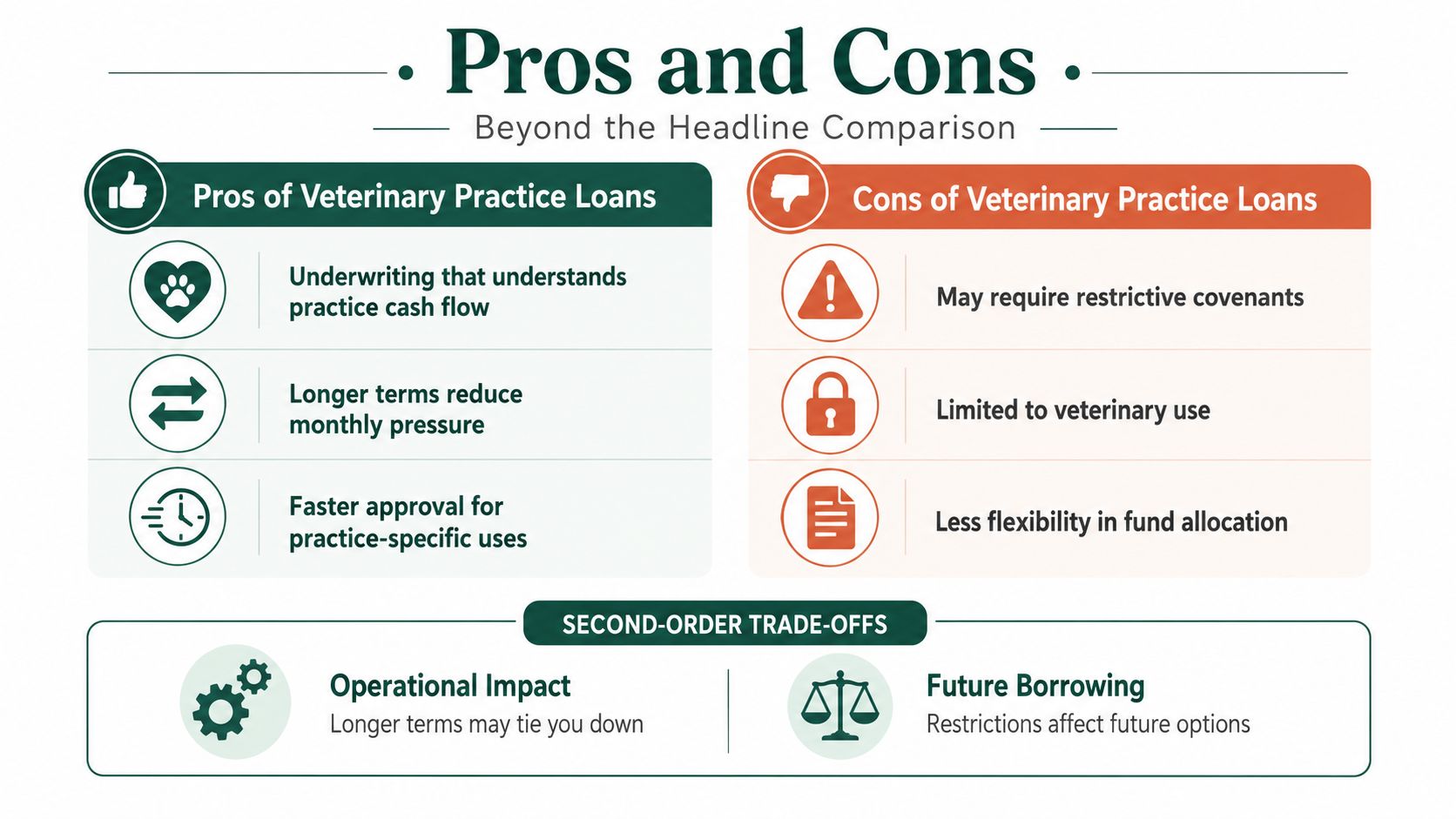
The other drawback is strategic. If a lender specializes too narrowly, it may not be the best fit for an owner who wants broader banking relationships later. A general lender may offer less precision on underwriting, but more flexibility if the clinic's borrowing needs eventually extend beyond classic veterinary transactions.
There's also a real operational cost to short-term debt. If the payment is too tight, the clinic feels it in payroll decisions, supply ordering, and hiring timing. That's why a well-structured practice loan can be worth more than a cheaper-looking short facility that forces constant cash management.
What I'd focus on first
- Operational impact: Longer terms can protect cash flow, but they also keep the debt around longer.
- Collateral tension: If the lender ties up too much of the business, future borrowing gets harder.
- Refinancing risk: A short loan may look efficient until you have to roll it again.
- Relationship fit: A specialist lender can read veterinary KPIs more naturally than a generalist.
- Allocation control: General loans may be broader, but broader isn't always better when the funds have a specific job.
Here's the cleanest opinion: don't chase the lowest headline rate if the structure doesn't fit the asset. Match the debt to the project, then compare cost. That order matters.
Choosing the Right Loan for Your Clinic
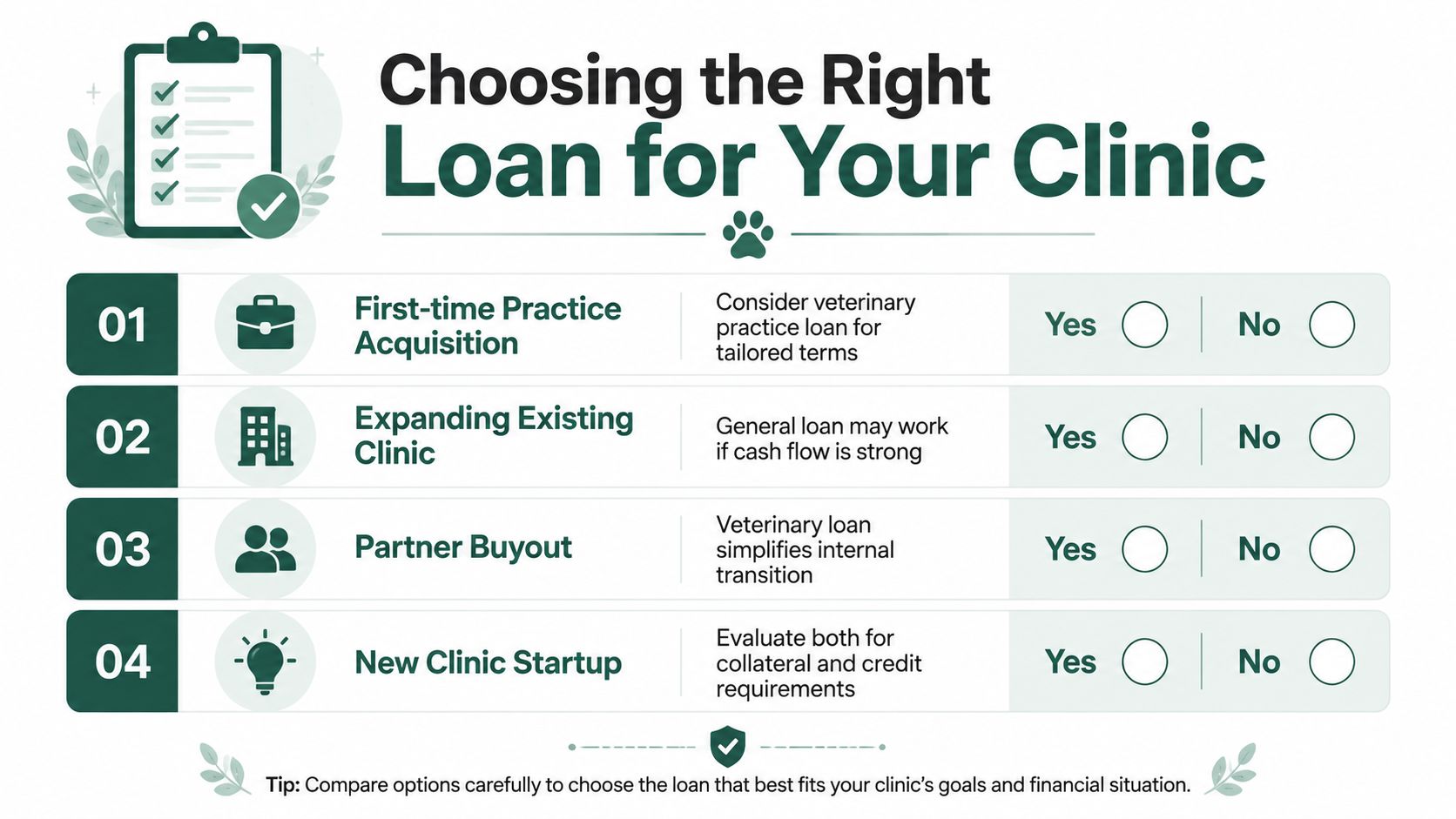
A first-time acquisition usually points toward a veterinary practice loan, because the deal needs structure, not just speed. A partner buyout does too, since the lender has to understand ownership transfer and ongoing clinic cash flow. A second location can go either way, but the more build-out, real estate, and equipment involved, the more a specialized structure tends to make sense.
A short working capital crunch is different. If payroll is due and the clinic just needs bridge money, a general small business product can be the practical answer. Don't overengineer a temporary problem.
Use this checklist before you apply.
- Match tenor to asset life: If the asset will support revenue for years, the debt shouldn't expire in a hurry.
- Compare total cost, not just rate: Monthly payment and equity injection matter as much as the advertised number.
- Decide what matters more right now: If the clinic needs cash immediately, speed wins. If the deal is strategic, structure wins.
- Confirm the lender understands veterinary operations: If they can't read the practice, they'll likely misread the risk.
If you're weighing an acquisition, equipment upgrade, or expansion, start with the structure that fits the clinic's cash flow first, then compare pricing. That's how you avoid paying for speed you didn't need or debt terms that don't belong on the balance sheet.
Veterinary Practice Loans helps veterinary owners compare acquisition, equipment, working capital, and expansion financing with structures built around clinic operations. If you're deciding between a specialized loan and a general small business loan, visit Veterinary Practice Loans to review the options and figure out which structure fits your clinic's next move.
